Drug discovery approaches
By:
Edson Ireeta Munanura
Medicinal Chemistry
Medicinal Chemistry is the science that deals with
the discovery or design of new therapeutic agents
and their development into useful medicines.
It involves:
• Synthesis
• Structure-Activity Relationships (SAR)
• Receptor interactions
• Absorption, distribution, metabolism, and
excretion (ADME)
Intriguing facts about the drug
discovery/dev’t process
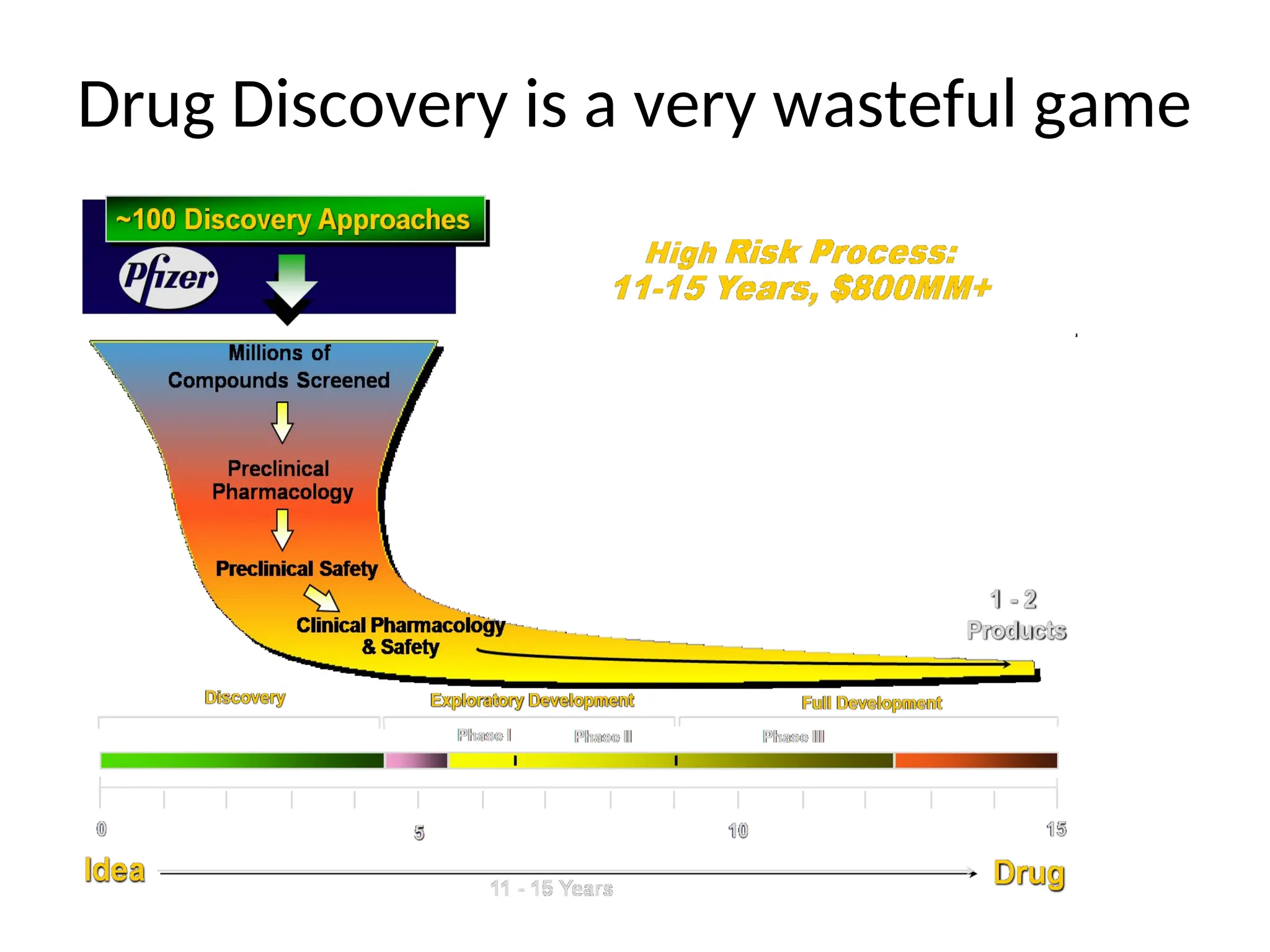
• Its takes 10-15 years to successfully introduce
a new drug on the market
• For every 5,000- 10,000 compounds that
enter the R&D pipeline, ultimately only one
receives approval
• On average, R&D of a successful drug costs
$800m to $2Bn.
Drug Discovery is a very wasteful game
Expenses &revenue curve for a new drug
6
It’s an expensive business
R&D investment in the USA between 1970 and 2004. Source is the PhRMA annual
survey (www.phrma.org/publications/publications/17.03.2005.1142.cfm).
Market withdrawals
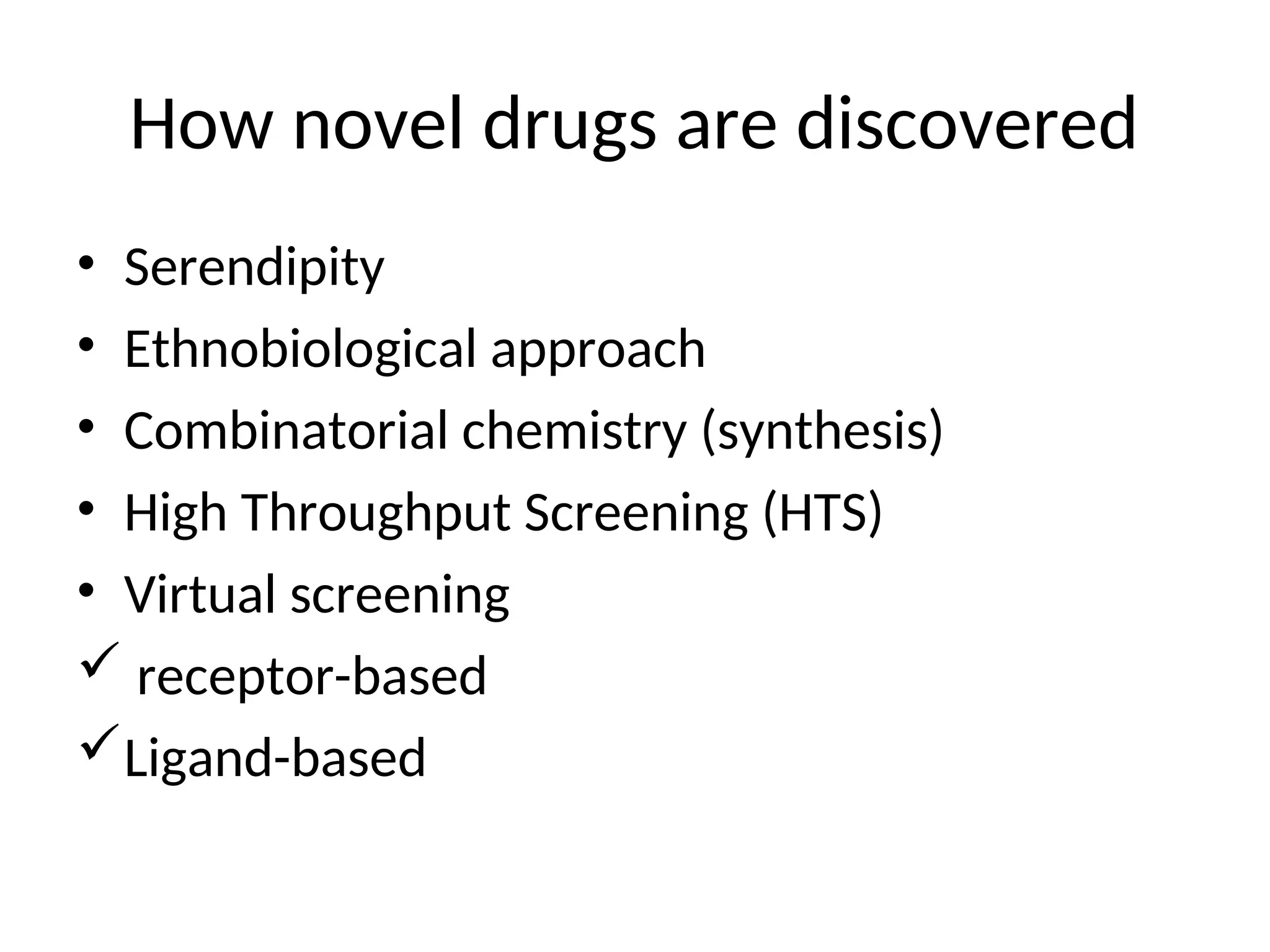
How novel drugs are discovered
• Serendipity
• Ethnobiological approach
• Combinatorial chemistry (synthesis)
• High Throughput Screening (HTS)
• Virtual screening
 receptor-based
Ligand-based
Target Protein
Large libraries
of molecules
High Throughout Screening
Hit
experimental
computational
Virtual Screening
Filtering,
QSAR,
Docking
Small Library of selected hits
Genome
Project
Target
Identification
Lead Search Development
Issues : ! Human Diversity ----- Customized Drug
! Possible Targets ----- Too many
Solutions for Lead Compound Search :
1. Existing Sample collection : a. Natural Sources scarce
b. Drug Design lead to
homogeneous & specific sets of
compounds.
2. De Novo Design
Too many unexpected & complicated synthesis
3. Combinatorial Chemistry
Drug Development of 21st Century
Drug discovery

Initial characterisation

Pre-clinical trials

Regulatory approval sought to start
trials in humans

Clinical trials Phases I, II, III

Submission of marketing/manufacturing
authorisation application to regulatory authorities

Regulatory authorities review
information and grant (or refuse) licences

Product goes on sale

Post-marketing surveillance
Library of compounds

In vitro screening: human/animal
receptor/enzyme assay; reporter system

Hits/lead

Biochemical, tissue or animal model of
function

lead

Animal model of therapeutic target

ADME, formulation, acute toxicology
The life history of a successful drug
Resource identification
Natural organisms, in particular plants
Medicinal plants continue to play a significant role
as a resource for the discovery of novel drugs
Balunas ad Koinghorn, Life Sci 2005.
• At least a quarter of all prescriptions dispensed in US
and UK contain, as active compounds, molecules derived
from flowering plants
• Medicines from natural sources are estimated to
comprise 80% of the medication used in primary
healthcare
• 12 out of the top 25 highest earning drugs are derived
from natural products
Ethno botanical approach
• Systematic screening of:
- Published literature on traditional medicinal plant use
(e.g. documented traditional healers‘ experience)
- Historical texts (e.g. ancient botanico-medicinal
manuscripts)
Advantages:
Pre-selection of potentially active resources
Promising safety profile (age-long experience)
Cost-efficient and comparatively fast
Drug Discovery
One way to “discover” drugs
Serendipitous Drug Discovery
• The use of nitrous oxide and ether as narcotic gases in
surgery resulted from the observation that people who
inhaled these chemicals [in parties] did not experience any
pain after injury.
• The vasodilatory activity of amyl nitrite and nitroglycerin was
discovered by chemists who developed strong headaches
after inhaling or ingesting minor amounts.
• Acetylsalicylic acid was thought to be just a better tolerable
prodrug of salicylic acid, but turned out to have a unique
mechanism.
• Phenolphthalein was considered as a useful dye for cheap
wines; after a heroic self-experiment, a pharmacologist
experienced its drastic diarrhoic activity.
• Warfarin was used a rat poison.
Combinatorial chemistry
• Medicinal Chemists want to find a new medicine
that is more effective than an existing one, or
causes fewer side effects
• This can be achieved by synthesis of analogues
• Combinatorial chemistry is a synthetic strategy that
leads to large number of similar compounds in a
short period of time.
• The compounds that are generated are analogues
of compounds that are already biologically active
Combinatorial Chemistry approaches
• Solid-Phase Organic Synthesis:
The compound library have been synthesized on solid phase such
as resin bead, pins, or chips
• Solution-Phase Organic Synthesis
The compound library have been synthesized in solvent in the
reaction flask
Solid Phase Synthesis
 Product is linked to a Solid Support:
 Easy purification - Easy removal of excess reagents through
filtration
 Low yield
A simple model
1. Take some beads made from a polymer
2. React the beads with a group called a linker
3. Mix the bead in with an alcohol that you
want to use in a chemical reaction. The
linker will bind to it and hold it on the bead.
Cont’d
4. Have 6 reaction vessels each containing a
different acyl chloride. Put a 1/6 of your
beads into a mesh bag and put into a
container.
Cont’d
5. Esterification occurs forming 6 different esters.
6. The beads are removed from the vessel by lifting
up the mesh bag. They are washed to remove any
unreacted acyl chloride
Cont’d
7. A reaction is used to break the linker group
down.
8. The polymer beads are reused
9. You have made 6 different esters which
can now be tested for biological activity
Advantage??????
Large numbers of similar compounds have
been synthesised in a very short period
of time. Imagine how much longer it would
take if you did the reaction with one alcohol
and acyl chloride, and then did it again with a
different acyl chloride, and then again,
and again…. 36 times!
Combinatorial Chemistry
The game with the large numbers !!!
High throughput screening for drug
discovery
• FACT 1: recent understanding of disease
mechanisms (genomics era) has dramatically
increased no. of protein targets for new drug
treatment
• FACT 2: new technologies (e.g combinatorial
chemistry) have increased the number of drugs
that can be tested for activity at these targets.
HTS for drug discovery
• HTS is process by which large numbers of compounds are rapidly
tested for their ability to modify the properties of a selected
biological target.
• Goal is to identify ‘hits’ that:
 affect target in desired manner
 active at fairly low concentrations (i.e more likely to show
specificity)
 new has a new structure
• The greater the no. and diversity of compounds screened, the
more successful screen is likely to be.
• HTS = 50,000-100,000 compounds screened per day!!!
HTS
• The majority of drug targets are :
G-protein coupled 7 TM receptors (approx. 5000), nuclear
receptors(>150), ion channels (Approx. 1000), Enzymes
(Approx. total uncertain)
• For instance, for the top 100 drugs
18 bind to GPCR, 10 bind to nuclear receptors, 16 bind to ion
channels and most of remainder inhibit enzymes
• HTS can be used to screen for activity at all of these targets
to determine activity
 potency
 specificity, if screen simultaneously against different targets
Implementation of HTS: Needs
1. suitable libraries of compounds
• Source of chemicals for screen:
- in-house collection (5x10⁵
- 106
) of diverse
samples.
- supplement by acquisitions from specialist
companies
- combinatorial chemistry allows synthesis of large
no of diverse molecules.
Cont’d
2. assay method configured for automation
Assay requirements:
a) pharmacology of the target should not be altered by the
molecular manipulations
b) cost of assay development and reagents low
c) easy to use and suitable for automation ; assay requiring
few manipulations, no plate-o-plate transfers or washing
steps
d) robust signal-to-noise ratio. Hit defined as activity above a
certain threshold e.g. Ki < 5 nM
HTS Assays
• Radio-ligand binding assay: Measures affinity of
library compounds for target
• Cell-based fluorescence and radiotracer assays:
Useful for measuring ion-channel function
• Cell viability assays
• Cell proliferation assays
• Etc.
Needs cont’d
3) robotics workstation: Robots handle assays
in multi-well formats.
- sample dilutions
- sample dispensing
- plate washing
Cont’d
4) computerised data handling system
•A great deal of data is generated. Must be
accurate and reproducible.
• Need good computerised data handling
systems.
Combinatorial chemistry-HTS
Virtual screening
• Goal: identify ligands that tightly bind to a
protein
• Requirements: a computer database of
random potential ligands and a structure of
the target protein
• Repetitively dock new ligands to protein
• Score how tightly each ligand may bind
• Keep best ‘hits’; discard other ligands
Virtual
Sreening
Database
Experimental
Tests
Hits
N
OH
N
OH
N
OH
O
COOH
Br
Screening and hits selection
QSPR model
Useless
compounds
O
Cl
COOH
Br
Methodologies of a virtual screening
from A.R. Leach, V.J. Gillet “An Introduction to Chemoinformatics”, Kluwer Academic Publisher, 2003
Main Classes of Virtual Screening Methods
• Depend on the amount of structural and bioactivity
data available
– One active molecule known: perform similarity search
(ligand-based virtual screening)
– Several active molecules known: try to ID a common 3D
pharmacophore, then do a 3D database search
– Reasonable number of active and inactive structures
known: train a machine learning technique
– 3D structure of the protein known: use protein-ligand
docking
Platform for Ligand Based Virtual Screening
• Similarity search
~106
– 109
molecules
~103 -
– 104
molecules
Candidates for docking or
experimental tests
• Filters
• QSAR models
Filters to estimate “drug-likeness”
Lipinski rules for intestinal absorption
(« Rules of 5 »)
• H-bond donors < 5
(the sum of OH and NH groups);
• MWT < 500;
• LogP < 5
• H-bond acceptors < 10
(the sum of N and O atoms without H attached).
Lipinski rules for drug-like molecules (« Rules of 5 »)
Remove compounds containing too many rings
Remove compounds with toxic groups
Remove compounds with reactive groups
References
• Foye’s principles of medicinal chemistry
• Fundamentals of medicinal chemistry by
Gareth Thomas
• Medicinal chemistry by Ashutosh Kar 4th
Ed

Drug discovery approaches lecture.ppt pharma

  • 1.
  • 2.
    Medicinal Chemistry Medicinal Chemistryis the science that deals with the discovery or design of new therapeutic agents and their development into useful medicines. It involves: • Synthesis • Structure-Activity Relationships (SAR) • Receptor interactions • Absorption, distribution, metabolism, and excretion (ADME)
  • 3.
    Intriguing facts aboutthe drug discovery/dev’t process • Its takes 10-15 years to successfully introduce a new drug on the market • For every 5,000- 10,000 compounds that enter the R&D pipeline, ultimately only one receives approval • On average, R&D of a successful drug costs $800m to $2Bn.
  • 4.
    Drug Discovery isa very wasteful game
  • 5.
  • 6.
    6 It’s an expensivebusiness R&D investment in the USA between 1970 and 2004. Source is the PhRMA annual survey (www.phrma.org/publications/publications/17.03.2005.1142.cfm).
  • 7.
  • 8.
    How novel drugsare discovered • Serendipity • Ethnobiological approach • Combinatorial chemistry (synthesis) • High Throughput Screening (HTS) • Virtual screening  receptor-based Ligand-based
  • 9.
    Target Protein Large libraries ofmolecules High Throughout Screening Hit experimental computational Virtual Screening Filtering, QSAR, Docking Small Library of selected hits
  • 10.
    Genome Project Target Identification Lead Search Development Issues: ! Human Diversity ----- Customized Drug ! Possible Targets ----- Too many Solutions for Lead Compound Search : 1. Existing Sample collection : a. Natural Sources scarce b. Drug Design lead to homogeneous & specific sets of compounds. 2. De Novo Design Too many unexpected & complicated synthesis 3. Combinatorial Chemistry Drug Development of 21st Century
  • 11.
    Drug discovery  Initial characterisation  Pre-clinicaltrials  Regulatory approval sought to start trials in humans  Clinical trials Phases I, II, III  Submission of marketing/manufacturing authorisation application to regulatory authorities  Regulatory authorities review information and grant (or refuse) licences  Product goes on sale  Post-marketing surveillance Library of compounds  In vitro screening: human/animal receptor/enzyme assay; reporter system  Hits/lead  Biochemical, tissue or animal model of function  lead  Animal model of therapeutic target  ADME, formulation, acute toxicology The life history of a successful drug
  • 12.
    Resource identification Natural organisms,in particular plants Medicinal plants continue to play a significant role as a resource for the discovery of novel drugs Balunas ad Koinghorn, Life Sci 2005.
  • 13.
    • At leasta quarter of all prescriptions dispensed in US and UK contain, as active compounds, molecules derived from flowering plants • Medicines from natural sources are estimated to comprise 80% of the medication used in primary healthcare • 12 out of the top 25 highest earning drugs are derived from natural products
  • 14.
    Ethno botanical approach •Systematic screening of: - Published literature on traditional medicinal plant use (e.g. documented traditional healers‘ experience) - Historical texts (e.g. ancient botanico-medicinal manuscripts) Advantages: Pre-selection of potentially active resources Promising safety profile (age-long experience) Cost-efficient and comparatively fast
  • 15.
    Drug Discovery One wayto “discover” drugs
  • 16.
    Serendipitous Drug Discovery •The use of nitrous oxide and ether as narcotic gases in surgery resulted from the observation that people who inhaled these chemicals [in parties] did not experience any pain after injury. • The vasodilatory activity of amyl nitrite and nitroglycerin was discovered by chemists who developed strong headaches after inhaling or ingesting minor amounts. • Acetylsalicylic acid was thought to be just a better tolerable prodrug of salicylic acid, but turned out to have a unique mechanism. • Phenolphthalein was considered as a useful dye for cheap wines; after a heroic self-experiment, a pharmacologist experienced its drastic diarrhoic activity. • Warfarin was used a rat poison.
  • 17.
    Combinatorial chemistry • MedicinalChemists want to find a new medicine that is more effective than an existing one, or causes fewer side effects • This can be achieved by synthesis of analogues • Combinatorial chemistry is a synthetic strategy that leads to large number of similar compounds in a short period of time. • The compounds that are generated are analogues of compounds that are already biologically active
  • 18.
    Combinatorial Chemistry approaches •Solid-Phase Organic Synthesis: The compound library have been synthesized on solid phase such as resin bead, pins, or chips • Solution-Phase Organic Synthesis The compound library have been synthesized in solvent in the reaction flask
  • 19.
    Solid Phase Synthesis Product is linked to a Solid Support:  Easy purification - Easy removal of excess reagents through filtration  Low yield
  • 20.
    A simple model 1.Take some beads made from a polymer 2. React the beads with a group called a linker 3. Mix the bead in with an alcohol that you want to use in a chemical reaction. The linker will bind to it and hold it on the bead.
  • 21.
    Cont’d 4. Have 6reaction vessels each containing a different acyl chloride. Put a 1/6 of your beads into a mesh bag and put into a container.
  • 22.
    Cont’d 5. Esterification occursforming 6 different esters. 6. The beads are removed from the vessel by lifting up the mesh bag. They are washed to remove any unreacted acyl chloride
  • 23.
    Cont’d 7. A reactionis used to break the linker group down. 8. The polymer beads are reused 9. You have made 6 different esters which can now be tested for biological activity
  • 24.
    Advantage?????? Large numbers ofsimilar compounds have been synthesised in a very short period of time. Imagine how much longer it would take if you did the reaction with one alcohol and acyl chloride, and then did it again with a different acyl chloride, and then again, and again…. 36 times!
  • 25.
    Combinatorial Chemistry The gamewith the large numbers !!!
  • 26.
    High throughput screeningfor drug discovery • FACT 1: recent understanding of disease mechanisms (genomics era) has dramatically increased no. of protein targets for new drug treatment • FACT 2: new technologies (e.g combinatorial chemistry) have increased the number of drugs that can be tested for activity at these targets.
  • 27.
    HTS for drugdiscovery • HTS is process by which large numbers of compounds are rapidly tested for their ability to modify the properties of a selected biological target. • Goal is to identify ‘hits’ that:  affect target in desired manner  active at fairly low concentrations (i.e more likely to show specificity)  new has a new structure • The greater the no. and diversity of compounds screened, the more successful screen is likely to be. • HTS = 50,000-100,000 compounds screened per day!!!
  • 28.
    HTS • The majorityof drug targets are : G-protein coupled 7 TM receptors (approx. 5000), nuclear receptors(>150), ion channels (Approx. 1000), Enzymes (Approx. total uncertain) • For instance, for the top 100 drugs 18 bind to GPCR, 10 bind to nuclear receptors, 16 bind to ion channels and most of remainder inhibit enzymes • HTS can be used to screen for activity at all of these targets to determine activity  potency  specificity, if screen simultaneously against different targets
  • 29.
    Implementation of HTS:Needs 1. suitable libraries of compounds • Source of chemicals for screen: - in-house collection (5x10⁵ - 106 ) of diverse samples. - supplement by acquisitions from specialist companies - combinatorial chemistry allows synthesis of large no of diverse molecules.
  • 30.
    Cont’d 2. assay methodconfigured for automation Assay requirements: a) pharmacology of the target should not be altered by the molecular manipulations b) cost of assay development and reagents low c) easy to use and suitable for automation ; assay requiring few manipulations, no plate-o-plate transfers or washing steps d) robust signal-to-noise ratio. Hit defined as activity above a certain threshold e.g. Ki < 5 nM
  • 31.
    HTS Assays • Radio-ligandbinding assay: Measures affinity of library compounds for target • Cell-based fluorescence and radiotracer assays: Useful for measuring ion-channel function • Cell viability assays • Cell proliferation assays • Etc.
  • 32.
    Needs cont’d 3) roboticsworkstation: Robots handle assays in multi-well formats. - sample dilutions - sample dispensing - plate washing
  • 33.
    Cont’d 4) computerised datahandling system •A great deal of data is generated. Must be accurate and reproducible. • Need good computerised data handling systems.
  • 34.
  • 35.
    Virtual screening • Goal:identify ligands that tightly bind to a protein • Requirements: a computer database of random potential ligands and a structure of the target protein • Repetitively dock new ligands to protein • Score how tightly each ligand may bind • Keep best ‘hits’; discard other ligands
  • 36.
  • 37.
    Methodologies of avirtual screening from A.R. Leach, V.J. Gillet “An Introduction to Chemoinformatics”, Kluwer Academic Publisher, 2003
  • 38.
    Main Classes ofVirtual Screening Methods • Depend on the amount of structural and bioactivity data available – One active molecule known: perform similarity search (ligand-based virtual screening) – Several active molecules known: try to ID a common 3D pharmacophore, then do a 3D database search – Reasonable number of active and inactive structures known: train a machine learning technique – 3D structure of the protein known: use protein-ligand docking
  • 39.
    Platform for LigandBased Virtual Screening • Similarity search ~106 – 109 molecules ~103 - – 104 molecules Candidates for docking or experimental tests • Filters • QSAR models
  • 40.
    Filters to estimate“drug-likeness”
  • 41.
    Lipinski rules forintestinal absorption (« Rules of 5 ») • H-bond donors < 5 (the sum of OH and NH groups); • MWT < 500; • LogP < 5 • H-bond acceptors < 10 (the sum of N and O atoms without H attached).
  • 42.
    Lipinski rules fordrug-like molecules (« Rules of 5 »)
  • 43.
  • 44.
  • 45.
    Remove compounds withreactive groups
  • 46.
    References • Foye’s principlesof medicinal chemistry • Fundamentals of medicinal chemistry by Gareth Thomas • Medicinal chemistry by Ashutosh Kar 4th Ed