HIGH THROUGHPUT SCREENING (HTS)
Submitted to:
Prof. Asmita Gajbhiye
Miss. Anamika Jain
Mr. Shivam Kori
Mr. Shyamji Tantuway
Mr. Priyanshu Nema
Submitted by:
Mahendra Singour
M.Pharma 2nd Semester
Y23254010
Department of Pharmaceutical Sciences
Dr. Harisingh Gour Vishwavidyalaya, Sagar (M.P.)
DRUG DESIGN & DISCOVERY
PHSC CC-2201
HIGH THROUGHPUT SCREENING (HTS)
Identification of one or more positive candidates
extracted from a pool of possible candidates
based on specific criteria.
• High throughput screening (HTS) is a scientific method used in drug discovery,
genomics, and various other fields to rapidly and efficiently test a large number of
chemical compounds or biological entities for specific activities.
• High-throughput screening (HTS) has gained significant recognition over the past 20
years and is now considered a standard drug discovery technique in the pharmaceutical
industry.
• High-throughput screening (HTS) is an automated approach used to identify the
effects of multiple compounds in biological and chemical assays. It involves the use of
miniaturized assays, automation, robotics, and large-scale data analysis to discover and
investigate new lead compounds.
INTRODUCTION
• The primary goal of HTS is to identify potential candidates that exhibit a desired
biological activity, such as inhibiting the growth of cancer cells, blocking a specific
enzyme, or activating a cellular response.
• HTS reveals screening of more than 100,000 samples per day. Compared to
traditional drug screening methods.
• High throughput Screening was invented by Dr. Gyula Takatsky in 1951. (he
was the first to use microtiter plate with 6 rows of 12 wells)
• This process is referred as lead generation or hit to lead.
• HTS with the use of robotics, automation, and miniaturization, helps to screen
>100000 compounds in a short span of time against validated biological targets.
• It involves a automated operation system, a highly sensitive testing system,
specific screening in vitro models, and abundant compound library and a data
acquisition and processing system
• HTS reveals screening of more than 100,000 samples per day. Compared to
traditional drug screening methods.
• HTS is characterized by its simplicity, rapidness, low cost, and high
efficiency & good ligand target interactions.
• In order to learn about high throughput screening, we should have a general
understanding of the drug discovery process
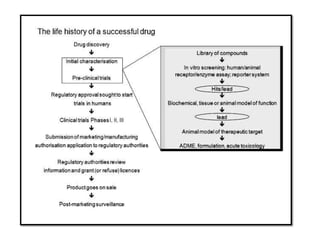
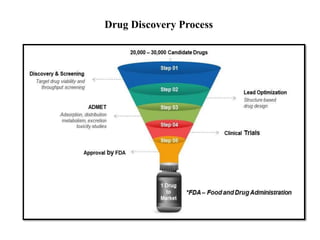
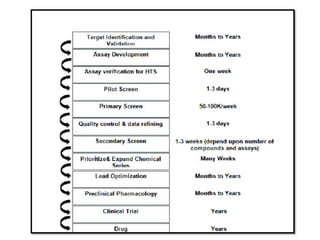
• Drug discovery is the process by which new medications or drugs are
discovered.
• It involves the various steps from disease identification, identification and
validation of related target(s), development of a lead that can interact with the
target and be effective in treating the disease, preclinical and clinical trials and
then finally marketing.
Drug Discovery Process
• HTS is process by which large no’s. of compounds are rapidly tested for their
ability to modify the properties of a selected biological target.
• Goal is to identify 'hits' or 'leads‘
- affect target in desired manner
- active at fairly low concentrations (.. more likely to show specificity)
- new structure
• It is a useful for discovering ligands for receptors, enzymes, ion-channels or
other pharmacological targets, or pharmacologically profiling a cellular or
biochemical pathway of interest
• Basically helps to identify a compound that can chemically modify a target
• This compound is identified as a hit and may be generated to a lead.
• A Hit is any compound that is confirmed to have binding activity to the target
and appears on High throughput screen. It gives the desired effect of the HTS
experiment and is confirmed on re-testing.
• HIT is a compound that has display desired biological target.
• The Lead is the compound with therapeutic or pharmacological activity but
sub- optimal structure that still requires modification.
• This is the compound selected from a cluster of hits based on certain parameters
like binding and modification capacity, affinity, selectivity, efficacy in cell tissue
assays, freedom of operation or patentability, drug metabolizing enzyme
interaction, serum albumin binding, cytotoxicity and many others of importance.
• Lead compounds have biological or pharmacological activity but may need
structural modification to better fit their target.
• This process is commonly referred as lead generation or hit to lead
(H2L).
• The lead is further optimized and thus can then go through preclinical and
clinical trials and if approved gets marketed.
• The general procedure of HTS involves testing a solution of different
compounds in assay plates called microtiter plates having wells.
• The ligand or protein or embryo of interest is introduced into these wells
containing test solution
• They are incubated for a short time period.
• Analysis is done microscopically or by analytical techniques like
spectrometry.
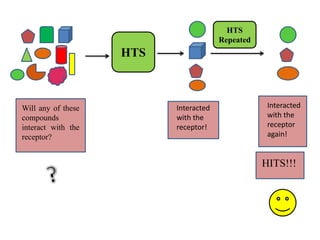
• Compounds showing desired effects are hits.
HTS
HTS
Repeated
Will any of these
compounds
interact with the
receptor?
Interacted
with the
receptor!
Interacted
with the
receptor
again!
HITS!!!
TECHNOLOGY INFRASTRUCTURE IN HTS
High Throughput Screening (HTS) technology infrastructure refers to the hardware,
software, and networking components that support the automated and rapid testing of
large numbers of biological samples or chemical compounds. The key components of
HTS technology infrastructure include:
1. Screening formats: As previously mentioned assays should be informative, robust,
reliable, reproducible, fast, cost effective and should easy to perform. The primary
goals of automation, miniaturization, and high throughput are to develop homogeneous
assay formats and the use of high sensitivity detection techniques. Several non
separation (homogeneous) or “mix-and measure” assay technologies are widely used as
it provide simplicity, and avoids steps which are time consuming and difficult-to-
automate, such as extraction, filtration, centrifugation, and washing. However 96-well
filter plates provides a provision if filtration is required in a particular assay. Non
isotopic end points such as fluorescence and luminescence based detection techniques
are prominently used due to increased sensitivity, flexibility in assay design, low cost
and improved safety, although radiometric assays, scintillation proximity assays have
played a major role in HTS.
2. Miniaturization : Miniaturization minimizes costs, prevent unnecessary
depletion of valuable compound supplies, reduce the amounts of reagents used, and
decrease the costs of disposing of assay waste by enabling the use of parallel sample
processing and multiplexed detection modes.
Miniaturization in high-throughput screening (HTS) is a crucial strategy for accelerating
drug discovery by reducing costs, increasing efficiency, and improving data quality. The
primary goal of miniaturization is to minimize the volume of reagents and samples
used in assays while maintaining the same level of information content and data quality.
This approach has several key benefits:
Cost Savings: Miniaturization significantly reduces the consumption of expensive
reagents and consumables, making it a cost-effective method for HTS.
Increased Efficiency: By using smaller volumes, researchers can process more samples
in less time, leading to increased productivity and faster turnaround times.
Improved Data Quality: Miniaturization allows for the inclusion of more controls and
replicates on each plate, which enhances data quality and reduces the risk of human
error.
Enhanced Automation: Higher well densities, such as 384 and 1536 well plates, can be
automated more easily, further reducing labor costs and increasing efficiency.
Better Use of Scarce Resources: Miniaturization ensures that valuable reagents and
samples are used more efficiently, making it particularly important for substances that
are scarce, expensive, or time-consuming to produce.
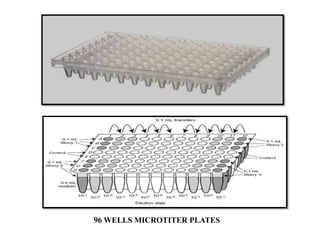
96 WELLS MICROTITER PLATES
• To achieve these benefits, researchers use advanced automation systems and
miniaturized assays. The miniaturization process involves reducing the volume of
reagents and samples while maintaining the same level of information content and
data quality. This is often achieved through the use of nanolitre dispensers and other
liquid handling technologies.
• Miniaturization also presents some challenges, such as evaporation, liquid
handling issues, and biological variability. To overcome these challenges,
researchers must carefully plan and execute their miniaturization strategies,
including choosing the right microtiter plates and optimizing liquid handling and
robotics. Overall, miniaturization is a critical component of modern HTS, enabling
researchers to efficiently and effectively identify promising drug candidates while
minimizing costs and resources.
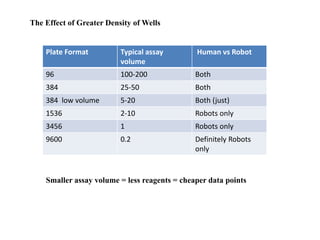
The Effect of Greater Density of Wells
Plate Format Typical assay
volume
Human vs Robot
96 100-200 Both
384 25-50 Both
384 low volume 5-20 Both (just)
1536 2-10 Robots only
3456 1 Robots only
9600 0.2 Definitely Robots
only
Smaller assay volume = less reagents = cheaper data points
3. Automation and robotics: Automation plays a crucial role in high-
throughput screening (HTS) by increasing efficiency, speed, and accuracy while
reducing labor costs and minimizing human error. Automation in HTS involves the use
of machines to perform laboratory tasks, such as pipetting, liquid handling, and signal
detection, to produce rich data sets in a short period of time. Key components of
automation in HTS:-
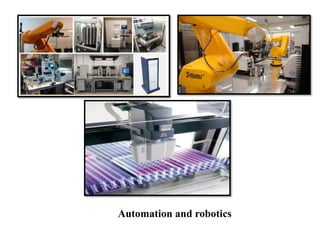
Robotic Automation: Robotic systems are used to handle and transport plates, as well
as perform tasks such as pipetting and dispensing reagents.
Liquid Handling: Automated liquid handling systems enable precise and efficient
dispensing of reagents and compounds, reducing the need for manual intervention.
Signal Detection: Automated systems can detect signals such as fluorescence,
luminescence, or absorbance, allowing for rapid data collection and analysis.
Software Integration: Sophisticated software is used to schedule and control the
automated processes, ensuring consistent well-to-well treatment and efficient data
management.
Automation and robotics
• Considerable degree of automation is essential to increase throughput above that
achieved by conventional, manual techniques, and to reduce pipetting errors, speed up
the plate preparation process and to ensure sample uniformity in a screening context,
especially on higher density plates.
• Automation of laboratory procedures, led to a significantly accelerated drug
discovery process compared to the traditional one-compound-at-a time approach.
Traditionally, an experienced organic chemist could synthesize and finalize
approximately 50 compounds each year; however due certain automation more than
2000 compounds can be easily generated yearly.
• Automation is a critical component of high-throughput screening, enabling the
rapid and efficient screening of large numbers of biological modulators and
compounds. Its benefits include increased speed, accuracy, and reproducibility, as
well as reduced labor costs and enhanced data management.
 HTS assays found to be applicable for screening of different types of libraries,
including combinatorial chemistry, genomics, protein, and peptide libraries. Basically.
 HTS is a process of screening and assaying large number of biological modulators
and effectors against selected and specific targets.
 HTS to be successful numerous steps like target identification, reagent preparation,
compound management, assay development and high throughput library screening
should be carried out with extreme care and precision. Methods commonly followed
are: firstly selecting the target. Currently there are about 500 targets being used by
companies. Of these, cell membranes receptors, mostly G-protein coupled receptors,
comprise the largest group (45% of the total), Enzymes make up the next largest group
(28%), followed by hormones (11%), unknowns (7%), ion-channels (5%), nuclear
receptors (2%), and finally DNA (2%). In recent studies, pharmaceutical companies
mainly look for compounds that interfere or modulate the function of GPCRs.
TYPES OF HIGH THROUGHPUT ASSAYS:
Assays mainly divided into biochemical and cell based assays. Biochemical assays are
further divided into heterogeneous and homogeneous assays.
HIGH THROUGHPUT ASSAYS:
1. Biochemical assays
Biochemical assays are receptor, protein or enzyme based assays uses the
particular target in a purified form. Biochemical assays are most frequently
carried out using scintillation proximity assay (SPA),radiometric, colorimetric
fluorescence detection techniques. Scintillation Proximity Assay is a technology
whereby binding reactions can be assayed without the washing or filtration
procedures normally used to separate bound from free fractions.
A. Homogeneous assay: In homogeneous assay measurement are based on the
distinct physical/chemical properties of analyte, or interaction between analyte
and surrounding environment. It is a single step process; reagent may be added
at single stage or in multiple steps. It only involves usual steps like fluid
addition, incubation and reading. It can be coupled with different detection
technique fluorescence, radiometric etc for HTS. Main advantage of
homogeneous assay is its simplicity (Mix and read) because minimum step which
ultimately contributes to the reduction of both cost and robotic complexity
required for automation. It have signal to background ratio less than 10.
B. Heterogeneous assays: Heterogeneous assays involves additional steps like
filtration, centrifugation etc. This contributes to the high signal to background ratio.
Due to higher steps it becomes complicated. Heterogeneous assay are performed
mainly when homogeneous assay fails or high signal to background ration is required.
Some techniques of biochemical assays are summarized below:
Fluorescence resonance energy transfer (FRET):
Fluorescence polarization (FP):
Homogeneous time resolved fluorescence (HTRF):
Fluorescence correlation spectroscopy (FCS):
Fluorescence intensity distribution analysis (FIDA):
Nuclear magnetic resonance (NMR):
TECHNIQUES OF BIOCHEMICALASSAY
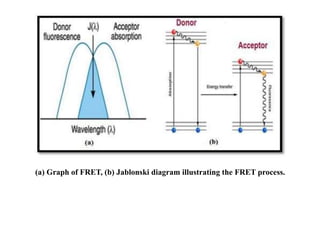
Fluorescence resonance energy transfer (FRET): It is the non- radioactive transfer
of energy between appropriate energy donor and acceptor molecules.
Following conditions must pertain for an effective FRET assay:
i) There should be an overlap between fluorescence emission spectrum of the donor
molecule and the absorption or excitation spectrum of the acceptor chromophore.
The degree of overlap is called as spectral overlap integral (J).
ii) Donor and acceptor fluorophore must be close to each other(typically 1 to 10
nanometer).
iii) There should be significant difference in extent of quenching of the starting
material and product.
iv) Transition dipole orientations of donor and acceptor must be approximately
parallel.
(a) Graph of FRET, (b) Jablonski diagram illustrating the FRET process.
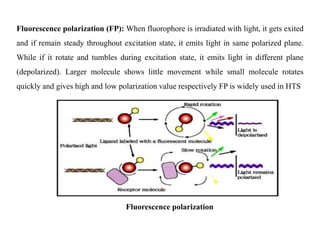
Fluorescence polarization (FP): When fluorophore is irradiated with light, it gets exited
and if remain steady throughout excitation state, it emits light in same polarized plane.
While if it rotate and tumbles during excitation state, it emits light in different plane
(depolarized). Larger molecule shows little movement while small molecule rotates
quickly and gives high and low polarization value respectively FP is widely used in HTS
Fluorescence polarization
Homogeneous time resolved fluorescence (HTRF): HTRF (long lived
fluorescence) consist of combination of standard FRET technology and time
resolved measurement (TR) of fluorescence, allows elimination of short lived
background fluorescence which occurs due to interfering material in the sample. It
allows delay of approximately 50 to 150μseconds between the initial excitation and
fluorescence measurement.
Fluorescence correlation spectroscopy (FCS): FCS measurements are carried out
using confocal optics to provide the highly focused excitation light and background
rejection required for single molecule detection.
Fluorescence intensity distribution analysis (FIDA): It yields information on
changes in spectral shift, and can also be used to monitor binding events when the
binding interaction influences these properties.
Nuclear magnetic resonance (NMR): NMR based screening is a useful tool for
lead identification, allows analysis of low molecular weight organic compound
which bind to the protein targets, and gives affinity and binding location of potential
lead compounds.
2. Cell based assays:
Cell-based assays for HTS can be classified under following classes:
I. Second messenger assays: It monitors signal transduction from activated cell-
surface receptors. Second messenger assays typically measure fast, transient
fluorescent signals that occur in matter of seconds or milliseconds.
II. Reporter gene assays: It monitors cellular responses at transcription/translation
level. It indicates the presence or absence of a gene product that in turn reflects
changes in a signal transduction pathway. The quantification of the reporter is usually
carried out by biochemical methods viz by measuring the enzymatic activity.
III. Cell proliferation assays: It monitors the overall growth/no growth responses of the
cell to external stimuli. These are quick and easy to be employed for automation.
Benefits of High Throughput Screening
•It allows screening of thousands of compounds on a repeatable basis.
•More effective drugs can be developed at a faster rate.
• It has the ability to optimize the compound lead selection and eliminating.
compounds that do not show measurable activity.
• It provides a higher level of confidence in the selected candidate drugs.
•The process reduces time and is cost-effective.
Instrumentation & Methodology
 MICROTITER PLATES (ASSAY PLATES)
• Plates/containers made of plastic, having spaced wells up to 384, 1536 or 3456
wells.
• They would contain solvents (e.g. DMSO + test compounds)
• They would also contain proteins, cells, etc. to be analysed.
• Some might be kept empty or contain pure solvents to serve as controls.
 DETECTORS
Diverse spectrometers (fluorescence, mass, NMR, FTIR, etc.), Chromatography (Gas,
Liquid, Ion exchange, etc.) and Microscopy (Scanning tunnelling microscopy, atomic
force microscopy, confocal microscopy) and Calorimeters.
The heart of the HTS system is a plate, or tray, which consists of tiny wells
where assay reagents and samples are deposited, and their reactions
monitored.
The configuration of the plate has changed from 96 wells (in a matrix of 8
rows by 12 columns) to 384, and now to a high density 1536 well format,
which - enables large - scale screening.
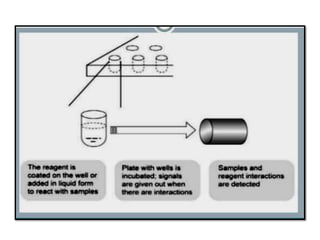
Assay reagents may be coated onto the plates or deposited in liquid form
together with test samples into the wells.
Both samples and assay reagents may be incubated, and those that interact
show signals, which can be detected.
Methodology
ADVANTAGES OF HTS
• High sensitivity of assay (single molecule detection)
• High speed of assay (automation)
• Minimization of assay (microtiter plate assay)
• Low background signal
• Clear message (best: Yes/No answer)
• Low complexity of assay (specific interaction)
• Reproducibility
• Fast data processing of results
LIMITATIONS OF HTS
• High cost
• Contamination of samples is possible.
• Analysis of data and selection of relevant data from large moulds of data
requires patience, professionalism, dedication and true expertise.
IMPORTANCE AND APPLICATIONS OF HTS
• Selection of compounds from a vast number synthesized by combinatorial
chemistry and other methods.
• For lead generation for the treatment of a disease.
• It is an efficient tool in studying biomolecular interactions and pathways.
• It is highly efficient, fast, accurate and dependable in compound screening Useful
in DNA sequencing
• Useful in toxicology, to study mechanism of action of various drugs and toxins.
• Study drug-drug interactions and the effects of drugs on metabolizing enzymes.
• Useful in cytotoxicity assays
• Useful in genotoxicity assays
RECENT ADVANCEMENTS
• Use of living organisms in HTS to study drug action and identify lead
molecules. Ultra HTS where above 100,000 compounds are screened at a time;
up to 300,000.
• Slow down in drive for miniaturization; 20 yrs since invention of 1536 well
plate but 384-well is still the most popular format.
• Focus more on high content screening - richer data.
• Use of in-silico screening to save money and only wet screen targeted subset
libraries.
REFERENCES
1. Hajare A., Salunkhe S. , Gorde S. , Nadaf S.J. & Pishawikar S. A.,“Review On:
High-Throughput Screening Is An Approach To Drug Discovery” American
Journal of PharmTech Research , 2014; 4(1) ISSN: 2249-3387,112-129.
2. Szymański P, Markowicz M, Mikiciuk-Olasik E. “Adaptation of high-
throughput screening in drug discovery-toxicological screening tests’’.
International journal of molecular sciences. 2011 Dec 29;13(1):427-52.
3. Hagemeyer A, Strasser P, Volpe Jr AF, editors. High-Throughput Screening in
Chemical Catalysis: Technologies, Strategies and Applications. John Wiley &
Sons; 2006 Mar 6.
4. https://www.slideshare.net/mohanlal28/new-high-thoughput-screening-copy.
5. https://www.slideshare.net/slideshow/high-throughput-screening-
90349842/90349842
High throughput screening for lead discovery .pptx

High throughput screening for lead discovery .pptx

  • 1.
    HIGH THROUGHPUT SCREENING(HTS) Submitted to: Prof. Asmita Gajbhiye Miss. Anamika Jain Mr. Shivam Kori Mr. Shyamji Tantuway Mr. Priyanshu Nema Submitted by: Mahendra Singour M.Pharma 2nd Semester Y23254010 Department of Pharmaceutical Sciences Dr. Harisingh Gour Vishwavidyalaya, Sagar (M.P.) DRUG DESIGN & DISCOVERY PHSC CC-2201
  • 2.
    HIGH THROUGHPUT SCREENING(HTS) Identification of one or more positive candidates extracted from a pool of possible candidates based on specific criteria.
  • 3.
    • High throughputscreening (HTS) is a scientific method used in drug discovery, genomics, and various other fields to rapidly and efficiently test a large number of chemical compounds or biological entities for specific activities. • High-throughput screening (HTS) has gained significant recognition over the past 20 years and is now considered a standard drug discovery technique in the pharmaceutical industry. • High-throughput screening (HTS) is an automated approach used to identify the effects of multiple compounds in biological and chemical assays. It involves the use of miniaturized assays, automation, robotics, and large-scale data analysis to discover and investigate new lead compounds. INTRODUCTION
  • 4.
    • The primarygoal of HTS is to identify potential candidates that exhibit a desired biological activity, such as inhibiting the growth of cancer cells, blocking a specific enzyme, or activating a cellular response. • HTS reveals screening of more than 100,000 samples per day. Compared to traditional drug screening methods. • High throughput Screening was invented by Dr. Gyula Takatsky in 1951. (he was the first to use microtiter plate with 6 rows of 12 wells) • This process is referred as lead generation or hit to lead. • HTS with the use of robotics, automation, and miniaturization, helps to screen >100000 compounds in a short span of time against validated biological targets. • It involves a automated operation system, a highly sensitive testing system, specific screening in vitro models, and abundant compound library and a data acquisition and processing system
  • 5.
    • HTS revealsscreening of more than 100,000 samples per day. Compared to traditional drug screening methods. • HTS is characterized by its simplicity, rapidness, low cost, and high efficiency & good ligand target interactions. • In order to learn about high throughput screening, we should have a general understanding of the drug discovery process • Drug discovery is the process by which new medications or drugs are discovered. • It involves the various steps from disease identification, identification and validation of related target(s), development of a lead that can interact with the target and be effective in treating the disease, preclinical and clinical trials and then finally marketing.
  • 7.
  • 9.
    • HTS isprocess by which large no’s. of compounds are rapidly tested for their ability to modify the properties of a selected biological target. • Goal is to identify 'hits' or 'leads‘ - affect target in desired manner - active at fairly low concentrations (.. more likely to show specificity) - new structure • It is a useful for discovering ligands for receptors, enzymes, ion-channels or other pharmacological targets, or pharmacologically profiling a cellular or biochemical pathway of interest
  • 10.
    • Basically helpsto identify a compound that can chemically modify a target • This compound is identified as a hit and may be generated to a lead. • A Hit is any compound that is confirmed to have binding activity to the target and appears on High throughput screen. It gives the desired effect of the HTS experiment and is confirmed on re-testing. • HIT is a compound that has display desired biological target. • The Lead is the compound with therapeutic or pharmacological activity but sub- optimal structure that still requires modification. • This is the compound selected from a cluster of hits based on certain parameters like binding and modification capacity, affinity, selectivity, efficacy in cell tissue assays, freedom of operation or patentability, drug metabolizing enzyme interaction, serum albumin binding, cytotoxicity and many others of importance. • Lead compounds have biological or pharmacological activity but may need structural modification to better fit their target.
  • 11.
    • This processis commonly referred as lead generation or hit to lead (H2L). • The lead is further optimized and thus can then go through preclinical and clinical trials and if approved gets marketed. • The general procedure of HTS involves testing a solution of different compounds in assay plates called microtiter plates having wells. • The ligand or protein or embryo of interest is introduced into these wells containing test solution • They are incubated for a short time period. • Analysis is done microscopically or by analytical techniques like spectrometry. • Compounds showing desired effects are hits.
  • 12.
    HTS HTS Repeated Will any ofthese compounds interact with the receptor? Interacted with the receptor! Interacted with the receptor again! HITS!!!
  • 13.
    TECHNOLOGY INFRASTRUCTURE INHTS High Throughput Screening (HTS) technology infrastructure refers to the hardware, software, and networking components that support the automated and rapid testing of large numbers of biological samples or chemical compounds. The key components of HTS technology infrastructure include: 1. Screening formats: As previously mentioned assays should be informative, robust, reliable, reproducible, fast, cost effective and should easy to perform. The primary goals of automation, miniaturization, and high throughput are to develop homogeneous assay formats and the use of high sensitivity detection techniques. Several non separation (homogeneous) or “mix-and measure” assay technologies are widely used as it provide simplicity, and avoids steps which are time consuming and difficult-to- automate, such as extraction, filtration, centrifugation, and washing. However 96-well filter plates provides a provision if filtration is required in a particular assay. Non isotopic end points such as fluorescence and luminescence based detection techniques are prominently used due to increased sensitivity, flexibility in assay design, low cost and improved safety, although radiometric assays, scintillation proximity assays have played a major role in HTS.
  • 14.
    2. Miniaturization :Miniaturization minimizes costs, prevent unnecessary depletion of valuable compound supplies, reduce the amounts of reagents used, and decrease the costs of disposing of assay waste by enabling the use of parallel sample processing and multiplexed detection modes. Miniaturization in high-throughput screening (HTS) is a crucial strategy for accelerating drug discovery by reducing costs, increasing efficiency, and improving data quality. The primary goal of miniaturization is to minimize the volume of reagents and samples used in assays while maintaining the same level of information content and data quality. This approach has several key benefits: Cost Savings: Miniaturization significantly reduces the consumption of expensive reagents and consumables, making it a cost-effective method for HTS. Increased Efficiency: By using smaller volumes, researchers can process more samples in less time, leading to increased productivity and faster turnaround times. Improved Data Quality: Miniaturization allows for the inclusion of more controls and replicates on each plate, which enhances data quality and reduces the risk of human error. Enhanced Automation: Higher well densities, such as 384 and 1536 well plates, can be automated more easily, further reducing labor costs and increasing efficiency. Better Use of Scarce Resources: Miniaturization ensures that valuable reagents and samples are used more efficiently, making it particularly important for substances that are scarce, expensive, or time-consuming to produce.
  • 15.
  • 16.
    • To achievethese benefits, researchers use advanced automation systems and miniaturized assays. The miniaturization process involves reducing the volume of reagents and samples while maintaining the same level of information content and data quality. This is often achieved through the use of nanolitre dispensers and other liquid handling technologies. • Miniaturization also presents some challenges, such as evaporation, liquid handling issues, and biological variability. To overcome these challenges, researchers must carefully plan and execute their miniaturization strategies, including choosing the right microtiter plates and optimizing liquid handling and robotics. Overall, miniaturization is a critical component of modern HTS, enabling researchers to efficiently and effectively identify promising drug candidates while minimizing costs and resources.
  • 17.
    The Effect ofGreater Density of Wells Plate Format Typical assay volume Human vs Robot 96 100-200 Both 384 25-50 Both 384 low volume 5-20 Both (just) 1536 2-10 Robots only 3456 1 Robots only 9600 0.2 Definitely Robots only Smaller assay volume = less reagents = cheaper data points
  • 18.
    3. Automation androbotics: Automation plays a crucial role in high- throughput screening (HTS) by increasing efficiency, speed, and accuracy while reducing labor costs and minimizing human error. Automation in HTS involves the use of machines to perform laboratory tasks, such as pipetting, liquid handling, and signal detection, to produce rich data sets in a short period of time. Key components of automation in HTS:- Robotic Automation: Robotic systems are used to handle and transport plates, as well as perform tasks such as pipetting and dispensing reagents. Liquid Handling: Automated liquid handling systems enable precise and efficient dispensing of reagents and compounds, reducing the need for manual intervention. Signal Detection: Automated systems can detect signals such as fluorescence, luminescence, or absorbance, allowing for rapid data collection and analysis. Software Integration: Sophisticated software is used to schedule and control the automated processes, ensuring consistent well-to-well treatment and efficient data management.
  • 19.
  • 20.
    • Considerable degreeof automation is essential to increase throughput above that achieved by conventional, manual techniques, and to reduce pipetting errors, speed up the plate preparation process and to ensure sample uniformity in a screening context, especially on higher density plates. • Automation of laboratory procedures, led to a significantly accelerated drug discovery process compared to the traditional one-compound-at-a time approach. Traditionally, an experienced organic chemist could synthesize and finalize approximately 50 compounds each year; however due certain automation more than 2000 compounds can be easily generated yearly. • Automation is a critical component of high-throughput screening, enabling the rapid and efficient screening of large numbers of biological modulators and compounds. Its benefits include increased speed, accuracy, and reproducibility, as well as reduced labor costs and enhanced data management.
  • 21.
     HTS assaysfound to be applicable for screening of different types of libraries, including combinatorial chemistry, genomics, protein, and peptide libraries. Basically.  HTS is a process of screening and assaying large number of biological modulators and effectors against selected and specific targets.  HTS to be successful numerous steps like target identification, reagent preparation, compound management, assay development and high throughput library screening should be carried out with extreme care and precision. Methods commonly followed are: firstly selecting the target. Currently there are about 500 targets being used by companies. Of these, cell membranes receptors, mostly G-protein coupled receptors, comprise the largest group (45% of the total), Enzymes make up the next largest group (28%), followed by hormones (11%), unknowns (7%), ion-channels (5%), nuclear receptors (2%), and finally DNA (2%). In recent studies, pharmaceutical companies mainly look for compounds that interfere or modulate the function of GPCRs. TYPES OF HIGH THROUGHPUT ASSAYS: Assays mainly divided into biochemical and cell based assays. Biochemical assays are further divided into heterogeneous and homogeneous assays. HIGH THROUGHPUT ASSAYS:
  • 22.
    1. Biochemical assays Biochemicalassays are receptor, protein or enzyme based assays uses the particular target in a purified form. Biochemical assays are most frequently carried out using scintillation proximity assay (SPA),radiometric, colorimetric fluorescence detection techniques. Scintillation Proximity Assay is a technology whereby binding reactions can be assayed without the washing or filtration procedures normally used to separate bound from free fractions. A. Homogeneous assay: In homogeneous assay measurement are based on the distinct physical/chemical properties of analyte, or interaction between analyte and surrounding environment. It is a single step process; reagent may be added at single stage or in multiple steps. It only involves usual steps like fluid addition, incubation and reading. It can be coupled with different detection technique fluorescence, radiometric etc for HTS. Main advantage of homogeneous assay is its simplicity (Mix and read) because minimum step which ultimately contributes to the reduction of both cost and robotic complexity required for automation. It have signal to background ratio less than 10.
  • 23.
    B. Heterogeneous assays:Heterogeneous assays involves additional steps like filtration, centrifugation etc. This contributes to the high signal to background ratio. Due to higher steps it becomes complicated. Heterogeneous assay are performed mainly when homogeneous assay fails or high signal to background ration is required. Some techniques of biochemical assays are summarized below: Fluorescence resonance energy transfer (FRET): Fluorescence polarization (FP): Homogeneous time resolved fluorescence (HTRF): Fluorescence correlation spectroscopy (FCS): Fluorescence intensity distribution analysis (FIDA): Nuclear magnetic resonance (NMR):
  • 24.
    TECHNIQUES OF BIOCHEMICALASSAY Fluorescenceresonance energy transfer (FRET): It is the non- radioactive transfer of energy between appropriate energy donor and acceptor molecules. Following conditions must pertain for an effective FRET assay: i) There should be an overlap between fluorescence emission spectrum of the donor molecule and the absorption or excitation spectrum of the acceptor chromophore. The degree of overlap is called as spectral overlap integral (J). ii) Donor and acceptor fluorophore must be close to each other(typically 1 to 10 nanometer). iii) There should be significant difference in extent of quenching of the starting material and product. iv) Transition dipole orientations of donor and acceptor must be approximately parallel.
  • 25.
    (a) Graph ofFRET, (b) Jablonski diagram illustrating the FRET process.
  • 26.
    Fluorescence polarization (FP):When fluorophore is irradiated with light, it gets exited and if remain steady throughout excitation state, it emits light in same polarized plane. While if it rotate and tumbles during excitation state, it emits light in different plane (depolarized). Larger molecule shows little movement while small molecule rotates quickly and gives high and low polarization value respectively FP is widely used in HTS Fluorescence polarization
  • 27.
    Homogeneous time resolvedfluorescence (HTRF): HTRF (long lived fluorescence) consist of combination of standard FRET technology and time resolved measurement (TR) of fluorescence, allows elimination of short lived background fluorescence which occurs due to interfering material in the sample. It allows delay of approximately 50 to 150μseconds between the initial excitation and fluorescence measurement. Fluorescence correlation spectroscopy (FCS): FCS measurements are carried out using confocal optics to provide the highly focused excitation light and background rejection required for single molecule detection. Fluorescence intensity distribution analysis (FIDA): It yields information on changes in spectral shift, and can also be used to monitor binding events when the binding interaction influences these properties. Nuclear magnetic resonance (NMR): NMR based screening is a useful tool for lead identification, allows analysis of low molecular weight organic compound which bind to the protein targets, and gives affinity and binding location of potential lead compounds.
  • 28.
    2. Cell basedassays: Cell-based assays for HTS can be classified under following classes: I. Second messenger assays: It monitors signal transduction from activated cell- surface receptors. Second messenger assays typically measure fast, transient fluorescent signals that occur in matter of seconds or milliseconds. II. Reporter gene assays: It monitors cellular responses at transcription/translation level. It indicates the presence or absence of a gene product that in turn reflects changes in a signal transduction pathway. The quantification of the reporter is usually carried out by biochemical methods viz by measuring the enzymatic activity. III. Cell proliferation assays: It monitors the overall growth/no growth responses of the cell to external stimuli. These are quick and easy to be employed for automation.
  • 29.
    Benefits of HighThroughput Screening •It allows screening of thousands of compounds on a repeatable basis. •More effective drugs can be developed at a faster rate. • It has the ability to optimize the compound lead selection and eliminating. compounds that do not show measurable activity. • It provides a higher level of confidence in the selected candidate drugs. •The process reduces time and is cost-effective.

  • 30.
    Instrumentation & Methodology MICROTITER PLATES (ASSAY PLATES) • Plates/containers made of plastic, having spaced wells up to 384, 1536 or 3456 wells. • They would contain solvents (e.g. DMSO + test compounds) • They would also contain proteins, cells, etc. to be analysed. • Some might be kept empty or contain pure solvents to serve as controls.  DETECTORS Diverse spectrometers (fluorescence, mass, NMR, FTIR, etc.), Chromatography (Gas, Liquid, Ion exchange, etc.) and Microscopy (Scanning tunnelling microscopy, atomic force microscopy, confocal microscopy) and Calorimeters.
  • 31.
    The heart ofthe HTS system is a plate, or tray, which consists of tiny wells where assay reagents and samples are deposited, and their reactions monitored. The configuration of the plate has changed from 96 wells (in a matrix of 8 rows by 12 columns) to 384, and now to a high density 1536 well format, which - enables large - scale screening. Assay reagents may be coated onto the plates or deposited in liquid form together with test samples into the wells. Both samples and assay reagents may be incubated, and those that interact show signals, which can be detected. Methodology
  • 33.
    ADVANTAGES OF HTS •High sensitivity of assay (single molecule detection) • High speed of assay (automation) • Minimization of assay (microtiter plate assay) • Low background signal • Clear message (best: Yes/No answer) • Low complexity of assay (specific interaction) • Reproducibility • Fast data processing of results LIMITATIONS OF HTS • High cost • Contamination of samples is possible. • Analysis of data and selection of relevant data from large moulds of data requires patience, professionalism, dedication and true expertise.
  • 34.
    IMPORTANCE AND APPLICATIONSOF HTS • Selection of compounds from a vast number synthesized by combinatorial chemistry and other methods. • For lead generation for the treatment of a disease. • It is an efficient tool in studying biomolecular interactions and pathways. • It is highly efficient, fast, accurate and dependable in compound screening Useful in DNA sequencing • Useful in toxicology, to study mechanism of action of various drugs and toxins. • Study drug-drug interactions and the effects of drugs on metabolizing enzymes. • Useful in cytotoxicity assays • Useful in genotoxicity assays
  • 35.
    RECENT ADVANCEMENTS • Useof living organisms in HTS to study drug action and identify lead molecules. Ultra HTS where above 100,000 compounds are screened at a time; up to 300,000. • Slow down in drive for miniaturization; 20 yrs since invention of 1536 well plate but 384-well is still the most popular format. • Focus more on high content screening - richer data. • Use of in-silico screening to save money and only wet screen targeted subset libraries.
  • 36.
    REFERENCES 1. Hajare A.,Salunkhe S. , Gorde S. , Nadaf S.J. & Pishawikar S. A.,“Review On: High-Throughput Screening Is An Approach To Drug Discovery” American Journal of PharmTech Research , 2014; 4(1) ISSN: 2249-3387,112-129. 2. Szymański P, Markowicz M, Mikiciuk-Olasik E. “Adaptation of high- throughput screening in drug discovery-toxicological screening tests’’. International journal of molecular sciences. 2011 Dec 29;13(1):427-52. 3. Hagemeyer A, Strasser P, Volpe Jr AF, editors. High-Throughput Screening in Chemical Catalysis: Technologies, Strategies and Applications. John Wiley & Sons; 2006 Mar 6. 4. https://www.slideshare.net/mohanlal28/new-high-thoughput-screening-copy. 5. https://www.slideshare.net/slideshow/high-throughput-screening- 90349842/90349842