PEMBERTON OSTEOTOMY
FOR ACETABULAR DYSPLASIA
JBJS- ESSENTIAL SURGICAL TECHNIQUES
INDIAN EDITION
OCTOBER 2015, VOL.4, NO. 3, SPECIAL EDITION
Shier- Chieg Huang, MD, PhD
Ting- Ming Wang, MD, PhD
Kuan- Wen Wu, MD
Ken N. Kuo, MD
PRESENTED BY Dr. LIBIN THOMAS MANATHARA
INTRODUCTION
• More than 550 operations of Pemberton's osteotomy
done as primary treatment for developmental dysplasia
of hip since 1993
• Originally described by Pemberton in 1965
• Pericapsular Osteotomy of the Ilium for Treatment of Congenital
Subluxation and Dislocation of the Hip, PAUL A. PEMBERTON, J
Bone Joint Surg Am, 1965 Jan; 47 (1): 65 -86 . http://dx.doi.org/
INTRODUCTION
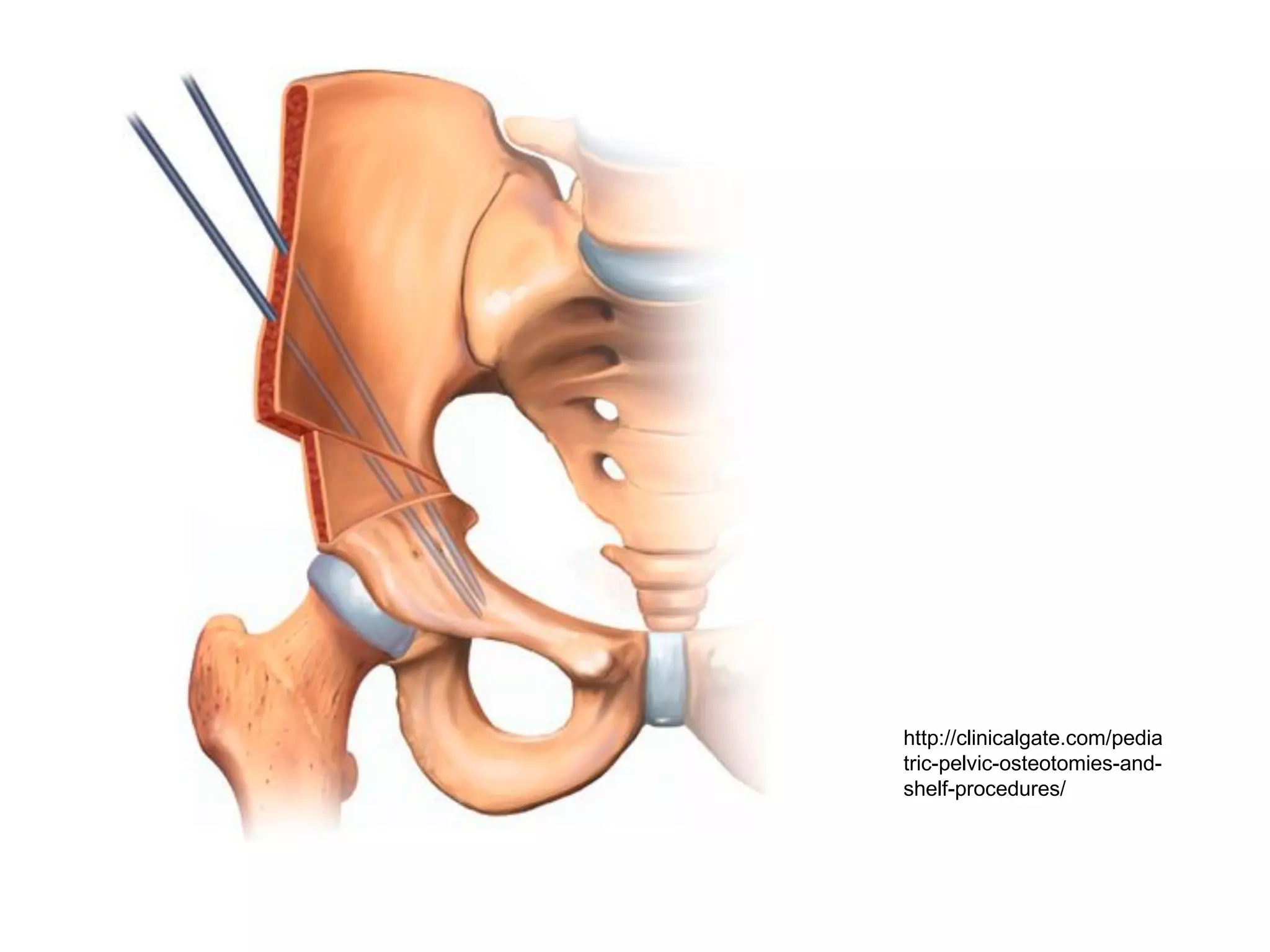
• Characterised by a redirection of the
acetabular roof, hinged on the triradiate
cartilage after an incomplete iliac
osteotomy
INTRODUCTION
• The shape of the acetabulum is modified
by rotating the acetabular fragment
caudally and anteriorly to improve the
anterior and lateral coverage of the
femoral head
• Two similar modifications, the Dega
osteotomy and the San Diego osteotomy
were designed for the same purpose
INTRODUCTION
• With the Dega, the osteotomy penetrates
the anterior and middle portions of the
inner cortex of the ilium and leaves an
intact posteromedial iliac cortex and sciatic
notch as a posterior hinge
• The San Diego utilises complete bicortical
osteotomies both anteriorly and posteriorly,
to provide increased superior and
posterior coverage
https://books.google.co.in/books?id=lWV47ye7jTUC&pg=PA137&lpg=PA137&dq=san+diego+osteotomy&source=bl&ot
s=3QDqfnpxiq&sig=a4tfFaimCgj8HEs9Ubt1bsNE_1I&hl=en&sa=X&ved=0ahUKEwj--
aLn7s7JAhVGTBQKHZfHDNYQ6AEILjAC#v=onepage&q=san%20diego%20osteotomy&f=false
http://hipdysplasia.org/developmental-dysplasia-of-the-hip/child-treatment-methods/osteotomy/
INTRODUCTION
• Most experienced pediatric orthopedic surgeons can
expect the Pemberton acetabuloplasty to yield greater
correction of acetabular dysplasia than the Salter
innonimate osteotomy , without the need for internal
fixation of the osteotomy site
• Salter innonimate osteotomy- a type of open wedge innominate osteotomy which extends and
retroverts acetabulum around fixed axis, it redirects entire acetabulum so that its roof covers
femoral head both anteriorly and superiorly, it extends and retroverts acetabulum around fixed
axis
http://hipdysplasia.org/developmental-dysplasia-of-the-hip/child-treatment-methods/osteotomy/
INTRODUCTION
• Although some authors have cautioned
against the use of the Pemberton
osteotomy in children older than 7yrs
because of concerns about decreasing
remodeling potential and a less flexible
triradiate cartilage, some investigators
have reported that the Pemberton
osteotomy can be done at a later age with
good results, when combined with a
proximal femoral osteotomy
INTRODUCTION
• Nevertheless the iatrogenic injury to the
triradiate cartilage resulting from an
incorrectly performed Pemberton's
osteotomy is a possible serious
complication which may cause premature
closure of the triradiate cartilage resulting
in a shallow acetabulum
STEPS
• 1) Exposure
• 2) Perform iliopsoas tenotomy
• 3) Perform open reduction and osteotomy
• 4) Insert iliac bone graft
• 5) Postoperative management
STEP 1- EXPOSURE
• Place the patient in supine position with a
towel roll under the buttock and chest on
the side on which the operation is to be
performed
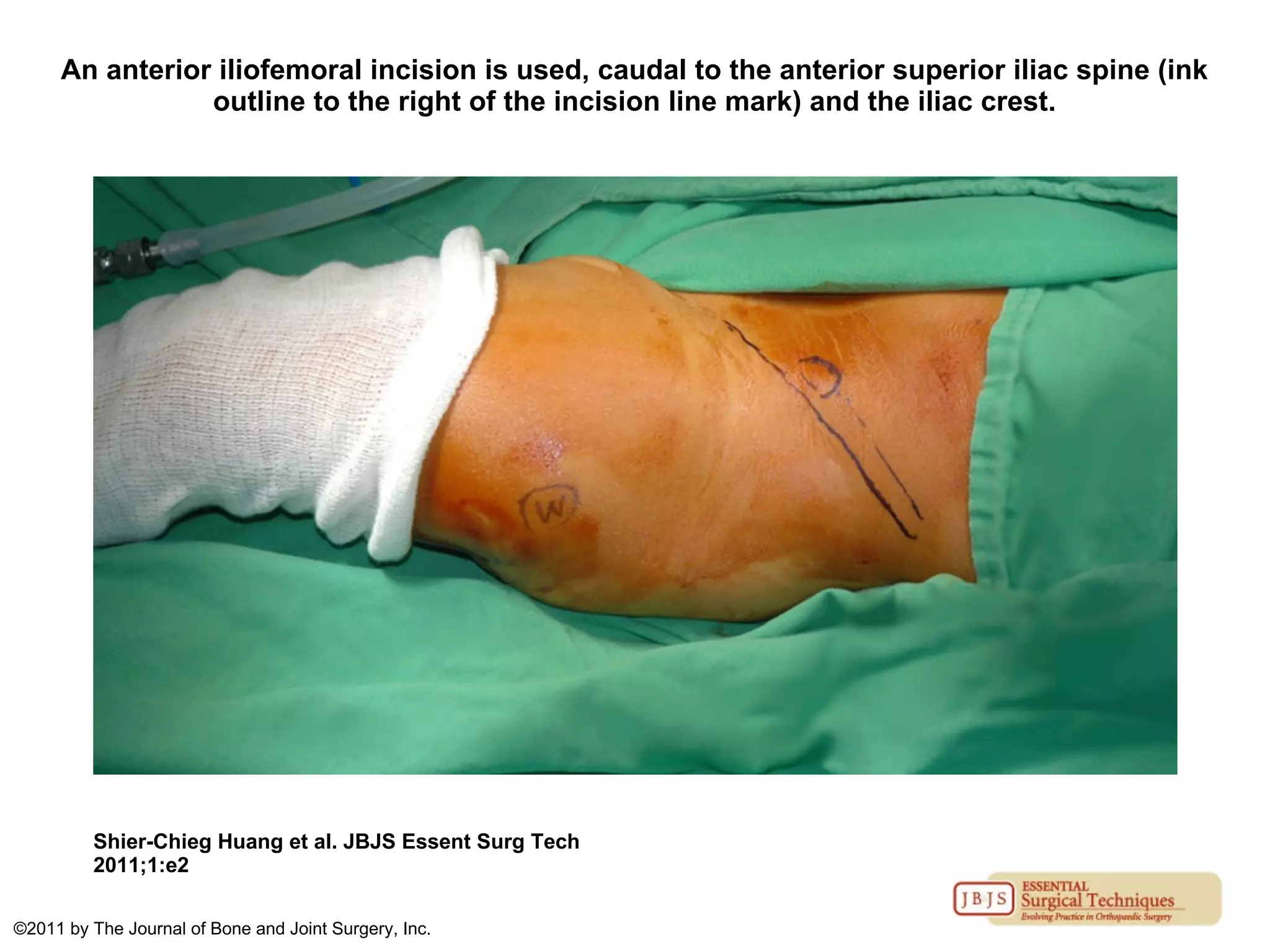
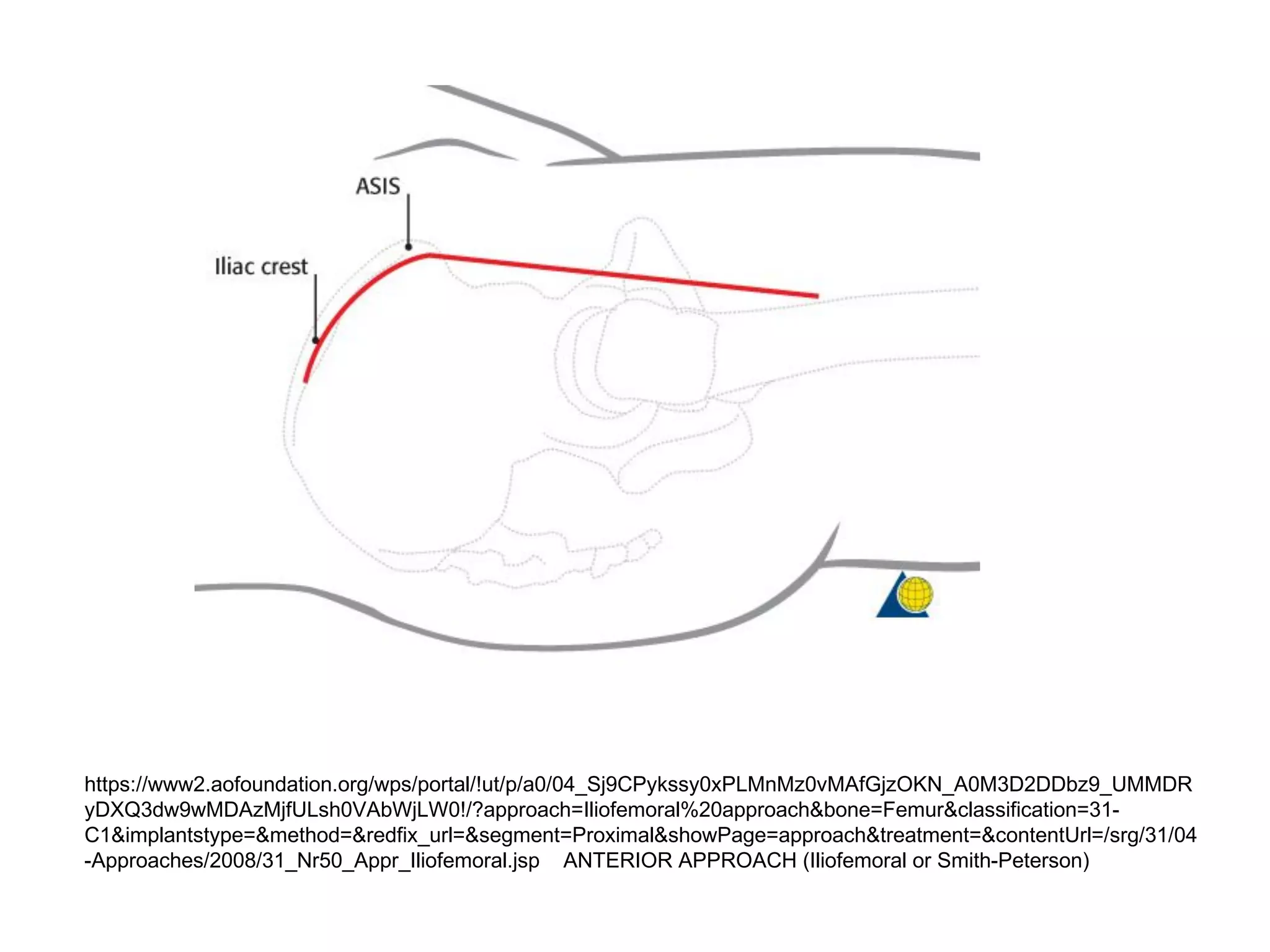
• Make an anterior iliofemoral incision that is
not directly on the iliac crest
https://www2.aofoundation.org/wps/portal/surgery?showPage=preparation&contentUrl=srg/32/03-
Preparation/32_P3_supine.jsp&bone=Femur&segment=Shaft&preparation=Supine%20position%20without%20traction
&Language=en
An anterior iliofemoral incision is used, caudal to the anterior superior iliac spine (ink
outline to the right of the incision line mark) and the iliac crest.
Shier-Chieg Huang et al. JBJS Essent Surg Tech
2011;1:e2
©2011 by The Journal of Bone and Joint Surgery, Inc.
https://www2.aofoundation.org/wps/portal/!ut/p/a0/04_Sj9CPykssy0xPLMnMz0vMAfGjzOKN_A0M3D2DDbz9_UMMDR
yDXQ3dw9wMDAzMjfULsh0VAbWjLW0!/?approach=Iliofemoral%20approach&bone=Femur&classification=31-
C1&implantstype=&method=&redfix_url=&segment=Proximal&showPage=approach&treatment=&contentUrl=/srg/31/04
-Approaches/2008/31_Nr50_Appr_Iliofemoral.jsp ANTERIOR APPROACH (Iliofemoral or Smith-Peterson)
Exposure
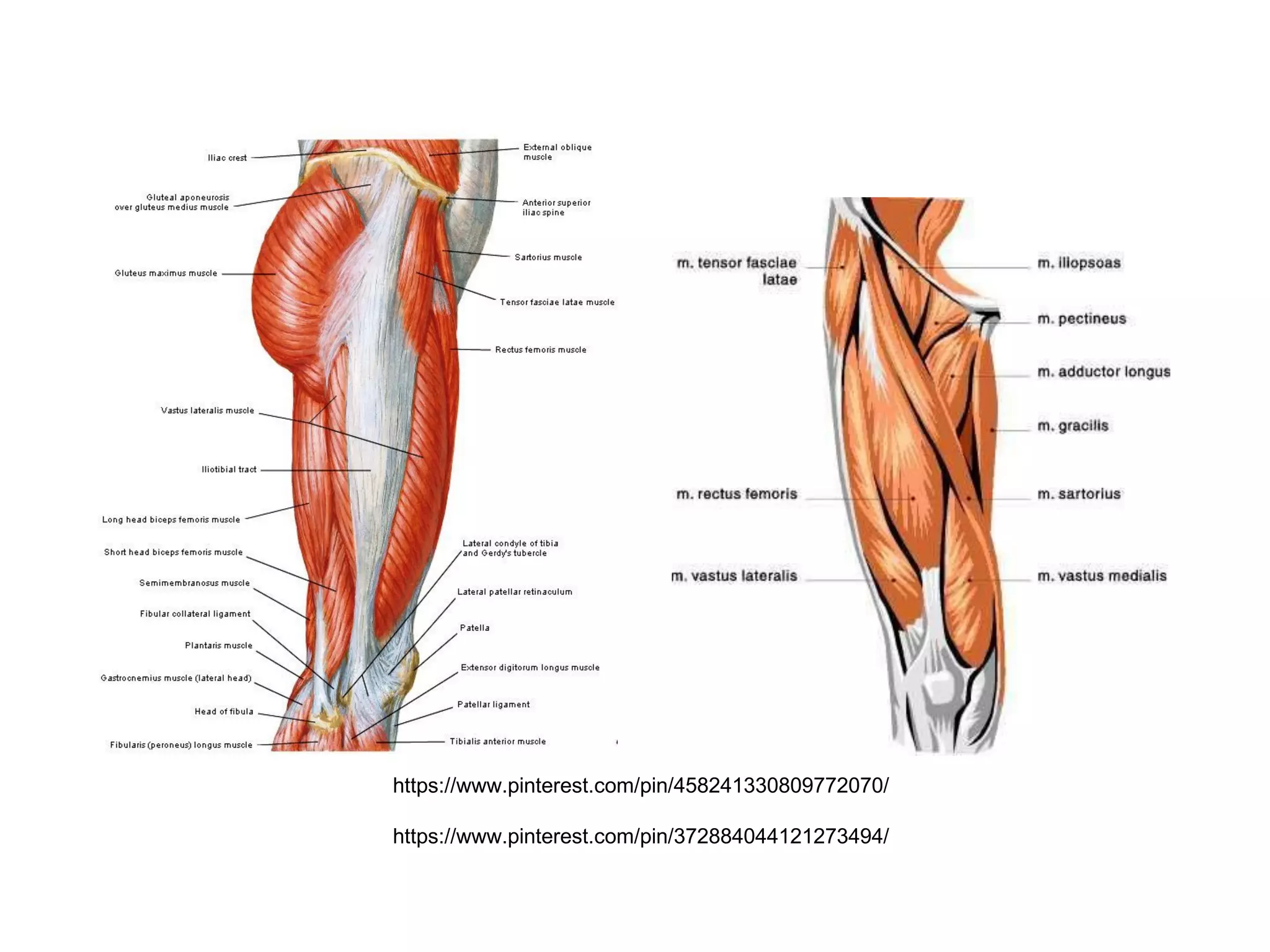
• Dissect the subcutaneous tissue
• Identify the muscle interval between
Sartorious and Tensor Fascia Lata (TFL)
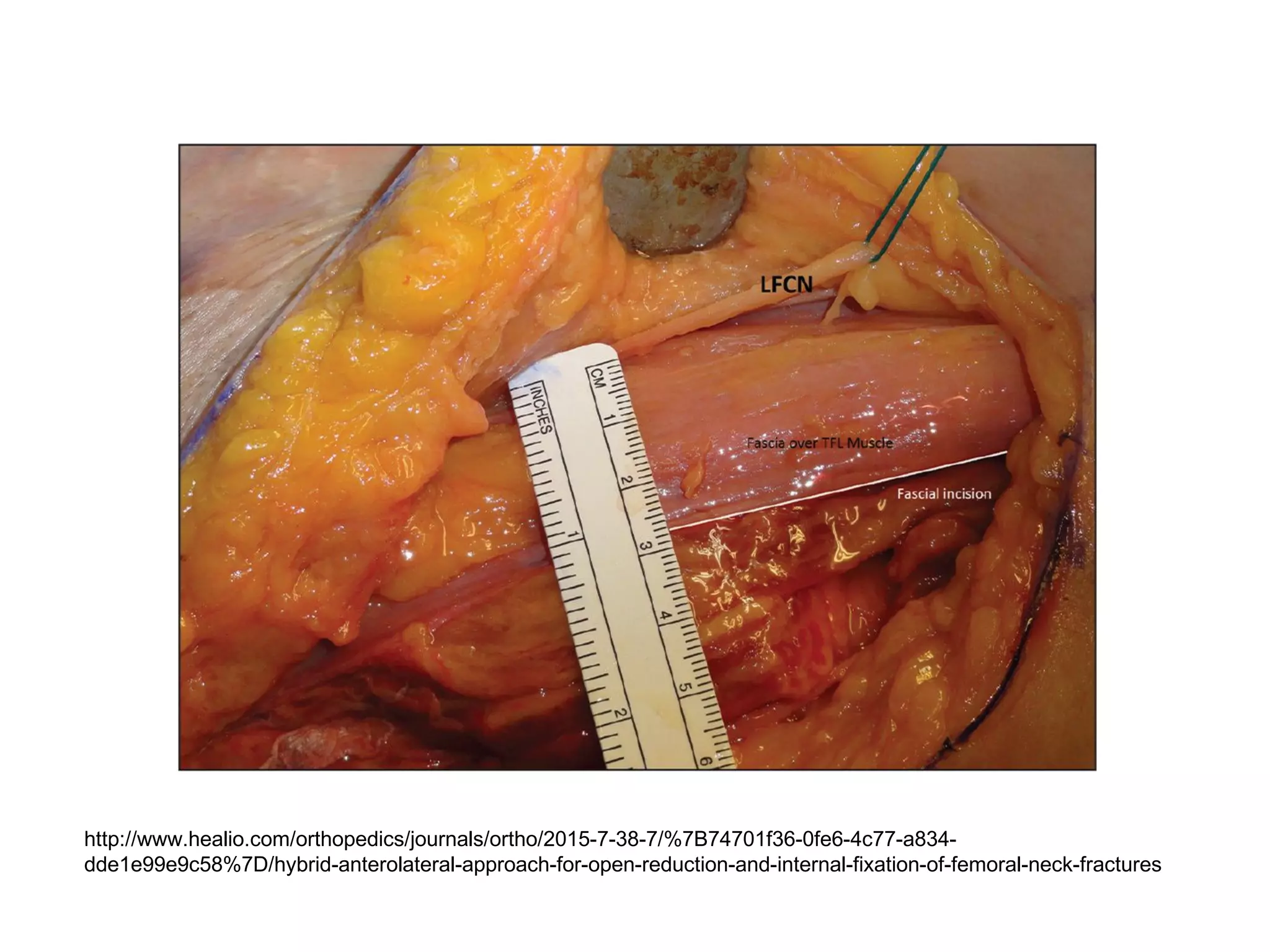
• In this intermuscular interval, beneath the
deep fascia you can find the fatty tissue
around the lateral femoral cutaneous
nerve (LFCN)
http://www.jointpreservationinstitute.com/hip-dysplasia.html
https://www.pinterest.com/pin/458241330809772070/
https://www.pinterest.com/pin/372884044121273494/
Exposure
• Incise this deep fascia carefully
• Identify the nerve clearly and protect it with
gentle traction
• Retract it medially after it is well mobilised
both proximally and distally
http://www.healio.com/orthopedics/journals/ortho/2015-7-38-7/%7B74701f36-0fe6-4c77-a834-
dde1e99e9c58%7D/hybrid-anterolateral-approach-for-open-reduction-and-internal-fixation-of-femoral-neck-fractures
"Gray826-LFC" by Dan Hoey - Edited version of PD image Image:Gray826.png.
Licensed under Public Domain via Commons -
https://commons.wikimedia.org/wiki/File:Gray826-
LFC.png#/media/File:Gray826-LFC.png
http://thepainsource.com/meralgia-paresthetica-lateral-femoral-cutaneous-
neuropathy/
Exposure
• Expose the iliac crest
• Releasing the external oblique muscles on
the crest facilitates the exposure of the
cartilagenous iliac apophysis
• Identify the anterior superior iliac spine
(ASIS)
http://ranzcrpart1.wikia.com/wiki/Abdomen:Muscles:Anterolateral_abdominal_muscles_and_aponeuroses
http://orthopaedicprinciples.com/2013/06/idiopathic-scoliosis-rishi-m-kanna/
Exposure
• Divide the cartilage at the iliac crest by
identifying it with thumb and index finger
and incising directly in the midline
• Strip off each half of the iliac apophysis
with a periosteal elevator to expose the
ilium subperiosteally both medially and
laterally
The iliac crest cartilaginous apophysis is split sharply, with the thumb and the index
finger used to gauge the thickness and direction of the iliac wing.
Shier-Chieg Huang et al. JBJS Essent Surg Tech
2011;1:e2
©2011 by The Journal of Bone and Joint Surgery, Inc.
Exposure
• Pack a gauze sponge on the inner and
outer cortices to facilitate subperiosteal
dissection and provide hemostasis
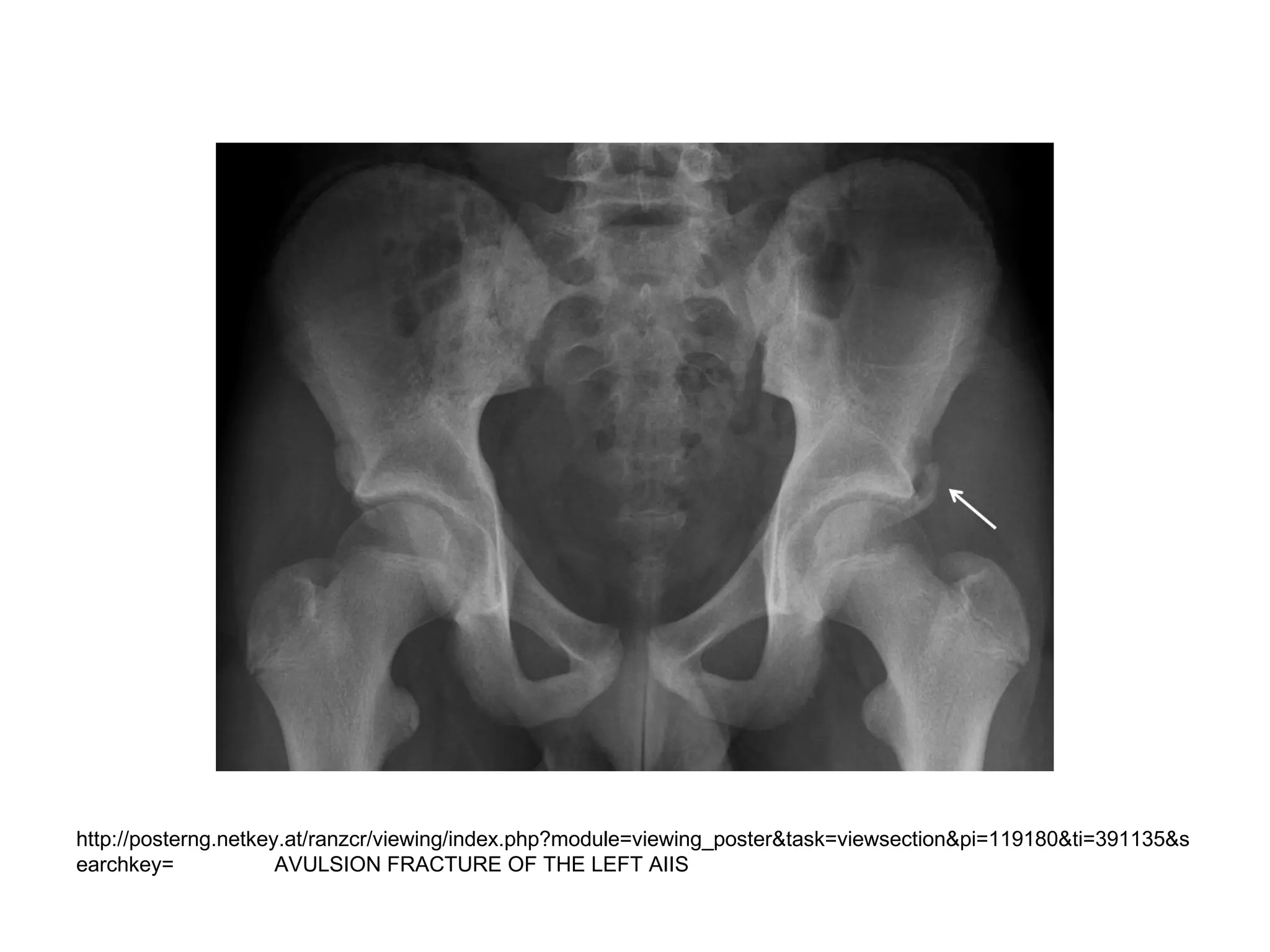
• Expose the anterior inferior iliac spine
(AIIS) by elevating the periosteum with the
hip abductor muscles from the outer cortex
of the ilium until the AIIS is clearly defined
http://slideplayer.com/slide/4207487/
https://www.studyblue.com/notes/note/n/pelvic-appendage-features-identification/deck/14579134
http://posterng.netkey.at/ranzcr/viewing/index.php?module=viewing_poster&task=viewsection&pi=119180&ti=391135&s
earchkey= AVULSION FRACTURE OF THE LEFT AIIS
http://www.anatomy-physiotherapy.com/component/content/article?id=1070:differentiated-activation-of-hip-abductors
http://bodybuilding-wizard.com/muscles-that-act-on-the-hip/
STEP 2- PERFORM ILIOPSOAS TENOTOMY
• Identify the tendon of the straight head of
the rectus femoris at its origin on the AIIS
• Transect the tendon close to the AIIS but
leave a short stump for later tendon
reattachment
http://www.anatomy-physiotherapy.com/27-systems/musculoskeletal/lower-extremity/hip/1055-origin-of-the-direct-and-
reflected-rectus-femoris-head
from Arthroscopy. 2014 Jul;30(7):796-802. doi: 10.1016/j.arthro.2014.03.003. Epub 2014 May 2.
Origin of the direct and reflected head of the rectus femoris: an anatomic study.
Ryan JM1, Harris JD2, Graham WC1, Virk SS1, Ellis TJ3
http://www.ncbi.nlm.nih.gov/pubmed/?term=Origin+of+the+Direct+and+Reflected+Head+of+the+Rectus+Femoris:+An+
Anatomic+Study
http://radsource.us/rectus-femoris-quadriceps-injury/
The tendon of the straight head of the rectus femoris muscle is isolated and is divided
just caudal to the anterior inferior iliac spine (AIIS).
Shier-Chieg Huang et al. JBJS Essent Surg Tech
2011;1:e2
©2011 by The Journal of Bone and Joint Surgery, Inc.
PERFORM ILIOPSOAS TENOTOMY
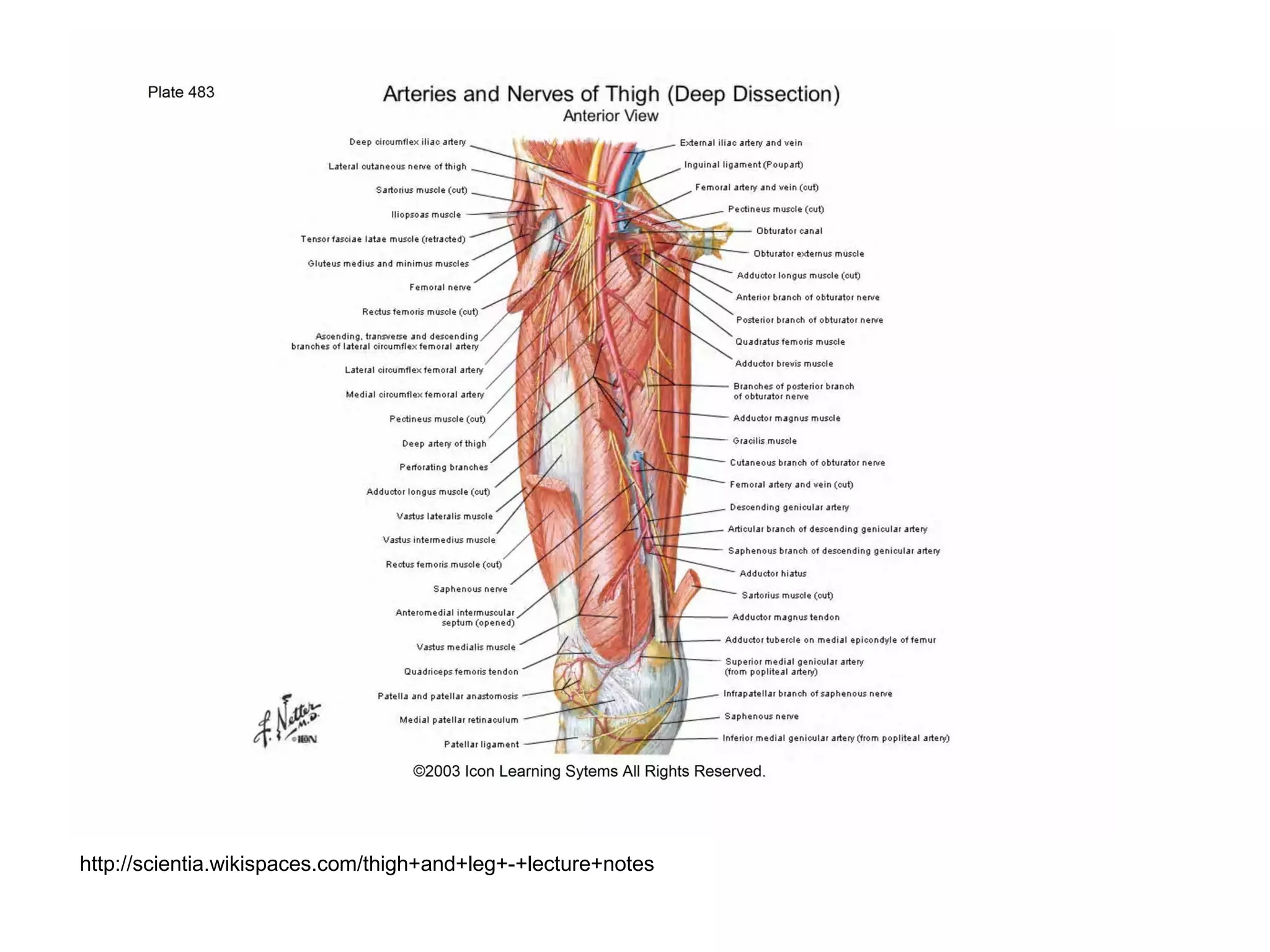
• Protect and preserve the ascending
branch of the anterior/ lateral femoral
circumflex artery (LFCA), which may be
visible in the surgical field at this time
"Thigh arteries schema" by Human_leg_bones_labeled.svg: Original uploader was Jecowa at en.wikipediaderivative
work: Mcstrother (talk) - Human_leg_bones_labeled.svg. Licensed under CC BY 3.0 via Commons -
https://commons.wikimedia.org/wiki/File:Thigh_arteries_schema.svg#/media/File:Thigh_arteries_schema.svg
http://scientia.wikispaces.com/thigh+and+leg+-+lecture+notes
PERFORM ILIOPSOAS TENOTOMY
• Bluntly dissect the iliacus muscle belly
medial to the ilium and identify the psoas
tendon at the level of the anterior pelvic
rim
• Release the tendinous part of the iliopsoas
muscle
http://www.stretchify.com/psoasiliops
oas-stretches/
The iliopsoas tendon is identified at the pelvic rim, and the tendinous portion is divided,
leaving the muscular portion intact.
Shier-Chieg Huang et al. JBJS Essent Surg Tech
2011;1:e2
©2011 by The Journal of Bone and Joint Surgery, Inc.
PERFORM ILIOPSOAS TENOTOMY
• Be careful of the femoral neurovascular
bundle, which is located immediately
medial to the psoas muscle but on the
anterior aspect
• The femoral NV bundle can be retracted
and protected with a blunt retractor
http://accessmedicine.mhmedical.com/da
ta/books/mort/mort_c036f003.gif
PERFORM ILIOPSOAS TENOTOMY
• Identify the acetabulum- hip capsule junction
• If the femoral head is well reduced in the
acetabulum, you can identify the edge of the
acetabulum and the reflected head of the rectus
femoris mucle easily
• Dissect the soft tissue overlying the capsule and
then identify the margin of the joint capsule at
the acetabular rim
http://www.americanhipinstitute.org/wp-content/themes/american-hip-institue/images/psoas-impingement.jpg
http://jbjs.org/content/96/20/1673
PERFORM ILIOPSOAS TENOTOMY
• Sometimes the capsule becomes redundant and
adherent to the ilium as the result of a previous
femoral head dislocation
• In this situation, dissect the abductor muscle
from the capsule and use a periosteal elevator to
strip off any soft tissue from the anterior aspect
of the ilium to reveal the junction of the hip
capsule and cartilagenous labrum
http://helpmegrowutah.blogspot.in/2013/03/hip-healthy-swaddling-developmental.html
http://orthoinfo.aaos.org/topic.cfm?topic=a00347
STEP 3- PERFORM OPEN
REDUCTION AND OSTEOTOMY
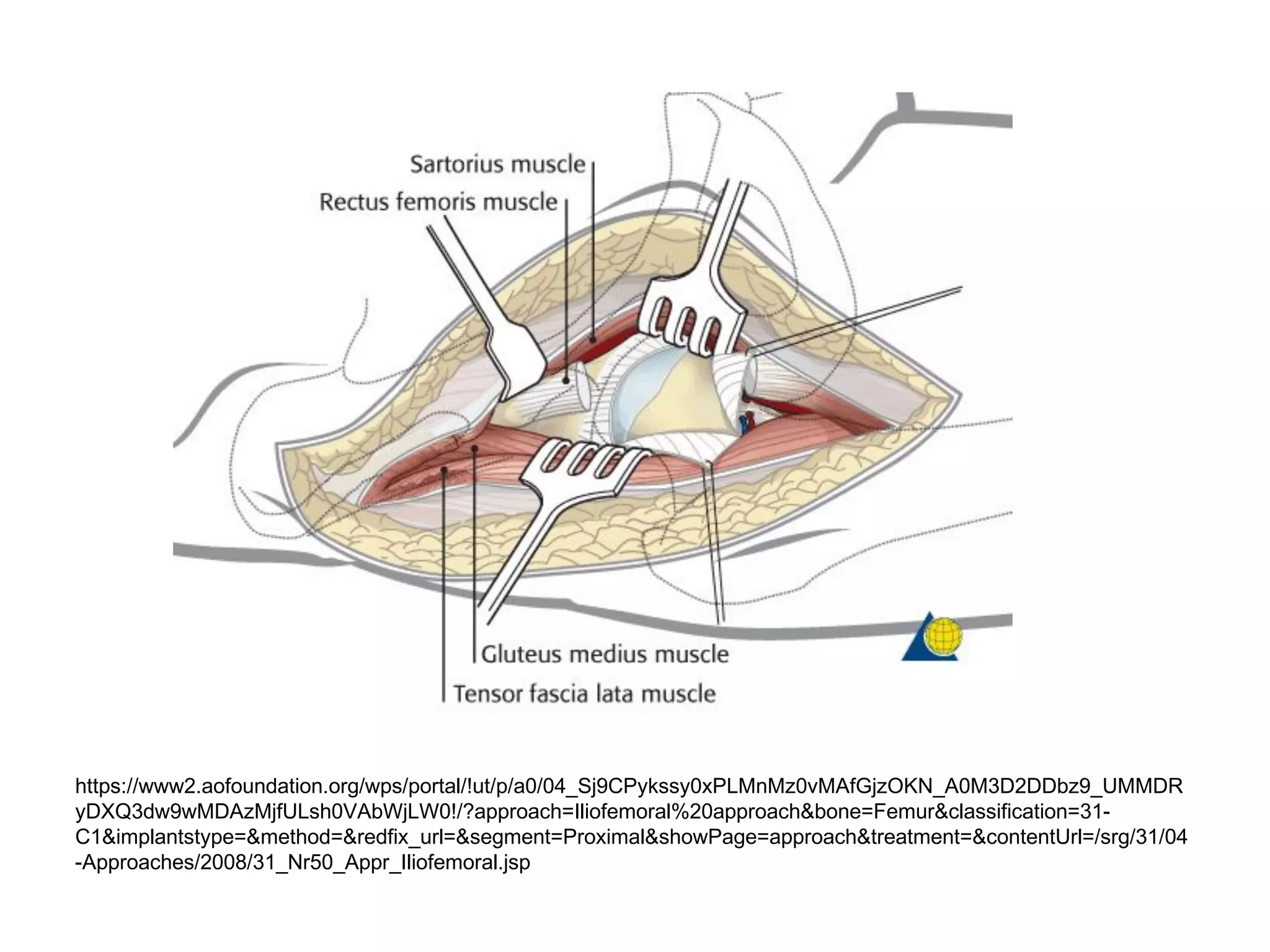
• Perform an open reduction
• If the femoral head is dislocated, perform a
T- shaped capsulotomy near the
acetabular rim, including the upper and
lower margins of the hip capsule
https://www2.aofoundation.org/wps/portal/!ut/p/a0/04_Sj9CPykssy0xPLMnMz0vMAfGjzOKN_A0M3D2DDbz9_UMMDR
yDXQ3dw9wMDAzMjfULsh0VAbWjLW0!/?approach=Iliofemoral%20approach&bone=Femur&classification=31-
C1&implantstype=&method=&redfix_url=&segment=Proximal&showPage=approach&treatment=&contentUrl=/srg/31/04
-Approaches/2008/31_Nr50_Appr_Iliofemoral.jsp
Capsular incision outline with the stem of the T parallel with the femoral neck.
Shier-Chieg Huang et al. JBJS Essent Surg Tech
2011;1:e2
©2011 by The Journal of Bone and Joint Surgery, Inc.
PERFORM OPEN REDUCTION
AND OSTEOTOMY
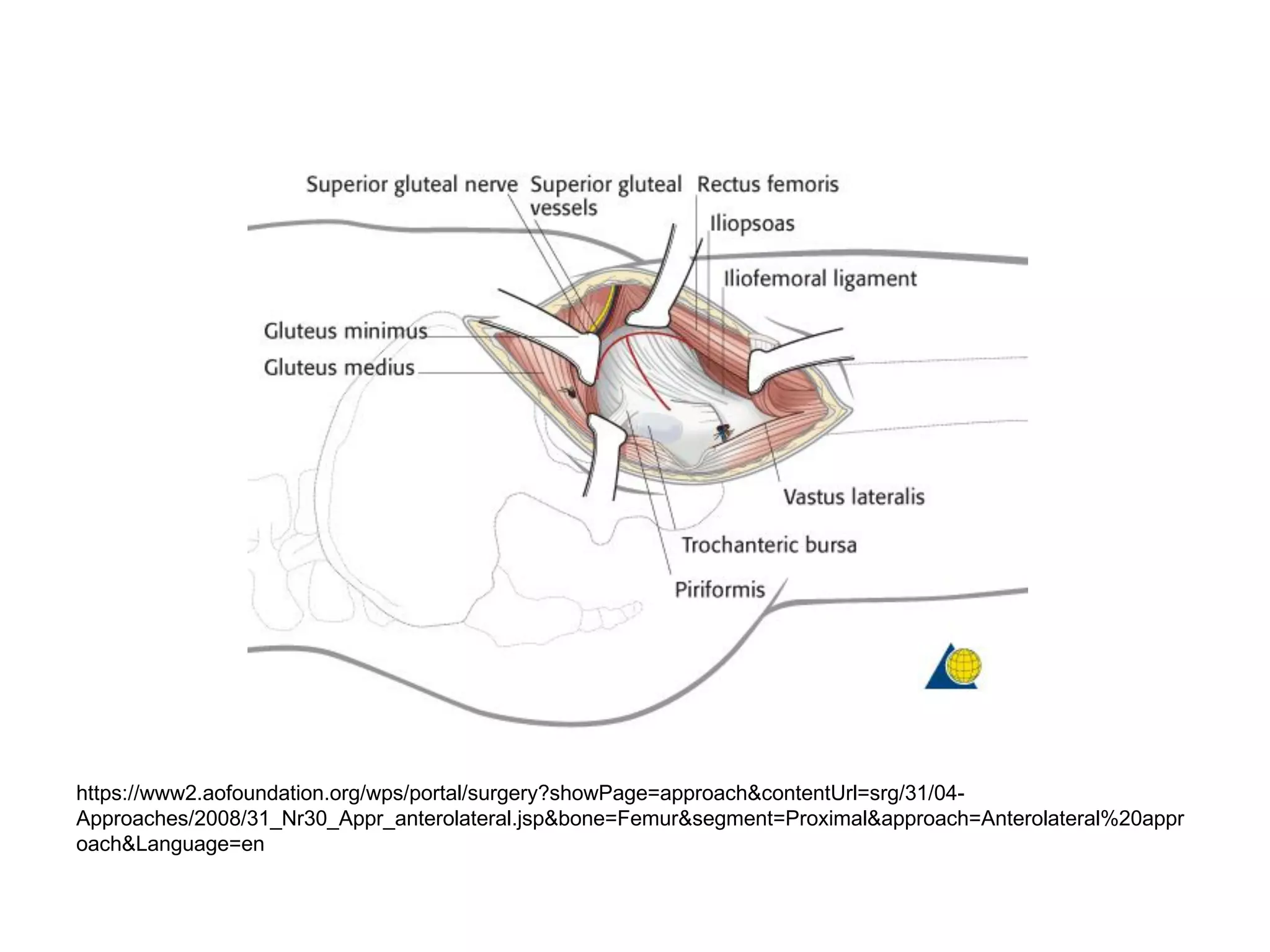
• Make the stem of the T- shaped
capsulotomy parallel to the femoral neck,
slightly superiorly to avoid a small inferior
capsular flap, which will make the
capsulorrhaphy more difficult
https://www2.aofoundation.org/wps/portal/surgery?showPage=approach&contentUrl=srg/31/04-
Approaches/2008/31_Nr30_Appr_anterolateral.jsp&bone=Femur&segment=Proximal&approach=Anterolateral%20appr
oach&Language=en
PERFORM OPEN REDUCTION
AND OSTEOTOMY
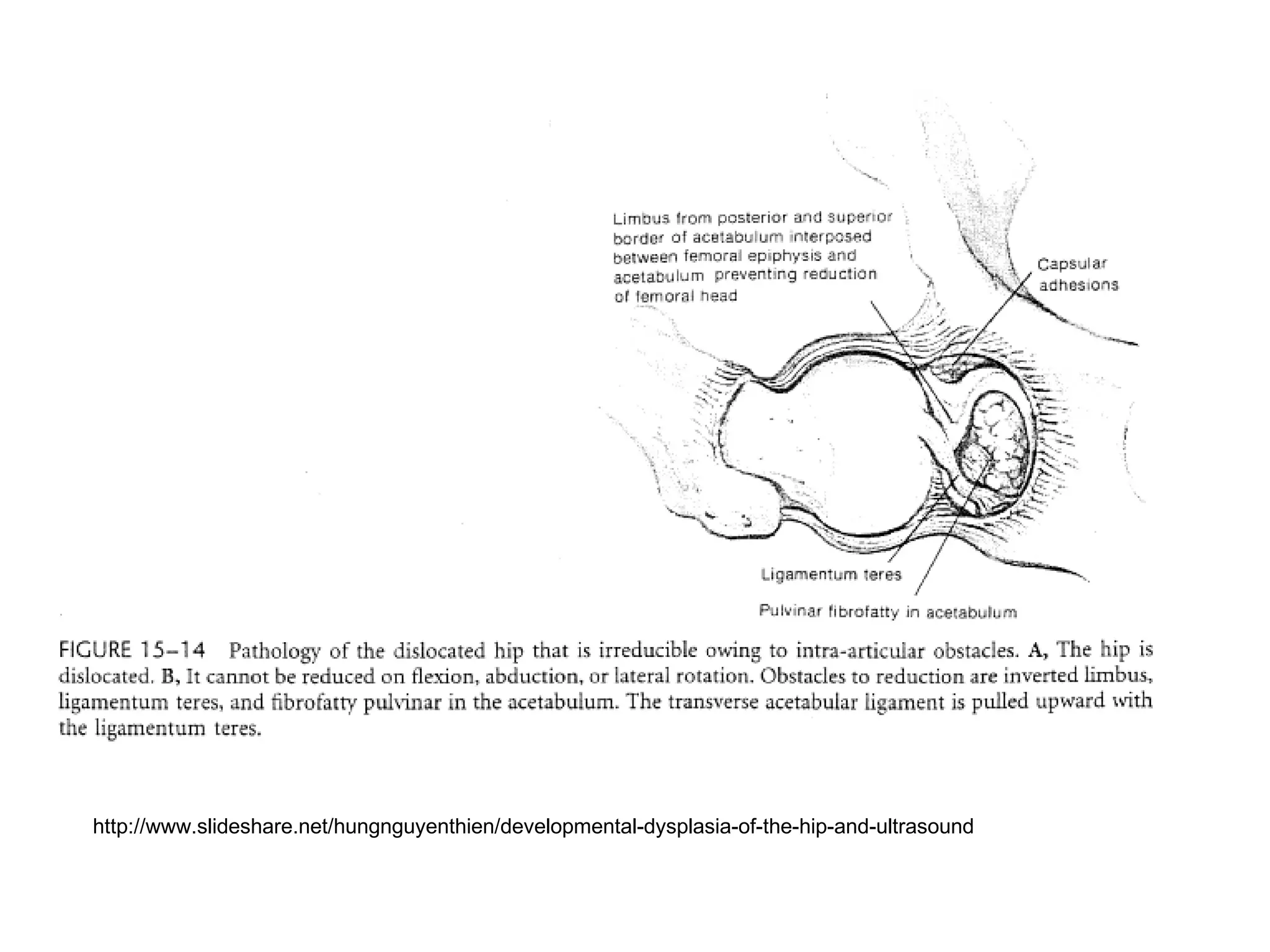
• Remove the ligamentum teres sharply and
remove all of the fibrofatty tissue (pulvinar
tissue) from the true acetabulum
• Identify and palpate the tension of the
transverse acetabular ligament with your
finger before releasing it with scissors
http://www.slideshare.net/hungnguyenthien/developmental-dysplasia-of-the-hip-and-ultrasound
http://boneandspine.com/hip-joint-anatomy/
https://www.studyblue.com/notes/note/n
/joints-of-lower-limb-
meszaros/deck/5355224
PERFORM OPEN REDUCTION
AND OSTEOTOMY
• Recheck to ensure that there is no tension
of the transverse acetabular ligament after
release, as remaining transverse
acetabular ligament can impede complete
reduction of the femoral head
PERFORM OPEN REDUCTION
AND OSTEOTOMY
• Check hip stability
• Reduce the femoral head into the
acetabulum under direct vision and test
the hip stability in a neutral position as well
as in abduction and internal rotation
PERFORM OPEN REDUCTION
AND OSTEOTOMY
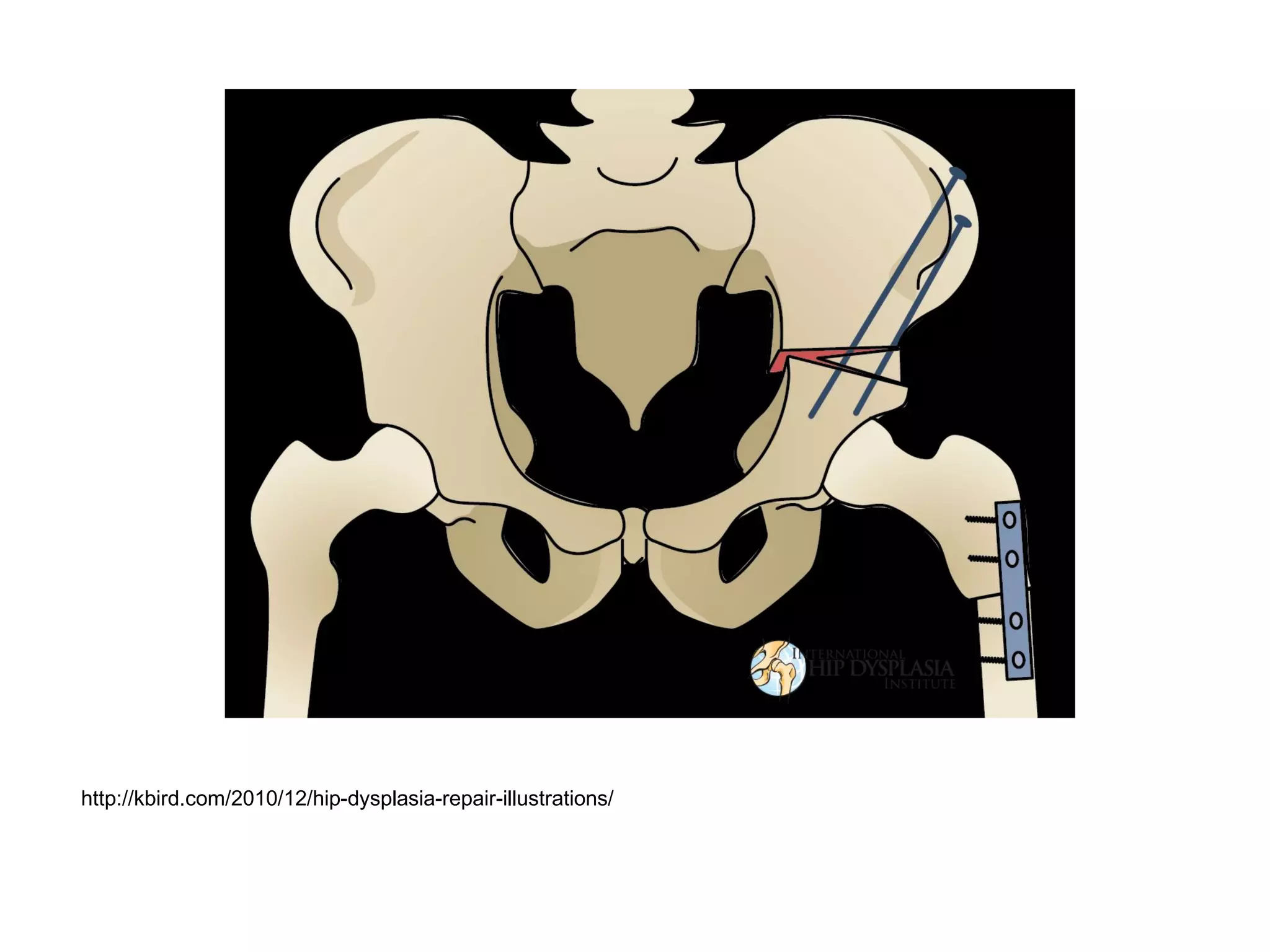
• If the hip is unstable in a neutral position
but is stable in abduction and internal
rotation, a Pemberton acetabuloplasty is
indicated
• If hip stability cannot be maintained even
in abduction and internal rotation, an
additional proximal femoral varus and/ or
rotational osteotomy should be considered
Varus osteotomy of the femur
Open Reduction, Pelvic Osteotomy, Femoral Shortening and Varus Osteotomy -
See more at: http://hipdysplasia.org/developmental-dysplasia-of-the-hip/child-treatment-
methods/osteotomy/#sthash.BArftDsO.dpuf
http://hipdysplasia.org/developmental-dysplasia-of-the-hip/child-treatment-methods/osteotomy/
http://kbird.com/2010/12/hip-dysplasia-repair-illustrations/
PERFORM OPEN REDUCTION
AND OSTEOTOMY
• Make medial and lateral cut lines
• Remove the gauze sponge on either side
of the iliac bone
• Check bleeding from perforating vessels
from the iliac wing
PERFORM OPEN REDUCTION
AND OSTEOTOMY
• Once hemostasis is achieved, you can
proceed with the Pemberton osteotomy
• Locate the sciatic notch first with a small
periosteal elevator and protect the
adjacent soft tissue, including the sciatic
nerve, with a retractor
PERFORM OPEN REDUCTION
AND OSTEOTOMY
• Begin with the medial iliac cut first
• Outline the cut line with the electrocautery
tip
• Using a small straight osteotome, begin
the medial cut line about 1 to 1.5cm above
the superior hip joint line and curve it
inferiorly and posteriorly, aiming at the
sciatic notch
Medial cut line: outline on a skeletal model.
Shier-Chieg Huang et al. JBJS Essent Surg Tech
2011;1:e2
©2011 by The Journal of Bone and Joint Surgery, Inc.
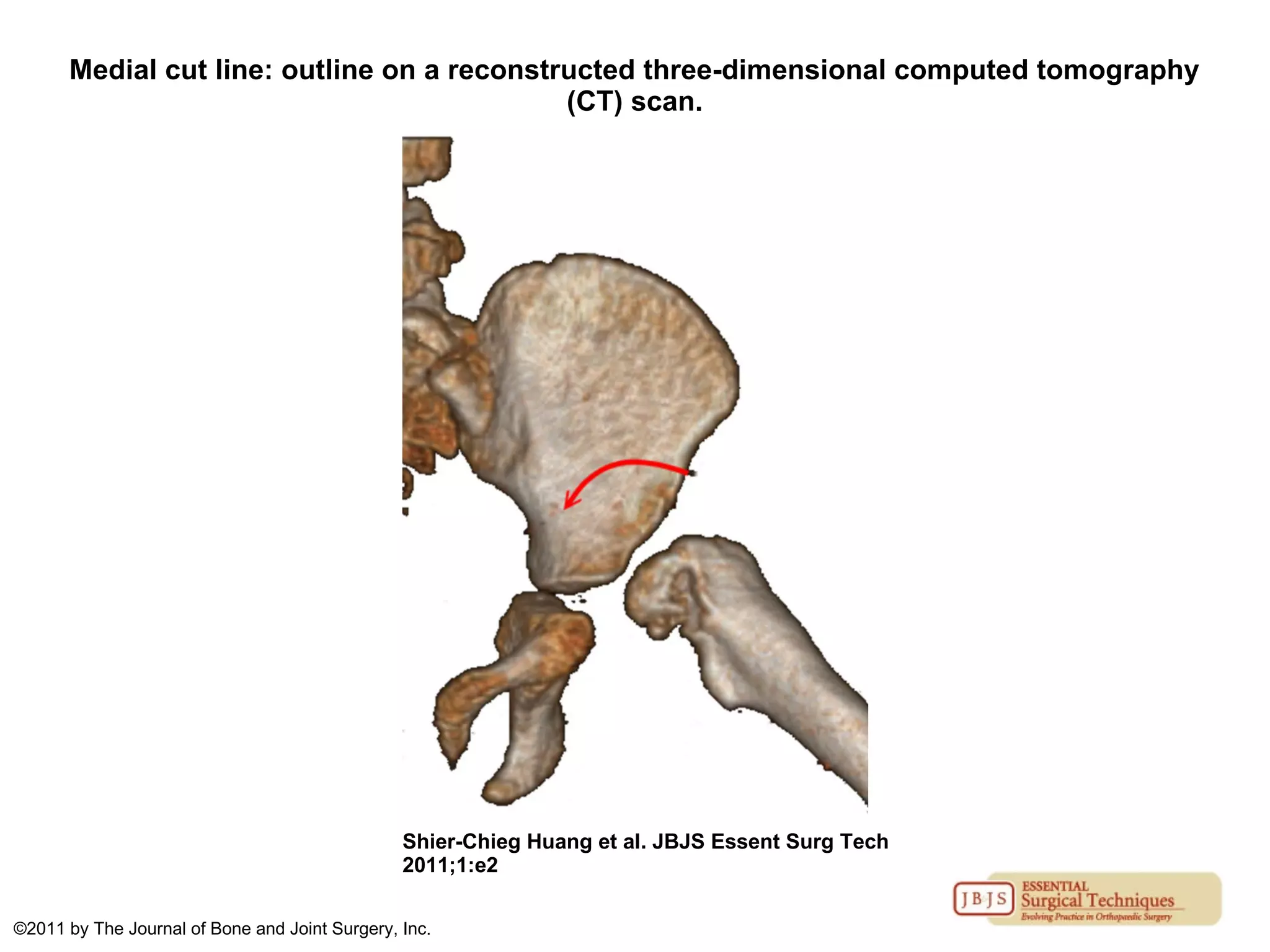
Medial cut line: outline on a reconstructed three-dimensional computed tomography
(CT) scan.
Shier-Chieg Huang et al. JBJS Essent Surg Tech
2011;1:e2
©2011 by The Journal of Bone and Joint Surgery, Inc.
Medial cut line in the surgical field.
Shier-Chieg Huang et al. JBJS Essent Surg Tech
2011;1:e2
©2011 by The Journal of Bone and Joint Surgery, Inc.
PERFORM OPEN REDUCTION
AND OSTEOTOMY
• The cut line extends halfway to the sciatic
notch and ends at the ridge of the pelvic
inlet of the ilium
• The lateral cut line has the same starting
point as the medial cut
• With the medial cut line as a reference,
use the same osteotome to make the
lateral cut line along the joint capsule
Lateral cut line: outline on a skeletal model.
Shier-Chieg Huang et al. JBJS Essent Surg Tech
2011;1:e2
©2011 by The Journal of Bone and Joint Surgery, Inc.
Lateral cut line: outline on a reconstructed three-dimensional computed tomography
(CT) scan.
Shier-Chieg Huang et al. JBJS Essent Surg Tech
2011;1:e2
©2011 by The Journal of Bone and Joint Surgery, Inc.
Lateral cut line in the surgical field.
Shier-Chieg Huang et al. JBJS Essent Surg Tech
2011;1:e2
©2011 by The Journal of Bone and Joint Surgery, Inc.
PERFORM OPEN REDUCTION
AND OSTEOTOMY
• Complete the osteotomy
• Use wider curved osteotomes to complete
the osteotomy, beginning anteriorly and
following the medial and lateral cut lines
• As this osteotomy advances, push the
osteotome against the distal fragment to
check the degree of downward
displacement
Iliac osteotomy with use of a large curved osteotome.
Shier-Chieg Huang et al. JBJS Essent Surg Tech
2011;1:e2
©2011 by The Journal of Bone and Joint Surgery, Inc.
http://teachmeanatomy.info/pelvis/bones/pelvic-girdle/hip-bone-of-a-5-year-old-triradiate-cartilage-present/
PERFORM OPEN REDUCTION
AND OSTEOTOMY
• If the osteotomy site opens more than 2 to
3cm and the distal fragment hinges on the
triradiate cartilage, there is no need to
further advance the osteotome
• If the opening is insufficient, advance the
osteotome and check the amount of
osteotomy opening again
STEP 4- INSERT ILIAC BONE
GRAFT
• Harvest a wedge shaped iliac crest bone
graft (about a 35 degree wedge) from the
iliac wing
• Reduce the femoral head and place a
towel roll under the knee to help maintain
the hip in an abducted and flexed position
INSERT ILIAC BONE GRAFT
• Hold the inferior osteotomy fragment open
anteriorly and inferiorly with a towel clip to
cover the femoral head
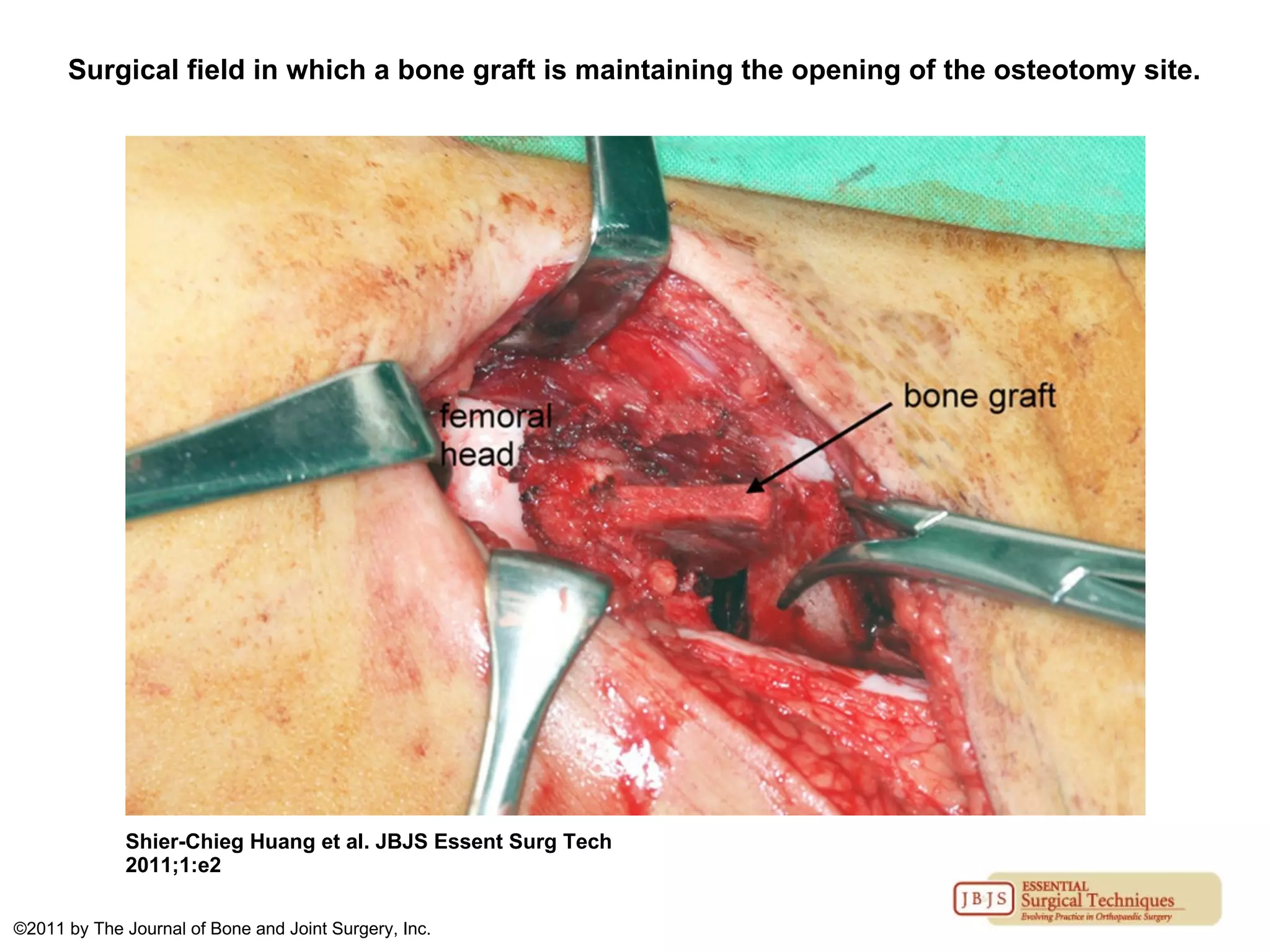
• Then insert the triangularly shaped bone
graft into the osteotomy opening site
INSERT ILIAC BONE GRAFT
• Usually, the osteotomy bone fragment is
stable and there is no need for internal
fixation
• If the bone graft is not stable, fixation with
one or two Kirschner wires may be
necessary
Surgical field in which a bone graft is maintaining the opening of the osteotomy site.
Shier-Chieg Huang et al. JBJS Essent Surg Tech
2011;1:e2
©2011 by The Journal of Bone and Joint Surgery, Inc.
Postoperative reconstructed three-dimensional computed tomography (CT) scan from
the anterior view showing the bone graft in place.
Shier-Chieg Huang et al. JBJS Essent Surg Tech
2011;1:e2
©2011 by The Journal of Bone and Joint Surgery, Inc.
Postoperative reconstructed three-dimensional computed tomography (CT) scan from
the posterior view showing the bone graft in place.
Shier-Chieg Huang et al. JBJS Essent Surg Tech
2011;1:e2
©2011 by The Journal of Bone and Joint Surgery, Inc.
http://clinicalgate.com/pedia
tric-pelvic-osteotomies-and-
shelf-procedures/
INSERT ILIAC BONE GRAFT
• Repair the hip capsule by bringing the two
flaps of the T- capsulotomy to the
acetabular flap of the capsule
• It is not necessary to resect the redundant
capsule
https://www2.aofoundation.org/wps/portal/!ut/p/a0/04_Sj9CPykssy0xPLMnMz0vMAfGjzOKN_A0M3D2DDbz9_UMMDR
yDXQ3dw9wMDAzMjfULsh0VAbWjLW0!/?approach=Anterolateral%20approach&bone=Femur&segment=Proximal&sh
owPage=approach&contentUrl=/srg/31/04-Approaches/2008/31_Nr30_Appr_anterolateral.jsp
INSERT ILIAC BONE GRAFT
• Repair the tendon of the straight head of
the rectus femoris muscle to the AIIS
• Suture the iliac apophysis over the
remaining ilium and close the wound
STEP 5- POSTOPERATIVE
MANAGEMENT
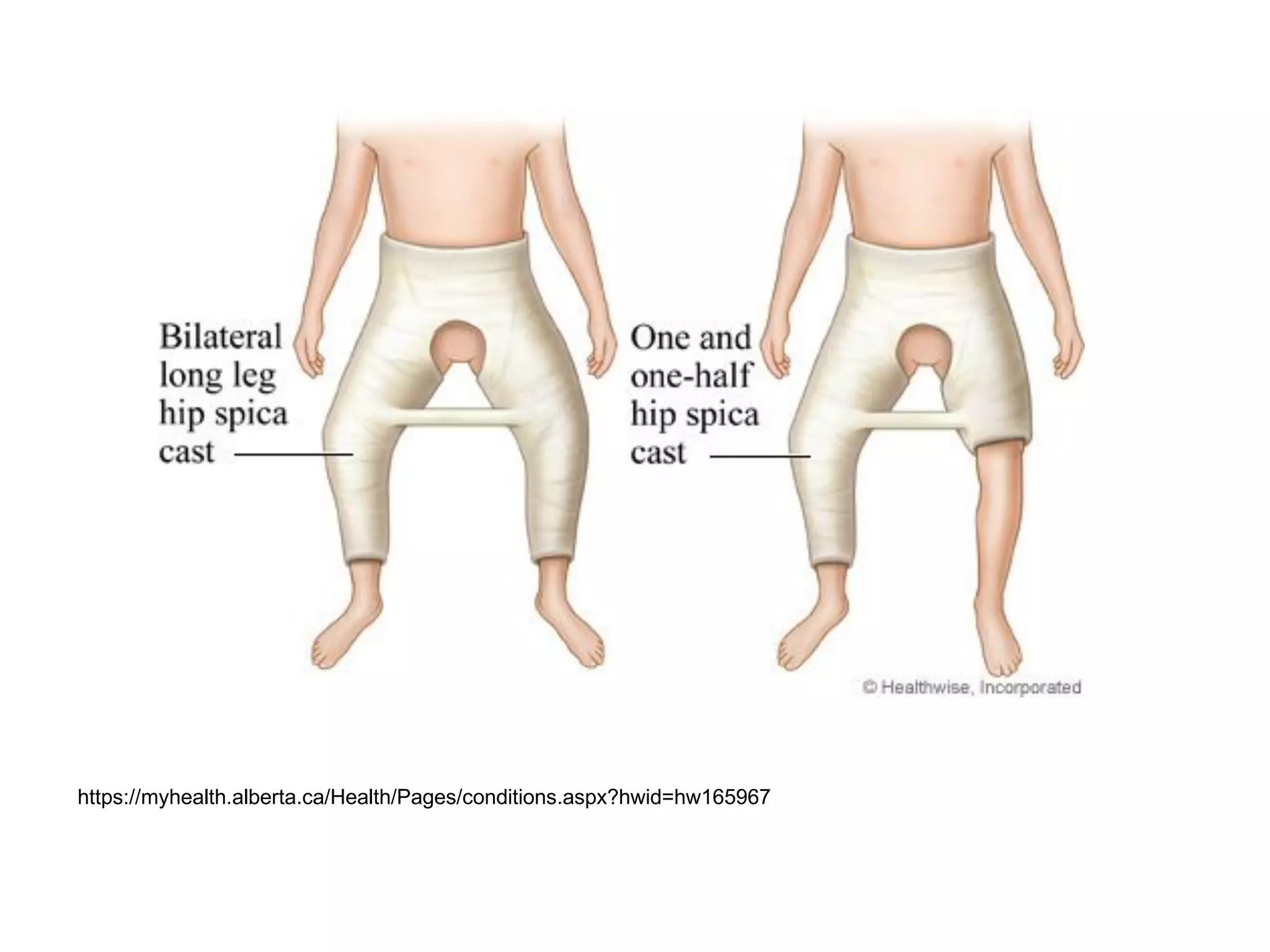
• Apply a hip spica cast after skin closure
• An assistant should hold both hips in
about 20 degrees of flexion, 30 degrees of
abduction and neutral or slight internal
rotation while the cast is applied
• The spica cast is worn for four weeks after
a simple Pemberton osteotomy
https://myhealth.alberta.ca/Health/Pages/conditions.aspx?hwid=hw165967
POSTOPERATIVE
MANAGEMENT
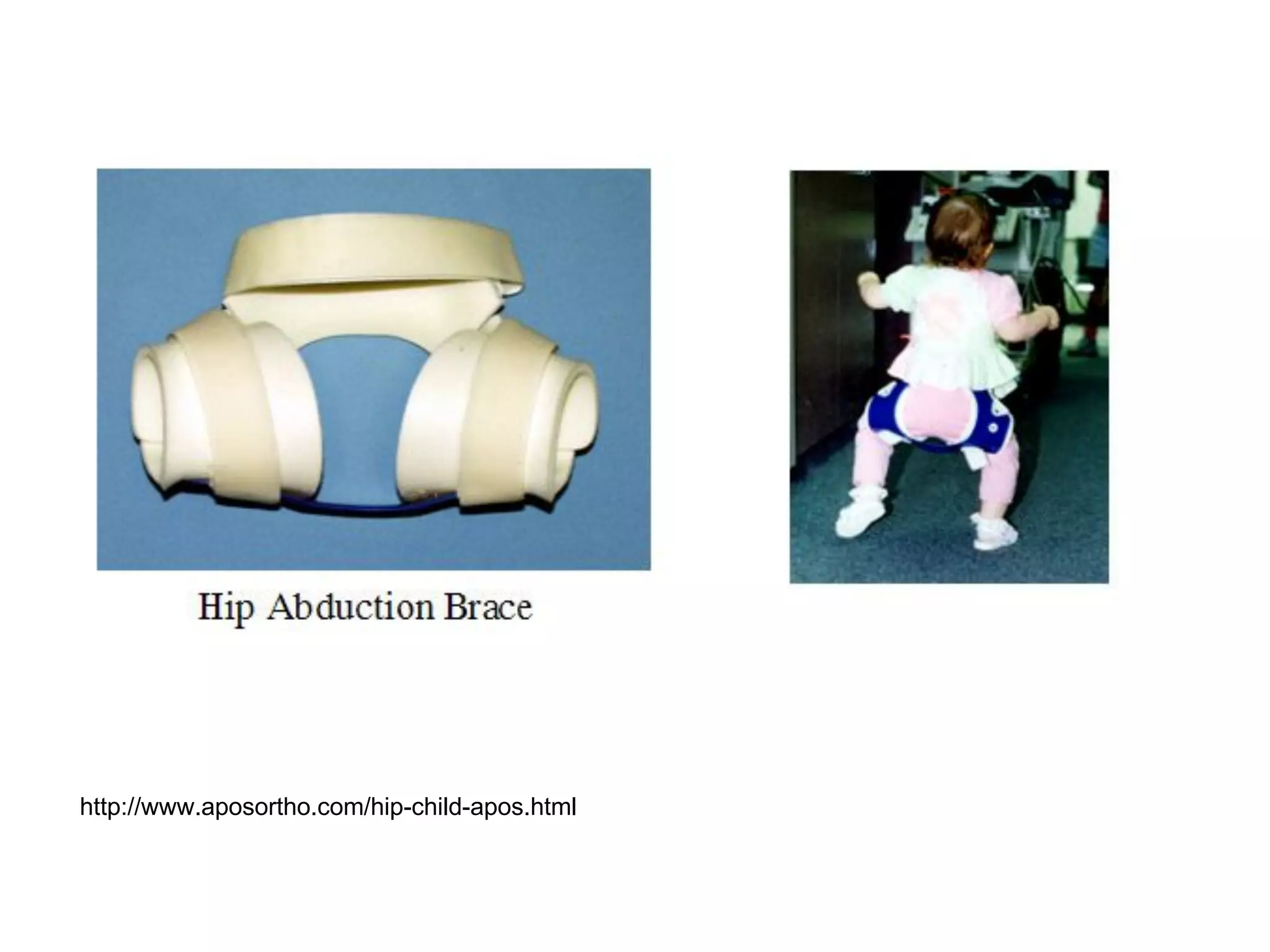
• If a combined open hip reduction
procedure was done, the hip spica cast is
used for 6 weeks, this is followed by use of
4 weeks of a hip abduction brace or a
bilateral cylinder cast with a spreader bar
to hold the hips in 60 degrees of abduction
(30 degrees of abduction for each hip)
http://www.aposortho.com/hip-child-apos.html
RESULTS
• In their clinical and radiological review of
49 patients followed up for more than
10years after treatment of DDH of hip with
a unilateral PO, there were no
redislocations and no patient required
additional surgery for residual hip
dysplasia after the original PO
RESULTS
• If there was overcorrection or inferior
displacement of the reduced femoral head ,
there was a high risk of femoral head
osteonecrosis
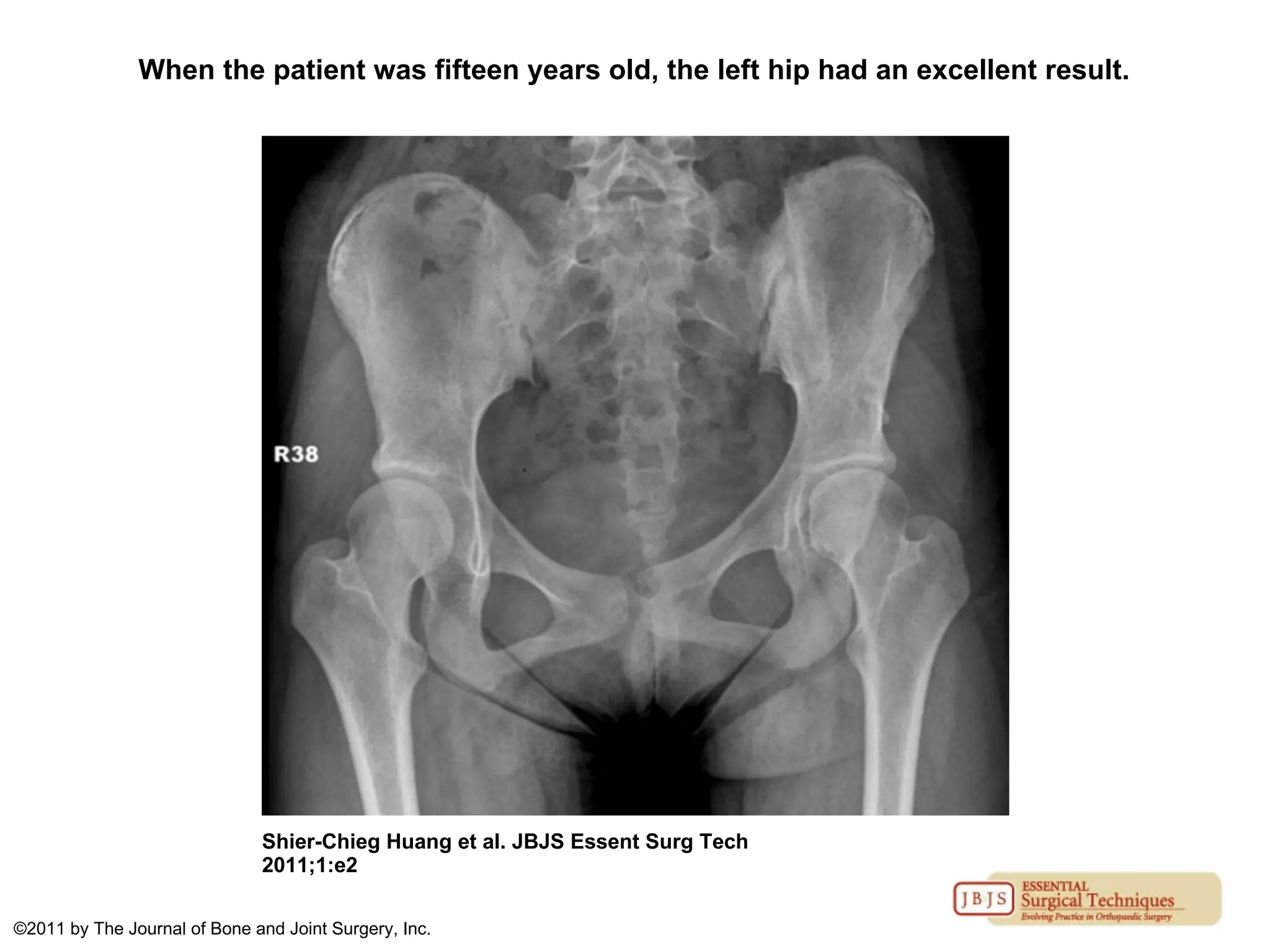
• X rays of a patient treated at 20months
and followed up for 14yrs after the surgery
are shown
Anteroposterior pelvic radiograph of a twenty-month-old girl with developmental
dysplasia of the left hip.
Shier-Chieg Huang et al. JBJS Essent Surg Tech
2011;1:e2
©2011 by The Journal of Bone and Joint Surgery, Inc.
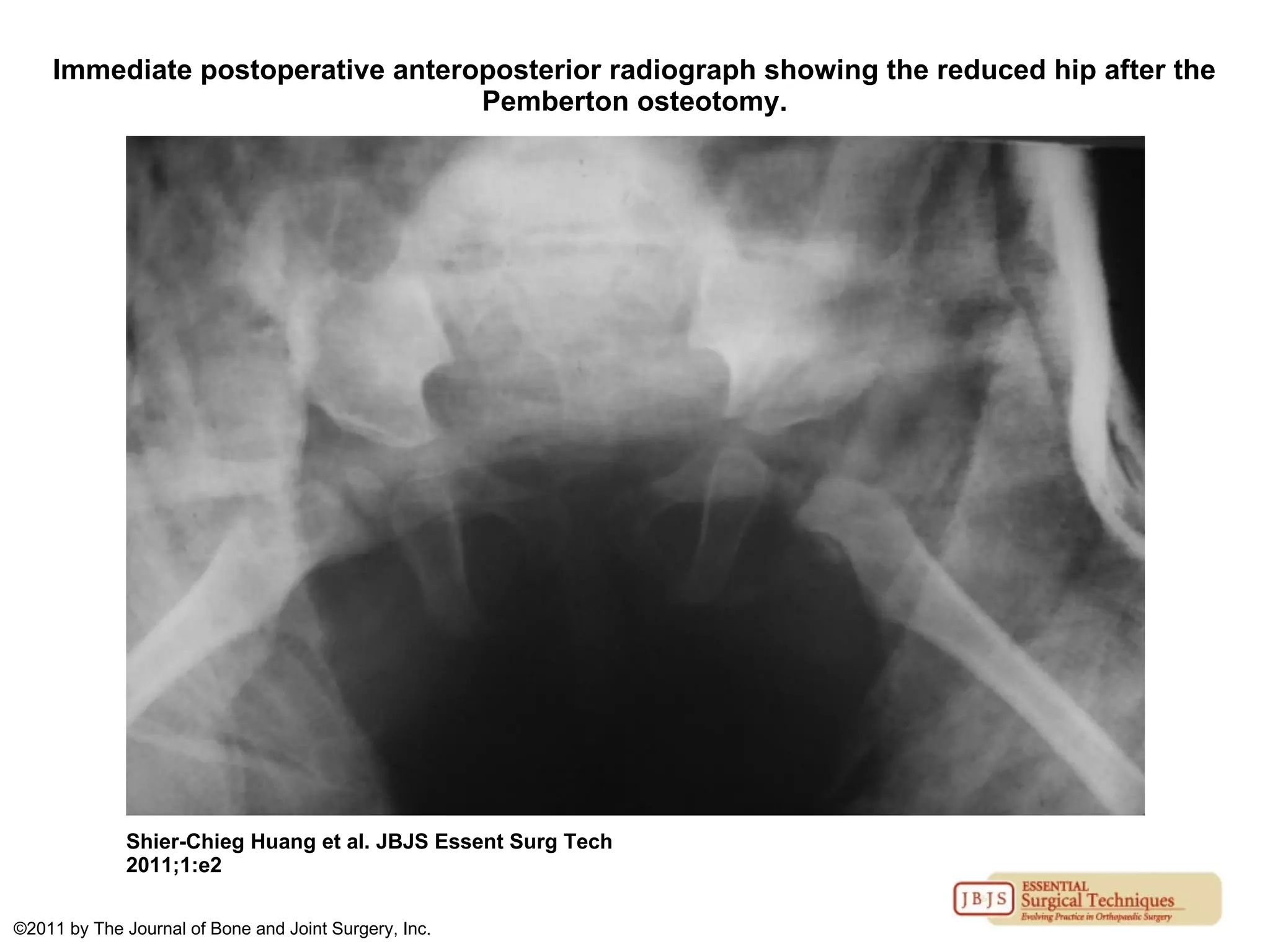
Immediate postoperative anteroposterior radiograph showing the reduced hip after the
Pemberton osteotomy.
Shier-Chieg Huang et al. JBJS Essent Surg Tech
2011;1:e2
©2011 by The Journal of Bone and Joint Surgery, Inc.
When the patient was fifteen years old, the left hip had an excellent result.
Shier-Chieg Huang et al. JBJS Essent Surg Tech
2011;1:e2
©2011 by The Journal of Bone and Joint Surgery, Inc.
INDICATIONS
• Developmental dysplasia of the hip
• Acetabular dysplasia
• Legg- Calve- Perthe's disease with
femoral head subluxation/ lateral
protrusion
• Anterosuperior deficiency of the
acetabulum secondary to neuromuscular
disease
• Sequelae of an infected hip with femoral
head subluxation
CONTRAINDICATIONS
• Closed triradiate cartilage
• Deformed femoral head
• Small acetabular volume
• Active infection/ Osteomyelitis
PITFALLS AND CHALLENGES
• Bone graft dislodgement
• Overcorrection may cause femoral head
impingement and osteonecrosis
• Premature triradiate cartilage closure
• Transiliac lengthening of the ipsilateral
limb at the time of the opening wedge
osteotomy
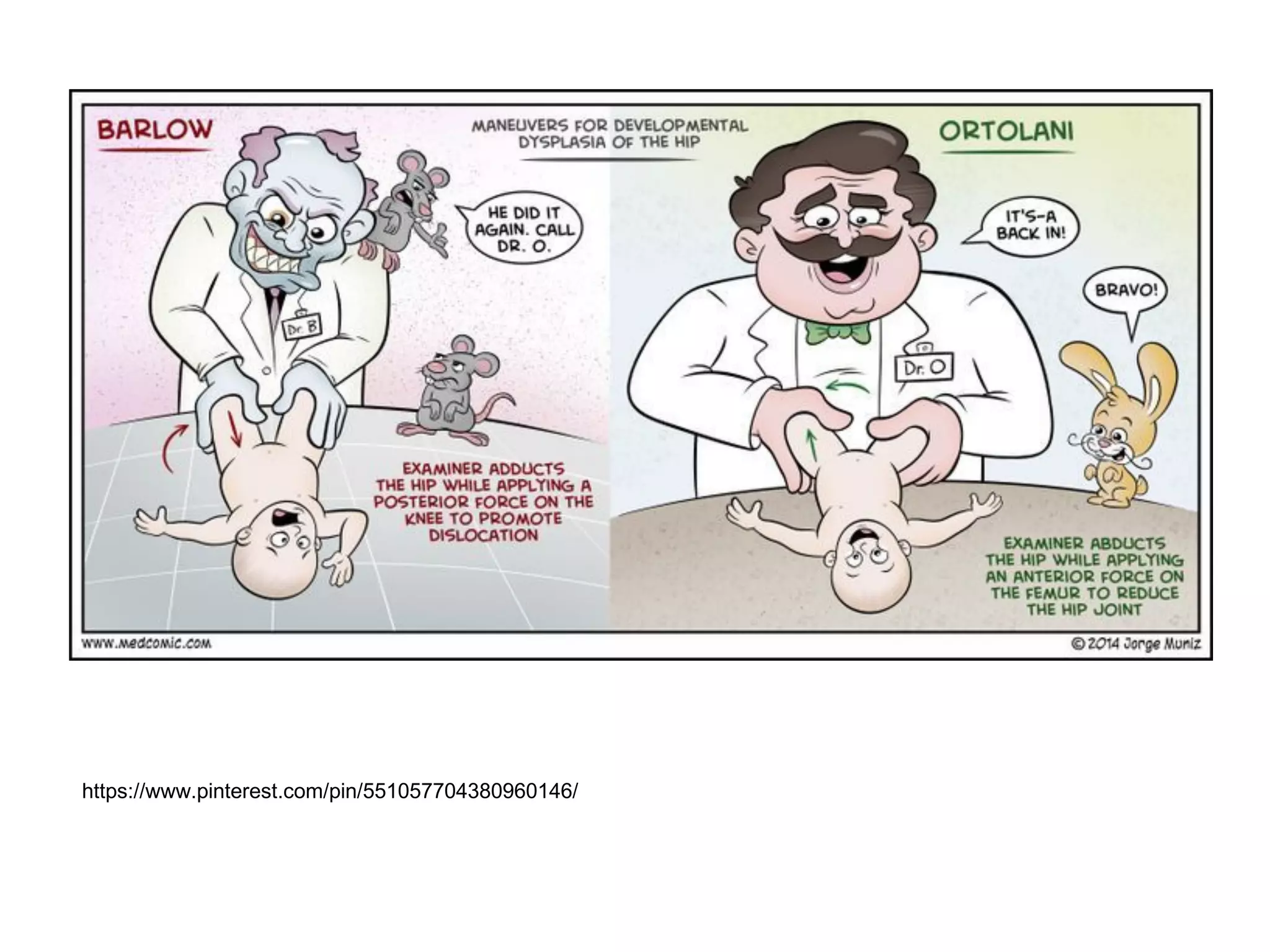
https://www.pinterest.com/pin/551057704380960146/
THANK YOU

Pemberton's Osteotomy for Acetabular Dysplasia