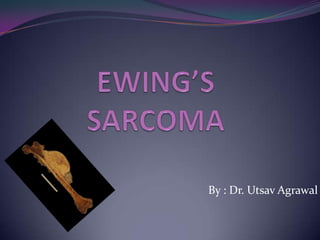
By : Dr. Utsav Agrawal
Introduction
 Ewing, in 1921 described it as a tumor occuring in the
    diaphysis of long bone, in children, asso. With febrile
    attacks , anorexia and anaemia and which was radio-
    sensitive.
   He believed it arose from endothelial elements of bone
    marrow and described it as diffuse endothelioma of bone
   Willis found rosette formation and presence of primary
    lesion, usually in adrenals, in many cases
   Ewings sarcoma is thought to be of either neuro-
    ectodermal or stem cell origin
   All Ewings sarcoma’s are considered high grade malignancy
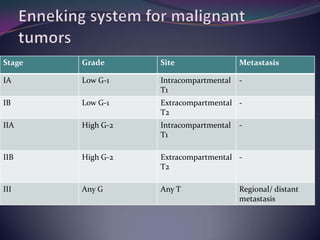
    and categorized under Enneking Stage II or III
Epidemiology
 9% of primary bone sarcomas
 4th most common primary malignancy of bone but 2nd most
   common below 30yrs and most common below 10 yrs of age.
 Age Group – 95% patients age between 5 to 30 yrs
                - of these most range between 5 to 15 yrs
• Sex - slight male prediliction – 60%
• More common in Whites (95%)
• No known predisposing factor
• Chromosomal translocation – t(11;22)(q24;q12)
  leading to fusion of EWS and FLI gene.
   also t(21;22) and t(7;22)
Clinical Features
 Pain
 Swelling
 Fever
 Weight loss
 Anemia
 Raised ESR and CRP
 Leukocytosis
 And, symptoms depending on area of involvement
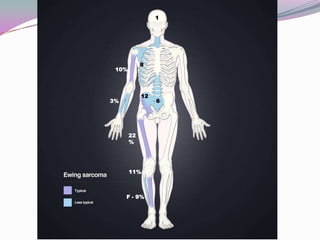
Location
 Can develop in any bone
 Principally affects the lower segment of the skeleton in more
  than 2/3 cases
 In long tubular bones – proximal segment more frequently
  involved than distal fragment (5:1 to 3:1)
  Usually of diaphyseal origin. Sometimes dia-metaphyseal.
  Rarely, metaphyseal.
 In vertebrae, most commonly involved – Sacrum
  Body is mainly affected with subsequent involvement of
intra and para-spinal tissues and posterior elements
  mostly metastatic.
• Rarely may be localized to soft-tissue or peri-osteum.
1


            8
 10%


            12
3%               6


       22
       %


       11%


     F - 9%
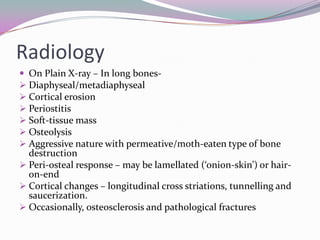
Radiology
 On Plain X-ray – In long bones-
 Diaphyseal/metadiaphyseal
 Cortical erosion
 Periostitis
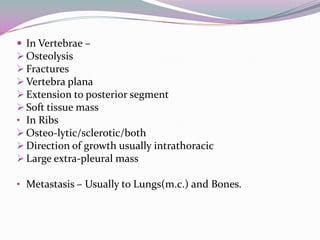
 Soft-tissue mass
 Osteolysis
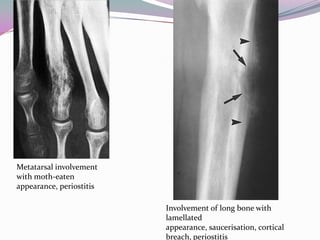
 Aggressive nature with permeative/moth-eaten type of bone
  destruction
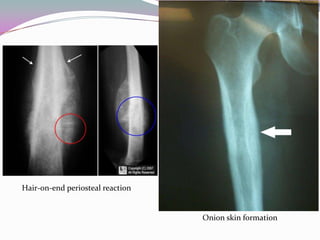
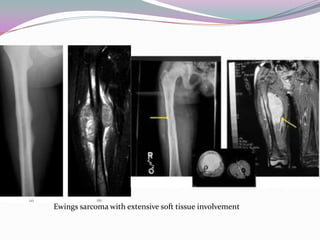
 Peri-osteal response – may be lamellated (‘onion-skin’) or hair-
  0n-end
 Cortical changes – longitudinal cross striations, tunnelling and
  saucerization.
 Occasionally, osteosclerosis and pathological fractures
Hair-on-end periosteal reaction


                                  Onion skin formation
Metatarsal involvement
with moth-eaten
appearance, periostitis

                          Involvement of long bone with
                          lamellated
                          appearance, saucerisation, cortical
                          breach, periostitis
Ewings sarcoma with extensive soft tissue involvement
 In Vertebrae –
 Osteolysis
 Fractures
 Vertebra plana
 Extension to posterior segment
 Soft tissue mass
• In Ribs
 Osteo-lytic/sclerotic/both
 Direction of growth usually intrathoracic
 Large extra-pleural mass

• Metastasis – Usually to Lungs(m.c.) and Bones.
• Bone Scan -        uptake
                - rarely cold spots
•   Gallium scan
•   CT scan – For extra-osseous and trans-articular spread
             - for chest metastasis
             - evaluation of response to therapy
•   MRI – for extra-osseous and intramedullary extent of lesion
        - metastasis
        - pre-operative planning ( along with MR-angio)
        - response to therapy
•   PET scan
•   Biopsy
Histo-pathology
 Diaphyseal/dia-metaphyseal
 Predominantly medullary, then extends to haversian
    system and cortex
   Greyish-white to pink in color
   soft, friable
   Often of semi-liquid consistency
   Areas of hemorrhage, necrosis and cyst formation
    present
   Onion-skin periosteal reaction
Microscopy
 Small round undifferentiated tumor cells with little
    cytoplasm and indistinct borders
   Round nuclei with stippled evenly distributed powder-like
    chromatin and 1-2 nucleoli
   Frequent mitosis
   Necrosis and Ghost cells
   Minimal inter-cellular substance
   Rosette and psuedo-rosette formation
   Perithelioma
   NO GIANT CELLS
   PAS +ve  presence of glycogen
   Reactive for vimentin
Ewings Family of Tumors
 1. Ewings
 2. PNET
 3. Askins
Similarity between Ewings and PNET
• C/f, radiology, light microscopy
• Chromosomal translocation t(11:22)(q24:q12)
• Reactivity towards p30/32 MIC-2 in 90%
Differences : In PNET
• More frequent epiphyseal involvement, Pathological fractures, metastasis
• Rosette formation
• Electron microscopy – features of neural differentiation like dendritic
  processes, abundance of cytoplasmic granules, intermediate
  filaments, neurosecretory granules and microtubule formation.
• Immunohistochemistry - +ve for neural markers – S-
  100, synaptophysin, NSE, neuro-filament protein.
Differential diagnosis
 Osteosarcoma
 Lymphoma
 Leukemia
 Osteomyelitis
 PNET
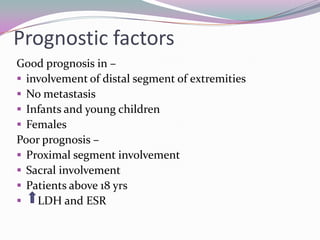
Prognostic factors
Good prognosis in –
 involvement of distal segment of extremities
 No metastasis
 Infants and young children
 Females
Poor prognosis –
 Proximal segment involvement
 Sacral involvement
 Patients above 18 yrs
 LDH and ESR
Stage   Grade      Site                 Metastasis

IA      Low G-1    Intracompartmental   -
                   T1
IB      Low G-1    Extracompartmental -
                   T2
IIA     High G-2   Intracompartmental   -
                   T1

IIB     High G-2   Extracompartmental -
                   T2

III     Any G      Any T                Regional/ distant
                                        metastasis
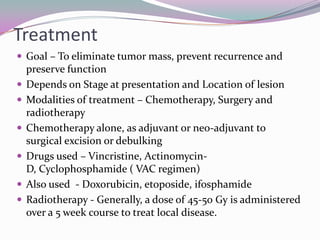
Treatment
 Goal – To eliminate tumor mass, prevent recurrence and
    preserve function
   Depends on Stage at presentation and Location of lesion
   Modalities of treatment – Chemotherapy, Surgery and
    radiotherapy
   Chemotherapy alone, as adjuvant or neo-adjuvant to
    surgical excision or debulking
   Drugs used – Vincristine, Actinomycin-
    D, Cyclophosphamide ( VAC regimen)
   Also used - Doxorubicin, etoposide, ifosphamide
   Radiotherapy - Generally, a dose of 45-50 Gy is administered
    over a 5 week course to treat local disease.
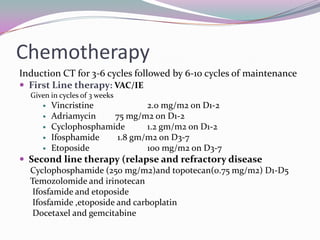
Chemotherapy
Induction CT for 3-6 cycles followed by 6-10 cycles of maintenance
 First Line therapy: VAC/IE
  Given in cycles of 3 weeks
        Vincristine           2.0 mg/m2 on D1-2
        Adriamycin    75 mg/m2 on D1-2
        Cyclophosphamide      1.2 gm/m2 on D1-2
        Ifosphamide    1.8 gm/m2 on D3-7
        Etoposide             100 mg/m2 on D3-7
 Second line therapy (relapse and refractory disease
  Cyclophosphamide (250 mg/m2)and topotecan(0.75 mg/m2) D1-D5
  Temozolomide and irinotecan
   Ifosfamide and etoposide
   Ifosfamide ,etoposide and carboplatin
   Docetaxel and gemcitabine
Radiotherapy
 For,
  Tumors where Resection is Impossible
  For skull, face, vertebra, or pelvic primary
  where only an intra-lesional resection is achievable
  Patient with poor Surgical risk
  Patient refusing surgery
 Pre-op - Indicated when narrow resection margins are expected
   To sterilize the tumor compartment before surgery & to potentially
 reduce the risk of dissemination during surgery
 Local recurrence with pre-op RT <5%
 Post-op - For gross or microscopic positive margin
  For marginal Resection
  For wide-resection with Poor Histological response to Neo-adjuvant
 Chemotherapy
Newer Therapies
 Nutlin – 3a  MDM-2 antagonist
 Figitumumab – antibodies against IGF-R1
 mTOR inhibitors – everolimus, rapamycin
 Retinoids – Fenretinide
 Biphosphonates
 TRAIL receptor agonists
 Gene therapy
THANK YOU

Ewings sarcoma_utsav

  • 1.
    By : Dr.Utsav Agrawal
  • 2.
    Introduction  Ewing, in1921 described it as a tumor occuring in the diaphysis of long bone, in children, asso. With febrile attacks , anorexia and anaemia and which was radio- sensitive.  He believed it arose from endothelial elements of bone marrow and described it as diffuse endothelioma of bone  Willis found rosette formation and presence of primary lesion, usually in adrenals, in many cases  Ewings sarcoma is thought to be of either neuro- ectodermal or stem cell origin  All Ewings sarcoma’s are considered high grade malignancy and categorized under Enneking Stage II or III
  • 3.
    Epidemiology  9% ofprimary bone sarcomas  4th most common primary malignancy of bone but 2nd most common below 30yrs and most common below 10 yrs of age.  Age Group – 95% patients age between 5 to 30 yrs - of these most range between 5 to 15 yrs • Sex - slight male prediliction – 60% • More common in Whites (95%) • No known predisposing factor • Chromosomal translocation – t(11;22)(q24;q12) leading to fusion of EWS and FLI gene. also t(21;22) and t(7;22)
  • 4.
    Clinical Features  Pain Swelling  Fever  Weight loss  Anemia  Raised ESR and CRP  Leukocytosis  And, symptoms depending on area of involvement
  • 5.
    Location  Can developin any bone  Principally affects the lower segment of the skeleton in more than 2/3 cases  In long tubular bones – proximal segment more frequently involved than distal fragment (5:1 to 3:1) Usually of diaphyseal origin. Sometimes dia-metaphyseal. Rarely, metaphyseal.  In vertebrae, most commonly involved – Sacrum Body is mainly affected with subsequent involvement of intra and para-spinal tissues and posterior elements mostly metastatic. • Rarely may be localized to soft-tissue or peri-osteum.
  • 6.
    1 8 10% 12 3% 6 22 % 11% F - 9%
  • 7.
    Radiology  On PlainX-ray – In long bones-  Diaphyseal/metadiaphyseal  Cortical erosion  Periostitis  Soft-tissue mass  Osteolysis  Aggressive nature with permeative/moth-eaten type of bone destruction  Peri-osteal response – may be lamellated (‘onion-skin’) or hair- 0n-end  Cortical changes – longitudinal cross striations, tunnelling and saucerization.  Occasionally, osteosclerosis and pathological fractures
  • 8.
  • 9.
    Metatarsal involvement with moth-eaten appearance,periostitis Involvement of long bone with lamellated appearance, saucerisation, cortical breach, periostitis
  • 10.
    Ewings sarcoma withextensive soft tissue involvement
  • 11.
     In Vertebrae–  Osteolysis  Fractures  Vertebra plana  Extension to posterior segment  Soft tissue mass • In Ribs  Osteo-lytic/sclerotic/both  Direction of growth usually intrathoracic  Large extra-pleural mass • Metastasis – Usually to Lungs(m.c.) and Bones.
  • 12.
    • Bone Scan- uptake - rarely cold spots • Gallium scan • CT scan – For extra-osseous and trans-articular spread - for chest metastasis - evaluation of response to therapy • MRI – for extra-osseous and intramedullary extent of lesion - metastasis - pre-operative planning ( along with MR-angio) - response to therapy • PET scan • Biopsy
  • 13.
    Histo-pathology  Diaphyseal/dia-metaphyseal  Predominantlymedullary, then extends to haversian system and cortex  Greyish-white to pink in color  soft, friable  Often of semi-liquid consistency  Areas of hemorrhage, necrosis and cyst formation present  Onion-skin periosteal reaction
  • 14.
    Microscopy  Small roundundifferentiated tumor cells with little cytoplasm and indistinct borders  Round nuclei with stippled evenly distributed powder-like chromatin and 1-2 nucleoli  Frequent mitosis  Necrosis and Ghost cells  Minimal inter-cellular substance  Rosette and psuedo-rosette formation  Perithelioma  NO GIANT CELLS  PAS +ve  presence of glycogen  Reactive for vimentin
  • 15.
    Ewings Family ofTumors  1. Ewings  2. PNET  3. Askins Similarity between Ewings and PNET • C/f, radiology, light microscopy • Chromosomal translocation t(11:22)(q24:q12) • Reactivity towards p30/32 MIC-2 in 90% Differences : In PNET • More frequent epiphyseal involvement, Pathological fractures, metastasis • Rosette formation • Electron microscopy – features of neural differentiation like dendritic processes, abundance of cytoplasmic granules, intermediate filaments, neurosecretory granules and microtubule formation. • Immunohistochemistry - +ve for neural markers – S- 100, synaptophysin, NSE, neuro-filament protein.
  • 16.
    Differential diagnosis  Osteosarcoma Lymphoma  Leukemia  Osteomyelitis  PNET
  • 17.
    Prognostic factors Good prognosisin –  involvement of distal segment of extremities  No metastasis  Infants and young children  Females Poor prognosis –  Proximal segment involvement  Sacral involvement  Patients above 18 yrs  LDH and ESR
  • 18.
    Stage Grade Site Metastasis IA Low G-1 Intracompartmental - T1 IB Low G-1 Extracompartmental - T2 IIA High G-2 Intracompartmental - T1 IIB High G-2 Extracompartmental - T2 III Any G Any T Regional/ distant metastasis
  • 19.
    Treatment  Goal –To eliminate tumor mass, prevent recurrence and preserve function  Depends on Stage at presentation and Location of lesion  Modalities of treatment – Chemotherapy, Surgery and radiotherapy  Chemotherapy alone, as adjuvant or neo-adjuvant to surgical excision or debulking  Drugs used – Vincristine, Actinomycin- D, Cyclophosphamide ( VAC regimen)  Also used - Doxorubicin, etoposide, ifosphamide  Radiotherapy - Generally, a dose of 45-50 Gy is administered over a 5 week course to treat local disease.
  • 20.
    Chemotherapy Induction CT for3-6 cycles followed by 6-10 cycles of maintenance  First Line therapy: VAC/IE Given in cycles of 3 weeks  Vincristine 2.0 mg/m2 on D1-2  Adriamycin 75 mg/m2 on D1-2  Cyclophosphamide 1.2 gm/m2 on D1-2  Ifosphamide 1.8 gm/m2 on D3-7  Etoposide 100 mg/m2 on D3-7  Second line therapy (relapse and refractory disease Cyclophosphamide (250 mg/m2)and topotecan(0.75 mg/m2) D1-D5 Temozolomide and irinotecan Ifosfamide and etoposide Ifosfamide ,etoposide and carboplatin Docetaxel and gemcitabine
  • 21.
    Radiotherapy For, Tumors where Resection is Impossible  For skull, face, vertebra, or pelvic primary  where only an intra-lesional resection is achievable  Patient with poor Surgical risk  Patient refusing surgery Pre-op - Indicated when narrow resection margins are expected To sterilize the tumor compartment before surgery & to potentially reduce the risk of dissemination during surgery Local recurrence with pre-op RT <5% Post-op - For gross or microscopic positive margin For marginal Resection For wide-resection with Poor Histological response to Neo-adjuvant Chemotherapy
  • 22.
    Newer Therapies  Nutlin– 3a  MDM-2 antagonist  Figitumumab – antibodies against IGF-R1  mTOR inhibitors – everolimus, rapamycin  Retinoids – Fenretinide  Biphosphonates  TRAIL receptor agonists  Gene therapy
  • 23.