
HTML
What is HTML?
• HTML stands for Hyper Text Markup Language .
• It is used to design and develop Web Pages.
• HTML is
– A Simple mark up language (NOT a programming language)
– Browser/Platform Independent (plain ASCII text format)
– Not Case Sensitive
– HTML is Interpreted by browser (NOT compiled).
– A medium for User Interface (GUI)
HTML Tags
• The HTML instructions are called tags, and look like
<TAG> ….. Text here…….. </TAG>
• Tags are used for data presentation
• There are two types of tags
1. Container tags : Tags that have starting as well as ending part.
e.g. <TITLE> Title of the Web Page </TITLE>
2. Empty tags : Tags that do not have the closing part.
e.g. <BR> , <HR>
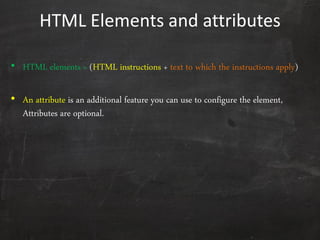
HTML Elements and attributes
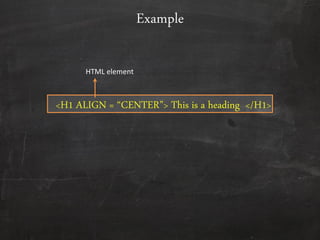
• HTML elements = (HTML instructions + text to which the instructions apply)
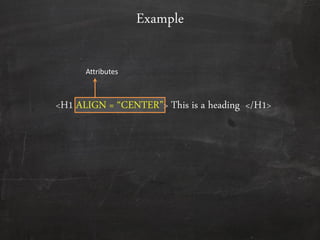
• An attribute is an additional feature you can use to configure the element,
Attributes are optional.
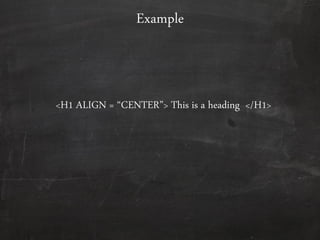
<H1 ALIGN = ‚CENTER‛> This is a heading </H1>
Example
<H1 ALIGN = ‚CENTER‛> This is a heading </H1>
Example
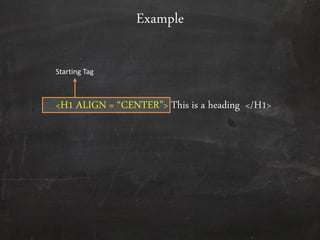
Starting Tag
<H1 ALIGN = ‚CENTER‛> This is a heading </H1>
Example
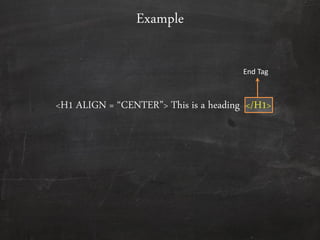
End Tag
<H1 ALIGN = ‚CENTER‛> This is a heading </H1>
Example
Attributes
<H1 ALIGN = ‚CENTER‛> This is a heading </H1>
Example
HTML element
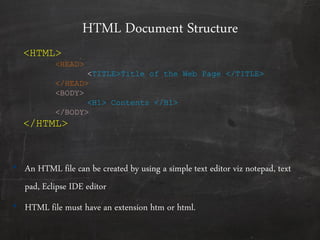
HTML Document Structure
• An HTML file can be created by using a simple text editor viz notepad, text
pad, Eclipse IDE editor
• HTML file must have an extension htm or html.
<HTML>
<HEAD>
<TITLE>Title of the Web Page </TITLE>
</HEAD>
<BODY>
<H1> Contents </H1>
</BODY>
</HTML>
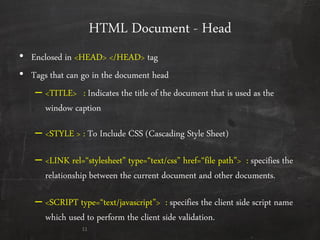
HTML Document - Head
• Enclosed in <HEAD> </HEAD> tag
• Tags that can go in the document head
– <TITLE> : Indicates the title of the document that is used as the
window caption
– <STYLE > : To Include CSS (Cascading Style Sheet)
– <LINK rel=‚stylesheet‛ type=‚text/css‛ href=‚file path‛> : specifies the
relationship between the current document and other documents.
– <SCRIPT type=‚text/javascript‛> : specifies the client side script name
which used to perform the client side validation.
11
HTML Document - Head
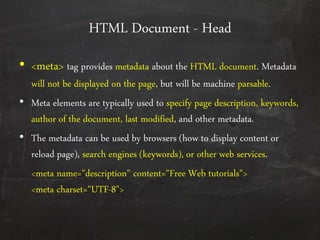
• <meta> tag provides metadata about the HTML document. Metadata
will not be displayed on the page, but will be machine parsable.
• Meta elements are typically used to specify page description, keywords,
author of the document, last modified, and other metadata.
• The metadata can be used by browsers (how to display content or
reload page), search engines (keywords), or other web services.
<meta name="description" content="Free Web tutorials">
<meta charset="UTF-8">
HTML Document - Head
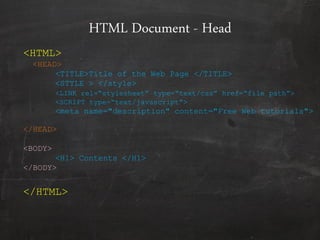
<HTML>
<HEAD>
<TITLE>Title of the Web Page </TITLE>
<STYLE > </style>
<LINK rel=“stylesheet” type=“text/css” href=“file path”>
<SCRIPT type=“text/javascript”>
<meta name="description" content="Free Web tutorials">
</HEAD>
<BODY>
<H1> Contents </H1>
</BODY>
</HTML>
HTML Document – Body
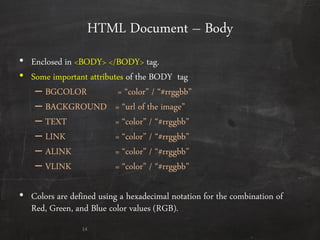
• Enclosed in <BODY> </BODY> tag.
• Some important attributes of the BODY tag
– BGCOLOR = ‚color‛ / ‚#rrggbb‛
– BACKGROUND = ‚url of the image‛
– TEXT = ‚color‛ / ‚#rrggbb‛
– LINK = ‚color‛ / ‚#rrggbb‛
– ALINK = ‚color‛ / ‚#rrggbb‛
– VLINK = ‚color‛ / ‚#rrggbb‛
• Colors are defined using a hexadecimal notation for the combination of
Red, Green, and Blue color values (RGB).
14
Try Out
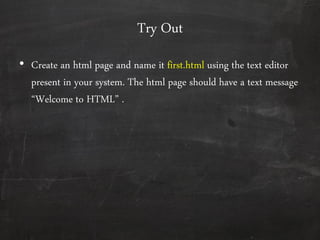
• Create an html page and name it first.html using the text editor
present in your system. The html page should have a text message
‚Welcome to HTML‛ .
Try Out
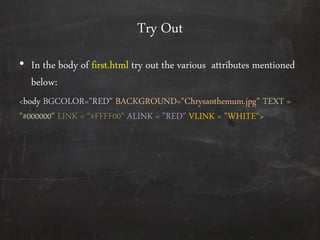
• In the body of first.html try out the various attributes mentioned
below:
<body BGCOLOR="RED" BACKGROUND="Chrysanthemum.jpg" TEXT =
"#000000" LINK = "#FFFF00" ALINK = "RED" VLINK = "WHITE‚>
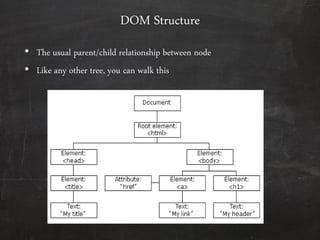
DOM Structure
• The usual parent/child relationship between node
• Like any other tree, you can walk this
Formatting the web page
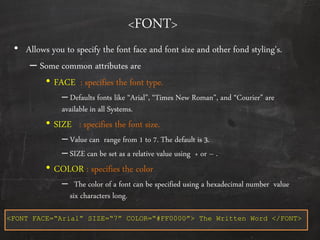
<FONT>
• Allows you to specify the font face and font size and other fond styling's.
– Some common attributes are
• FACE : specifies the font type.
– Defaults fonts like ‚Arial‛, ‚Times New Roman‛, and ‚Courier‛ are
available in all Systems.
• SIZE : specifies the font size.
– Value can range from 1 to 7. The default is 3.
– SIZE can be set as a relative value using + or – .
• COLOR : specifies the color
– The color of a font can be specified using a hexadecimal number value
six characters long.
<FONT FACE=“Arial” SIZE=“7” COLOR=“#FF0000”> The Written Word </FONT>
Text Formatting tags
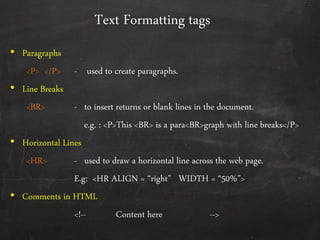
• Paragraphs
<P> </P> - used to create paragraphs.
• Line Breaks
<BR> - to insert returns or blank lines in the document.
e.g. : <P>This <BR> is a para<BR>graph with line breaks</P>
• Horizontal Lines
<HR> - used to draw a horizontal line across the web page.
E.g: <HR ALIGN = ‚right‛ WIDTH = ‚50%‛>
• Comments in HTML
<!-- Content here -->
Text Formatting tags
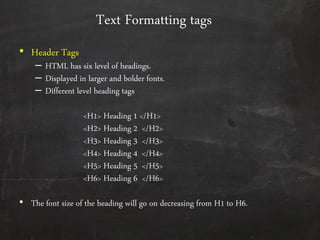
• Header Tags
– HTML has six level of headings.
– Displayed in larger and bolder fonts.
– Different level heading tags
<H1> Heading 1 </H1>
<H2> Heading 2 </H2>
<H3> Heading 3 </H3>
<H4> Heading 4 </H4>
<H5> Heading 5 </H5>
<H6> Heading 6 </H6>
• The font size of the heading will go on decreasing from H1 to H6.
Text Formatting tags
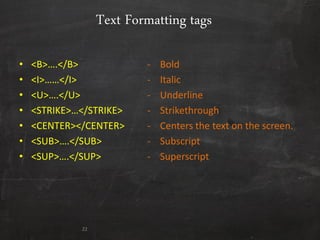
• <B>….</B> - Bold
• <I>……</I> - Italic
• <U>….</U> - Underline
• <STRIKE>…</STRIKE> - Strikethrough
• <CENTER></CENTER> - Centers the text on the screen.
• <SUB>….</SUB> - Subscript
• <SUP>….</SUP> - Superscript
22
Try Out
• Modify first.html with following features
– Add 3 headings with paragraphs underneath to each
– Each paragrapshs and heading should be of different color
– Each heading should be italic
– Each subheading should be italic, bold and underlined
Lists in HTML
Lists in HTML
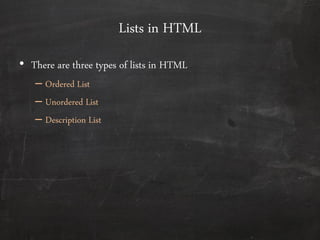
• There are three types of lists in HTML
– Ordered List
– Unordered List
– Description List
Lists in HTML
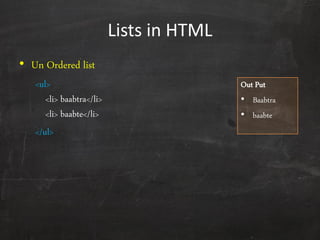
• Un Ordered list
<ul>
<li> baabtra</li>
<li> baabte</li>
</ul>
Out Put
• Baabtra
• baabte
Lists in HTML
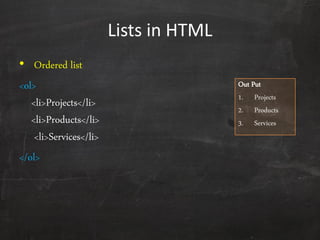
• Ordered list
<ol>
<li>Projects</li>
<li>Products</li>
<li>Services</li>
</ol>
Out Put
1. Projects
2. Products
3. Services
Lists in HTML
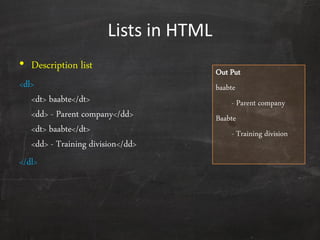
• Description list
<dl>
<dt> baabte</dt>
<dd> - Parent company</dd>
<dt> baabte</dt>
<dd> - Training division</dd>
</dl>
Out Put
baabte
- Parent company
Baabte
- Training division
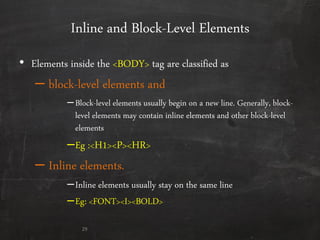
Inline and Block-Level Elements
• Elements inside the <BODY> tag are classified as
– block-level elements and
–Block-level elements usually begin on a new line. Generally, block-
level elements may contain inline elements and other block-level
elements
–Eg :<H1><P><HR>
– Inline elements.
–Inline elements usually stay on the same line
–Eg: <FONT><I><BOLD>
29
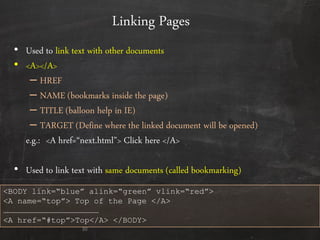
Linking Pages
• Used to link text with other documents
• <A></A>
– HREF
– NAME (bookmarks inside the page)
– TITLE (balloon help in IE)
– TARGET (Define where the linked document will be opened)
e.g.: <A href=‚next.html‛> Click here </A>
• Used to link text with same documents (called bookmarking)
30
<BODY link=“blue” alink=“green” vlink=“red”>
<A name=“top”> Top of the Page </A>
……………………………………………………
<A href=“#top”>Top</A> </BODY>
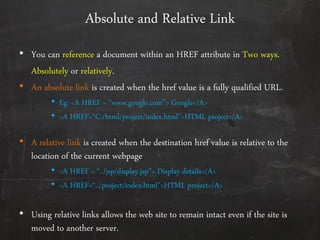
Absolute and Relative Link
• You can reference a document within an HREF attribute in Two ways.
Absolutely or relatively.
• An absolute link is created when the href value is a fully qualified URL.
• Eg: <A HREF = ‚www.google.com"> Google</A>
• <A HREF=‚C:/html/project/index.html‛>HTML project</A>
• A relative link is created when the destination href value is relative to the
location of the current webpage
• <A HREF = ‚../jsp/display.jsp‛> Display details</A>
• <A HREF=‚../project/index.html‛>HTML project</A>
• Using relative links allows the web site to remain intact even if the site is
moved to another server.
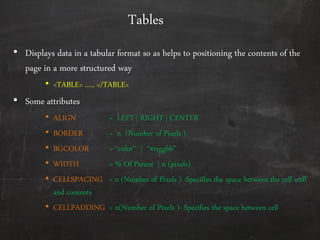
Tables
• Displays data in a tabular format so as helps to positioning the contents of the
page in a more structured way
• <TABLE> ….. </TABLE>
• Some attributes
• ALIGN = LEFT | RIGHT | CENTER
• BORDER = n (Number of Pixels )
• BGCOLOR = ‚color‛ | ‚#rrggbb‛
• WIDTH = % Of Parent | n (pixels)
• CELLSPACING = n (Number of Pixels ) -Specifies the space between the cell wall
and contents
• CELLPADDING = n(Number of Pixels )- Specifies the space between cell
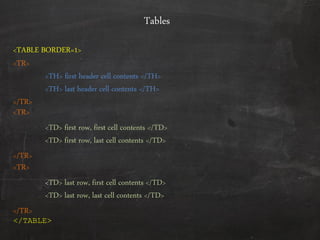
Tables
<TABLE BORDER=1>
<TR>
<TH> first header cell contents </TH>
<TH> last header cell contents </TH>
</TR>
<TR>
<TD> first row, first cell contents </TD>
<TD> first row, last cell contents </TD>
</TR>
<TR>
<TD> last row, first cell contents </TD>
<TD> last row, last cell contents </TD>
</TR>
</TABLE>
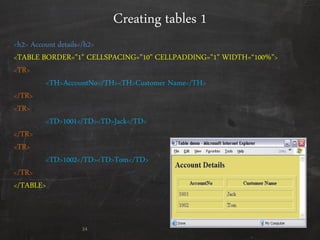
<h2> Account details</h2>
<TABLE BORDER="1" CELLSPACING="10" CELLPADDING="1" WIDTH=‚100%">
<TR>
<TH>AccountNo</TH><TH>Customer Name</TH>
</TR>
<TR>
<TD>1001</TD><TD>Jack</TD>
</TR>
<TR>
<TD>1002</TD><TD>Tom</TD>
</TR>
</TABLE>
Creating tables 1
34
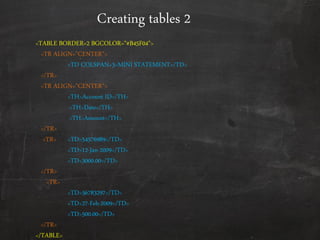
Creating tables 2
<TABLE BORDER=2 BGCOLOR="#B45F04">
<TR ALIGN="CENTER">
<TD COLSPAN=3>MINI STATEMENT</TD>
</TR>
<TR ALIGN="CENTER‚>
<TH>Account ID</TH>
<TH>Date</TH>
<TH>Amount</TH>
</TR>
<TR> <TD>54576989</TD>
<TD>12-Jan-2009</TD>
<TD>3000.00</TD>
</TR>
<TR>
<TD>56783297</TD>
<TD>27-Feb-2009</TD>
<TD>500.00</TD>
</TR>
</TABLE>
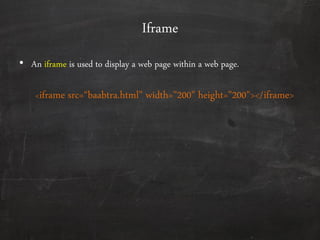
Iframe
• An iframe is used to display a web page within a web page.
<iframe src=‚baabtra.html" width="200" height="200"></iframe>
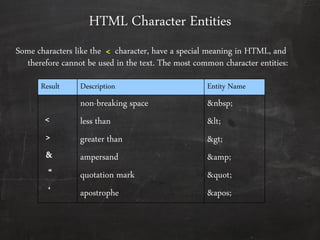
Some characters like the < character, have a special meaning in HTML, and
therefore cannot be used in the text. The most common character entities:
HTML Character Entities
Result Description Entity Name
<
>
&
‚
‘
non-breaking space
less than
greater than
ampersand
quotation mark
apostrophe
&nbsp;
&lt;
&gt;
&amp;
&quot;
&apos;
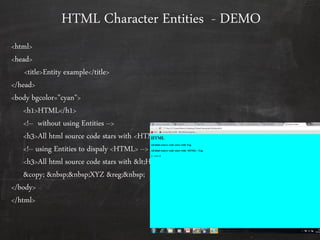
HTML Character Entities - DEMO
<html>
<head>
<title>Entity example</title>
</head>
<body bgcolor="cyan">
<h1>HTML</h1>
<!-- without using Entities -->
<h3>All html source code stars with <HTML> Tag</h3>
<!-- using Entities to dispaly <HTML> -->
<h3>All html source code stars with &lt;HTML&gt; Tag</h3>
&copy; &nbsp;&nbsp;XYZ &reg;&nbsp;
</body>
</html>
Forms
• Used for creating Graphical User Interface (GUI)
• In a web application client interact through GUI.
• FORM by itself really cannot do anything
• Forms become powerful when connected to a server application
• A single HTML page can have multiple forms.
Forms
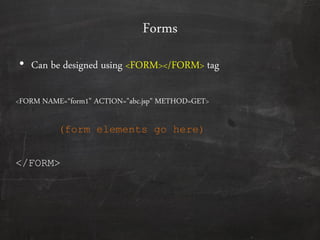
• Can be designed using <FORM></FORM> tag
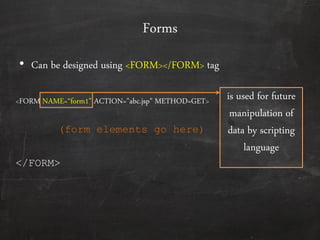
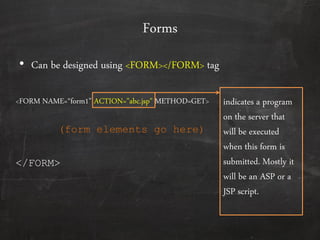
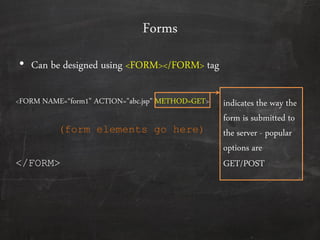
<FORM NAME=‚form1‛ ACTION="abc.jsp" METHOD=GET>
</FORM>
(form elements go here)
Forms
• Can be designed using <FORM></FORM> tag
<FORM NAME=‚form1‛ ACTION="abc.jsp" METHOD=GET>
</FORM>
(form elements go here)
is used for future
manipulation of
data by scripting
language
Forms
• Can be designed using <FORM></FORM> tag
<FORM NAME=‚form1‛ ACTION="abc.jsp" METHOD=GET>
</FORM>
(form elements go here)
indicates a program
on the server that
will be executed
when this form is
submitted. Mostly it
will be an ASP or a
JSP script.
Forms
• Can be designed using <FORM></FORM> tag
<FORM NAME=‚form1‛ ACTION="abc.jsp" METHOD=GET>
</FORM>
(form elements go here)
indicates the way the
form is submitted to
the server - popular
options are
GET/POST
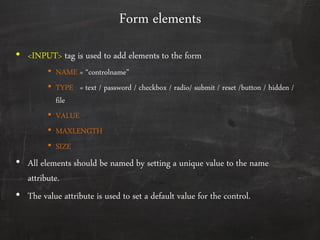
Form elements
• <INPUT> tag is used to add elements to the form
• NAME = ‚controlname‛
• TYPE = text / password / checkbox / radio/ submit / reset /button / hidden /
file
• VALUE
• MAXLENGTH
• SIZE
• All elements should be named by setting a unique value to the name
attribute.
• The value attribute is used to set a default value for the control.
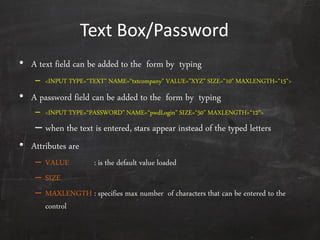
Text Box/Password
• A text field can be added to the form by typing
– <INPUT TYPE=‚TEXT" NAME=‚txtcompany" VALUE=‛XYZ‛ SIZE="10" MAXLENGTH="15">
• A password field can be added to the form by typing
– <INPUT TYPE=‚PASSWORD‛ NAME=‚pwdLogin‛ SIZE=‚50‛ MAXLENGTH=‚12‛>
– when the text is entered, stars appear instead of the typed letters
• Attributes are
– VALUE : is the default value loaded
– SIZE
– MAXLENGTH : specifies max number of characters that can be entered to the
control
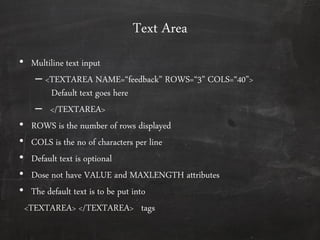
Text Area
• Multiline text input
– <TEXTAREA NAME=‚feedback‛ ROWS=‚3‛ COLS=‚40‛>
Default text goes here
– </TEXTAREA>
• ROWS is the number of rows displayed
• COLS is the no of characters per line
• Default text is optional
• Dose not have VALUE and MAXLENGTH attributes
• The default text is to be put into
<TEXTAREA> </TEXTAREA> tags
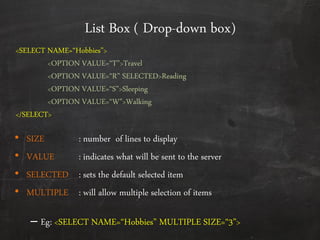
List Box ( Drop-down box)
• SIZE : number of lines to display
• VALUE : indicates what will be sent to the server
• SELECTED : sets the default selected item
• MULTIPLE : will allow multiple selection of items
– Eg: <SELECT NAME=‚Hobbies‛ MULTIPLE SIZE=‚3‛>
<SELECT NAME=‚Hobbies‛>
<OPTION VALUE=‚T‛>Travel
<OPTION VALUE=‚R‛ SELECTED>Reading
<OPTION VALUE=‚S‛>Sleeping
<OPTION VALUE=‚W‛>Walking
</SELECT>
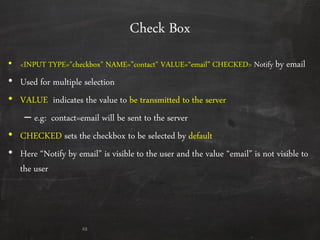
Check Box
• <INPUT TYPE="checkbox" NAME=‛contact" VALUE=‚email‛ CHECKED> Notify by email
• Used for multiple selection
• VALUE indicates the value to be transmitted to the server
– e.g: contact=email will be sent to the server
• CHECKED sets the checkbox to be selected by default
• Here ‚Notify by email‛ is visible to the user and the value ‚email‛ is not visible to
the user
48
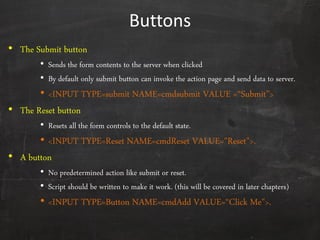
Buttons
• The Submit button
• Sends the form contents to the server when clicked
• By default only submit button can invoke the action page and send data to server.
• <INPUT TYPE=submit NAME=cmdsubmit VALUE =‚Submit‛>
• The Reset button
• Resets all the form controls to the default state.
• <INPUT TYPE=Reset NAME=cmdReset VALUE="Reset">.
• A button
• No predetermined action like submit or reset.
• Script should be written to make it work. (this will be covered in later chapters)
• <INPUT TYPE=Button NAME=cmdAdd VALUE=‚Click Me">.
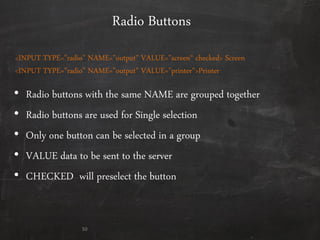
Radio Buttons
• Radio buttons with the same NAME are grouped together
• Radio buttons are used for Single selection
• Only one button can be selected in a group
• VALUE data to be sent to the server
• CHECKED will preselect the button
50
<INPUT TYPE="radio" NAME="output" VALUE="screen‚ checked> Screen
<INPUT TYPE="radio" NAME="output" VALUE="printer">Printer
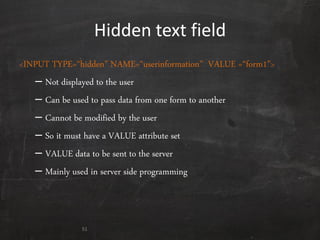
Hidden text field
<INPUT TYPE=‚hidden‛ NAME=‚userinformation‛ VALUE =‚form1‛>
– Not displayed to the user
– Can be used to pass data from one form to another
– Cannot be modified by the user
– So it must have a VALUE attribute set
– VALUE data to be sent to the server
– Mainly used in server side programming
51
52
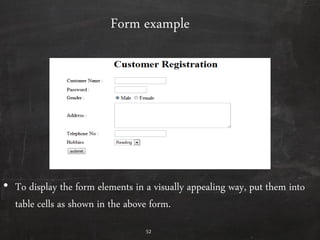
Form example
• To display the form elements in a visually appealing way, put them into
table cells as shown in the above form.
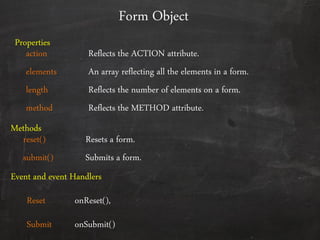
Form Object
action Reflects the ACTION attribute.
elements An array reflecting all the elements in a form.
length Reflects the number of elements on a form.
method Reflects the METHOD attribute.
reset() Resets a form.
submit() Submits a form.
Properties
Methods
Event and event Handlers
Reset onReset(),
Submit onSubmit()
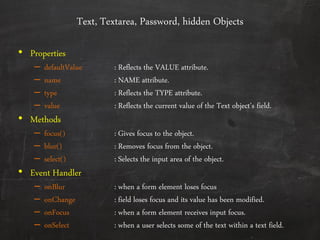
Text, Textarea, Password, hidden Objects
• Properties
– defaultValue : Reflects the VALUE attribute.
– name : NAME attribute.
– type : Reflects the TYPE attribute.
– value : Reflects the current value of the Text object’s field.
• Methods
– focus() : Gives focus to the object.
– blur() : Removes focus from the object.
– select() : Selects the input area of the object.
• Event Handler
– onBlur : when a form element loses focus
– onChange : field loses focus and its value has been modified.
– onFocus : when a form element receives input focus.
– onSelect : when a user selects some of the text within a text field.
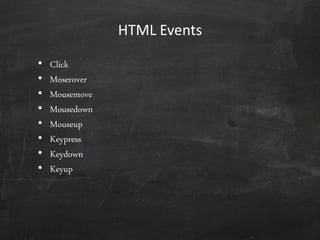
HTML Events
• Click
• Moserover
• Mousemove
• Mousedown
• Mouseup
• Keypress
• Keydown
• Keyup
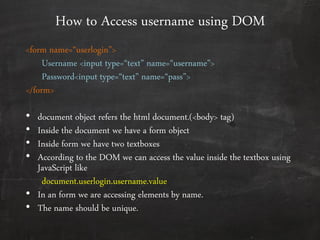
How to Access username using DOM
<form name=‚userlogin‛>
Username <input type=‚text‛ name=‚username‛>
Password<input type=‚text‛ name=‚pass‛>
</form>
• document object refers the html document.(<body> tag)
• Inside the document we have a form object
• Inside form we have two textboxes
• According to the DOM we can access the value inside the textbox using
JavaScript like
document.userlogin.username.value
• In an form we are accessing elements by name.
• The name should be unique.
57
Try Out
• Create a login screen with a heading Login , two text fields user
name , password and a submit button. Put the UI elements in a
table structure so as to give it good look and feel.
End of day

Html

  • 1.
  • 2.
    What is HTML? •HTML stands for Hyper Text Markup Language . • It is used to design and develop Web Pages. • HTML is – A Simple mark up language (NOT a programming language) – Browser/Platform Independent (plain ASCII text format) – Not Case Sensitive – HTML is Interpreted by browser (NOT compiled). – A medium for User Interface (GUI)
  • 3.
    HTML Tags • TheHTML instructions are called tags, and look like <TAG> ….. Text here…….. </TAG> • Tags are used for data presentation • There are two types of tags 1. Container tags : Tags that have starting as well as ending part. e.g. <TITLE> Title of the Web Page </TITLE> 2. Empty tags : Tags that do not have the closing part. e.g. <BR> , <HR>
  • 4.
    HTML Elements andattributes • HTML elements = (HTML instructions + text to which the instructions apply) • An attribute is an additional feature you can use to configure the element, Attributes are optional.
  • 5.
    <H1 ALIGN =‚CENTER‛> This is a heading </H1> Example
  • 6.
    <H1 ALIGN =‚CENTER‛> This is a heading </H1> Example Starting Tag
  • 7.
    <H1 ALIGN =‚CENTER‛> This is a heading </H1> Example End Tag
  • 8.
    <H1 ALIGN =‚CENTER‛> This is a heading </H1> Example Attributes
  • 9.
    <H1 ALIGN =‚CENTER‛> This is a heading </H1> Example HTML element
  • 10.
    HTML Document Structure •An HTML file can be created by using a simple text editor viz notepad, text pad, Eclipse IDE editor • HTML file must have an extension htm or html. <HTML> <HEAD> <TITLE>Title of the Web Page </TITLE> </HEAD> <BODY> <H1> Contents </H1> </BODY> </HTML>
  • 11.
    HTML Document -Head • Enclosed in <HEAD> </HEAD> tag • Tags that can go in the document head – <TITLE> : Indicates the title of the document that is used as the window caption – <STYLE > : To Include CSS (Cascading Style Sheet) – <LINK rel=‚stylesheet‛ type=‚text/css‛ href=‚file path‛> : specifies the relationship between the current document and other documents. – <SCRIPT type=‚text/javascript‛> : specifies the client side script name which used to perform the client side validation. 11
  • 12.
    HTML Document -Head • <meta> tag provides metadata about the HTML document. Metadata will not be displayed on the page, but will be machine parsable. • Meta elements are typically used to specify page description, keywords, author of the document, last modified, and other metadata. • The metadata can be used by browsers (how to display content or reload page), search engines (keywords), or other web services. <meta name="description" content="Free Web tutorials"> <meta charset="UTF-8">
  • 13.
    HTML Document -Head <HTML> <HEAD> <TITLE>Title of the Web Page </TITLE> <STYLE > </style> <LINK rel=“stylesheet” type=“text/css” href=“file path”> <SCRIPT type=“text/javascript”> <meta name="description" content="Free Web tutorials"> </HEAD> <BODY> <H1> Contents </H1> </BODY> </HTML>
  • 14.
    HTML Document –Body • Enclosed in <BODY> </BODY> tag. • Some important attributes of the BODY tag – BGCOLOR = ‚color‛ / ‚#rrggbb‛ – BACKGROUND = ‚url of the image‛ – TEXT = ‚color‛ / ‚#rrggbb‛ – LINK = ‚color‛ / ‚#rrggbb‛ – ALINK = ‚color‛ / ‚#rrggbb‛ – VLINK = ‚color‛ / ‚#rrggbb‛ • Colors are defined using a hexadecimal notation for the combination of Red, Green, and Blue color values (RGB). 14
  • 15.
    Try Out • Createan html page and name it first.html using the text editor present in your system. The html page should have a text message ‚Welcome to HTML‛ .
  • 16.
    Try Out • Inthe body of first.html try out the various attributes mentioned below: <body BGCOLOR="RED" BACKGROUND="Chrysanthemum.jpg" TEXT = "#000000" LINK = "#FFFF00" ALINK = "RED" VLINK = "WHITE‚>
  • 17.
    DOM Structure • Theusual parent/child relationship between node • Like any other tree, you can walk this
  • 18.
  • 19.
    <FONT> • Allows youto specify the font face and font size and other fond styling's. – Some common attributes are • FACE : specifies the font type. – Defaults fonts like ‚Arial‛, ‚Times New Roman‛, and ‚Courier‛ are available in all Systems. • SIZE : specifies the font size. – Value can range from 1 to 7. The default is 3. – SIZE can be set as a relative value using + or – . • COLOR : specifies the color – The color of a font can be specified using a hexadecimal number value six characters long. <FONT FACE=“Arial” SIZE=“7” COLOR=“#FF0000”> The Written Word </FONT>
  • 20.
    Text Formatting tags •Paragraphs <P> </P> - used to create paragraphs. • Line Breaks <BR> - to insert returns or blank lines in the document. e.g. : <P>This <BR> is a para<BR>graph with line breaks</P> • Horizontal Lines <HR> - used to draw a horizontal line across the web page. E.g: <HR ALIGN = ‚right‛ WIDTH = ‚50%‛> • Comments in HTML <!-- Content here -->
  • 21.
    Text Formatting tags •Header Tags – HTML has six level of headings. – Displayed in larger and bolder fonts. – Different level heading tags <H1> Heading 1 </H1> <H2> Heading 2 </H2> <H3> Heading 3 </H3> <H4> Heading 4 </H4> <H5> Heading 5 </H5> <H6> Heading 6 </H6> • The font size of the heading will go on decreasing from H1 to H6.
  • 22.
    Text Formatting tags •<B>….</B> - Bold • <I>……</I> - Italic • <U>….</U> - Underline • <STRIKE>…</STRIKE> - Strikethrough • <CENTER></CENTER> - Centers the text on the screen. • <SUB>….</SUB> - Subscript • <SUP>….</SUP> - Superscript 22
  • 23.
    Try Out • Modifyfirst.html with following features – Add 3 headings with paragraphs underneath to each – Each paragrapshs and heading should be of different color – Each heading should be italic – Each subheading should be italic, bold and underlined
  • 24.
  • 25.
    Lists in HTML •There are three types of lists in HTML – Ordered List – Unordered List – Description List
  • 26.
    Lists in HTML •Un Ordered list <ul> <li> baabtra</li> <li> baabte</li> </ul> Out Put • Baabtra • baabte
  • 27.
    Lists in HTML •Ordered list <ol> <li>Projects</li> <li>Products</li> <li>Services</li> </ol> Out Put 1. Projects 2. Products 3. Services
  • 28.
    Lists in HTML •Description list <dl> <dt> baabte</dt> <dd> - Parent company</dd> <dt> baabte</dt> <dd> - Training division</dd> </dl> Out Put baabte - Parent company Baabte - Training division
  • 29.
    Inline and Block-LevelElements • Elements inside the <BODY> tag are classified as – block-level elements and –Block-level elements usually begin on a new line. Generally, block- level elements may contain inline elements and other block-level elements –Eg :<H1><P><HR> – Inline elements. –Inline elements usually stay on the same line –Eg: <FONT><I><BOLD> 29
  • 30.
    Linking Pages • Usedto link text with other documents • <A></A> – HREF – NAME (bookmarks inside the page) – TITLE (balloon help in IE) – TARGET (Define where the linked document will be opened) e.g.: <A href=‚next.html‛> Click here </A> • Used to link text with same documents (called bookmarking) 30 <BODY link=“blue” alink=“green” vlink=“red”> <A name=“top”> Top of the Page </A> …………………………………………………… <A href=“#top”>Top</A> </BODY>
  • 31.
    Absolute and RelativeLink • You can reference a document within an HREF attribute in Two ways. Absolutely or relatively. • An absolute link is created when the href value is a fully qualified URL. • Eg: <A HREF = ‚www.google.com"> Google</A> • <A HREF=‚C:/html/project/index.html‛>HTML project</A> • A relative link is created when the destination href value is relative to the location of the current webpage • <A HREF = ‚../jsp/display.jsp‛> Display details</A> • <A HREF=‚../project/index.html‛>HTML project</A> • Using relative links allows the web site to remain intact even if the site is moved to another server.
  • 32.
    Tables • Displays datain a tabular format so as helps to positioning the contents of the page in a more structured way • <TABLE> ….. </TABLE> • Some attributes • ALIGN = LEFT | RIGHT | CENTER • BORDER = n (Number of Pixels ) • BGCOLOR = ‚color‛ | ‚#rrggbb‛ • WIDTH = % Of Parent | n (pixels) • CELLSPACING = n (Number of Pixels ) -Specifies the space between the cell wall and contents • CELLPADDING = n(Number of Pixels )- Specifies the space between cell
  • 33.
    Tables <TABLE BORDER=1> <TR> <TH> firstheader cell contents </TH> <TH> last header cell contents </TH> </TR> <TR> <TD> first row, first cell contents </TD> <TD> first row, last cell contents </TD> </TR> <TR> <TD> last row, first cell contents </TD> <TD> last row, last cell contents </TD> </TR> </TABLE>
  • 34.
    <h2> Account details</h2> <TABLEBORDER="1" CELLSPACING="10" CELLPADDING="1" WIDTH=‚100%"> <TR> <TH>AccountNo</TH><TH>Customer Name</TH> </TR> <TR> <TD>1001</TD><TD>Jack</TD> </TR> <TR> <TD>1002</TD><TD>Tom</TD> </TR> </TABLE> Creating tables 1 34
  • 35.
    Creating tables 2 <TABLEBORDER=2 BGCOLOR="#B45F04"> <TR ALIGN="CENTER"> <TD COLSPAN=3>MINI STATEMENT</TD> </TR> <TR ALIGN="CENTER‚> <TH>Account ID</TH> <TH>Date</TH> <TH>Amount</TH> </TR> <TR> <TD>54576989</TD> <TD>12-Jan-2009</TD> <TD>3000.00</TD> </TR> <TR> <TD>56783297</TD> <TD>27-Feb-2009</TD> <TD>500.00</TD> </TR> </TABLE>
  • 36.
    Iframe • An iframeis used to display a web page within a web page. <iframe src=‚baabtra.html" width="200" height="200"></iframe>
  • 37.
    Some characters likethe < character, have a special meaning in HTML, and therefore cannot be used in the text. The most common character entities: HTML Character Entities Result Description Entity Name < > & ‚ ‘ non-breaking space less than greater than ampersand quotation mark apostrophe &nbsp; &lt; &gt; &amp; &quot; &apos;
  • 38.
    HTML Character Entities- DEMO <html> <head> <title>Entity example</title> </head> <body bgcolor="cyan"> <h1>HTML</h1> <!-- without using Entities --> <h3>All html source code stars with <HTML> Tag</h3> <!-- using Entities to dispaly <HTML> --> <h3>All html source code stars with &lt;HTML&gt; Tag</h3> &copy; &nbsp;&nbsp;XYZ &reg;&nbsp; </body> </html>
  • 39.
    Forms • Used forcreating Graphical User Interface (GUI) • In a web application client interact through GUI. • FORM by itself really cannot do anything • Forms become powerful when connected to a server application • A single HTML page can have multiple forms.
  • 40.
    Forms • Can bedesigned using <FORM></FORM> tag <FORM NAME=‚form1‛ ACTION="abc.jsp" METHOD=GET> </FORM> (form elements go here)
  • 41.
    Forms • Can bedesigned using <FORM></FORM> tag <FORM NAME=‚form1‛ ACTION="abc.jsp" METHOD=GET> </FORM> (form elements go here) is used for future manipulation of data by scripting language
  • 42.
    Forms • Can bedesigned using <FORM></FORM> tag <FORM NAME=‚form1‛ ACTION="abc.jsp" METHOD=GET> </FORM> (form elements go here) indicates a program on the server that will be executed when this form is submitted. Mostly it will be an ASP or a JSP script.
  • 43.
    Forms • Can bedesigned using <FORM></FORM> tag <FORM NAME=‚form1‛ ACTION="abc.jsp" METHOD=GET> </FORM> (form elements go here) indicates the way the form is submitted to the server - popular options are GET/POST
  • 44.
    Form elements • <INPUT>tag is used to add elements to the form • NAME = ‚controlname‛ • TYPE = text / password / checkbox / radio/ submit / reset /button / hidden / file • VALUE • MAXLENGTH • SIZE • All elements should be named by setting a unique value to the name attribute. • The value attribute is used to set a default value for the control.
  • 45.
    Text Box/Password • Atext field can be added to the form by typing – <INPUT TYPE=‚TEXT" NAME=‚txtcompany" VALUE=‛XYZ‛ SIZE="10" MAXLENGTH="15"> • A password field can be added to the form by typing – <INPUT TYPE=‚PASSWORD‛ NAME=‚pwdLogin‛ SIZE=‚50‛ MAXLENGTH=‚12‛> – when the text is entered, stars appear instead of the typed letters • Attributes are – VALUE : is the default value loaded – SIZE – MAXLENGTH : specifies max number of characters that can be entered to the control
  • 46.
    Text Area • Multilinetext input – <TEXTAREA NAME=‚feedback‛ ROWS=‚3‛ COLS=‚40‛> Default text goes here – </TEXTAREA> • ROWS is the number of rows displayed • COLS is the no of characters per line • Default text is optional • Dose not have VALUE and MAXLENGTH attributes • The default text is to be put into <TEXTAREA> </TEXTAREA> tags
  • 47.
    List Box (Drop-down box) • SIZE : number of lines to display • VALUE : indicates what will be sent to the server • SELECTED : sets the default selected item • MULTIPLE : will allow multiple selection of items – Eg: <SELECT NAME=‚Hobbies‛ MULTIPLE SIZE=‚3‛> <SELECT NAME=‚Hobbies‛> <OPTION VALUE=‚T‛>Travel <OPTION VALUE=‚R‛ SELECTED>Reading <OPTION VALUE=‚S‛>Sleeping <OPTION VALUE=‚W‛>Walking </SELECT>
  • 48.
    Check Box • <INPUTTYPE="checkbox" NAME=‛contact" VALUE=‚email‛ CHECKED> Notify by email • Used for multiple selection • VALUE indicates the value to be transmitted to the server – e.g: contact=email will be sent to the server • CHECKED sets the checkbox to be selected by default • Here ‚Notify by email‛ is visible to the user and the value ‚email‛ is not visible to the user 48
  • 49.
    Buttons • The Submitbutton • Sends the form contents to the server when clicked • By default only submit button can invoke the action page and send data to server. • <INPUT TYPE=submit NAME=cmdsubmit VALUE =‚Submit‛> • The Reset button • Resets all the form controls to the default state. • <INPUT TYPE=Reset NAME=cmdReset VALUE="Reset">. • A button • No predetermined action like submit or reset. • Script should be written to make it work. (this will be covered in later chapters) • <INPUT TYPE=Button NAME=cmdAdd VALUE=‚Click Me">.
  • 50.
    Radio Buttons • Radiobuttons with the same NAME are grouped together • Radio buttons are used for Single selection • Only one button can be selected in a group • VALUE data to be sent to the server • CHECKED will preselect the button 50 <INPUT TYPE="radio" NAME="output" VALUE="screen‚ checked> Screen <INPUT TYPE="radio" NAME="output" VALUE="printer">Printer
  • 51.
    Hidden text field <INPUTTYPE=‚hidden‛ NAME=‚userinformation‛ VALUE =‚form1‛> – Not displayed to the user – Can be used to pass data from one form to another – Cannot be modified by the user – So it must have a VALUE attribute set – VALUE data to be sent to the server – Mainly used in server side programming 51
  • 52.
    52 Form example • Todisplay the form elements in a visually appealing way, put them into table cells as shown in the above form.
  • 53.
    Form Object action Reflectsthe ACTION attribute. elements An array reflecting all the elements in a form. length Reflects the number of elements on a form. method Reflects the METHOD attribute. reset() Resets a form. submit() Submits a form. Properties Methods Event and event Handlers Reset onReset(), Submit onSubmit()
  • 54.
    Text, Textarea, Password,hidden Objects • Properties – defaultValue : Reflects the VALUE attribute. – name : NAME attribute. – type : Reflects the TYPE attribute. – value : Reflects the current value of the Text object’s field. • Methods – focus() : Gives focus to the object. – blur() : Removes focus from the object. – select() : Selects the input area of the object. • Event Handler – onBlur : when a form element loses focus – onChange : field loses focus and its value has been modified. – onFocus : when a form element receives input focus. – onSelect : when a user selects some of the text within a text field.
  • 55.
    HTML Events • Click •Moserover • Mousemove • Mousedown • Mouseup • Keypress • Keydown • Keyup
  • 56.
    How to Accessusername using DOM <form name=‚userlogin‛> Username <input type=‚text‛ name=‚username‛> Password<input type=‚text‛ name=‚pass‛> </form> • document object refers the html document.(<body> tag) • Inside the document we have a form object • Inside form we have two textboxes • According to the DOM we can access the value inside the textbox using JavaScript like document.userlogin.username.value • In an form we are accessing elements by name. • The name should be unique.
  • 57.
    57 Try Out • Createa login screen with a heading Login , two text fields user name , password and a submit button. Put the UI elements in a table structure so as to give it good look and feel.
  • 58.