 While sitting at your desk, lift your right foot off
the ground and make clockwise circles.
 Now, while doing this draw the number “6” in
the air with your right hand.
 Your foot will change direction and there’s
nothing you can do about it.
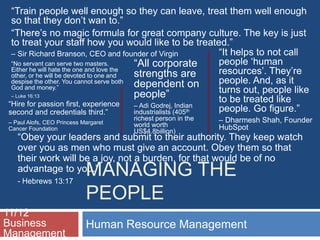
MANAGING THE
PEOPLE
Human Resource Management
11/12
Business
Management
“All corporate
strengths are
dependent on
people”
– Adi Godrej, Indian
industrialists (405th
richest person in the
world worth
US$4.8billion)
“Train people well enough so they can leave, treat them well enough
so that they don’t wan to.”
“There’s no magic formula for great company culture. The key is just
to treat your staff how you would like to be treated.”
– Sir Richard Branson, CEO and founder of Virgin
“Hire for passion first, experience
second and credentials third.”
– Paul Alofs, CEO Princess Margaret
Cancer Foundation
“It helps to not call
people ‘human
resources’. They’re
people. And, as it
turns out, people like
to be treated like
people. Go figure.”
– Dharmesh Shah, Founder
HubSpot
“Obey your leaders and submit to their authority. They keep watch
over you as men who must give an account. Obey them so that
their work will be a joy, not a burden, for that would be of no
advantage to you.”
- Hebrews 13:17
“No servant can serve two masters.
Either he will hate the one and love the
other, or he will be devoted to one and
despise the other. You cannot serve both
God and money.”
– Luke 16:13
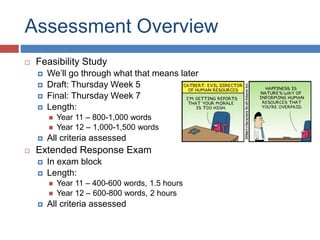
Assessment Overview
 Feasibility Study
 We’ll go through what that means later
 Draft: Thursday Week 5
 Final: Thursday Week 7
 Length:
 Year 11 – 800-1,000 words
 Year 12 – 1,000-1,500 words
 All criteria assessed
 Extended Response Exam
 In exam block
 Length:
 Year 11 – 400-600 words, 1.5 hours
 Year 12 – 600-800 words, 2 hours
 All criteria assessed
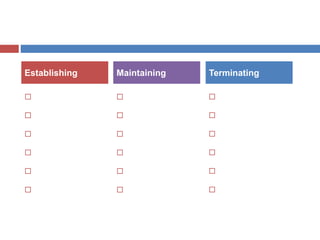
What is Human Resources?
 ‘…is the management of the employment
relationship…it covers establishing,
maintaining and terminating
employment…[HRM] involves planning,
organising, leading and controlling the staffing
needs of an organisation.’
Mylonas, et al (2007), p283












Establishing Maintaining






Terminating
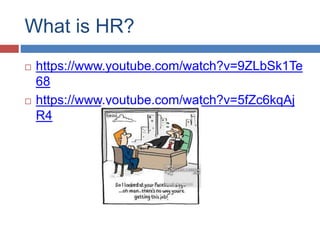
What is HR?
 https://www.youtube.com/watch?v=9ZLbSk1Te
68
 https://www.youtube.com/watch?v=5fZc6kqAj
R4
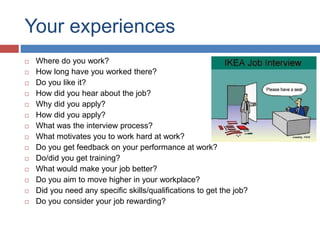
Your experiences
 Where do you work?
 How long have you worked there?
 Do you like it?
 How did you hear about the job?
 Why did you apply?
 How did you apply?
 What was the interview process?
 What motivates you to work hard at work?
 Do you get feedback on your performance at work?
 Do/did you get training?
 What would make your job better?
 Do you aim to move higher in your workplace?
 Did you need any specific skills/qualifications to get the job?
 Do you consider your job rewarding?
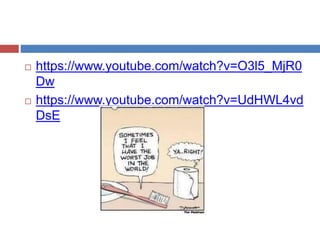
 https://www.youtube.com/watch?v=O3l5_MjR0
Dw
 https://www.youtube.com/watch?v=UdHWL4vd
DsE
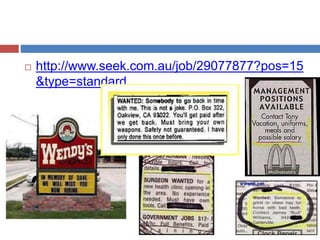
 http://www.seek.com.au/job/29077877?pos=15
&type=standard
Job Ads
 Go to a job search engine:
 www.seek.com.au
 www.careerone.com.au
 www.hays.com.au
 www.jobsinhr.com.au
 Find at least 3 different job ads for HR-related jobs from three
different types of workplaces
 What is the job title?
 Who would you be working for?
 What is the pay?
 Where is the job (location)?
 What are 3 responsibilities of the role?
 What are 3 skills/experience requirements?
 Identify the qualifications needed, if any.
 Is there anything in the ad that might make someone want to apply for
the job?
 http://courses.curtin.edu.au/course_overview/u
ndergraduate/human-resources
Uni Degrees
 Visit a university website (Qld, Australia or
international) or use the university guides
available
 Find 4 undergraduate degrees which indicate
an ability to work in HR
 What uni?
 What is the degree?
 How long does it take to complete?
 If in Qld, what OP do you need?
 What prerequisites do you need?
 What careers outcomes are available?
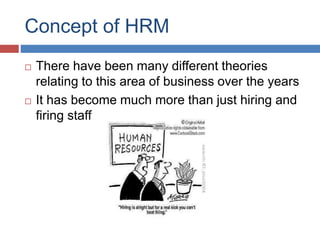
Concept of HRM
 There have been many different theories
relating to this area of business over the years
 It has become much more than just hiring and
firing staff
PM HRM
 Human resources has replaced personnel
management
 PM only concerned with hiring and keeping
records
 PM has become HR in large orgs due to the
broader nature of issues and the number of
staff
 Managers are concerned about productivity
 How much can we get for what we put in (cost
minimisation)
 Humans as a resource are important
 What skills would make a human important in a
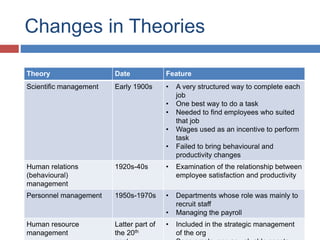
Changes in Theories
Theory Date Feature
Scientific management Early 1900s • A very structured way to complete each
job
• One best way to do a task
• Needed to find employees who suited
that job
• Wages used as an incentive to perform
task
• Failed to bring behavioural and
productivity changes
Human relations
(behavioural)
management
1920s-40s • Examination of the relationship between
employee satisfaction and productivity
Personnel management 1950s-1970s • Departments whose role was mainly to
recruit staff
• Managing the payroll
Human resource
management
Latter part of
the 20th
• Included in the strategic management
of the org
Strategic Importance
 Developing:
 From a separate task to an integrated function
 Serves org’s strategy and objectives
 Prospective employees are assessed carefully
 Ensuring they possess the right skills to help the org
 Often people with a particular skill are needed
 Linking this with someone who fits the corporate
culture is difficult
 What kind of person do we need to suit Groves’
corporate culture?
 Go to www.sofitel.com.au
 What kind of corporate culture would they
have based on what you can tell from the
website?
 Let’s say they have a job going to work on the
reception desk, who would get hired from the
next slide…
The Sofitel is hiring…who would get
the job?
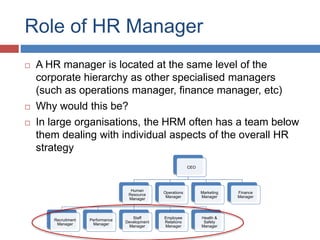
Role of HR Manager
 A HR manager is located at the same level of the
corporate hierarchy as other specialised managers
(such as operations manager, finance manager, etc)
 Why would this be?
 In large organisations, the HRM often has a team below
them dealing with individual aspects of the overall HR
strategy
CEO
Human
Resource
Manager
Recruitment
Manager
Performance
Manager
Staff
Development
Manager
Employee
Relations
Manager
Health &
Safety
Manager
Operations
Manager
Marketing
Manager
Finance
Manager
Complete…
 Read:
 pp283-287
 Textbook Tasks:
 p285, Q1,2,5
 p286, Q1-3
 p287, Q1,3
 Extension: remaining questions
People & Work
 Three vital aspects in an environment where
workers are performing at their best:
1. Job design
2. Motivation
3. Job satisfaction
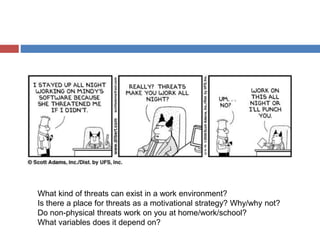
What kind of threats can exist in a work environment?
Is there a place for threats as a motivational strategy? Why/why not?
Do non-physical threats work on you at home/work/school?
What variables does it depend on?
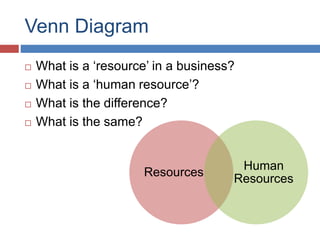
Venn Diagram
 What is a ‘resource’ in a business?
 What is a ‘human resource’?
 What is the difference?
 What is the same?
Resources
Human
Resources
Motivation, Satisfaction &
Performance
 HR perspective of management sees the staff
as humans – with needs to be fulfilled
 More than just inputs in the production process
 Staff have
 Expectations of a job
 Seek a degree of satisfaction from their work, and
 Need to be motivated to perform their best
Expectations
 What do/would you expect from your
workplace?
 Are these expectations fulfilled?
 What happens when your expectations are
fulfilled?
Satisfaction
 Job satisfaction is potentially different for each
worker
 It is affected by the expectations you have
 What gives you job/school satisfaction?
 How could you be more satisfied at
work/school?
Motivation
 Motivation is what drives someone to put effort
into something
 Very individualised
 Not always positive motivation
 What positive motivation exists for you to do
well at work/school?
 What negative motivation exists for you to do
well at work/school?
 Does motivation = happiness?
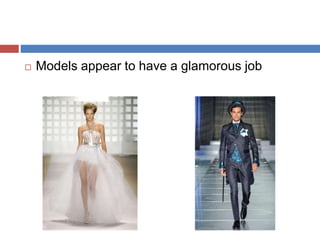
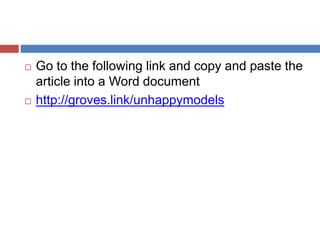
 Models appear to have a glamorous job
 Go to the following link and copy and paste the
article into a Word document
 http://groves.link/unhappymodels
 Complete the following based on the article:
 Highlight any words you do not understand and
then look them up – put the definitions at the end
of the document
 What does the research by City University tell you
about the sort of things that human beings need
to feel satisfied and happy?
 Is being motivated the same as being happy?
Explain your answer.
Just so you know…
 Due to absences etc we are running a few
lessons behind the Term Overview (perhaps
even a week behind)
Human Resource Planning
 Procedural
 Involves:
 Planning
 Attracting
 Maintaining
the workforce
Planning Process
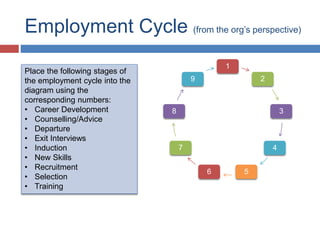
 The employment cycle demonstrates the
regular order of an individuals life in a
particular job
 For organisations, this cycle is repeated for
each individual employee who is hired and
eventually departs
Employment Cycle (from the org’s perspective)
1
2
3
4
56
7
8
9
Place the following stages of
the employment cycle into the
diagram using the
corresponding numbers:
• Career Development
• Counselling/Advice
• Departure
• Exit Interviews
• Induction
• New Skills
• Recruitment
• Selection
• Training
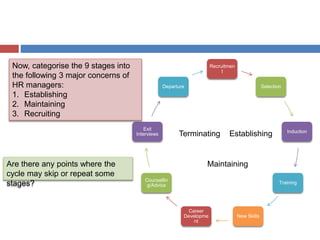
Recruitmen
t
Selection
Induction
Training
New Skills
Career
Developme
nt
Counsellin
g/Advice
Exit
Interviews
Departure
Establishing
Maintaining
Terminating
Now, categorise the 9 stages into
the following 3 major concerns of
HR managers:
1. Establishing
2. Maintaining
3. Recruiting
Are there any points where the
cycle may skip or repeat some
stages?
Job Analysis
 HR managers must determine the HR needs
of the org
 Staff retire, resign, are fired, promoted, die, etc
and the needs of the business change
 Forecast and plan to meet the org’s future needs
for employees
Job Descriptions
 HR managers complete job analysis
 This gives us job descriptions
 What is the point of a job description?
 Parts of a job description:
 Title
 Tasks
 Skills
 Working environment
 Hours of work
 Work practices
 These can help to create selection criteria
 Find a job ad on www.seek.com.au which has
a job description with as many of the aspects
listed as possible:
 Title
 Tasks
 Skills
 Working environment
 Hours of work
 Work practices
Attraction & Development
 Helps find the right person for the job
 Once they are found, further training and
development has to take place
 Performance appraisals are also used after
hiring to ensure the org knows what training
the new recruit needs
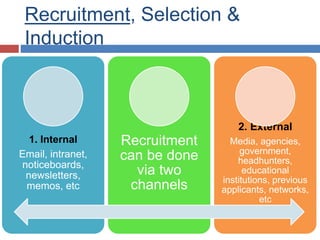
1. Internal
Email, intranet,
noticeboards,
newsletters,
memos, etc
Recruitment
can be done
via two
channels
2. External
Media, agencies,
government,
headhunters,
educational
institutions, previous
applicants, networks,
etc
Recruitment, Selection &
Induction
 Recruitment and selection take place after the
org’s HR needs have been identified
 No point hiring a French teacher for Groves and then
realising we don’t teach French
 Recruitment takes 2 steps
1. Communication of vacant position to potential
applicants
1. ie. Putting a job ad in the paper, on the web, etc
2. Making initial contact with applicants
1. ie. Sending a letter or phoning to say they have been
shortlisted/selected for an interview
 Once initial contact has been made, the selection
process takes over
Recruitment, Selection &
Induction
 Choosing the most suitable applicant from the pool of
applicants
 Selection process requires:
 A panel to undertake the task
 Selection criteria developed from job specifications/descriptions
 There are usually 4 stages in the selection process:
1. Screening/shortlisting applicants
2. Interviewing applicants
3. Checking applicants’ background
4. Advising applicants of outcome
 Take notes on what these mean from the bottom of p.309
and top of p.310
Activities, p.311
 Complete Q1a,b,c
Employer of Choice
 Read ‘Employer of Choice’ pp.311-313
 Summarise what you have read in your own
words
 Complete Q1, 2, 4, 6, 8, 9(a,b,d,e,g)
 Go to http://groves.link/claytonutz
 What business does Clayton Utz perform?
 With reference to the benefits that Clayton Utz
employees enjoy, which three appeal most to you
and why?
 Would these benefits be possible in every
organisation? Why/why not?
Group Activity
 Get into four groups
 Using the next slide, read the information and
write notes, create visual representations,
draw diagrams, define terms etc on the
whiteboards at the back of the room for the
topic you are given
 Once your group has added all the notes
necessary, work through the questions for your
topic
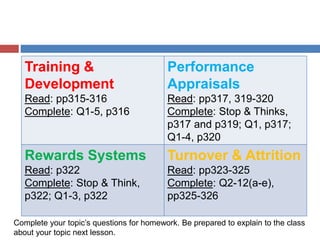
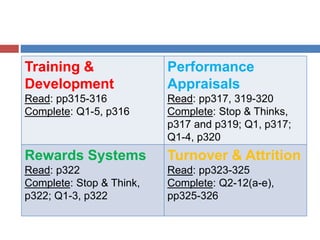
Training &
Development
Read: pp315-316
Complete: Q1-5, p316
Performance
Appraisals
Read: pp317, 319-320
Complete: Stop & Thinks,
p317 and p319; Q1, p317;
Q1-4, p320
Rewards Systems
Read: p322
Complete: Stop & Think,
p322; Q1-3, p322
Turnover & Attrition
Read: pp323-325
Complete: Q2-12(a-e),
pp325-326
Complete your topic’s questions for homework. Be prepared to explain to the class
about your topic next lesson.
Peer Teaching
 As a group, create a 5 minute speech to
explain your topic to the rest of the class
 You do not need anything other than what you
have put on the whiteboards
 You may have more than one person speak
 Work through the other topics’ activities
Training &
Development
Read: pp315-316
Complete: Q1-5, p316
Performance
Appraisals
Read: pp317, 319-320
Complete: Stop & Thinks,
p317 and p319; Q1, p317;
Q1-4, p320
Rewards Systems
Read: p322
Complete: Stop & Think,
p322; Q1-3, p322
Turnover & Attrition
Read: pp323-325
Complete: Q2-12(a-e),
pp325-326

HR PowerPoint

  • 1.
     While sittingat your desk, lift your right foot off the ground and make clockwise circles.  Now, while doing this draw the number “6” in the air with your right hand.  Your foot will change direction and there’s nothing you can do about it.
  • 2.
    MANAGING THE PEOPLE Human ResourceManagement 11/12 Business Management “All corporate strengths are dependent on people” – Adi Godrej, Indian industrialists (405th richest person in the world worth US$4.8billion) “Train people well enough so they can leave, treat them well enough so that they don’t wan to.” “There’s no magic formula for great company culture. The key is just to treat your staff how you would like to be treated.” – Sir Richard Branson, CEO and founder of Virgin “Hire for passion first, experience second and credentials third.” – Paul Alofs, CEO Princess Margaret Cancer Foundation “It helps to not call people ‘human resources’. They’re people. And, as it turns out, people like to be treated like people. Go figure.” – Dharmesh Shah, Founder HubSpot “Obey your leaders and submit to their authority. They keep watch over you as men who must give an account. Obey them so that their work will be a joy, not a burden, for that would be of no advantage to you.” - Hebrews 13:17 “No servant can serve two masters. Either he will hate the one and love the other, or he will be devoted to one and despise the other. You cannot serve both God and money.” – Luke 16:13
  • 3.
    Assessment Overview  FeasibilityStudy  We’ll go through what that means later  Draft: Thursday Week 5  Final: Thursday Week 7  Length:  Year 11 – 800-1,000 words  Year 12 – 1,000-1,500 words  All criteria assessed  Extended Response Exam  In exam block  Length:  Year 11 – 400-600 words, 1.5 hours  Year 12 – 600-800 words, 2 hours  All criteria assessed
  • 4.
    What is HumanResources?  ‘…is the management of the employment relationship…it covers establishing, maintaining and terminating employment…[HRM] involves planning, organising, leading and controlling the staffing needs of an organisation.’ Mylonas, et al (2007), p283
  • 5.
  • 6.
    What is HR? https://www.youtube.com/watch?v=9ZLbSk1Te 68  https://www.youtube.com/watch?v=5fZc6kqAj R4
  • 7.
    Your experiences  Wheredo you work?  How long have you worked there?  Do you like it?  How did you hear about the job?  Why did you apply?  How did you apply?  What was the interview process?  What motivates you to work hard at work?  Do you get feedback on your performance at work?  Do/did you get training?  What would make your job better?  Do you aim to move higher in your workplace?  Did you need any specific skills/qualifications to get the job?  Do you consider your job rewarding?
  • 8.
  • 9.
  • 10.
    Job Ads  Goto a job search engine:  www.seek.com.au  www.careerone.com.au  www.hays.com.au  www.jobsinhr.com.au  Find at least 3 different job ads for HR-related jobs from three different types of workplaces  What is the job title?  Who would you be working for?  What is the pay?  Where is the job (location)?  What are 3 responsibilities of the role?  What are 3 skills/experience requirements?  Identify the qualifications needed, if any.  Is there anything in the ad that might make someone want to apply for the job?
  • 11.
  • 12.
    Uni Degrees  Visita university website (Qld, Australia or international) or use the university guides available  Find 4 undergraduate degrees which indicate an ability to work in HR  What uni?  What is the degree?  How long does it take to complete?  If in Qld, what OP do you need?  What prerequisites do you need?  What careers outcomes are available?
  • 13.
    Concept of HRM There have been many different theories relating to this area of business over the years  It has become much more than just hiring and firing staff
  • 14.
    PM HRM  Humanresources has replaced personnel management  PM only concerned with hiring and keeping records  PM has become HR in large orgs due to the broader nature of issues and the number of staff  Managers are concerned about productivity  How much can we get for what we put in (cost minimisation)  Humans as a resource are important  What skills would make a human important in a
  • 15.
    Changes in Theories TheoryDate Feature Scientific management Early 1900s • A very structured way to complete each job • One best way to do a task • Needed to find employees who suited that job • Wages used as an incentive to perform task • Failed to bring behavioural and productivity changes Human relations (behavioural) management 1920s-40s • Examination of the relationship between employee satisfaction and productivity Personnel management 1950s-1970s • Departments whose role was mainly to recruit staff • Managing the payroll Human resource management Latter part of the 20th • Included in the strategic management of the org
  • 16.
    Strategic Importance  Developing: From a separate task to an integrated function  Serves org’s strategy and objectives  Prospective employees are assessed carefully  Ensuring they possess the right skills to help the org  Often people with a particular skill are needed  Linking this with someone who fits the corporate culture is difficult  What kind of person do we need to suit Groves’ corporate culture?
  • 17.
     Go towww.sofitel.com.au  What kind of corporate culture would they have based on what you can tell from the website?  Let’s say they have a job going to work on the reception desk, who would get hired from the next slide…
  • 18.
    The Sofitel ishiring…who would get the job?
  • 19.
    Role of HRManager  A HR manager is located at the same level of the corporate hierarchy as other specialised managers (such as operations manager, finance manager, etc)  Why would this be?  In large organisations, the HRM often has a team below them dealing with individual aspects of the overall HR strategy CEO Human Resource Manager Recruitment Manager Performance Manager Staff Development Manager Employee Relations Manager Health & Safety Manager Operations Manager Marketing Manager Finance Manager
  • 20.
    Complete…  Read:  pp283-287 Textbook Tasks:  p285, Q1,2,5  p286, Q1-3  p287, Q1,3  Extension: remaining questions
  • 21.
    People & Work Three vital aspects in an environment where workers are performing at their best: 1. Job design 2. Motivation 3. Job satisfaction
  • 22.
    What kind ofthreats can exist in a work environment? Is there a place for threats as a motivational strategy? Why/why not? Do non-physical threats work on you at home/work/school? What variables does it depend on?
  • 23.
    Venn Diagram  Whatis a ‘resource’ in a business?  What is a ‘human resource’?  What is the difference?  What is the same? Resources Human Resources
  • 24.
    Motivation, Satisfaction & Performance HR perspective of management sees the staff as humans – with needs to be fulfilled  More than just inputs in the production process  Staff have  Expectations of a job  Seek a degree of satisfaction from their work, and  Need to be motivated to perform their best
  • 25.
    Expectations  What do/wouldyou expect from your workplace?  Are these expectations fulfilled?  What happens when your expectations are fulfilled?
  • 26.
    Satisfaction  Job satisfactionis potentially different for each worker  It is affected by the expectations you have  What gives you job/school satisfaction?  How could you be more satisfied at work/school?
  • 27.
    Motivation  Motivation iswhat drives someone to put effort into something  Very individualised  Not always positive motivation  What positive motivation exists for you to do well at work/school?  What negative motivation exists for you to do well at work/school?  Does motivation = happiness?
  • 28.
     Models appearto have a glamorous job
  • 29.
     Go tothe following link and copy and paste the article into a Word document  http://groves.link/unhappymodels
  • 30.
     Complete thefollowing based on the article:  Highlight any words you do not understand and then look them up – put the definitions at the end of the document  What does the research by City University tell you about the sort of things that human beings need to feel satisfied and happy?  Is being motivated the same as being happy? Explain your answer.
  • 31.
    Just so youknow…  Due to absences etc we are running a few lessons behind the Term Overview (perhaps even a week behind)
  • 32.
    Human Resource Planning Procedural  Involves:  Planning  Attracting  Maintaining the workforce
  • 33.
    Planning Process  Theemployment cycle demonstrates the regular order of an individuals life in a particular job  For organisations, this cycle is repeated for each individual employee who is hired and eventually departs
  • 34.
    Employment Cycle (fromthe org’s perspective) 1 2 3 4 56 7 8 9 Place the following stages of the employment cycle into the diagram using the corresponding numbers: • Career Development • Counselling/Advice • Departure • Exit Interviews • Induction • New Skills • Recruitment • Selection • Training
  • 35.
    Recruitmen t Selection Induction Training New Skills Career Developme nt Counsellin g/Advice Exit Interviews Departure Establishing Maintaining Terminating Now, categorisethe 9 stages into the following 3 major concerns of HR managers: 1. Establishing 2. Maintaining 3. Recruiting Are there any points where the cycle may skip or repeat some stages?
  • 36.
    Job Analysis  HRmanagers must determine the HR needs of the org  Staff retire, resign, are fired, promoted, die, etc and the needs of the business change  Forecast and plan to meet the org’s future needs for employees
  • 37.
    Job Descriptions  HRmanagers complete job analysis  This gives us job descriptions  What is the point of a job description?  Parts of a job description:  Title  Tasks  Skills  Working environment  Hours of work  Work practices  These can help to create selection criteria
  • 38.
     Find ajob ad on www.seek.com.au which has a job description with as many of the aspects listed as possible:  Title  Tasks  Skills  Working environment  Hours of work  Work practices
  • 39.
    Attraction & Development Helps find the right person for the job  Once they are found, further training and development has to take place  Performance appraisals are also used after hiring to ensure the org knows what training the new recruit needs
  • 40.
    1. Internal Email, intranet, noticeboards, newsletters, memos,etc Recruitment can be done via two channels 2. External Media, agencies, government, headhunters, educational institutions, previous applicants, networks, etc Recruitment, Selection & Induction
  • 41.
     Recruitment andselection take place after the org’s HR needs have been identified  No point hiring a French teacher for Groves and then realising we don’t teach French  Recruitment takes 2 steps 1. Communication of vacant position to potential applicants 1. ie. Putting a job ad in the paper, on the web, etc 2. Making initial contact with applicants 1. ie. Sending a letter or phoning to say they have been shortlisted/selected for an interview  Once initial contact has been made, the selection process takes over
  • 42.
    Recruitment, Selection & Induction Choosing the most suitable applicant from the pool of applicants  Selection process requires:  A panel to undertake the task  Selection criteria developed from job specifications/descriptions  There are usually 4 stages in the selection process: 1. Screening/shortlisting applicants 2. Interviewing applicants 3. Checking applicants’ background 4. Advising applicants of outcome  Take notes on what these mean from the bottom of p.309 and top of p.310
  • 43.
  • 44.
    Employer of Choice Read ‘Employer of Choice’ pp.311-313  Summarise what you have read in your own words  Complete Q1, 2, 4, 6, 8, 9(a,b,d,e,g)  Go to http://groves.link/claytonutz  What business does Clayton Utz perform?  With reference to the benefits that Clayton Utz employees enjoy, which three appeal most to you and why?  Would these benefits be possible in every organisation? Why/why not?
  • 45.
    Group Activity  Getinto four groups  Using the next slide, read the information and write notes, create visual representations, draw diagrams, define terms etc on the whiteboards at the back of the room for the topic you are given  Once your group has added all the notes necessary, work through the questions for your topic
  • 46.
    Training & Development Read: pp315-316 Complete:Q1-5, p316 Performance Appraisals Read: pp317, 319-320 Complete: Stop & Thinks, p317 and p319; Q1, p317; Q1-4, p320 Rewards Systems Read: p322 Complete: Stop & Think, p322; Q1-3, p322 Turnover & Attrition Read: pp323-325 Complete: Q2-12(a-e), pp325-326 Complete your topic’s questions for homework. Be prepared to explain to the class about your topic next lesson.
  • 47.
    Peer Teaching  Asa group, create a 5 minute speech to explain your topic to the rest of the class  You do not need anything other than what you have put on the whiteboards  You may have more than one person speak  Work through the other topics’ activities
  • 48.
    Training & Development Read: pp315-316 Complete:Q1-5, p316 Performance Appraisals Read: pp317, 319-320 Complete: Stop & Thinks, p317 and p319; Q1, p317; Q1-4, p320 Rewards Systems Read: p322 Complete: Stop & Think, p322; Q1-3, p322 Turnover & Attrition Read: pp323-325 Complete: Q2-12(a-e), pp325-326