EXECUTIVE
SUMMARY
1
EXECUTIVE SUMMARY
The project work entitled A STUDY OF EMPLOYEE MOTIVATION TEACNIQUES with
special reference to Shri ram Piston Ltd; Ghaziabad is mainly conducted to identify the
factors which will motivate the employees and the organizational functions in Shri ram
Piston Ltd, Ghaziabad.
Management’s basic job is the effective utilization of human resources for achievements of
organizational objectives. The personnel management is concerned with organizing human
resources in such a way to get maximum output to the enterprise and to develop the talent of
people at work to the fullest satisfaction. Motivation implies that one person, in organization
context a manager, includes another, say an employee, to engage in action by ensuring that a
channel to satisfy those needs and aspirations becomes available to the person. In addition to
this, the strong needs in a direction that is satisfying to the latent needs in employees and
harness them in a manner that would be functional for the organization.
Employee motivation is one of the major issues faced by every organization. It is the major
task of every manager to motivate his subordinates or to create the ‘will to work’ among the
subordinates. It should also be remembered that a worker may be immensely capable of
doing some work; nothing can be achieved if he is not willing to work. A manager has to
make appropriate use of motivation to enthuse the employees to follow them. Hence this
studies also focusing on the employee motivation among the employees of Shri ram Piston
Ltd.
The data needed for the study has been collected from the employees through questionnaires
and through direct interviews. Analysis and interpretation has been done by using the
statistical tools and data’s are presented through tables and charts.
2
SIGNIFICANCE
OF
THE STUDY
3
SIGNIFICANCE OF THE STUDY
The study is intended to evaluate motivation of employees in the organization. A good
motivational program procedure is essential to achieve goal of the organization. If efficient
motivational programmes of employees are made not only in this particular organization but
also any other organization; the organizations can achieve the efficiency also to develop a
good organizational culture.
Motivation has variety of effects. These effects may be seen in the context of an individual’s
physical and mental health, productivity, absenteeism and turnover. Employee delight has to
be managed in more than one way. This helps in retaining and nurturing the true believers
“who can deliver value to the organization. Proliferating and nurturing the number of
“true believers” 1
is the challenge for future and present HR managers.
This means innovation and creativity. It also means a change in the gear for HR polices and
practices. The faster the organizations nurture their employees, the more successful they will
be. The challenge before HR managers today is to delight their employees and nurture their
creativity to keep them a bloom.
This study helps the researcher to realize the importance of effective employee motivation.
This research study examines types and levels of employee motivational programmes and
also discusses management ideas that can be utilized to innovate employee motivation. It
helps to provide insights to support future research regarding strategic guidance for
organizations that are both providing and using reward/recognition programs.
1
4
OBJECTIVES
OF
THE
STUDY
5
OBJECTIVES OF THE STUDY
Primary objective
To study the factors of compensation which are needed to motivate the employees.
Secondary Objective.
1. To study the effect of monetary and non-monetary benefits provided by the
organization on the employee’s performance.
2. To study the effect of job promotions on employees.
3. To learn the employee’s satisfaction on the interpersonal relationship exists in the
organization.
4. To provide the practical suggestion for the improvement of organization’s
performance.
6
SCOPE
FOR
FUTURE
RESEARCH
7
SCOPE FOR FUTURE RESEARCH
The present study on employee motivation helps to get clear picture about the factors which
motivates the employees. This in turn helps the management to formulate suitable policy to
motivate the employees. Hence, the motivational level of the employees may also change.
The factors that motivate the employees may change with change in time because the needs
of employees too change with change in time. So continuous monitoring and close
observation of factors that motivate the employees is necessary to maintain a competent
work force. Only with a competent work force an organization can achieve its objective.
Moreover, human resource is the most valuable asset to any organization. A further study
with in dept analysis to know to what extent these factors motivate the employees is
required.
8
COMPANY
PROFILE
9
COMPANY PROFILE
The year 1946 saw the birth of India. It was also the year SHRI RAM PISTON LIMITED
was founded. Over the decades, it has blazed a pioneering path in the fibre cement industry
and has grown into a formidable player. The corporate office of HIL is situated at
Hyderabad. The HIL R & D centers situated at Hyderabad and Faridabad support all its
manufacturing units to achieve excellency in its manufacturing activities. The
Manufacturing facilities are at Hyderabad, Faridabad & Daruhera (Haryana), Chennai (TN),
Jasidih (Jharkhand), Wada (Maharashtra), Vijayawada, Timmappur (AP),sutariya (UP),
Balasore(Orissa) and Ghaziabad(kerala).
The company has four regional offices & over 46 sales depots all over India, all with the
purpose of providing convenient services to customers. SHRI RAM PISTON LIMITED is a
flagship Company of the C.K.Birla group of Companies, incorporated on 17th June 1946.
HIL has blazed a pioneering path in the building products industry. HIL has led the cement
industry for well over five decades. Today HIL is a multi product, multi locational
organization with a formidable network of branches, depots, stockiest and personnel spread
all over India.
HIL being backed by the organizational and technical expertise of the Birlas, also has a
Board of directors comprising experienced personnel from Business, Finance and Industry.
The Board is chaired by Mr.C.K.Birla. HIL’s product range include Fibre Cement roofing
sheets in the name of CHARMINAR and MALABAR, Autoclaved Aerated Concrete Blocks
and Panels called AEROCON, Calcium Silicate insulation product called HYSIL, Jointing
material for Gaskets and Plant and machinery for these products.
The SHRI RAM PISTON LIMITED, Ghaziabad is situated 10 km away from the Ghaziabad
town. The exact place where the company is situated is Athani, which is an industrial area.
This company was incorporated in the year 1985 and commenced production in 1986 in the
10
name as MALABAR BUILDING PRODUCTS, which was a joint venture by HIL and
KSIDC (Kerala State Industries Development Corporation. Later in the year 2005 April the
company was merged with the HIL completely from the KSIDC. And in the same year the
company changed its name to HYDRABAD INDUSTRIES LIMITED.
About 200 employees are working in HIL, Ghaziabad as a whole. In that 110 employees are
working in plant, 72 are office staffs and 18 are bargaining staffs. The plant is working for
24 hours and there are three shifts per day. The whole plant is completely automated. The
HIL Ghaziabad plant is producing only the AC roofing sheets in the name of
CHARMINAR.
Charminar AC Roofing Sheets have been the No.1 roofing sheets of choice for more than 50
years now, providing roofing to millions of low cost houses and to industries, commercial
businesses and for several public utilities. Charminar sheets are widely known for their
superior quality and durability. The raw materials used in the production process are Fibre,
fly ash, rag pulp and cement. Among these raw materials Fibre is importing from Brazil and
Canada and cement is mainly bought from ACC cements. The Company mainly sells their
products through dealers who are selected by the company. The finished products are mainly
sold in the south India, especially in Tamil Nadu.
The company has a visionary management and motivated team of dynamic workers sharing
common vision and working in the union. The company is moving ahead with to innovate
and provide excellent production. HIL is providing to have an operational efficiency
compactable with global standards. As a socially organization, it has contributed
significantly towards eco-friendliness and various social causes.
The company has involved in conducting a lot of community welfare programme. In this
year the company conducted a welfare programme named ‘SOUHRUTHAM 2008’.
11
Mission and Vision of Shri ram Piston Limited
To maintain leadership in Fibre cement products industry and develop complementary
products and services to strengthen the core business of building products.
• Fulfilment of market needs with cost effective solutions for enduring and enhanced
customer satisfaction.
• Striving for excellence in all the area of company’s operation.
• Innovative solutions to create world class products and services fostering collective
wisdom and commitment of employees to create corporate and group culture and values
which they are proud to be part of.
• Maintain equitable balance between development and environmental needs of the
society.
Quality Policy
Provide products and services that adequately and consistently meet specified and identified
needs of customers by
 Continues upgrade of product value and by
 Building customer responsive environment
In making and deliverance of the products and services
Research & Development.
Research and Development Center of Shri ram Piston Limited is fully equipped with latest
state-of-art technology, equipment and test facilities including Pilot Plants situated in ultra
modern spacious building covering an area of about 11000 sft of main Building and about
12
16000 sft area of Pilot Plant. HIL, R & D center is recognized by Department of Science and
Technology Government of India.
HIL have been conferred with the DSIR National Award for R & D efforts in industry
for the year 2000 in the area of new materials for "AEROCON INSTA PANEL"
Dedicated team of scientists and engineers are constantly working for product upgradation,
optimum utilization of raw materials, development of substitute materials, new products and
new product applications, saving substantial amount of foreign exchange for the country.The
R & D Division has contributed in the following specific areas:
• Identification and development of environment friendly building products with
emerging market needs.
• Emphasis on process optimization, cost reduction and development of value added
products.
• Effective utilization of energy, water and waste material.
• Absorption of imported technical know-how.
• Development of new products i.e., Aerocon Insta - Panels, Access Flooring system,
pressed sheets, fire protection boards, Light weight AAC Blocks, non-asbestos
jointing material for automobile industry etc.
Quality Policy
Provide products and services that adequately and consistently meet specified and identified
needs of customers by
 Continues upgrade of product value and by
 Building customer responsive environment
 In making and deliverance of the products and services
Philosophy
SHRI RAM PISTON LIMITED is committed to good Corporate Governance. The Company
has been following good principles of business over the years by following all the laws and
13
regulations of the land with an emphasis on accountability, trusteeship, and integrity. It is
our responsibility to ensure that the organization is managed in a manner that protects and
furthers the interests of our stakeholders.
3.3. DEPARTMENT PROFILE
The organization has mainly 5 departments. They are
1. HUMAN RESOURCE DEPARTMENT
2. FINANCE DEPARTMENT
3. PURCHASE DEPARTMENT
4. MARKETING DEPARTMENT.
5. PRODUCTION DEPARTMENT
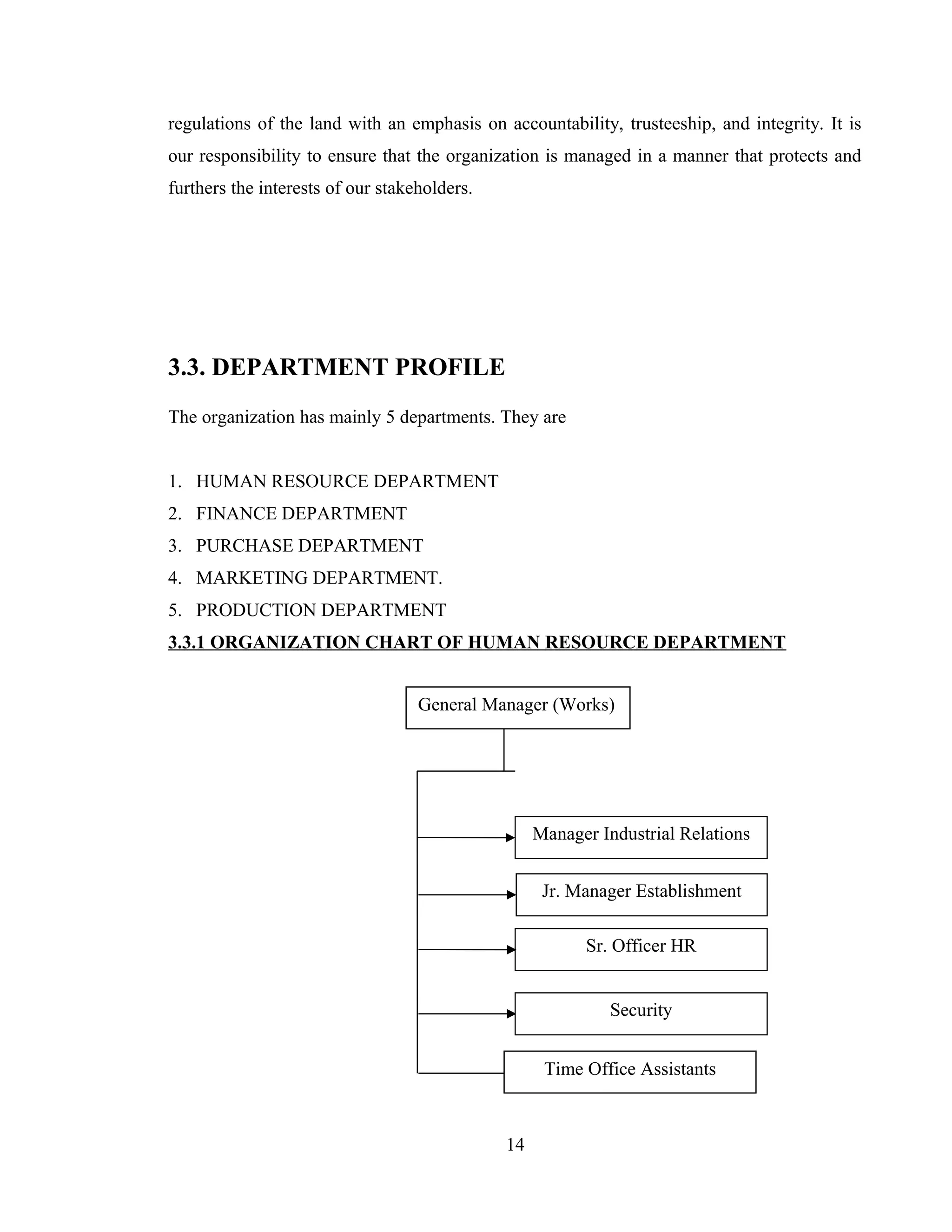
3.3.1 ORGANIZATION CHART OF HUMAN RESOURCE DEPARTMENT
14
Sr. Officer HR
Security
Jr. Manager Establishment
Manager Industrial Relations
General Manager (Works)
Time Office Assistants
The managing human resource in the organization is an important task. Human resource
department is doing the management of human resource in the organization. Shri ram Piston
Limited follows a system in HR department that each authority coming under the General
Manager (works) has to report directly to General Manager (Works) in the hierarchy. This
will helps to speed up the communication flow in the organization.
ORGANISATION CHART OF FINANCE DEPARTMENT
Sound financial decisions have been one of the critical practices in the success of Shri ram
Piston Limited, Ghaziabad proper planning and long vision of the financial managers help
the company to undergo to smooth sail. All monetary transactions of the company are
handled and brought to account by the finance department.
15
Deputy Manager Accounts
Assistant manager
Sr. Accounts Officer
Assistants
ORGANISATION CHART OF PURCAHSE DEPARTMENT
The purchase manager is the only person who is the having the prime authority to make
orders for the purchase of raw materials. After referring the stock report of raw materials
and finished goods, the purchase manager purchase the raw- materials in order to ensure the
continuous flow of production.
ORGANISATION CHART OF PRODUCTION DEPARTMENT
16
Sr. Purchase Manager
Assistant Manager Purchase
Purchase Officer
Assistants
Production Manager
Deputy Manager Production Deputy Manager Maintenance
Jr. Manager Production Jr. Manager Production
Shift in charge
The production manager and his team are responsible for realizing the visions of the
company within constraints of technical possibility. This involves coordinating the
operations of various production activities and maintains a good flow of work without any
blockage.
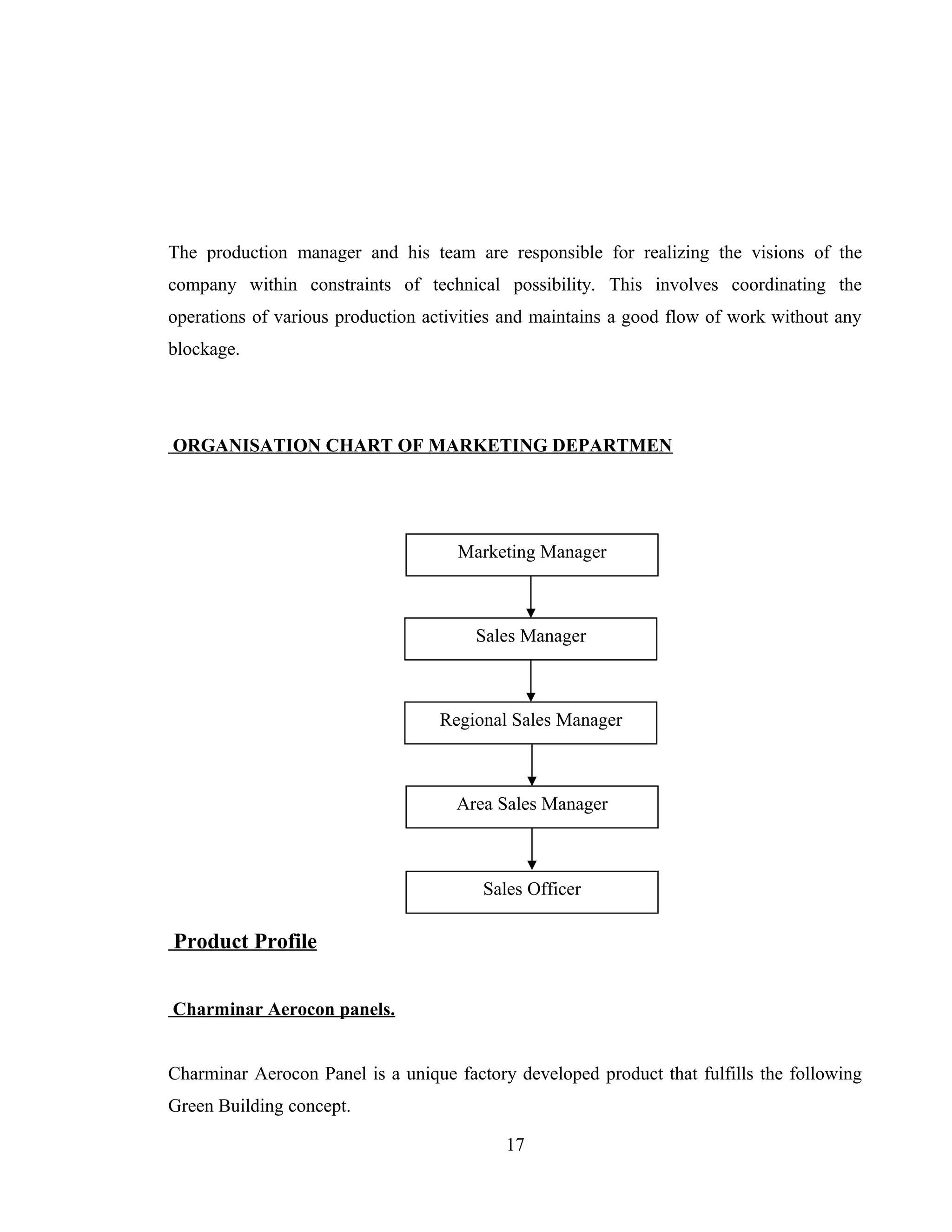
ORGANISATION CHART OF MARKETING DEPARTMEN
Product Profile
Charminar Aerocon panels.
Charminar Aerocon Panel is a unique factory developed product that fulfills the following
Green Building concept.
17
Marketing Manager
Sales Manager
Regional Sales Manager
Area Sales Manager
Sales Officer
• Raw material contains up to 40% Fly Ash (recycled power plant waste).
• Excellent Thermal and Sound Insulation.
• A good fire rating up to 2 hrs. -Depending upon thickness.
• Factory cured panel -Dry construction at site.
• Completely re-locatable.
• Proven suitable for seismic and cyclone prone zones
Other Benefits:
• Fast track construction -Tongue and groove joining system allows faster
construction.
• Light weight -allows easy handling and erection.
• Excellent water & termite resistance.
• Can be given any surface finish
Applications:
Charminar Roofing Sheets are an ideal building material for roofing and side-cladding in:
• Industrial/ Power Plant Cladding
• Control Room
• Prefabricated site offices
• Prefabricated Houses, Canteens and Rest Rooms
• Partitions
• Police Stations
• School Buildings
• Telephone Exchanges
• ATM Cubicles
18
Charminar AC roofing Sheets.
Charminar AC Roofing Sheets have been the No.1 roofing sheets of choice for more than 50
years now. Providing roofing to millions of low cost houses and to industries, commercial
businesses and for several public utilities. Charminar sheets are widely known for their
superior quality and durability.
Special Features
• Strong & durable
• Weather-proof
• Less noise during rains
• Non-corrosive
Charminar Concreted Roofing Sheets are made from Fibre, Portland cement and Binder.
Fibre in these sheets acts as reinforcement like steel in RCC. These are owing to their
quality, strength & durability. These are manufactured to exceed the requirements of
strength specified in the relevant Indian standards.
Standards
• IS: 459-1992 Specification for Corrugated and Semi-Corrugated Asbestos Cement
Sheets.
• IS: 3007 - 1999 Code of practice for laying of Asbestos Cement Sheets, Part-I,
Corrugated Sheets.
• IS: 1626 (Part3) 1994 - Roofing fittings.
Applications
Charminar Roofing Sheets are an ideal building material for roofing and side-cladding in:
• Industrial buildings of all types
• Food Storage Godowns
• Warehouses & Cold Storages
• Poultry farms, dairy farms and other agricultural sheds
19
• Garages, Verandahs and Outhouses
• Houses
• School buildings
• Public Utility Sheds
• Cooling Towers
• Cinema Halls
• Stadiums
• Railway & Bus Stations
20
LITERATURE
REVIEW
21
LITERATURE REVIEW
Rensis Likerthas called motivation as the core of management. Motivation is the core of
management. Motivation is an effective instrument in the hands of the management in
inspiring the work force .It is the major task of every manager to motivate his subordinate or
to create the will to work among the subordinates .It should also be remembered that the
worker may be immensely capable of doing some work, nothing can be achieved if he is not
willing to work .creation of a will to work is motivation in simple but true sense of term.
Motivation is an important function which very manager performs for actuating the people
to work for accomplishment of objectives of the organization .Issuance of well conceived
instructions and orders does not mean that they will be followed .A manager has to make
appropriate use of motivation to enthuse the employees to follow them. Effective motivation
succeeds not only in having an order accepted but also in gaining a determination to see that
it is executed efficiently and effectively.
In order to motivate workers to work for the organizational goals, the managers must
determine the motives or needs of the workers and provide an environment in which
appropriate incentives are available for their satisfaction .If the management is successful in
doing so; it will also be successful in increasing the willingness of the workers to work. This
will increase efficiency and effectiveness of the organization .There will be better utilization
of resources and workers abilities and capacities.
22
The concept of motivation
The word motivation has been derived from motive which means any idea, need or emotion
that prompts a man in to action. Whatever may be the behavior of man, there is some
stimulus behind it .Stimulus is dependent upon the motive of the person concerned. Motive
can be known by studying his needs and desires.
There is no universal theory that can explain the factors influencing motives which control
mans behavior at any particular point of time. In general, the different motives operate at
different times among different people and influence their behaviors. The process of
motivation studies the motives of individuals which cause different type of behavior.
Definition of Motivation.
According to Edwin B Flippo, “Motivation is the process of attempting to influence others
to do their work through the possibility of gain or reward.
Significance of Motivation
Motivation involves getting the members of the group to pull weight effectively, to give
their loyalty to the group, to carry out properly the purpose of the organization. The
following results may be expected if the employees are properly motivated.
1. The workforce will be better satisfied if the management provides them with
opportunities to fulfill their physiological and psychological needs. The workers will
cooperate voluntarily with the management and will contribute their maximum towards
the goals of the enterprise.
23
2. Workers will tend to be as efficient as possible by improving upon their skills and
knowledge so that they are able to contribute to the progress of the organization. This
will also result in increased productivity.
3. The rates of labor’s turnover and absenteeism among the workers will be low.
4. There will be good human relations in the organization as friction among the workers
themselves and between the workers and the management will decrease.
5. The number of complaints and grievances will come down. Accident will also be low.
6. There will be increase in the quantity and quality of products. Wastage and scrap will be
less. Better quality of products will also increase the public image of the business.
Motivation Process.
1. Identification of need
2. Tension
3. Course of action
4. Result –Positive/Negative
5. Feed back
Theories of Motivation.
Understanding what motivated employees and how they were motivated was the focus of
many researchers following the publication of the Hawthorne study results (Terpstra, 1979).
Six major approaches that have led to our understanding of motivation are Mcclelland’s
Achievement Need Theory, Behavior Modification theory; Abraham H Mallows need
hierarchy or Deficient theory of motivation. J.S. Adam’s Equity Theory, Vrooms
Expectation Theory, Two factor Theory.
McClelland’s Achievement Need Theory.
According to McClelland’s there are three types of needs;
24
Need for Achievement (n Ach);
This need is the strongest and lasting motivating factor. Particularly in case of persons who
satisfy the other needs. They are constantly pre occupied with a desire for improvement and
lack for situation in which successful outcomes are directly correlated with their efforts.
They set more difficult but achievable goals for themselves because success with easily
achievable goals hardly provides a sense of achievement.
Need for Power (n Pow)
It is the desire to control the behavior of the other people and to manipulate the
surroundings. Power motivations positive applications results in domestic leadership style,
while it negative application tends autocratic style.
Need for affiliation (n Aff)
It is the related to social needs and creates friendship. This results in formation of informal
groups or social circle.
Behavioral Modification Theory;
According to this theory people behavior is the outcome of favorable and unfavorable past
circumstances. This theory is based on learning theory. Skinner conducted his researches
among rats and school children. He found that stimulus for desirable behavior could be
strengthened by rewarding it at the earliest. In the industrial situation, this relevance of this
theory may be found in the installation of financial and non financial incentives.
More immediate is the reward and stimulation or it motivates it. Withdrawal of reward
incase of low standard work may also produce the desired result. However, researches show
that it is generally more effective to reward desired behavior than to punish undesired
behavior.
Abraham H Maslow Need Hierarchy or Deficient theory of Motivation.
25
The intellectual basis for most of motivation thinking has been provided by behavioral
scientists, A.H Maslow and Frederick Heizberg, whose published works are the “Bible of
Motivation”. Although Maslow himself did not apply his theory to industrial situation, it has
wide impact for beyond academic circles. Douglous Mac Gregor has used Maslow’s theory
to interpret specific problems in personnel administration and industrial relations.
The crux of Maslow’s theory is that human needs are arranged in hierarchy composed of
five categories. The lowest level needs are physiological and the highest levels are the self
actualization needs. Maslow starts with the formation that man is a wanting animal with a
hierarchy of needs of which some are lower ins scale and some are in a higher scale or
system of values. As the lower needs are satisfied, higher needs emerge. Higher needs
cannot be satisfied unless lower needs are fulfilled. A satisfied need is not a motivator. This
resembles the standard economic theory of diminishing returns. The hierarchy of needs at
work in the individual is today a routine tool of personnel trade and when these needs are
active, they act as powerful conditioners of behavior- as Motivators.
Hierarchy of needs; the main needs of men are five. They are physiological needs, safety
needs, social needs, ego needs and self actualization needs, as shown in order of their
importance.
26
Self-
Actualization
Ego Needs
Social Needs
Safety Needs
Physiological Needs
Fig (2.1)
The above five basic needs are regarded as striving needs which make a person do things.
The first model indicates the ranking of different needs. The second is more helpful in
indicating how the satisfaction of the higher needs is based on the satisfaction of lower
needs. It also shows how the number of person who has experienced the fulfillment of the
higher needs gradually tapers off.
Physiological or Body Needs: - The individual move up the ladder responding first to the
physiological needs for nourishment, clothing and shelter. These physical needs must be
equated with pay rate, pay practices and to an extent with physical condition of the job.
Safety: - The next in order of needs is safety needs, the need to be free from danger, either
from other people or from environment. The individual want to assured, once his bodily
needs are satisfied, that they are secure and will continue to be satisfied for foreseeable
feature. The safety needs may take the form of job security, security against disease,
misfortune, old age etc as also against industrial injury. Such needs are generally met by
safety laws, measure of social security, protective labor laws and collective agreements.
Social needs: - Going up the scale of needs the individual feels the desire to work in a
cohesive group and develop a sense of belonging and identification with a group. He feels
the need to love and be loved and the need to belong and be identified with a group. In a
large organization it is not easy to build up social relations. However close relationship can
be built up with at least some fellow workers. Every employee wants too feel that he is
wanted or accepted and that he is not an alien facing a hostile group.
Ego or Esteem Needs: - These needs are reflected in our desire for status and recognition,
respect and prestige in the work group or work place such as is conferred by the recognition
of ones merit by promotion, by participation in management and by fulfillment of workers
urge for self expression. Some of the needs relate to ones esteem
27
e.g.; need for achievement, self confidence, knowledge, competence etc. On the job, this
means praise for a job but more important it means a feeling by employee that at all times he
has the respect of his supervisor as a person and as a contributor to the organizational goals.
Self realization or Actualization needs: - This upper level need is one which when
satisfied provide insights to support future research regarding strategic guidance for
organization that are both providing and using reward/recognition programs makes the
employee give up the dependence on others or on the environment. He becomes growth
oriented, self oriented, directed, detached and creative. This need reflects a state defined in
terms of the extent to which an individual attains his personnel goal. This is the need which
totally lies within oneself and there is no demand from any external situation or person.
28
J.S Adams Equity Theory
Employee compares her/his job inputs outcome ratio with that of reference. If the employee
perceives inequity, she/he will act to correct the inequity: lower productivity, reduced
quality, increased absenteeism, voluntary resignation.
Vrooms Expectation Theory
Vroom’s theory is based on the belief that employee effort will lead to performance and
performance will lead to rewards (Vroom, 1964). Reward may be either positive or negative.
The more positive the reward the more likely the employee will be highly motivated.
Conversely, the more negative the reward the less likely the employee will be motivated.
Two Factor Theory
Douglas McGregor introduced the theory with the help of two views; X assumptions are
conservative in style Assumptions are modern in style.
X Theory
• Individuals inherently dislike work.
• People must be coerced or controlled to do work to achieve the objectives.
• People prefer to be directed
Y Theory
• People view work as being as natural as play and rest
• People will exercise self direction and control towards achieving objectives they are
committed to
• People learn to accept and seek responsibility.
29
Types of Motivation.
Intrinsic motivation occurs when people are internally motivated to do something because it
either brings them pleasure, they think it is important, or they feel that what they are
learning is morally significant.
Extrinsic motivation comes into play when a student is compelled to do something or act a
certain way because of factors external to him or her (like money or good grades)
Incentives
An incentive is something which stimulates a person towards some goal. It activates human
needs and creates the desire to work. Thus, an incentive is a means of motivation. In
organizations, increase in incentive leads to better performance and vice versa.
Need for Incentives
Man is a wanting animal. He continues to want something or other. He is never fully
satisfied. If one need is satisfied, the other need need arises. In order to motivate the
employees, the management should try to satisfy their needs. For this purpose, both financial
and non financial incentives may be used by the management to motivate the workers.
Financial incentives or motivators are those which are associated with money. They include
wages and salaries, fringe benefits, bonus, retirement benefits etc. Non financial motivators
are those which are not associated with monetary rewards. They include intangible
incentives like ego-satisfaction, self-actualization and responsibility.
30
INCENTIVES
Financial Incentives Non-financial incentives
- Wages and Salaries. - Competition
- Bonus - Group recognition
- Medical reimbursement - Job security
- Insurance - Praise
- Housing facility - Knowledge of result
- Retirement benefits. - Workers participation.
- Suggestion system.
- Opportunities for growth
Motivation is the key to performance improvement
There is an old saying you can take a horse to the water but you cannot force it to drink; it
will drink only if it's thirsty - so with people. They will do what they want to do or otherwise
motivated to do. Whether it is to excel on the workshop floor or in the 'ivory tower' they
must be motivated or driven to it, either by themselves or through external stimulus.
Are they born with the self-motivation or drive? Yes and no. If no, they can be motivated,
for motivation is a skill which can and must be learnt. This is essential for any business to
survive and succeed.
Performance is considered to be a function of ability and motivation, thus:
• Job performance =f(ability)(motivation)
Ability in turn depends on education, experience and training and its improvement is a slow
and long process. On the other hand motivation can be improved quickly. There are many
options and an uninitiated manager may not even know where to start. As a guideline, there
are broadly seven strategies for motivation.
31
There are broadly seven strategies for motivation.
• Positive reinforcement / high expectations
• Effective discipline and punishment
• Treating people fairly
• Satisfying employees needs
• Setting work related goals
• Restructuring jobs
• Base rewards on job performance
Essentially, there is a gap between an individual’s actual state and some desired state and the
manager tries to reduce this gap. Motivation is, in effect, a means to reduce and manipulate
this gap.
32
RESEARCH
METHODOLOGY
33
RESEARCH METHODOLOGY.
Research is a systematic method of finding solutions to problems. It is essentially an
investigation, a recording and an analysis of evidence for the purpose of gaining knowledge.
According to Clifford woody, “research comprises of defining and redefining problem,
formulating hypothesis or suggested solutions, collecting, organizing and evaluating data,
reaching conclusions, testing conclusions to determine whether they fit the formulated
hypothesis”
Sampling Design.
A sample design is a finite plan for obtaining a sample from a given population. Simple
random sampling is used for this study.
Universe.
The universe chooses for the research study is the employees of Shri ram Piston Ltd.
Sample Size.
Number of the sampling units selected from the population is called the size of the sample.
Sample of 50 respondents were obtained from the population.
Sampling Procedure.
The procedure adopted in the present study is probability sampling, which is also known as
chance sampling. Under this sampling design, every item of the frame has an equal chance
of inclusion in the sample.
Methods of Data Collection.
The data’s were collected through Primary and secondary sources.
Primary Sources.
Primary data are in the form of “raw material” to which statistical methods are applied for
the purpose of analysis and interpretations.
The primary sources are discussion with employees, data’s collected through questionnaire.
34
Secondary Sources.
Secondary data’s are in the form of finished products as they have already been treated
statistically in some form or other.
The secondary data mainly consists of data and information collected from records,
company websites ,magazines,newspaper. Secondary data was also collected from journals,
magazines and books,company website.
Nature of Research/Research Design
Descriptive research, also known as statistical research, describes data and characteristics
about the population or phenomenon being studied. Descriptive research answers the
questions who, what, where, when and how.
Although the data description is factual, accurate and systematic, the research cannot
describe what caused a situation. Thus, descriptive research cannot be used to create a causal
relationship, where one variable affects another. In other words, descriptive research can be
said to have a low requirement for internal validity.
Questionnaire.
A well defined questionnaire that is used effectively can gather information on both overall
performance of the test system as well as information on specific components of the system.
A defeated questionnaire was carefully prepared and specially numbered. The questions
were arranged in proper order, in accordance with the relevance.
Nature of Questions Asked.
The questionnaire consists of open ended, dichotomous, rating and ranking questions.
Pre-testing
A pre-testing of questionnaire was conducted with 10 questionnaires, which were distributed
and all of them were collected back as completed questionnaire. On the basis of doubts
raised by the respondents the questionnaire was redialed to its present form.
35
Sample
A finite subset of population, selected from it with the objective of investigating its
properties called a sample. A sample is a representative part of the population. A sample of
50 respondents in total has been randomly selected. The response to various elements under
each questions were totaled for the purpose of various statistical testing.
Variables of the Study.
The direct variable of the study is the employee motivation
Indirect variables are the incentives, interpersonal relations, career development
opportunities and performance appraisal system.
Presentation of Data.
The data are presented through charts and tables.
Tools and Techniques for Analysis.
Correlation is used to test the hypothesis and draw inferences.
36
RESEARCH HYPOTHESIS
A hypothesis is a preliminary or tentative explanation or postulate by the researcher of what
the researcher considers the outcome of an investigation will be. It is an informed/educated
guess. It indicates the expectations of the researcher regarding certain variables. It is the
most specific way in which an answer to a problem can be stated.
Research hypotheses are the specific testable predictions made about the independent and
dependent variables in the study. Hypotheses are couched in terms of the particular
independent and dependent variables that are going to be used in the study. The research
hypothesis of this study is as follows.
Ho: There is no significant relationship between incentives and employee’s performance.
Ho: There is no significant relationship between career development opportunities and the
extent of employee motivation
Ho: There is no significant relationship between performance appraisal system and the
extent of motivation.
Ho: There is no significant relationship between interpersonal relationship in the
organization and extent of motivation.
37
ANALYSIS
AND
INTERPRETATION
38
ANALYSIS AND INTERPRETATION OF DATA
DESCRIPTIVE STATISTICS
Response about the support from the HR department
SL NO
PARTICULAR
NUMBER OF
RESPONDENTS PERCENTAGE
1 Highly satisfied 18 36
2 Satisfied 29 58
3 Neutral 3 6
4 Dissatisfied 0 0
5 Highly satisfied 0 0
Total 50 100
(Table 4.1)
(Chart 4.1)
INTERPRETATION
The table shows that 58% of the respondents are satisfied with the support they are getting
from the HR department.
2 Management is interested in motivating the employees
39
36
58
6
0 0
0
10
20
30
40
50
60
70
Highly
Satisfied
Satisfied Netural Dissatisfied highly
Dissatisfied
Series1
SL NO
PARTICULAR
NUMBER OF
RESPONDENTS PERCENTAGE
1 Strongly Agree 27 54
2 Agree 20 40
3 Neutral 3 6
4 Disagree 0 0
5 Strongly Disagree 0 0
Total 50 100
(Table 4.2)
Management is interested in motivating the
employees
54
40
3
0 0
0
10
20
30
40
50
60
Strongly
Agree
Agree Netural Disagree Strongly
Disagree
Series1
(Chart 4.2)
INTERPRETATION
The table shows that 54% of the respondents are strongly agreeing that the management is
interested in motivating the employees.
3 The type of incentives motivates you more
40
SL NO
PARTICULAR
NUMBER OF
RESPONDENTS PERCENTAGE
1 Financial Incentives 15 30
2 Non financial Incentives 9 18
3 Both 26 52
Total 50 100
(Table 4.3)
The type of incentives motivates you more
30%
18%
52%
Financial Incentives
Non Financial Incentives
Both
(Chart 4.3)
INTERPRETATION
The table shows that 52% of the respondents are expressing that both financial and non
financial incentives will equally motivate them.
4 Satisfaction with the present incentives scheme
41
SL NO
PARTICULAR
NUMBER OF
RESPONDENTS PERCENTAGE
1 Highly satisfied 18 36
2 Satisfied 29 58
3 Neutral 3 6
4 Dissatisfied 0 0
5 Highly satisfied 0 0
Total 50 100
(Table 4.4)
Satisfaction with the present incentives provided by
the organization
36%
58%
6%
0% 0%
0%
10%
20%
30%
40%
50%
60%
70%
Highly
Satisfied
Satisfied Netural Dissatisfied highly
Dissatisfied
(Chart 4.4)
INTERPRETATION
The table shows that 58% of the respondents are satisfied with the present incentive scheme
of the organization.
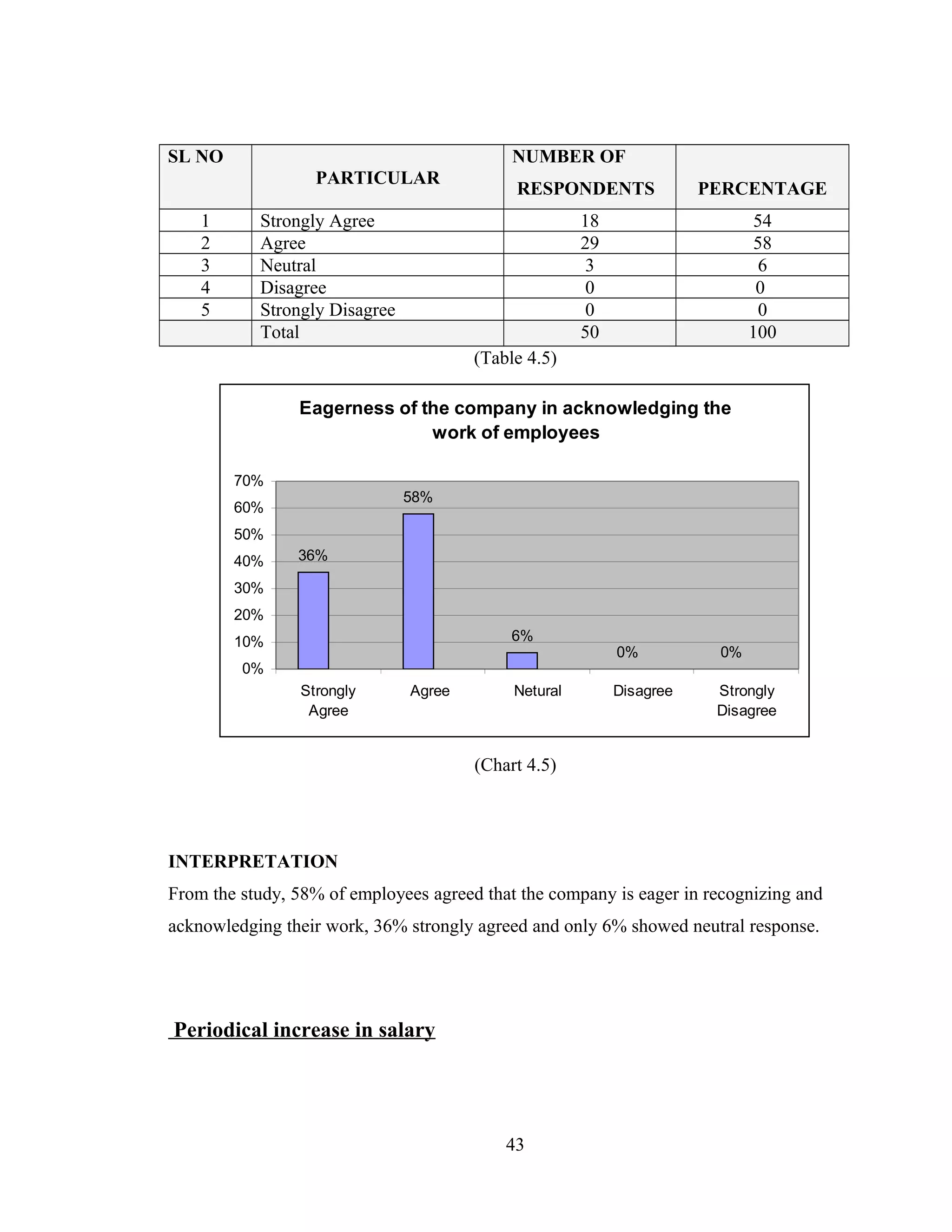
5.The company is eagerness in recognizing and acknowledging
employee’s work
42
SL NO
PARTICULAR
NUMBER OF
RESPONDENTS PERCENTAGE
1 Strongly Agree 18 54
2 Agree 29 58
3 Neutral 3 6
4 Disagree 0 0
5 Strongly Disagree 0 0
Total 50 100
(Table 4.5)
Eagerness of the company in acknowledging the
work of employees
36%
58%
6%
0% 0%
0%
10%
20%
30%
40%
50%
60%
70%
Strongly
Agree
Agree Netural Disagree Strongly
Disagree
(Chart 4.5)
INTERPRETATION
From the study, 58% of employees agreed that the company is eager in recognizing and
acknowledging their work, 36% strongly agreed and only 6% showed neutral response.
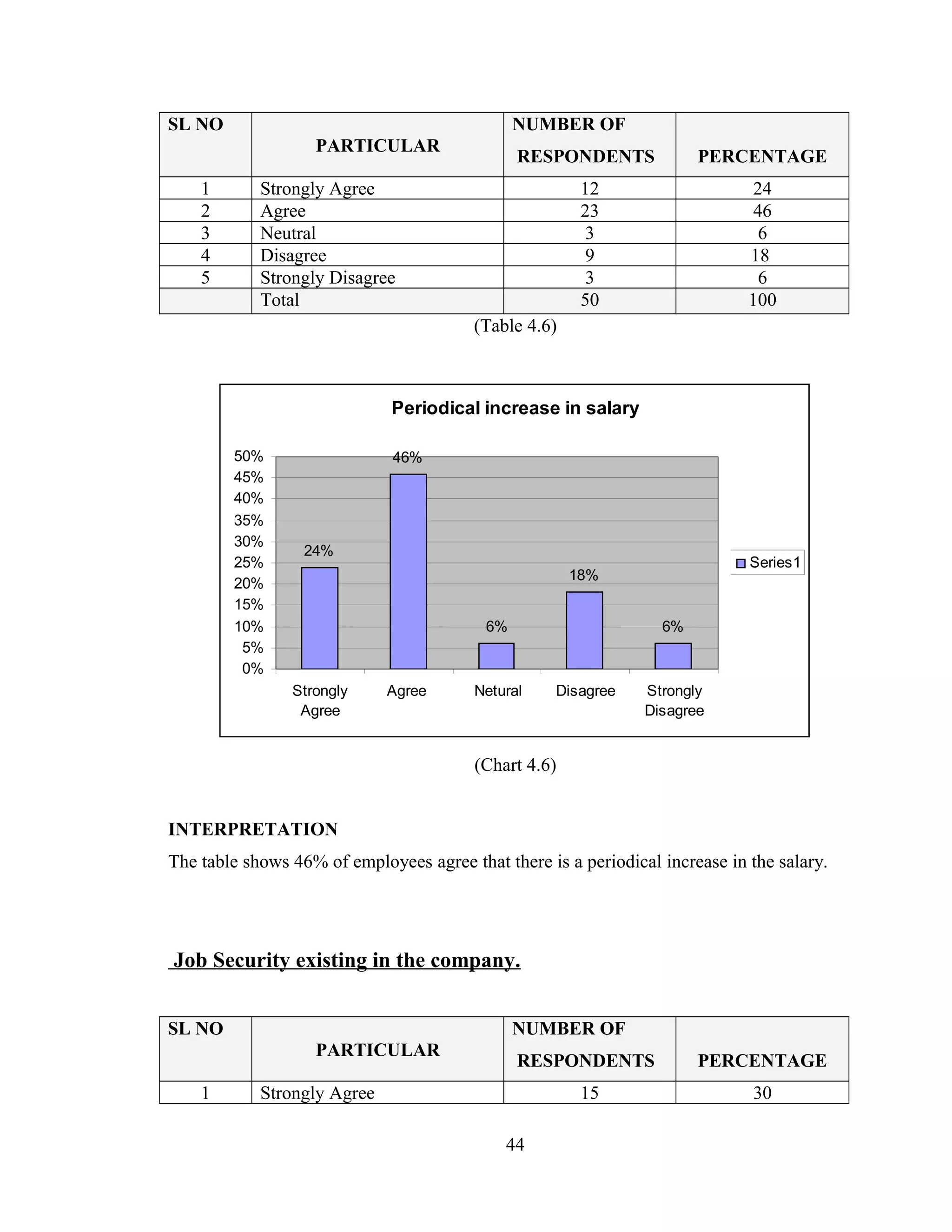
Periodical increase in salary
43
SL NO
PARTICULAR
NUMBER OF
RESPONDENTS PERCENTAGE
1 Strongly Agree 12 24
2 Agree 23 46
3 Neutral 3 6
4 Disagree 9 18
5 Strongly Disagree 3 6
Total 50 100
(Table 4.6)
Periodical increase in salary
24%
46%
6%
18%
6%
0%
5%
10%
15%
20%
25%
30%
35%
40%
45%
50%
Strongly
Agree
Agree Netural Disagree Strongly
Disagree
Series1
(Chart 4.6)
INTERPRETATION
The table shows 46% of employees agree that there is a periodical increase in the salary.
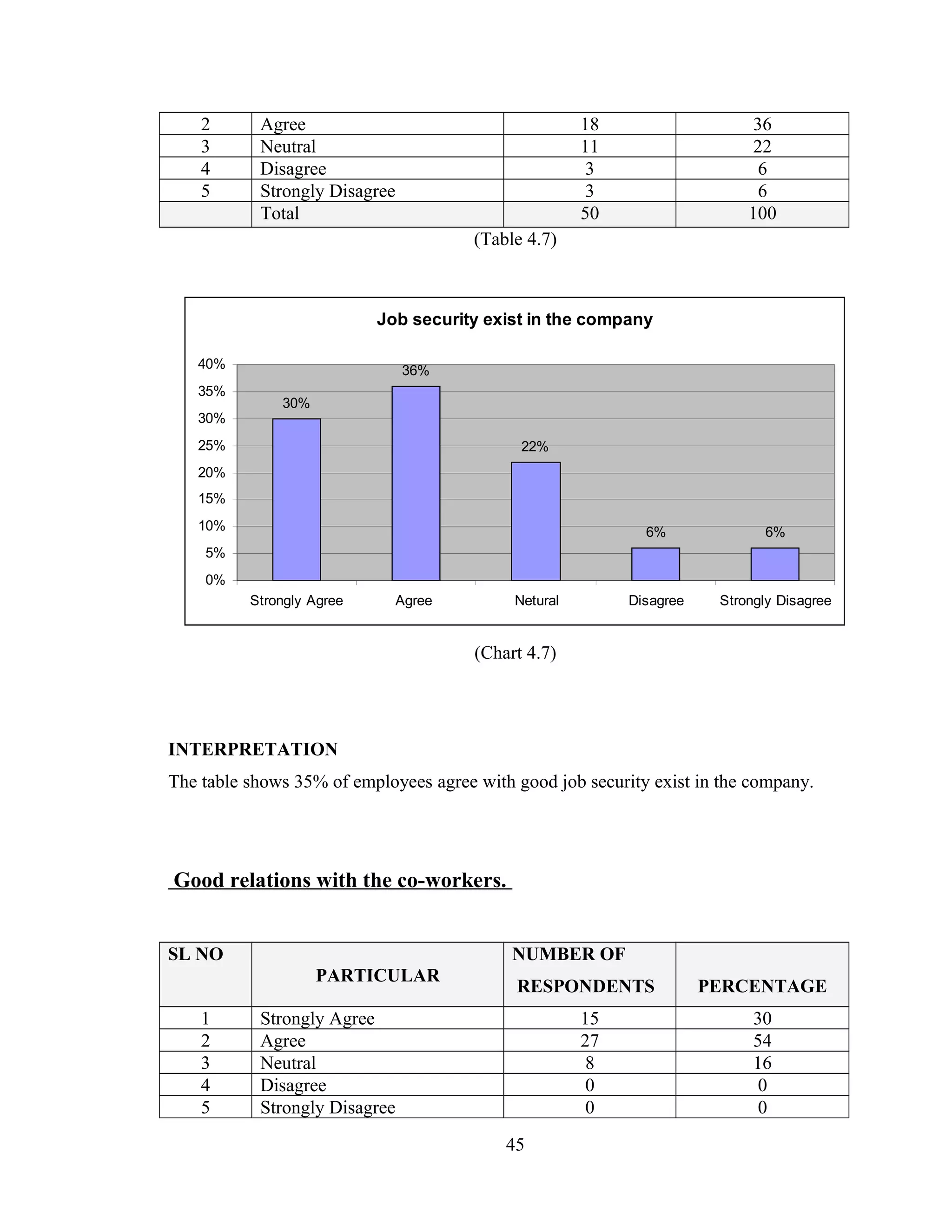
Job Security existing in the company.
SL NO
PARTICULAR
NUMBER OF
RESPONDENTS PERCENTAGE
1 Strongly Agree 15 30
44
2 Agree 18 36
3 Neutral 11 22
4 Disagree 3 6
5 Strongly Disagree 3 6
Total 50 100
(Table 4.7)
Job security exist in the company
30%
36%
22%
6% 6%
0%
5%
10%
15%
20%
25%
30%
35%
40%
Strongly Agree Agree Netural Disagree Strongly Disagree
(Chart 4.7)
INTERPRETATION
The table shows 35% of employees agree with good job security exist in the company.
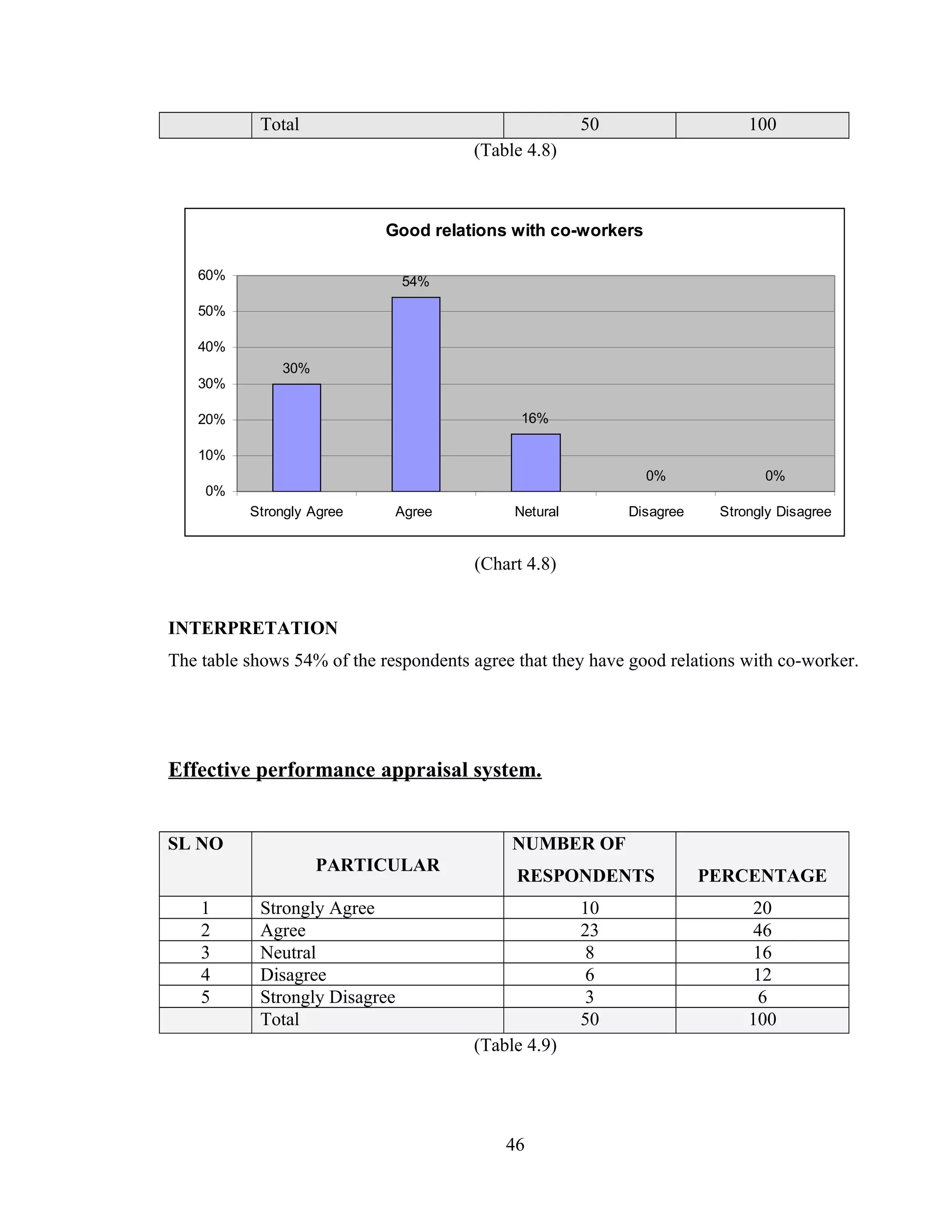
Good relations with the co-workers.
SL NO
PARTICULAR
NUMBER OF
RESPONDENTS PERCENTAGE
1 Strongly Agree 15 30
2 Agree 27 54
3 Neutral 8 16
4 Disagree 0 0
5 Strongly Disagree 0 0
45
Total 50 100
(Table 4.8)
Good relations with co-workers
30%
54%
16%
0% 0%
0%
10%
20%
30%
40%
50%
60%
Strongly Agree Agree Netural Disagree Strongly Disagree
(Chart 4.8)
INTERPRETATION
The table shows 54% of the respondents agree that they have good relations with co-worker.
Effective performance appraisal system.
SL NO
PARTICULAR
NUMBER OF
RESPONDENTS PERCENTAGE
1 Strongly Agree 10 20
2 Agree 23 46
3 Neutral 8 16
4 Disagree 6 12
5 Strongly Disagree 3 6
Total 50 100
(Table 4.9)
46
Effective performance appraisal system.
20%
46%
16%
12%
6%
0%
5%
10%
15%
20%
25%
30%
35%
40%
45%
50%
Strongly Agree Agree Netural Disagree Strongly Disagree
(Chart 4.9)
INTERPRETATION
The table shows 46% of the respondents agree to effective performance appraisal system
existing in the company.
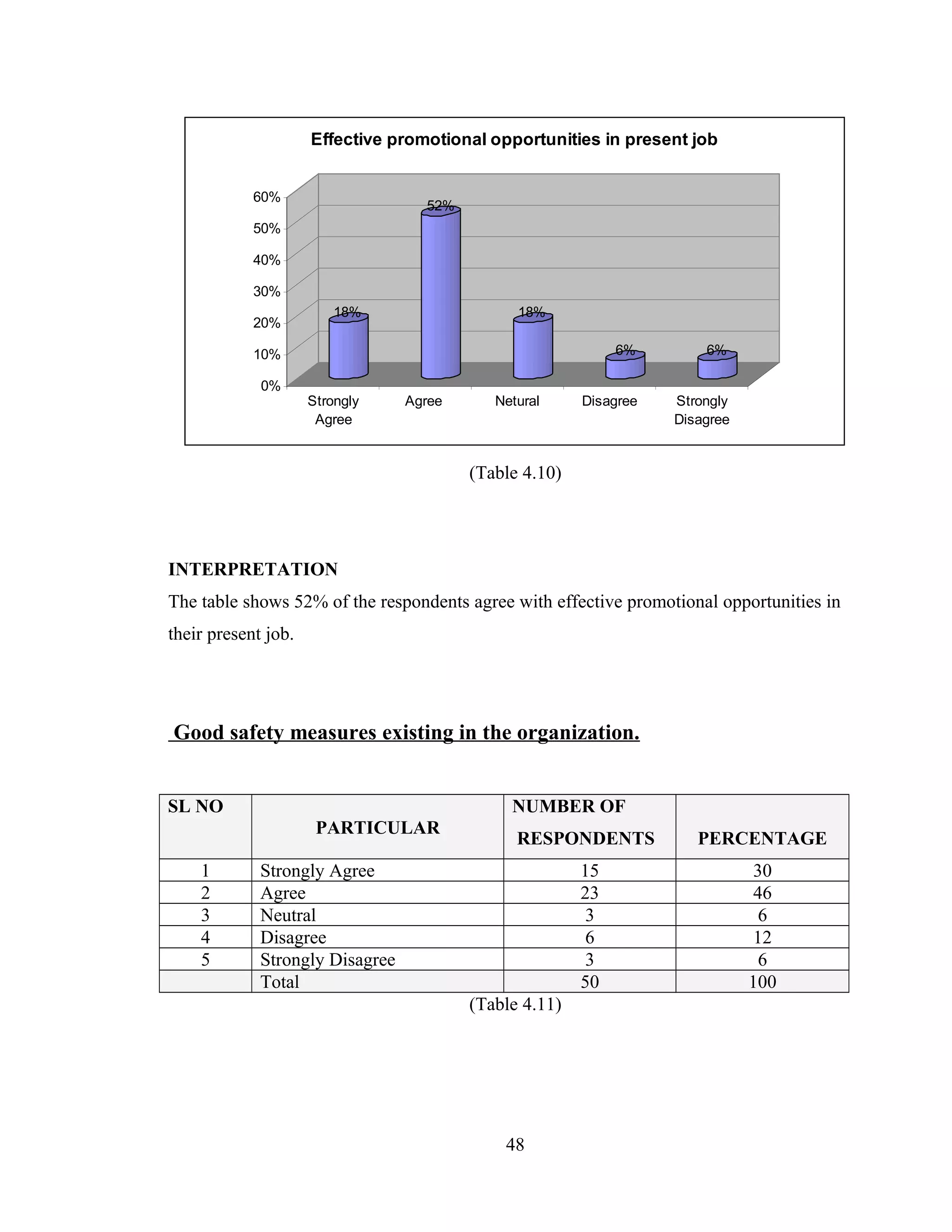
Effective promotional opportunities in present job,
SL NO
PARTICULAR
NUMBER OF
RESPONDENTS PERCENTAGE
1 Strongly Agree 9 18
2 Agree 26 52
3 Neutral 9 18
4 Disagree 3 6
5 Strongly Disagree 3 6
Total 50 100
(Table 4.10)
47
18%
52%
18%
6% 6%
0%
10%
20%
30%
40%
50%
60%
Strongly
Agree
Agree Netural Disagree Strongly
Disagree
Effective promotional opportunities in present job
(Table 4.10)
INTERPRETATION
The table shows 52% of the respondents agree with effective promotional opportunities in
their present job.
Good safety measures existing in the organization.
SL NO
PARTICULAR
NUMBER OF
RESPONDENTS PERCENTAGE
1 Strongly Agree 15 30
2 Agree 23 46
3 Neutral 3 6
4 Disagree 6 12
5 Strongly Disagree 3 6
Total 50 100
(Table 4.11)
48
30%
46%
6%
12%
6%
0%
5%
10%
15%
20%
25%
30%
35%
40%
45%
50%
Strongly
Agree
Agree Netural Disagree Strongly
Disagree
Good safety measures existing in the organization.
(Chart 4.11)
INTERPRETATION
The table shows 46% of the respondents agree that there is a good safety measure existing in
the company.
Performance appraisal activities are helpful to get motivated.
SL NO
PARTICULAR
NUMBER OF
RESPONDENTS PERCENTAGE
1 Strongly Agree 9 18
2 Agree 23 46
3 Neutral 6 12
4 Disagree 3 3
5 Strongly Disagree 9 18
Total 50 100
(Table 4.12)
49
Performance appraisal activities are helpful to get motivated
18%
46%
12%
6%
18%
0%
5%
10%
15%
20%
25%
30%
35%
40%
45%
50%
Strongly Agree Agree Netural Disagree Strongly Disagree
(Chart 4.12)
INTERPRETATION
The table shows 46% of the respondents agree that the performance appraisal activities are
helpful to get motivated.
Support from the co-worker is helpful to get motivated
SL NO
PARTICULAR
NUMBER OF
RESPONDENTS PERCENTAGE
1 Strongly Agree 12 20
2 Agree 29 46
3 Neutral 0 0
4 Disagree 6 12
5 Strongly Disagree 3 6
Total 50 100
(Table 4.13)
50
Support from the co-worker is helpful to get motivated
24%
58%
0%
12%
6%
0%
10%
20%
30%
40%
50%
60%
70%
Strongly Agree Agree Netural Disagree Strongly Disagree
(Chart 4.13)
INTERPRETATION
The table shows 58% of the respondents agree that the support from the co-worker is helpful
to get motivated.
Career development opportunities are helpful to get motivated
SL NO
PARTICULAR
NUMBER OF
RESPONDENTS PERCENTAGE
1 Strongly Agree 10 20
2 Agree 26 52
3 Neutral 2 4
4 Disagree 4 8
5 Strongly Disagree 8 16
Total 50 100
(Table No.4.14)
51
20%
52%
4%
8%
16%
0%
10%
20%
30%
40%
50%
60%
Strongly
Agree
Agree Neutral Disagree Strongly
Disagree
(Chart 4.14)
INTERPRETATION
The table shows 52% of the respondents agree that the career development opportunities are
helpful to get motivated.
Factors which motivates you the most.
SL NO
PARTICULAR
NUMBER OF
RESPONDENTS PERCENTAGE
1 Salary increase 21 42
2 Promotion 15 30
3 Leave 3 6
4 Motivational talk 5 10
5 Recognition 6 12
Total 50 100
(Table 4.15)
52
42%
30%
6%
10%
12% Salary increase
Promotion
Leave
Motivational talk
Recognition
(Chart 4.15)
INTERPRETATION
The table shows that the 42% of the respondent is responding that increase in salary will
motivate them the most.
Incentives and other benefits will influence your performance
SL NO
PARTICULAR
NUMBER OF
RESPONDENTS PERCENTAGE
1 Influence 32 64
2 Does not influence 12 24
3 No opinion 6 12
Total 50 100
(Table 4.16)
53
64%
24%
12%
Influence
Does not influence
No opinion
(Chart 4.16)
INTERPRETATION
The table shows 64% of the respondents responded that incentives and other benefits will
influence their performance
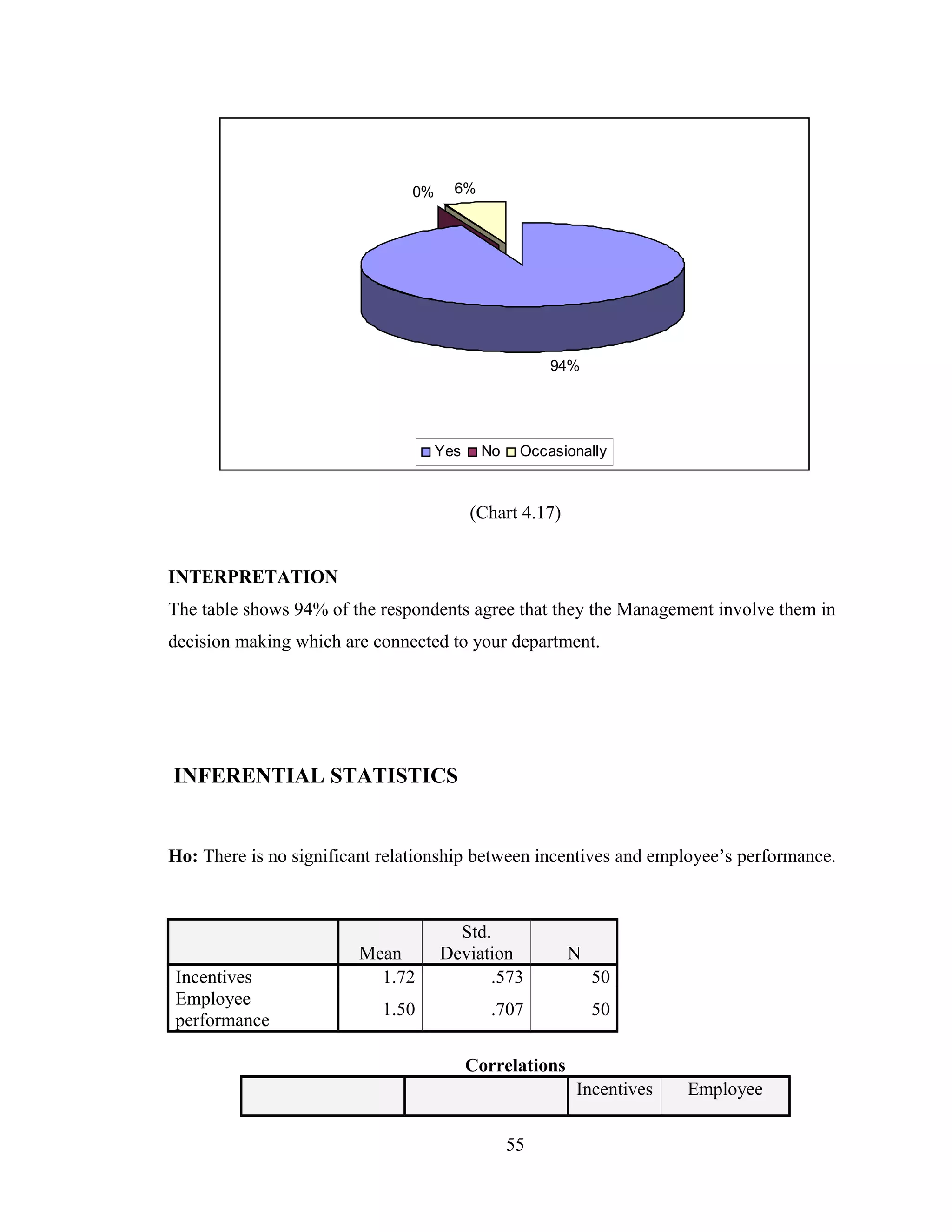
Management involves you in decision making which are connected to
your department.
SL NO
PARTICULAR
NUMBER OF
RESPONDENTS PERCENTAGE
1 Yes 47 94
2 No 0 0
3 Occasionally 3 6
Total 50 100
(Table 4.17)
54
94%
0% 6%
Yes No Occasionally
(Chart 4.17)
INTERPRETATION
The table shows 94% of the respondents agree that they the Management involve them in
decision making which are connected to your department.
INFERENTIAL STATISTICS
Ho: There is no significant relationship between incentives and employee’s performance.
Mean
Std.
Deviation N
Incentives 1.72 .573 50
Employee
performance
1.50 .707 50
Correlations
Incentives Employee
55
performance
Incentives Pearson Correlation 1 .655(**)
Sig. (2-tailed) . .000
Sum of Squares
and Cross-products
16.080 13.000
Covariance .328 .265
N 50 50
Employee
performance
Pearson Correlation
.655(**) 1
Sig. (2-tailed) .000 .
Sum of Squares
and Cross-products
13.000 24.500
Covariance .265 .500
N 50 50
** Correlation is significant at the 0.01 level (2-tailed).
Inference:
Since the Correlation is significant at the 0.01 level (2-tailed) the null hypothesis that is
“There is no significant relationship between incentives and employee’s performance”
is rejected and an alternative hypothesis is framed.
H1: There is significant relationship between incentives and employee’s performance.
Ho: There is no significant relationship between career development opportunities and the
extent of employee motivation
Mean
Std.
Deviation N
career
development
opportunities
3.70 1.035 50
extent of
motivation
3.36 1.317 45
Correlations
56
career
development
opportunities
extent of
motivation
career
development
opportunities
Pearson
Correlation 1 .909(**)
Sig. (2-tailed) . .000
Sum of Squares
and Cross-
products
52.500 52.111
Covariance 1.071 1.184
N 50 45
extent of
motivation
Pearson
Correlation
.909(**) 1
Sig. (2-tailed) .000 .
Sum of Squares
and Cross-
products
52.111 76.311
Covariance 1.184 1.734
N 45 45
** Correlation is significant at the 0.01 level (2-tailed).
Inference:
Since the Correlation is significant at the 0.01 level (2-tailed) the null hypothesis that is
“There is no significant relationship between career development opportunities and the
extent of employee motivation” is rejected and an alternative hypothesis is framed.
H1: There is significant relationship between career development opportunities and the
extent of employee motivation
Ho: There is no significant relationship between performance appraisal system and the
extent of motivation.
Mean
Std.
Deviation N
Performance
appraisal system
2.40 1.143 50
Extent of
Motivation
2.60 1.355 50
Correlations
57
performance
appraisal
system
Extent of
Motivation
Performance
appraisal system
Pearson
Correlation
1 .962(**)
Sig. (2-tailed) . .000
Sum of Squares
and Cross-
products
64.000 73.000
Covariance 1.306 1.490
N 50 50
Extent of
Motivation
Pearson
Correlation
.962(**) 1
Sig. (2-tailed) .000 .
Sum of Squares
and Cross-
products
73.000 90.000
Covariance 1.490 1.837
N 50 50
** Correlation is significant at the 0.01 level (2-tailed).
Inference:
Since the Correlation is significant at the 0.01 level (2-tailed) the null hypothesis that is
“There is no significant relationship between performance appraisal system and the
extent of motivation” is rejected and an alternative hypothesis is framed.
H1: There is significant relationship between performance appraisal system and the extent
of motivation.
Ho: There is no significant relationship between interpersonal relationship in the
organization and extent of motivation.
Mean
Std.
Deviation N
Employee
relations
1.86 .670 50
Extent of
motivation
2.18 1.119 50
Correlations
58
Employee
relations
Extent of
motivation
Employee
relations
Pearson
Correlation
1 .877(**)
Sig. (2-tailed) . .000
Sum of Squares
and Cross-
products
22.020 32.260
Covariance .449 .658
N 50 50
Extent of
motivation
Pearson
Correlation
.877(**) 1
Sig. (2-tailed) .000 .
Sum of Squares
and Cross-
products
32.260 61.380
Covariance .658 1.253
N 50 50
** Correlation is significant at the 0.01 level (2-tailed).
Inference:
Since the Correlation is significant at the 0.01 level (2-tailed) the null hypothesis that is
“There is no significant relationship between interpersonal relationship in the organization
and extent of motivation.” is rejected and an alternative hypothesis is framed.
H1: There is significant relationship between interpersonal relationship in the organization
and extent of motivation.
59
FINDINGS
FINDINGS
The findings of the study are follows
• The Shri ram Piston Limited has a well defined & sound organization structure.
• There is a harmonious relationship is exist in the organization between employees
and management.
• The employees are really motivated by the management.
• The employees are satisfied with the present incentive plan of the company.
60
• Most of the workers agreed that the company is eager in recognizing and
acknowledging their work.
• The study reveals that there is a good relationship exists among employees.
• Majority of the employees agreed that there job security to their present job.
• The company is providing good safety measures for ensuring the employees safety.
• From the study it is clear that most of employees agrees to the fact that performance
appraisal activities and support from the coworkers in helpful to get motivated.
• The study reveals that increase in the salary will motivates the employees more.
• The incentives and other benefits will influence the performance of the employees.
61
SUGGESTIONS
SUGGESTIONS
The suggestions for the findings from the study are follows
• Most of the employees agree that the performance appraisal activities are helpful to
get motivated, so the company should try to improve performance appraisal system,
so that they can improve their performance.
62
• Non financial incentive plans should also be implemented; it can improve the
productivity level of the employees.
• Organization should give importance to communication between employees and gain
co-ordination through it.
• Skills of the employees should be appreciated.
• Better carrier development opportunities should be given to the employees for their
improvement.
• If the centralized system of management is changed to a decentralized one, then
there would be active and committed participation of staff for the success of the
organization
63
LIMITATION
OF
THE
STUDY
LIMITATIONS OF THE STUDY
The limitations of the study are the following
64
• The data was collected through questionnaire. The responds from the respondents
may not be accurate.
• The sample taken for the study was only 50 and the results drawn may not be
accurate.
• Since the organization has strict control, it acts as another barrier for getting data.
• Another difficulty was very limited time-span of the project.
• Lack of experience of Researcher.
65
CONCLUSION
CONCLUSION
66
The study concludes that, the motivational program procedure in SHRI RAM PISTON LTD
is found effective but not highly effective. The study on employee motivation highlighted so
many factors which will help to motivate the employees. The study was conducted among
50 employees and collected information through structured questionnaire. The study helped
to findings which were related with employee motivational programs which are provided in
the organization.
The performance appraisal activities really play a major role in motivating the employees of
the organization. It is a major factor that makes an employee feels good in his work and
results in his satisfaction too. The organization can still concentrate on specific areas which
are evolved from this study in order to make the motivational programs more effective. Only
if the employees are properly motivated- they work well and only if they work well the
organization is going to benefit out it. Steps should be taken to improve the motivational
programs procedure in the future. The suggestions of this report may help in this direction.
This document aims at providing employees and management members with the information
that can be beneficial both personally and professionally. Every business enterprise has
multiple objectives including of adequate profit for payment of a reasonable rate of return to
the owners and for investment in business through satisfaction of customers, maintenance of
a contended workforce and creation of a public image.
The human resources can play an important role in the realization of the objectives.
Employees work in the organization for the satisfaction of their needs. If the human
resources are not properly motivated, the management will not be able to accomplish the
desired results. Therefore, human resources should be managed with utmost care to inspire,
encourage and impel them to contribute their maximum for the achievement of the business
objectives.
67
BIBLIOGRAPHY
BIBLIOGRAPHY
Books reffered
68
 Motivating employees-By Anne Bruce & james S. Pepitone
 365 Ways To Motivate & reward With Littile or No Money – Diann A
Podmoroff
 Motivating employees: bringout the best in your people – barry silverstein
 Perfect Phrases For Motivating & Rewarding Employees –By Diamond
Harriet.
 Research methodology- C.R Kothari
 Personnel management – Arun Monappa and Mirza S.Saiyadain
 Human Resource and personal management-Aswathappa k
 Human Resource management-Rao VSP
 Employment law in India-Rnghavi singhania
WEBSITES REFFERED:
www.bel-india.com
www.google.com
fastcompany.com
smallbusiness.com
bignerds.com
ask.com
69
ANNEXURE
ANNEXTURE
70
1. No. of response about the support from the HR department :
SL NO
PARTICULAR
NUMBER OF
RESPONDENTS PERCENTAGE
1 Highly satisfied
2 Satisfied
3 Neutral
4 Dissatisfied
5 Highly satisfied
Total
2 To what extent management is interested in motivating the employees?
SL NO
PARTICULAR
NUMBER OF
RESPONDENTS PERCENTAGE
1 Strongly Agree
2 Agree
3 Neutral
4 Disagree
5 Strongly Disagree
Total
(Table 4.2)
3 The type of incentives motivates you more:
SL NO
PARTICULAR
NUMBER OF
RESPONDENTS PERCENTAGE
1 Financial Incentives
71
2 Non financial Incentives
3 Both
Total
4 Level of satisfaction with the present incentives scheme:
SL NO
PARTICULAR
NUMBER OF
RESPONDENTS PERCENTAGE
1 Highly satisfied
2 Satisfied
3 Neutral
4 Dissatisfied
5 Highly satisfied
Total
5.The company is eagerness in recognizing and acknowledging
employee’s work:
SL NO
PARTICULAR
NUMBER OF
RESPONDENTS PERCENTAGE
1 Strongly Agree
2 Agree
3 Neutral
4 Disagree
72
5 Strongly Disagree
Total
6.To what extent the periodical increase in salary?
SL NO
PARTICULAR
NUMBER OF
RESPONDENTS PERCENTAGE
1 Strongly Agree
2 Agree
3 Neutral
4 Disagree
5 Strongly Disagree
Total
7.To what extent level of Career development opportunities are helpful to
get motivated?
SL NO
PARTICULAR
NUMBER OF
RESPONDENTS PERCENTAGE
1 Strongly Agree
2 Agree
3 Neutral
4 Disagree
5 Strongly Disagree
Total
73
8.Level of effective performance appraisal system:
SL NO
PARTICULAR
NUMBER OF
RESPONDENTS PERCENTAGE
1 Strongly Agree
2 Agree
3 Neutral
4 Disagree
5 Strongly Disagree
Total
9.Effective promotional opportunities in present job:
SL NO
PARTICULAR
NUMBER OF
RESPONDENTS PERCENTAGE
1 Strongly Agree
2 Agree
3 Neutral
4 Disagree
5 Strongly Disagree
Total
10.Satisfactory level of safety measures existing in the organization:
74
SL NO
PARTICULAR
NUMBER OF
RESPONDENTS PERCENTAGE
1 Strongly Agree
2 Agree
3 Neutral
4 Disagree
5 Strongly Disagree
Total
75
76
77
78
79
80

A study of employee motivation

  • 1.
  • 2.
    EXECUTIVE SUMMARY The projectwork entitled A STUDY OF EMPLOYEE MOTIVATION TEACNIQUES with special reference to Shri ram Piston Ltd; Ghaziabad is mainly conducted to identify the factors which will motivate the employees and the organizational functions in Shri ram Piston Ltd, Ghaziabad. Management’s basic job is the effective utilization of human resources for achievements of organizational objectives. The personnel management is concerned with organizing human resources in such a way to get maximum output to the enterprise and to develop the talent of people at work to the fullest satisfaction. Motivation implies that one person, in organization context a manager, includes another, say an employee, to engage in action by ensuring that a channel to satisfy those needs and aspirations becomes available to the person. In addition to this, the strong needs in a direction that is satisfying to the latent needs in employees and harness them in a manner that would be functional for the organization. Employee motivation is one of the major issues faced by every organization. It is the major task of every manager to motivate his subordinates or to create the ‘will to work’ among the subordinates. It should also be remembered that a worker may be immensely capable of doing some work; nothing can be achieved if he is not willing to work. A manager has to make appropriate use of motivation to enthuse the employees to follow them. Hence this studies also focusing on the employee motivation among the employees of Shri ram Piston Ltd. The data needed for the study has been collected from the employees through questionnaires and through direct interviews. Analysis and interpretation has been done by using the statistical tools and data’s are presented through tables and charts. 2
  • 3.
  • 4.
    SIGNIFICANCE OF THESTUDY The study is intended to evaluate motivation of employees in the organization. A good motivational program procedure is essential to achieve goal of the organization. If efficient motivational programmes of employees are made not only in this particular organization but also any other organization; the organizations can achieve the efficiency also to develop a good organizational culture. Motivation has variety of effects. These effects may be seen in the context of an individual’s physical and mental health, productivity, absenteeism and turnover. Employee delight has to be managed in more than one way. This helps in retaining and nurturing the true believers “who can deliver value to the organization. Proliferating and nurturing the number of “true believers” 1 is the challenge for future and present HR managers. This means innovation and creativity. It also means a change in the gear for HR polices and practices. The faster the organizations nurture their employees, the more successful they will be. The challenge before HR managers today is to delight their employees and nurture their creativity to keep them a bloom. This study helps the researcher to realize the importance of effective employee motivation. This research study examines types and levels of employee motivational programmes and also discusses management ideas that can be utilized to innovate employee motivation. It helps to provide insights to support future research regarding strategic guidance for organizations that are both providing and using reward/recognition programs. 1 4
  • 5.
  • 6.
    OBJECTIVES OF THESTUDY Primary objective To study the factors of compensation which are needed to motivate the employees. Secondary Objective. 1. To study the effect of monetary and non-monetary benefits provided by the organization on the employee’s performance. 2. To study the effect of job promotions on employees. 3. To learn the employee’s satisfaction on the interpersonal relationship exists in the organization. 4. To provide the practical suggestion for the improvement of organization’s performance. 6
  • 7.
  • 8.
    SCOPE FOR FUTURERESEARCH The present study on employee motivation helps to get clear picture about the factors which motivates the employees. This in turn helps the management to formulate suitable policy to motivate the employees. Hence, the motivational level of the employees may also change. The factors that motivate the employees may change with change in time because the needs of employees too change with change in time. So continuous monitoring and close observation of factors that motivate the employees is necessary to maintain a competent work force. Only with a competent work force an organization can achieve its objective. Moreover, human resource is the most valuable asset to any organization. A further study with in dept analysis to know to what extent these factors motivate the employees is required. 8
  • 9.
  • 10.
    COMPANY PROFILE The year1946 saw the birth of India. It was also the year SHRI RAM PISTON LIMITED was founded. Over the decades, it has blazed a pioneering path in the fibre cement industry and has grown into a formidable player. The corporate office of HIL is situated at Hyderabad. The HIL R & D centers situated at Hyderabad and Faridabad support all its manufacturing units to achieve excellency in its manufacturing activities. The Manufacturing facilities are at Hyderabad, Faridabad & Daruhera (Haryana), Chennai (TN), Jasidih (Jharkhand), Wada (Maharashtra), Vijayawada, Timmappur (AP),sutariya (UP), Balasore(Orissa) and Ghaziabad(kerala). The company has four regional offices & over 46 sales depots all over India, all with the purpose of providing convenient services to customers. SHRI RAM PISTON LIMITED is a flagship Company of the C.K.Birla group of Companies, incorporated on 17th June 1946. HIL has blazed a pioneering path in the building products industry. HIL has led the cement industry for well over five decades. Today HIL is a multi product, multi locational organization with a formidable network of branches, depots, stockiest and personnel spread all over India. HIL being backed by the organizational and technical expertise of the Birlas, also has a Board of directors comprising experienced personnel from Business, Finance and Industry. The Board is chaired by Mr.C.K.Birla. HIL’s product range include Fibre Cement roofing sheets in the name of CHARMINAR and MALABAR, Autoclaved Aerated Concrete Blocks and Panels called AEROCON, Calcium Silicate insulation product called HYSIL, Jointing material for Gaskets and Plant and machinery for these products. The SHRI RAM PISTON LIMITED, Ghaziabad is situated 10 km away from the Ghaziabad town. The exact place where the company is situated is Athani, which is an industrial area. This company was incorporated in the year 1985 and commenced production in 1986 in the 10
  • 11.
    name as MALABARBUILDING PRODUCTS, which was a joint venture by HIL and KSIDC (Kerala State Industries Development Corporation. Later in the year 2005 April the company was merged with the HIL completely from the KSIDC. And in the same year the company changed its name to HYDRABAD INDUSTRIES LIMITED. About 200 employees are working in HIL, Ghaziabad as a whole. In that 110 employees are working in plant, 72 are office staffs and 18 are bargaining staffs. The plant is working for 24 hours and there are three shifts per day. The whole plant is completely automated. The HIL Ghaziabad plant is producing only the AC roofing sheets in the name of CHARMINAR. Charminar AC Roofing Sheets have been the No.1 roofing sheets of choice for more than 50 years now, providing roofing to millions of low cost houses and to industries, commercial businesses and for several public utilities. Charminar sheets are widely known for their superior quality and durability. The raw materials used in the production process are Fibre, fly ash, rag pulp and cement. Among these raw materials Fibre is importing from Brazil and Canada and cement is mainly bought from ACC cements. The Company mainly sells their products through dealers who are selected by the company. The finished products are mainly sold in the south India, especially in Tamil Nadu. The company has a visionary management and motivated team of dynamic workers sharing common vision and working in the union. The company is moving ahead with to innovate and provide excellent production. HIL is providing to have an operational efficiency compactable with global standards. As a socially organization, it has contributed significantly towards eco-friendliness and various social causes. The company has involved in conducting a lot of community welfare programme. In this year the company conducted a welfare programme named ‘SOUHRUTHAM 2008’. 11
  • 12.
    Mission and Visionof Shri ram Piston Limited To maintain leadership in Fibre cement products industry and develop complementary products and services to strengthen the core business of building products. • Fulfilment of market needs with cost effective solutions for enduring and enhanced customer satisfaction. • Striving for excellence in all the area of company’s operation. • Innovative solutions to create world class products and services fostering collective wisdom and commitment of employees to create corporate and group culture and values which they are proud to be part of. • Maintain equitable balance between development and environmental needs of the society. Quality Policy Provide products and services that adequately and consistently meet specified and identified needs of customers by  Continues upgrade of product value and by  Building customer responsive environment In making and deliverance of the products and services Research & Development. Research and Development Center of Shri ram Piston Limited is fully equipped with latest state-of-art technology, equipment and test facilities including Pilot Plants situated in ultra modern spacious building covering an area of about 11000 sft of main Building and about 12
  • 13.
    16000 sft areaof Pilot Plant. HIL, R & D center is recognized by Department of Science and Technology Government of India. HIL have been conferred with the DSIR National Award for R & D efforts in industry for the year 2000 in the area of new materials for "AEROCON INSTA PANEL" Dedicated team of scientists and engineers are constantly working for product upgradation, optimum utilization of raw materials, development of substitute materials, new products and new product applications, saving substantial amount of foreign exchange for the country.The R & D Division has contributed in the following specific areas: • Identification and development of environment friendly building products with emerging market needs. • Emphasis on process optimization, cost reduction and development of value added products. • Effective utilization of energy, water and waste material. • Absorption of imported technical know-how. • Development of new products i.e., Aerocon Insta - Panels, Access Flooring system, pressed sheets, fire protection boards, Light weight AAC Blocks, non-asbestos jointing material for automobile industry etc. Quality Policy Provide products and services that adequately and consistently meet specified and identified needs of customers by  Continues upgrade of product value and by  Building customer responsive environment  In making and deliverance of the products and services Philosophy SHRI RAM PISTON LIMITED is committed to good Corporate Governance. The Company has been following good principles of business over the years by following all the laws and 13
  • 14.
    regulations of theland with an emphasis on accountability, trusteeship, and integrity. It is our responsibility to ensure that the organization is managed in a manner that protects and furthers the interests of our stakeholders. 3.3. DEPARTMENT PROFILE The organization has mainly 5 departments. They are 1. HUMAN RESOURCE DEPARTMENT 2. FINANCE DEPARTMENT 3. PURCHASE DEPARTMENT 4. MARKETING DEPARTMENT. 5. PRODUCTION DEPARTMENT 3.3.1 ORGANIZATION CHART OF HUMAN RESOURCE DEPARTMENT 14 Sr. Officer HR Security Jr. Manager Establishment Manager Industrial Relations General Manager (Works) Time Office Assistants
  • 15.
    The managing humanresource in the organization is an important task. Human resource department is doing the management of human resource in the organization. Shri ram Piston Limited follows a system in HR department that each authority coming under the General Manager (works) has to report directly to General Manager (Works) in the hierarchy. This will helps to speed up the communication flow in the organization. ORGANISATION CHART OF FINANCE DEPARTMENT Sound financial decisions have been one of the critical practices in the success of Shri ram Piston Limited, Ghaziabad proper planning and long vision of the financial managers help the company to undergo to smooth sail. All monetary transactions of the company are handled and brought to account by the finance department. 15 Deputy Manager Accounts Assistant manager Sr. Accounts Officer Assistants
  • 16.
    ORGANISATION CHART OFPURCAHSE DEPARTMENT The purchase manager is the only person who is the having the prime authority to make orders for the purchase of raw materials. After referring the stock report of raw materials and finished goods, the purchase manager purchase the raw- materials in order to ensure the continuous flow of production. ORGANISATION CHART OF PRODUCTION DEPARTMENT 16 Sr. Purchase Manager Assistant Manager Purchase Purchase Officer Assistants Production Manager Deputy Manager Production Deputy Manager Maintenance Jr. Manager Production Jr. Manager Production Shift in charge
  • 17.
    The production managerand his team are responsible for realizing the visions of the company within constraints of technical possibility. This involves coordinating the operations of various production activities and maintains a good flow of work without any blockage. ORGANISATION CHART OF MARKETING DEPARTMEN Product Profile Charminar Aerocon panels. Charminar Aerocon Panel is a unique factory developed product that fulfills the following Green Building concept. 17 Marketing Manager Sales Manager Regional Sales Manager Area Sales Manager Sales Officer
  • 18.
    • Raw materialcontains up to 40% Fly Ash (recycled power plant waste). • Excellent Thermal and Sound Insulation. • A good fire rating up to 2 hrs. -Depending upon thickness. • Factory cured panel -Dry construction at site. • Completely re-locatable. • Proven suitable for seismic and cyclone prone zones Other Benefits: • Fast track construction -Tongue and groove joining system allows faster construction. • Light weight -allows easy handling and erection. • Excellent water & termite resistance. • Can be given any surface finish Applications: Charminar Roofing Sheets are an ideal building material for roofing and side-cladding in: • Industrial/ Power Plant Cladding • Control Room • Prefabricated site offices • Prefabricated Houses, Canteens and Rest Rooms • Partitions • Police Stations • School Buildings • Telephone Exchanges • ATM Cubicles 18
  • 19.
    Charminar AC roofingSheets. Charminar AC Roofing Sheets have been the No.1 roofing sheets of choice for more than 50 years now. Providing roofing to millions of low cost houses and to industries, commercial businesses and for several public utilities. Charminar sheets are widely known for their superior quality and durability. Special Features • Strong & durable • Weather-proof • Less noise during rains • Non-corrosive Charminar Concreted Roofing Sheets are made from Fibre, Portland cement and Binder. Fibre in these sheets acts as reinforcement like steel in RCC. These are owing to their quality, strength & durability. These are manufactured to exceed the requirements of strength specified in the relevant Indian standards. Standards • IS: 459-1992 Specification for Corrugated and Semi-Corrugated Asbestos Cement Sheets. • IS: 3007 - 1999 Code of practice for laying of Asbestos Cement Sheets, Part-I, Corrugated Sheets. • IS: 1626 (Part3) 1994 - Roofing fittings. Applications Charminar Roofing Sheets are an ideal building material for roofing and side-cladding in: • Industrial buildings of all types • Food Storage Godowns • Warehouses & Cold Storages • Poultry farms, dairy farms and other agricultural sheds 19
  • 20.
    • Garages, Verandahsand Outhouses • Houses • School buildings • Public Utility Sheds • Cooling Towers • Cinema Halls • Stadiums • Railway & Bus Stations 20
  • 21.
  • 22.
    LITERATURE REVIEW Rensis Likerthascalled motivation as the core of management. Motivation is the core of management. Motivation is an effective instrument in the hands of the management in inspiring the work force .It is the major task of every manager to motivate his subordinate or to create the will to work among the subordinates .It should also be remembered that the worker may be immensely capable of doing some work, nothing can be achieved if he is not willing to work .creation of a will to work is motivation in simple but true sense of term. Motivation is an important function which very manager performs for actuating the people to work for accomplishment of objectives of the organization .Issuance of well conceived instructions and orders does not mean that they will be followed .A manager has to make appropriate use of motivation to enthuse the employees to follow them. Effective motivation succeeds not only in having an order accepted but also in gaining a determination to see that it is executed efficiently and effectively. In order to motivate workers to work for the organizational goals, the managers must determine the motives or needs of the workers and provide an environment in which appropriate incentives are available for their satisfaction .If the management is successful in doing so; it will also be successful in increasing the willingness of the workers to work. This will increase efficiency and effectiveness of the organization .There will be better utilization of resources and workers abilities and capacities. 22
  • 23.
    The concept ofmotivation The word motivation has been derived from motive which means any idea, need or emotion that prompts a man in to action. Whatever may be the behavior of man, there is some stimulus behind it .Stimulus is dependent upon the motive of the person concerned. Motive can be known by studying his needs and desires. There is no universal theory that can explain the factors influencing motives which control mans behavior at any particular point of time. In general, the different motives operate at different times among different people and influence their behaviors. The process of motivation studies the motives of individuals which cause different type of behavior. Definition of Motivation. According to Edwin B Flippo, “Motivation is the process of attempting to influence others to do their work through the possibility of gain or reward. Significance of Motivation Motivation involves getting the members of the group to pull weight effectively, to give their loyalty to the group, to carry out properly the purpose of the organization. The following results may be expected if the employees are properly motivated. 1. The workforce will be better satisfied if the management provides them with opportunities to fulfill their physiological and psychological needs. The workers will cooperate voluntarily with the management and will contribute their maximum towards the goals of the enterprise. 23
  • 24.
    2. Workers willtend to be as efficient as possible by improving upon their skills and knowledge so that they are able to contribute to the progress of the organization. This will also result in increased productivity. 3. The rates of labor’s turnover and absenteeism among the workers will be low. 4. There will be good human relations in the organization as friction among the workers themselves and between the workers and the management will decrease. 5. The number of complaints and grievances will come down. Accident will also be low. 6. There will be increase in the quantity and quality of products. Wastage and scrap will be less. Better quality of products will also increase the public image of the business. Motivation Process. 1. Identification of need 2. Tension 3. Course of action 4. Result –Positive/Negative 5. Feed back Theories of Motivation. Understanding what motivated employees and how they were motivated was the focus of many researchers following the publication of the Hawthorne study results (Terpstra, 1979). Six major approaches that have led to our understanding of motivation are Mcclelland’s Achievement Need Theory, Behavior Modification theory; Abraham H Mallows need hierarchy or Deficient theory of motivation. J.S. Adam’s Equity Theory, Vrooms Expectation Theory, Two factor Theory. McClelland’s Achievement Need Theory. According to McClelland’s there are three types of needs; 24
  • 25.
    Need for Achievement(n Ach); This need is the strongest and lasting motivating factor. Particularly in case of persons who satisfy the other needs. They are constantly pre occupied with a desire for improvement and lack for situation in which successful outcomes are directly correlated with their efforts. They set more difficult but achievable goals for themselves because success with easily achievable goals hardly provides a sense of achievement. Need for Power (n Pow) It is the desire to control the behavior of the other people and to manipulate the surroundings. Power motivations positive applications results in domestic leadership style, while it negative application tends autocratic style. Need for affiliation (n Aff) It is the related to social needs and creates friendship. This results in formation of informal groups or social circle. Behavioral Modification Theory; According to this theory people behavior is the outcome of favorable and unfavorable past circumstances. This theory is based on learning theory. Skinner conducted his researches among rats and school children. He found that stimulus for desirable behavior could be strengthened by rewarding it at the earliest. In the industrial situation, this relevance of this theory may be found in the installation of financial and non financial incentives. More immediate is the reward and stimulation or it motivates it. Withdrawal of reward incase of low standard work may also produce the desired result. However, researches show that it is generally more effective to reward desired behavior than to punish undesired behavior. Abraham H Maslow Need Hierarchy or Deficient theory of Motivation. 25
  • 26.
    The intellectual basisfor most of motivation thinking has been provided by behavioral scientists, A.H Maslow and Frederick Heizberg, whose published works are the “Bible of Motivation”. Although Maslow himself did not apply his theory to industrial situation, it has wide impact for beyond academic circles. Douglous Mac Gregor has used Maslow’s theory to interpret specific problems in personnel administration and industrial relations. The crux of Maslow’s theory is that human needs are arranged in hierarchy composed of five categories. The lowest level needs are physiological and the highest levels are the self actualization needs. Maslow starts with the formation that man is a wanting animal with a hierarchy of needs of which some are lower ins scale and some are in a higher scale or system of values. As the lower needs are satisfied, higher needs emerge. Higher needs cannot be satisfied unless lower needs are fulfilled. A satisfied need is not a motivator. This resembles the standard economic theory of diminishing returns. The hierarchy of needs at work in the individual is today a routine tool of personnel trade and when these needs are active, they act as powerful conditioners of behavior- as Motivators. Hierarchy of needs; the main needs of men are five. They are physiological needs, safety needs, social needs, ego needs and self actualization needs, as shown in order of their importance. 26 Self- Actualization Ego Needs Social Needs Safety Needs Physiological Needs
  • 27.
    Fig (2.1) The abovefive basic needs are regarded as striving needs which make a person do things. The first model indicates the ranking of different needs. The second is more helpful in indicating how the satisfaction of the higher needs is based on the satisfaction of lower needs. It also shows how the number of person who has experienced the fulfillment of the higher needs gradually tapers off. Physiological or Body Needs: - The individual move up the ladder responding first to the physiological needs for nourishment, clothing and shelter. These physical needs must be equated with pay rate, pay practices and to an extent with physical condition of the job. Safety: - The next in order of needs is safety needs, the need to be free from danger, either from other people or from environment. The individual want to assured, once his bodily needs are satisfied, that they are secure and will continue to be satisfied for foreseeable feature. The safety needs may take the form of job security, security against disease, misfortune, old age etc as also against industrial injury. Such needs are generally met by safety laws, measure of social security, protective labor laws and collective agreements. Social needs: - Going up the scale of needs the individual feels the desire to work in a cohesive group and develop a sense of belonging and identification with a group. He feels the need to love and be loved and the need to belong and be identified with a group. In a large organization it is not easy to build up social relations. However close relationship can be built up with at least some fellow workers. Every employee wants too feel that he is wanted or accepted and that he is not an alien facing a hostile group. Ego or Esteem Needs: - These needs are reflected in our desire for status and recognition, respect and prestige in the work group or work place such as is conferred by the recognition of ones merit by promotion, by participation in management and by fulfillment of workers urge for self expression. Some of the needs relate to ones esteem 27
  • 28.
    e.g.; need forachievement, self confidence, knowledge, competence etc. On the job, this means praise for a job but more important it means a feeling by employee that at all times he has the respect of his supervisor as a person and as a contributor to the organizational goals. Self realization or Actualization needs: - This upper level need is one which when satisfied provide insights to support future research regarding strategic guidance for organization that are both providing and using reward/recognition programs makes the employee give up the dependence on others or on the environment. He becomes growth oriented, self oriented, directed, detached and creative. This need reflects a state defined in terms of the extent to which an individual attains his personnel goal. This is the need which totally lies within oneself and there is no demand from any external situation or person. 28
  • 29.
    J.S Adams EquityTheory Employee compares her/his job inputs outcome ratio with that of reference. If the employee perceives inequity, she/he will act to correct the inequity: lower productivity, reduced quality, increased absenteeism, voluntary resignation. Vrooms Expectation Theory Vroom’s theory is based on the belief that employee effort will lead to performance and performance will lead to rewards (Vroom, 1964). Reward may be either positive or negative. The more positive the reward the more likely the employee will be highly motivated. Conversely, the more negative the reward the less likely the employee will be motivated. Two Factor Theory Douglas McGregor introduced the theory with the help of two views; X assumptions are conservative in style Assumptions are modern in style. X Theory • Individuals inherently dislike work. • People must be coerced or controlled to do work to achieve the objectives. • People prefer to be directed Y Theory • People view work as being as natural as play and rest • People will exercise self direction and control towards achieving objectives they are committed to • People learn to accept and seek responsibility. 29
  • 30.
    Types of Motivation. Intrinsicmotivation occurs when people are internally motivated to do something because it either brings them pleasure, they think it is important, or they feel that what they are learning is morally significant. Extrinsic motivation comes into play when a student is compelled to do something or act a certain way because of factors external to him or her (like money or good grades) Incentives An incentive is something which stimulates a person towards some goal. It activates human needs and creates the desire to work. Thus, an incentive is a means of motivation. In organizations, increase in incentive leads to better performance and vice versa. Need for Incentives Man is a wanting animal. He continues to want something or other. He is never fully satisfied. If one need is satisfied, the other need need arises. In order to motivate the employees, the management should try to satisfy their needs. For this purpose, both financial and non financial incentives may be used by the management to motivate the workers. Financial incentives or motivators are those which are associated with money. They include wages and salaries, fringe benefits, bonus, retirement benefits etc. Non financial motivators are those which are not associated with monetary rewards. They include intangible incentives like ego-satisfaction, self-actualization and responsibility. 30
  • 31.
    INCENTIVES Financial Incentives Non-financialincentives - Wages and Salaries. - Competition - Bonus - Group recognition - Medical reimbursement - Job security - Insurance - Praise - Housing facility - Knowledge of result - Retirement benefits. - Workers participation. - Suggestion system. - Opportunities for growth Motivation is the key to performance improvement There is an old saying you can take a horse to the water but you cannot force it to drink; it will drink only if it's thirsty - so with people. They will do what they want to do or otherwise motivated to do. Whether it is to excel on the workshop floor or in the 'ivory tower' they must be motivated or driven to it, either by themselves or through external stimulus. Are they born with the self-motivation or drive? Yes and no. If no, they can be motivated, for motivation is a skill which can and must be learnt. This is essential for any business to survive and succeed. Performance is considered to be a function of ability and motivation, thus: • Job performance =f(ability)(motivation) Ability in turn depends on education, experience and training and its improvement is a slow and long process. On the other hand motivation can be improved quickly. There are many options and an uninitiated manager may not even know where to start. As a guideline, there are broadly seven strategies for motivation. 31
  • 32.
    There are broadlyseven strategies for motivation. • Positive reinforcement / high expectations • Effective discipline and punishment • Treating people fairly • Satisfying employees needs • Setting work related goals • Restructuring jobs • Base rewards on job performance Essentially, there is a gap between an individual’s actual state and some desired state and the manager tries to reduce this gap. Motivation is, in effect, a means to reduce and manipulate this gap. 32
  • 33.
  • 34.
    RESEARCH METHODOLOGY. Research isa systematic method of finding solutions to problems. It is essentially an investigation, a recording and an analysis of evidence for the purpose of gaining knowledge. According to Clifford woody, “research comprises of defining and redefining problem, formulating hypothesis or suggested solutions, collecting, organizing and evaluating data, reaching conclusions, testing conclusions to determine whether they fit the formulated hypothesis” Sampling Design. A sample design is a finite plan for obtaining a sample from a given population. Simple random sampling is used for this study. Universe. The universe chooses for the research study is the employees of Shri ram Piston Ltd. Sample Size. Number of the sampling units selected from the population is called the size of the sample. Sample of 50 respondents were obtained from the population. Sampling Procedure. The procedure adopted in the present study is probability sampling, which is also known as chance sampling. Under this sampling design, every item of the frame has an equal chance of inclusion in the sample. Methods of Data Collection. The data’s were collected through Primary and secondary sources. Primary Sources. Primary data are in the form of “raw material” to which statistical methods are applied for the purpose of analysis and interpretations. The primary sources are discussion with employees, data’s collected through questionnaire. 34
  • 35.
    Secondary Sources. Secondary data’sare in the form of finished products as they have already been treated statistically in some form or other. The secondary data mainly consists of data and information collected from records, company websites ,magazines,newspaper. Secondary data was also collected from journals, magazines and books,company website. Nature of Research/Research Design Descriptive research, also known as statistical research, describes data and characteristics about the population or phenomenon being studied. Descriptive research answers the questions who, what, where, when and how. Although the data description is factual, accurate and systematic, the research cannot describe what caused a situation. Thus, descriptive research cannot be used to create a causal relationship, where one variable affects another. In other words, descriptive research can be said to have a low requirement for internal validity. Questionnaire. A well defined questionnaire that is used effectively can gather information on both overall performance of the test system as well as information on specific components of the system. A defeated questionnaire was carefully prepared and specially numbered. The questions were arranged in proper order, in accordance with the relevance. Nature of Questions Asked. The questionnaire consists of open ended, dichotomous, rating and ranking questions. Pre-testing A pre-testing of questionnaire was conducted with 10 questionnaires, which were distributed and all of them were collected back as completed questionnaire. On the basis of doubts raised by the respondents the questionnaire was redialed to its present form. 35
  • 36.
    Sample A finite subsetof population, selected from it with the objective of investigating its properties called a sample. A sample is a representative part of the population. A sample of 50 respondents in total has been randomly selected. The response to various elements under each questions were totaled for the purpose of various statistical testing. Variables of the Study. The direct variable of the study is the employee motivation Indirect variables are the incentives, interpersonal relations, career development opportunities and performance appraisal system. Presentation of Data. The data are presented through charts and tables. Tools and Techniques for Analysis. Correlation is used to test the hypothesis and draw inferences. 36
  • 37.
    RESEARCH HYPOTHESIS A hypothesisis a preliminary or tentative explanation or postulate by the researcher of what the researcher considers the outcome of an investigation will be. It is an informed/educated guess. It indicates the expectations of the researcher regarding certain variables. It is the most specific way in which an answer to a problem can be stated. Research hypotheses are the specific testable predictions made about the independent and dependent variables in the study. Hypotheses are couched in terms of the particular independent and dependent variables that are going to be used in the study. The research hypothesis of this study is as follows. Ho: There is no significant relationship between incentives and employee’s performance. Ho: There is no significant relationship between career development opportunities and the extent of employee motivation Ho: There is no significant relationship between performance appraisal system and the extent of motivation. Ho: There is no significant relationship between interpersonal relationship in the organization and extent of motivation. 37
  • 38.
  • 39.
    ANALYSIS AND INTERPRETATIONOF DATA DESCRIPTIVE STATISTICS Response about the support from the HR department SL NO PARTICULAR NUMBER OF RESPONDENTS PERCENTAGE 1 Highly satisfied 18 36 2 Satisfied 29 58 3 Neutral 3 6 4 Dissatisfied 0 0 5 Highly satisfied 0 0 Total 50 100 (Table 4.1) (Chart 4.1) INTERPRETATION The table shows that 58% of the respondents are satisfied with the support they are getting from the HR department. 2 Management is interested in motivating the employees 39 36 58 6 0 0 0 10 20 30 40 50 60 70 Highly Satisfied Satisfied Netural Dissatisfied highly Dissatisfied Series1
  • 40.
    SL NO PARTICULAR NUMBER OF RESPONDENTSPERCENTAGE 1 Strongly Agree 27 54 2 Agree 20 40 3 Neutral 3 6 4 Disagree 0 0 5 Strongly Disagree 0 0 Total 50 100 (Table 4.2) Management is interested in motivating the employees 54 40 3 0 0 0 10 20 30 40 50 60 Strongly Agree Agree Netural Disagree Strongly Disagree Series1 (Chart 4.2) INTERPRETATION The table shows that 54% of the respondents are strongly agreeing that the management is interested in motivating the employees. 3 The type of incentives motivates you more 40
  • 41.
    SL NO PARTICULAR NUMBER OF RESPONDENTSPERCENTAGE 1 Financial Incentives 15 30 2 Non financial Incentives 9 18 3 Both 26 52 Total 50 100 (Table 4.3) The type of incentives motivates you more 30% 18% 52% Financial Incentives Non Financial Incentives Both (Chart 4.3) INTERPRETATION The table shows that 52% of the respondents are expressing that both financial and non financial incentives will equally motivate them. 4 Satisfaction with the present incentives scheme 41
  • 42.
    SL NO PARTICULAR NUMBER OF RESPONDENTSPERCENTAGE 1 Highly satisfied 18 36 2 Satisfied 29 58 3 Neutral 3 6 4 Dissatisfied 0 0 5 Highly satisfied 0 0 Total 50 100 (Table 4.4) Satisfaction with the present incentives provided by the organization 36% 58% 6% 0% 0% 0% 10% 20% 30% 40% 50% 60% 70% Highly Satisfied Satisfied Netural Dissatisfied highly Dissatisfied (Chart 4.4) INTERPRETATION The table shows that 58% of the respondents are satisfied with the present incentive scheme of the organization. 5.The company is eagerness in recognizing and acknowledging employee’s work 42
  • 43.
    SL NO PARTICULAR NUMBER OF RESPONDENTSPERCENTAGE 1 Strongly Agree 18 54 2 Agree 29 58 3 Neutral 3 6 4 Disagree 0 0 5 Strongly Disagree 0 0 Total 50 100 (Table 4.5) Eagerness of the company in acknowledging the work of employees 36% 58% 6% 0% 0% 0% 10% 20% 30% 40% 50% 60% 70% Strongly Agree Agree Netural Disagree Strongly Disagree (Chart 4.5) INTERPRETATION From the study, 58% of employees agreed that the company is eager in recognizing and acknowledging their work, 36% strongly agreed and only 6% showed neutral response. Periodical increase in salary 43
  • 44.
    SL NO PARTICULAR NUMBER OF RESPONDENTSPERCENTAGE 1 Strongly Agree 12 24 2 Agree 23 46 3 Neutral 3 6 4 Disagree 9 18 5 Strongly Disagree 3 6 Total 50 100 (Table 4.6) Periodical increase in salary 24% 46% 6% 18% 6% 0% 5% 10% 15% 20% 25% 30% 35% 40% 45% 50% Strongly Agree Agree Netural Disagree Strongly Disagree Series1 (Chart 4.6) INTERPRETATION The table shows 46% of employees agree that there is a periodical increase in the salary. Job Security existing in the company. SL NO PARTICULAR NUMBER OF RESPONDENTS PERCENTAGE 1 Strongly Agree 15 30 44
  • 45.
    2 Agree 1836 3 Neutral 11 22 4 Disagree 3 6 5 Strongly Disagree 3 6 Total 50 100 (Table 4.7) Job security exist in the company 30% 36% 22% 6% 6% 0% 5% 10% 15% 20% 25% 30% 35% 40% Strongly Agree Agree Netural Disagree Strongly Disagree (Chart 4.7) INTERPRETATION The table shows 35% of employees agree with good job security exist in the company. Good relations with the co-workers. SL NO PARTICULAR NUMBER OF RESPONDENTS PERCENTAGE 1 Strongly Agree 15 30 2 Agree 27 54 3 Neutral 8 16 4 Disagree 0 0 5 Strongly Disagree 0 0 45
  • 46.
    Total 50 100 (Table4.8) Good relations with co-workers 30% 54% 16% 0% 0% 0% 10% 20% 30% 40% 50% 60% Strongly Agree Agree Netural Disagree Strongly Disagree (Chart 4.8) INTERPRETATION The table shows 54% of the respondents agree that they have good relations with co-worker. Effective performance appraisal system. SL NO PARTICULAR NUMBER OF RESPONDENTS PERCENTAGE 1 Strongly Agree 10 20 2 Agree 23 46 3 Neutral 8 16 4 Disagree 6 12 5 Strongly Disagree 3 6 Total 50 100 (Table 4.9) 46
  • 47.
    Effective performance appraisalsystem. 20% 46% 16% 12% 6% 0% 5% 10% 15% 20% 25% 30% 35% 40% 45% 50% Strongly Agree Agree Netural Disagree Strongly Disagree (Chart 4.9) INTERPRETATION The table shows 46% of the respondents agree to effective performance appraisal system existing in the company. Effective promotional opportunities in present job, SL NO PARTICULAR NUMBER OF RESPONDENTS PERCENTAGE 1 Strongly Agree 9 18 2 Agree 26 52 3 Neutral 9 18 4 Disagree 3 6 5 Strongly Disagree 3 6 Total 50 100 (Table 4.10) 47
  • 48.
    18% 52% 18% 6% 6% 0% 10% 20% 30% 40% 50% 60% Strongly Agree Agree NeturalDisagree Strongly Disagree Effective promotional opportunities in present job (Table 4.10) INTERPRETATION The table shows 52% of the respondents agree with effective promotional opportunities in their present job. Good safety measures existing in the organization. SL NO PARTICULAR NUMBER OF RESPONDENTS PERCENTAGE 1 Strongly Agree 15 30 2 Agree 23 46 3 Neutral 3 6 4 Disagree 6 12 5 Strongly Disagree 3 6 Total 50 100 (Table 4.11) 48
  • 49.
    30% 46% 6% 12% 6% 0% 5% 10% 15% 20% 25% 30% 35% 40% 45% 50% Strongly Agree Agree Netural DisagreeStrongly Disagree Good safety measures existing in the organization. (Chart 4.11) INTERPRETATION The table shows 46% of the respondents agree that there is a good safety measure existing in the company. Performance appraisal activities are helpful to get motivated. SL NO PARTICULAR NUMBER OF RESPONDENTS PERCENTAGE 1 Strongly Agree 9 18 2 Agree 23 46 3 Neutral 6 12 4 Disagree 3 3 5 Strongly Disagree 9 18 Total 50 100 (Table 4.12) 49
  • 50.
    Performance appraisal activitiesare helpful to get motivated 18% 46% 12% 6% 18% 0% 5% 10% 15% 20% 25% 30% 35% 40% 45% 50% Strongly Agree Agree Netural Disagree Strongly Disagree (Chart 4.12) INTERPRETATION The table shows 46% of the respondents agree that the performance appraisal activities are helpful to get motivated. Support from the co-worker is helpful to get motivated SL NO PARTICULAR NUMBER OF RESPONDENTS PERCENTAGE 1 Strongly Agree 12 20 2 Agree 29 46 3 Neutral 0 0 4 Disagree 6 12 5 Strongly Disagree 3 6 Total 50 100 (Table 4.13) 50
  • 51.
    Support from theco-worker is helpful to get motivated 24% 58% 0% 12% 6% 0% 10% 20% 30% 40% 50% 60% 70% Strongly Agree Agree Netural Disagree Strongly Disagree (Chart 4.13) INTERPRETATION The table shows 58% of the respondents agree that the support from the co-worker is helpful to get motivated. Career development opportunities are helpful to get motivated SL NO PARTICULAR NUMBER OF RESPONDENTS PERCENTAGE 1 Strongly Agree 10 20 2 Agree 26 52 3 Neutral 2 4 4 Disagree 4 8 5 Strongly Disagree 8 16 Total 50 100 (Table No.4.14) 51
  • 52.
    20% 52% 4% 8% 16% 0% 10% 20% 30% 40% 50% 60% Strongly Agree Agree Neutral DisagreeStrongly Disagree (Chart 4.14) INTERPRETATION The table shows 52% of the respondents agree that the career development opportunities are helpful to get motivated. Factors which motivates you the most. SL NO PARTICULAR NUMBER OF RESPONDENTS PERCENTAGE 1 Salary increase 21 42 2 Promotion 15 30 3 Leave 3 6 4 Motivational talk 5 10 5 Recognition 6 12 Total 50 100 (Table 4.15) 52
  • 53.
    42% 30% 6% 10% 12% Salary increase Promotion Leave Motivationaltalk Recognition (Chart 4.15) INTERPRETATION The table shows that the 42% of the respondent is responding that increase in salary will motivate them the most. Incentives and other benefits will influence your performance SL NO PARTICULAR NUMBER OF RESPONDENTS PERCENTAGE 1 Influence 32 64 2 Does not influence 12 24 3 No opinion 6 12 Total 50 100 (Table 4.16) 53
  • 54.
    64% 24% 12% Influence Does not influence Noopinion (Chart 4.16) INTERPRETATION The table shows 64% of the respondents responded that incentives and other benefits will influence their performance Management involves you in decision making which are connected to your department. SL NO PARTICULAR NUMBER OF RESPONDENTS PERCENTAGE 1 Yes 47 94 2 No 0 0 3 Occasionally 3 6 Total 50 100 (Table 4.17) 54
  • 55.
    94% 0% 6% Yes NoOccasionally (Chart 4.17) INTERPRETATION The table shows 94% of the respondents agree that they the Management involve them in decision making which are connected to your department. INFERENTIAL STATISTICS Ho: There is no significant relationship between incentives and employee’s performance. Mean Std. Deviation N Incentives 1.72 .573 50 Employee performance 1.50 .707 50 Correlations Incentives Employee 55
  • 56.
    performance Incentives Pearson Correlation1 .655(**) Sig. (2-tailed) . .000 Sum of Squares and Cross-products 16.080 13.000 Covariance .328 .265 N 50 50 Employee performance Pearson Correlation .655(**) 1 Sig. (2-tailed) .000 . Sum of Squares and Cross-products 13.000 24.500 Covariance .265 .500 N 50 50 ** Correlation is significant at the 0.01 level (2-tailed). Inference: Since the Correlation is significant at the 0.01 level (2-tailed) the null hypothesis that is “There is no significant relationship between incentives and employee’s performance” is rejected and an alternative hypothesis is framed. H1: There is significant relationship between incentives and employee’s performance. Ho: There is no significant relationship between career development opportunities and the extent of employee motivation Mean Std. Deviation N career development opportunities 3.70 1.035 50 extent of motivation 3.36 1.317 45 Correlations 56
  • 57.
    career development opportunities extent of motivation career development opportunities Pearson Correlation 1.909(**) Sig. (2-tailed) . .000 Sum of Squares and Cross- products 52.500 52.111 Covariance 1.071 1.184 N 50 45 extent of motivation Pearson Correlation .909(**) 1 Sig. (2-tailed) .000 . Sum of Squares and Cross- products 52.111 76.311 Covariance 1.184 1.734 N 45 45 ** Correlation is significant at the 0.01 level (2-tailed). Inference: Since the Correlation is significant at the 0.01 level (2-tailed) the null hypothesis that is “There is no significant relationship between career development opportunities and the extent of employee motivation” is rejected and an alternative hypothesis is framed. H1: There is significant relationship between career development opportunities and the extent of employee motivation Ho: There is no significant relationship between performance appraisal system and the extent of motivation. Mean Std. Deviation N Performance appraisal system 2.40 1.143 50 Extent of Motivation 2.60 1.355 50 Correlations 57
  • 58.
    performance appraisal system Extent of Motivation Performance appraisal system Pearson Correlation 1.962(**) Sig. (2-tailed) . .000 Sum of Squares and Cross- products 64.000 73.000 Covariance 1.306 1.490 N 50 50 Extent of Motivation Pearson Correlation .962(**) 1 Sig. (2-tailed) .000 . Sum of Squares and Cross- products 73.000 90.000 Covariance 1.490 1.837 N 50 50 ** Correlation is significant at the 0.01 level (2-tailed). Inference: Since the Correlation is significant at the 0.01 level (2-tailed) the null hypothesis that is “There is no significant relationship between performance appraisal system and the extent of motivation” is rejected and an alternative hypothesis is framed. H1: There is significant relationship between performance appraisal system and the extent of motivation. Ho: There is no significant relationship between interpersonal relationship in the organization and extent of motivation. Mean Std. Deviation N Employee relations 1.86 .670 50 Extent of motivation 2.18 1.119 50 Correlations 58
  • 59.
    Employee relations Extent of motivation Employee relations Pearson Correlation 1 .877(**) Sig.(2-tailed) . .000 Sum of Squares and Cross- products 22.020 32.260 Covariance .449 .658 N 50 50 Extent of motivation Pearson Correlation .877(**) 1 Sig. (2-tailed) .000 . Sum of Squares and Cross- products 32.260 61.380 Covariance .658 1.253 N 50 50 ** Correlation is significant at the 0.01 level (2-tailed). Inference: Since the Correlation is significant at the 0.01 level (2-tailed) the null hypothesis that is “There is no significant relationship between interpersonal relationship in the organization and extent of motivation.” is rejected and an alternative hypothesis is framed. H1: There is significant relationship between interpersonal relationship in the organization and extent of motivation. 59
  • 60.
    FINDINGS FINDINGS The findings ofthe study are follows • The Shri ram Piston Limited has a well defined & sound organization structure. • There is a harmonious relationship is exist in the organization between employees and management. • The employees are really motivated by the management. • The employees are satisfied with the present incentive plan of the company. 60
  • 61.
    • Most ofthe workers agreed that the company is eager in recognizing and acknowledging their work. • The study reveals that there is a good relationship exists among employees. • Majority of the employees agreed that there job security to their present job. • The company is providing good safety measures for ensuring the employees safety. • From the study it is clear that most of employees agrees to the fact that performance appraisal activities and support from the coworkers in helpful to get motivated. • The study reveals that increase in the salary will motivates the employees more. • The incentives and other benefits will influence the performance of the employees. 61
  • 62.
    SUGGESTIONS SUGGESTIONS The suggestions forthe findings from the study are follows • Most of the employees agree that the performance appraisal activities are helpful to get motivated, so the company should try to improve performance appraisal system, so that they can improve their performance. 62
  • 63.
    • Non financialincentive plans should also be implemented; it can improve the productivity level of the employees. • Organization should give importance to communication between employees and gain co-ordination through it. • Skills of the employees should be appreciated. • Better carrier development opportunities should be given to the employees for their improvement. • If the centralized system of management is changed to a decentralized one, then there would be active and committed participation of staff for the success of the organization 63
  • 64.
    LIMITATION OF THE STUDY LIMITATIONS OF THESTUDY The limitations of the study are the following 64
  • 65.
    • The datawas collected through questionnaire. The responds from the respondents may not be accurate. • The sample taken for the study was only 50 and the results drawn may not be accurate. • Since the organization has strict control, it acts as another barrier for getting data. • Another difficulty was very limited time-span of the project. • Lack of experience of Researcher. 65
  • 66.
  • 67.
    The study concludesthat, the motivational program procedure in SHRI RAM PISTON LTD is found effective but not highly effective. The study on employee motivation highlighted so many factors which will help to motivate the employees. The study was conducted among 50 employees and collected information through structured questionnaire. The study helped to findings which were related with employee motivational programs which are provided in the organization. The performance appraisal activities really play a major role in motivating the employees of the organization. It is a major factor that makes an employee feels good in his work and results in his satisfaction too. The organization can still concentrate on specific areas which are evolved from this study in order to make the motivational programs more effective. Only if the employees are properly motivated- they work well and only if they work well the organization is going to benefit out it. Steps should be taken to improve the motivational programs procedure in the future. The suggestions of this report may help in this direction. This document aims at providing employees and management members with the information that can be beneficial both personally and professionally. Every business enterprise has multiple objectives including of adequate profit for payment of a reasonable rate of return to the owners and for investment in business through satisfaction of customers, maintenance of a contended workforce and creation of a public image. The human resources can play an important role in the realization of the objectives. Employees work in the organization for the satisfaction of their needs. If the human resources are not properly motivated, the management will not be able to accomplish the desired results. Therefore, human resources should be managed with utmost care to inspire, encourage and impel them to contribute their maximum for the achievement of the business objectives. 67
  • 68.
  • 69.
     Motivating employees-ByAnne Bruce & james S. Pepitone  365 Ways To Motivate & reward With Littile or No Money – Diann A Podmoroff  Motivating employees: bringout the best in your people – barry silverstein  Perfect Phrases For Motivating & Rewarding Employees –By Diamond Harriet.  Research methodology- C.R Kothari  Personnel management – Arun Monappa and Mirza S.Saiyadain  Human Resource and personal management-Aswathappa k  Human Resource management-Rao VSP  Employment law in India-Rnghavi singhania WEBSITES REFFERED: www.bel-india.com www.google.com fastcompany.com smallbusiness.com bignerds.com ask.com 69
  • 70.
  • 71.
    1. No. ofresponse about the support from the HR department : SL NO PARTICULAR NUMBER OF RESPONDENTS PERCENTAGE 1 Highly satisfied 2 Satisfied 3 Neutral 4 Dissatisfied 5 Highly satisfied Total 2 To what extent management is interested in motivating the employees? SL NO PARTICULAR NUMBER OF RESPONDENTS PERCENTAGE 1 Strongly Agree 2 Agree 3 Neutral 4 Disagree 5 Strongly Disagree Total (Table 4.2) 3 The type of incentives motivates you more: SL NO PARTICULAR NUMBER OF RESPONDENTS PERCENTAGE 1 Financial Incentives 71
  • 72.
    2 Non financialIncentives 3 Both Total 4 Level of satisfaction with the present incentives scheme: SL NO PARTICULAR NUMBER OF RESPONDENTS PERCENTAGE 1 Highly satisfied 2 Satisfied 3 Neutral 4 Dissatisfied 5 Highly satisfied Total 5.The company is eagerness in recognizing and acknowledging employee’s work: SL NO PARTICULAR NUMBER OF RESPONDENTS PERCENTAGE 1 Strongly Agree 2 Agree 3 Neutral 4 Disagree 72
  • 73.
    5 Strongly Disagree Total 6.Towhat extent the periodical increase in salary? SL NO PARTICULAR NUMBER OF RESPONDENTS PERCENTAGE 1 Strongly Agree 2 Agree 3 Neutral 4 Disagree 5 Strongly Disagree Total 7.To what extent level of Career development opportunities are helpful to get motivated? SL NO PARTICULAR NUMBER OF RESPONDENTS PERCENTAGE 1 Strongly Agree 2 Agree 3 Neutral 4 Disagree 5 Strongly Disagree Total 73
  • 74.
    8.Level of effectiveperformance appraisal system: SL NO PARTICULAR NUMBER OF RESPONDENTS PERCENTAGE 1 Strongly Agree 2 Agree 3 Neutral 4 Disagree 5 Strongly Disagree Total 9.Effective promotional opportunities in present job: SL NO PARTICULAR NUMBER OF RESPONDENTS PERCENTAGE 1 Strongly Agree 2 Agree 3 Neutral 4 Disagree 5 Strongly Disagree Total 10.Satisfactory level of safety measures existing in the organization: 74
  • 75.
    SL NO PARTICULAR NUMBER OF RESPONDENTSPERCENTAGE 1 Strongly Agree 2 Agree 3 Neutral 4 Disagree 5 Strongly Disagree Total 75
  • 76.
  • 77.
  • 78.
  • 79.
  • 80.