Human Research Management
(HRM
FIRST LICTURE
Definition of human Researce Management
(HRM)
Edwin Flippo:"Human Resource Management as "planning, organizing, directing,
controlling of procurement, development, compensation, integration, maintenance and
separation of human resources to the end that individual, organizational and social
objectives are achieved."
The National Institute of Personal Management (NIPM) of India has defined human
resources - personal management as "that part of management which is concerned with
people at work and with their relationship within an enterprise. Its aim is to bring
together and develop into an effective organization of the men and women who make up
enterprise and having regard for the well-being of the individuals and of working
oups, to enable them to make their best contribution to its success".
HRM
According to Decenzo and Robbins, "Human Resource
Management is concerned with the people dimension” in
management. Since every organization is made up of people,
acquiring their services, developing their skills, motivating them to
higher levels of performance and ensuring that they continue to
maintain their commitment to the organization is essential to
achieve organsational objectives. This is true, regardless of the type
chife
oforganization - government, business, education, health or social
action".
Historical development of HRM
The term 'human resource management' is relatively new, gaining prominence in US
companies and business schools from about 1980 (Brewster, 1994).
0
Growing trade union power also led management to create departments that
specialised in conducting negotiations and monitoring the agreements.
littleinfluence on strategic issues. Changes in the business world led some observers
to propose that issues concerned with managing people should have a higher profile,
and especially that line managers should take more interest .
Guest (1987) attributes this change to:
The emergence of more globally integrated markets in which competition is
more extensive and severe.
The economic success during the 1980s of countries that had given employee
management a relatively high priority, such as Japan and (West) Germany.
The highly publicised companies of excellence' literature (Peters and
Waterman, 1982) which suggested that high-performance organisations were
characterised by a strong commitment to HRM.
6
• Changes in the composition of the workforce, particularly the growth of a
more educated staff.
Declining trade union membership and collective bargaining in many
economies.
The Importance of Human Capital (H C)
Employees provide an organization's human capital.
H C is the set of skills that you have acquired on the job, through training and
experience, and which increase your value in the marketplace.
HC defined as the collective sum of the attributes, life experience, knowledge,
inventiveness, energy and enthusiasm that its people choose to invest in their
work.
He defined also as the elusive asset; measuring and managing human capital: A
strategic imperative for HR.
●
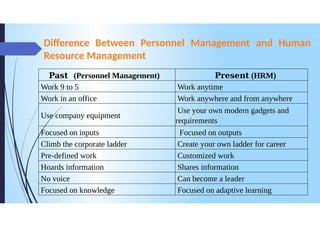
Difference Between Personnel
Resource Management
Management and Human
Past (Personnel Management)
Work9to 5
Work in an office
Use company equipment
Focused on inputs
Climb the corporate ladder
Pre-defined work
Hoards information
No voice
Present (HRM)
Work anytime
Work anywhere and from anywhere
Use your own modern gadgets and
requirements
Focused on outputs
Create your own ladder for career
Customized work
Shares information
Can become a leader
Focused on knowledge Focused on adaptive learning
Key Elements of HR
The four key elements of HR are :
Selection and Placement
Job Design
Compensation and Rewards
Diversity Management
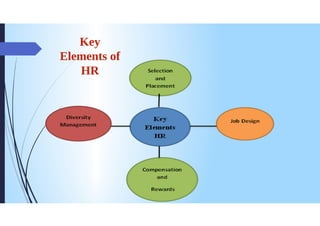
Key
Elements of
HR Selection
and
Placement
Diversity
Management
Key
Elements
Job Design
HR
Compensation
and
Rewards
1- Selection and Placement
This includes explaining the technical competencies needed (for example,
collecting statistical data) and defining behavioral competencies. Behavioral
competencies may have a customer focus, such as the ability to show empathy and
support of customers' feelings and points of view, or a work management focus,
such as the ability to complete tasks efficiently or to know when to seek guidance.
In addition, make the organization's culture clear by discussing the values that
underpin the organization-describe your organization's "heroes." For example,
are the heroes of your company the people who go the extra mile to get customers
to smile? Are they the people who toil through the night to develop new code? Are
they the ones who can network and reach a company president to make the sale?
By sharing such stories of company heroes with your potential hires, you'll help
reinforce what makes your company unique.
●
This, in turn, will help the job candidates determine whether they'll fit into your
organization's culture.
Job Design
Design jobs that involve doing a whole piece of work and are
challenging but doable. Job design refers to the process of putting
together various elements to form a job, bearing in mind
organizational and individual worker requirements, as well as
considerations of health, safety, and ergonomics. Train employees
to have the knowledge and skills to perform all parts of their job
and give them the authority and accountability to do so. Lawler, E.
(1992).
Compensation and Rewards
Evaluate and pay people based on their performance, not simply for showing up on
the job.
• Offer rewards for skill development and organizational performance, emphasizing
teamwork, collaboration, and responsibility for performance.
Help employees identify new skills to develop so that they can advance and
achieve higher pay and rewards.
●
Compensation systems that include incentives, gain sharing, profit-sharing, and
skill-based pay reward employees who learn new skills and put those skills to work
for the organization.
●
Employees who are trained in a broad range of skills and problem solving are more
likely to grow on the job and feel more satisfaction. Their training enables them to
make more valuable contributions to the company, which, in turn, gains them
higher rewards and greater commitment to the company. Barnes, W. F. (2001).
●
Diversity Management
In past decades, "diversity” meant avoiding discrimination against women and
minorities in hiring. Today, diversity goes far beyond this limited definition;
diversity management involves actively appreciating and using the differing
perspectives and ideas that individuals bring to the workplace.
Diversity is an invaluable contributor to innovation and problem-solving
success.
Diversity helps company teams to come up with more creative and effective
solutions.
Teams whose members have complementary skills are often more successful
because members can see one another's blind spots.
Members will be more inclined to make different kinds of mistakes, which
means that they'll be able to catch and correct those mistakes.
The main functions of HRM
SECOND LICTURE
The main functions of human resource
management
Human recourse planning
Job analysis
Jobdescription
Recruitment and selection
Compensation and Rewards
Training
Human Resource Planning(HRP)
HRP focuses on the size and nature of the workforce required to fulfill
the strategy. It typically begins with a broad forecast of the number and
type of employees necessary, followed by a more precise analysis to
ascertain skills and competencies required of recruits. That informs
recruitment and selection.
E.W. Vetter viewed (HRP) as
"a process by which an organisation should move from its current
manpower position to its desired manpower position. Through planning,
management strives to have the right number and right kind of people at
the right places at the right time, doing things which result in both the
organisation and the individual receiving maximum long-run
benefit."(Aquinas P.G, 2009, Human Resource Management - Principles
and Practice:33)
According to Leon C. Megginson (HRP)
is "an integrated approach to performing the planning aspects of the
personnel function in order to have a sufficient supply of adequately
developed and motivated people to perform the duties and tasks required
to meet organisational objectives and satisfy the individual needs and
goals of organisational members.( Aquinas P.G, 2009, Human Resource
Management - Principles and Practice:33)
Human Resource Planning - Need and Importance:
I. Assessing Future Personnel Needs.
II. Foundation for Other HRM Functions.
III. Coping with Change.
DIV. Investment Perspective.
IV. Expansion and Diversification Plans.
VI. Employee Turnover.
VII. Conformity with Government Guidelines.
VIII. International Expansion Strategies.
IX. Having Highly Talented Manpower Inventory.
Human Resource Planning - Objectives:
The main objectives of HRP are:
(i) Proper assessment of human resources needs in future.
(ii) Anticipation of deficient or surplus manpower and taking the
corrective action.
(iii) To create a highly talented workforce in the organization.
(iv) To protect the weaker sections of the society.
(v) To manage the challenges in the organization due to
modernization, restructuring and re-engineering.
(vi) To facilitate the realization of the organization's objectives by providing
right number and types of personnel.
(vii) Toreduce the costs associated with personnel by proper planning.
(viii)To determine the future skill requirements of the organization.
(ix) Toplan careers for individual employee.
(x) Providing a better view of HR dimensions to top management.
ki Determining the training and development needs of employees.
Human Resource Plan - Factors:
external factors:
1-Government Policies.
2-Level of Economic Development.
3-Business Environment.
4-Level of Technology.
5- International Factors.
6- Outsourcing.
Internal Factors:
i. Company policies and strategies.
ii. Human resource policies.
iii. Job analysis.
iv. Time horizons.
v. Type and quality of information.
vi. Company's production operations policy.
vii. Trade unions.
Steps to strategic Human Resource Planning
1. Analysing Organizational Objectives.
2. Inventory of Present Human Resources.
3. Forecasting Demand and Supply of Human Resource.
4. Estimating Manpower Gaps.
5. Formulating the Human Resource Action Plan.
6. Monitoring, Control and Feedback.
Job Analysis
(HRM
Third LICTURE
2- Job analysis:
Job analysis identifies the principal constituents of a role, including skills and
level of responsibility. It typically leads to a written job description that guides
selection, training and performance appraisal.
Issues to consider in job analysis include:
How is the data for the job description collected? Possibilities include interviewing
the job incumbent, observing people doing the job, and distributing questionnaires.
Who should collect this information or data? Should it be the job incumbent, the
supervisor or an internal or external specialist?
How should the job information be structured and laid out?
A comprehensive job analysis will show:
1. The job-oriented activities.
2- who a worker is to report to as well as the relationship of a worker
with others which include superiors, colleagues, and subordinates.
3- Behaviors performed during the work.
4- Equipment, materials, etc. to be used in performing the work
5- Job context like the physical working conditions, work schedule,
6- Personal data related to the job such as technical skills
7- Personal attributes like aptitudes, physical characteristics
job analysis will divided into subsets:
Job Description
Job title,
Job location,
Jobsummary,
Reporting to,
Working conditions,
Job duties,
Machines to be used
Hazards, etc
9
Job Specification
Qualification,
Experience,
Training,
Skills,
Responsibilities,
Emotional Characteristics,
Sensory demands, etc
The methods and technique used to gathering information about job:
1- Personal observation
2- Personal interviews
3-Data collection through questionnaire
4- Review of long records
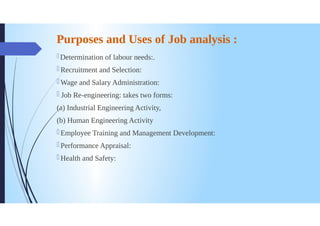
Purposes and Uses of Job analysis :
Determination of labour needs:.
Recruitment and Selection:
Wage and Salary Administration:
Job Re-engineering: takes two forms:
(a) Industrial Engineering Activity,
(b) Human Engineering Activity
0 Employee Training and Management Development:
Performance Appraisal:
Health and Safety:
Job Description
Job description is setting forth in clear terms and in writing the
duties, functions, responsibilities, and demands of a specific job.
The main competencies identified were
Job identification;
Job Summary:;
Job duties/responsibilities;
Relation to other jobs;
Supervision; and
Working conditions/environment
Job Specification
- is simply the expression of job description in terms of personnel qualities. It
is a list of human requirements needed to perform the job well.
- itis the minimum acceptable personnel characteristics or qualities necessary for the
efficient and effective performance of a job
The main competencies identified were
0 Job identification;
Job Summary:;
Job duties/responsibilities;
Relation to other jobs;
Supervision; and
Working conditions/environment
(a) Physical characteristics:.
(b)Psychological characteristics or special aptitudes
(c) Personal characteristics: unusual sensory qualities of sight, smell, hearing,
adaptability, conversational ability, etc.
(d) Demographic variables like age, sex, education, language ability, etc.pecial
aptitudes:
Job Design
fourth LICTURE
2- Job Design:
Job design is the process of deciding on the contents of a job in
terms of its duties and responsibilities; techniques, systems,
procedures, and methods to be used in carrying out the job;
and the relationships that should exist between the jobholder
and his superiors, subordinates and colleagues.
The certain factors that influence job design:
1. The Process of Intrinsic Motivation.
2- Characteristics of task structure.
3- Motivating characteristics of jobs.
4- The job characteristics model
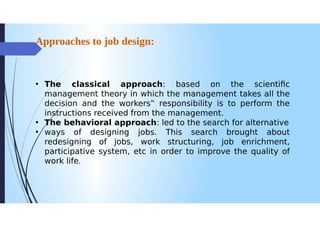
Approaches to job design:
●
The classical approach: based on the scientific
management theory in which the management takes all the
decision and the workers" responsibility is to perform the
instructions received from the management.
●
The behavioral approach: led to the search for alternative
ways of designing jobs. This search brought about
redesigning of jobs, work structuring, job enrichment,
participative system, etc in order to improve the quality of
work life.
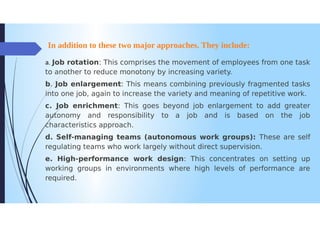
In addition to these two major approaches. They include:
a. Job rotation: This comprises the movement of employees from one task
to another to reduce monotony by increasing variety.
b.Job enlargement: This means combining previously fragmented tasks
into one job, again to increase the variety and meaning of repetitive work.
c. Job enrichment: This goes beyond job enlargement to add greater
autonomy and responsibility to a job and is based on the job
characteristics approach.
d. Self-managing teams (autonomous work groups): These are self
regulating teams who work largely without direct supervision.
e. High-performance work design: This concentrates on setting up
working groups in environments where high levels of performance are
required.
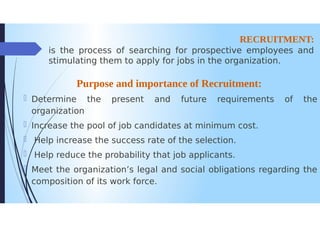
RECRUITMENT:
is the process of searching for prospective employees and
stimulating them to apply for jobs in the organization.
Purpose and importance of Recruitment:
Determine the present and future requirements
organization
D/Increase the pool of job candidates at minimum cost.
Help increase the success rate of the selection.
Help reduce the probability that job applicants.
Meet the organization's legal and social obligations regarding the
composition of its work force.
of the
Begin identifying and preparing potential job applicants who will be appropriate
candidates.
Increase organizational and individual effectiveness in the short term and long term.
Evaluate the effectiveness of various recruiting techniques and sources for all types of
job applicants.
Recruitment is a positive function in which publicity is given to the jobs available in
the
organization and interested candidates are encouraged to submit applications for the
purpose of selection.
0 Recruitment represents the first contact that a company makes with potential
employees
CRUITMENT PROCESS
The process comprises five interrelated stages:
Planning: involves the translation of likely job vacancies and
information about the nature of these jobs into set of objectives or
targets that specify the (1) Numbers and (2) Types of applicants to be
contacted.
0 Strategy Development
When it is estimated that what types of recruitment and how many are
required then one has concentrate in (1). Make or Buy employees. (2).
Technological sophistication of recruitment and selection devices. (3).
Geographical distribution of labours market comprising job seekers.
(4)Sources of recruitment.
5). Sequencing the activities in the recruitment process.
Searching
Once a recruitment plan and strategy are worked out, the search
process can begin. Search involves two steps
(1) Source activation and
(2) Selling.
Screening
Screening of applicants can be regarded as an integral part of
the recruiting process, though many view it as the first step in
the selection process. Even the definition on recruitment, we
quoted in the beginning of this chapter, excludes screening
from its scope.
Evaluation And Control
The costs generally incurred are: -
Salaries for recruiters.
0
Management and professional time spent on preparing job description,
job specifications, advertisements, agency liaison and so forth.
The cost of advertisements or other recruitment methods, that is, agency
fees.
Recruitment overheads and administrative expenses.
Costs of overtime and outsourcing while the vacancies remain unfilled.
Cost of recruiting unsuitable candidates for the selection process.
SOURCES OF RECRUITMENT :
Internal Sources:
1) Promotion17
2) Transfers
3) Internal notification
4) Retirement
5) Recall
6) Former employees
Miscellaneous external sources.
Internal notification (advertisement)
Sometimes, management issues an internal notification for the
benefit of existing employees.
Most employees know from their own experience about the
requirement of the job and what sort
External Sources:
1) Campus recruitment
2) Press advertisement
3) Management consultancy service (Advertisement) & private
employment exchanges
4) Deputation of personnel or transfer from one enterprise to
another
5) Management training schemes
6) Walk-ins, write-ins, talk-ins.
Evaluation of External Recruitment External
sources of recruitment have both merits and
demerits.
The merits:
The organization will have the benefit of new skills, new
talents and new experiences, if people are hired from
external sources.
●
The management will be able to fulfill reservation
requirements in favour of the disadvantaged sections of
the society.
Scope for resentment, heartburn and jealousy can be
avoided by recruiting from outside.
The demerits:
Better motivation and increased morale associated with promoting
own employees lost to the organization.
External recruitment is costly.
If recruitment and selection processes are not properly carried
out, chances of right candidates being rejected and wrong
applicants being selected occur.
0
1
High training time is associated with external recruitment.
98% of organizational success depends upon efficient employee
selection

hhrrmm.pdf

  • 1.
  • 2.
    Definition of humanResearce Management (HRM) Edwin Flippo:"Human Resource Management as "planning, organizing, directing, controlling of procurement, development, compensation, integration, maintenance and separation of human resources to the end that individual, organizational and social objectives are achieved." The National Institute of Personal Management (NIPM) of India has defined human resources - personal management as "that part of management which is concerned with people at work and with their relationship within an enterprise. Its aim is to bring together and develop into an effective organization of the men and women who make up enterprise and having regard for the well-being of the individuals and of working oups, to enable them to make their best contribution to its success".
  • 3.
    HRM According to Decenzoand Robbins, "Human Resource Management is concerned with the people dimension” in management. Since every organization is made up of people, acquiring their services, developing their skills, motivating them to higher levels of performance and ensuring that they continue to maintain their commitment to the organization is essential to achieve organsational objectives. This is true, regardless of the type chife oforganization - government, business, education, health or social action".
  • 4.
    Historical development ofHRM The term 'human resource management' is relatively new, gaining prominence in US companies and business schools from about 1980 (Brewster, 1994). 0 Growing trade union power also led management to create departments that specialised in conducting negotiations and monitoring the agreements. littleinfluence on strategic issues. Changes in the business world led some observers to propose that issues concerned with managing people should have a higher profile, and especially that line managers should take more interest .
  • 5.
    Guest (1987) attributesthis change to: The emergence of more globally integrated markets in which competition is more extensive and severe. The economic success during the 1980s of countries that had given employee management a relatively high priority, such as Japan and (West) Germany. The highly publicised companies of excellence' literature (Peters and Waterman, 1982) which suggested that high-performance organisations were characterised by a strong commitment to HRM. 6 • Changes in the composition of the workforce, particularly the growth of a more educated staff. Declining trade union membership and collective bargaining in many economies.
  • 6.
    The Importance ofHuman Capital (H C) Employees provide an organization's human capital. H C is the set of skills that you have acquired on the job, through training and experience, and which increase your value in the marketplace. HC defined as the collective sum of the attributes, life experience, knowledge, inventiveness, energy and enthusiasm that its people choose to invest in their work. He defined also as the elusive asset; measuring and managing human capital: A strategic imperative for HR. ●
  • 7.
    Difference Between Personnel ResourceManagement Management and Human Past (Personnel Management) Work9to 5 Work in an office Use company equipment Focused on inputs Climb the corporate ladder Pre-defined work Hoards information No voice Present (HRM) Work anytime Work anywhere and from anywhere Use your own modern gadgets and requirements Focused on outputs Create your own ladder for career Customized work Shares information Can become a leader Focused on knowledge Focused on adaptive learning
  • 8.
    Key Elements ofHR The four key elements of HR are : Selection and Placement Job Design Compensation and Rewards Diversity Management
  • 9.
  • 10.
    1- Selection andPlacement This includes explaining the technical competencies needed (for example, collecting statistical data) and defining behavioral competencies. Behavioral competencies may have a customer focus, such as the ability to show empathy and support of customers' feelings and points of view, or a work management focus, such as the ability to complete tasks efficiently or to know when to seek guidance. In addition, make the organization's culture clear by discussing the values that underpin the organization-describe your organization's "heroes." For example, are the heroes of your company the people who go the extra mile to get customers to smile? Are they the people who toil through the night to develop new code? Are they the ones who can network and reach a company president to make the sale? By sharing such stories of company heroes with your potential hires, you'll help reinforce what makes your company unique. ● This, in turn, will help the job candidates determine whether they'll fit into your organization's culture.
  • 11.
    Job Design Design jobsthat involve doing a whole piece of work and are challenging but doable. Job design refers to the process of putting together various elements to form a job, bearing in mind organizational and individual worker requirements, as well as considerations of health, safety, and ergonomics. Train employees to have the knowledge and skills to perform all parts of their job and give them the authority and accountability to do so. Lawler, E. (1992).
  • 12.
    Compensation and Rewards Evaluateand pay people based on their performance, not simply for showing up on the job. • Offer rewards for skill development and organizational performance, emphasizing teamwork, collaboration, and responsibility for performance. Help employees identify new skills to develop so that they can advance and achieve higher pay and rewards. ● Compensation systems that include incentives, gain sharing, profit-sharing, and skill-based pay reward employees who learn new skills and put those skills to work for the organization. ● Employees who are trained in a broad range of skills and problem solving are more likely to grow on the job and feel more satisfaction. Their training enables them to make more valuable contributions to the company, which, in turn, gains them higher rewards and greater commitment to the company. Barnes, W. F. (2001). ●
  • 13.
    Diversity Management In pastdecades, "diversity” meant avoiding discrimination against women and minorities in hiring. Today, diversity goes far beyond this limited definition; diversity management involves actively appreciating and using the differing perspectives and ideas that individuals bring to the workplace. Diversity is an invaluable contributor to innovation and problem-solving success. Diversity helps company teams to come up with more creative and effective solutions. Teams whose members have complementary skills are often more successful because members can see one another's blind spots. Members will be more inclined to make different kinds of mistakes, which means that they'll be able to catch and correct those mistakes.
  • 14.
    The main functionsof HRM SECOND LICTURE
  • 15.
    The main functionsof human resource management Human recourse planning Job analysis Jobdescription Recruitment and selection Compensation and Rewards Training
  • 16.
    Human Resource Planning(HRP) HRPfocuses on the size and nature of the workforce required to fulfill the strategy. It typically begins with a broad forecast of the number and type of employees necessary, followed by a more precise analysis to ascertain skills and competencies required of recruits. That informs recruitment and selection.
  • 17.
    E.W. Vetter viewed(HRP) as "a process by which an organisation should move from its current manpower position to its desired manpower position. Through planning, management strives to have the right number and right kind of people at the right places at the right time, doing things which result in both the organisation and the individual receiving maximum long-run benefit."(Aquinas P.G, 2009, Human Resource Management - Principles and Practice:33) According to Leon C. Megginson (HRP) is "an integrated approach to performing the planning aspects of the personnel function in order to have a sufficient supply of adequately developed and motivated people to perform the duties and tasks required to meet organisational objectives and satisfy the individual needs and goals of organisational members.( Aquinas P.G, 2009, Human Resource Management - Principles and Practice:33)
  • 18.
    Human Resource Planning- Need and Importance: I. Assessing Future Personnel Needs. II. Foundation for Other HRM Functions. III. Coping with Change. DIV. Investment Perspective. IV. Expansion and Diversification Plans. VI. Employee Turnover. VII. Conformity with Government Guidelines. VIII. International Expansion Strategies. IX. Having Highly Talented Manpower Inventory.
  • 19.
    Human Resource Planning- Objectives: The main objectives of HRP are: (i) Proper assessment of human resources needs in future. (ii) Anticipation of deficient or surplus manpower and taking the corrective action. (iii) To create a highly talented workforce in the organization. (iv) To protect the weaker sections of the society. (v) To manage the challenges in the organization due to modernization, restructuring and re-engineering.
  • 20.
    (vi) To facilitatethe realization of the organization's objectives by providing right number and types of personnel. (vii) Toreduce the costs associated with personnel by proper planning. (viii)To determine the future skill requirements of the organization. (ix) Toplan careers for individual employee. (x) Providing a better view of HR dimensions to top management. ki Determining the training and development needs of employees.
  • 21.
    Human Resource Plan- Factors: external factors: 1-Government Policies. 2-Level of Economic Development. 3-Business Environment. 4-Level of Technology. 5- International Factors. 6- Outsourcing.
  • 22.
    Internal Factors: i. Companypolicies and strategies. ii. Human resource policies. iii. Job analysis. iv. Time horizons. v. Type and quality of information. vi. Company's production operations policy. vii. Trade unions.
  • 23.
    Steps to strategicHuman Resource Planning 1. Analysing Organizational Objectives. 2. Inventory of Present Human Resources. 3. Forecasting Demand and Supply of Human Resource. 4. Estimating Manpower Gaps. 5. Formulating the Human Resource Action Plan. 6. Monitoring, Control and Feedback.
  • 24.
  • 25.
    2- Job analysis: Jobanalysis identifies the principal constituents of a role, including skills and level of responsibility. It typically leads to a written job description that guides selection, training and performance appraisal. Issues to consider in job analysis include: How is the data for the job description collected? Possibilities include interviewing the job incumbent, observing people doing the job, and distributing questionnaires. Who should collect this information or data? Should it be the job incumbent, the supervisor or an internal or external specialist? How should the job information be structured and laid out?
  • 26.
    A comprehensive jobanalysis will show: 1. The job-oriented activities. 2- who a worker is to report to as well as the relationship of a worker with others which include superiors, colleagues, and subordinates. 3- Behaviors performed during the work. 4- Equipment, materials, etc. to be used in performing the work 5- Job context like the physical working conditions, work schedule, 6- Personal data related to the job such as technical skills 7- Personal attributes like aptitudes, physical characteristics
  • 27.
    job analysis willdivided into subsets: Job Description Job title, Job location, Jobsummary, Reporting to, Working conditions, Job duties, Machines to be used Hazards, etc 9 Job Specification Qualification, Experience, Training, Skills, Responsibilities, Emotional Characteristics, Sensory demands, etc
  • 28.
    The methods andtechnique used to gathering information about job: 1- Personal observation 2- Personal interviews 3-Data collection through questionnaire 4- Review of long records
  • 29.
    Purposes and Usesof Job analysis : Determination of labour needs:. Recruitment and Selection: Wage and Salary Administration: Job Re-engineering: takes two forms: (a) Industrial Engineering Activity, (b) Human Engineering Activity 0 Employee Training and Management Development: Performance Appraisal: Health and Safety:
  • 30.
    Job Description Job descriptionis setting forth in clear terms and in writing the duties, functions, responsibilities, and demands of a specific job. The main competencies identified were Job identification; Job Summary:; Job duties/responsibilities; Relation to other jobs; Supervision; and Working conditions/environment
  • 31.
    Job Specification - issimply the expression of job description in terms of personnel qualities. It is a list of human requirements needed to perform the job well. - itis the minimum acceptable personnel characteristics or qualities necessary for the efficient and effective performance of a job The main competencies identified were 0 Job identification; Job Summary:; Job duties/responsibilities; Relation to other jobs; Supervision; and Working conditions/environment
  • 32.
    (a) Physical characteristics:. (b)Psychologicalcharacteristics or special aptitudes (c) Personal characteristics: unusual sensory qualities of sight, smell, hearing, adaptability, conversational ability, etc. (d) Demographic variables like age, sex, education, language ability, etc.pecial aptitudes:
  • 33.
  • 34.
    2- Job Design: Jobdesign is the process of deciding on the contents of a job in terms of its duties and responsibilities; techniques, systems, procedures, and methods to be used in carrying out the job; and the relationships that should exist between the jobholder and his superiors, subordinates and colleagues.
  • 35.
    The certain factorsthat influence job design: 1. The Process of Intrinsic Motivation. 2- Characteristics of task structure. 3- Motivating characteristics of jobs. 4- The job characteristics model
  • 36.
    Approaches to jobdesign: ● The classical approach: based on the scientific management theory in which the management takes all the decision and the workers" responsibility is to perform the instructions received from the management. ● The behavioral approach: led to the search for alternative ways of designing jobs. This search brought about redesigning of jobs, work structuring, job enrichment, participative system, etc in order to improve the quality of work life.
  • 37.
    In addition tothese two major approaches. They include: a. Job rotation: This comprises the movement of employees from one task to another to reduce monotony by increasing variety. b.Job enlargement: This means combining previously fragmented tasks into one job, again to increase the variety and meaning of repetitive work. c. Job enrichment: This goes beyond job enlargement to add greater autonomy and responsibility to a job and is based on the job characteristics approach. d. Self-managing teams (autonomous work groups): These are self regulating teams who work largely without direct supervision. e. High-performance work design: This concentrates on setting up working groups in environments where high levels of performance are required.
  • 38.
    RECRUITMENT: is the processof searching for prospective employees and stimulating them to apply for jobs in the organization. Purpose and importance of Recruitment: Determine the present and future requirements organization D/Increase the pool of job candidates at minimum cost. Help increase the success rate of the selection. Help reduce the probability that job applicants. Meet the organization's legal and social obligations regarding the composition of its work force. of the
  • 39.
    Begin identifying andpreparing potential job applicants who will be appropriate candidates. Increase organizational and individual effectiveness in the short term and long term. Evaluate the effectiveness of various recruiting techniques and sources for all types of job applicants. Recruitment is a positive function in which publicity is given to the jobs available in the organization and interested candidates are encouraged to submit applications for the purpose of selection. 0 Recruitment represents the first contact that a company makes with potential employees
  • 40.
    CRUITMENT PROCESS The processcomprises five interrelated stages: Planning: involves the translation of likely job vacancies and information about the nature of these jobs into set of objectives or targets that specify the (1) Numbers and (2) Types of applicants to be contacted. 0 Strategy Development When it is estimated that what types of recruitment and how many are required then one has concentrate in (1). Make or Buy employees. (2). Technological sophistication of recruitment and selection devices. (3). Geographical distribution of labours market comprising job seekers. (4)Sources of recruitment. 5). Sequencing the activities in the recruitment process.
  • 41.
    Searching Once a recruitmentplan and strategy are worked out, the search process can begin. Search involves two steps (1) Source activation and (2) Selling.
  • 42.
    Screening Screening of applicantscan be regarded as an integral part of the recruiting process, though many view it as the first step in the selection process. Even the definition on recruitment, we quoted in the beginning of this chapter, excludes screening from its scope.
  • 43.
    Evaluation And Control Thecosts generally incurred are: - Salaries for recruiters. 0 Management and professional time spent on preparing job description, job specifications, advertisements, agency liaison and so forth. The cost of advertisements or other recruitment methods, that is, agency fees. Recruitment overheads and administrative expenses. Costs of overtime and outsourcing while the vacancies remain unfilled. Cost of recruiting unsuitable candidates for the selection process.
  • 44.
    SOURCES OF RECRUITMENT: Internal Sources: 1) Promotion17 2) Transfers 3) Internal notification 4) Retirement 5) Recall 6) Former employees Miscellaneous external sources.
  • 45.
    Internal notification (advertisement) Sometimes,management issues an internal notification for the benefit of existing employees. Most employees know from their own experience about the requirement of the job and what sort
  • 46.
    External Sources: 1) Campusrecruitment 2) Press advertisement 3) Management consultancy service (Advertisement) & private employment exchanges 4) Deputation of personnel or transfer from one enterprise to another 5) Management training schemes 6) Walk-ins, write-ins, talk-ins.
  • 47.
    Evaluation of ExternalRecruitment External sources of recruitment have both merits and demerits. The merits: The organization will have the benefit of new skills, new talents and new experiences, if people are hired from external sources. ● The management will be able to fulfill reservation requirements in favour of the disadvantaged sections of the society. Scope for resentment, heartburn and jealousy can be avoided by recruiting from outside.
  • 48.
    The demerits: Better motivationand increased morale associated with promoting own employees lost to the organization. External recruitment is costly. If recruitment and selection processes are not properly carried out, chances of right candidates being rejected and wrong applicants being selected occur. 0 1 High training time is associated with external recruitment. 98% of organizational success depends upon efficient employee selection