OVERVIEW
 Introduction to international compensation
 Meaning and definition of international
compensation
 Objectives of international compensation
 Components and benefits of international
compensation
 Approaches to international compensation
INTRODUCTION
 Compensation is an integral part of human resource
management.
 Compensation provided to employees can direct in
the form of monetary benefits and indirect in the
form of non-monetary benefits.
 Compensation does not include only salary but it is
the sum of all rewards & allowances provided to
employees in return of their services.
 Almost all the employees accept jobs in MNC’s
take-up assignments in various countries due to the
compensation package.
MEANING & DEFINITION
According to R. Wayne Mondy “ Compensation is
the total of all rewards provided to employees in
return to their services. The overall purpose of
providing compensation are to attract, retain, and
motivate employees”.
OBJECTIVES
From the point of view of firm:
 The compensation policy should be in line with the
structure, business needs and overall strategy of the
organisation.
 The policy should aim at attracting and retaining
the best talent.
 It should enhance employee satisfaction.
 It should be clear in terms of understanding of the
employees & convenient to administer.
From the point of view of employees:
 The employee expects proper compensation against
his competency and performance level.
 The employee expects substantial financial gain for
his own comfort and for his family also.
 The employee expects his present and future needs
to be taken care of .
 The policy should be progressive in nature.
COMPONENTS OF
INTERNATIONAL COMPENSATION
Base salary
Hardship premium
COLA Housing allowance
Allowances Home leave allowance Educational allowance
Relocation allowance Spouse assistance
Benefits
BASE SALARY
 Primary component of a package .
 Foundation block for international
compensation.
HARDSHIP PREMIUM
o It is perceived as an
inducement in the form
of salary premium to
accept foreign
assignment.
o Salary premium will
be 5%-40% of the base
salary.
COLA
o It involves a payment to
compensate for differences
in expenditures between the
home country and the
foreign country.
Why?
o To maintain the PCN
standard of living in the
HCN.
HOUSING ALLOWANCE
o This allowance implies
that employees should be
entitled to receive
accommodation that is
equivalent to that provided
for similar foreign
employees .
o This allowances are
often paid on either an
assessed or an accrual
basis.
HOME LEAVE ALLOWANCE
 A period of annual
leave taken by a staff
member in order to
visit their home
country.
OBJECTIVES IMPORTANCE
 To attract employees
 Employee satisfaction
 Productivity
 Time for Non-work
related issues.
o To ensure that
employees who live
abroad for an extended
period undergo
reorientation and re-
exposure .
EDUCATIONAL ALLOWANCES
 Providing allowance
for expatriate’s
children .
 Problems:-
I. Level of education
provided for
II. Adequacy of local
schools &
transportation in
host country.
RELOCATION ALLOWANCE
 This allowance cover
usually covers the
additional expenses of
expatriates during
relocation .
 It includes moving,
shipping, storage cost etc..
SPOUSE ASSISTANCE
 To help guard against or
offset income lost by an
expatriate’s as a result of
relocating abroad.
 Some firms may pay an
allowance to make up for a
spouse’s lost income.
 MNC’s generally pay
allowances in order to
encourage employees to take
up international assignments.
BENEFITS
 Pension plans.
 Medical coverage.
 Social security benefits.
 Vocations and special leave.
 Rest and rehabilitation
leave.
 Emergency provisions.
ISSUES
 Pension plans are very difficult
to deal with country-to-country.
 Transportability of benefits is
difficult to normalize.
 Laws governing private benefits
practices differ from country to
country.
 Firm practices vary.
APPROACHES
The two main approaches to expatriate
compensation are:
I. Going Rate Approach
II. Balance Sheet Approach
GOING RATE APPROACH
 It is also referred as the market rate approach.
 It is based on local market rates.
 It relies on survey comparisons among:
- Local nationals (HCNs)
- Expatriates of same nationality.
- Expatriates of all nationalities.
 Compensation based on the selected survey
comparison.
 Base pay & benefits may be supplemented by
additional payments for low pay countries.
ADVANTAGES &
DISADVANTAGES
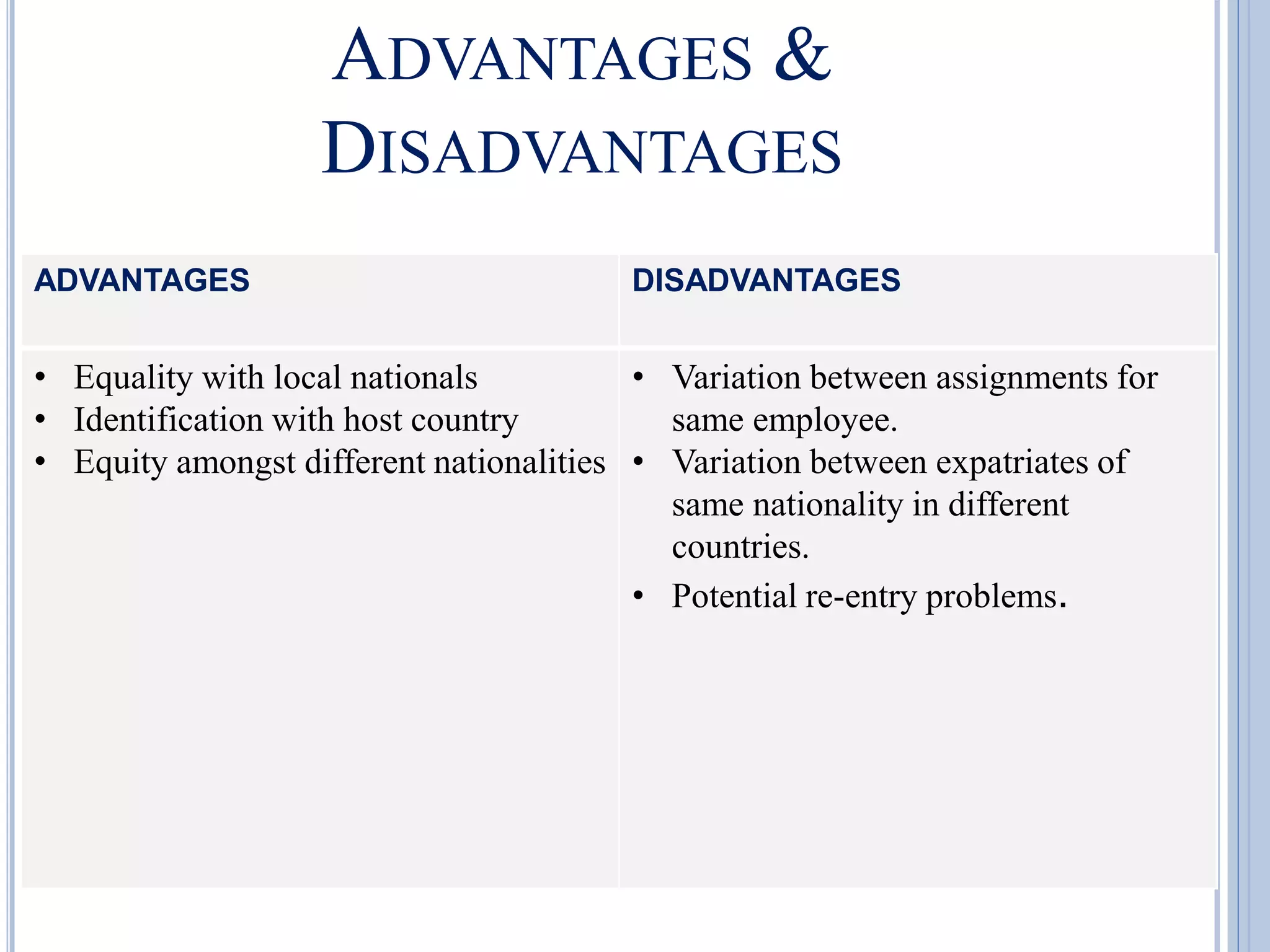
ADVANTAGES DISADVANTAGES
• Equality with local nationals
• Identification with host country
• Equity amongst different nationalities
• Variation between assignments for
same employee.
• Variation between expatriates of
same nationality in different
countries.
• Potential re-entry problems.
BALANCE SHEET APPROACH
 Balance sheet approach is also known as build –
up approach.
 Balance sheet approach to international
compensation is a system designed to equalize
purchasing power of employees at comparable
position level living abroad & in home country
and to provide incentives to offset qualitative
difference between assignment location.
OUTLAYS CONSIDERED IN
BALANCE SHEET APPROACH
 Goods and services.
 Housing
 Income tax
 Reserve
ADVANTAGES &
DISADVANTAGES
ADVANTAGES DISADVANTAGES
• Equity
- Between assignments
- Between expatriates of the same
nationality
• Facilitates expatriate re-entry
• Easy to communicate to
employees
• Can result in great disparities
- Between expatriates of different
nationalities
- Between expatriates and local
nationals
• Can be quite complex to administer.
BY:
INDU DOLAI
POORNIMA
ANKITHA KSHATRIYA

International compensation ppt

  • 2.
    OVERVIEW  Introduction tointernational compensation  Meaning and definition of international compensation  Objectives of international compensation  Components and benefits of international compensation  Approaches to international compensation
  • 3.
    INTRODUCTION  Compensation isan integral part of human resource management.  Compensation provided to employees can direct in the form of monetary benefits and indirect in the form of non-monetary benefits.  Compensation does not include only salary but it is the sum of all rewards & allowances provided to employees in return of their services.  Almost all the employees accept jobs in MNC’s take-up assignments in various countries due to the compensation package.
  • 4.
    MEANING & DEFINITION Accordingto R. Wayne Mondy “ Compensation is the total of all rewards provided to employees in return to their services. The overall purpose of providing compensation are to attract, retain, and motivate employees”.
  • 5.
    OBJECTIVES From the pointof view of firm:  The compensation policy should be in line with the structure, business needs and overall strategy of the organisation.  The policy should aim at attracting and retaining the best talent.  It should enhance employee satisfaction.  It should be clear in terms of understanding of the employees & convenient to administer.
  • 6.
    From the pointof view of employees:  The employee expects proper compensation against his competency and performance level.  The employee expects substantial financial gain for his own comfort and for his family also.  The employee expects his present and future needs to be taken care of .  The policy should be progressive in nature.
  • 7.
    COMPONENTS OF INTERNATIONAL COMPENSATION Basesalary Hardship premium COLA Housing allowance Allowances Home leave allowance Educational allowance Relocation allowance Spouse assistance Benefits
  • 8.
    BASE SALARY  Primarycomponent of a package .  Foundation block for international compensation.
  • 9.
    HARDSHIP PREMIUM o Itis perceived as an inducement in the form of salary premium to accept foreign assignment. o Salary premium will be 5%-40% of the base salary.
  • 10.
    COLA o It involvesa payment to compensate for differences in expenditures between the home country and the foreign country. Why? o To maintain the PCN standard of living in the HCN.
  • 11.
    HOUSING ALLOWANCE o Thisallowance implies that employees should be entitled to receive accommodation that is equivalent to that provided for similar foreign employees . o This allowances are often paid on either an assessed or an accrual basis.
  • 12.
    HOME LEAVE ALLOWANCE A period of annual leave taken by a staff member in order to visit their home country.
  • 13.
    OBJECTIVES IMPORTANCE  Toattract employees  Employee satisfaction  Productivity  Time for Non-work related issues. o To ensure that employees who live abroad for an extended period undergo reorientation and re- exposure .
  • 14.
    EDUCATIONAL ALLOWANCES  Providingallowance for expatriate’s children .  Problems:- I. Level of education provided for II. Adequacy of local schools & transportation in host country.
  • 15.
    RELOCATION ALLOWANCE  Thisallowance cover usually covers the additional expenses of expatriates during relocation .  It includes moving, shipping, storage cost etc..
  • 16.
    SPOUSE ASSISTANCE  Tohelp guard against or offset income lost by an expatriate’s as a result of relocating abroad.  Some firms may pay an allowance to make up for a spouse’s lost income.  MNC’s generally pay allowances in order to encourage employees to take up international assignments.
  • 17.
    BENEFITS  Pension plans. Medical coverage.  Social security benefits.  Vocations and special leave.  Rest and rehabilitation leave.  Emergency provisions.
  • 18.
    ISSUES  Pension plansare very difficult to deal with country-to-country.  Transportability of benefits is difficult to normalize.  Laws governing private benefits practices differ from country to country.  Firm practices vary.
  • 19.
    APPROACHES The two mainapproaches to expatriate compensation are: I. Going Rate Approach II. Balance Sheet Approach
  • 20.
    GOING RATE APPROACH It is also referred as the market rate approach.  It is based on local market rates.  It relies on survey comparisons among: - Local nationals (HCNs) - Expatriates of same nationality. - Expatriates of all nationalities.  Compensation based on the selected survey comparison.  Base pay & benefits may be supplemented by additional payments for low pay countries.
  • 21.
    ADVANTAGES & DISADVANTAGES ADVANTAGES DISADVANTAGES •Equality with local nationals • Identification with host country • Equity amongst different nationalities • Variation between assignments for same employee. • Variation between expatriates of same nationality in different countries. • Potential re-entry problems.
  • 22.
    BALANCE SHEET APPROACH Balance sheet approach is also known as build – up approach.  Balance sheet approach to international compensation is a system designed to equalize purchasing power of employees at comparable position level living abroad & in home country and to provide incentives to offset qualitative difference between assignment location.
  • 23.
    OUTLAYS CONSIDERED IN BALANCESHEET APPROACH  Goods and services.  Housing  Income tax  Reserve
  • 24.
    ADVANTAGES & DISADVANTAGES ADVANTAGES DISADVANTAGES •Equity - Between assignments - Between expatriates of the same nationality • Facilitates expatriate re-entry • Easy to communicate to employees • Can result in great disparities - Between expatriates of different nationalities - Between expatriates and local nationals • Can be quite complex to administer.
  • 25.