Associate Professor,
BON SECOURS COLLEGE FOR WOMEN,
THANJAVUR
Dr.N.R.SARAVANAN
MBA, MBA, MA (Yoga), PGDHRM, M.Phil, Ph.D,
HUMAN RESOURCE MANAGEMENT
Human Resource Roles & Functions
Unit - I
DEFINITION OF HRD
 A set of systematic and planned activities
designed by an organization to provide its
members with the necessary skills to meet
current and future job demands.
EMERGENCE OF HRD
 Employee needs extend beyond the
training classroom
 Includes coaching, group work, and
problem solving
 Need for basic employee development
 Need for structured career development
RELATIONSHIP BETWEEN HRM AND HRD
 Human resource management (HRM)
encompasses many functions
 Human resource development (HRD) is just
one of the functions within HRM
PRIMARY FUNCTIONS OF HRM
 Human resource planning
 Equal employment opportunity
 Staffing (recruitment and selection)
 Compensation and benefits
 Employee and labor relations
 Health, safety, and security
 Human resource development
SECONDARY HRM FUNCTIONS
 Organization and job design
 Performance management/ performance
appraisal systems
 Research and information systems
HRD FUNCTIONS
 Training and development (T&D)
 Organizational development
 Career development
ORGANIZATIONAL DEVELOPMENT
 The process of improving an organization’s
effectiveness and member’s well-being
through the application of behavioral science
concepts
 Focuses on both macro- and micro-levels
 HRD plays the role of a change agent
CAREER DEVELOPMENT
 Ongoing process by which individuals
progress through series of changes until they
achieve their personal level of maximum
achievement.
 Career planning
 Career management
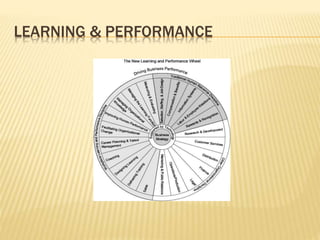
LEARNING & PERFORMANCE
CRITICAL HRD ISSUES
 Strategic management and HRD
 The supervisor’s role in HRD
 Organizational structure of HRD
STRATEGIC MANAGEMENT & HRD
 Strategic management aims to ensure
organizational effectiveness for the
foreseeable future – e.g., maximizing profits
in the next 3 to 5 years
 HRD aims to get managers and workers
ready for new products, procedures, and
materials
SUPERVISOR’S ROLE IN HRD
 Implements HRD programs and procedures
 On-the-job training (OJT)
 Coaching/mentoring/counseling
 Career and employee development
 A “front-line participant” in HRD

ORGANIZATIONAL STRUCTURE OF HRD
DEPARTMENTS
 Depends on company size, industry and
maturity
 No single structure used
 Depends in large part on how well the HRD
manager becomes an institutional part of the
company – i.e., a revenue contributor, not
just a revenue user
SAMPLE HRD JOBS/ROLES
 Executive/Manager
 HR Strategic Advisor
 HR Systems Designer/Developer
 Organization Change Agent
 Organization Design Consultant
 Learning Program Specialist
 Instructor/Facilitator
 Individual Development and Career Counselor
 Performance Consultant (Coach)
 Researcher
HR’S STRATEGIC ROLE
 Employees as organisation’s assets
 Driving business strategy
 Spanning organizational functions
 HRD Deliverables:
 Performance
 Capacity Building
 Problem solving/consulting
 Org. change and development
STRATEGIC HRD
 Integration of HRD with strategy formulation
and implementation
 Long-term view of HR policy
 Horizontal integration among HR functions
 Vertical integration with corporate strategy
 SHR as core competitive advantage
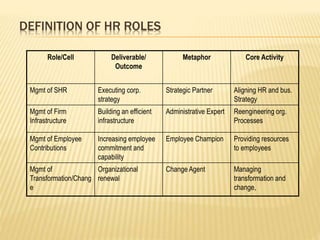
DEFINITION OF HR ROLES
Role/Cell Deliverable/
Outcome
Metaphor Core Activity
Mgmt of SHR Executing corp.
strategy
Strategic Partner Aligning HR and bus.
Strategy
Mgmt of Firm
Infrastructure
Building an efficient
infrastructure
Administrative Expert Reengineering org.
Processes
Mgmt of Employee
Contributions
Increasing employee
commitment and
capability
Employee Champion Providing resources
to employees
Mgmt of
Transformation/Chang
e
Organizational
renewal
Change Agent Managing
transformation and
change,
IMPORTANCE OF HUMAN RESOURCES
 Human resources are an important part of the
value chain
 They can be unique, and thus a source of
core competence in an organization
 If a core competence is related to HR, then
HR can contribute to competitive advantage
STRATEGIC ANALYSIS OF HR: PURPOSE
 People related strategies may be important to
new strategy (for example, a change in the
way the organization does business)
 In today’s technologically complex business
world, analysis of existing human resources
is important in order to determine what
options are available
 The network of people within an organization
and their relationships with people can be an
important part of strategy
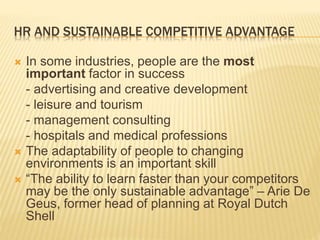
HR AND SUSTAINABLE COMPETITIVE ADVANTAGE
 In some industries, people are the most
important factor in success
- advertising and creative development
- leisure and tourism
- management consulting
- hospitals and medical professions
 The adaptability of people to changing
environments is an important skill
 “The ability to learn faster than your competitors
may be the only sustainable advantage” – Arie De
Geus, former head of planning at Royal Dutch
Shell
CHALLENGES FOR HRD
 Changing workforce demographics
 Competing in global economy
 Eliminating the skills gap
 Need for lifelong learning
 Need for organizational learning
COMPETING IN THE GLOBAL ECONOMY
 New technologies
 Need for more skilled and educated workers
 Cultural sensitivity required
 Team involvement
 Problem solving
 Better communications skills
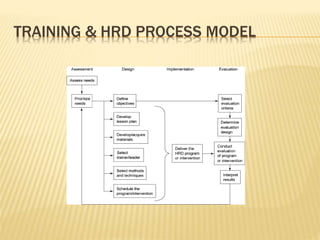
TRAINING & HRD PROCESS MODEL
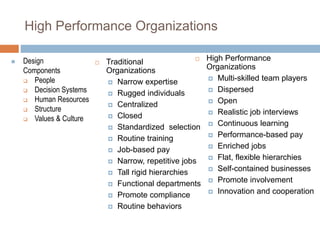
High Performance Organizations
 Traditional
Organizations
 Narrow expertise
 Rugged individuals
 Centralized
 Closed
 Standardized selection
 Routine training
 Job-based pay
 Narrow, repetitive jobs
 Tall rigid hierarchies
 Functional departments
 Promote compliance
 Routine behaviors
 High Performance
Organizations
 Multi-skilled team players
 Dispersed
 Open
 Realistic job interviews
 Continuous learning
 Performance-based pay
 Enriched jobs
 Flat, flexible hierarchies
 Self-contained businesses
 Promote involvement
 Innovation and cooperation
 Design
Components
 People
 Decision Systems
 Human Resources
 Structure
 Values & Culture
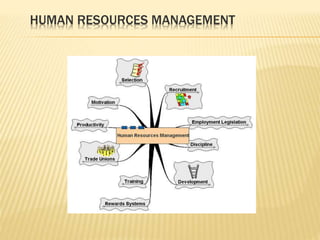
HUMAN RESOURCES MANAGEMENT
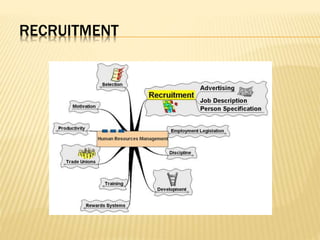
RECRUITMENT
RECRUITMENT
 The process by which a job vacancy
is identified and potential employees are notified.
 The nature of the recruitment process
is regulated and subject
to employment law.
 Main forms of recruitment through advertising in
newspapers, magazines, trade papers and internal
vacancy lists.
RECRUITMENT
 Job description – outline of the role
of the job holder
 Person specification – outline
of the skills and qualities required
of the post holder
 Applicants may demonstrate their suitability through
application form, letter or curriculum vitae (CV)
SELECTION
SELECTION
 The process of assessing candidates and
appointing a post holder
 Applicants short listed –
most suitable candidates selected
 Selection process –
varies according to organisation:
SELECTION
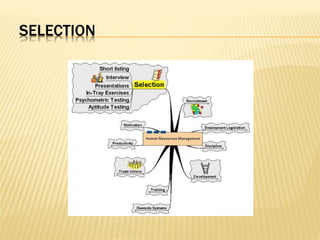
 Interview – most common method
 Psychometric testing – assessing the personality of the applicants –
will they fit in?
 Aptitude testing – assessing the skills
of applicants
 In-tray exercise – activity based around what the applicant will be
doing, e.g. writing a letter to a disgruntled customer
 Presentation – looking for different skills
as well as the ideas of the candidate
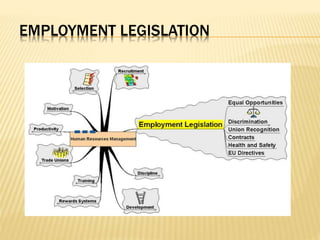
EMPLOYMENT LEGISLATION
 Increasingly important
aspect of the HRM role
 Wide range
of areas for attention
 Adds to the cost of the
business
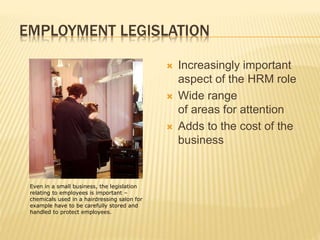
Even in a small business, the legislation
relating to employees is important –
chemicals used in a hairdressing salon for
example have to be carefully stored and
handled to protect employees.
DISCRIMINATION
 Crucial aspects
of employment legislation:
 Race
 Gender
 Disability
Disability is no longer an issue for employers
to ignore, they must take reasonable steps
to accommodate and recruit disabled workers.
Copyright: Mela, http://www.sxc.hu
DISCIPLINE
DISCIPLINE
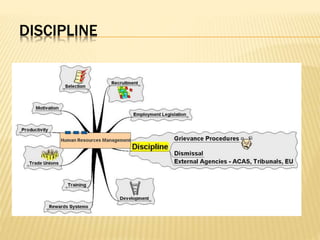
 Firms cannot just ‘sack’ workers
 Wide range of procedures and steps
in dealing with workplace conflict
 Informal meetings
 Formal meetings
 Verbal warnings
 Written warnings
 Grievance procedures
 Working with external agencies
DEVELOPMENT
DEVELOPMENT
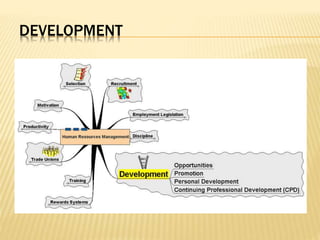
 Developing the employee
can be regarded as investing
in a valuable asset
 A source of motivation
 A source of helping the employee fulfil potential
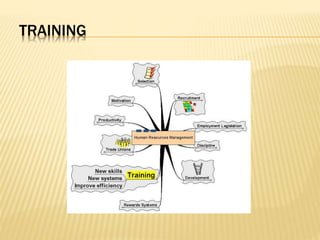
TRAINING
TRAINING
 Similar to development:
 Provides new skills for the employee
 Keeps the employee up to date
with changes in the field
 Aims to improve efficiency
 Can be external or ‘in-house’
***Good Afternoon Budding Managers***
***Unit 01 HR Roles and Functions***
contd
ROLE OF HR MANAGER 8/1/13
 Conscience Role
 Counsellor
 Mediator
 Spokesman
 Problem solver
 Change Agent
 - As a Specialist
 - As a Source of help and also a controller
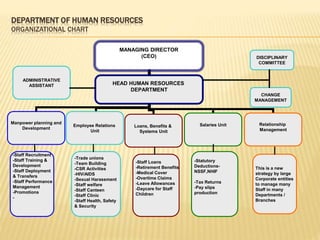
DEPARTMENT OF HUMAN RESOURCES
ORGANIZATIONAL CHART
MANAGING DIRECTOR
(CEO)
Manpower planning and
Development
Salaries Unit Relationship
Management
Employee Relations
Unit
Loans, Benefits &
Systems Unit
HEAD HUMAN RESOURCES
DEPARTMENT
-Trade unions
-Team Building
-CSR Activities
-HIV/AIDS
-Sexual Harassment
-Staff welfare
-Staff Canteen
-Staff Clinic
-Staff Health, Safety
& Security
-Statutory
Deductions-
NSSF,NHIF
-Tax Returns
-Pay slips
production
This is a new
strategy by large
Corporate entities
to manage many
Staff in many
Departments /
Branches
-Staff Loans
-Retirement Benefits
-Medical Cover
-Overtime Claims
-Leave Allowances
-Daycare for Staff
Children
-Staff Recruitment
-Staff Training &
Development
-Staff Deployment
& Transfers
-Staff Performance
Management
-Promotions
-
ADMINISTRATIVE
ASSISTANT
DISCIPLINARY
COMMITTEE
CHANGE
MANAGEMENT
HR ORGANIZATION STRUCTURE
The organizational structure of HR
is usually very flexible and it reflects
the immediate need of the
organisation. There is no modern
organisation where the HRM
organizational Structure stayed the
same for 18 months.
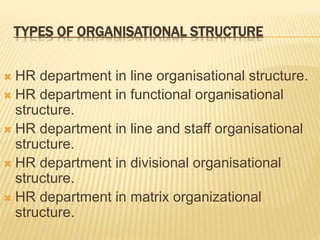
TYPES OF ORGANISATIONAL STRUCTURE
 HR department in line organisational structure.
 HR department in functional organisational
structure.
 HR department in line and staff organisational
structure.
 HR department in divisional organisational
structure.
 HR department in matrix organizational
structure.
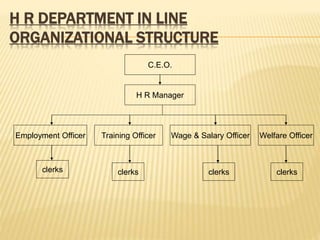
H R DEPARTMENT IN LINE
ORGANIZATIONAL STRUCTURE
C.E.O.
H R Manager
Training OfficerEmployment Officer Wage & Salary Officer Welfare Officer
clerks clerks clerksclerks
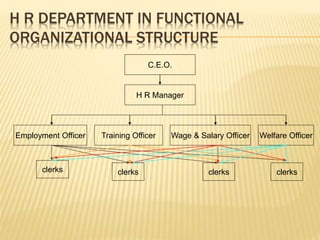
H R DEPARTMENT IN FUNCTIONAL
ORGANIZATIONAL STRUCTURE
C.E.O.
H R Manager
Training OfficerEmployment Officer Wage & Salary Officer Welfare Officer
clerks clerks clerksclerks
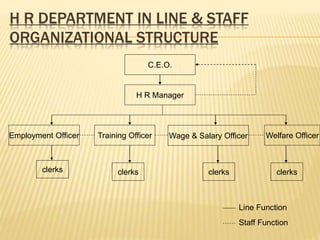
H R DEPARTMENT IN LINE & STAFF
ORGANIZATIONAL STRUCTURE
C.E.O.
H R Manager
Training OfficerEmployment Officer Wage & Salary Officer Welfare Officer
clerks clerks clerksclerks
Staff Function
Line Function
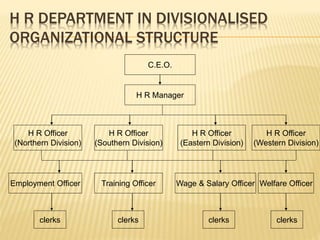
H R DEPARTMENT IN DIVISIONALISED
ORGANIZATIONAL STRUCTURE
C.E.O.
H R Manager
Training OfficerEmployment Officer Wage & Salary Officer Welfare Officer
clerks clerks clerksclerks
H R Officer
(Northern Division)
H R Officer
(Southern Division)
H R Officer
(Eastern Division)
H R Officer
(Western Division)
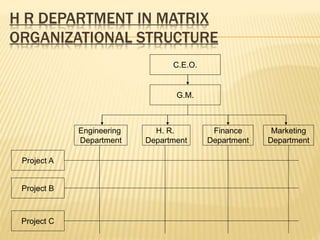
H R DEPARTMENT IN MATRIX
ORGANIZATIONAL STRUCTURE
C.E.O.
G.M.
H. R.
Department
Engineering
Department
Finance
Department
Marketing
Department
Project A
Project B
Project C
Human
Resource
Development
SIGNIFICANCE OF HRD
 It refers to the Knowledge, skills, abilities,
talents, aptitude, values and beliefs of an
Organizational Work force.
CHARACTERISTICS OF HR
 HR is complete humanbeing, emp enter with
their own values and sentiments.
 Competencies are developed through HRD
Programmes.
 Background, expectations and values vary
from person to person, hence every one
should be managed differently.
FEATURES OF HRD
 HRD is a systematic approach
 HRD is a continuous Process approach
 HRD is multidisciplinary
 HRD is embodied with techniques and
processes
 HRD develops skills at all fn levels
SCOPE FOR HRD
 Recruiting with possibilities of Dev.
 Selecting to meet future demands
 Analysing, Appraising & developing
performance of employees
 Training to acquire new skills
 Planning for succesion
 Learning through Group dynamics, Job
rotation, Enlargement & empowerment.
NEED FOR HRD
 Changes in Economic policies
 Changing Job requirements
 Need for multi skilled HR
 Orgn Visibility and Transformation Process
 Technological Advances
 Organizational Complexity
 Human Relations
HRD OBJECTIVES
 To Prepare the employee to meet the present
and changing future job requirements.
 To prepare for higher level jobs.
 To enhance Orgn. Capabilities.
 To ensure smooth and efficient working of the
Orgn.
HRD FUNCTIONS
 Performance Appraisal
 Employee Training
 Executive Development
 Career Planning & Development
 Succession plng
 Involvement in Quality Circles
 Worker’s Participation in Mgt
TECHNIQUES/ METHODS/INSTRUMENTS
 Performance App / Potential Appraisal
 Career Plng / CareerDevelopment
 Employee Training / Executive development
 Organizational Change / Orgn Development
 WPM / Qly Circles
 Employee Councelling / Team work / Role
Analysis
 Monetary rewards/Employee
Benefits/Grievance Mechanism
HR Strategies &
Organizational
Strategies
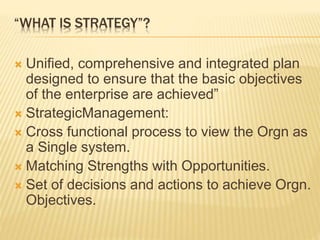
“WHAT IS STRATEGY”?
 Unified, comprehensive and integrated plan
designed to ensure that the basic objectives
of the enterprise are achieved”
 StrategicManagement:
 Cross functional process to view the Orgn as
a Single system.
 Matching Strengths with Opportunities.
 Set of decisions and actions to achieve Orgn.
Objectives.
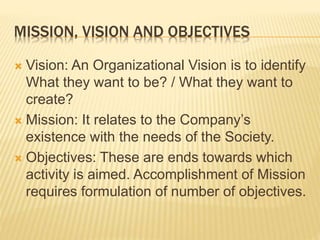
MISSION, VISION AND OBJECTIVES
 Vision: An Organizational Vision is to identify
What they want to be? / What they want to
create?
 Mission: It relates to the Company’s
existence with the needs of the Society.
 Objectives: These are ends towards which
activity is aimed. Accomplishment of Mission
requires formulation of number of objectives.
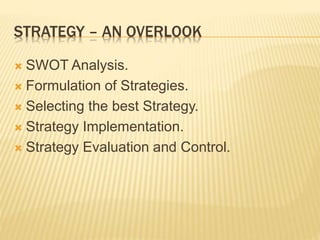
STRATEGY – AN OVERLOOK
 SWOT Analysis.
 Formulation of Strategies.
 Selecting the best Strategy.
 Strategy Implementation.
 Strategy Evaluation and Control.
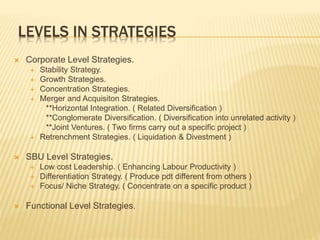
LEVELS IN STRATEGIES
 Corporate Level Strategies.
 Stability Strategy.
 Growth Strategies.
 Concentration Strategies.
 Merger and Acquisiton Strategies.
**Horizontal Integration. ( Related Diversification )
**Conglomerate Diversification. ( Diversification into unrelated activity )
**Joint Ventures. ( Two firms carry out a specific project )
 Retrenchment Strategies. ( Liquidation & Divestment )
 SBU Level Strategies.
 Low cost Leadership. ( Enhancing Labour Productivity )
 Differentiation Strategy. ( Produce pdt different from others )
 Focus/ Niche Strategy. ( Concentrate on a specific product )
 Functional Level Strategies.
International HRM
( Global
Environment )
INTERNATIONAL HRM ( GLOBAL ENVIRONMENT)
 International Co: “Export the Pdt
manufactured in the home country.”
 Multinational Co: “ Establishes
branches/subsidiaries in various countries
and operate as a domestic company”
INTERNATIONAL HRM ( GLOBAL ENVIRONMENT)
 Global Co: Produces Globally and Market
Locally (or) Produces locally and Market
Globally.
 Transnational Co: Produces, Markets,
Invests and Operates across the world.
SOURCES OF GLOBAL RECRUITMENT
 Parent Company Nationals.
 Host Company Nationals.
 Third Country Nationals.
GLOBAL SELECTION APPROACH
 Ethnocentric Approach
 Polycentric Approach
 Geocentric Approach
 ## Concept of Expatriates
COMPENSATION IN GLOBAL ENVIRONMENT
 Expatriate Pay
 Gratuity
 Allowances
 Taxation
Human Resource Planning and Recruitment
Unit - II
HR PLANNING
 HR Planning is the process of examining an
organizations’ future human resource need.
 It involves:
 Identifying and acquiring the right number of people with the
proper skills
 Motivating them to achieve high performance
 Creating interactive links between business objectives and
resource planning activities
Human Resource Planning (HR Planning) is both a process and a set of plans.
It is how organizations assess the future supply of and demand for human
resources.
An effective HR plan also provides mechanisms to eliminate any gaps that may
exist between supply and demand. Thus, HR planning determines the
members and types of employees to be recruited into the organization or
phased out of it.
Dynamic by nature, the HR planning process often requires periodic
readjustments as labor market conditions change.
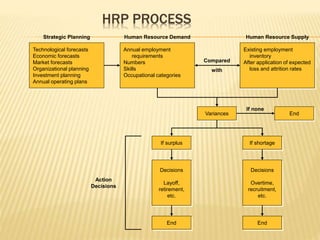
HUMAN RESOURCE PLANNING
Technological forecasts
Economic forecasts
Market forecasts
Organizational planning
Investment planning
Annual operating plans
Annual employment
requirements
Numbers
Skills
Occupational categories
Existing employment
inventory
After application of expected
loss and attrition rates
Variances End
If surplus If shortage
Decisions
Layoff,
retirement,
etc.
Decisions
Overtime,
recruitment,
etc.
End End
Strategic Planning Human Resource Demand Human Resource Supply
Compared
with
If none
Action
Decisions
HRP PROCESS
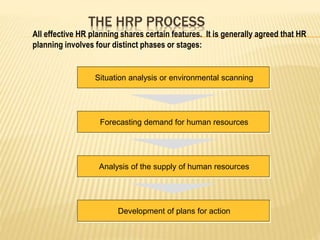
All effective HR planning shares certain features. It is generally agreed that HR
planning involves four distinct phases or stages:
Situation analysis or environmental scanning
Forecasting demand for human resources
Analysis of the supply of human resources
Development of plans for action
THE HRP PROCESS
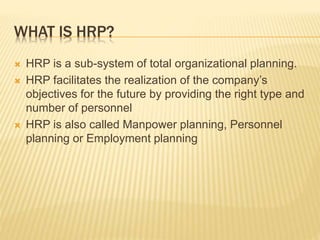
WHAT IS HRP?
 HRP is a sub-system of total organizational planning.
 HRP facilitates the realization of the company’s
objectives for the future by providing the right type and
number of personnel
 HRP is also called Manpower planning, Personnel
planning or Employment planning
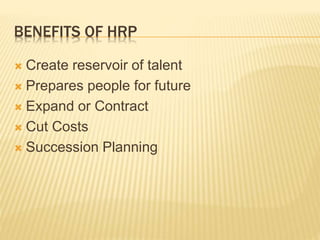
BENEFITS OF HRP
 Create reservoir of talent
 Prepares people for future
 Expand or Contract
 Cut Costs
 Succession Planning
FORECASTING TECHNIQUES
 Managerial Judgment
 Ratio trend analysis
 Work Study Techniques
 Delphi Technique
 Flow Models
 Others
FACTORS IN DEMAND FORECASTING
 Social factors – Working conditions, Govt. regulations,
environmental conditions, religious, cultural.
 Technological Factors
 Political Factors – Trade restrictions, War etc.
 Economic Factors
 Demand generation
 Growth
 Employee Turnover
JOB ANALYSIS
 Job Analysis is not a one time activity as jobs are
changing constantly
 The job and not the person – an important
consideration in job analysis is conducted of the job
and not of the person
 It simply highlights what are the minimum activities that
are entailed in a job.
JOB ANALYSIS
 Skill Range
 Does the job cover a reasonable but not too
extensive range of different tasks?
 Are there opportunities to use knowledge and
skills associated with effective performance of
the job?
 Can the individual make full use of their skills
and develop their skill base?
JOB ANALYSIS
 Job Purpose
 Is the purpose of the job clearly and
unequivocally
 Is its contribution to the organisation’s objectives
evident?
 Is its contribution to its dept obvious?
 Is the post holder responsible for the successful
completion of the whole job?
 Do the internal systems help the post holder do
the job?
JOB ANALYSIS
 Relationships
 Are the formal relationships clearly specified and
related to the achievement of the objectives?
 Is there opportunity to develop working
relationships within and across the department’s
boundaries?
 Are colleagues available with whom the post
holder can discuss professional issues
JOB ANALYSIS
 Job Outcomes:
 Can the post holder see the result of their
efforts?
 Can the results of the post holders efforts be
recognised?
 Does the post holder have the opportunity to
influence their own levels of performance?
 Rewards
 Are the rewards appropriate and obtainable?
 Are the rewards linked directly with the
performance of the post holder?
STEPS IN JOB ANALYSIS
1. Organizational Analysis – Overview of various jobs in
the organization and the linkages between them and
the contribution of various jobs towards achieving
organizational efficiency and effectiveness.
2. Uses of Job Analysis Information
3. Selection of jobs for analysis
4. Collection of Data
5. Preparation of Job description – tasks, duties,
responsibilities
6. Preparation of Job Specification – personal attributes
required in terms of education, training, aptitude and
experience to fulfill the job description
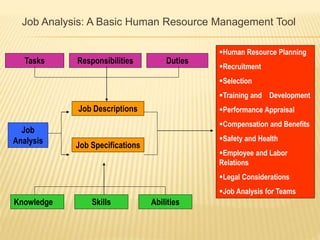
Tasks Responsibilities Duties
Job
Analysis
Job Descriptions
Job Specifications
Knowledge Skills Abilities
Human Resource Planning
Recruitment
Selection
Training and Development
Performance Appraisal
Compensation and Benefits
Safety and Health
Employee and Labor
Relations
Legal Considerations
Job Analysis for Teams
Job Analysis: A Basic Human Resource Management Tool
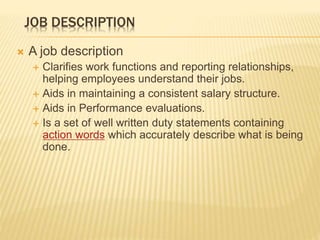
JOB DESCRIPTION
 A job description
 Clarifies work functions and reporting relationships,
helping employees understand their jobs.
 Aids in maintaining a consistent salary structure.
 Aids in Performance evaluations.
 Is a set of well written duty statements containing
action words which accurately describe what is being
done.
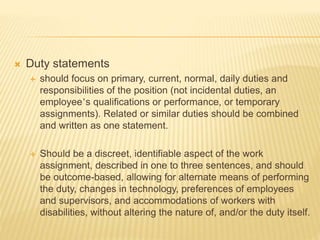
 Duty statements
 should focus on primary, current, normal, daily duties and
responsibilities of the position (not incidental duties, an
employee’s qualifications or performance, or temporary
assignments). Related or similar duties should be combined
and written as one statement.
 Should be a discreet, identifiable aspect of the work
assignment, described in one to three sentences, and should
be outcome-based, allowing for alternate means of performing
the duty, changes in technology, preferences of employees
and supervisors, and accommodations of workers with
disabilities, without altering the nature of, and/or the duty itself.
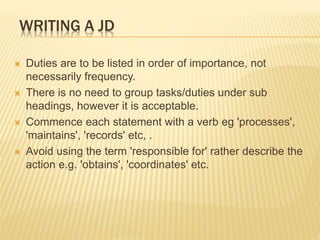
WRITING A JD
 Duties are to be listed in order of importance, not
necessarily frequency.
 There is no need to group tasks/duties under sub
headings, however it is acceptable.
 Commence each statement with a verb eg 'processes',
'maintains', 'records' etc, .
 Avoid using the term 'responsible for' rather describe the
action e.g. 'obtains', 'coordinates' etc.
WRITING A JD
 Frequencies should be identified in multiples of 5%.
Duties that take less than 5% of the officer's time
should not be shown as separate but grouped with
other duties.
 Use action verbs which tell what the position does.
Examples include "supervises", "programs", "directs"
and "analyzes". Provide specific examples to
illustrate the duties Avoid ambiguous terms such as
"oversees" or "manages", instead, describe the
activities involved in overseeing or managing.
Quantify activities when possible. Examples may
include: How often is the activity performed? How
much money does this position manage? What is
the volume of work handled?
WRITING A JD : PRIMARY FUNCTION
 What is the Position's objective?
 What is the Role of Position (including key
relationships)?
 Position summary [Briefly state the purpose or
objective of the position]:
 Essential job functions [State the major
responsibilities, indicate New (N) or Existing (E), and
the estimated percent of time devoted to each -
include descriptive statements of typical or
representative tasks associated with the major
responsibilities/functions]:
 State briefly the general function of your position,
including the basic nature of the department and the
relationship of your position with other positions in
PERSON SPECIFICATION
 Person Specification is a statement
derived from the job analysis process
and the job description
 Of the characteristics that an individual
would need to possess in order to fulfill
the requirements of a job
REASONS FOR CONDUCTING JOB
ANALYSIS
 Staffing – would be haphazard if recruiter did not
know qualifications needed for job
 Training and Development – if specification lists a
particular knowledge, skill, or ability, and the person
filling the position does not possess all the
necessary qualifications, training and/or
development is needed
 Compensation and Benefits – value of job must be
known before dollar value can be placed on it
REASONS FOR CONDUCTING JOB
ANALYSIS (CONTINUED)
 Safety and Health – helps identify safety and health
considerations
 Employee and Labor Relations – lead to more objective
human resource decisions
 Legal Considerations – having done job analysis important
for supporting legality of employment practices
CONDUCTING JOB ANALYSIS
The people who participate in job
analysis should include, at a minimum:
 The employee
 The employee’s immediate supervisor
 Other key stakeholders in the organization
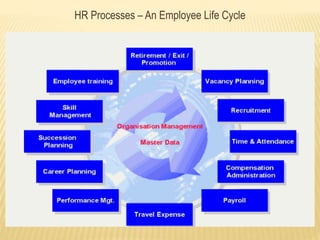
HR Processes – An Employee Life Cycle
ROUTINE HR FUNCTIONS
 Manpower planning
 Recruitment and Selection
 Training & Development
 Appraisals – Performance Management
 Transfers / Promotions
 Compensation and Benefits
NON ROUTINE HR FUNCTIONS
 Culture Management
 Change Management
 Cross Cultural Issue Management
 HR Audit
 HR Accounting
 Outsourcing of HR
 VRS / Existing Employee Management /
Succession Planning
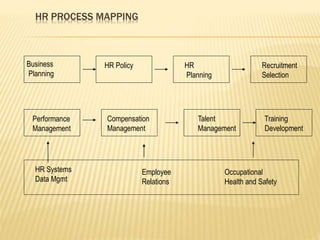
HR PROCESS MAPPING
Business
Planning
HR Policy HR
Planning
Recruitment
Selection
Performance
Management
Compensation
Management
Talent
Management
Training
Development
HR Systems
Data Mgmt
Employee
Relations
Occupational
Health and Safety
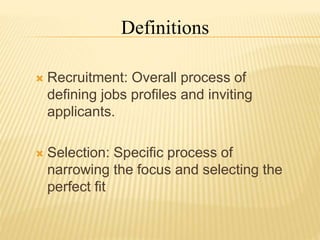
 Recruitment: Overall process of
defining jobs profiles and inviting
applicants.
 Selection: Specific process of
narrowing the focus and selecting the
perfect fit
Definitions
MANPOWER PLANNING
 Business Needs
 Financial Feasibility
 Future Plans
 Brand Name
MANPOWER PLANNING
 Why does the position exist?
Temporary Replacement
Permanent Replacement
Creation of new position
RECRUITMENT AND SELECTION PROCESS
 Business Plan
 Related HR Plan
 Competencies
 People
 Compensation and Benefits
 Numbers
 Current : Budgeted and Actual
 Future : Short Term and Long Term
 Three Conditions
 Current = Future
 Maintenance B = A
 Vacancy Filling B > A
 Current > Future
 Redundancy Planning
 Current < Future
 Recruitment Plan
RECRUITMENT AND SELECTION PROCESS
 Recruitment Plan
 Position Description/Specifications
 Person Specifications
 Method of Recruitment
 Internal
 Reference/Promotions/Transfers
 External
 Advertisement
 Where to advertise
 Writing an advertisement
 Consultants
 Retainer
 Multiple
 Internet
 Receiving Applications and Screening/Filing
RECRUITMENT AND SELECTION PROCESS
 Screening /Short-listing
 Coding
 Computer aided screening
 Selection Tools
 Written Tests
 Group Discussions
 Interviews
 Assessment Centres
 Reference Checks
 Offer
 Joining
WHY OBJECTIVE SETTING?
 Gives direction to job.
 Helps focus on important job areas.
 Assists review and change in job emphasis.
 Provides a basis for appraisal, counselling
and feedback.
 Increases mutual job understanding with
superior.
HRS ROLE IN PERFORMANCE MANAGEMENT
 Delivering time-lines
 Ensuring timely adherence
 Auditing the objectives jointly with line
managers
 Ensuring objectives are in line with
organisational goals
 Requesting modification if required
Training & Development and
Performance Appraisal
UNIT - III
INTRODUCTION
 Performance appraisal is an evaluation of
the performance of an employee against the
job standards in terms of quantitative,
qualitative and behavioural aspects at the
workplace.
 A successful PA process involves explaining
the job, communicating expectations,
observing and documenting behaviour and
providing frequent informal feedback.
WHY PA ?
 It helps the supervisor and the employee
to –
 Understand individual strengths &
weaknesses of performance
 Mutually understand expectations for
performance
 Form a basis for personnel action
 Determine training & development needs of
employees
PERFORMANCE APPRAISAL AND TRAINING NEEDS
 Review org. goals to associate preferred org.
results in terms of units of performance i.e.
quality, quantity, cost or timeliness.
 Specify desired results for the domain, gives
guidance & focus on results needed by other
domains Learning goals
 Prioritize the range of results needed from the
employee helps the supervisor understand what
training needs to be given.
PERFORMANCE APPRAISAL AND TRAINING NEEDS
 Identify measures to evaluate if an how well the
domain’s desired results were achieved.
 Identify standards for evaluating how well the
desired results were achieved.
 Document a performance plan – desired results,
measures and standards.
 Conduct ongoing measurement to track the
performance of the employee.
PERFORMANCE APPRAISAL AND TRAINING NEEDS
 To provide an opportunity for the employee for
introspection, Self-evaluation and goal-setting so that
he remains on the path of development.
 To prepare the employees for higher jobs by
reinforcing development of behaviour & qualities for
these higher level positions.
 To generate relevant data on each employee
periodically.
 To enable employee to adopt the norms and values
of the organization and develop commitment.
PERFORMANCE APPRAISAL PROCESS
 Done on certain criterions or standards fixed
in advance.
 Employee should be aware of those
yardsticks.
 Steps in PA
 Establishing standards
 Communicating stds. to employees
 Measuring actual performance.
 Comparing actual with stds.
 Discussing reports with employees
 Taking corrective action
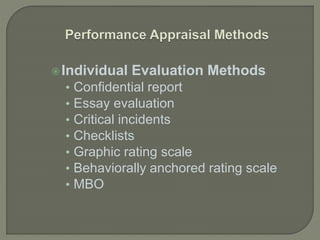
Individual Evaluation Methods
• Confidential report
• Essay evaluation
• Critical incidents
• Checklists
• Graphic rating scale
• Behaviorally anchored rating scale
• MBO
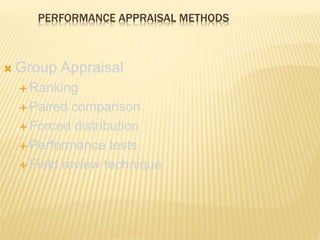
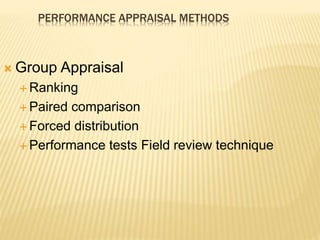
 Group Appraisal
 Ranking
 Paired comparison
 Forced distribution
 Performance tests
 Field review technique
PERFORMANCE APPRAISAL METHODS
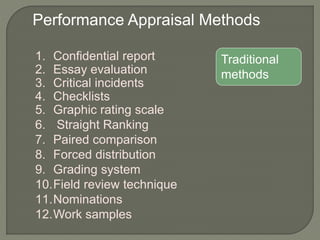
Performance Appraisal Methods
Traditional
methods
1. Confidential report
2. Essay evaluation
3. Critical incidents
4. Checklists
5. Graphic rating scale
6. Straight Ranking
7. Paired comparison
8. Forced distribution
9. Grading system
10.Field review technique
11.Nominations
12.Work samples
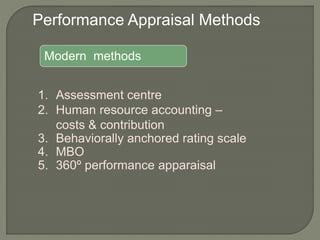
Performance Appraisal Methods
Modern methods
1. Assessment centre
2. Human resource accounting –
costs & contribution
3. Behaviorally anchored rating scale
4. MBO
5. 360º performance apparaisal
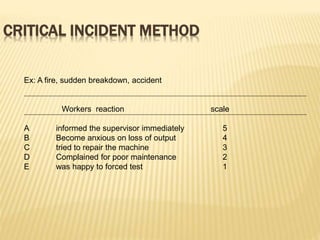
CRITICAL INCIDENT METHOD
Ex: A fire, sudden breakdown, accident
Workers reaction scale
A informed the supervisor immediately 5
B Become anxious on loss of output 4
C tried to repair the machine 3
D Complained for poor maintenance 2
E was happy to forced test 1
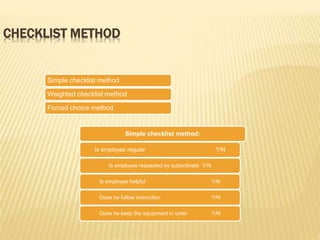
CHECKLIST METHOD
Simple checklist method
Weighted checklist method
Forced choice method
Simple checklist method:
Is employee regular Y/N
Is employee respected by subordinate Y/N
Is employee helpful Y/N
Does he follow instruction Y/N
Does he keep the equipment in order Y/N
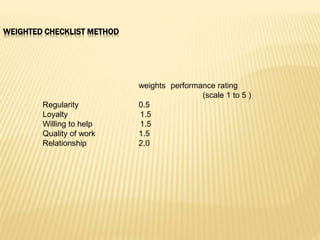
WEIGHTED CHECKLIST METHOD
weights performance rating
(scale 1 to 5 )
Regularity 0.5
Loyalty 1.5
Willing to help 1.5
Quality of work 1.5
Relationship 2.0
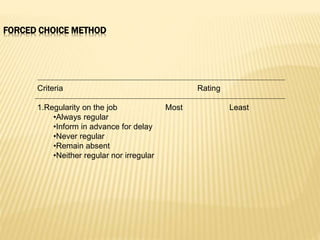
FORCED CHOICE METHOD
Criteria Rating
1.Regularity on the job Most Least
•Always regular
•Inform in advance for delay
•Never regular
•Remain absent
•Neither regular nor irregular
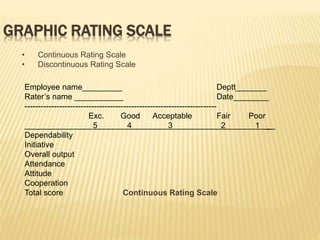
GRAPHIC RATING SCALE
• Continuous Rating Scale
• Discontinuous Rating Scale
Employee name_________ Deptt_______
Rater’s name ___________ Date________
------------------------------------------------------------------------
Exc. Good Acceptable Fair Poor
5 4 3 2 1 _
Dependability
Initiative
Overall output
Attendance
Attitude
Cooperation
Total score Continuous Rating Scale
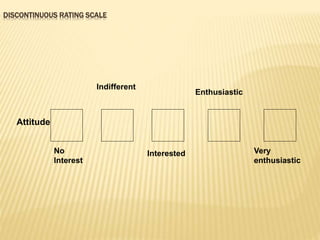
DISCONTINUOUS RATING SCALE
Attitude
No
Interest
Indifferent
Interested
Enthusiastic
Very
enthusiastic
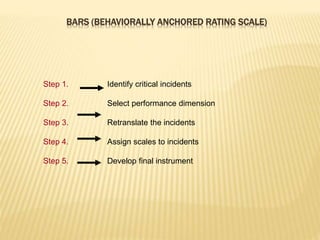
BARS (BEHAVIORALLY ANCHORED RATING SCALE)
Step 1. Identify critical incidents
Step 2. Select performance dimension
Step 3. Retranslate the incidents
Step 4. Assign scales to incidents
Step 5. Develop final instrument
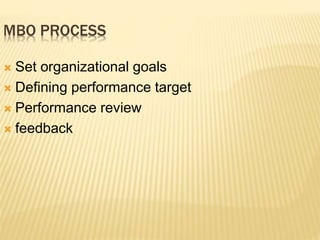
MBO PROCESS
 Set organizational goals
 Defining performance target
 Performance review
 feedback
 Group Appraisal
 Ranking
 Paired comparison
 Forced distribution
 Performance tests Field review technique
PERFORMANCE APPRAISAL METHODS
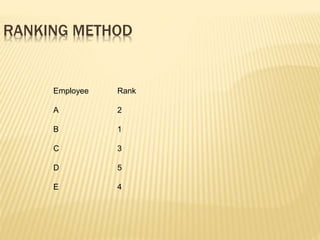
RANKING METHOD
Employee Rank
A 2
B 1
C 3
D 5
E 4
PAIRED COMPARISON METHOD
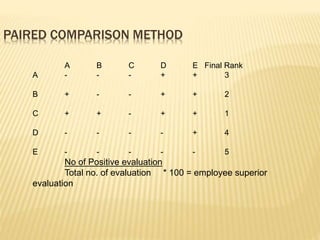
A B C D E Final Rank
A - - - + + 3
B + - - + + 2
C + + - + + 1
D - - - - + 4
E - - - - - 5
No of Positive evaluation
Total no. of evaluation * 100 = employee superior
evaluation
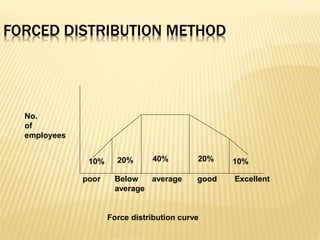
FORCED DISTRIBUTION METHOD
10% 20% 40% 20% 10%
poor Below
average
average good Excellent
No.
of
employees
Force distribution curve
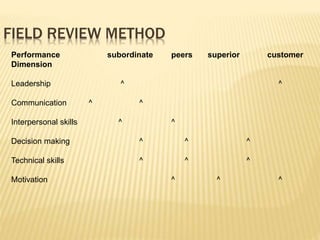
FIELD REVIEW METHOD
Performance subordinate peers superior customer
Dimension
Leadership ^ ^
Communication ^ ^
Interpersonal skills ^ ^
Decision making ^ ^ ^
Technical skills ^ ^ ^
Motivation ^ ^ ^
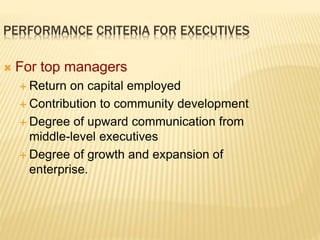
PERFORMANCE CRITERIA FOR EXECUTIVES
 For top managers
 Return on capital employed
 Contribution to community development
 Degree of upward communication from
middle-level executives
 Degree of growth and expansion of
enterprise.
FOR MIDDLE LEVEL MANAGERS
 Departmental performance
 Coordination among employees
 Degree of upward communication from supervisors
 Degree of clarity about corporate goals and policies
FOR SUPERVISORS
 Quality and quantity of output in a given period
 Labor cost per unit of output in a given period
 Material cost per unit in a given period
 Rate of absenteeism and turnover of employees
 No of accidents in a given period
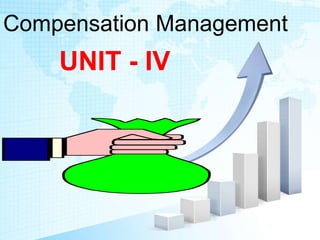
Compensation Management
UNIT - IV
A DEFINITION . . .
 All forms of
 financial return,
 tangible services and
 benefits
 that employees receive as part of their
employment relationship
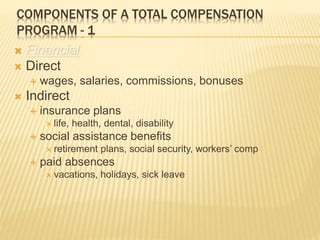
COMPONENTS OF A TOTAL COMPENSATION
PROGRAM - 1
 Financial
 Direct
 wages, salaries, commissions, bonuses
 Indirect
 insurance plans
 life, health, dental, disability
 social assistance benefits
 retirement plans, social security, workers’ comp
 paid absences
 vacations, holidays, sick leave
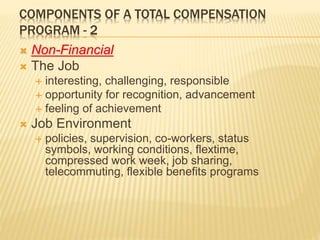
COMPONENTS OF A TOTAL COMPENSATION
PROGRAM - 2
 Non-Financial
 The Job
 interesting, challenging, responsible
 opportunity for recognition, advancement
 feeling of achievement
 Job Environment
 policies, supervision, co-workers, status
symbols, working conditions, flextime,
compressed work week, job sharing,
telecommuting, flexible benefits programs
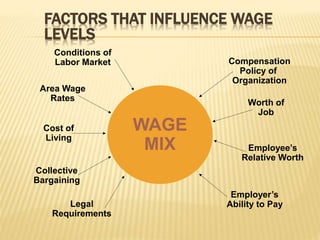
FACTORS THAT INFLUENCE WAGE
LEVELS
WAGE
MIX
Conditions of
Labor Market
Area Wage
Rates
Cost of
Living
Collective
Bargaining
Legal
Requirements
Compensation
Policy of
Organization
Worth of
Job
Employee’s
Relative Worth
Employer’s
Ability to Pay
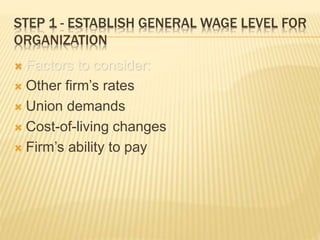
STEP 1 - ESTABLISH GENERAL WAGE LEVEL FOR
ORGANIZATION
 Factors to consider:
 Other firm’s rates
 Union demands
 Cost-of-living changes
 Firm’s ability to pay
STEP 2 - ESTABLISH WAGE STRUCTURE (THE
PAY FOR EACH JOB)
 Employ a job evaluation system
 Ranking
 Job Classification
 Point System
 Factor Comparison
 Results:
 pay grades
 rate ranges
STEP 3 - ESTABLISH PAY FOR EACH INDIVIDUAL
ON EACH JOB
 Inputs:
 Performance appraisal information
 Seniority system
A PAY MODEL -- 3 BASIC COMPONENTS
 I. Compensation Objectives
 II. Foundation Concepts
 III. Techniques for Management
A PAY MODEL
I. COMPENSATION OBJECTIVES - 1
 Organization Performance
 Labor Costs
 Attitudes and Behaviors
 Laws and Regulations
A PAY MODEL
I. COMPENSATION OBJECTIVES - 2
 Influence forms & procedures
 For example:
 if objective is pay for performance, emphasize
incentives, merit pay plans
 if objective is stable, experienced workforce,
emphasize seniority-based pay
A PAY MODEL
II. FOUNDATION CONCEPTS
 Equity
 External Equity
 Comparison: outside organization
 Internal Equity
 Comparison: inside organization, among
jobs
 Employee Equity
 Comparison: individuals doing same job
for same organization
A PAY MODEL
III. TECHNIQUES FOR MANAGEMENT
 A. Pay Level
 B. Pay Structure
 C. Individual Pay Rates
A PAY MODEL
III. TECHNIQUES FOR MANAGEMENT
A. PAY LEVEL
 Defined: average rates paid by
employer
 Applicable concept: External Equity
 3 Pure Alternatives
 lead competition
 match competition
 lag competition
 Mechanism used: Market Wage Survey
MARKET WAGE AND SALARY SURVEYS
 Select key jobs.
 Determine relevant labor market.
 Select organizations.
 Decide on information to collect:
wages/benefits/pay policies.
 Compile data received.
 Determine wages and benefits to pay.
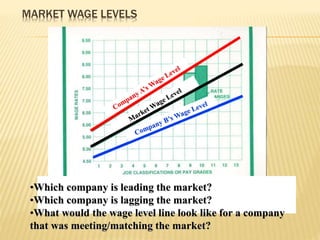
MARKET WAGE LEVELS
•Which company is leading the market?
•Which company is lagging the market?
•What would the wage level line look like for a company
that was meeting/matching the market?
A PAY MODEL
III. TECHNIQUES FOR MANAGEMENT
B. PAY STRUCTURE
 Defined: pay rates for different jobs
within a single organization
 Applicable concept: Internal Equity
 Pay more for jobs with
 greater qualifications
 less desirable working conditions
 more valuable output
 Mechanism used: Job Analysis & Job
Evaluation
JOB EVALUATION
 defined: the systematic evaluation of
job descriptions
 outcome: a hierarchy of organizational
jobs according to their content and
value to the organization
 Methods:
 ranking
 classification
 factor comparison
 point method
JOB RANKING SYSTEM
Simplest and oldest system of job
evaluation by which jobs are arrayed
on the basis of their relative worth
JOB CLASSIFICATION SYSTEM
System of job evaluation by which jobs
are classified and grouped according
to a series of predetermined wage grades
POINT SYSTEM
Quantitative job evaluation procedure
that determines the relative value of a job
by the total points assigned to it
FACTOR COMPARISON SYSTEM
Job evaluation system that permits the
evaluation process to be accomplished
on a factor-by-factor basis by developing
a factor comparison scale
HAY PROFILE METHOD
Job evaluation technique using three
factors – knowledge, mental activity,
and accountability – to evaluate
executive and managerial positions
A PAY MODEL
III. TECHNIQUES FOR MANAGEMENT
C. INDIVIDUAL PAY RATES
 Defined: pay rates for different
individuals doing the same job within an
organization
 Applicable concept: Employee Equity
 2 Techniques
 Flat Rate
 Pay Ranges
 Mechanisms used: Performance or
Seniority
WAGE CURVE
Curve in a scattergram representing
the relationship between relative worth
of jobs and wage rates
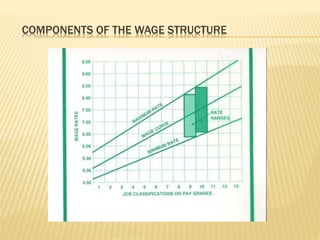
COMPONENTS OF THE WAGE STRUCTURE
PAY GRADES
Groups of jobs within a particular class
that are paid the same rate or rate range
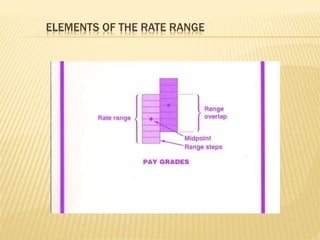
ELEMENTS OF THE RATE RANGE
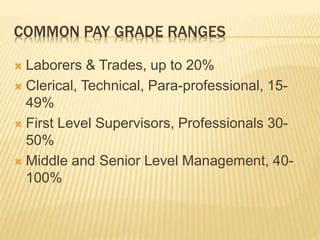
COMMON PAY GRADE RANGES
 Laborers & Trades, up to 20%
 Clerical, Technical, Para-professional, 15-
49%
 First Level Supervisors, Professionals 30-
50%
 Middle and Senior Level Management, 40-
100%
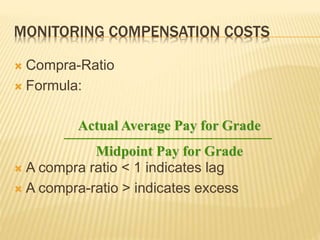
MONITORING COMPENSATION COSTS
 Compra-Ratio
 Formula:
 A compra ratio < 1 indicates lag
 A compra-ratio > indicates excess
Actual Average Pay for Grade
Midpoint Pay for Grade
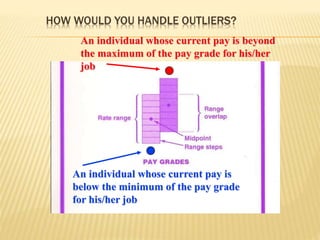
HOW WOULD YOU HANDLE OUTLIERS?
An individual whose current pay is beyond
the maximum of the pay grade for his/her
job
An individual whose current pay is
below the minimum of the pay grade
for his/her job
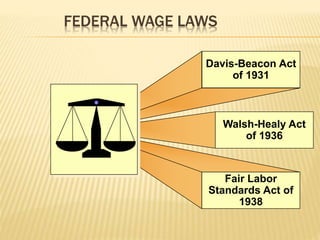
FEDERAL WAGE LAWS
Davis-Beacon Act
of 1931
Walsh-Healy Act
of 1936
Fair Labor
Standards Act of
1938
NONEXEMPT EMPLOYEES
Employees covered by the overtime
provisions of the Fair Labor Standards Act
EXEMPT EMPLOYEES
Employees not covered by the overtime
provisions of the Fair Labor Standards Act
COMPARABLE WORTH
The concept that male and female jobs
that are dissimilar, but equal in terms
of value or worth to the employer,
should be paid the same
Compression of differentials between
job classes, particularly the differential
between hourly workers and their managers
Performance Evaluation
Unit - V
What is Performance Appraisal
• It is the process by which organization evaluate
employee job performance.
• It is a process that involves determining and
communicating to an employee how he or she is
performing the job and ideally establishing a plan
of improvement.
• It is a systematic and objective way of evaluating
both work-related behaviour and potential of
employees.
6/29/2020 175
Difference between PM and PA
6/29/2020
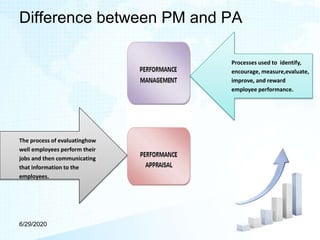
Processes used to identify,
encourage, measure,evaluate,
improve, and reward
employee performance.
The process of evaluatinghow
well employees perform their
jobs and then communicating
that information to the
employees.
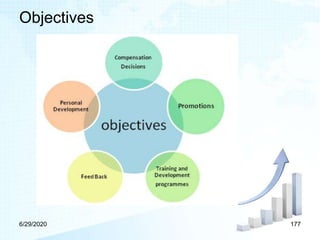
Objectives
6/29/2020 177
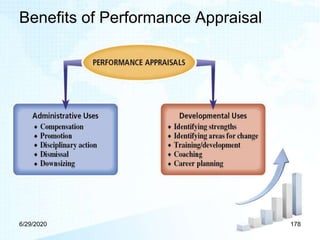
Benefits of Performance Appraisal
6/29/2020 178
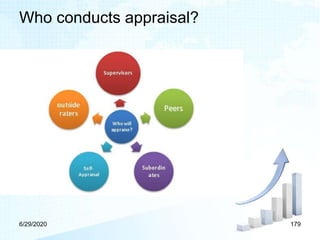
Who conducts appraisal?
6/29/2020 179
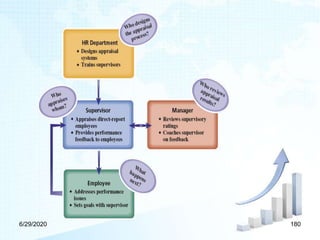
6/29/2020 180
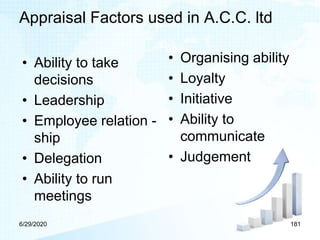
Appraisal Factors used in A.C.C. ltd
• Ability to take
decisions
• Leadership
• Employee relation -
ship
• Delegation
• Ability to run
meetings
• Organising ability
• Loyalty
• Initiative
• Ability to
communicate
• Judgement
6/29/2020 181
INTERESTING, RIGHT?
This is just a sneak preview of the full presentation. We hope you like
it! To see the rest of it, just click here to view it in full on
PowerShow.com. Then, if you’d like, you can also log in to
PowerShow.com to download the entire presentation for free.

Human Resource Management

  • 1.
    Associate Professor, BON SECOURSCOLLEGE FOR WOMEN, THANJAVUR Dr.N.R.SARAVANAN MBA, MBA, MA (Yoga), PGDHRM, M.Phil, Ph.D, HUMAN RESOURCE MANAGEMENT
  • 2.
    Human Resource Roles& Functions Unit - I
  • 3.
    DEFINITION OF HRD A set of systematic and planned activities designed by an organization to provide its members with the necessary skills to meet current and future job demands.
  • 4.
    EMERGENCE OF HRD Employee needs extend beyond the training classroom  Includes coaching, group work, and problem solving  Need for basic employee development  Need for structured career development
  • 5.
    RELATIONSHIP BETWEEN HRMAND HRD  Human resource management (HRM) encompasses many functions  Human resource development (HRD) is just one of the functions within HRM
  • 6.
    PRIMARY FUNCTIONS OFHRM  Human resource planning  Equal employment opportunity  Staffing (recruitment and selection)  Compensation and benefits  Employee and labor relations  Health, safety, and security  Human resource development
  • 7.
    SECONDARY HRM FUNCTIONS Organization and job design  Performance management/ performance appraisal systems  Research and information systems
  • 8.
    HRD FUNCTIONS  Trainingand development (T&D)  Organizational development  Career development
  • 9.
    ORGANIZATIONAL DEVELOPMENT  Theprocess of improving an organization’s effectiveness and member’s well-being through the application of behavioral science concepts  Focuses on both macro- and micro-levels  HRD plays the role of a change agent
  • 10.
    CAREER DEVELOPMENT  Ongoingprocess by which individuals progress through series of changes until they achieve their personal level of maximum achievement.  Career planning  Career management
  • 11.
  • 12.
    CRITICAL HRD ISSUES Strategic management and HRD  The supervisor’s role in HRD  Organizational structure of HRD
  • 13.
    STRATEGIC MANAGEMENT &HRD  Strategic management aims to ensure organizational effectiveness for the foreseeable future – e.g., maximizing profits in the next 3 to 5 years  HRD aims to get managers and workers ready for new products, procedures, and materials
  • 14.
    SUPERVISOR’S ROLE INHRD  Implements HRD programs and procedures  On-the-job training (OJT)  Coaching/mentoring/counseling  Career and employee development  A “front-line participant” in HRD
  • 15.
    ORGANIZATIONAL STRUCTURE OFHRD DEPARTMENTS  Depends on company size, industry and maturity  No single structure used  Depends in large part on how well the HRD manager becomes an institutional part of the company – i.e., a revenue contributor, not just a revenue user
  • 16.
    SAMPLE HRD JOBS/ROLES Executive/Manager  HR Strategic Advisor  HR Systems Designer/Developer  Organization Change Agent  Organization Design Consultant  Learning Program Specialist  Instructor/Facilitator  Individual Development and Career Counselor  Performance Consultant (Coach)  Researcher
  • 17.
    HR’S STRATEGIC ROLE Employees as organisation’s assets  Driving business strategy  Spanning organizational functions  HRD Deliverables:  Performance  Capacity Building  Problem solving/consulting  Org. change and development
  • 18.
    STRATEGIC HRD  Integrationof HRD with strategy formulation and implementation  Long-term view of HR policy  Horizontal integration among HR functions  Vertical integration with corporate strategy  SHR as core competitive advantage
  • 19.
    DEFINITION OF HRROLES Role/Cell Deliverable/ Outcome Metaphor Core Activity Mgmt of SHR Executing corp. strategy Strategic Partner Aligning HR and bus. Strategy Mgmt of Firm Infrastructure Building an efficient infrastructure Administrative Expert Reengineering org. Processes Mgmt of Employee Contributions Increasing employee commitment and capability Employee Champion Providing resources to employees Mgmt of Transformation/Chang e Organizational renewal Change Agent Managing transformation and change,
  • 20.
    IMPORTANCE OF HUMANRESOURCES  Human resources are an important part of the value chain  They can be unique, and thus a source of core competence in an organization  If a core competence is related to HR, then HR can contribute to competitive advantage
  • 21.
    STRATEGIC ANALYSIS OFHR: PURPOSE  People related strategies may be important to new strategy (for example, a change in the way the organization does business)  In today’s technologically complex business world, analysis of existing human resources is important in order to determine what options are available  The network of people within an organization and their relationships with people can be an important part of strategy
  • 22.
    HR AND SUSTAINABLECOMPETITIVE ADVANTAGE  In some industries, people are the most important factor in success - advertising and creative development - leisure and tourism - management consulting - hospitals and medical professions  The adaptability of people to changing environments is an important skill  “The ability to learn faster than your competitors may be the only sustainable advantage” – Arie De Geus, former head of planning at Royal Dutch Shell
  • 23.
    CHALLENGES FOR HRD Changing workforce demographics  Competing in global economy  Eliminating the skills gap  Need for lifelong learning  Need for organizational learning
  • 24.
    COMPETING IN THEGLOBAL ECONOMY  New technologies  Need for more skilled and educated workers  Cultural sensitivity required  Team involvement  Problem solving  Better communications skills
  • 25.
    TRAINING & HRDPROCESS MODEL
  • 26.
    High Performance Organizations Traditional Organizations  Narrow expertise  Rugged individuals  Centralized  Closed  Standardized selection  Routine training  Job-based pay  Narrow, repetitive jobs  Tall rigid hierarchies  Functional departments  Promote compliance  Routine behaviors  High Performance Organizations  Multi-skilled team players  Dispersed  Open  Realistic job interviews  Continuous learning  Performance-based pay  Enriched jobs  Flat, flexible hierarchies  Self-contained businesses  Promote involvement  Innovation and cooperation  Design Components  People  Decision Systems  Human Resources  Structure  Values & Culture
  • 27.
  • 28.
  • 29.
    RECRUITMENT  The processby which a job vacancy is identified and potential employees are notified.  The nature of the recruitment process is regulated and subject to employment law.  Main forms of recruitment through advertising in newspapers, magazines, trade papers and internal vacancy lists.
  • 30.
    RECRUITMENT  Job description– outline of the role of the job holder  Person specification – outline of the skills and qualities required of the post holder  Applicants may demonstrate their suitability through application form, letter or curriculum vitae (CV)
  • 31.
  • 32.
    SELECTION  The processof assessing candidates and appointing a post holder  Applicants short listed – most suitable candidates selected  Selection process – varies according to organisation:
  • 33.
    SELECTION  Interview –most common method  Psychometric testing – assessing the personality of the applicants – will they fit in?  Aptitude testing – assessing the skills of applicants  In-tray exercise – activity based around what the applicant will be doing, e.g. writing a letter to a disgruntled customer  Presentation – looking for different skills as well as the ideas of the candidate
  • 34.
  • 35.
    EMPLOYMENT LEGISLATION  Increasinglyimportant aspect of the HRM role  Wide range of areas for attention  Adds to the cost of the business Even in a small business, the legislation relating to employees is important – chemicals used in a hairdressing salon for example have to be carefully stored and handled to protect employees.
  • 36.
    DISCRIMINATION  Crucial aspects ofemployment legislation:  Race  Gender  Disability Disability is no longer an issue for employers to ignore, they must take reasonable steps to accommodate and recruit disabled workers. Copyright: Mela, http://www.sxc.hu
  • 37.
  • 38.
    DISCIPLINE  Firms cannotjust ‘sack’ workers  Wide range of procedures and steps in dealing with workplace conflict  Informal meetings  Formal meetings  Verbal warnings  Written warnings  Grievance procedures  Working with external agencies
  • 39.
  • 40.
    DEVELOPMENT  Developing theemployee can be regarded as investing in a valuable asset  A source of motivation  A source of helping the employee fulfil potential
  • 41.
  • 42.
    TRAINING  Similar todevelopment:  Provides new skills for the employee  Keeps the employee up to date with changes in the field  Aims to improve efficiency  Can be external or ‘in-house’
  • 43.
    ***Good Afternoon BuddingManagers*** ***Unit 01 HR Roles and Functions*** contd
  • 44.
    ROLE OF HRMANAGER 8/1/13  Conscience Role  Counsellor  Mediator  Spokesman  Problem solver  Change Agent  - As a Specialist  - As a Source of help and also a controller
  • 45.
    DEPARTMENT OF HUMANRESOURCES ORGANIZATIONAL CHART MANAGING DIRECTOR (CEO) Manpower planning and Development Salaries Unit Relationship Management Employee Relations Unit Loans, Benefits & Systems Unit HEAD HUMAN RESOURCES DEPARTMENT -Trade unions -Team Building -CSR Activities -HIV/AIDS -Sexual Harassment -Staff welfare -Staff Canteen -Staff Clinic -Staff Health, Safety & Security -Statutory Deductions- NSSF,NHIF -Tax Returns -Pay slips production This is a new strategy by large Corporate entities to manage many Staff in many Departments / Branches -Staff Loans -Retirement Benefits -Medical Cover -Overtime Claims -Leave Allowances -Daycare for Staff Children -Staff Recruitment -Staff Training & Development -Staff Deployment & Transfers -Staff Performance Management -Promotions - ADMINISTRATIVE ASSISTANT DISCIPLINARY COMMITTEE CHANGE MANAGEMENT
  • 46.
    HR ORGANIZATION STRUCTURE Theorganizational structure of HR is usually very flexible and it reflects the immediate need of the organisation. There is no modern organisation where the HRM organizational Structure stayed the same for 18 months.
  • 47.
    TYPES OF ORGANISATIONALSTRUCTURE  HR department in line organisational structure.  HR department in functional organisational structure.  HR department in line and staff organisational structure.  HR department in divisional organisational structure.  HR department in matrix organizational structure.
  • 48.
    H R DEPARTMENTIN LINE ORGANIZATIONAL STRUCTURE C.E.O. H R Manager Training OfficerEmployment Officer Wage & Salary Officer Welfare Officer clerks clerks clerksclerks
  • 49.
    H R DEPARTMENTIN FUNCTIONAL ORGANIZATIONAL STRUCTURE C.E.O. H R Manager Training OfficerEmployment Officer Wage & Salary Officer Welfare Officer clerks clerks clerksclerks
  • 50.
    H R DEPARTMENTIN LINE & STAFF ORGANIZATIONAL STRUCTURE C.E.O. H R Manager Training OfficerEmployment Officer Wage & Salary Officer Welfare Officer clerks clerks clerksclerks Staff Function Line Function
  • 51.
    H R DEPARTMENTIN DIVISIONALISED ORGANIZATIONAL STRUCTURE C.E.O. H R Manager Training OfficerEmployment Officer Wage & Salary Officer Welfare Officer clerks clerks clerksclerks H R Officer (Northern Division) H R Officer (Southern Division) H R Officer (Eastern Division) H R Officer (Western Division)
  • 52.
    H R DEPARTMENTIN MATRIX ORGANIZATIONAL STRUCTURE C.E.O. G.M. H. R. Department Engineering Department Finance Department Marketing Department Project A Project B Project C
  • 53.
  • 54.
    SIGNIFICANCE OF HRD It refers to the Knowledge, skills, abilities, talents, aptitude, values and beliefs of an Organizational Work force.
  • 55.
    CHARACTERISTICS OF HR HR is complete humanbeing, emp enter with their own values and sentiments.  Competencies are developed through HRD Programmes.  Background, expectations and values vary from person to person, hence every one should be managed differently.
  • 56.
    FEATURES OF HRD HRD is a systematic approach  HRD is a continuous Process approach  HRD is multidisciplinary  HRD is embodied with techniques and processes  HRD develops skills at all fn levels
  • 57.
    SCOPE FOR HRD Recruiting with possibilities of Dev.  Selecting to meet future demands  Analysing, Appraising & developing performance of employees  Training to acquire new skills  Planning for succesion  Learning through Group dynamics, Job rotation, Enlargement & empowerment.
  • 58.
    NEED FOR HRD Changes in Economic policies  Changing Job requirements  Need for multi skilled HR  Orgn Visibility and Transformation Process  Technological Advances  Organizational Complexity  Human Relations
  • 59.
    HRD OBJECTIVES  ToPrepare the employee to meet the present and changing future job requirements.  To prepare for higher level jobs.  To enhance Orgn. Capabilities.  To ensure smooth and efficient working of the Orgn.
  • 60.
    HRD FUNCTIONS  PerformanceAppraisal  Employee Training  Executive Development  Career Planning & Development  Succession plng  Involvement in Quality Circles  Worker’s Participation in Mgt
  • 61.
    TECHNIQUES/ METHODS/INSTRUMENTS  PerformanceApp / Potential Appraisal  Career Plng / CareerDevelopment  Employee Training / Executive development  Organizational Change / Orgn Development  WPM / Qly Circles  Employee Councelling / Team work / Role Analysis  Monetary rewards/Employee Benefits/Grievance Mechanism
  • 62.
  • 63.
    “WHAT IS STRATEGY”? Unified, comprehensive and integrated plan designed to ensure that the basic objectives of the enterprise are achieved”  StrategicManagement:  Cross functional process to view the Orgn as a Single system.  Matching Strengths with Opportunities.  Set of decisions and actions to achieve Orgn. Objectives.
  • 64.
    MISSION, VISION ANDOBJECTIVES  Vision: An Organizational Vision is to identify What they want to be? / What they want to create?  Mission: It relates to the Company’s existence with the needs of the Society.  Objectives: These are ends towards which activity is aimed. Accomplishment of Mission requires formulation of number of objectives.
  • 65.
    STRATEGY – ANOVERLOOK  SWOT Analysis.  Formulation of Strategies.  Selecting the best Strategy.  Strategy Implementation.  Strategy Evaluation and Control.
  • 66.
    LEVELS IN STRATEGIES Corporate Level Strategies.  Stability Strategy.  Growth Strategies.  Concentration Strategies.  Merger and Acquisiton Strategies. **Horizontal Integration. ( Related Diversification ) **Conglomerate Diversification. ( Diversification into unrelated activity ) **Joint Ventures. ( Two firms carry out a specific project )  Retrenchment Strategies. ( Liquidation & Divestment )  SBU Level Strategies.  Low cost Leadership. ( Enhancing Labour Productivity )  Differentiation Strategy. ( Produce pdt different from others )  Focus/ Niche Strategy. ( Concentrate on a specific product )  Functional Level Strategies.
  • 67.
  • 68.
    INTERNATIONAL HRM (GLOBAL ENVIRONMENT)  International Co: “Export the Pdt manufactured in the home country.”  Multinational Co: “ Establishes branches/subsidiaries in various countries and operate as a domestic company”
  • 69.
    INTERNATIONAL HRM (GLOBAL ENVIRONMENT)  Global Co: Produces Globally and Market Locally (or) Produces locally and Market Globally.  Transnational Co: Produces, Markets, Invests and Operates across the world.
  • 70.
    SOURCES OF GLOBALRECRUITMENT  Parent Company Nationals.  Host Company Nationals.  Third Country Nationals.
  • 71.
    GLOBAL SELECTION APPROACH Ethnocentric Approach  Polycentric Approach  Geocentric Approach  ## Concept of Expatriates
  • 72.
    COMPENSATION IN GLOBALENVIRONMENT  Expatriate Pay  Gratuity  Allowances  Taxation
  • 73.
    Human Resource Planningand Recruitment Unit - II
  • 74.
    HR PLANNING  HRPlanning is the process of examining an organizations’ future human resource need.  It involves:  Identifying and acquiring the right number of people with the proper skills  Motivating them to achieve high performance  Creating interactive links between business objectives and resource planning activities
  • 75.
    Human Resource Planning(HR Planning) is both a process and a set of plans. It is how organizations assess the future supply of and demand for human resources. An effective HR plan also provides mechanisms to eliminate any gaps that may exist between supply and demand. Thus, HR planning determines the members and types of employees to be recruited into the organization or phased out of it. Dynamic by nature, the HR planning process often requires periodic readjustments as labor market conditions change. HUMAN RESOURCE PLANNING
  • 76.
    Technological forecasts Economic forecasts Marketforecasts Organizational planning Investment planning Annual operating plans Annual employment requirements Numbers Skills Occupational categories Existing employment inventory After application of expected loss and attrition rates Variances End If surplus If shortage Decisions Layoff, retirement, etc. Decisions Overtime, recruitment, etc. End End Strategic Planning Human Resource Demand Human Resource Supply Compared with If none Action Decisions HRP PROCESS
  • 77.
    All effective HRplanning shares certain features. It is generally agreed that HR planning involves four distinct phases or stages: Situation analysis or environmental scanning Forecasting demand for human resources Analysis of the supply of human resources Development of plans for action THE HRP PROCESS
  • 78.
    WHAT IS HRP? HRP is a sub-system of total organizational planning.  HRP facilitates the realization of the company’s objectives for the future by providing the right type and number of personnel  HRP is also called Manpower planning, Personnel planning or Employment planning
  • 79.
    BENEFITS OF HRP Create reservoir of talent  Prepares people for future  Expand or Contract  Cut Costs  Succession Planning
  • 80.
    FORECASTING TECHNIQUES  ManagerialJudgment  Ratio trend analysis  Work Study Techniques  Delphi Technique  Flow Models  Others
  • 81.
    FACTORS IN DEMANDFORECASTING  Social factors – Working conditions, Govt. regulations, environmental conditions, religious, cultural.  Technological Factors  Political Factors – Trade restrictions, War etc.  Economic Factors  Demand generation  Growth  Employee Turnover
  • 82.
    JOB ANALYSIS  JobAnalysis is not a one time activity as jobs are changing constantly  The job and not the person – an important consideration in job analysis is conducted of the job and not of the person  It simply highlights what are the minimum activities that are entailed in a job.
  • 83.
    JOB ANALYSIS  SkillRange  Does the job cover a reasonable but not too extensive range of different tasks?  Are there opportunities to use knowledge and skills associated with effective performance of the job?  Can the individual make full use of their skills and develop their skill base?
  • 84.
    JOB ANALYSIS  JobPurpose  Is the purpose of the job clearly and unequivocally  Is its contribution to the organisation’s objectives evident?  Is its contribution to its dept obvious?  Is the post holder responsible for the successful completion of the whole job?  Do the internal systems help the post holder do the job?
  • 85.
    JOB ANALYSIS  Relationships Are the formal relationships clearly specified and related to the achievement of the objectives?  Is there opportunity to develop working relationships within and across the department’s boundaries?  Are colleagues available with whom the post holder can discuss professional issues
  • 86.
    JOB ANALYSIS  JobOutcomes:  Can the post holder see the result of their efforts?  Can the results of the post holders efforts be recognised?  Does the post holder have the opportunity to influence their own levels of performance?  Rewards  Are the rewards appropriate and obtainable?  Are the rewards linked directly with the performance of the post holder?
  • 87.
    STEPS IN JOBANALYSIS 1. Organizational Analysis – Overview of various jobs in the organization and the linkages between them and the contribution of various jobs towards achieving organizational efficiency and effectiveness. 2. Uses of Job Analysis Information 3. Selection of jobs for analysis 4. Collection of Data 5. Preparation of Job description – tasks, duties, responsibilities 6. Preparation of Job Specification – personal attributes required in terms of education, training, aptitude and experience to fulfill the job description
  • 88.
    Tasks Responsibilities Duties Job Analysis JobDescriptions Job Specifications Knowledge Skills Abilities Human Resource Planning Recruitment Selection Training and Development Performance Appraisal Compensation and Benefits Safety and Health Employee and Labor Relations Legal Considerations Job Analysis for Teams Job Analysis: A Basic Human Resource Management Tool
  • 89.
    JOB DESCRIPTION  Ajob description  Clarifies work functions and reporting relationships, helping employees understand their jobs.  Aids in maintaining a consistent salary structure.  Aids in Performance evaluations.  Is a set of well written duty statements containing action words which accurately describe what is being done.
  • 90.
     Duty statements should focus on primary, current, normal, daily duties and responsibilities of the position (not incidental duties, an employee’s qualifications or performance, or temporary assignments). Related or similar duties should be combined and written as one statement.  Should be a discreet, identifiable aspect of the work assignment, described in one to three sentences, and should be outcome-based, allowing for alternate means of performing the duty, changes in technology, preferences of employees and supervisors, and accommodations of workers with disabilities, without altering the nature of, and/or the duty itself.
  • 91.
    WRITING A JD Duties are to be listed in order of importance, not necessarily frequency.  There is no need to group tasks/duties under sub headings, however it is acceptable.  Commence each statement with a verb eg 'processes', 'maintains', 'records' etc, .  Avoid using the term 'responsible for' rather describe the action e.g. 'obtains', 'coordinates' etc.
  • 92.
    WRITING A JD Frequencies should be identified in multiples of 5%. Duties that take less than 5% of the officer's time should not be shown as separate but grouped with other duties.  Use action verbs which tell what the position does. Examples include "supervises", "programs", "directs" and "analyzes". Provide specific examples to illustrate the duties Avoid ambiguous terms such as "oversees" or "manages", instead, describe the activities involved in overseeing or managing. Quantify activities when possible. Examples may include: How often is the activity performed? How much money does this position manage? What is the volume of work handled?
  • 93.
    WRITING A JD: PRIMARY FUNCTION  What is the Position's objective?  What is the Role of Position (including key relationships)?  Position summary [Briefly state the purpose or objective of the position]:  Essential job functions [State the major responsibilities, indicate New (N) or Existing (E), and the estimated percent of time devoted to each - include descriptive statements of typical or representative tasks associated with the major responsibilities/functions]:  State briefly the general function of your position, including the basic nature of the department and the relationship of your position with other positions in
  • 94.
    PERSON SPECIFICATION  PersonSpecification is a statement derived from the job analysis process and the job description  Of the characteristics that an individual would need to possess in order to fulfill the requirements of a job
  • 95.
    REASONS FOR CONDUCTINGJOB ANALYSIS  Staffing – would be haphazard if recruiter did not know qualifications needed for job  Training and Development – if specification lists a particular knowledge, skill, or ability, and the person filling the position does not possess all the necessary qualifications, training and/or development is needed  Compensation and Benefits – value of job must be known before dollar value can be placed on it
  • 96.
    REASONS FOR CONDUCTINGJOB ANALYSIS (CONTINUED)  Safety and Health – helps identify safety and health considerations  Employee and Labor Relations – lead to more objective human resource decisions  Legal Considerations – having done job analysis important for supporting legality of employment practices
  • 97.
    CONDUCTING JOB ANALYSIS Thepeople who participate in job analysis should include, at a minimum:  The employee  The employee’s immediate supervisor  Other key stakeholders in the organization
  • 98.
    HR Processes –An Employee Life Cycle
  • 99.
    ROUTINE HR FUNCTIONS Manpower planning  Recruitment and Selection  Training & Development  Appraisals – Performance Management  Transfers / Promotions  Compensation and Benefits
  • 100.
    NON ROUTINE HRFUNCTIONS  Culture Management  Change Management  Cross Cultural Issue Management  HR Audit  HR Accounting  Outsourcing of HR  VRS / Existing Employee Management / Succession Planning
  • 101.
    HR PROCESS MAPPING Business Planning HRPolicy HR Planning Recruitment Selection Performance Management Compensation Management Talent Management Training Development HR Systems Data Mgmt Employee Relations Occupational Health and Safety
  • 102.
     Recruitment: Overallprocess of defining jobs profiles and inviting applicants.  Selection: Specific process of narrowing the focus and selecting the perfect fit Definitions
  • 103.
    MANPOWER PLANNING  BusinessNeeds  Financial Feasibility  Future Plans  Brand Name
  • 104.
    MANPOWER PLANNING  Whydoes the position exist? Temporary Replacement Permanent Replacement Creation of new position
  • 105.
    RECRUITMENT AND SELECTIONPROCESS  Business Plan  Related HR Plan  Competencies  People  Compensation and Benefits  Numbers  Current : Budgeted and Actual  Future : Short Term and Long Term  Three Conditions  Current = Future  Maintenance B = A  Vacancy Filling B > A  Current > Future  Redundancy Planning  Current < Future  Recruitment Plan
  • 106.
    RECRUITMENT AND SELECTIONPROCESS  Recruitment Plan  Position Description/Specifications  Person Specifications  Method of Recruitment  Internal  Reference/Promotions/Transfers  External  Advertisement  Where to advertise  Writing an advertisement  Consultants  Retainer  Multiple  Internet  Receiving Applications and Screening/Filing
  • 107.
    RECRUITMENT AND SELECTIONPROCESS  Screening /Short-listing  Coding  Computer aided screening  Selection Tools  Written Tests  Group Discussions  Interviews  Assessment Centres  Reference Checks  Offer  Joining
  • 108.
    WHY OBJECTIVE SETTING? Gives direction to job.  Helps focus on important job areas.  Assists review and change in job emphasis.  Provides a basis for appraisal, counselling and feedback.  Increases mutual job understanding with superior.
  • 109.
    HRS ROLE INPERFORMANCE MANAGEMENT  Delivering time-lines  Ensuring timely adherence  Auditing the objectives jointly with line managers  Ensuring objectives are in line with organisational goals  Requesting modification if required
  • 110.
    Training & Developmentand Performance Appraisal UNIT - III
  • 111.
    INTRODUCTION  Performance appraisalis an evaluation of the performance of an employee against the job standards in terms of quantitative, qualitative and behavioural aspects at the workplace.  A successful PA process involves explaining the job, communicating expectations, observing and documenting behaviour and providing frequent informal feedback.
  • 112.
    WHY PA ? It helps the supervisor and the employee to –  Understand individual strengths & weaknesses of performance  Mutually understand expectations for performance  Form a basis for personnel action  Determine training & development needs of employees
  • 113.
    PERFORMANCE APPRAISAL ANDTRAINING NEEDS  Review org. goals to associate preferred org. results in terms of units of performance i.e. quality, quantity, cost or timeliness.  Specify desired results for the domain, gives guidance & focus on results needed by other domains Learning goals  Prioritize the range of results needed from the employee helps the supervisor understand what training needs to be given.
  • 114.
    PERFORMANCE APPRAISAL ANDTRAINING NEEDS  Identify measures to evaluate if an how well the domain’s desired results were achieved.  Identify standards for evaluating how well the desired results were achieved.  Document a performance plan – desired results, measures and standards.  Conduct ongoing measurement to track the performance of the employee.
  • 115.
    PERFORMANCE APPRAISAL ANDTRAINING NEEDS  To provide an opportunity for the employee for introspection, Self-evaluation and goal-setting so that he remains on the path of development.  To prepare the employees for higher jobs by reinforcing development of behaviour & qualities for these higher level positions.  To generate relevant data on each employee periodically.  To enable employee to adopt the norms and values of the organization and develop commitment.
  • 116.
    PERFORMANCE APPRAISAL PROCESS Done on certain criterions or standards fixed in advance.  Employee should be aware of those yardsticks.  Steps in PA  Establishing standards  Communicating stds. to employees  Measuring actual performance.  Comparing actual with stds.  Discussing reports with employees  Taking corrective action
  • 117.
    Individual Evaluation Methods •Confidential report • Essay evaluation • Critical incidents • Checklists • Graphic rating scale • Behaviorally anchored rating scale • MBO
  • 118.
     Group Appraisal Ranking  Paired comparison  Forced distribution  Performance tests  Field review technique PERFORMANCE APPRAISAL METHODS
  • 119.
    Performance Appraisal Methods Traditional methods 1.Confidential report 2. Essay evaluation 3. Critical incidents 4. Checklists 5. Graphic rating scale 6. Straight Ranking 7. Paired comparison 8. Forced distribution 9. Grading system 10.Field review technique 11.Nominations 12.Work samples
  • 120.
    Performance Appraisal Methods Modernmethods 1. Assessment centre 2. Human resource accounting – costs & contribution 3. Behaviorally anchored rating scale 4. MBO 5. 360º performance apparaisal
  • 121.
    CRITICAL INCIDENT METHOD Ex:A fire, sudden breakdown, accident Workers reaction scale A informed the supervisor immediately 5 B Become anxious on loss of output 4 C tried to repair the machine 3 D Complained for poor maintenance 2 E was happy to forced test 1
  • 122.
    CHECKLIST METHOD Simple checklistmethod Weighted checklist method Forced choice method Simple checklist method: Is employee regular Y/N Is employee respected by subordinate Y/N Is employee helpful Y/N Does he follow instruction Y/N Does he keep the equipment in order Y/N
  • 123.
    WEIGHTED CHECKLIST METHOD weightsperformance rating (scale 1 to 5 ) Regularity 0.5 Loyalty 1.5 Willing to help 1.5 Quality of work 1.5 Relationship 2.0
  • 124.
    FORCED CHOICE METHOD CriteriaRating 1.Regularity on the job Most Least •Always regular •Inform in advance for delay •Never regular •Remain absent •Neither regular nor irregular
  • 125.
    GRAPHIC RATING SCALE •Continuous Rating Scale • Discontinuous Rating Scale Employee name_________ Deptt_______ Rater’s name ___________ Date________ ------------------------------------------------------------------------ Exc. Good Acceptable Fair Poor 5 4 3 2 1 _ Dependability Initiative Overall output Attendance Attitude Cooperation Total score Continuous Rating Scale
  • 126.
  • 127.
    BARS (BEHAVIORALLY ANCHOREDRATING SCALE) Step 1. Identify critical incidents Step 2. Select performance dimension Step 3. Retranslate the incidents Step 4. Assign scales to incidents Step 5. Develop final instrument
  • 128.
    MBO PROCESS  Setorganizational goals  Defining performance target  Performance review  feedback
  • 129.
     Group Appraisal Ranking  Paired comparison  Forced distribution  Performance tests Field review technique PERFORMANCE APPRAISAL METHODS
  • 130.
  • 131.
    PAIRED COMPARISON METHOD AB C D E Final Rank A - - - + + 3 B + - - + + 2 C + + - + + 1 D - - - - + 4 E - - - - - 5 No of Positive evaluation Total no. of evaluation * 100 = employee superior evaluation
  • 132.
    FORCED DISTRIBUTION METHOD 10%20% 40% 20% 10% poor Below average average good Excellent No. of employees Force distribution curve
  • 133.
    FIELD REVIEW METHOD Performancesubordinate peers superior customer Dimension Leadership ^ ^ Communication ^ ^ Interpersonal skills ^ ^ Decision making ^ ^ ^ Technical skills ^ ^ ^ Motivation ^ ^ ^
  • 134.
    PERFORMANCE CRITERIA FOREXECUTIVES  For top managers  Return on capital employed  Contribution to community development  Degree of upward communication from middle-level executives  Degree of growth and expansion of enterprise.
  • 135.
    FOR MIDDLE LEVELMANAGERS  Departmental performance  Coordination among employees  Degree of upward communication from supervisors  Degree of clarity about corporate goals and policies
  • 136.
    FOR SUPERVISORS  Qualityand quantity of output in a given period  Labor cost per unit of output in a given period  Material cost per unit in a given period  Rate of absenteeism and turnover of employees  No of accidents in a given period
  • 137.
  • 138.
    A DEFINITION .. .  All forms of  financial return,  tangible services and  benefits  that employees receive as part of their employment relationship
  • 139.
    COMPONENTS OF ATOTAL COMPENSATION PROGRAM - 1  Financial  Direct  wages, salaries, commissions, bonuses  Indirect  insurance plans  life, health, dental, disability  social assistance benefits  retirement plans, social security, workers’ comp  paid absences  vacations, holidays, sick leave
  • 140.
    COMPONENTS OF ATOTAL COMPENSATION PROGRAM - 2  Non-Financial  The Job  interesting, challenging, responsible  opportunity for recognition, advancement  feeling of achievement  Job Environment  policies, supervision, co-workers, status symbols, working conditions, flextime, compressed work week, job sharing, telecommuting, flexible benefits programs
  • 141.
    FACTORS THAT INFLUENCEWAGE LEVELS WAGE MIX Conditions of Labor Market Area Wage Rates Cost of Living Collective Bargaining Legal Requirements Compensation Policy of Organization Worth of Job Employee’s Relative Worth Employer’s Ability to Pay
  • 142.
    STEP 1 -ESTABLISH GENERAL WAGE LEVEL FOR ORGANIZATION  Factors to consider:  Other firm’s rates  Union demands  Cost-of-living changes  Firm’s ability to pay
  • 143.
    STEP 2 -ESTABLISH WAGE STRUCTURE (THE PAY FOR EACH JOB)  Employ a job evaluation system  Ranking  Job Classification  Point System  Factor Comparison  Results:  pay grades  rate ranges
  • 144.
    STEP 3 -ESTABLISH PAY FOR EACH INDIVIDUAL ON EACH JOB  Inputs:  Performance appraisal information  Seniority system
  • 145.
    A PAY MODEL-- 3 BASIC COMPONENTS  I. Compensation Objectives  II. Foundation Concepts  III. Techniques for Management
  • 146.
    A PAY MODEL I.COMPENSATION OBJECTIVES - 1  Organization Performance  Labor Costs  Attitudes and Behaviors  Laws and Regulations
  • 147.
    A PAY MODEL I.COMPENSATION OBJECTIVES - 2  Influence forms & procedures  For example:  if objective is pay for performance, emphasize incentives, merit pay plans  if objective is stable, experienced workforce, emphasize seniority-based pay
  • 148.
    A PAY MODEL II.FOUNDATION CONCEPTS  Equity  External Equity  Comparison: outside organization  Internal Equity  Comparison: inside organization, among jobs  Employee Equity  Comparison: individuals doing same job for same organization
  • 149.
    A PAY MODEL III.TECHNIQUES FOR MANAGEMENT  A. Pay Level  B. Pay Structure  C. Individual Pay Rates
  • 150.
    A PAY MODEL III.TECHNIQUES FOR MANAGEMENT A. PAY LEVEL  Defined: average rates paid by employer  Applicable concept: External Equity  3 Pure Alternatives  lead competition  match competition  lag competition  Mechanism used: Market Wage Survey
  • 151.
    MARKET WAGE ANDSALARY SURVEYS  Select key jobs.  Determine relevant labor market.  Select organizations.  Decide on information to collect: wages/benefits/pay policies.  Compile data received.  Determine wages and benefits to pay.
  • 152.
    MARKET WAGE LEVELS •Whichcompany is leading the market? •Which company is lagging the market? •What would the wage level line look like for a company that was meeting/matching the market?
  • 153.
    A PAY MODEL III.TECHNIQUES FOR MANAGEMENT B. PAY STRUCTURE  Defined: pay rates for different jobs within a single organization  Applicable concept: Internal Equity  Pay more for jobs with  greater qualifications  less desirable working conditions  more valuable output  Mechanism used: Job Analysis & Job Evaluation
  • 154.
    JOB EVALUATION  defined:the systematic evaluation of job descriptions  outcome: a hierarchy of organizational jobs according to their content and value to the organization  Methods:  ranking  classification  factor comparison  point method
  • 155.
    JOB RANKING SYSTEM Simplestand oldest system of job evaluation by which jobs are arrayed on the basis of their relative worth
  • 156.
    JOB CLASSIFICATION SYSTEM Systemof job evaluation by which jobs are classified and grouped according to a series of predetermined wage grades
  • 157.
    POINT SYSTEM Quantitative jobevaluation procedure that determines the relative value of a job by the total points assigned to it
  • 158.
    FACTOR COMPARISON SYSTEM Jobevaluation system that permits the evaluation process to be accomplished on a factor-by-factor basis by developing a factor comparison scale
  • 159.
    HAY PROFILE METHOD Jobevaluation technique using three factors – knowledge, mental activity, and accountability – to evaluate executive and managerial positions
  • 160.
    A PAY MODEL III.TECHNIQUES FOR MANAGEMENT C. INDIVIDUAL PAY RATES  Defined: pay rates for different individuals doing the same job within an organization  Applicable concept: Employee Equity  2 Techniques  Flat Rate  Pay Ranges  Mechanisms used: Performance or Seniority
  • 161.
    WAGE CURVE Curve ina scattergram representing the relationship between relative worth of jobs and wage rates
  • 162.
    COMPONENTS OF THEWAGE STRUCTURE
  • 163.
    PAY GRADES Groups ofjobs within a particular class that are paid the same rate or rate range
  • 164.
    ELEMENTS OF THERATE RANGE
  • 165.
    COMMON PAY GRADERANGES  Laborers & Trades, up to 20%  Clerical, Technical, Para-professional, 15- 49%  First Level Supervisors, Professionals 30- 50%  Middle and Senior Level Management, 40- 100%
  • 166.
    MONITORING COMPENSATION COSTS Compra-Ratio  Formula:  A compra ratio < 1 indicates lag  A compra-ratio > indicates excess Actual Average Pay for Grade Midpoint Pay for Grade
  • 167.
    HOW WOULD YOUHANDLE OUTLIERS? An individual whose current pay is beyond the maximum of the pay grade for his/her job An individual whose current pay is below the minimum of the pay grade for his/her job
  • 168.
    FEDERAL WAGE LAWS Davis-BeaconAct of 1931 Walsh-Healy Act of 1936 Fair Labor Standards Act of 1938
  • 169.
    NONEXEMPT EMPLOYEES Employees coveredby the overtime provisions of the Fair Labor Standards Act
  • 170.
    EXEMPT EMPLOYEES Employees notcovered by the overtime provisions of the Fair Labor Standards Act
  • 171.
    COMPARABLE WORTH The conceptthat male and female jobs that are dissimilar, but equal in terms of value or worth to the employer, should be paid the same
  • 172.
    Compression of differentialsbetween job classes, particularly the differential between hourly workers and their managers
  • 173.
  • 174.
    What is PerformanceAppraisal • It is the process by which organization evaluate employee job performance. • It is a process that involves determining and communicating to an employee how he or she is performing the job and ideally establishing a plan of improvement. • It is a systematic and objective way of evaluating both work-related behaviour and potential of employees. 6/29/2020 175
  • 175.
    Difference between PMand PA 6/29/2020 Processes used to identify, encourage, measure,evaluate, improve, and reward employee performance. The process of evaluatinghow well employees perform their jobs and then communicating that information to the employees.
  • 176.
  • 177.
    Benefits of PerformanceAppraisal 6/29/2020 178
  • 178.
  • 179.
  • 180.
    Appraisal Factors usedin A.C.C. ltd • Ability to take decisions • Leadership • Employee relation - ship • Delegation • Ability to run meetings • Organising ability • Loyalty • Initiative • Ability to communicate • Judgement 6/29/2020 181
  • 181.
    INTERESTING, RIGHT? This isjust a sneak preview of the full presentation. We hope you like it! To see the rest of it, just click here to view it in full on PowerShow.com. Then, if you’d like, you can also log in to PowerShow.com to download the entire presentation for free.