The Law
TERM 1
paul.white@groves.qld.edu.au
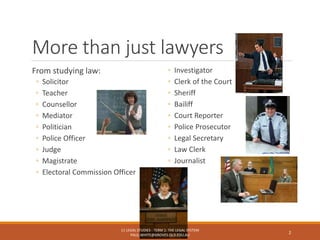
More than just lawyers
From studying law:
◦ Solicitor
◦ Teacher
◦ Counsellor
◦ Mediator
◦ Politician
◦ Police Officer
◦ Judge
◦ Magistrate
◦ Electoral Commission Officer
◦ Investigator
◦ Clerk of the Court
◦ Sheriff
◦ Bailiff
◦ Court Reporter
◦ Police Prosecutor
◦ Legal Secretary
◦ Law Clerk
◦ Journalist
11 LEGAL STUDIES - TERM 1: THE LEGAL SYSTEM
PAUL.WHITE@GROVES.QLD.EDU.AU
2
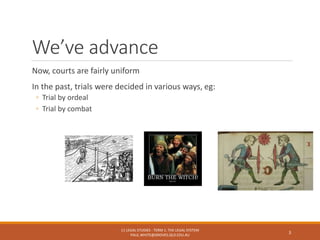
We’ve advance
Now, courts are fairly uniform
In the past, trials were decided in various ways, eg:
◦ Trial by ordeal
◦ Trial by combat
11 LEGAL STUDIES - TERM 1: THE LEGAL SYSTEM
PAUL.WHITE@GROVES.QLD.EDU.AU
3
Key Terms/Vocabulary
Adversarial system
Alternative dispute resolution
Bill
Common law
Democracy
Inquisitorial system
Judge
Jury
Magistrate
Obiter dicta
Ombudsman
Ratio decidendi
Rule of law
Separation of powers
Statute law
Statutory interpretation
Tribunals
Ultra vires
11 LEGAL STUDIES - TERM 1: THE LEGAL SYSTEM
PAUL.WHITE@GROVES.QLD.EDU.AU
4
Why have laws?
This section of the topic will look at:
◦ Democracy
◦ Rules and Laws
◦ The Rule of Law
◦ Influence on our Laws
◦ Development of our Legal System
These headings can be found on pages 2-11 of your textbook
(Investigating Legal Studies for Queensland).
Other sources have been used to add extra information.
11 LEGAL STUDIES - TERM 1: THE LEGAL SYSTEM
PAUL.WHITE@GROVES.QLD.EDU.AU
5
Democracy
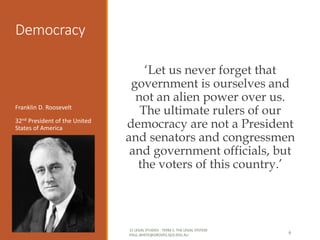
‘Let us never forget that
government is ourselves and
not an alien power over us.
The ultimate rulers of our
democracy are not a President
and senators and congressmen
and government officials, but
the voters of this country.’
Franklin D. Roosevelt
32nd President of the United
States of America
11 LEGAL STUDIES - TERM 1: THE LEGAL SYSTEM
PAUL.WHITE@GROVES.QLD.EDU.AU
6
Australia is a democratic country – we are a representative democracy
We have politicians representing us in government
We vote these people in and they decide on laws
In a direct democracy (like Ancient Athens), everyone voted on every
law to be passed
This is not practical in modern society
◦ We have 22 million people, Athens had 250,000
◦ We are a large country, Athens was not
◦ We pass many complex laws and changes to laws each year, Athens did not
11 LEGAL STUDIES - TERM 1: THE LEGAL SYSTEM
PAUL.WHITE@GROVES.QLD.EDU.AU
7
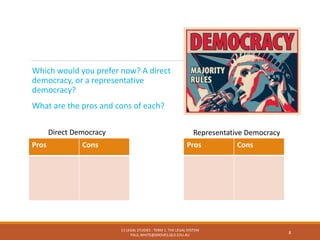
Which would you prefer now? A direct
democracy, or a representative
democracy?
What are the pros and cons of each?
11 LEGAL STUDIES - TERM 1: THE LEGAL SYSTEM
PAUL.WHITE@GROVES.QLD.EDU.AU
8
Pros Cons Pros Cons
Direct Democracy Representative Democracy
The quote from Roosevelt is why every one in Australia needs to
understand the importance of democracy
In other countries people are killed because they fight for their right to
vote
Here, we often take it for granted, and even complain about having to
vote
Some people do not take it seriously and cast meaningless votes
11 LEGAL STUDIES - TERM 1: THE LEGAL SYSTEM
PAUL.WHITE@GROVES.QLD.EDU.AU
9
Activities on Moodle
Rules and Laws
Society has customs (or norms), rules and laws
Norms and rules are behavioural controls, but do not have the status or
force of a law
When society becomes concerned that norms that are in place for the
good of the community are not being upheld, then it can become a law
11 LEGAL STUDIES - TERM 1: THE LEGAL SYSTEM
PAUL.WHITE@GROVES.QLD.EDU.AU
10
Norms: socially acceptable habits; no dictated consequence.
Eg. RSVPing by the due date, waiting in queues, taking a gift to a birthday
party, don’t pick your nose in public…
What others can you think of?
Rules: regulate our lives in a more formal manner; specifically stated, often
in written form; have a pre-determined consequence.
Eg. Don’t be late to school, don’t put your foot over the line when bowling a
bowling ball, household chores.
List 3 norms and 3 rules and indicate what the possible consequence could
be.
11 LEGAL STUDIES - TERM 1: THE LEGAL SYSTEM
PAUL.WHITE@GROVES.QLD.EDU.AU
11
Laws:
Three features that distinguish a law from a rule or norm:
◦ Authority
◦ We cannot decree that a rule is a law
◦ In Australia, authority to make laws rests with parliaments and courts
◦ Consequences
◦ More serious than not following a norm or rule
◦ Enforced by courts/tribunals and police
◦ Punishment can include fines, jail terms or community service – these do not happen if you
break a norm or a rule
◦ Regulation
◦ Laws regulate the behaviour of members of society
◦ Also regulate how to settle a dispute, such as going to court
11 LEGAL STUDIES - TERM 1: THE LEGAL SYSTEM
PAUL.WHITE@GROVES.QLD.EDU.AU
12
Example
Norm:
Used to be customary (normal practice) to ask for a non-smoking table
at a restaurant
If they had none available, you either dealt with the smokers, or went
elsewhere
Rule:
We realised smoking is harmful to everyone, and instituted rules
whereby managers of restaurants could refuse entry to smokers
Smokers were either not allowed to light up, or had to stay in smoking
areas
11 LEGAL STUDIES - TERM 1: THE LEGAL SYSTEM
PAUL.WHITE@GROVES.QLD.EDU.AU
13
Law:
In 2005, Qld passed anti-smoking laws
Amended the Tobacco and Other Smoking Products Act 1998
Gradually increased the level of anti-smoking over 18 months
There are many regulations as to where people can and cannot smoke,
including how far from doors and playgrounds, and not being able to
smoke where food is provided
As of December 2010, 219 people had been at a restaurant or café for
breaking these laws
11 LEGAL STUDIES - TERM 1: THE LEGAL SYSTEM
PAUL.WHITE@GROVES.QLD.EDU.AU
14
1. What are the three features of a law that distinguish it from a rule or
norm?
2. Identify specific examples of these three features in the new
Queensland laws that apply to patrons who smoke in restaurants.
3. Do you believe it is fair for patrons to be fined for smoking in
restaurants or should only the restaurant’s owners be penalised if
they fail to stop patrons from lighting up?
11 LEGAL STUDIES - TERM 1: THE LEGAL SYSTEM
PAUL.WHITE@GROVES.QLD.EDU.AU
15
The Rule of Law
The principle that all people are subject to the law and are equal before
the law.
Every democratic society has the rule of law to ensure citizens respect
the laws of that country
Also makes sure the government and those making laws abide by the
law
No individual or group is ‘untouchable’ or beyond the law
No one can be convicted of a crime without a proper trial using pre-
existing laws
11 LEGAL STUDIES - TERM 1: THE LEGAL SYSTEM
PAUL.WHITE@GROVES.QLD.EDU.AU
16
Taken and adapted from: http://www.lawcouncil.asn.au/lawcouncil/images/LCA-
PDF/a-z-docs/PolicyStatementRuleofLaw.pdf
There are a number of key principles relating to the rule of law
These key principles include:
1. The law must be both readily known and available, and certain and clear
2. The law should be applied to all people equally and should not discriminate
between people on arbitrary or irrational grounds
3. All people are entitled to the presumption of innocence and to a fair and public
trial
4. Everyone should have access to competent and independent legal advice
5. The Judiciary should be independent of the Executive and Legislature
6. The Executive should be subject to the law and any action undertaken by the
Executive should be authorised by law
7. No person should be subject to treatment or punishment which is inconsistent
with respect for the inherent dignity of every human being
8. States must comply with their international legal obligations whether created
by treaty or arising under customary international law
11 LEGAL STUDIES - TERM 1: THE LEGAL SYSTEM
PAUL.WHITE@GROVES.QLD.EDU.AU
17
Taken and adapted from: http://www.lawcouncil.asn.au/lawcouncil/images/LCA-PDF/a-z-
docs/PolicyStatementRuleofLaw.pdf
1.The law must be both readily known and
available, and certain and clear
People must be able to know in advance whether their conduct might
attract criminal sanction or a civil penalty
11 LEGAL STUDIES - TERM 1: THE LEGAL SYSTEM
PAUL.WHITE@GROVES.QLD.EDU.AU
18
Taken and adapted from: http://www.lawcouncil.asn.au/lawcouncil/images/LCA-PDF/a-z-
docs/PolicyStatementRuleofLaw.pdf
2.The law should be applied to all people
equally and should not discriminate between
people on arbitrary or irrational grounds
In particular, no one should be regarded as above the law
All people should be held to account for a breach of law, regardless of
rank or station.
11 LEGAL STUDIES - TERM 1: THE LEGAL SYSTEM
PAUL.WHITE@GROVES.QLD.EDU.AU
19
Taken and adapted from: http://www.lawcouncil.asn.au/lawcouncil/images/LCA-PDF/a-z-
docs/PolicyStatementRuleofLaw.pdf
3.All people are entitled to the presumption of
innocence and to a fair and public trial
No one should be subject to punitive action by the state
◦ Unless he or she has first been found guilty of an offence by an independent,
impartial and competent tribunal
Inherent in this is a prohibition on indefinite detention without trial.
11 LEGAL STUDIES - TERM 1: THE LEGAL SYSTEM
PAUL.WHITE@GROVES.QLD.EDU.AU
20
Taken and adapted from: http://www.lawcouncil.asn.au/lawcouncil/images/LCA-PDF/a-z-
docs/PolicyStatementRuleofLaw.pdf
4.Everyone should have access to competent
and independent legal advice
Everyone should have access to a competent and independent lawyer of
their choice in order to establish and defend their rights.
11 LEGAL STUDIES - TERM 1: THE LEGAL SYSTEM
PAUL.WHITE@GROVES.QLD.EDU.AU
21
Taken and adapted from: http://www.lawcouncil.asn.au/lawcouncil/images/LCA-PDF/a-z-
docs/PolicyStatementRuleofLaw.pdf
5.The Judiciary should be independent of the
Executive and Legislature
The existence of an independent, impartial and competent judiciary is
an essential component of the rule of law
(This has to do with the separation of powers, which we will look at
another time)
11 LEGAL STUDIES - TERM 1: THE LEGAL SYSTEM
PAUL.WHITE@GROVES.QLD.EDU.AU
22
Taken and adapted from: http://www.lawcouncil.asn.au/lawcouncil/images/LCA-PDF/a-z-
docs/PolicyStatementRuleofLaw.pdf
6.The Executive should be subject to the law
and any action undertaken by the Executive
should be authorised by law
Executive powers should be carefully defined by law
It should not be left to the Executive to determine for itself what
powers it has and when and how they may be used
11 LEGAL STUDIES - TERM 1: THE LEGAL SYSTEM
PAUL.WHITE@GROVES.QLD.EDU.AU
23
Taken and adapted from: http://www.lawcouncil.asn.au/lawcouncil/images/LCA-PDF/a-z-
docs/PolicyStatementRuleofLaw.pdf
7.No person should be subject to treatment or
punishment which is inconsistent with
respect for the inherent dignity of every
human being
No person should be subject to torture
No person should be subject to cruel, inhuman or degrading treatment
or punishment
No person should be subject to the death penalty
11 LEGAL STUDIES - TERM 1: THE LEGAL SYSTEM
PAUL.WHITE@GROVES.QLD.EDU.AU
24
Taken and adapted from: http://www.lawcouncil.asn.au/lawcouncil/images/LCA-PDF/a-z-
docs/PolicyStatementRuleofLaw.pdf
8.States must comply with their international
legal obligations whether created by treaty
or arising under customary international law
Both states and individuals are entitled to expect that other states will
comply with and honour their international legal obligations
◦ Including obligations relating to the promotion and protection of human
rights
States must avoid inconsistencies between their international legal
obligations and their domestic laws and policies.
11 LEGAL STUDIES - TERM 1: THE LEGAL SYSTEM
PAUL.WHITE@GROVES.QLD.EDU.AU
25
Taken and adapted from: http://www.lawcouncil.asn.au/lawcouncil/images/LCA-PDF/a-z-
docs/PolicyStatementRuleofLaw.pdf

1 What is law?

  • 1.
  • 2.
    More than justlawyers From studying law: ◦ Solicitor ◦ Teacher ◦ Counsellor ◦ Mediator ◦ Politician ◦ Police Officer ◦ Judge ◦ Magistrate ◦ Electoral Commission Officer ◦ Investigator ◦ Clerk of the Court ◦ Sheriff ◦ Bailiff ◦ Court Reporter ◦ Police Prosecutor ◦ Legal Secretary ◦ Law Clerk ◦ Journalist 11 LEGAL STUDIES - TERM 1: THE LEGAL SYSTEM PAUL.WHITE@GROVES.QLD.EDU.AU 2
  • 3.
    We’ve advance Now, courtsare fairly uniform In the past, trials were decided in various ways, eg: ◦ Trial by ordeal ◦ Trial by combat 11 LEGAL STUDIES - TERM 1: THE LEGAL SYSTEM PAUL.WHITE@GROVES.QLD.EDU.AU 3
  • 4.
    Key Terms/Vocabulary Adversarial system Alternativedispute resolution Bill Common law Democracy Inquisitorial system Judge Jury Magistrate Obiter dicta Ombudsman Ratio decidendi Rule of law Separation of powers Statute law Statutory interpretation Tribunals Ultra vires 11 LEGAL STUDIES - TERM 1: THE LEGAL SYSTEM PAUL.WHITE@GROVES.QLD.EDU.AU 4
  • 5.
    Why have laws? Thissection of the topic will look at: ◦ Democracy ◦ Rules and Laws ◦ The Rule of Law ◦ Influence on our Laws ◦ Development of our Legal System These headings can be found on pages 2-11 of your textbook (Investigating Legal Studies for Queensland). Other sources have been used to add extra information. 11 LEGAL STUDIES - TERM 1: THE LEGAL SYSTEM PAUL.WHITE@GROVES.QLD.EDU.AU 5
  • 6.
    Democracy ‘Let us neverforget that government is ourselves and not an alien power over us. The ultimate rulers of our democracy are not a President and senators and congressmen and government officials, but the voters of this country.’ Franklin D. Roosevelt 32nd President of the United States of America 11 LEGAL STUDIES - TERM 1: THE LEGAL SYSTEM PAUL.WHITE@GROVES.QLD.EDU.AU 6
  • 7.
    Australia is ademocratic country – we are a representative democracy We have politicians representing us in government We vote these people in and they decide on laws In a direct democracy (like Ancient Athens), everyone voted on every law to be passed This is not practical in modern society ◦ We have 22 million people, Athens had 250,000 ◦ We are a large country, Athens was not ◦ We pass many complex laws and changes to laws each year, Athens did not 11 LEGAL STUDIES - TERM 1: THE LEGAL SYSTEM PAUL.WHITE@GROVES.QLD.EDU.AU 7
  • 8.
    Which would youprefer now? A direct democracy, or a representative democracy? What are the pros and cons of each? 11 LEGAL STUDIES - TERM 1: THE LEGAL SYSTEM PAUL.WHITE@GROVES.QLD.EDU.AU 8 Pros Cons Pros Cons Direct Democracy Representative Democracy
  • 9.
    The quote fromRoosevelt is why every one in Australia needs to understand the importance of democracy In other countries people are killed because they fight for their right to vote Here, we often take it for granted, and even complain about having to vote Some people do not take it seriously and cast meaningless votes 11 LEGAL STUDIES - TERM 1: THE LEGAL SYSTEM PAUL.WHITE@GROVES.QLD.EDU.AU 9 Activities on Moodle
  • 10.
    Rules and Laws Societyhas customs (or norms), rules and laws Norms and rules are behavioural controls, but do not have the status or force of a law When society becomes concerned that norms that are in place for the good of the community are not being upheld, then it can become a law 11 LEGAL STUDIES - TERM 1: THE LEGAL SYSTEM PAUL.WHITE@GROVES.QLD.EDU.AU 10
  • 11.
    Norms: socially acceptablehabits; no dictated consequence. Eg. RSVPing by the due date, waiting in queues, taking a gift to a birthday party, don’t pick your nose in public… What others can you think of? Rules: regulate our lives in a more formal manner; specifically stated, often in written form; have a pre-determined consequence. Eg. Don’t be late to school, don’t put your foot over the line when bowling a bowling ball, household chores. List 3 norms and 3 rules and indicate what the possible consequence could be. 11 LEGAL STUDIES - TERM 1: THE LEGAL SYSTEM PAUL.WHITE@GROVES.QLD.EDU.AU 11
  • 12.
    Laws: Three features thatdistinguish a law from a rule or norm: ◦ Authority ◦ We cannot decree that a rule is a law ◦ In Australia, authority to make laws rests with parliaments and courts ◦ Consequences ◦ More serious than not following a norm or rule ◦ Enforced by courts/tribunals and police ◦ Punishment can include fines, jail terms or community service – these do not happen if you break a norm or a rule ◦ Regulation ◦ Laws regulate the behaviour of members of society ◦ Also regulate how to settle a dispute, such as going to court 11 LEGAL STUDIES - TERM 1: THE LEGAL SYSTEM PAUL.WHITE@GROVES.QLD.EDU.AU 12
  • 13.
    Example Norm: Used to becustomary (normal practice) to ask for a non-smoking table at a restaurant If they had none available, you either dealt with the smokers, or went elsewhere Rule: We realised smoking is harmful to everyone, and instituted rules whereby managers of restaurants could refuse entry to smokers Smokers were either not allowed to light up, or had to stay in smoking areas 11 LEGAL STUDIES - TERM 1: THE LEGAL SYSTEM PAUL.WHITE@GROVES.QLD.EDU.AU 13
  • 14.
    Law: In 2005, Qldpassed anti-smoking laws Amended the Tobacco and Other Smoking Products Act 1998 Gradually increased the level of anti-smoking over 18 months There are many regulations as to where people can and cannot smoke, including how far from doors and playgrounds, and not being able to smoke where food is provided As of December 2010, 219 people had been at a restaurant or café for breaking these laws 11 LEGAL STUDIES - TERM 1: THE LEGAL SYSTEM PAUL.WHITE@GROVES.QLD.EDU.AU 14
  • 15.
    1. What arethe three features of a law that distinguish it from a rule or norm? 2. Identify specific examples of these three features in the new Queensland laws that apply to patrons who smoke in restaurants. 3. Do you believe it is fair for patrons to be fined for smoking in restaurants or should only the restaurant’s owners be penalised if they fail to stop patrons from lighting up? 11 LEGAL STUDIES - TERM 1: THE LEGAL SYSTEM PAUL.WHITE@GROVES.QLD.EDU.AU 15
  • 16.
    The Rule ofLaw The principle that all people are subject to the law and are equal before the law. Every democratic society has the rule of law to ensure citizens respect the laws of that country Also makes sure the government and those making laws abide by the law No individual or group is ‘untouchable’ or beyond the law No one can be convicted of a crime without a proper trial using pre- existing laws 11 LEGAL STUDIES - TERM 1: THE LEGAL SYSTEM PAUL.WHITE@GROVES.QLD.EDU.AU 16
  • 17.
    Taken and adaptedfrom: http://www.lawcouncil.asn.au/lawcouncil/images/LCA- PDF/a-z-docs/PolicyStatementRuleofLaw.pdf There are a number of key principles relating to the rule of law These key principles include: 1. The law must be both readily known and available, and certain and clear 2. The law should be applied to all people equally and should not discriminate between people on arbitrary or irrational grounds 3. All people are entitled to the presumption of innocence and to a fair and public trial 4. Everyone should have access to competent and independent legal advice 5. The Judiciary should be independent of the Executive and Legislature 6. The Executive should be subject to the law and any action undertaken by the Executive should be authorised by law 7. No person should be subject to treatment or punishment which is inconsistent with respect for the inherent dignity of every human being 8. States must comply with their international legal obligations whether created by treaty or arising under customary international law 11 LEGAL STUDIES - TERM 1: THE LEGAL SYSTEM PAUL.WHITE@GROVES.QLD.EDU.AU 17 Taken and adapted from: http://www.lawcouncil.asn.au/lawcouncil/images/LCA-PDF/a-z- docs/PolicyStatementRuleofLaw.pdf
  • 18.
    1.The law mustbe both readily known and available, and certain and clear People must be able to know in advance whether their conduct might attract criminal sanction or a civil penalty 11 LEGAL STUDIES - TERM 1: THE LEGAL SYSTEM PAUL.WHITE@GROVES.QLD.EDU.AU 18 Taken and adapted from: http://www.lawcouncil.asn.au/lawcouncil/images/LCA-PDF/a-z- docs/PolicyStatementRuleofLaw.pdf
  • 19.
    2.The law shouldbe applied to all people equally and should not discriminate between people on arbitrary or irrational grounds In particular, no one should be regarded as above the law All people should be held to account for a breach of law, regardless of rank or station. 11 LEGAL STUDIES - TERM 1: THE LEGAL SYSTEM PAUL.WHITE@GROVES.QLD.EDU.AU 19 Taken and adapted from: http://www.lawcouncil.asn.au/lawcouncil/images/LCA-PDF/a-z- docs/PolicyStatementRuleofLaw.pdf
  • 20.
    3.All people areentitled to the presumption of innocence and to a fair and public trial No one should be subject to punitive action by the state ◦ Unless he or she has first been found guilty of an offence by an independent, impartial and competent tribunal Inherent in this is a prohibition on indefinite detention without trial. 11 LEGAL STUDIES - TERM 1: THE LEGAL SYSTEM PAUL.WHITE@GROVES.QLD.EDU.AU 20 Taken and adapted from: http://www.lawcouncil.asn.au/lawcouncil/images/LCA-PDF/a-z- docs/PolicyStatementRuleofLaw.pdf
  • 21.
    4.Everyone should haveaccess to competent and independent legal advice Everyone should have access to a competent and independent lawyer of their choice in order to establish and defend their rights. 11 LEGAL STUDIES - TERM 1: THE LEGAL SYSTEM PAUL.WHITE@GROVES.QLD.EDU.AU 21 Taken and adapted from: http://www.lawcouncil.asn.au/lawcouncil/images/LCA-PDF/a-z- docs/PolicyStatementRuleofLaw.pdf
  • 22.
    5.The Judiciary shouldbe independent of the Executive and Legislature The existence of an independent, impartial and competent judiciary is an essential component of the rule of law (This has to do with the separation of powers, which we will look at another time) 11 LEGAL STUDIES - TERM 1: THE LEGAL SYSTEM PAUL.WHITE@GROVES.QLD.EDU.AU 22 Taken and adapted from: http://www.lawcouncil.asn.au/lawcouncil/images/LCA-PDF/a-z- docs/PolicyStatementRuleofLaw.pdf
  • 23.
    6.The Executive shouldbe subject to the law and any action undertaken by the Executive should be authorised by law Executive powers should be carefully defined by law It should not be left to the Executive to determine for itself what powers it has and when and how they may be used 11 LEGAL STUDIES - TERM 1: THE LEGAL SYSTEM PAUL.WHITE@GROVES.QLD.EDU.AU 23 Taken and adapted from: http://www.lawcouncil.asn.au/lawcouncil/images/LCA-PDF/a-z- docs/PolicyStatementRuleofLaw.pdf
  • 24.
    7.No person shouldbe subject to treatment or punishment which is inconsistent with respect for the inherent dignity of every human being No person should be subject to torture No person should be subject to cruel, inhuman or degrading treatment or punishment No person should be subject to the death penalty 11 LEGAL STUDIES - TERM 1: THE LEGAL SYSTEM PAUL.WHITE@GROVES.QLD.EDU.AU 24 Taken and adapted from: http://www.lawcouncil.asn.au/lawcouncil/images/LCA-PDF/a-z- docs/PolicyStatementRuleofLaw.pdf
  • 25.
    8.States must complywith their international legal obligations whether created by treaty or arising under customary international law Both states and individuals are entitled to expect that other states will comply with and honour their international legal obligations ◦ Including obligations relating to the promotion and protection of human rights States must avoid inconsistencies between their international legal obligations and their domestic laws and policies. 11 LEGAL STUDIES - TERM 1: THE LEGAL SYSTEM PAUL.WHITE@GROVES.QLD.EDU.AU 25 Taken and adapted from: http://www.lawcouncil.asn.au/lawcouncil/images/LCA-PDF/a-z- docs/PolicyStatementRuleofLaw.pdf