1
PRESENTED BY:-
Gourav Kottawar.
Recruitment:-
The process of attracting individuals on
a timely basis, in sufficient numbers,
and with appropriate qualifications, and
encouraging them to apply for jobs with
an organization
2
Methods Used in Internal
Recruiting
Job Posting
Employee Referrals
Internal Job Fairs
3
 Internal recruiters
 An internal recruiter (alternatively in-house recruiter
or corporate recruiter) is member of a company or
organization and typically works in the human resources
department. Internal recruiters may be multifunctional,
serving in an HR generalist role or in a specific role
focusing all their time on recruiting. Activities vary from
firm to firm but may include.
4
Recruitment Sources and Methods
Recruitment sources: Place where
qualified individuals are found
Recruitment methods: Means by
which potential employees can be
attracted to the firm
5
PROCESS
 Job analysis:-
In situations where multiple new jobs are created
and recruited for the first time, a job analysis
might be undertaken to document the knowledge,
skill, ability, and other personal characteristics
required for the job. From these the relevant
information is captured in such documents as job
descriptions and job specifications.
6
 Sourcing:-
Sourcing is the use of one or more strategies to attract or
identify candidates to fill job vacancies. It may involve
internal and external advertising, using appropriate
media, such as local or national newspapers, specialist
recruitment media, professional publications, window
advertisements, job centers, or in a variety of ways via
the internet.
8
 selection
 • Step 1. Give the appropriate job title
 • Step 2. Say something positive about the organization
 • Step 3. Describe the job
 • Step 4. Highlight positive working conditions
 • Step 5. If appropriate, provide information on wages
and benefits
 • Step 6. Indicate how to apply
 Suitability for a job is typically assessed by looking for
that are required for a job. These can be determined
via: résumés , job application; Biographical Information
which is an assessment that asks for a more extensive
background than an application; or a job interview.
9
External Recruitment Sources
Why external recruitment?
 Acquire skills not possessed by current employees
 Obtain employees with different backgrounds to provide
a diversity of ideas
10
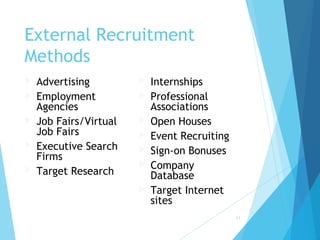
External Recruitment
Methods
 Advertising
 Employment
Agencies
 Job Fairs/Virtual
Job Fairs
 Executive Search
Firms
 Target Research
 Internships
 Professional
Associations
 Open Houses
 Event Recruiting
 Sign-on Bonuses
 Company
Database
 Target Internet
sites
11
Recruitment
 What is the role of a recruiter?
 Why is it important to have a recruiter?
 What is the future of recruiting?
12
Recruitment Strategy
Defined direction used to identify
source and attract a candidate
pool.
13
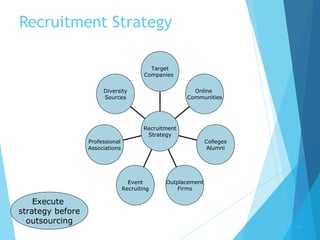
Recruitment Strategy
Diversity
Sources
Professional
Associations
Event
Recruiting
Outplacement
Firms
Colleges
Alumni
Online
Communities
Target
Companies
Recruitment
Strategy
14
Execute
strategy before
outsourcing
External Environment of
Recruitment
Labor Market Conditions
Legal Considerations
Corporate Image
15
Internal Environment of
Recruitment
Human Resource Planning
Promotion Policies
Firm’s Knowledge of Employees
Nepotism
16
External Recruitment Sources
 Internet
 Community Colleges
 Colleges and Universities
 Competitors and Other Firms
 Outplacement Firms
 Military Personnel
 Consultants or Researcher
 Professional Associations
17
Executive Search Firms
 Dedicated resource to locate experienced
professionals and executives
 Have established network of professionals
 Contingency search firms – receive fees
only upon successful placement
 Retained search firms – receives payment
up front, during the project and after
successful placement
21
Sign-on Bonuses
 3 out of 5 companies use signing bonus as
recruitment tool
 Often used when applicant maybe leaving $ on
the table
 Amounts vary depending on the level of position
24
Key metrics to monitor and
track [Time-to-hire]
[The total time required for hiring.]
 [Quality-of-hire]
[How satisfied an organization is with a hire.]
 [Number of vacancies outstanding]
[The total number of job vacancies
the company has.]
 [Cost-per-hire]
[The total cost associated with a given
position and hire.]
 [Recruit source effectiveness]
[The effectiveness of each source the
company uses to generate candidates.]
25
Exercise
 Read recruiting dilemma on page 131
 Break into groups of three for 10min
 Develop two - three solution
 Report back
26
Applicant Tracking System
Automates
online recruiting
Allows
companies to
track recruiting
results
27

Recruitment process

  • 1.
  • 2.
    Recruitment:- The process ofattracting individuals on a timely basis, in sufficient numbers, and with appropriate qualifications, and encouraging them to apply for jobs with an organization 2
  • 3.
    Methods Used inInternal Recruiting Job Posting Employee Referrals Internal Job Fairs 3
  • 4.
     Internal recruiters An internal recruiter (alternatively in-house recruiter or corporate recruiter) is member of a company or organization and typically works in the human resources department. Internal recruiters may be multifunctional, serving in an HR generalist role or in a specific role focusing all their time on recruiting. Activities vary from firm to firm but may include. 4
  • 5.
    Recruitment Sources andMethods Recruitment sources: Place where qualified individuals are found Recruitment methods: Means by which potential employees can be attracted to the firm 5
  • 6.
    PROCESS  Job analysis:- Insituations where multiple new jobs are created and recruited for the first time, a job analysis might be undertaken to document the knowledge, skill, ability, and other personal characteristics required for the job. From these the relevant information is captured in such documents as job descriptions and job specifications. 6
  • 7.
     Sourcing:- Sourcing isthe use of one or more strategies to attract or identify candidates to fill job vacancies. It may involve internal and external advertising, using appropriate media, such as local or national newspapers, specialist recruitment media, professional publications, window advertisements, job centers, or in a variety of ways via the internet. 8
  • 8.
     selection  •Step 1. Give the appropriate job title  • Step 2. Say something positive about the organization  • Step 3. Describe the job  • Step 4. Highlight positive working conditions  • Step 5. If appropriate, provide information on wages and benefits  • Step 6. Indicate how to apply  Suitability for a job is typically assessed by looking for that are required for a job. These can be determined via: résumés , job application; Biographical Information which is an assessment that asks for a more extensive background than an application; or a job interview. 9
  • 9.
    External Recruitment Sources Whyexternal recruitment?  Acquire skills not possessed by current employees  Obtain employees with different backgrounds to provide a diversity of ideas 10
  • 10.
    External Recruitment Methods  Advertising Employment Agencies  Job Fairs/Virtual Job Fairs  Executive Search Firms  Target Research  Internships  Professional Associations  Open Houses  Event Recruiting  Sign-on Bonuses  Company Database  Target Internet sites 11
  • 11.
    Recruitment  What isthe role of a recruiter?  Why is it important to have a recruiter?  What is the future of recruiting? 12
  • 12.
    Recruitment Strategy Defined directionused to identify source and attract a candidate pool. 13
  • 13.
  • 14.
    External Environment of Recruitment LaborMarket Conditions Legal Considerations Corporate Image 15
  • 15.
    Internal Environment of Recruitment HumanResource Planning Promotion Policies Firm’s Knowledge of Employees Nepotism 16
  • 16.
    External Recruitment Sources Internet  Community Colleges  Colleges and Universities  Competitors and Other Firms  Outplacement Firms  Military Personnel  Consultants or Researcher  Professional Associations 17
  • 17.
    Executive Search Firms Dedicated resource to locate experienced professionals and executives  Have established network of professionals  Contingency search firms – receive fees only upon successful placement  Retained search firms – receives payment up front, during the project and after successful placement 21
  • 18.
    Sign-on Bonuses  3out of 5 companies use signing bonus as recruitment tool  Often used when applicant maybe leaving $ on the table  Amounts vary depending on the level of position 24
  • 19.
    Key metrics tomonitor and track [Time-to-hire] [The total time required for hiring.]  [Quality-of-hire] [How satisfied an organization is with a hire.]  [Number of vacancies outstanding] [The total number of job vacancies the company has.]  [Cost-per-hire] [The total cost associated with a given position and hire.]  [Recruit source effectiveness] [The effectiveness of each source the company uses to generate candidates.] 25
  • 20.
    Exercise  Read recruitingdilemma on page 131  Break into groups of three for 10min  Develop two - three solution  Report back 26
  • 21.
    Applicant Tracking System Automates onlinerecruiting Allows companies to track recruiting results 27