Court Structure
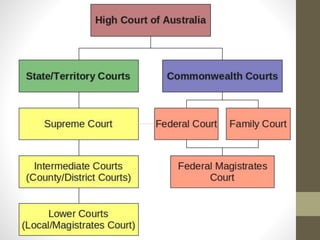
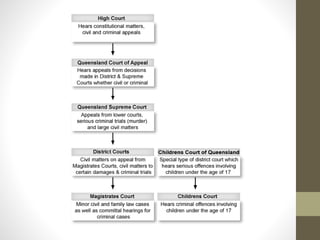
• Our courts have a hierarchy federally as well as for each state
• Different courts hear different issues and some issues can be
appealed and so move up through courts
• Courts often have two jurisdictions:
• Original
• Appellate
• Original is the jurisdiction an issue/case is heard the first time
• If the outcome is not desirable, either party (prosecution or
defense) can appeal the decision (for a legal reason)
• The issue then goes to the appellate jurisdiction
• The appellate jurisdiction can be considered slightly higher
than the original jurisdiction of the same court
• ie. The appellate jurisdiction of the Supreme Court of Qld is
slightly higher than the original jurisdiction of the Supreme Court
of Australia
Federal Courts
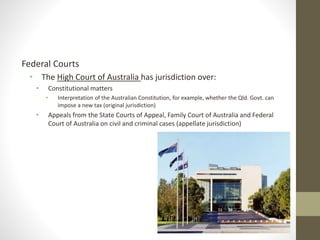
• The High Court of Australia has jurisdiction over:
• Constitutional matters
• Interpretation of the Australian Constitution, for example, whether the Qld. Govt. can
impose a new tax (original jurisdiction)
• Appeals from the State Courts of Appeal, Family Court of Australia and Federal
Court of Australia on civil and criminal cases (appellate jurisdiction)
• The Family Court of Australia has jurisdiction (original and
appellate) over:
• Family law matters including divorce, maintenance, property
settlements, rights of children following divorce (but no
jurisdiction over criminal cases)
• The Federal Court of Australia has jurisdiction (original and
appellate) over:
• Specific areas of law including competition laws, consumer laws,
bankruptcy, taxation law issues, immigration issues, a small
number of criminal cases
State Courts
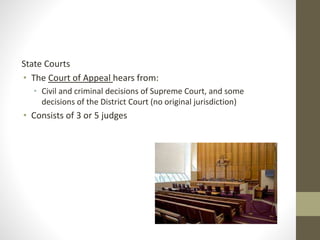
• The Court of Appeal hears from:
• Civil and criminal decisions of Supreme Court, and some
decisions of the District Court (no original jurisdiction)
• Consists of 3 or 5 judges
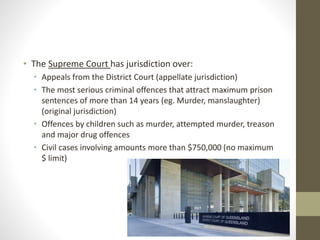
• The Supreme Court has jurisdiction over:
• Appeals from the District Court (appellate jurisdiction)
• The most serious criminal offences that attract maximum prison
sentences of more than 14 years (eg. Murder, manslaughter)
(original jurisdiction)
• Offences by children such as murder, attempted murder, treason
and major drug offences
• Civil cases involving amounts more than $750,000 (no maximum
$ limit)
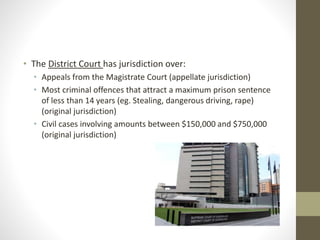
• The District Court has jurisdiction over:
• Appeals from the Magistrate Court (appellate jurisdiction)
• Most criminal offences that attract a maximum prison sentence
of less than 14 years (eg. Stealing, dangerous driving, rape)
(original jurisdiction)
• Civil cases involving amounts between $150,000 and $750,000
(original jurisdiction)
• The Magistrate Court has jurisdiction over:
• Minor criminal offences that may or may not attract a prison
sentence (eg. Drink driving, smoking marijuana)
• Civil cases involving amounts less than $50,000
• Domestic violence matters
• No appellate jurisdiction other than for tribunals
• Appeals from various tribunals (eg. The Small Claims Tribunal)
• Note that the Govt. has set up tribunals to have jurisdiction over
special types of cases
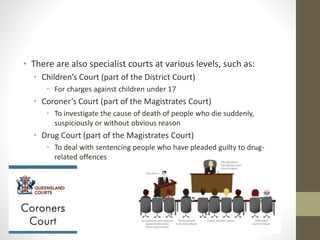
• There are also specialist courts at various levels, such as:
• Children’s Court (part of the District Court)
• For charges against children under 17
• Coroner’s Court (part of the Magistrates Court)
• To investigate the cause of death of people who die suddenly,
suspiciously or without obvious reason
• Drug Court (part of the Magistrates Court)
• To deal with sentencing people who have pleaded guilty to drug-
related offences
• The court hierarchy is important because:
• It is useful to know in which court to bring a legal action
• It is useful to know which court will hear an appeal from a
decision

5. Court Structure & Hierarchy

  • 1.
  • 2.
    • Our courtshave a hierarchy federally as well as for each state • Different courts hear different issues and some issues can be appealed and so move up through courts
  • 5.
    • Courts oftenhave two jurisdictions: • Original • Appellate • Original is the jurisdiction an issue/case is heard the first time • If the outcome is not desirable, either party (prosecution or defense) can appeal the decision (for a legal reason) • The issue then goes to the appellate jurisdiction • The appellate jurisdiction can be considered slightly higher than the original jurisdiction of the same court • ie. The appellate jurisdiction of the Supreme Court of Qld is slightly higher than the original jurisdiction of the Supreme Court of Australia
  • 6.
    Federal Courts • TheHigh Court of Australia has jurisdiction over: • Constitutional matters • Interpretation of the Australian Constitution, for example, whether the Qld. Govt. can impose a new tax (original jurisdiction) • Appeals from the State Courts of Appeal, Family Court of Australia and Federal Court of Australia on civil and criminal cases (appellate jurisdiction)
  • 7.
    • The FamilyCourt of Australia has jurisdiction (original and appellate) over: • Family law matters including divorce, maintenance, property settlements, rights of children following divorce (but no jurisdiction over criminal cases)
  • 8.
    • The FederalCourt of Australia has jurisdiction (original and appellate) over: • Specific areas of law including competition laws, consumer laws, bankruptcy, taxation law issues, immigration issues, a small number of criminal cases
  • 9.
    State Courts • TheCourt of Appeal hears from: • Civil and criminal decisions of Supreme Court, and some decisions of the District Court (no original jurisdiction) • Consists of 3 or 5 judges
  • 10.
    • The SupremeCourt has jurisdiction over: • Appeals from the District Court (appellate jurisdiction) • The most serious criminal offences that attract maximum prison sentences of more than 14 years (eg. Murder, manslaughter) (original jurisdiction) • Offences by children such as murder, attempted murder, treason and major drug offences • Civil cases involving amounts more than $750,000 (no maximum $ limit)
  • 11.
    • The DistrictCourt has jurisdiction over: • Appeals from the Magistrate Court (appellate jurisdiction) • Most criminal offences that attract a maximum prison sentence of less than 14 years (eg. Stealing, dangerous driving, rape) (original jurisdiction) • Civil cases involving amounts between $150,000 and $750,000 (original jurisdiction)
  • 12.
    • The MagistrateCourt has jurisdiction over: • Minor criminal offences that may or may not attract a prison sentence (eg. Drink driving, smoking marijuana) • Civil cases involving amounts less than $50,000 • Domestic violence matters • No appellate jurisdiction other than for tribunals • Appeals from various tribunals (eg. The Small Claims Tribunal) • Note that the Govt. has set up tribunals to have jurisdiction over special types of cases
  • 13.
    • There arealso specialist courts at various levels, such as: • Children’s Court (part of the District Court) • For charges against children under 17 • Coroner’s Court (part of the Magistrates Court) • To investigate the cause of death of people who die suddenly, suspiciously or without obvious reason • Drug Court (part of the Magistrates Court) • To deal with sentencing people who have pleaded guilty to drug- related offences
  • 14.
    • The courthierarchy is important because: • It is useful to know in which court to bring a legal action • It is useful to know which court will hear an appeal from a decision