HISTORICAL
DEVELOPMENTS FOR
INDIGENOUS
AUSTRALIANS
10 Legal Studies
HAVE YOU HEARD OF…
Native Title
Mabo v Queensland (No. 2) (1992)
Pastoral Leases
Wik Peoples v Queensland (1996)
Uluru lease and Kakadu
The Stolen Generations
NATIVE TITLE
Native Title: the rights and interests of
Aboriginal and Torres Strait Islander people in
land and waters according to their traditional
laws and customs which are recognised under
Australian law
MABO V QUEENSLAND
(NO. 2) (1992) 175 CLR
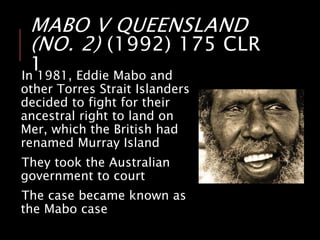
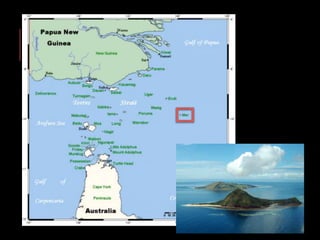
1In 1981, Eddie Mabo and
other Torres Strait Islanders
decided to fight for their
ancestral right to land on
Mer, which the British had
renamed Murray Island
They took the Australian
government to court
The case became known as
the Mabo case
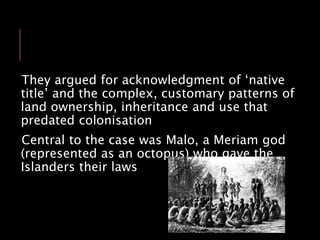
They argued for acknowledgment of ‘native
title’ and the complex, customary patterns of
land ownership, inheritance and use that
predated colonisation
Central to the case was Malo, a Meriam god
(represented as an octopus) who gave the
Islanders their laws
When the court ruled in favour of the
Murray Islanders in 1992, it recognised
their equality before the law and the
obligation for Australian law to respect
Meriam law
In doing so, it marked a new way for
Australia to view its history and future
This High Court ruling overturns the
legal doctrine of terra nullius and
recognises that
 the community of Murray Island had a valid system of
land ownership that predates white settlement
 Australia’s Indigenous peoples owned traditional land
under native title
 native title continues to the present day, unless
extinguished by the Crown
 native title may be extinguished if the landholders lose
all connection to their lands and cease to observe their
traditional laws and customs.
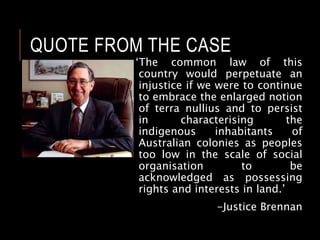
QUOTE FROM THE CASE
‘The common law of this
country would perpetuate an
injustice if we were to continue
to embrace the enlarged notion
of terra nullius and to persist
in characterising the
indigenous inhabitants of
Australian colonies as peoples
too low in the scale of social
organisation to be
acknowledged as possessing
rights and interests in land.’
-Justice Brennan
The link below gives a history of Indigenous rights and
conflicts over the time of white colonization until 2006.
http://www.abc.net.au/tv/mabo/timeline/
NATIVE TITLE ACT 1993
(CTH)
Since the Mabo case in 1992, legal reform has
continued
Sets out the content and nature of the rights of
owners of native title
For a native title claim to be recognisable there
must be continuous acknowledgement and
observance of the Indigenous Australian clan
or tribe’s customary law since British
sovereignty
You must belong to a clan or tribe that owned
the land and the land claim must be of
traditional and cultural significance to the tribe
RESEARCH
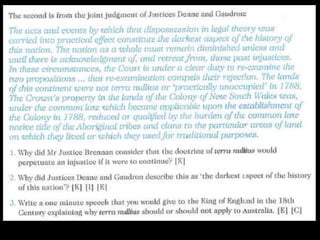
1. One of the High Court Judges in Mabo No. 2 disagreed
with the other judges. Find out which judge it was and
the reasons why he disagreed.
2. Where else in the world did a colonial government
declare land to be terra nullius?
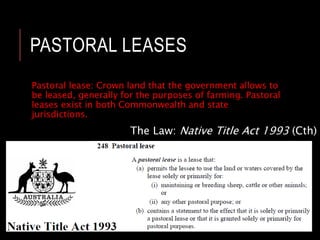
PASTORAL LEASES
Pastoral lease: Crown land that the government allows to
be leased, generally for the purposes of farming. Pastoral
leases exist in both Commonwealth and state
jurisdictions.
The Law: Native Title Act 1993 (Cth)
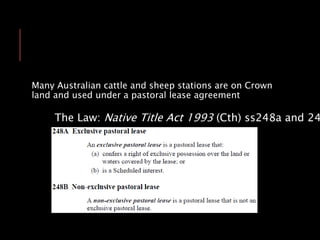
Many Australian cattle and sheep stations are on Crown
land and used under a pastoral lease agreement
The Law: Native Title Act 1993 (Cth) ss248a and 24
WIK PEOPLES V
QUEENSLAND (1996) 187 CLR
1 (Commonly called the Wik
decision)
The Wik people of Cape York in northern Qld used Mabo
No. 2 as a precedent
They claimed native title over the land that had
previously been leased by the Qld Government for
pastoral use
The point of law that needed to be considered was
whether pastoral leases extinguished a native title claim
Point of law: a question which must be answered by
applying the relevant legal principles and by an
interpretation of the law
The High Court ruled in favour of the Wik peoples, 4
judges to 3
This meant that native title could exist alongside farmers
who had pastoral leases
However, it did not mean that native title overrode
pastoral lease agreements
The issue now was deciding how they would coexist and
what compensation would apply for the original owners
(if any)
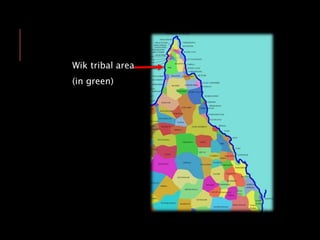
Wik tribal area
(in green)
‘HIGH COURT RULES ON
PASTORAL LEASES IN WIK
DECISION’
http://www.abc.net.au/tv/mabo/timeline/
ULURU & KAKADU
Some major tourist sites have been given back to
Indigenous Australians under native title
Uluru was handed back to the Anangu people in 1985
The Australian Government said it would return the land
to its traditional owners
But, on the condition that it be leased back to the
national parks authority for 90 years
Uluru is jointly managed by the Anangu people and the
Commonwealth
The traditional owners receive rent from the Australian
Government for the tourism business conducted there
Visitors are asked not to climb the rock and certain
sections are not meant to be photographed
Kakadu is owned by Aboriginal land trusts
Leased as a national park
There are sacred areas where tourists/visitors are not
allowed
Rock art at Ubirr and Nourlangie is thought to be among
the most culturally important in the world
HOMEWORK: RESEARCH
TASK
Individually, choose one of the following to research:
 Gurindji Strike (also known as the Wave Hill Walk-Off)
 Freedom Ride
 1967 Referendum
In your research, find the following:
 What was the issue being argued?
 When did the issue begin and end? (or is it still going?)
 Who were the main parties involved?
 What was the outcome?
 Find at least 3 images to enhance your findings
 Upload your findings to Learner.Link (under Week 4).

3c Historical Developments for Indigenous Australians

  • 1.
  • 2.
    HAVE YOU HEARDOF… Native Title Mabo v Queensland (No. 2) (1992) Pastoral Leases Wik Peoples v Queensland (1996) Uluru lease and Kakadu The Stolen Generations
  • 3.
    NATIVE TITLE Native Title:the rights and interests of Aboriginal and Torres Strait Islander people in land and waters according to their traditional laws and customs which are recognised under Australian law
  • 4.
    MABO V QUEENSLAND (NO.2) (1992) 175 CLR 1In 1981, Eddie Mabo and other Torres Strait Islanders decided to fight for their ancestral right to land on Mer, which the British had renamed Murray Island They took the Australian government to court The case became known as the Mabo case
  • 5.
    They argued foracknowledgment of ‘native title’ and the complex, customary patterns of land ownership, inheritance and use that predated colonisation Central to the case was Malo, a Meriam god (represented as an octopus) who gave the Islanders their laws
  • 6.
    When the courtruled in favour of the Murray Islanders in 1992, it recognised their equality before the law and the obligation for Australian law to respect Meriam law In doing so, it marked a new way for Australia to view its history and future
  • 8.
    This High Courtruling overturns the legal doctrine of terra nullius and recognises that  the community of Murray Island had a valid system of land ownership that predates white settlement  Australia’s Indigenous peoples owned traditional land under native title  native title continues to the present day, unless extinguished by the Crown  native title may be extinguished if the landholders lose all connection to their lands and cease to observe their traditional laws and customs.
  • 9.
    QUOTE FROM THECASE ‘The common law of this country would perpetuate an injustice if we were to continue to embrace the enlarged notion of terra nullius and to persist in characterising the indigenous inhabitants of Australian colonies as peoples too low in the scale of social organisation to be acknowledged as possessing rights and interests in land.’ -Justice Brennan
  • 11.
    The link belowgives a history of Indigenous rights and conflicts over the time of white colonization until 2006. http://www.abc.net.au/tv/mabo/timeline/
  • 12.
    NATIVE TITLE ACT1993 (CTH) Since the Mabo case in 1992, legal reform has continued Sets out the content and nature of the rights of owners of native title For a native title claim to be recognisable there must be continuous acknowledgement and observance of the Indigenous Australian clan or tribe’s customary law since British sovereignty You must belong to a clan or tribe that owned the land and the land claim must be of traditional and cultural significance to the tribe
  • 13.
    RESEARCH 1. One ofthe High Court Judges in Mabo No. 2 disagreed with the other judges. Find out which judge it was and the reasons why he disagreed. 2. Where else in the world did a colonial government declare land to be terra nullius?
  • 14.
    PASTORAL LEASES Pastoral lease:Crown land that the government allows to be leased, generally for the purposes of farming. Pastoral leases exist in both Commonwealth and state jurisdictions. The Law: Native Title Act 1993 (Cth)
  • 15.
    Many Australian cattleand sheep stations are on Crown land and used under a pastoral lease agreement The Law: Native Title Act 1993 (Cth) ss248a and 24
  • 16.
    WIK PEOPLES V QUEENSLAND(1996) 187 CLR 1 (Commonly called the Wik decision) The Wik people of Cape York in northern Qld used Mabo No. 2 as a precedent They claimed native title over the land that had previously been leased by the Qld Government for pastoral use The point of law that needed to be considered was whether pastoral leases extinguished a native title claim Point of law: a question which must be answered by applying the relevant legal principles and by an interpretation of the law
  • 17.
    The High Courtruled in favour of the Wik peoples, 4 judges to 3 This meant that native title could exist alongside farmers who had pastoral leases However, it did not mean that native title overrode pastoral lease agreements The issue now was deciding how they would coexist and what compensation would apply for the original owners (if any)
  • 18.
  • 19.
    ‘HIGH COURT RULESON PASTORAL LEASES IN WIK DECISION’ http://www.abc.net.au/tv/mabo/timeline/
  • 20.
    ULURU & KAKADU Somemajor tourist sites have been given back to Indigenous Australians under native title Uluru was handed back to the Anangu people in 1985 The Australian Government said it would return the land to its traditional owners But, on the condition that it be leased back to the national parks authority for 90 years
  • 21.
    Uluru is jointlymanaged by the Anangu people and the Commonwealth The traditional owners receive rent from the Australian Government for the tourism business conducted there Visitors are asked not to climb the rock and certain sections are not meant to be photographed
  • 22.
    Kakadu is ownedby Aboriginal land trusts Leased as a national park There are sacred areas where tourists/visitors are not allowed Rock art at Ubirr and Nourlangie is thought to be among the most culturally important in the world
  • 23.
    HOMEWORK: RESEARCH TASK Individually, chooseone of the following to research:  Gurindji Strike (also known as the Wave Hill Walk-Off)  Freedom Ride  1967 Referendum In your research, find the following:  What was the issue being argued?  When did the issue begin and end? (or is it still going?)  Who were the main parties involved?  What was the outcome?  Find at least 3 images to enhance your findings  Upload your findings to Learner.Link (under Week 4).