HUMAN RESOURCE PLANNING
 HR planning is a roadmap that
describes how an organization will meet
its current and future human resource
needs based on the strategic plans of
the organization.
 HR planning is a critical element for
ensuring organization success and can
be implemented in part by HR
management policies built on these
Standards.
HR PLANNING should be;
 Done to guide and coordinate all HR
activities so they work together to
support the overall strategy
responsive to internal and external
environment.
 linked to the organization’s overall
strategy to compete domestically and
globally.
HR PLANNING….
 Right number of people with right
skills at right place at right time to
implement organizational strategies in
order to achieve organizational
objectives.
 In light of the organization’s
objectives, corporate and business
level strategies, HRP is the process of
analyzing an organization’s human
resource needs and developing plans,
policies, and systems to satisfy those
needs.
HR PLANNING
 HR planning is a systematic process of
reviewing and anticipating human
resource requirements to ensure that
there are sufficient employees and
volunteers with the required skills
available when needed.
 Human Resource planning is a critical
component of organizational planning
that ensures that the right resources
are available at the right time to
achieve organizational goals, vision,
and strategy.
HR PLANNING
 Setting human resource objectives
and deciding how to meet them
 Ensuring HR resource supply
meets human resource demands
DEFINITIONS
Mondey and Noe, “ the analysis of future
personnel requirement referred to human
resource planning.”
Wendell French, “Human resource
planning is the process of assessing the
organizations human needs in light of
organizational goals and making plans to
ensure that a competent ,stable
workforce is employed.”
IMPORTANCE OF HR PLANNING
 Foundation of HR function
 Avoid the uncertainties
 Cope with change
 Support the strategic plan
 Utilization of HR
 Job satisfaction
 Employee retention
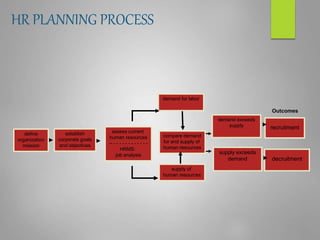
HR PLANNING PROCESS
HR Planning consists the following five
steps;
 Understanding Goals and Plans of
Organization
 Assessing Current HR
 Forecasting HR Demand and Supply
 Action Plan
 Audit and Adjustment
demand for labor
compare demand
for and supply of
human resources
recruitment
decruitment
define
organization
mission
establish
corporate goals
and objectives
demand exceeds
supply
supply exceeds
demand
assess current
human resources
-- - - - - - - - - - - - -
HRMS:
job analysis
Outcomes
supply of
human resources
HR PLANNING PROCESS
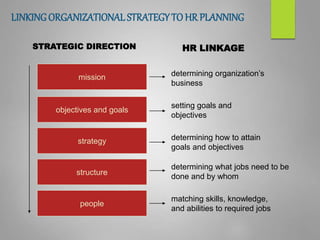
mission
objectives and goals
strategy
structure
people
STRATEGIC DIRECTION HR LINKAGE
determining organization’s
business
setting goals and
objectives
determining how to attain
goals and objectives
determining what jobs need to be
done and by whom
matching skills, knowledge,
and abilities to required jobs
LINKINGORGANIZATIONALSTRATEGYTO HR PLANNING
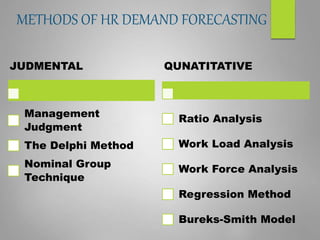
METHODS OF HR DEMAND FORECASTING
JUDMENTAL
Management
Judgment
The Delphi Method
Nominal Group
Technique
QUNATITATIVE
Ratio Analysis
Work Load Analysis
Work Force Analysis
Regression Method
Bureks-Smith Model
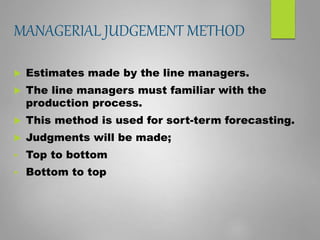
MANAGERIAL JUDGEMENT METHOD
 Estimates made by the line managers.
 The line managers must familiar with the
production process.
 This method is used for sort-term forecasting.
 Judgments will be made;
 Top to bottom
 Bottom to top
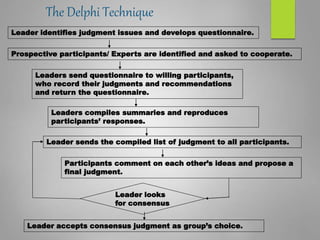
The Delphi Technique
Leader identifies judgment issues and develops questionnaire.
Prospective participants/ Experts are identified and asked to cooperate.
Leaders send questionnaire to willing participants,
who record their judgments and recommendations
and return the questionnaire.
Leaders compiles summaries and reproduces
participants’ responses.
Leader sends the compiled list of judgment to all participants.
Participants comment on each other’s ideas and propose a
final judgment.
Leader looks
for consensus
Leader accepts consensus judgment as group’s choice.
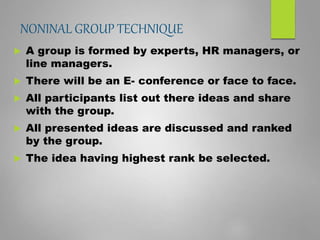
NONINAL GROUP TECHNIQUE
 A group is formed by experts, HR managers, or
line managers.
 There will be an E- conference or face to face.
 All participants list out there ideas and share
with the group.
 All presented ideas are discussed and ranked
by the group.
 The idea having highest rank be selected.
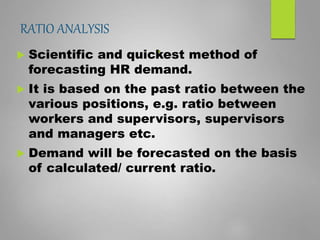
RATIO ANALYSIS
 Scientific and quickest method of
forecasting HR demand.
 It is based on the past ratio between the
various positions, e.g. ratio between
workers and supervisors, supervisors
and managers etc.
 Demand will be forecasted on the basis
of calculated/ current ratio.
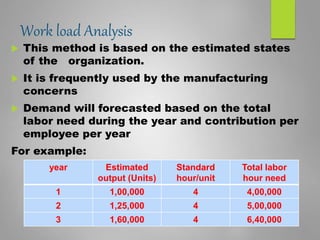
Work load Analysis
 This method is based on the estimated states
of the organization.
 It is frequently used by the manufacturing
concerns
 Demand will forecasted based on the total
labor need during the year and contribution per
employee per year
For example:
year Estimated
output (Units)
Standard
hour/unit
Total labor
hour need
1 1,00,000 4 4,00,000
2 1,25,000 4 5,00,000
3 1,60,000 4 6,40,000
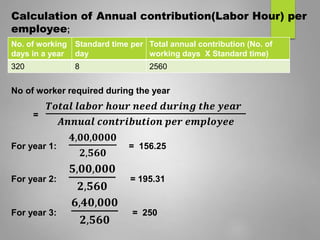
Calculation of Annual contribution(Labor Hour) per
employee;
No of worker required during the year
=
𝑻𝒐𝒕𝒂𝒍 𝒍𝒂𝒃𝒐𝒓 𝒉𝒐𝒖𝒓 𝒏𝒆𝒆𝒅 𝒅𝒖𝒓𝒊𝒏𝒈 𝒕𝒉𝒆 𝒚𝒆𝒂𝒓
𝑨𝒏𝒏𝒖𝒂𝒍 𝒄𝒐𝒏𝒕𝒓𝒊𝒃𝒖𝒕𝒊𝒐𝒏 𝒑𝒆𝒓 𝒆𝒎𝒑𝒍𝒐𝒚𝒆𝒆
For year 1:
𝟒,𝟎𝟎,𝟎𝟎𝟎𝟎
𝟐,𝟓𝟔𝟎
= 156.25
For year 2:
𝟓,𝟎𝟎,𝟎𝟎𝟎
𝟐,𝟓𝟔𝟎
= 195.31
For year 3:
𝟔,𝟒𝟎,𝟎𝟎𝟎
𝟐,𝟓𝟔𝟎
= 250
No. of working
days in a year
Standard time per
day
Total annual contribution (No. of
working days X Standard time)
320 8 2560
Work force analysis
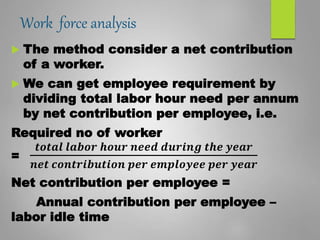
 The method consider a net contribution
of a worker.
 We can get employee requirement by
dividing total labor hour need per annum
by net contribution per employee, i.e.
Required no of worker
=
𝒕𝒐𝒕𝒂𝒍 𝒍𝒂𝒃𝒐𝒓 𝒉𝒐𝒖𝒓 𝒏𝒆𝒆𝒅 𝒅𝒖𝒓𝒊𝒏𝒈 𝒕𝒉𝒆 𝒚𝒆𝒂𝒓
𝒏𝒆𝒕 𝒄𝒐𝒏𝒕𝒓𝒊𝒃𝒖𝒕𝒊𝒐𝒏 𝒑𝒆𝒓 𝒆𝒎𝒑𝒍𝒐𝒚𝒆𝒆 𝒑𝒆𝒓 𝒚𝒆𝒂𝒓
Net contribution per employee =
Annual contribution per employee –
labor idle time
Regression Method
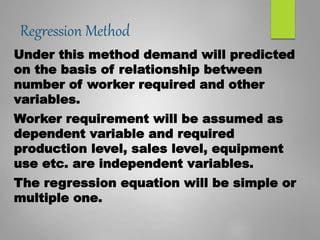
Under this method demand will predicted
on the basis of relationship between
number of worker required and other
variables.
Worker requirement will be assumed as
dependent variable and required
production level, sales level, equipment
use etc. are independent variables.
The regression equation will be simple or
multiple one.
Bureks-Smith model
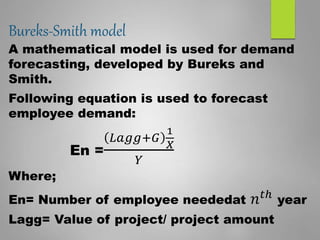
A mathematical model is used for demand
forecasting, developed by Bureks and
Smith.
Following equation is used to forecast
employee demand:
En =
𝐿𝑎𝑔𝑔+𝐺
1
𝑋
𝑌
Where;
En= Number of employee neededat 𝑛 𝑡ℎ
year
Lagg= Value of project/ project amount
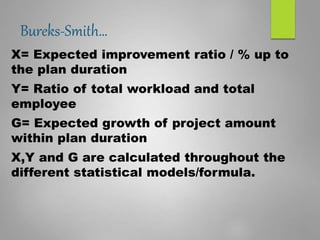
Bureks-Smith…
X= Expected improvement ratio / % up to
the plan duration
Y= Ratio of total workload and total
employee
G= Expected growth of project amount
within plan duration
X,Y and G are calculated throughout the
different statistical models/formula.
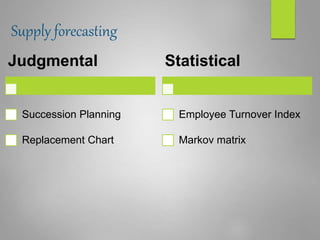
Supply forecasting
Judgmental
Succession Planning
Replacement Chart
Statistical
Employee Turnover Index
Markov matrix
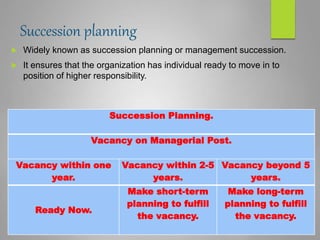
Succession planning
 Widely known as succession planning or management succession.
 It ensures that the organization has individual ready to move in to
position of higher responsibility.
Succession Planning.
Vacancy on Managerial Post.
Vacancy within one
year.
Vacancy within 2-5
years.
Vacancy beyond 5
years.
Ready Now.
Make short-term
planning to fulfill
the vacancy.
Make long-term
planning to fulfill
the vacancy.
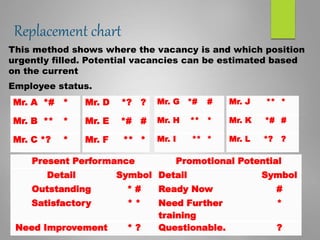
Replacement chart
This method shows where the vacancy is and which position
urgently filled. Potential vacancies can be estimated based
on the current
Employee status.
Mr. A *# *
Mr. B ** *
Mr. C *? *
Mr. D *? ?
Mr. E *# #
Mr. F ** *
Mr. G *# #
Mr. H ** *
Mr. I ** *
Mr. J ** *
Mr. K *# #
Mr. L *? ?
Present Performance Promotional Potential
Detail Symbol Detail Symbol
Outstanding * # Ready Now #
Satisfactory * * Need Further
training
*
Need Improvement * ? Questionable. ?
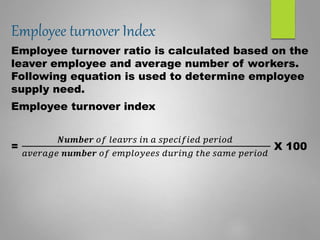
Employee turnover Index
Employee turnover ratio is calculated based on the
leaver employee and average number of workers.
Following equation is used to determine employee
supply need.
Employee turnover index
=
𝑵𝒖𝒎𝒃𝒆𝒓 𝑜𝑓 𝑙𝑒𝑎𝑣𝑟𝑠 𝑖𝑛 𝑎 𝑠𝑝𝑒𝑐𝑖𝑓𝑖𝑒𝑑 𝑝𝑒𝑟𝑖𝑜𝑑
𝑎𝑣𝑒𝑟𝑎𝑔𝑒 𝒏𝒖𝒎𝒃𝒆𝒓 𝑜𝑓 𝑒𝑚𝑝𝑙𝑜𝑦𝑒𝑒𝑠 𝑑𝑢𝑟𝑖𝑛𝑔 𝑡ℎ𝑒 𝑠𝑎𝑚𝑒 𝑝𝑒𝑟𝑖𝑜𝑑
X 100
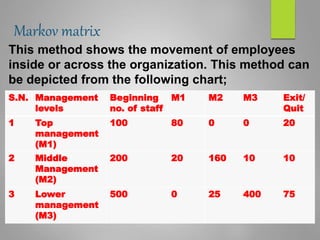
Markov matrix
This method shows the movement of employees
inside or across the organization. This method can
be depicted from the following chart;
S.N. Management
levels
Beginning
no. of staff
M1 M2 M3 Exit/
Quit
1 Top
management
(M1)
100 80 0 0 20
2 Middle
Management
(M2)
200 20 160 10 10
3 Lower
management
(M3)
500 0 25 400 75
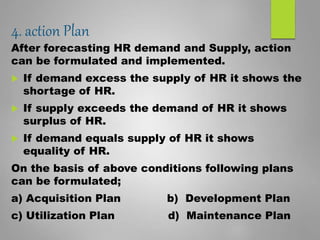
4. action Plan
After forecasting HR demand and Supply, action
can be formulated and implemented.
 If demand excess the supply of HR it shows the
shortage of HR.
 If supply exceeds the demand of HR it shows
surplus of HR.
 If demand equals supply of HR it shows
equality of HR.
On the basis of above conditions following plans
can be formulated;
a) Acquisition Plan b) Development Plan
c) Utilization Plan d) Maintenance Plan
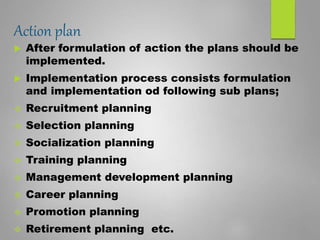
Action plan
 After formulation of action the plans should be
implemented.
 Implementation process consists formulation
and implementation od following sub plans;
 Recruitment planning
 Selection planning
 Socialization planning
 Training planning
 Management development planning
 Career planning
 Promotion planning
 Retirement planning etc.
5. Audit and adjustment
 This is controlling stage of planning.
 Implemented plans can be controlled.
 causes of negation deviation on planning
can be identified.
 Necessary corrective actions can be are
taken to make planning much effective.
 This stage also known as feedback of HR
planning.
HR inventory
 It is also called skilled inventory. A human
resource inventory consists of up to date
information about the entire employees of the
organization.
 This information facilitates the assessment of
current skilled manpower, which is useful to
determine the need of special type of manpower
in the organization.
 The record contains information regarding the
personal introduction, academic qualification,
trainings, experience, position, salary and
benefits, performance level, specialized skills,
job preference, rewards and punishment etc. of
the employee.
Human resource information system (HRIS)
 HRIS has been implemented to assist HR
inventory.
 HRIS include information on all
employees (local and across the border)
currently on the organization and provide
computerized information about the
position and skill available. HRIS consists
the following categories:-
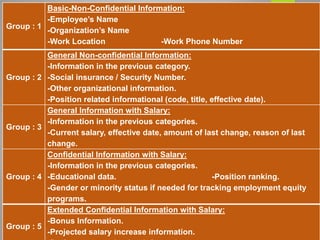
Group : 1
Basic-Non-Confidential Information:
-Employee’s Name
-Organization’s Name
-Work Location -Work Phone Number
Group : 2
General Non-confidential Information:
-Information in the previous category.
-Social insurance / Security Number.
-Other organizational information.
-Position related informational (code, title, effective date).
Group : 3
General Information with Salary:
-Information in the previous categories.
-Current salary, effective date, amount of last change, reason of last
change.
Group : 4
Confidential Information with Salary:
-Information in the previous categories.
-Educational data. -Position ranking.
-Gender or minority status if needed for tracking employment equity
programs.
Group : 5
Extended Confidential Information with Salary:
-Bonus Information.
-Projected salary increase information.
Hr planning

Hr planning

  • 1.
    HUMAN RESOURCE PLANNING HR planning is a roadmap that describes how an organization will meet its current and future human resource needs based on the strategic plans of the organization.  HR planning is a critical element for ensuring organization success and can be implemented in part by HR management policies built on these Standards.
  • 2.
    HR PLANNING shouldbe;  Done to guide and coordinate all HR activities so they work together to support the overall strategy responsive to internal and external environment.  linked to the organization’s overall strategy to compete domestically and globally.
  • 3.
    HR PLANNING….  Rightnumber of people with right skills at right place at right time to implement organizational strategies in order to achieve organizational objectives.  In light of the organization’s objectives, corporate and business level strategies, HRP is the process of analyzing an organization’s human resource needs and developing plans, policies, and systems to satisfy those needs.
  • 4.
    HR PLANNING  HRplanning is a systematic process of reviewing and anticipating human resource requirements to ensure that there are sufficient employees and volunteers with the required skills available when needed.  Human Resource planning is a critical component of organizational planning that ensures that the right resources are available at the right time to achieve organizational goals, vision, and strategy.
  • 5.
    HR PLANNING  Settinghuman resource objectives and deciding how to meet them  Ensuring HR resource supply meets human resource demands
  • 6.
    DEFINITIONS Mondey and Noe,“ the analysis of future personnel requirement referred to human resource planning.” Wendell French, “Human resource planning is the process of assessing the organizations human needs in light of organizational goals and making plans to ensure that a competent ,stable workforce is employed.”
  • 7.
    IMPORTANCE OF HRPLANNING  Foundation of HR function  Avoid the uncertainties  Cope with change  Support the strategic plan  Utilization of HR  Job satisfaction  Employee retention
  • 8.
    HR PLANNING PROCESS HRPlanning consists the following five steps;  Understanding Goals and Plans of Organization  Assessing Current HR  Forecasting HR Demand and Supply  Action Plan  Audit and Adjustment
  • 9.
    demand for labor comparedemand for and supply of human resources recruitment decruitment define organization mission establish corporate goals and objectives demand exceeds supply supply exceeds demand assess current human resources -- - - - - - - - - - - - - HRMS: job analysis Outcomes supply of human resources HR PLANNING PROCESS
  • 10.
    mission objectives and goals strategy structure people STRATEGICDIRECTION HR LINKAGE determining organization’s business setting goals and objectives determining how to attain goals and objectives determining what jobs need to be done and by whom matching skills, knowledge, and abilities to required jobs LINKINGORGANIZATIONALSTRATEGYTO HR PLANNING
  • 11.
    METHODS OF HRDEMAND FORECASTING JUDMENTAL Management Judgment The Delphi Method Nominal Group Technique QUNATITATIVE Ratio Analysis Work Load Analysis Work Force Analysis Regression Method Bureks-Smith Model
  • 12.
    MANAGERIAL JUDGEMENT METHOD Estimates made by the line managers.  The line managers must familiar with the production process.  This method is used for sort-term forecasting.  Judgments will be made;  Top to bottom  Bottom to top
  • 13.
    The Delphi Technique Leaderidentifies judgment issues and develops questionnaire. Prospective participants/ Experts are identified and asked to cooperate. Leaders send questionnaire to willing participants, who record their judgments and recommendations and return the questionnaire. Leaders compiles summaries and reproduces participants’ responses. Leader sends the compiled list of judgment to all participants. Participants comment on each other’s ideas and propose a final judgment. Leader looks for consensus Leader accepts consensus judgment as group’s choice.
  • 14.
    NONINAL GROUP TECHNIQUE A group is formed by experts, HR managers, or line managers.  There will be an E- conference or face to face.  All participants list out there ideas and share with the group.  All presented ideas are discussed and ranked by the group.  The idea having highest rank be selected.
  • 15.
    RATIO ANALYSIS  Scientificand quickest method of forecasting HR demand.  It is based on the past ratio between the various positions, e.g. ratio between workers and supervisors, supervisors and managers etc.  Demand will be forecasted on the basis of calculated/ current ratio.
  • 16.
    Work load Analysis This method is based on the estimated states of the organization.  It is frequently used by the manufacturing concerns  Demand will forecasted based on the total labor need during the year and contribution per employee per year For example: year Estimated output (Units) Standard hour/unit Total labor hour need 1 1,00,000 4 4,00,000 2 1,25,000 4 5,00,000 3 1,60,000 4 6,40,000
  • 17.
    Calculation of Annualcontribution(Labor Hour) per employee; No of worker required during the year = 𝑻𝒐𝒕𝒂𝒍 𝒍𝒂𝒃𝒐𝒓 𝒉𝒐𝒖𝒓 𝒏𝒆𝒆𝒅 𝒅𝒖𝒓𝒊𝒏𝒈 𝒕𝒉𝒆 𝒚𝒆𝒂𝒓 𝑨𝒏𝒏𝒖𝒂𝒍 𝒄𝒐𝒏𝒕𝒓𝒊𝒃𝒖𝒕𝒊𝒐𝒏 𝒑𝒆𝒓 𝒆𝒎𝒑𝒍𝒐𝒚𝒆𝒆 For year 1: 𝟒,𝟎𝟎,𝟎𝟎𝟎𝟎 𝟐,𝟓𝟔𝟎 = 156.25 For year 2: 𝟓,𝟎𝟎,𝟎𝟎𝟎 𝟐,𝟓𝟔𝟎 = 195.31 For year 3: 𝟔,𝟒𝟎,𝟎𝟎𝟎 𝟐,𝟓𝟔𝟎 = 250 No. of working days in a year Standard time per day Total annual contribution (No. of working days X Standard time) 320 8 2560
  • 18.
    Work force analysis The method consider a net contribution of a worker.  We can get employee requirement by dividing total labor hour need per annum by net contribution per employee, i.e. Required no of worker = 𝒕𝒐𝒕𝒂𝒍 𝒍𝒂𝒃𝒐𝒓 𝒉𝒐𝒖𝒓 𝒏𝒆𝒆𝒅 𝒅𝒖𝒓𝒊𝒏𝒈 𝒕𝒉𝒆 𝒚𝒆𝒂𝒓 𝒏𝒆𝒕 𝒄𝒐𝒏𝒕𝒓𝒊𝒃𝒖𝒕𝒊𝒐𝒏 𝒑𝒆𝒓 𝒆𝒎𝒑𝒍𝒐𝒚𝒆𝒆 𝒑𝒆𝒓 𝒚𝒆𝒂𝒓 Net contribution per employee = Annual contribution per employee – labor idle time
  • 19.
    Regression Method Under thismethod demand will predicted on the basis of relationship between number of worker required and other variables. Worker requirement will be assumed as dependent variable and required production level, sales level, equipment use etc. are independent variables. The regression equation will be simple or multiple one.
  • 20.
    Bureks-Smith model A mathematicalmodel is used for demand forecasting, developed by Bureks and Smith. Following equation is used to forecast employee demand: En = 𝐿𝑎𝑔𝑔+𝐺 1 𝑋 𝑌 Where; En= Number of employee neededat 𝑛 𝑡ℎ year Lagg= Value of project/ project amount
  • 21.
    Bureks-Smith… X= Expected improvementratio / % up to the plan duration Y= Ratio of total workload and total employee G= Expected growth of project amount within plan duration X,Y and G are calculated throughout the different statistical models/formula.
  • 22.
    Supply forecasting Judgmental Succession Planning ReplacementChart Statistical Employee Turnover Index Markov matrix
  • 23.
    Succession planning  Widelyknown as succession planning or management succession.  It ensures that the organization has individual ready to move in to position of higher responsibility. Succession Planning. Vacancy on Managerial Post. Vacancy within one year. Vacancy within 2-5 years. Vacancy beyond 5 years. Ready Now. Make short-term planning to fulfill the vacancy. Make long-term planning to fulfill the vacancy.
  • 24.
    Replacement chart This methodshows where the vacancy is and which position urgently filled. Potential vacancies can be estimated based on the current Employee status. Mr. A *# * Mr. B ** * Mr. C *? * Mr. D *? ? Mr. E *# # Mr. F ** * Mr. G *# # Mr. H ** * Mr. I ** * Mr. J ** * Mr. K *# # Mr. L *? ? Present Performance Promotional Potential Detail Symbol Detail Symbol Outstanding * # Ready Now # Satisfactory * * Need Further training * Need Improvement * ? Questionable. ?
  • 25.
    Employee turnover Index Employeeturnover ratio is calculated based on the leaver employee and average number of workers. Following equation is used to determine employee supply need. Employee turnover index = 𝑵𝒖𝒎𝒃𝒆𝒓 𝑜𝑓 𝑙𝑒𝑎𝑣𝑟𝑠 𝑖𝑛 𝑎 𝑠𝑝𝑒𝑐𝑖𝑓𝑖𝑒𝑑 𝑝𝑒𝑟𝑖𝑜𝑑 𝑎𝑣𝑒𝑟𝑎𝑔𝑒 𝒏𝒖𝒎𝒃𝒆𝒓 𝑜𝑓 𝑒𝑚𝑝𝑙𝑜𝑦𝑒𝑒𝑠 𝑑𝑢𝑟𝑖𝑛𝑔 𝑡ℎ𝑒 𝑠𝑎𝑚𝑒 𝑝𝑒𝑟𝑖𝑜𝑑 X 100
  • 26.
    Markov matrix This methodshows the movement of employees inside or across the organization. This method can be depicted from the following chart; S.N. Management levels Beginning no. of staff M1 M2 M3 Exit/ Quit 1 Top management (M1) 100 80 0 0 20 2 Middle Management (M2) 200 20 160 10 10 3 Lower management (M3) 500 0 25 400 75
  • 27.
    4. action Plan Afterforecasting HR demand and Supply, action can be formulated and implemented.  If demand excess the supply of HR it shows the shortage of HR.  If supply exceeds the demand of HR it shows surplus of HR.  If demand equals supply of HR it shows equality of HR. On the basis of above conditions following plans can be formulated; a) Acquisition Plan b) Development Plan c) Utilization Plan d) Maintenance Plan
  • 28.
    Action plan  Afterformulation of action the plans should be implemented.  Implementation process consists formulation and implementation od following sub plans;  Recruitment planning  Selection planning  Socialization planning  Training planning  Management development planning  Career planning  Promotion planning  Retirement planning etc.
  • 29.
    5. Audit andadjustment  This is controlling stage of planning.  Implemented plans can be controlled.  causes of negation deviation on planning can be identified.  Necessary corrective actions can be are taken to make planning much effective.  This stage also known as feedback of HR planning.
  • 30.
    HR inventory  Itis also called skilled inventory. A human resource inventory consists of up to date information about the entire employees of the organization.  This information facilitates the assessment of current skilled manpower, which is useful to determine the need of special type of manpower in the organization.  The record contains information regarding the personal introduction, academic qualification, trainings, experience, position, salary and benefits, performance level, specialized skills, job preference, rewards and punishment etc. of the employee.
  • 31.
    Human resource informationsystem (HRIS)  HRIS has been implemented to assist HR inventory.  HRIS include information on all employees (local and across the border) currently on the organization and provide computerized information about the position and skill available. HRIS consists the following categories:-
  • 32.
    Group : 1 Basic-Non-ConfidentialInformation: -Employee’s Name -Organization’s Name -Work Location -Work Phone Number Group : 2 General Non-confidential Information: -Information in the previous category. -Social insurance / Security Number. -Other organizational information. -Position related informational (code, title, effective date). Group : 3 General Information with Salary: -Information in the previous categories. -Current salary, effective date, amount of last change, reason of last change. Group : 4 Confidential Information with Salary: -Information in the previous categories. -Educational data. -Position ranking. -Gender or minority status if needed for tracking employment equity programs. Group : 5 Extended Confidential Information with Salary: -Bonus Information. -Projected salary increase information.