Human Resource Planning
BY - PROF. RUCHITA MANDLI
(SOIM – SOU)
After reading this chapter, you
should be able to:
 Understand the significance and
character of human resource
planning.
 List the factors affecting human
resources planning.
 Elucidate the process of human
resources planning.
 List the barriers to an effective
human resource planning.
Human resource planning
Human resource planning is a process of
identifying and then matching the human
resource requirements and availability in
order to determine the future HR activities
of the organization on the basis of the
overall organizational objective.
Significance of human
resource planning :
 Assessing future recruitment
requirements.
 Optimum utilization of available
human resources.
 Developing training and retraining
programmes.
Significance of human
resource planning (contd.)
 Formulating compensation policies.
 Determining management
development programmes.
 Gaining competitive advantage.
 Shaping future plans and strategies.
Factors affecting human
resource planning
 Strategy of the organization.
 Culture of the organization.
 Competitive and financial
environment.
 Current organizational situation.
 Quantity and skill levels of human
resources required.
Human resource planning
process
Steps in a HR planning process are
 Considering organizational objectives
and strategies.
 Assessment of external environment.
 Preparation of in-house skill and
competency inventory.
Human resource planning
process (contd.)
 HR forecasting—need assessment.
 HR forecasting—estimation of
availability.
 Developing HR plans and programmes.
Step-1: Considering
organizational objectives and
strategies
 The organizational strategy along with
the mission and vision statement
clearly expresses the future intent of
the organization.
 HR plans are generally guided by the
overall organizational objectives and
strategies.
Step-2: Assessment of
external environment
Step-2: Assessment of
external environment (contd.)
 Organizations undertake environmental
scanning to identify the changes in the
external environment.
 Purpose of environmental scanning is
to examine the business environment,
to seize the opportunities and tackle
the threats.
Step-2: Assessment of
external environment (contd.)
External environment is influenced by
 Economic situation
 Legislative measures
 Labour market scenario
 Technological advancement
Step-3: Preparation of in-
house skills and competency
inventory
 A compilation of skills, competencies and
qualifications of the entire workforce is
described as a skill inventory.
Skill inventory can be prepared through
 Skills audit (assessing the current skill levels
of a firm). It involves assessing the
performance of the employees from the task
perspective.
Step-3: Preparation of in-
house skills and competency
inventory (contd.)
 Core competency analysis (assessing
the extra-ordinary abilities of the firm).
These abilities may be its advanced
technology, well-reputed management,
problem-solving ability, employees’ and
KSA.
Step-4: HR forecasting—need
assessment
Forecasts involve estimating the future
requirements of the organization in terms
of the nature and the number of people.
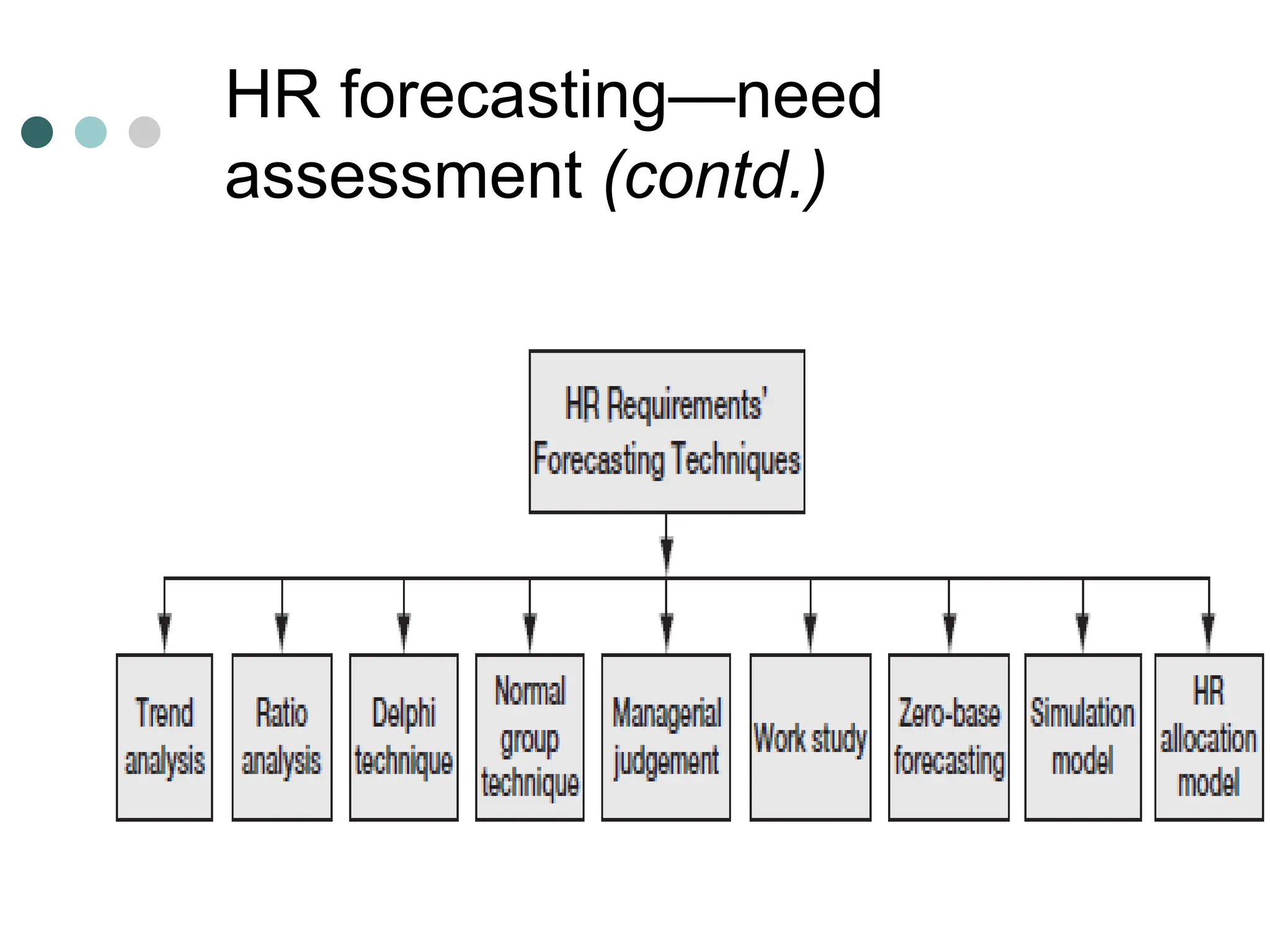
Forecasting techniques commonly used
for human resource forecasting are
HR forecasting—need
assessment (contd.)
HR forecasting— Ratio analysis
 Ratio analysis is the analysis of the
relationship between any two
numerical variables.
 It presumes a certain relationship
between two given variables and
using that relationship, predicts future
HR requirements.
HR forecasting— Delphi
technique
 The Delphi technique is basically a
group-based systematic forecasting
method.
 This technique does not require any
face-to-face participation by the
experts.
HR forecasting— Delphi
technique (contd.)
 This method aims at maximizing the
benefits and minimizing the
dysfunctional aspects of group
decision-making as it eliminates group
dynamics and individual dominance
from the process.
HR forecasting— normal group
technique
 It is an interactive mode of decision-
making.
 Each expert in a group independently
develops HR requirements and
presents it before other experts in the
group.
HR forecasting— normal group
technique (contd.)
 Each member’s proposal is relatively
graded and the top-ranked proposal is
selected as the final HR forecast.
HR forecasting— managerial
judgement
 The forecasting in managerial
judgement is based on the managers’
subjective views on the possible
human resource requirements in the
future.
 Forecasts are made about the HR
requirements, usually by the senior
managers of the organization based
on their experience.
Types of managerial judgement
 Bottom-up approach- In this method, the
process of HR forecasting begins with the
lowest level of the managerial hierarchy and
the managers in charge of each division or
department forecast the HR requirements.
This forecasting process is then moved up
gradually to the higher levels of the
management.
Types of managerial judgement
(contd.)
 Top-down approach- In this method,
experts working at the highest levels
of the management forecast the HR
needs of the organization on the basis
of the information available and the
field expertise.
HR forecasting— work study
technique
 It aims at examining the business
operations to achieve the optimum
utilization of the human and physical
resources available.
 The major purpose of this technique is
to improve the employees’ productivity
and organizational efficiency.
HR forecasting— work study
technique (contd.)
 This technique is normally carried out
through method study and work
measurement techniques.
HR forecasting— zero-base
forecasting
 Zero-base forecasting requires lines
managers to justify the need to
continue with the positions or jobs
that fall vacant in their department.
 It does not consider any position as
eligible for routine continuance.
HR forecasting— zero-base
forecasting (contd.)
 This method requires managers to
conduct a comprehensive study of the
utility of each vacancy before seeking
replacements. This technique is
derived from the widely popular
concept of zero-base budgeting.
HR forecasting— simulation
model
 Simulation model is a mathematics-
oriented, software-enabled technique.
 This model simulates the HR
requirements and availability to
determine the likely gap between the
demand for and the supply of human
resources.
HR forecasting— simulation
model (contd.)
 The working of the simulation model
involves asking several what-if
questions to develop alternatives in
the forecasting process.
HR forecasting— human
resource allocation approach
HAPP method has four components
 Employees
 Functions
 A matching model and
 A formal rule structure
HR forecasting— human
resource allocation approach
(contd.)
 This method allows comprehensive
modelling of the interaction among
these components.
 The matching model deals with the
allocation of different jobs to employees.
 An organization would make HR
forecasting based on the specific
outcome of the matching model.
HR forecasting—estimation of
availability
This process involves the estimation of the
availability of the required number of
employees.
The techniques for forecasting HR availability
through internal sources are
 Replacement charts- These are records that
contain details about the currently serving
employees and the possible replacements for
them in their position.
HR forecasting—estimation of
availability (contd.)
 Turnover rate
 Human resource management
information system (HRIS)
 Productivity level
 Overtime and absenteeism
 Succession planning
Step-5: Developing HR plans
and programmes
 The estimated HR needs are matched
with the estimated HR availability to
identify the skill shortage or surplus.
 Based on the outcome, appropriate
HR plans are developed.
Step-5: Developing HR plans
and programmes (contd.)
 The outcome of such comparisons
would be either the recruitment of
more employees or a reduction of
the existing workforce.
Barriers to HR planning
process
 Insufficient realization of the importance
of HR plans.
 Glut in the Indian labour market.
 Union resistance.
 Cost–benefit misconceptions.
 Absence of coordination.
 Future uncertainty.

HUMAN RESOURCE PLANNING .ppt DETAILS AND CHARTS

  • 1.
    Human Resource Planning BY- PROF. RUCHITA MANDLI (SOIM – SOU)
  • 2.
    After reading thischapter, you should be able to:  Understand the significance and character of human resource planning.  List the factors affecting human resources planning.  Elucidate the process of human resources planning.  List the barriers to an effective human resource planning.
  • 3.
    Human resource planning Humanresource planning is a process of identifying and then matching the human resource requirements and availability in order to determine the future HR activities of the organization on the basis of the overall organizational objective.
  • 4.
    Significance of human resourceplanning :  Assessing future recruitment requirements.  Optimum utilization of available human resources.  Developing training and retraining programmes.
  • 5.
    Significance of human resourceplanning (contd.)  Formulating compensation policies.  Determining management development programmes.  Gaining competitive advantage.  Shaping future plans and strategies.
  • 6.
    Factors affecting human resourceplanning  Strategy of the organization.  Culture of the organization.  Competitive and financial environment.  Current organizational situation.  Quantity and skill levels of human resources required.
  • 7.
    Human resource planning process Stepsin a HR planning process are  Considering organizational objectives and strategies.  Assessment of external environment.  Preparation of in-house skill and competency inventory.
  • 8.
    Human resource planning process(contd.)  HR forecasting—need assessment.  HR forecasting—estimation of availability.  Developing HR plans and programmes.
  • 10.
    Step-1: Considering organizational objectivesand strategies  The organizational strategy along with the mission and vision statement clearly expresses the future intent of the organization.  HR plans are generally guided by the overall organizational objectives and strategies.
  • 11.
  • 12.
    Step-2: Assessment of externalenvironment (contd.)  Organizations undertake environmental scanning to identify the changes in the external environment.  Purpose of environmental scanning is to examine the business environment, to seize the opportunities and tackle the threats.
  • 13.
    Step-2: Assessment of externalenvironment (contd.) External environment is influenced by  Economic situation  Legislative measures  Labour market scenario  Technological advancement
  • 14.
    Step-3: Preparation ofin- house skills and competency inventory  A compilation of skills, competencies and qualifications of the entire workforce is described as a skill inventory. Skill inventory can be prepared through  Skills audit (assessing the current skill levels of a firm). It involves assessing the performance of the employees from the task perspective.
  • 15.
    Step-3: Preparation ofin- house skills and competency inventory (contd.)  Core competency analysis (assessing the extra-ordinary abilities of the firm). These abilities may be its advanced technology, well-reputed management, problem-solving ability, employees’ and KSA.
  • 16.
    Step-4: HR forecasting—need assessment Forecastsinvolve estimating the future requirements of the organization in terms of the nature and the number of people. Forecasting techniques commonly used for human resource forecasting are
  • 17.
  • 18.
    HR forecasting— Ratioanalysis  Ratio analysis is the analysis of the relationship between any two numerical variables.  It presumes a certain relationship between two given variables and using that relationship, predicts future HR requirements.
  • 19.
    HR forecasting— Delphi technique The Delphi technique is basically a group-based systematic forecasting method.  This technique does not require any face-to-face participation by the experts.
  • 20.
    HR forecasting— Delphi technique(contd.)  This method aims at maximizing the benefits and minimizing the dysfunctional aspects of group decision-making as it eliminates group dynamics and individual dominance from the process.
  • 21.
    HR forecasting— normalgroup technique  It is an interactive mode of decision- making.  Each expert in a group independently develops HR requirements and presents it before other experts in the group.
  • 22.
    HR forecasting— normalgroup technique (contd.)  Each member’s proposal is relatively graded and the top-ranked proposal is selected as the final HR forecast.
  • 23.
    HR forecasting— managerial judgement The forecasting in managerial judgement is based on the managers’ subjective views on the possible human resource requirements in the future.  Forecasts are made about the HR requirements, usually by the senior managers of the organization based on their experience.
  • 24.
    Types of managerialjudgement  Bottom-up approach- In this method, the process of HR forecasting begins with the lowest level of the managerial hierarchy and the managers in charge of each division or department forecast the HR requirements. This forecasting process is then moved up gradually to the higher levels of the management.
  • 25.
    Types of managerialjudgement (contd.)  Top-down approach- In this method, experts working at the highest levels of the management forecast the HR needs of the organization on the basis of the information available and the field expertise.
  • 26.
    HR forecasting— workstudy technique  It aims at examining the business operations to achieve the optimum utilization of the human and physical resources available.  The major purpose of this technique is to improve the employees’ productivity and organizational efficiency.
  • 27.
    HR forecasting— workstudy technique (contd.)  This technique is normally carried out through method study and work measurement techniques.
  • 28.
    HR forecasting— zero-base forecasting Zero-base forecasting requires lines managers to justify the need to continue with the positions or jobs that fall vacant in their department.  It does not consider any position as eligible for routine continuance.
  • 29.
    HR forecasting— zero-base forecasting(contd.)  This method requires managers to conduct a comprehensive study of the utility of each vacancy before seeking replacements. This technique is derived from the widely popular concept of zero-base budgeting.
  • 30.
    HR forecasting— simulation model Simulation model is a mathematics- oriented, software-enabled technique.  This model simulates the HR requirements and availability to determine the likely gap between the demand for and the supply of human resources.
  • 31.
    HR forecasting— simulation model(contd.)  The working of the simulation model involves asking several what-if questions to develop alternatives in the forecasting process.
  • 32.
    HR forecasting— human resourceallocation approach HAPP method has four components  Employees  Functions  A matching model and  A formal rule structure
  • 33.
    HR forecasting— human resourceallocation approach (contd.)  This method allows comprehensive modelling of the interaction among these components.  The matching model deals with the allocation of different jobs to employees.  An organization would make HR forecasting based on the specific outcome of the matching model.
  • 34.
    HR forecasting—estimation of availability Thisprocess involves the estimation of the availability of the required number of employees. The techniques for forecasting HR availability through internal sources are  Replacement charts- These are records that contain details about the currently serving employees and the possible replacements for them in their position.
  • 35.
    HR forecasting—estimation of availability(contd.)  Turnover rate  Human resource management information system (HRIS)  Productivity level  Overtime and absenteeism  Succession planning
  • 36.
    Step-5: Developing HRplans and programmes  The estimated HR needs are matched with the estimated HR availability to identify the skill shortage or surplus.  Based on the outcome, appropriate HR plans are developed.
  • 37.
    Step-5: Developing HRplans and programmes (contd.)  The outcome of such comparisons would be either the recruitment of more employees or a reduction of the existing workforce.
  • 38.
    Barriers to HRplanning process  Insufficient realization of the importance of HR plans.  Glut in the Indian labour market.  Union resistance.  Cost–benefit misconceptions.  Absence of coordination.  Future uncertainty.