Fundamentals of Human Resource Management, 10/e, DeCenzo/Robbins
Chapter 1
The Dynamic Environment
of Human Resource
Management (HRM)
Fundamentals of Human Resource Management, 10/e, DeCenzo/Robbins
Introduction
Strong employees = competitive advantage.
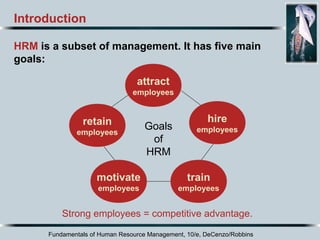
HRM is a subset of management. It has five main
goals:
Goals
of
HRM
hire
employees
attract
employees
retain
employees
motivate
employees
train
employees
Fundamentals of Human Resource Management, 10/e, DeCenzo/Robbins
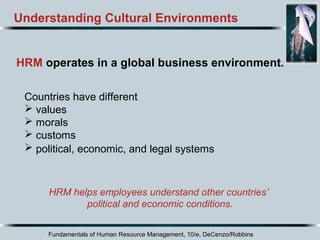
HRM helps employees understand other countries’
political and economic conditions.
Understanding Cultural Environments
Countries have different
 values
 morals
 customs
 political, economic, and legal systems
HRM operates in a global business environment.
Fundamentals of Human Resource Management, 10/e, DeCenzo/Robbins
Understanding Cultural Environments
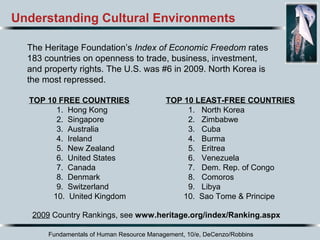
TOP 10 LEAST-FREE COUNTRIES
1. North Korea
2. Zimbabwe
3. Cuba
4. Burma
5. Eritrea
6. Venezuela
7. Dem. Rep. of Congo
8. Comoros
9. Libya
10. Sao Tome & Principe
The Heritage Foundation’s Index of Economic Freedom rates
183 countries on openness to trade, business, investment,
and property rights. The U.S. was #6 in 2009. North Korea is
the most repressed.
2009 Country Rankings, see www.heritage.org/index/Ranking.aspx
TOP 10 FREE COUNTRIES
1. Hong Kong
2. Singapore
3. Australia
4. Ireland
5. New Zealand
6. United States
7. Canada
8. Denmark
9. Switzerland
10. United Kingdom
Fundamentals of Human Resource Management, 10/e, DeCenzo/Robbins
The Changing World of Technology
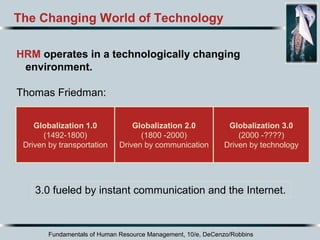
HRM operates in a technologically changing
environment.
Thomas Friedman:
Globalization 1.0
(1492-1800)
Driven by transportation
Globalization 2.0
(1800 -2000)
Driven by communication
Globalization 3.0
(2000 -????)
Driven by technology
3.0 fueled by instant communication and the Internet.
Globalization 2.0
(1800 -2000)
Driven by communication
Globalization 3.0
(2000 -????)
Driven by technology
Globalization 1.0
(1492-1800)
Driven by transportation
Globalization 2.0
(1800 -2000)
Driven by communication
Globalization 3.0
(2000 -????)
Driven by technology
Globalization 1.0
(1492-1800)
Driven by transportation
Globalization 2.0
(1800 -2000)
Driven by communication
Globalization 3.0
(2000 -????)
Driven by technology
Globalization 1.0
(1492-1800)
Driven by transportation
Globalization 2.0
(1800 -2000)
Driven by communication
Fundamentals of Human Resource Management, 10/e, DeCenzo/Robbins
1. Learning as a Way of Being by Peter B. Vaill
2. Thinking for a Living: How to Get Better Performance and
Results from Knowledge Workers by Thomas H. Davenport
3. Information Anxiety 2 by Richard S. Wurman
The Changing World of Technology
The IT field is growing.
Knowledge workers focus on the acquisition and
application of information for decision making.
Some books for aspiring knowledge workers:
Fundamentals of Human Resource Management, 10/e, DeCenzo/Robbins
The Changing World of Technology
HRM information systems help to
 facilitate HR plans
 make decisions faster
 clearly define jobs
 evaluate performance
 provide desirable, cost-effective benefits
Fundamentals of Human Resource Management, 10/e, DeCenzo/Robbins
The Changing World of Technology
HR managers use technology to:
 recruit, hire, and train employees
 motivate and monitor workers
 research fair compensation packages
 communicate throughout the
organization
 evaluate decentralized employees’
performance
Fundamentals of Human Resource Management, 10/e, DeCenzo/Robbins
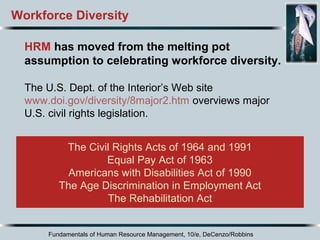
Workforce Diversity
HRM has moved from the melting pot
assumption to celebrating workforce diversity.
The U.S. Dept. of the Interior’s Web site
www.doi.gov/diversity/8major2.htm overviews major
U.S. civil rights legislation.
The Civil Rights Acts of 1964 and 1991
Equal Pay Act of 1963
Americans with Disabilities Act of 1990
The Age Discrimination in Employment Act
The Rehabilitation Act
Fundamentals of Human Resource Management, 10/e, DeCenzo/Robbins
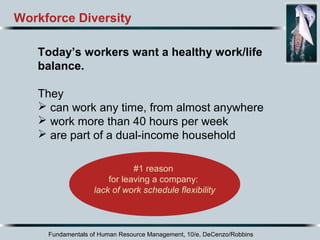
Workforce Diversity
Today’s workers want a healthy work/life
balance.
They
 can work any time, from almost anywhere
 work more than 40 hours per week
 are part of a dual-income household
#1 reason
for leaving a company:
lack of work schedule flexibility
Fundamentals of Human Resource Management, 10/e, DeCenzo/Robbins
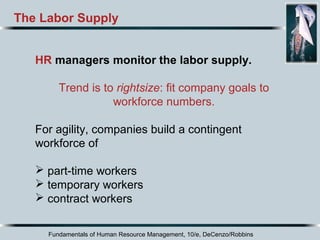
The Labor Supply
HR managers monitor the labor supply.
Trend is to rightsize: fit company goals to
workforce numbers.
For agility, companies build a contingent
workforce of
 part-time workers
 temporary workers
 contract workers
Fundamentals of Human Resource Management, 10/e, DeCenzo/Robbins
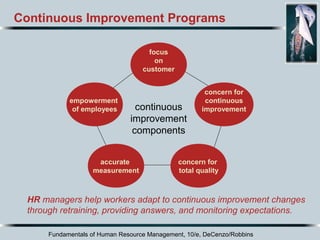
Continuous Improvement Programs
HR managers help workers adapt to continuous improvement changes
through retraining, providing answers, and monitoring expectations.
continuous
improvement
components
empowerment
of employees
accurate
measurement
concern for
total quality
focus
on
customer
concern for
continuous
improvement
Fundamentals of Human Resource Management, 10/e, DeCenzo/Robbins
Employee Involvement
It’s all about employee empowerment through
involvement, which increases worker productivity
and loyalty.
See http://workhelp.org/joomla/content/view/284/ for
managerial tips on empowering employees.
Employee Involvement Concepts
delegation • participative management
work teams • goal setting • employer training
Fundamentals of Human Resource Management, 10/e, DeCenzo/Robbins
Other HRM Challenges
Challenges for HRM:
 The recession has brought layoffs and low
morale.
 Increased offshoring means jobs can move
overseas, even HR.
 Today’s spate of mergers and acquisitions
increase HR’s role.
Fundamentals of Human Resource Management, 10/e, DeCenzo/Robbins
A Look at Ethics
Code of ethics: a formal statement of an
organization’s primary values and the ethical rules
it expects members to follow.
HR managers must take part in enforcing ethics
rules.
Video: Robert Lane, Ethics at Deere
Sarbanes-Oxley Act of 2002
Requires proper financial recordkeeping
for public companies
Fundamentals of Human Resource Management, 10/e, DeCenzo/Robbins
True or False?
1. HRM should assume all countries have the same cultures.
False!
2. Technology and information technology have little impact on HRM.
False!
3. Today’s workforce is composed of diverse groups.
True!
4. Rightsizing is a strategy companies use to balance their labor supply.
True!
5. Continuous improvement programs eliminate change in an organization.
False!
6. Employee empowerment increases worker involvement and productivity.
True!
7. HRM is affected by the economy.
True!
8. HRM can play a vital role in enforcing ethical codes of conduct.
True!

Hrm chapter 1

  • 1.
    Fundamentals of HumanResource Management, 10/e, DeCenzo/Robbins Chapter 1 The Dynamic Environment of Human Resource Management (HRM)
  • 2.
    Fundamentals of HumanResource Management, 10/e, DeCenzo/Robbins Introduction Strong employees = competitive advantage. HRM is a subset of management. It has five main goals: Goals of HRM hire employees attract employees retain employees motivate employees train employees
  • 3.
    Fundamentals of HumanResource Management, 10/e, DeCenzo/Robbins HRM helps employees understand other countries’ political and economic conditions. Understanding Cultural Environments Countries have different  values  morals  customs  political, economic, and legal systems HRM operates in a global business environment.
  • 4.
    Fundamentals of HumanResource Management, 10/e, DeCenzo/Robbins Understanding Cultural Environments TOP 10 LEAST-FREE COUNTRIES 1. North Korea 2. Zimbabwe 3. Cuba 4. Burma 5. Eritrea 6. Venezuela 7. Dem. Rep. of Congo 8. Comoros 9. Libya 10. Sao Tome & Principe The Heritage Foundation’s Index of Economic Freedom rates 183 countries on openness to trade, business, investment, and property rights. The U.S. was #6 in 2009. North Korea is the most repressed. 2009 Country Rankings, see www.heritage.org/index/Ranking.aspx TOP 10 FREE COUNTRIES 1. Hong Kong 2. Singapore 3. Australia 4. Ireland 5. New Zealand 6. United States 7. Canada 8. Denmark 9. Switzerland 10. United Kingdom
  • 5.
    Fundamentals of HumanResource Management, 10/e, DeCenzo/Robbins The Changing World of Technology HRM operates in a technologically changing environment. Thomas Friedman: Globalization 1.0 (1492-1800) Driven by transportation Globalization 2.0 (1800 -2000) Driven by communication Globalization 3.0 (2000 -????) Driven by technology 3.0 fueled by instant communication and the Internet. Globalization 2.0 (1800 -2000) Driven by communication Globalization 3.0 (2000 -????) Driven by technology Globalization 1.0 (1492-1800) Driven by transportation Globalization 2.0 (1800 -2000) Driven by communication Globalization 3.0 (2000 -????) Driven by technology Globalization 1.0 (1492-1800) Driven by transportation Globalization 2.0 (1800 -2000) Driven by communication Globalization 3.0 (2000 -????) Driven by technology Globalization 1.0 (1492-1800) Driven by transportation Globalization 2.0 (1800 -2000) Driven by communication
  • 6.
    Fundamentals of HumanResource Management, 10/e, DeCenzo/Robbins 1. Learning as a Way of Being by Peter B. Vaill 2. Thinking for a Living: How to Get Better Performance and Results from Knowledge Workers by Thomas H. Davenport 3. Information Anxiety 2 by Richard S. Wurman The Changing World of Technology The IT field is growing. Knowledge workers focus on the acquisition and application of information for decision making. Some books for aspiring knowledge workers:
  • 7.
    Fundamentals of HumanResource Management, 10/e, DeCenzo/Robbins The Changing World of Technology HRM information systems help to  facilitate HR plans  make decisions faster  clearly define jobs  evaluate performance  provide desirable, cost-effective benefits
  • 8.
    Fundamentals of HumanResource Management, 10/e, DeCenzo/Robbins The Changing World of Technology HR managers use technology to:  recruit, hire, and train employees  motivate and monitor workers  research fair compensation packages  communicate throughout the organization  evaluate decentralized employees’ performance
  • 9.
    Fundamentals of HumanResource Management, 10/e, DeCenzo/Robbins Workforce Diversity HRM has moved from the melting pot assumption to celebrating workforce diversity. The U.S. Dept. of the Interior’s Web site www.doi.gov/diversity/8major2.htm overviews major U.S. civil rights legislation. The Civil Rights Acts of 1964 and 1991 Equal Pay Act of 1963 Americans with Disabilities Act of 1990 The Age Discrimination in Employment Act The Rehabilitation Act
  • 10.
    Fundamentals of HumanResource Management, 10/e, DeCenzo/Robbins Workforce Diversity Today’s workers want a healthy work/life balance. They  can work any time, from almost anywhere  work more than 40 hours per week  are part of a dual-income household #1 reason for leaving a company: lack of work schedule flexibility
  • 11.
    Fundamentals of HumanResource Management, 10/e, DeCenzo/Robbins The Labor Supply HR managers monitor the labor supply. Trend is to rightsize: fit company goals to workforce numbers. For agility, companies build a contingent workforce of  part-time workers  temporary workers  contract workers
  • 12.
    Fundamentals of HumanResource Management, 10/e, DeCenzo/Robbins Continuous Improvement Programs HR managers help workers adapt to continuous improvement changes through retraining, providing answers, and monitoring expectations. continuous improvement components empowerment of employees accurate measurement concern for total quality focus on customer concern for continuous improvement
  • 13.
    Fundamentals of HumanResource Management, 10/e, DeCenzo/Robbins Employee Involvement It’s all about employee empowerment through involvement, which increases worker productivity and loyalty. See http://workhelp.org/joomla/content/view/284/ for managerial tips on empowering employees. Employee Involvement Concepts delegation • participative management work teams • goal setting • employer training
  • 14.
    Fundamentals of HumanResource Management, 10/e, DeCenzo/Robbins Other HRM Challenges Challenges for HRM:  The recession has brought layoffs and low morale.  Increased offshoring means jobs can move overseas, even HR.  Today’s spate of mergers and acquisitions increase HR’s role.
  • 15.
    Fundamentals of HumanResource Management, 10/e, DeCenzo/Robbins A Look at Ethics Code of ethics: a formal statement of an organization’s primary values and the ethical rules it expects members to follow. HR managers must take part in enforcing ethics rules. Video: Robert Lane, Ethics at Deere Sarbanes-Oxley Act of 2002 Requires proper financial recordkeeping for public companies
  • 16.
    Fundamentals of HumanResource Management, 10/e, DeCenzo/Robbins True or False? 1. HRM should assume all countries have the same cultures. False! 2. Technology and information technology have little impact on HRM. False! 3. Today’s workforce is composed of diverse groups. True! 4. Rightsizing is a strategy companies use to balance their labor supply. True! 5. Continuous improvement programs eliminate change in an organization. False! 6. Employee empowerment increases worker involvement and productivity. True! 7. HRM is affected by the economy. True! 8. HRM can play a vital role in enforcing ethical codes of conduct. True!

Editor's Notes

  • #12 Need to keep in mind WHERE you locate in order to find the right kind of supply of people. Quality of education is not serving us very well.
  • #14 A lot of companies cut training first. That is something that needs to be done most!