CANCER FOCUS -
CERVICAL CANCER IN
A REGION OF THE UK:
NORTHERN IRELAND
Learning objectives
 Define high- and low-risk HPV genotypes
 Describe the prevalence of HPV positivity
in Northern Ireland
 Discuss the implications of the HPV
vaccination on cervical cancer screening
What is HPV
 Human papillomavirus is a double-stranded DNA virus that infects
the epithelial cells of skin and mucosa.
 The epithelial surfaces include all areas covered by skin and/or
mucosa such as the cervix, vagina, penis, anus, mouth, throat,
tongue, and tonsils.
 Referred to papillomavirus as certain types may cause benign skin
warts, or papillomas.
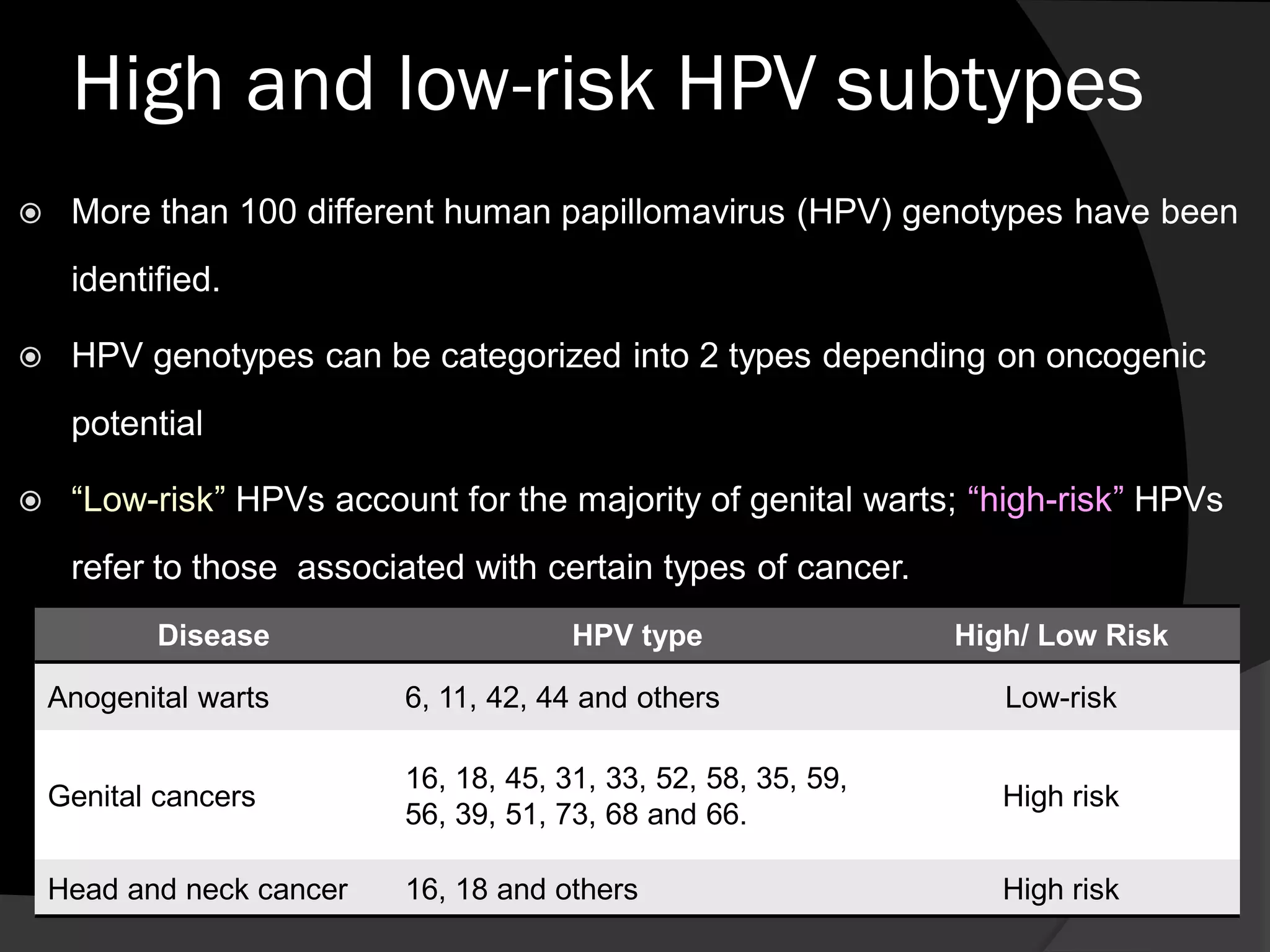
High and low-risk HPV subtypes
 More than 100 different human papillomavirus (HPV) genotypes have been
identified.
 HPV genotypes can be categorized into 2 types depending on oncogenic
potential
 “Low-risk” HPVs account for the majority of genital warts; “high-risk” HPVs
refer to those associated with certain types of cancer.
Disease HPV type High/ Low Risk
Anogenital warts 6, 11, 42, 44 and others Low-risk
Genital cancers
16, 18, 45, 31, 33, 52, 58, 35, 59,
56, 39, 51, 73, 68 and 66.
High risk
Head and neck cancer 16, 18 and others High risk
Transmission and Activity of HPV
 Virus spread by skin contact – mainly by sexual activity.
 Many HPV infections are transient.
 The virus can remain inactive for a long period after the infection.
Usually the body's immune system responds and clears the HPV
infection.
 Persistent HPV infections, pre-malignant conditions and cervical
cancer.
How does HPV infection lead to malignancy ?
1. Inactivation of the cellular p53 gene by the E6 oncoprotein
2. Inactivation of the pRB gene by the HPV E7 oncoprotein.
Cervical Cancer
 Cervical cancer is the second most common cancer in
females after breast cancer.
 Globally every year 470,000 new cases are diagnosed,
and 230,000 deaths occur, 80% are in low resource
countries
 In Northern Ireland: Each year approximately 80 cases of
cervical cancer are diagnosed; and an average of 30
deaths due to cervical cancer.
 5-year relative survival rates are 67.8%.
(Northern Ireland Cancer Registry data)
Cervical Cancer
 Predominately affects younger women (half of cases aged
44 years or younger).
 Large numbers of premalignant Lesions:
Annually an average 700 CIN III lesions, 650 moderate to
severe dysplasia (CIN II) lesions and 170 mild dysplasia
(CIN I) are diagnosed. (Northern Ireland Cancer Registry)
 Even after successful treatment of CIN lesions and cervical
cancer, infertility, physical morbidity and psychological
effects can occur.
HPV Testing
 Testing for HPV is generally not available on request through the NHS.
 If a cervical smear test shows signs of borderline changes or mild
dyskaryosis then HPV testing will be carried out.
 Identifies whether there is a HPV infection (HPV positive/ HPV
negative) and the genotype of the HPV (high/ low risk) .
 Helps determine whether a woman requires treatment and what follow-
up is necessary. (www.nhs.uk)
Prevalence of HPV in N. Ireland
High-risk HPV prevalence by age group
35.9
16.6
10.2 7.2
0.0
10.0
20.0
30.0
40.0
50.0
60.0
70.0
80.0
90.0
100.0
20-29 years 30-39 years 40-49 years 50-64 years
age group
Prevalence(%)
high-risk HPV negative
high-risk HPV positive
Prevalence of HPV in N. Ireland
Prevalence of high-risk HPV genotypes age standardized to the
Northern Ireland population
0 1 2 3 4 5 6
HPV 68
HPV 35
HPV 58
HPV 56
HPV 45
HPV 39
HPV 33
HPV 66
HPV 18
HPV 59
Derived HPV 52
HPV 51
HPV 31
HPV 16
Prevalence (%)
The HPV Vaccine
 Two prophylactic vaccines have been developed
Gardasil (Merck) - A quadrivalent vaccine protecting against four
types of HPV – 16,18, 6 and 11.
Cervarix (GlaxoSmithKline) - A bivalent vaccine and protects
against two HPV types - 16 and 18.
Both vaccines require 3 doses over a 6 month period for maximum
effectiveness.
 Do not provide protection if already infected with HPV.
The HPV Vaccine
 Highly effective in preventing infection with the types
of HPV they target.
 Avert 70% or more of SCCs by preventing some HPV
infections.
 Vaccines duration of protection is uncertain – booster
vaccinations may be needed.
The HPV Vaccination Programme (N.I.)
 Programme launched on 3 September 2008.
 Aimed at girls within year 9 (aged 12 -13)
 Cervarix vaccine
 Figures from January 2009 – showed a high uptake of
vaccine (89.56% for the first dose and 84.28% for the second
dose).
 Catch up programme introduced to include girls aged 13 -18
HPV Vaccine And Cervical Screening
 Effects of the HPV vaccination programme will take decades
before a noticeable effect on cervical cancer incidence can be
observed.
 Long lasting impact on the prevalence of cervical cancer.
 The vaccine should:
1. Reduce the need and hence cost for medical care, biopsies, and
invasive procedures associated with the follow- up of abnormal
smear tests.
2. Alleviate the associated anxieties of these procedures.
HPV Vaccine And Cervical Screening
Cervical cancer screening will still be required to detect:
1. Cancers and precancerous lesions caused by other
HPV types ~ 30% of cervical cancers.
2. The development of cancers in women who have not
been vaccinated or who are already infected with HPV.
HPV Vaccine And Cervical Screening -
Future Considerations
 Impact of vaccination on the effectiveness of screening for cervical
cancer.
1. As the prevalence of cervical dysplasias decreases, the positive
predictive value of smear tests (i.e. the likelihood that a positive
screening test will give a correct result ) will decrease. Leading to more
women being referred for unnecessary diagnostic procedures and follow-
up.
2. Maintaining cytology as the primary cervical screening test may become
too costly
Possible introduction of HPV testing as a population screening tool

HPV and Cervical Cancer

  • 1.
    CANCER FOCUS - CERVICALCANCER IN A REGION OF THE UK: NORTHERN IRELAND
  • 2.
    Learning objectives  Definehigh- and low-risk HPV genotypes  Describe the prevalence of HPV positivity in Northern Ireland  Discuss the implications of the HPV vaccination on cervical cancer screening
  • 3.
    What is HPV Human papillomavirus is a double-stranded DNA virus that infects the epithelial cells of skin and mucosa.  The epithelial surfaces include all areas covered by skin and/or mucosa such as the cervix, vagina, penis, anus, mouth, throat, tongue, and tonsils.  Referred to papillomavirus as certain types may cause benign skin warts, or papillomas.
  • 4.
    High and low-riskHPV subtypes  More than 100 different human papillomavirus (HPV) genotypes have been identified.  HPV genotypes can be categorized into 2 types depending on oncogenic potential  “Low-risk” HPVs account for the majority of genital warts; “high-risk” HPVs refer to those associated with certain types of cancer. Disease HPV type High/ Low Risk Anogenital warts 6, 11, 42, 44 and others Low-risk Genital cancers 16, 18, 45, 31, 33, 52, 58, 35, 59, 56, 39, 51, 73, 68 and 66. High risk Head and neck cancer 16, 18 and others High risk
  • 5.
    Transmission and Activityof HPV  Virus spread by skin contact – mainly by sexual activity.  Many HPV infections are transient.  The virus can remain inactive for a long period after the infection. Usually the body's immune system responds and clears the HPV infection.  Persistent HPV infections, pre-malignant conditions and cervical cancer.
  • 7.
    How does HPVinfection lead to malignancy ? 1. Inactivation of the cellular p53 gene by the E6 oncoprotein 2. Inactivation of the pRB gene by the HPV E7 oncoprotein.
  • 8.
    Cervical Cancer  Cervicalcancer is the second most common cancer in females after breast cancer.  Globally every year 470,000 new cases are diagnosed, and 230,000 deaths occur, 80% are in low resource countries  In Northern Ireland: Each year approximately 80 cases of cervical cancer are diagnosed; and an average of 30 deaths due to cervical cancer.  5-year relative survival rates are 67.8%. (Northern Ireland Cancer Registry data)
  • 9.
    Cervical Cancer  Predominatelyaffects younger women (half of cases aged 44 years or younger).  Large numbers of premalignant Lesions: Annually an average 700 CIN III lesions, 650 moderate to severe dysplasia (CIN II) lesions and 170 mild dysplasia (CIN I) are diagnosed. (Northern Ireland Cancer Registry)  Even after successful treatment of CIN lesions and cervical cancer, infertility, physical morbidity and psychological effects can occur.
  • 10.
    HPV Testing  Testingfor HPV is generally not available on request through the NHS.  If a cervical smear test shows signs of borderline changes or mild dyskaryosis then HPV testing will be carried out.  Identifies whether there is a HPV infection (HPV positive/ HPV negative) and the genotype of the HPV (high/ low risk) .  Helps determine whether a woman requires treatment and what follow- up is necessary. (www.nhs.uk)
  • 11.
    Prevalence of HPVin N. Ireland High-risk HPV prevalence by age group 35.9 16.6 10.2 7.2 0.0 10.0 20.0 30.0 40.0 50.0 60.0 70.0 80.0 90.0 100.0 20-29 years 30-39 years 40-49 years 50-64 years age group Prevalence(%) high-risk HPV negative high-risk HPV positive
  • 12.
    Prevalence of HPVin N. Ireland Prevalence of high-risk HPV genotypes age standardized to the Northern Ireland population 0 1 2 3 4 5 6 HPV 68 HPV 35 HPV 58 HPV 56 HPV 45 HPV 39 HPV 33 HPV 66 HPV 18 HPV 59 Derived HPV 52 HPV 51 HPV 31 HPV 16 Prevalence (%)
  • 13.
    The HPV Vaccine Two prophylactic vaccines have been developed Gardasil (Merck) - A quadrivalent vaccine protecting against four types of HPV – 16,18, 6 and 11. Cervarix (GlaxoSmithKline) - A bivalent vaccine and protects against two HPV types - 16 and 18. Both vaccines require 3 doses over a 6 month period for maximum effectiveness.  Do not provide protection if already infected with HPV.
  • 14.
    The HPV Vaccine Highly effective in preventing infection with the types of HPV they target.  Avert 70% or more of SCCs by preventing some HPV infections.  Vaccines duration of protection is uncertain – booster vaccinations may be needed.
  • 15.
    The HPV VaccinationProgramme (N.I.)  Programme launched on 3 September 2008.  Aimed at girls within year 9 (aged 12 -13)  Cervarix vaccine  Figures from January 2009 – showed a high uptake of vaccine (89.56% for the first dose and 84.28% for the second dose).  Catch up programme introduced to include girls aged 13 -18
  • 16.
    HPV Vaccine AndCervical Screening  Effects of the HPV vaccination programme will take decades before a noticeable effect on cervical cancer incidence can be observed.  Long lasting impact on the prevalence of cervical cancer.  The vaccine should: 1. Reduce the need and hence cost for medical care, biopsies, and invasive procedures associated with the follow- up of abnormal smear tests. 2. Alleviate the associated anxieties of these procedures.
  • 17.
    HPV Vaccine AndCervical Screening Cervical cancer screening will still be required to detect: 1. Cancers and precancerous lesions caused by other HPV types ~ 30% of cervical cancers. 2. The development of cancers in women who have not been vaccinated or who are already infected with HPV.
  • 18.
    HPV Vaccine AndCervical Screening - Future Considerations  Impact of vaccination on the effectiveness of screening for cervical cancer. 1. As the prevalence of cervical dysplasias decreases, the positive predictive value of smear tests (i.e. the likelihood that a positive screening test will give a correct result ) will decrease. Leading to more women being referred for unnecessary diagnostic procedures and follow- up. 2. Maintaining cytology as the primary cervical screening test may become too costly Possible introduction of HPV testing as a population screening tool