HAEMATOLOGICAL MALIGNANCY
Benjamin Smeeton (Year 4)
An introduction to PART
ONE
What are we going to
cover?
(1) The Basics
i)Haematopoiesis
ii)Extra-medullary haematopoiesis
(1) Common malignancies
i)Leukaemias
ii)Myeloproliferative disorders
iii)Multiple myeloma
(2) Questions
}
An integrated approach
For each disease we will explore the basic
pathological concepts underpinning the clinical
manifestations.
Don’t worry
we’ll all go
m
A quick quiz to test your
existing knowledge!
(1)A 63 year old female presents to her GP with general fatigue and lethargy of 6 months
duration. She suffers from HTN, but is otherwise well. A FBC reveals WBCs and Hb↑ ↓
(iron, B12 and folate are normal). The doctor orders a blood film.
Examination of the blood film reveals large reticulocytes and damaged red cells. The
presence of characteristic smear cells is also noted.
What is the most likely diagnosis?
• Acute myeloid leukaemia
• Multiple myeloma
• Iron deficiency anaemia
• Chronic lymphocytic leukaemia
• Essential thrombocythaemia
(2)A 4 year old boy presents with his mother. His mother explains he has had a widespread
rash for 7 days and that he has been ‘somewhat lethargic’ for the last 2 weeks. O/E: he is
pale, with a widespread purpuric rash but there is no fever or meningism; generalised
non-tender lymphadenopathy and splenomegaly are also noted. A FBC reveals WCC,↓
Hb, Plts and a blood film is ordered.↓ ↓
Examination of the blood film reveals blast cells.
What is the most likely diagnosis?
• Bacterial meningitis
• Acute myeloid leukaemia
• Acute lymphoblastic leukaemia
• Chronic lymphocytic leukaemia
• Essential thrombocythaemia
A quick quiz to test your
existing knowledge!
(3)A 65 year old man presents to his GP with intermittent headache and dizziness of 6
months duration. He has also noted an unpleasant burning sensation in his hands and feet,
especially when he is in the shower. O/E: both his big and first toes of his right foot are
dusky in colour and tender to touch.
What single pathological process is most likely to account for his symptoms?
• Bone marrow failure
• Plasma cell proliferation
• Chronic haemolysis
• Chronic lymphocytic leukaemia
• Myeloproliferation
A quick quiz to test your
existing knowledge!
(4)A 58 year old farmer presents with severe upper arm pain having suffered a trivial fall at
home. He also complains of lower back pain and significant lethargy for the last 6 months.
O/E: he is notably pale with a pulse of 120 bpm, with a visibly inflamed and painful upper
left arm. He is also considerably kyphotic. Urinalysis is +++ for protein.
What is the most likely haematological diagnosis?
• Multiple myeloma
• Grave’s disease
• Chronic lymphocytic leukaemia
• Primary myelofibrosis
• Essential thrombocythaemia
A quick quiz to test your
existing knowledge!
The Basics: Haematopoiesis
Pluripoten
t
haematopoi
etic stem
cell
Myeloid
stem
cell
Lymphoi
d stem
cell
Megakaryo
cyte
Platelets RBC Monocyte Neutrophi
l
Basophil Eosinophi
l
B-
lymphocyt
e
T-
lymphocyt
e
Plasma
cell
The Basics: Haematopoiesis
• In an adult, all blood cells are
produced in the red marrow.
Restricted to the bones of the axial
skeleton (vertebrae, ribs, sternum,
skull, sacrum, pelvis and femur).
• In fetal life, the major haemopoietic
tissues are:
• Yolk sac (before 6 weeks).
• Liver and spleen (6 weeks to 6-7 months). In
disease, the liver and spleen can again
become haemopoietic, even in adult
life (extramedullary haemopoiesis).
Common malignancies:
introduction
• The same basic pathological mechanism underpins a large number
of haematological malignancies.Essentially, a haemopoietic stem cell
in the BM acquires genetic mutations which disrupt the normal
differentiation and maturation of its progeny.
• The resulting disease depends on how these mutations affect the
differentiation pathway.
MUTATED
Pluripoten
t
haematopoi
etic stem
cell
Common malignancies:
overview
More
indolent
Undifferentiated
Acute
leukaemias
(ALL /
AML)
Chronic
lymphocytic
leukaemia
(CLL)
Chronic
myeloid
leukaemia
(CML)
Differentiated
Normal
differentiation
Abnormal
differentiation
Myeloid
cell
line
Lymphoi
d cell
line
Myeloprolife
rative
disorder
Myelodysplas
tic disorder
Lymphomas
Dealt with as a
slightly
separate entity!
More
aggressive
Common malignancies: what we
will be covering!
(1) Leukaemias
i) Acute lymphoblastic (ALL)
ii) Acute myeloid (AML)
iii) Chronic lymphocytic (CLL)
•
Myeloproliferat
ive
• Chronic myeloid leukaemia*
• Polycythaemia vera
• Essential thrombocythaemia
• Primary myelofibrosis
(3) Others
i) Multiple myeloma
ii) Myelodysplastic disorders
i)Lymphomas
(4)Hodgkin
(5)Non-Hodgkin
Although it is a
leukaemia it is
also considered a
myeloproliferativ
These will becovered indetail inPart II
Acute leukaemias: ALL & AML
• Characterised by the presence of large numbers of
undifferentiated blood cells (blasts) in the BM.These
immature cells rapidly overwhelm the normal
developing blood cells and spill out into the
peripheral blood.
• Clinical features reflect the consequences of bone
marrow failure.
• Highly aggressive and rapidly fatal without
treatment (6-12 weeks).
• Types:
• ALL - acute lymphoblastic leukaemia
• AML - acute myeloid leukaemia
• Diagnosis requires the presence of > 20% blasts in
the blood or bone marrow.
• Sudden onset of marrow failure
(pancytopenia).
- Fatigue and lethargy ( RBCs)↓
- Infections ( WBCs)↓
- Bleeding, bruising and purpura ( Plts)↓
• Bone pain (esp. in children)
• Lymphadenopathy
• Splenomegaly
Acute leukaemias: ALL & AML
• ALL (acute lymphoblastic leukaemia):
• Commonest childhood cancer (peak incidence at
age 2-4 years)
• Modern treatment has improved prognosis
significantly (4 stages - induction, consolidation,
CNS prophylaxis, and maintenance)
• Male gender and age > 10 years represent negative
prognostic factors.
• AML (acute myeloid leukaemia):
• May occur at any age, but becomes increasingly
common in older people.
• Down’s syndrome = 400x greater incidence.
• Poor prognosis, patients over the age of 70 rarely
survive beyond 1 year.
• Sudden onset of marrow failure
(pancytopenia).
- Fatigue and lethargy ( RBCs)↓
- Infections ( WBCs)↓
- Bleeding, bruising and purpura ( Plts)↓
• Bone pain (esp. in children)
• Lymphadenopathy
• Splenomegaly
Chronic leukaemias: Chronic
Lymphocytic Leukaemia
• Commonest leukemia in adults.
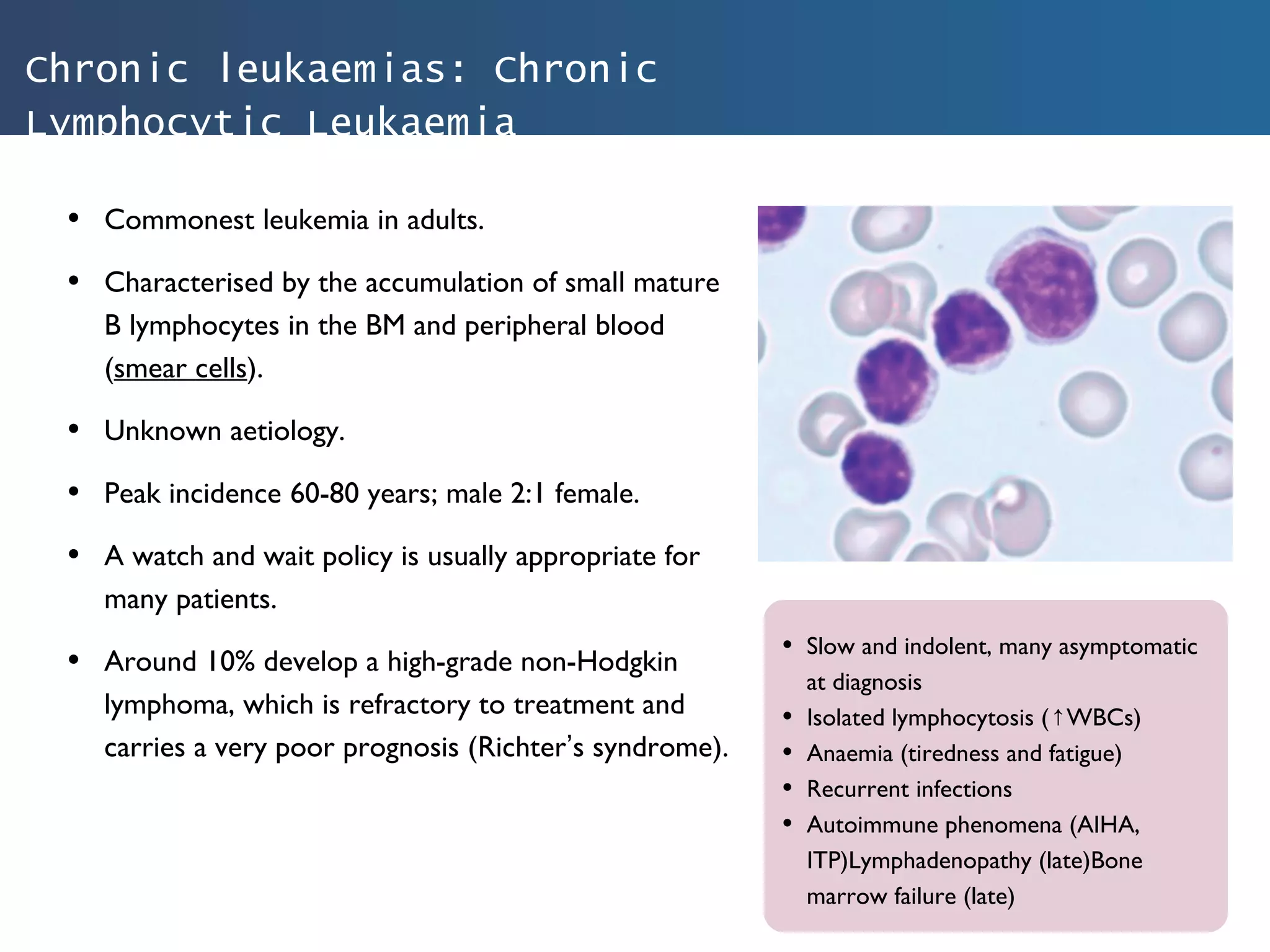
• Characterised by the accumulation of small mature
B lymphocytes in the BM and peripheral blood
(smear cells).
• Unknown aetiology.
• Peak incidence 60-80 years; male 2:1 female.
• A watch and wait policy is usually appropriate for
many patients.
• Around 10% develop a high-grade non-Hodgkin
lymphoma, which is refractory to treatment and
carries a very poor prognosis (Richter’s syndrome).
• Slow and indolent, many asymptomatic
at diagnosis
• Isolated lymphocytosis ( WBCs)↑
• Anaemia (tiredness and fatigue)
• Recurrent infections
• Autoimmune phenomena (AIHA,
ITP)Lymphadenopathy (late)Bone
marrow failure (late)
Myeloproliferative disorders:
overview
• A group of neoplastic disorders characterised by
the overproduction of normal myeloid cells.
• Occur mostly in the elderly.
• Caused by a genetic abnormality which bestows a
proliferation advantage to one or more myeloid cell
lineages.
• Types:
• Chronic myeloid leukaemia ( neutrophils)↑
• Polycythaemia vera ( RBCs)↑
• Essential thrombocythaemia ( Plts)↑
• Primary myelofibrosis ( Megakaryocytes)↑
• Diagnosis is difficult as blood cell overproduction
can often be a normal physiological response.
Chronic
myeloid
leukaemia
(CML)
Polycythaemi
a vera
Essential
thrombocytha
emia
Platelets
RBCNeutrophi
l
MUTATED
Myeloid
stem cell
Myeloproliferative disorders:
Chronic Myeloid Leukaemia
• CML is the most common myeloproliferative
disorder.
• Very rare in children; incidence increases with age.
• Examination of the peripheral blood reveals large
numbers of neutrophils and neutrophil precursors.
• Associated with the Philadelphia chromosome.
• 95% possess the t(9;22) translocation.
• The translocation produces an abnormal fusion
gene, BCR-ABL, which generates a protein with
excessive tyrosine kinase growth signaling
properties.
• Tx. imatinib (tyrosine kinase inhibitor - not
curative).
• Pallor
• Night sweats
• Fatigue, weight loss and anorexia.
• Massive splenomegaly
• Begins with a ‘chronic’ phase (5
years) which then spontaneously
transforms into a ‘blast’ crisis with
fulminant bone marrow failure.
Myeloproliferative disorders:
Polycythaemia Vera
• Increased production of RBCs.
• Excess proliferation of other myeloid lineages is
usually seen ( neu plts).↑ ↑
• Rarely presents before age 40.
• 90% of cases associated with a mutation in the
erythropoietin signaling pathway (JAK-2).
• The key to diagnosis is the exclusion of a secondary
physiological erythrocytosis.
• Chronic hypoxia (e.g. lung disease)
• ↑EPO secretion (e.g. RCC, PCKD)
• Thrombosis is a serious risk.
• With treatment (venesection), patients often
survive 10 years; most die from thrombosis /
haemorrhage.
• Plethora (red face)
• Erythromelalgia (burning red skin)
• Pruritus (particularly after hot
baths)
• Hepatosplenomegaly
• Headache, dizziness and stroke (↑
blood viscosity).
• Mesenteric, portal or splenic vein
thrombosis.
Myeloproliferative disorders:
Polycythaemia Vera
Myeloproliferative disorders:
Essential Thrombocythaemia
• Increased production of platelets (megakaryocyte
cell line).
• Platelet count > 600 x 109
/L (normal = 150-400)
• Difficult to differentiate from reactive causes of
thrombocytosis (e.g. infection, malignancy).
• 50% possess JAK-2 mutation.
• Usually affects older patients; presents with
thrombotic or bleeding complications.
• An indolent condition with a median survival of 12-
15 years.
• Rarely transforms into an acute leukaemia.
• Many asymptomatic (25%)
• Erythromelalgia and digital ischaemia
(intense burning and pain)
• Stroke
• Recurrent abortions and fetal
growth retardation
• Hepatic and portal vein thrombosis
(e.g. Budd-Chiari syndrome)
Myeloproliferative disorders:
Primary Myelofibrosis
• Overproliferation of megakaryocytes which release
fibroblast-stimulating factors (e.g. platelet-derived
growth factor).
• Usually presents age 50+
• These factors stimulate marrow stromal cells to lay
down fibrous tissue in the BM.
• The marrow space becomes obliterated resulting in
extramedullary haematopoiesis.
• Immature nucleated RBCs and neutrophils enter
the peripheral blood (leukoerythroblastosis).
• Distorted RBCs (teardrop cells) and a ‘dry tap’ on
trephine needle biopsy are typical.
• Very poor prognosis, 3-5 years.
• Hepatosplenomegaly and pallor
• Splenic pain
• Constitutional symptoms (weight
loss, night sweats, fever)
• Anaemia symptoms (SOB, fatigue,
palpitations)
• Gout (increased cell turnover =
hyperuricaemia)
Others: Multiple Myeloma
• A malignant disease of plasma cells in the BM.
• Unknown aetiology.
• Generalised BM involvement; although areas of
greatest haematopoietic activity (vertebrae, ribs and
skull) are predominantly affected.
• Malignant plasma cells produce a single non-
functioning monoclonal immunoglobulin
(paraprotein) in large quantities.
• The abnormal plasma cells also produce free
immunoglobulin light chains, which are readily
filtered and excreted by the kidneys (Bence-Jones
protein).
Plasma
cell
YY
Y Y
Y
Y
Y
Y
Y
Y
Y
Y
Y
Y
Y
Y
Y
Y
Y
Y
Y
Y
Y
Y
YYY
Y Y
Y
Y
Y
YY
Others: Multiple Myeloma
• Clinical features:
• Bony destruction: proliferating plasma cells
stimulate osteoclast activity (lytic lesions).
• Immunosuppression: production of normal
immunoglobulins is impaired, leading to immune
paresis (recurrent infections).
• Renal failure: free light chains produced by the
malignant cells become trapped in the renal tubules
resulting in kidney damage.
• Diagnosis:
• Serum electrophoresis (serum paraprotein)
• Urine electrophoresis (Bence-Jones protein)
• Bone marrow aspirate (demonstrates plasma cell
infiltration).
• Peak age 50-60 years.Bone
destruction / pain
• Renal failure
• Bone marrow failure
• Immunodeficiency
• Hypercalcaemia
• Amyloidosis (peripheral neuropathy,
cardiomyopathy etc)
Common malignancies: summary
• The same basic pathological mechanism underpins a large number
of haematological malignancies.Using knowledge of haematopoiesis,
the haematological malignancies can be categorised into:
• Acute leukaemias
• Chronic leukaemias
• Myeloproliferative disorders
• Others (e.g. myeloma)
• In part two of this series, we will be covering the topic of
lymphoma.
Common malignancies: summary
Pluripoten
t
haematopo
ietic
stem cell
Myeloid
stem
cell
Lymphoi
d stem
cell
Megakaryo
cyte
Platelets RBC Monocyte Neutrophi
l
Basophil Eosinophi
l
B-
lymphocyt
e
T-
lymphocyt
e
Plasma
cell
Acute
leukaemias
(ALL / AML)
Chronic
leukaemias
(CLL /
CML)
Myeloprolifera
tivedisordersEssential
thrombocythae
mia
Polycythaemi
avera
Chronic
myeloid
eukaemia
Primary
myelofibrosis
Multiple
myeloma
SBA questions: haematology
quiz
(1)A 63 year old female presents to her GP with general fatigue and lethargy of 6 months
duration. She suffers from HTN, but is otherwise well. A FBC reveals WBCs and Hb↑ ↓
(iron, B12 and folate are normal). The doctor orders a blood film.
Examination of the blood film reveals large reticulocytes and damaged red cells. The
presence of characteristic smear cells is also noted.
What is the most likely diagnosis?
• Acute myeloid leukaemia
• Multiple myeloma
• Iron deficiency anaemia
• Chronic lymphocytic leukaemia
• Essential thrombocythaemia
SBA questions: haematology
quiz
(2)A 4 year old boy presents with his mother. His mother explains he has had a widespread
rash for 7 days and that he has been ‘somewhat lethargic’ for the last 2 weeks. O/E: he is
pale, with a widespread purpuric rash but there is no fever or meningism; generalised
non-tender lymphadenopathy and splenomegaly are also noted. A FBC reveals WCC,↓
Hb, Plts and a blood film is ordered.↓ ↓
Examination of the blood film reveals blast cells.
What is the most likely diagnosis?
• Bacterial meningitis
• Acute myeloid leukaemia
• Acute lymphoblastic leukaemia
• Chronic lymphocytic leukaemia
• Essential thrombocythaemia
SBA questions: haematology
quiz
(3)A 65 year old man presents to his GP with intermittent headache and dizziness of 6
months duration. He has also noted an unpleasant burning sensation in his hands and feet,
especially when he is in the shower. O/E: both his big and first toes of his right foot are
dusky in colour and tender to touch.
What single pathological process is most likely to account for his symptoms?
• Bone marrow failure
• Plasma cell proliferation
• Chronic haemolysis
• Chronic lymphocytic leukaemia
• Myeloproliferation
SBA questions: haematology
quiz
(4)A 58 year old farmer presents with severe upper arm pain having suffered a trivial fall at
home. He also complains of lower back pain and significant lethargy for the last 6 months.
O/E: he is notably pale with a pulse of 120 bpm, with a visibly inflamed and painful upper
left arm. He is also considerably kyphotic. Urinalysis is +++ for protein.
What is the most likely haematological diagnosis?
• Multiple myeloma
• Grave’s disease
• Chronic lymphocytic leukaemia
• Primary myelofibrosis
• Essential thrombocythaemia
An introduction to haematological
malignancy: Part one
Thank you for
listening!

An introduction to haematological malignancies

  • 1.
    HAEMATOLOGICAL MALIGNANCY Benjamin Smeeton(Year 4) An introduction to PART ONE
  • 2.
    What are wegoing to cover? (1) The Basics i)Haematopoiesis ii)Extra-medullary haematopoiesis (1) Common malignancies i)Leukaemias ii)Myeloproliferative disorders iii)Multiple myeloma (2) Questions } An integrated approach For each disease we will explore the basic pathological concepts underpinning the clinical manifestations. Don’t worry we’ll all go m
  • 3.
    A quick quizto test your existing knowledge! (1)A 63 year old female presents to her GP with general fatigue and lethargy of 6 months duration. She suffers from HTN, but is otherwise well. A FBC reveals WBCs and Hb↑ ↓ (iron, B12 and folate are normal). The doctor orders a blood film. Examination of the blood film reveals large reticulocytes and damaged red cells. The presence of characteristic smear cells is also noted. What is the most likely diagnosis? • Acute myeloid leukaemia • Multiple myeloma • Iron deficiency anaemia • Chronic lymphocytic leukaemia • Essential thrombocythaemia
  • 4.
    (2)A 4 yearold boy presents with his mother. His mother explains he has had a widespread rash for 7 days and that he has been ‘somewhat lethargic’ for the last 2 weeks. O/E: he is pale, with a widespread purpuric rash but there is no fever or meningism; generalised non-tender lymphadenopathy and splenomegaly are also noted. A FBC reveals WCC,↓ Hb, Plts and a blood film is ordered.↓ ↓ Examination of the blood film reveals blast cells. What is the most likely diagnosis? • Bacterial meningitis • Acute myeloid leukaemia • Acute lymphoblastic leukaemia • Chronic lymphocytic leukaemia • Essential thrombocythaemia A quick quiz to test your existing knowledge!
  • 5.
    (3)A 65 yearold man presents to his GP with intermittent headache and dizziness of 6 months duration. He has also noted an unpleasant burning sensation in his hands and feet, especially when he is in the shower. O/E: both his big and first toes of his right foot are dusky in colour and tender to touch. What single pathological process is most likely to account for his symptoms? • Bone marrow failure • Plasma cell proliferation • Chronic haemolysis • Chronic lymphocytic leukaemia • Myeloproliferation A quick quiz to test your existing knowledge!
  • 6.
    (4)A 58 yearold farmer presents with severe upper arm pain having suffered a trivial fall at home. He also complains of lower back pain and significant lethargy for the last 6 months. O/E: he is notably pale with a pulse of 120 bpm, with a visibly inflamed and painful upper left arm. He is also considerably kyphotic. Urinalysis is +++ for protein. What is the most likely haematological diagnosis? • Multiple myeloma • Grave’s disease • Chronic lymphocytic leukaemia • Primary myelofibrosis • Essential thrombocythaemia A quick quiz to test your existing knowledge!
  • 7.
    The Basics: Haematopoiesis Pluripoten t haematopoi eticstem cell Myeloid stem cell Lymphoi d stem cell Megakaryo cyte Platelets RBC Monocyte Neutrophi l Basophil Eosinophi l B- lymphocyt e T- lymphocyt e Plasma cell
  • 8.
    The Basics: Haematopoiesis •In an adult, all blood cells are produced in the red marrow. Restricted to the bones of the axial skeleton (vertebrae, ribs, sternum, skull, sacrum, pelvis and femur). • In fetal life, the major haemopoietic tissues are: • Yolk sac (before 6 weeks). • Liver and spleen (6 weeks to 6-7 months). In disease, the liver and spleen can again become haemopoietic, even in adult life (extramedullary haemopoiesis).
  • 9.
    Common malignancies: introduction • Thesame basic pathological mechanism underpins a large number of haematological malignancies.Essentially, a haemopoietic stem cell in the BM acquires genetic mutations which disrupt the normal differentiation and maturation of its progeny. • The resulting disease depends on how these mutations affect the differentiation pathway. MUTATED Pluripoten t haematopoi etic stem cell
  • 10.
  • 11.
    Common malignancies: whatwe will be covering! (1) Leukaemias i) Acute lymphoblastic (ALL) ii) Acute myeloid (AML) iii) Chronic lymphocytic (CLL) • Myeloproliferat ive • Chronic myeloid leukaemia* • Polycythaemia vera • Essential thrombocythaemia • Primary myelofibrosis (3) Others i) Multiple myeloma ii) Myelodysplastic disorders i)Lymphomas (4)Hodgkin (5)Non-Hodgkin Although it is a leukaemia it is also considered a myeloproliferativ These will becovered indetail inPart II
  • 12.
    Acute leukaemias: ALL& AML • Characterised by the presence of large numbers of undifferentiated blood cells (blasts) in the BM.These immature cells rapidly overwhelm the normal developing blood cells and spill out into the peripheral blood. • Clinical features reflect the consequences of bone marrow failure. • Highly aggressive and rapidly fatal without treatment (6-12 weeks). • Types: • ALL - acute lymphoblastic leukaemia • AML - acute myeloid leukaemia • Diagnosis requires the presence of > 20% blasts in the blood or bone marrow. • Sudden onset of marrow failure (pancytopenia). - Fatigue and lethargy ( RBCs)↓ - Infections ( WBCs)↓ - Bleeding, bruising and purpura ( Plts)↓ • Bone pain (esp. in children) • Lymphadenopathy • Splenomegaly
  • 13.
    Acute leukaemias: ALL& AML • ALL (acute lymphoblastic leukaemia): • Commonest childhood cancer (peak incidence at age 2-4 years) • Modern treatment has improved prognosis significantly (4 stages - induction, consolidation, CNS prophylaxis, and maintenance) • Male gender and age > 10 years represent negative prognostic factors. • AML (acute myeloid leukaemia): • May occur at any age, but becomes increasingly common in older people. • Down’s syndrome = 400x greater incidence. • Poor prognosis, patients over the age of 70 rarely survive beyond 1 year. • Sudden onset of marrow failure (pancytopenia). - Fatigue and lethargy ( RBCs)↓ - Infections ( WBCs)↓ - Bleeding, bruising and purpura ( Plts)↓ • Bone pain (esp. in children) • Lymphadenopathy • Splenomegaly
  • 14.
    Chronic leukaemias: Chronic LymphocyticLeukaemia • Commonest leukemia in adults. • Characterised by the accumulation of small mature B lymphocytes in the BM and peripheral blood (smear cells). • Unknown aetiology. • Peak incidence 60-80 years; male 2:1 female. • A watch and wait policy is usually appropriate for many patients. • Around 10% develop a high-grade non-Hodgkin lymphoma, which is refractory to treatment and carries a very poor prognosis (Richter’s syndrome). • Slow and indolent, many asymptomatic at diagnosis • Isolated lymphocytosis ( WBCs)↑ • Anaemia (tiredness and fatigue) • Recurrent infections • Autoimmune phenomena (AIHA, ITP)Lymphadenopathy (late)Bone marrow failure (late)
  • 15.
    Myeloproliferative disorders: overview • Agroup of neoplastic disorders characterised by the overproduction of normal myeloid cells. • Occur mostly in the elderly. • Caused by a genetic abnormality which bestows a proliferation advantage to one or more myeloid cell lineages. • Types: • Chronic myeloid leukaemia ( neutrophils)↑ • Polycythaemia vera ( RBCs)↑ • Essential thrombocythaemia ( Plts)↑ • Primary myelofibrosis ( Megakaryocytes)↑ • Diagnosis is difficult as blood cell overproduction can often be a normal physiological response. Chronic myeloid leukaemia (CML) Polycythaemi a vera Essential thrombocytha emia Platelets RBCNeutrophi l MUTATED Myeloid stem cell
  • 16.
    Myeloproliferative disorders: Chronic MyeloidLeukaemia • CML is the most common myeloproliferative disorder. • Very rare in children; incidence increases with age. • Examination of the peripheral blood reveals large numbers of neutrophils and neutrophil precursors. • Associated with the Philadelphia chromosome. • 95% possess the t(9;22) translocation. • The translocation produces an abnormal fusion gene, BCR-ABL, which generates a protein with excessive tyrosine kinase growth signaling properties. • Tx. imatinib (tyrosine kinase inhibitor - not curative). • Pallor • Night sweats • Fatigue, weight loss and anorexia. • Massive splenomegaly • Begins with a ‘chronic’ phase (5 years) which then spontaneously transforms into a ‘blast’ crisis with fulminant bone marrow failure.
  • 17.
    Myeloproliferative disorders: Polycythaemia Vera •Increased production of RBCs. • Excess proliferation of other myeloid lineages is usually seen ( neu plts).↑ ↑ • Rarely presents before age 40. • 90% of cases associated with a mutation in the erythropoietin signaling pathway (JAK-2). • The key to diagnosis is the exclusion of a secondary physiological erythrocytosis. • Chronic hypoxia (e.g. lung disease) • ↑EPO secretion (e.g. RCC, PCKD) • Thrombosis is a serious risk. • With treatment (venesection), patients often survive 10 years; most die from thrombosis / haemorrhage. • Plethora (red face) • Erythromelalgia (burning red skin) • Pruritus (particularly after hot baths) • Hepatosplenomegaly • Headache, dizziness and stroke (↑ blood viscosity). • Mesenteric, portal or splenic vein thrombosis.
  • 18.
  • 19.
    Myeloproliferative disorders: Essential Thrombocythaemia •Increased production of platelets (megakaryocyte cell line). • Platelet count > 600 x 109 /L (normal = 150-400) • Difficult to differentiate from reactive causes of thrombocytosis (e.g. infection, malignancy). • 50% possess JAK-2 mutation. • Usually affects older patients; presents with thrombotic or bleeding complications. • An indolent condition with a median survival of 12- 15 years. • Rarely transforms into an acute leukaemia. • Many asymptomatic (25%) • Erythromelalgia and digital ischaemia (intense burning and pain) • Stroke • Recurrent abortions and fetal growth retardation • Hepatic and portal vein thrombosis (e.g. Budd-Chiari syndrome)
  • 20.
    Myeloproliferative disorders: Primary Myelofibrosis •Overproliferation of megakaryocytes which release fibroblast-stimulating factors (e.g. platelet-derived growth factor). • Usually presents age 50+ • These factors stimulate marrow stromal cells to lay down fibrous tissue in the BM. • The marrow space becomes obliterated resulting in extramedullary haematopoiesis. • Immature nucleated RBCs and neutrophils enter the peripheral blood (leukoerythroblastosis). • Distorted RBCs (teardrop cells) and a ‘dry tap’ on trephine needle biopsy are typical. • Very poor prognosis, 3-5 years. • Hepatosplenomegaly and pallor • Splenic pain • Constitutional symptoms (weight loss, night sweats, fever) • Anaemia symptoms (SOB, fatigue, palpitations) • Gout (increased cell turnover = hyperuricaemia)
  • 21.
    Others: Multiple Myeloma •A malignant disease of plasma cells in the BM. • Unknown aetiology. • Generalised BM involvement; although areas of greatest haematopoietic activity (vertebrae, ribs and skull) are predominantly affected. • Malignant plasma cells produce a single non- functioning monoclonal immunoglobulin (paraprotein) in large quantities. • The abnormal plasma cells also produce free immunoglobulin light chains, which are readily filtered and excreted by the kidneys (Bence-Jones protein). Plasma cell YY Y Y Y Y Y Y Y Y Y Y Y Y Y Y Y Y Y Y Y Y Y Y YYY Y Y Y Y Y YY
  • 22.
    Others: Multiple Myeloma •Clinical features: • Bony destruction: proliferating plasma cells stimulate osteoclast activity (lytic lesions). • Immunosuppression: production of normal immunoglobulins is impaired, leading to immune paresis (recurrent infections). • Renal failure: free light chains produced by the malignant cells become trapped in the renal tubules resulting in kidney damage. • Diagnosis: • Serum electrophoresis (serum paraprotein) • Urine electrophoresis (Bence-Jones protein) • Bone marrow aspirate (demonstrates plasma cell infiltration). • Peak age 50-60 years.Bone destruction / pain • Renal failure • Bone marrow failure • Immunodeficiency • Hypercalcaemia • Amyloidosis (peripheral neuropathy, cardiomyopathy etc)
  • 23.
    Common malignancies: summary •The same basic pathological mechanism underpins a large number of haematological malignancies.Using knowledge of haematopoiesis, the haematological malignancies can be categorised into: • Acute leukaemias • Chronic leukaemias • Myeloproliferative disorders • Others (e.g. myeloma) • In part two of this series, we will be covering the topic of lymphoma.
  • 24.
    Common malignancies: summary Pluripoten t haematopo ietic stemcell Myeloid stem cell Lymphoi d stem cell Megakaryo cyte Platelets RBC Monocyte Neutrophi l Basophil Eosinophi l B- lymphocyt e T- lymphocyt e Plasma cell Acute leukaemias (ALL / AML) Chronic leukaemias (CLL / CML) Myeloprolifera tivedisordersEssential thrombocythae mia Polycythaemi avera Chronic myeloid eukaemia Primary myelofibrosis Multiple myeloma
  • 25.
    SBA questions: haematology quiz (1)A63 year old female presents to her GP with general fatigue and lethargy of 6 months duration. She suffers from HTN, but is otherwise well. A FBC reveals WBCs and Hb↑ ↓ (iron, B12 and folate are normal). The doctor orders a blood film. Examination of the blood film reveals large reticulocytes and damaged red cells. The presence of characteristic smear cells is also noted. What is the most likely diagnosis? • Acute myeloid leukaemia • Multiple myeloma • Iron deficiency anaemia • Chronic lymphocytic leukaemia • Essential thrombocythaemia
  • 26.
    SBA questions: haematology quiz (2)A4 year old boy presents with his mother. His mother explains he has had a widespread rash for 7 days and that he has been ‘somewhat lethargic’ for the last 2 weeks. O/E: he is pale, with a widespread purpuric rash but there is no fever or meningism; generalised non-tender lymphadenopathy and splenomegaly are also noted. A FBC reveals WCC,↓ Hb, Plts and a blood film is ordered.↓ ↓ Examination of the blood film reveals blast cells. What is the most likely diagnosis? • Bacterial meningitis • Acute myeloid leukaemia • Acute lymphoblastic leukaemia • Chronic lymphocytic leukaemia • Essential thrombocythaemia
  • 27.
    SBA questions: haematology quiz (3)A65 year old man presents to his GP with intermittent headache and dizziness of 6 months duration. He has also noted an unpleasant burning sensation in his hands and feet, especially when he is in the shower. O/E: both his big and first toes of his right foot are dusky in colour and tender to touch. What single pathological process is most likely to account for his symptoms? • Bone marrow failure • Plasma cell proliferation • Chronic haemolysis • Chronic lymphocytic leukaemia • Myeloproliferation
  • 28.
    SBA questions: haematology quiz (4)A58 year old farmer presents with severe upper arm pain having suffered a trivial fall at home. He also complains of lower back pain and significant lethargy for the last 6 months. O/E: he is notably pale with a pulse of 120 bpm, with a visibly inflamed and painful upper left arm. He is also considerably kyphotic. Urinalysis is +++ for protein. What is the most likely haematological diagnosis? • Multiple myeloma • Grave’s disease • Chronic lymphocytic leukaemia • Primary myelofibrosis • Essential thrombocythaemia
  • 29.
    An introduction tohaematological malignancy: Part one Thank you for listening!