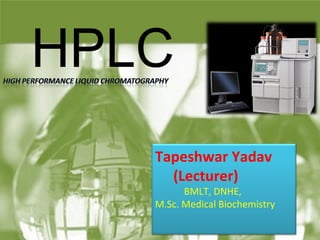
HPLC
Tapeshwar Yadav
(Lecturer)
BMLT, DNHE,
M.Sc. Medical Biochemistry
H
P
igh
erformance
L iquid
C hromatography
H
P
igh
ressure
L iquid
C hromatography
H
P
igh
riced
L iquid
C hromatography
INTRODUCTION
•HPLC stands for “High-performance liquid
chromatography”(sometimes referred to as
High-pressure liquid chromatography).
•High performance liquid chromatography is a
powerful tool in analysis, it yields high
performance and high speed compared to
traditional columns chromatography because of
the forcibly pumped mobile phase.
•It is used in biochemistry and analytical
chemistry to identify, quantify and purify the
individual components of a mixture.
CONTD…
•HPLC is a chromatographic technique that can
separate a mixture of compounds
•In HPLC, the stationary phase is composed of
uniform, ultrafine particles which greatly
increase it’s adsorptive area.
•This stationary phase is packed firmly into a
column.
•This techniques explained above are slow and
time consuming.
CONTD…
•So, the separation can be greatly improved
by applying high pressure in the range of
5,000 – 10,000 psi.
•HPLC requires non-compressible resin
materials and strong metal column generally
made of stainless steel and are manufactured
in such a way that the can withstand pressure
up to 8,000 psi.
•The HPLC is achieved by a considerable
increase in column efficiency.
CONTD…
•The HPLC is achieved by a considerable
increase in column efficiency.
•It is achieved by using packing materials of
small particle size i.e 5-20µm.
•The small size particles create considerable
resistance to flow of mobile phase.
•This resistance is overcome by using high
pressures to pump the solvent through the
column.
PRINCIPLE:
The principle of separation in normal
phase mode and reverse phase mode is
adsorption. When a mixture of components are
introduced into a HPLC column, they travel
according to their relative affinities towards the
stationary phase. The component which has
more affinity towards the adsorbent, travels
slower. The component which has less affinity
towards the stationary phase travels faster.
Since no 2 components have the same affinity
towards the stationary phase, the components
are separated.
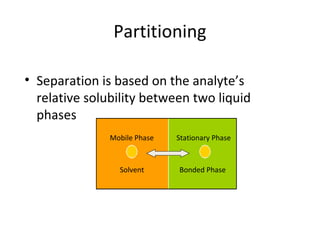
Partitioning
• Separation is based on the analyte’s
relative solubility between two liquid
phases
Stationary PhaseMobile Phase
Solvent Bonded Phase
HPLC - Modes
• Normal Phase.
- Polar stationary phase and non-polar
solvent.
• Reverse Phase.
- Non-polar stationary phase and a
polar solvent.
INSTRUMENTATION
INSTRUMENTATON:
1. Solvent delivery system
2. Pumps
3. Sample injection system
4. Column
5. Detectors
6. Recorders and Integrators
INSTRUMENTATON:
1.Solvent delivery system: The solvents or mobile phases used
must be passed through the column .
2.Pumps: High pressure pump to push the mobile phase
through the column.
3.Sample injection system: a device to inject the sample in to
mobile phase.
4.Column: In which the separation will takes place.
5.Detectors: Used for detecting the conc. Of the sample
components as they come out the column.
6.Recorders and Integrators: A potentiometric recorder to
produce a chromatogram.
Electrochemical Detectors:
• The detector can detect the individual molecules that elute
from the column and convert the data into an electrical signal
• A detector serves to measure the amount of those molecules
• The detector provides an output to a recorder or computer
that results in the liquid chromatogram
• Detector is selected based on the analyte or the sample under
detection
DETECTORS:
Detectors used depends upon the property of the
compounds to be separated. Different detectors available are:
1. Refractive index detectors
2. U.V detectors
3. Fluorescence detectors
4. Electro chemical detectors
5. Evaporative light scattering detectors
6. IR detectors
7. Photo diode array detector
1. Ultraviolet (UV)
•This type of detector responds to substances that
absorb light.
•The UV detector is mainly to separate and
identify the principal active components of a
mixture.
•UV detectors are the most versatile, having the
best sensitivity and linearity.
•UV detectors cannot be used for testing
substances that are low in chromophores
(colorless or virtually colorless) as they cannot
absorb light at low range.
•They are cost-effective and popular and are
widely used in industry
2. Refractive Index (RI) Detection
The refractive index (RI) detector uses a monochromator and is one of
the least sensitive LC detectors.
•This detector is extremely useful for detecting those compounds that
are non-ionic, do not absorb ultraviolet light and do not fluoresce.
•e.g. sugar, alcohol, fatty acid and polymers.
3. Fluorescence
•This is a specific detector that senses only those substances that emit
light. This detector is popular for trace analysis in environmental
science.
•As it is very sensitive, its response is only linear over a relatively
limited concentration range. As there are not many elements that
fluoresce , samples must be syntesized to make them detectable.
4. Mass Spectrometry
•The mass spectrometry detector coupled with HPLC is called
HPLC-MS. HPLC-MS is the most powerful detector, widely used
in pharmaceutical laboratories and research and development.
•The principal benefit of HPLC-MS is that it is capable of
analyzing and providing molecular identity of a wide range of
components.
5. Electro chemical detectors:
•Based on amperometric response of
analyte to electrode usually held at
constant potential.
•If the analyte is electro active, can be
highly sensitive since response is based
on a surface phenomenon rather than a
solution bulk property (e.g. UV-vis
absorbance)
•simplicity, convenience and wide-
spreading application
• Thin-layer flow cell of Teflon : 50μm
thick, 1 ~ 5 μL volume
• Indictor E: Pt, Au, C
• Multi-electrode:simultaneous
detection or sample purity indication.
6. Evaporative light scattering
detectors:
• Responds to any analyte that is
significantly less volatile than
the mobile phase.
• Eluate is mixed with N2(g) and
forms a fine mist.
• Solvent (m.p.) evaporates
leaving fine particles of analyte.
The particles themselves are
detected by light scattering.
• Response is proportional to
analyte mass.
7. IR detectors:
• filter instrument or FTIR
• Similar cell (V, 1.5 ~ 10 μL and b, 0.2 ~ 1.0mm)
• Limit: no suitable solvent, special optics
• FT-IR allows for spectrum records of flowing systems analogous
to the diode array system.
• Water/alcohols can be major interferences to solute detection
• LOD 100 ng
8. Photo diode array detector:
This is a recent one which is similar to U.V detector
which operates from 190-600 nm. Allows for the
recording of the entire spectrum of each solute as it passed
through the diode array detector. The resulting spectra is a
3-D or three dimensional plot of Response Vs Time Vs
Wave length.
Photo diode array detector
APPLICATIONS OF HPLC:
 HPLC has been successfully applied to the
separation of
o Proteins
oNucleic acid
oPolysaccharides
oPlant pigments
oAmino acids
oPesticides
oSteroids
oDrugs and their metabolites
oAnimal and plant hormones and
oComplex lipids.
APPLICATIONS OF HPLC:
i. Distinguish betn
toxic inorganic species and non-toxic
organic species of arsenic in body fluid.
ii. Rapid separation and quantification of the four
bilirubin fraction.
iii. Measurement of urinary and plasma catecholamines.
iv. Diagnosis and differentiation of various
hemoglobinopathies.
v. Quantitative determination of cortisol in serum and
urine.
CONTd…
vi. Measure the cytokines, their receptors, antibodies or
genes.
vii. Quantification of large variety of drugs and their
metabolites.
viii.Detection of fructosamin.
ix. Determination of HbA1C.
x. For measurement of Isoenzymes.
CONTd…
xi. Separation and purification of oligonucleotides.
xii. For detection of urine and fecal porphyrins.
xiii.Measurement of plasma free metanephrins.
xiv.Measurement of
o Vit-A,
o Serotonin,
o Thiamine,
o Thyroxin and
o Uric acid etc.
ADVANTAGES OF HPLC:
1. Separations fast and efficient (high resolution power)
2. Continuous monitoring of the column effluent
3. It can be applied to the separation and analysis of very complex
mixtures
4. Accurate quantitative measurements.
5. Repetitive and reproducible analysis using the same column.
6. Adsorption, partition, ion exchange and exclusion column
separations are excellently made.
8. Both aqueous and non aqueous samples can be analyzed with
little or no sample pre treatment.
9. HPLC is more versatile than GLC in some respects, because it
has the advantage of not being restricted to volatile and thermally
stable solute and the choice of mobile and stationary phases is
much wider in HPLC
10. A variety of solvents and column packing are available,
providing a high degree of selectivity for specific analyses.
11. It provides a means for determination of multiple components
in a single analysis.
Hplc

Hplc

  • 1.
  • 3.
  • 4.
  • 5.
  • 6.
    INTRODUCTION •HPLC stands for“High-performance liquid chromatography”(sometimes referred to as High-pressure liquid chromatography). •High performance liquid chromatography is a powerful tool in analysis, it yields high performance and high speed compared to traditional columns chromatography because of the forcibly pumped mobile phase. •It is used in biochemistry and analytical chemistry to identify, quantify and purify the individual components of a mixture.
  • 7.
    CONTD… •HPLC is achromatographic technique that can separate a mixture of compounds •In HPLC, the stationary phase is composed of uniform, ultrafine particles which greatly increase it’s adsorptive area. •This stationary phase is packed firmly into a column. •This techniques explained above are slow and time consuming.
  • 8.
    CONTD… •So, the separationcan be greatly improved by applying high pressure in the range of 5,000 – 10,000 psi. •HPLC requires non-compressible resin materials and strong metal column generally made of stainless steel and are manufactured in such a way that the can withstand pressure up to 8,000 psi. •The HPLC is achieved by a considerable increase in column efficiency.
  • 9.
    CONTD… •The HPLC isachieved by a considerable increase in column efficiency. •It is achieved by using packing materials of small particle size i.e 5-20µm. •The small size particles create considerable resistance to flow of mobile phase. •This resistance is overcome by using high pressures to pump the solvent through the column.
  • 10.
    PRINCIPLE: The principle ofseparation in normal phase mode and reverse phase mode is adsorption. When a mixture of components are introduced into a HPLC column, they travel according to their relative affinities towards the stationary phase. The component which has more affinity towards the adsorbent, travels slower. The component which has less affinity towards the stationary phase travels faster. Since no 2 components have the same affinity towards the stationary phase, the components are separated.
  • 11.
    Partitioning • Separation isbased on the analyte’s relative solubility between two liquid phases Stationary PhaseMobile Phase Solvent Bonded Phase
  • 12.
    HPLC - Modes •Normal Phase. - Polar stationary phase and non-polar solvent. • Reverse Phase. - Non-polar stationary phase and a polar solvent.
  • 13.
  • 18.
    INSTRUMENTATON: 1. Solvent deliverysystem 2. Pumps 3. Sample injection system 4. Column 5. Detectors 6. Recorders and Integrators
  • 19.
    INSTRUMENTATON: 1.Solvent delivery system:The solvents or mobile phases used must be passed through the column . 2.Pumps: High pressure pump to push the mobile phase through the column. 3.Sample injection system: a device to inject the sample in to mobile phase. 4.Column: In which the separation will takes place. 5.Detectors: Used for detecting the conc. Of the sample components as they come out the column. 6.Recorders and Integrators: A potentiometric recorder to produce a chromatogram.
  • 20.
    Electrochemical Detectors: • Thedetector can detect the individual molecules that elute from the column and convert the data into an electrical signal • A detector serves to measure the amount of those molecules • The detector provides an output to a recorder or computer that results in the liquid chromatogram • Detector is selected based on the analyte or the sample under detection
  • 21.
    DETECTORS: Detectors used dependsupon the property of the compounds to be separated. Different detectors available are: 1. Refractive index detectors 2. U.V detectors 3. Fluorescence detectors 4. Electro chemical detectors 5. Evaporative light scattering detectors 6. IR detectors 7. Photo diode array detector
  • 22.
    1. Ultraviolet (UV) •Thistype of detector responds to substances that absorb light. •The UV detector is mainly to separate and identify the principal active components of a mixture. •UV detectors are the most versatile, having the best sensitivity and linearity. •UV detectors cannot be used for testing substances that are low in chromophores (colorless or virtually colorless) as they cannot absorb light at low range. •They are cost-effective and popular and are widely used in industry
  • 23.
    2. Refractive Index(RI) Detection The refractive index (RI) detector uses a monochromator and is one of the least sensitive LC detectors. •This detector is extremely useful for detecting those compounds that are non-ionic, do not absorb ultraviolet light and do not fluoresce. •e.g. sugar, alcohol, fatty acid and polymers.
  • 24.
    3. Fluorescence •This isa specific detector that senses only those substances that emit light. This detector is popular for trace analysis in environmental science. •As it is very sensitive, its response is only linear over a relatively limited concentration range. As there are not many elements that fluoresce , samples must be syntesized to make them detectable.
  • 25.
    4. Mass Spectrometry •Themass spectrometry detector coupled with HPLC is called HPLC-MS. HPLC-MS is the most powerful detector, widely used in pharmaceutical laboratories and research and development. •The principal benefit of HPLC-MS is that it is capable of analyzing and providing molecular identity of a wide range of components.
  • 26.
    5. Electro chemicaldetectors: •Based on amperometric response of analyte to electrode usually held at constant potential. •If the analyte is electro active, can be highly sensitive since response is based on a surface phenomenon rather than a solution bulk property (e.g. UV-vis absorbance) •simplicity, convenience and wide- spreading application • Thin-layer flow cell of Teflon : 50μm thick, 1 ~ 5 μL volume • Indictor E: Pt, Au, C • Multi-electrode:simultaneous detection or sample purity indication.
  • 27.
    6. Evaporative lightscattering detectors: • Responds to any analyte that is significantly less volatile than the mobile phase. • Eluate is mixed with N2(g) and forms a fine mist. • Solvent (m.p.) evaporates leaving fine particles of analyte. The particles themselves are detected by light scattering. • Response is proportional to analyte mass.
  • 28.
    7. IR detectors: •filter instrument or FTIR • Similar cell (V, 1.5 ~ 10 μL and b, 0.2 ~ 1.0mm) • Limit: no suitable solvent, special optics • FT-IR allows for spectrum records of flowing systems analogous to the diode array system. • Water/alcohols can be major interferences to solute detection • LOD 100 ng
  • 29.
    8. Photo diodearray detector: This is a recent one which is similar to U.V detector which operates from 190-600 nm. Allows for the recording of the entire spectrum of each solute as it passed through the diode array detector. The resulting spectra is a 3-D or three dimensional plot of Response Vs Time Vs Wave length.
  • 30.
  • 31.
    APPLICATIONS OF HPLC: HPLC has been successfully applied to the separation of o Proteins oNucleic acid oPolysaccharides oPlant pigments oAmino acids oPesticides oSteroids oDrugs and their metabolites oAnimal and plant hormones and oComplex lipids.
  • 32.
    APPLICATIONS OF HPLC: i.Distinguish betn toxic inorganic species and non-toxic organic species of arsenic in body fluid. ii. Rapid separation and quantification of the four bilirubin fraction. iii. Measurement of urinary and plasma catecholamines. iv. Diagnosis and differentiation of various hemoglobinopathies. v. Quantitative determination of cortisol in serum and urine.
  • 33.
    CONTd… vi. Measure thecytokines, their receptors, antibodies or genes. vii. Quantification of large variety of drugs and their metabolites. viii.Detection of fructosamin. ix. Determination of HbA1C. x. For measurement of Isoenzymes.
  • 34.
    CONTd… xi. Separation andpurification of oligonucleotides. xii. For detection of urine and fecal porphyrins. xiii.Measurement of plasma free metanephrins. xiv.Measurement of o Vit-A, o Serotonin, o Thiamine, o Thyroxin and o Uric acid etc.
  • 35.
    ADVANTAGES OF HPLC: 1.Separations fast and efficient (high resolution power) 2. Continuous monitoring of the column effluent 3. It can be applied to the separation and analysis of very complex mixtures 4. Accurate quantitative measurements. 5. Repetitive and reproducible analysis using the same column. 6. Adsorption, partition, ion exchange and exclusion column separations are excellently made.
  • 36.
    8. Both aqueousand non aqueous samples can be analyzed with little or no sample pre treatment. 9. HPLC is more versatile than GLC in some respects, because it has the advantage of not being restricted to volatile and thermally stable solute and the choice of mobile and stationary phases is much wider in HPLC 10. A variety of solvents and column packing are available, providing a high degree of selectivity for specific analyses. 11. It provides a means for determination of multiple components in a single analysis.

Editor's Notes

  • #13 - “Like dissolves like”. In Normal Phase the analyte will be partitioned preferentially in the mobile phase and provide little interaction with the stationary phase. This is not desirable since selective retention on the column will be very hard to control. It can be controlled by modifying the stationary phase, a very time consuming and expensive proposition even if feasible. In Reverse Phase the opposite is true. The analyte will be partitioned preferentially in the stationary phase (“Like dissolves like”). and by simply modifying the mobile phase, by adjusting the polarity, ionic strength or pH, selectivity can be virtually fully controlled.