Physiological Changes in PregnancySandy Warner RNC – OB, MSN
AdaptationsNurses must understand the normal anatomical and physiological changes in pregnancy to recognize any deviation from normal.In addition to physical changes, there are also psychological changes that occur with pregnancy.
Body system alterationsCardiovascular HematologicalRespiratoryGenitourinaryGastrointestinalImmunologicalMusculoskeletalEndocrine
Cardiovascular Cardiovascular adaptation affects all organ systems.Cardiovascular anatomy and physiology changes to accommodate increasing maternal and fetal circulatory needs.
HeartAnatomic changes:Heart is enlarged, displaced upward and rotates to the left. PMI (point of maximal impulse) shifts to 4th	intercostal space and closer to the midclavicular line.
Heart sounds and rate:Audible splitting of S1 and S2; S 3 becomes audible.Benign systolic murmurs are common.Heart rate increases 15-20 beats as pregnancy progresses.
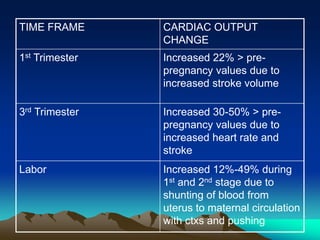
Cardiac OutputDefined as the amount of blood pumped from the left ventricle into the aorta each minute.(heart rate x stroke volume = CO)In pregnancy increased by 40% by 36-38 wks.Influenced by: Blood volumeStroke volumeHeart rate
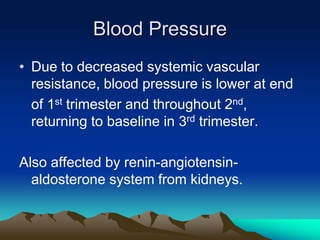
Blood PressureDue to decreased systemic vascular resistance, blood pressure is lower at end	of 1st trimester and throughout 2nd, returning to baseline in 3rd trimester.Also affected by renin-angiotensin-aldosterone system from kidneys.
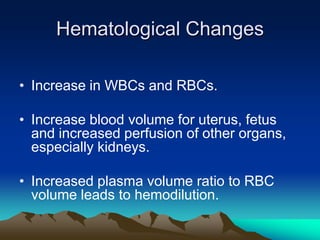
Hematological ChangesIncrease in WBCs and RBCs.Increase blood volume for uterus, fetus and increased perfusion of other organs, especially kidneys.Increased plasma volume ratio to RBC volume leads to hemodilution.
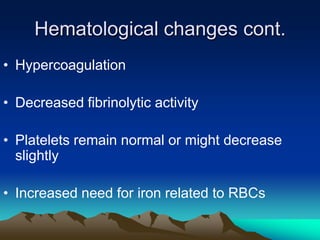
Hematological changes cont.HypercoagulationDecreased fibrinolytic activityPlatelets remain normal or might decrease slightlyIncreased need for iron related to RBCs
RespiratoryAnatomic changes:Diaphragm elevationChest expansionCapillary dilation early in pregnancy causesEngorgement of entire tract from nares to bronchiVoice changes
RespiratoryPhysiological changes:Increased need for oxygenImproved oxygen deliveryHyperventilationCompensatory respiratory alkalosis
GenitourinaryKidneys – increase in size and GFR.Ureters – dilate and elongate, becoming compressed 	by uterus.Bladder – tone decreases due to progesterone, becomes displaces as uterus grows.
GenitourinaryUrine flow accumulates and slows.Increased renal excretion of BUN, creatinine and glucose.Decreased serum BUN, creatinine and glucose.Decreased tubular reabsorption of glucose.Increased tubular reabsoption of sodium.
GenitourinaryUterus – rises out of pelvis during 1st trimester.Weight increases from 70 gms to 1100 gms.Volume at term averages 5 L but may be as		much as 20 L.Individual cells increase 100 fold in length by term,	allowing for contractions and involution.
GenitourinaryCervix:Increases in mass and fluid content.85% connective tissue and 15% smooth muscle.Ripening occurs via softening and effacement with the influence of hormones.
GastrointestinalMouth – changes in tastes, increase in saliva production, gums swell and bleed easier.Esophagus – decreased tone leads to reflux.Stomach – decreased tone and motility.Intestines – smooth muscle relaxation anddecreased tone and motility - constipation
GastrointestinalEsophagus, stomach and intestines move 	as uterus grows.Round ligament stretches as uterus 	expands.Gallbladder –decrease tone and motility	combined with increased emptying time can	cause increased risk of gallstones.
GastrointestinalHyperemesis – common in first trimester.Strong sense of smell.Increased saliva production.Can persist throughout pregnancy.
ImmunologicalPlacenta functions to help protect the fetus from infection with IgG.Decreased Tcell activity with pregnancy that increases susceptibility to viral infections.Immunity is enhanced by sleep/rest and decreased stress.
MusculoskeletalAbdominal muscles relax and pelvis tilts forward.Center of gravity shifts.Joints relax – waddling.Muscle aches from increasing weight of uterus.Posture change due to lumbodorsal curve of spine.
MusculoskeletalNormal weight gain 25-35#.Slight weight loss in 1st trimester from	nausea and vomiting.Average 1#/wk weight gain in 2nd and 3rd trimesters.
EndocrineThyroid:Function increases to meet metabolic and growth needs.Parathyroid:Helps regulate calcium, phosphorus, Vit. D and magnesium concentration.Increases in pregnancy to help skeletal growth.

H:\Physiological Changes In Pregnancy[2]

  • 1.
    Physiological Changes inPregnancySandy Warner RNC – OB, MSN
  • 2.
    AdaptationsNurses must understandthe normal anatomical and physiological changes in pregnancy to recognize any deviation from normal.In addition to physical changes, there are also psychological changes that occur with pregnancy.
  • 3.
    Body system alterationsCardiovascularHematologicalRespiratoryGenitourinaryGastrointestinalImmunologicalMusculoskeletalEndocrine
  • 4.
    Cardiovascular Cardiovascular adaptationaffects all organ systems.Cardiovascular anatomy and physiology changes to accommodate increasing maternal and fetal circulatory needs.
  • 5.
    HeartAnatomic changes:Heart isenlarged, displaced upward and rotates to the left. PMI (point of maximal impulse) shifts to 4th intercostal space and closer to the midclavicular line.
  • 6.
    Heart sounds andrate:Audible splitting of S1 and S2; S 3 becomes audible.Benign systolic murmurs are common.Heart rate increases 15-20 beats as pregnancy progresses.
  • 7.
    Cardiac OutputDefined asthe amount of blood pumped from the left ventricle into the aorta each minute.(heart rate x stroke volume = CO)In pregnancy increased by 40% by 36-38 wks.Influenced by: Blood volumeStroke volumeHeart rate
  • 9.
    Blood PressureDue todecreased systemic vascular resistance, blood pressure is lower at end of 1st trimester and throughout 2nd, returning to baseline in 3rd trimester.Also affected by renin-angiotensin-aldosterone system from kidneys.
  • 10.
    Hematological ChangesIncrease inWBCs and RBCs.Increase blood volume for uterus, fetus and increased perfusion of other organs, especially kidneys.Increased plasma volume ratio to RBC volume leads to hemodilution.
  • 11.
    Hematological changes cont.HypercoagulationDecreasedfibrinolytic activityPlatelets remain normal or might decrease slightlyIncreased need for iron related to RBCs
  • 12.
    RespiratoryAnatomic changes:Diaphragm elevationChestexpansionCapillary dilation early in pregnancy causesEngorgement of entire tract from nares to bronchiVoice changes
  • 13.
    RespiratoryPhysiological changes:Increased needfor oxygenImproved oxygen deliveryHyperventilationCompensatory respiratory alkalosis
  • 14.
    GenitourinaryKidneys – increasein size and GFR.Ureters – dilate and elongate, becoming compressed by uterus.Bladder – tone decreases due to progesterone, becomes displaces as uterus grows.
  • 15.
    GenitourinaryUrine flow accumulatesand slows.Increased renal excretion of BUN, creatinine and glucose.Decreased serum BUN, creatinine and glucose.Decreased tubular reabsorption of glucose.Increased tubular reabsoption of sodium.
  • 16.
    GenitourinaryUterus – risesout of pelvis during 1st trimester.Weight increases from 70 gms to 1100 gms.Volume at term averages 5 L but may be as much as 20 L.Individual cells increase 100 fold in length by term, allowing for contractions and involution.
  • 17.
    GenitourinaryCervix:Increases in massand fluid content.85% connective tissue and 15% smooth muscle.Ripening occurs via softening and effacement with the influence of hormones.
  • 18.
    GastrointestinalMouth – changesin tastes, increase in saliva production, gums swell and bleed easier.Esophagus – decreased tone leads to reflux.Stomach – decreased tone and motility.Intestines – smooth muscle relaxation anddecreased tone and motility - constipation
  • 19.
    GastrointestinalEsophagus, stomach andintestines move as uterus grows.Round ligament stretches as uterus expands.Gallbladder –decrease tone and motility combined with increased emptying time can cause increased risk of gallstones.
  • 20.
    GastrointestinalHyperemesis – commonin first trimester.Strong sense of smell.Increased saliva production.Can persist throughout pregnancy.
  • 21.
    ImmunologicalPlacenta functions tohelp protect the fetus from infection with IgG.Decreased Tcell activity with pregnancy that increases susceptibility to viral infections.Immunity is enhanced by sleep/rest and decreased stress.
  • 22.
    MusculoskeletalAbdominal muscles relaxand pelvis tilts forward.Center of gravity shifts.Joints relax – waddling.Muscle aches from increasing weight of uterus.Posture change due to lumbodorsal curve of spine.
  • 23.
    MusculoskeletalNormal weight gain25-35#.Slight weight loss in 1st trimester from nausea and vomiting.Average 1#/wk weight gain in 2nd and 3rd trimesters.
  • 24.
    EndocrineThyroid:Function increases tomeet metabolic and growth needs.Parathyroid:Helps regulate calcium, phosphorus, Vit. D and magnesium concentration.Increases in pregnancy to help skeletal growth.