Introduction to OB/GYN
                 Department of OB/GYN, DSMA


  Medvedev M.V., MD, PhD
Contents


Subject of OB/GYN


Organization of OB/GYN service


Short history of OB/GYN


The principles of preconception and antepartum care
Subject


 Obstetrics and Gynaecology (often abbreviated to
  OB/GYN, O&G or Obs & Gynae) are the two surgical
  specialties dealing with the female reproductive
  organs, and as such are often combined to form a
  single medical speciality and postgraduate training
  program. This combined training prepares the
  practicing OB/GYN to be adept at the surgical
  management of the entire scope of clinical pathology
  involving female reproductive organs, and to provide
  care for both pregnant and non-pregnant patients.
Organization

 Examples of subspecialty training available to physicians in the US are:
     Maternal-Fetal Medicine - an obstetrical subspecialty that focuses on the
      medical and surgical management of high-risk pregnancies
     Reproductive Endocrinology and Infertility - gynaecologic subspecialty
      focusing on the medical and surgical evaluation of women with problems related
      to the menstrual cycle and fertility
     Gynaecological Oncology - gynaecologic subspecialty focusing on the
      medical and surgical treatment of women with cancers of the reproductive
      organs
     Urogynaecology and Pelvic Reconstructive Surgery - gynaecologic
      subspecialty focusing on the diagnosis and surgical treatment of women with
      urinary incontinence and prolapse of the pelvic organs. Sometimes referred to
      (incorrectly) by laypersons as "Female Urology"
     Advanced Laparoscopic Surgery
     Family Planning - gynaecologic subspecialty offering training in contraception
      and (sometimes) pregnancy termination (abortion)
     Pediatric and Adolescent Gynaecology
     Menopausal and Geriatric Gynaecology
Organization


 In Ukraine we have 3 years of postgraduate training.
  Some OB/GYN surgeons elect to do further subspecialty
  training in programs known as 'fellowships' after
  completing their residency training, although the majority
  choose to enter private or academic practice as general
  OB/GYNs. Fellowship training in an obstetric or
  gynaecologic subspeciality can range from one to four
  years in duration, and these 'fellowship' programs
  usually have a research component involved with the
  clinical and surgical training.
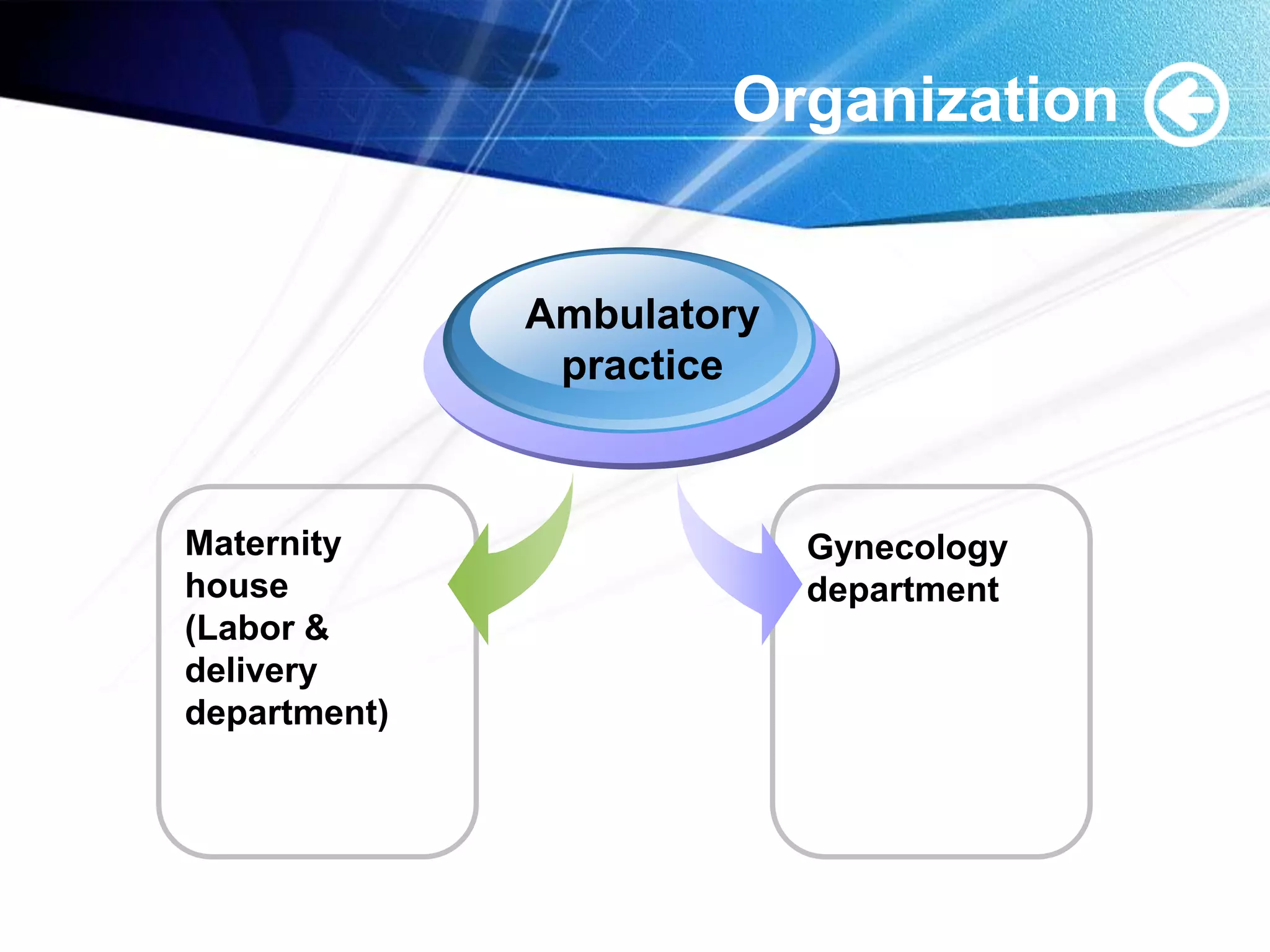
Organization


              Ambulatory
               practice


Maternity                  Gynecology
house                      department
(Labor &
delivery
department)
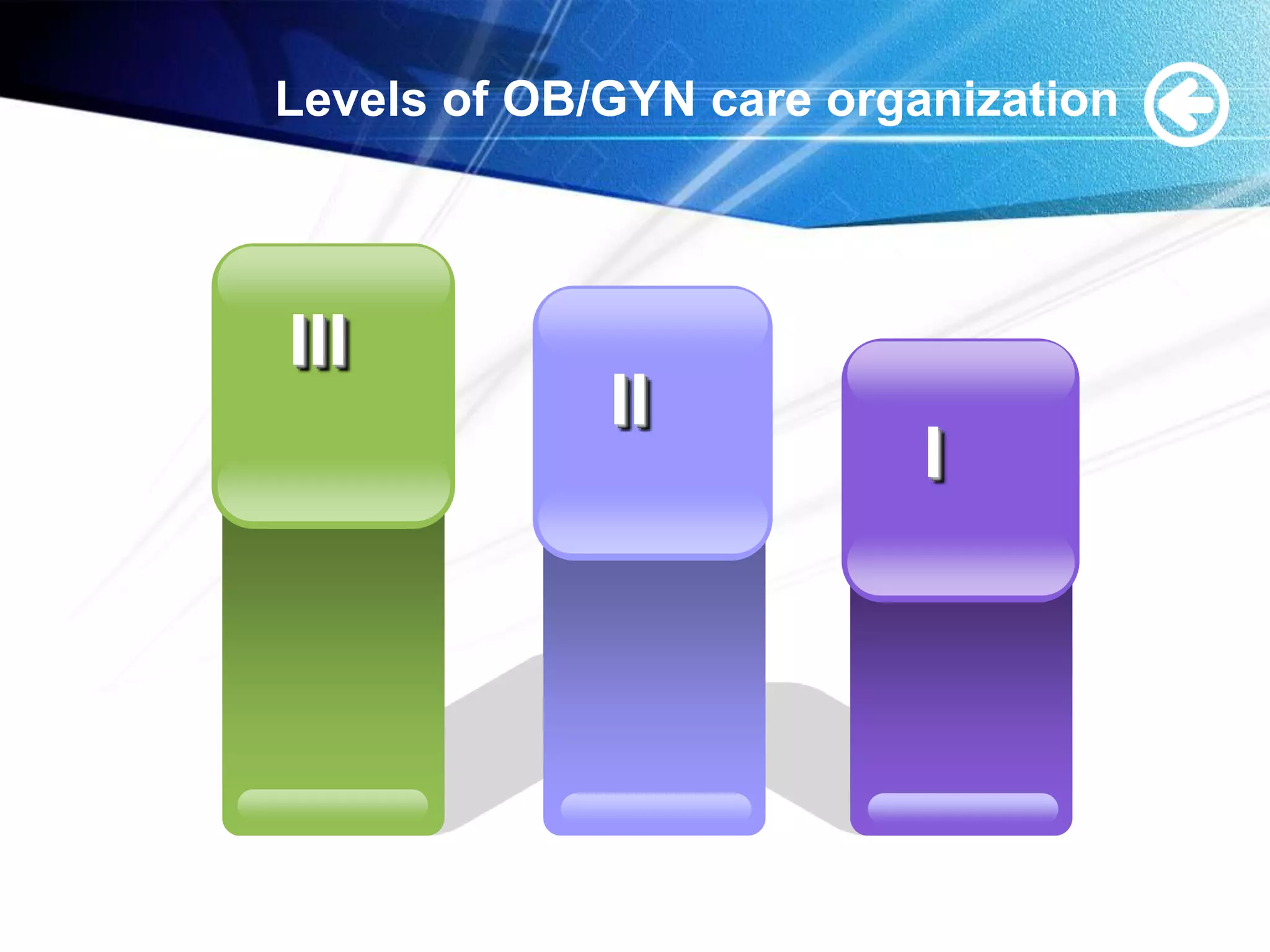
Levels of OB/GYN care organization


III
             II
                          I
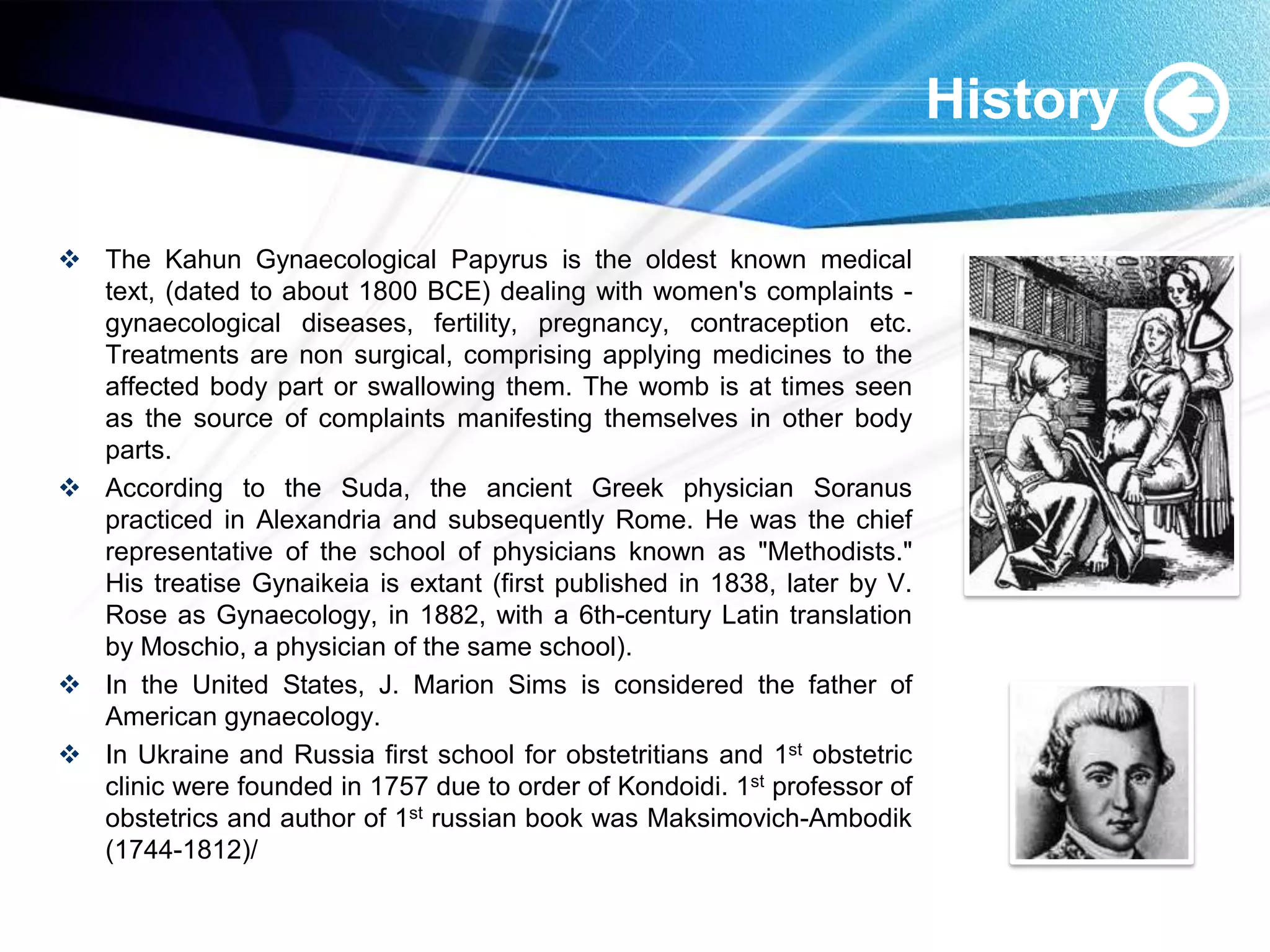
History

 The Kahun Gynaecological Papyrus is the oldest known medical
  text, (dated to about 1800 BCE) dealing with women's complaints -
  gynaecological diseases, fertility, pregnancy, contraception etc.
  Treatments are non surgical, comprising applying medicines to the
  affected body part or swallowing them. The womb is at times seen
  as the source of complaints manifesting themselves in other body
  parts.
 According to the Suda, the ancient Greek physician Soranus
  practiced in Alexandria and subsequently Rome. He was the chief
  representative of the school of physicians known as "Methodists."
  His treatise Gynaikeia is extant (first published in 1838, later by V.
  Rose as Gynaecology, in 1882, with a 6th-century Latin translation
  by Moschio, a physician of the same school).
 In the United States, J. Marion Sims is considered the father of
  American gynaecology.
 In Ukraine and Russia first school for obstetritians and 1st obstetric
  clinic were founded in 1757 due to order of Kondoidi. 1st professor of
  obstetrics and author of 1st russian book was Maksimovich-Ambodik
  (1744-1812)/
PRECONCEPTION COUNSELING
                           AND CARE

   Family planning and pregnancy spacing
   Family history
   Genetic history
   Medical, surgical, psychiatric, and neurologic histories
   Current medications
   Substance use
   Domestic abuse and violence
   Nutrition
   Environmental and occupational exposures
   Immunity and immunization status
   Risk factors for sexually transmitted diseases
   Obstetric and gynecologic history
   Physical examination
   Assessment of socioeconomic, education, and culture context
Patients should be counseled regarding the
          benefits of the following activities:

 Exercise
 Reducing weight before pregnancy, if obese; increasing weight, if
  underweight
 Avoiding food faddism
 Avoiding pregnancy within one month of receiving a live attenuated vaccine
  (e.g., rubella)
 Preventing HIV infection
 Determining the time of conception by an accurate menstrual history
 Abstaining from tobacco, alcohol, and illicit drug use before and during
  pregnancy
 Taking 0.4 mg of folic acid daily while attempting pregnancy and during the
  first trimester of pregnancy
 Maintaining good control of any preexisting medical conditions (e.g., diabetes,
  hypertension, asthma, systemic lupus erythematosus, seizures, thyroid
  disorders, inflammatory bowel disease).
ANTEPARTUM CARE

 Diagnosing pregnancy and determining gestational age
 Monitoring the progress of the pregnancy with periodic
  examinations and appropriate screening tests
 Assessing the well-being of the woman and her fetus
 Providing patient education that addresses all aspects of
  pregnancy
 Preparing the patient and her family for her management
  during labor, delivery, and the postpartum interval.
 Detecting medical and psychosocial complications and
  instituting indicated interventions
Diagnosis of pregnancy

Subjective signs
Physical examination
measure human chorionic gonadotropin (hCG)
Ultrasound examination
Detection of fetal heart
 activity (“fetal heart tones”)
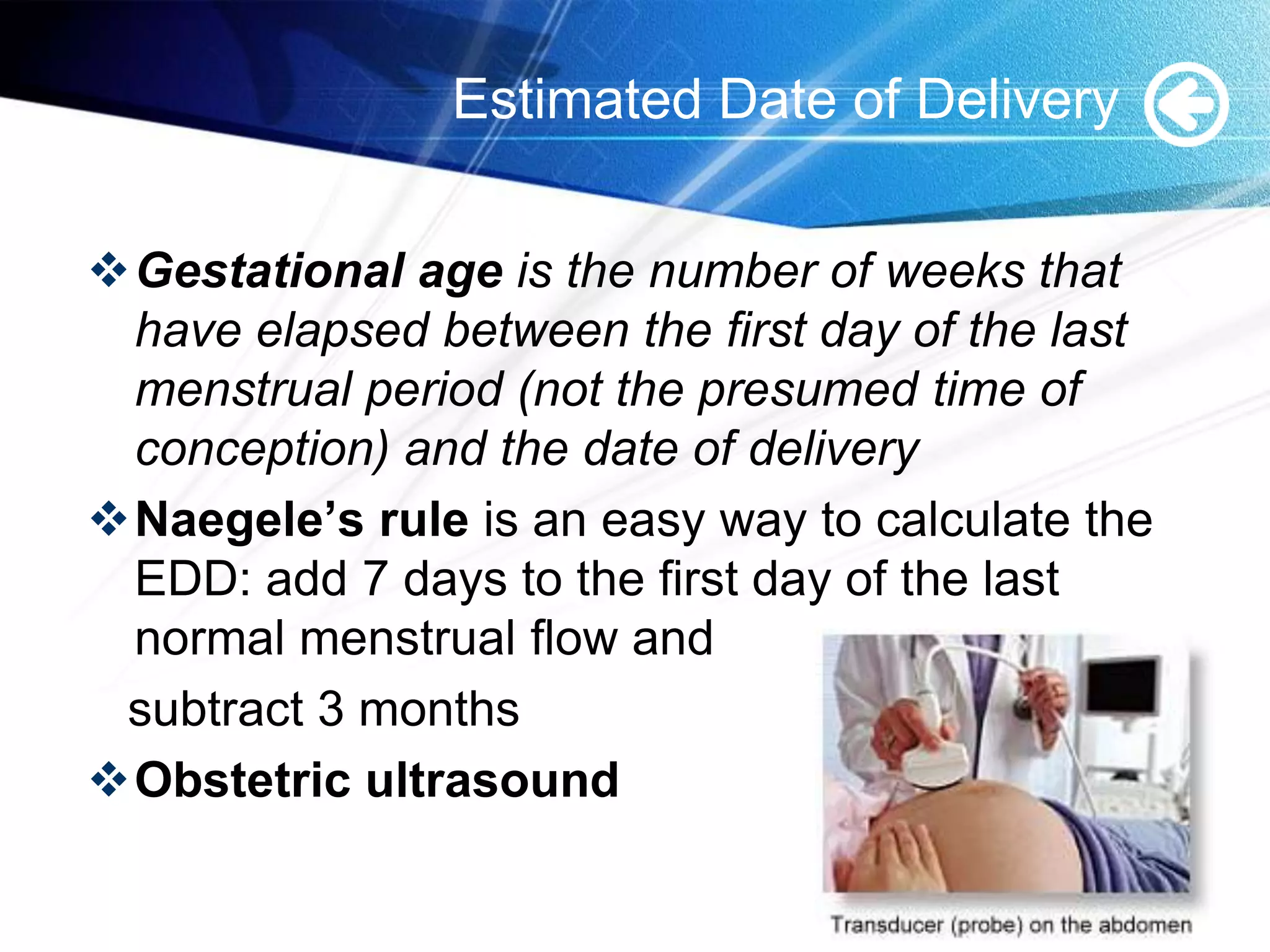
Estimated Date of Delivery

Gestational age is the number of weeks that
 have elapsed between the first day of the last
 menstrual period (not the presumed time of
 conception) and the date of delivery
Naegele’s rule is an easy way to calculate the
 EDD: add 7 days to the first day of the last
 normal menstrual flow and
 subtract 3 months
Obstetric ultrasound
Every prenatal assessment includes
               the following assessments:

Blood pressure
Weight
Urinalysis for albumin and glucose
Fundal height measurement
Fetal heart rate
Additional tests


 First trimester screening (10–13 weeks of gestation),
  which includes serum screening for pregnancy-associated
  plasma protein A (PPA) and beta-hCG, and an ultrasound
  assessment of nuchal transparency.
 Second trimester screening (15–20 weeks of gestation)
  consisting of triple (maternal serum α-fetal protein
  [MSAFP], estriol, and hCG) or quadruple (“quad”)
  (MSAFP, hCG, estriol, and inhibin) screening tests.
 Ultrasound examination for neural tube defects, in the
  second trimester
Additional tests


Glucose challenge test (GCT) and a glucose
 tolerance test (GTT)
Universal screening for group B streptococcus
 (GBS)
Hemoglobin and hematocrit levels is repeated in
 the third trimester
Assessment of Fetal Well-Being

Indications for Fetal Testing
• Antiphospholipid syndrome
• Hyperthyroidism (poorly controlled)
• Hemoglobinopathies (hemoglobin SS, SC, or S-
thalassemia)
• Significant heart disease
• Systemic lupus erythematosus
• Chronic renal disease
• Insulin-treated diabetes mellitus
• Hypertensive disorders
Assessment of Fetal Well-Being

 Pregnancy-related conditions:
• Pregnancy-induced hypertension
• Decreased fetal movement
• Oligohydramnios
• Polyhydramnios
• Intrauterine growth restriction
• Postterm pregnancy
• Isoimmunization (moderate to severe)
• Previous fetal demise
• Multiple gestation (with significant growth discrepancy)
Assessment of Fetal Well-Being

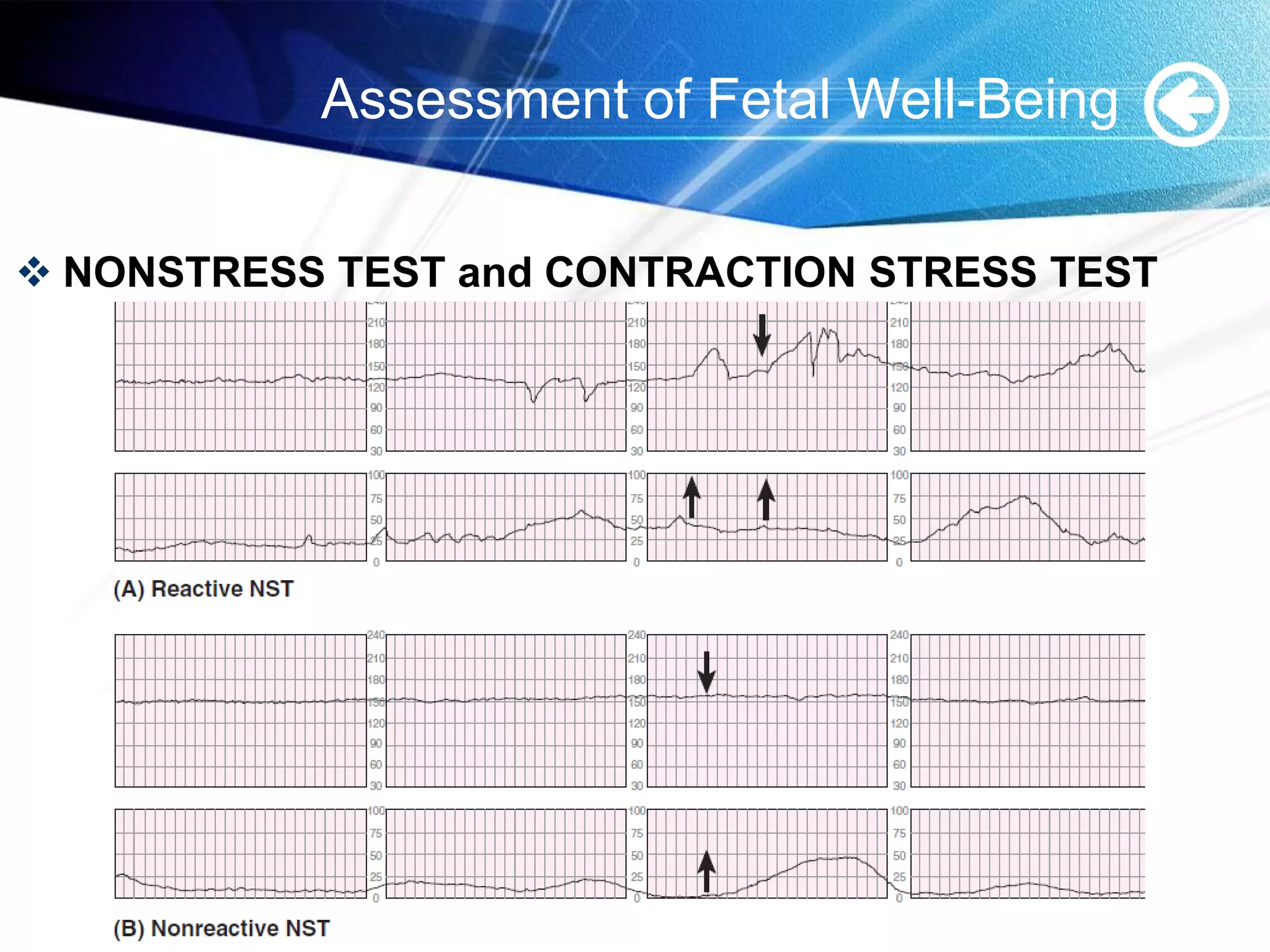
 NONSTRESS TEST and CONTRACTION STRESS TEST
BIOPHYSICAL PROFILE
DOPPLER ULTRASOUND OF
      UMBILICAL ARTERY
1. Introduction to obstetrics

1. Introduction to obstetrics

  • 1.
    Introduction to OB/GYN Department of OB/GYN, DSMA Medvedev M.V., MD, PhD
  • 2.
    Contents Subject of OB/GYN Organizationof OB/GYN service Short history of OB/GYN The principles of preconception and antepartum care
  • 3.
    Subject  Obstetrics andGynaecology (often abbreviated to OB/GYN, O&G or Obs & Gynae) are the two surgical specialties dealing with the female reproductive organs, and as such are often combined to form a single medical speciality and postgraduate training program. This combined training prepares the practicing OB/GYN to be adept at the surgical management of the entire scope of clinical pathology involving female reproductive organs, and to provide care for both pregnant and non-pregnant patients.
  • 4.
    Organization  Examples ofsubspecialty training available to physicians in the US are:  Maternal-Fetal Medicine - an obstetrical subspecialty that focuses on the medical and surgical management of high-risk pregnancies  Reproductive Endocrinology and Infertility - gynaecologic subspecialty focusing on the medical and surgical evaluation of women with problems related to the menstrual cycle and fertility  Gynaecological Oncology - gynaecologic subspecialty focusing on the medical and surgical treatment of women with cancers of the reproductive organs  Urogynaecology and Pelvic Reconstructive Surgery - gynaecologic subspecialty focusing on the diagnosis and surgical treatment of women with urinary incontinence and prolapse of the pelvic organs. Sometimes referred to (incorrectly) by laypersons as "Female Urology"  Advanced Laparoscopic Surgery  Family Planning - gynaecologic subspecialty offering training in contraception and (sometimes) pregnancy termination (abortion)  Pediatric and Adolescent Gynaecology  Menopausal and Geriatric Gynaecology
  • 5.
    Organization  In Ukrainewe have 3 years of postgraduate training. Some OB/GYN surgeons elect to do further subspecialty training in programs known as 'fellowships' after completing their residency training, although the majority choose to enter private or academic practice as general OB/GYNs. Fellowship training in an obstetric or gynaecologic subspeciality can range from one to four years in duration, and these 'fellowship' programs usually have a research component involved with the clinical and surgical training.
  • 6.
    Organization Ambulatory practice Maternity Gynecology house department (Labor & delivery department)
  • 7.
    Levels of OB/GYNcare organization III II I
  • 8.
    History  The KahunGynaecological Papyrus is the oldest known medical text, (dated to about 1800 BCE) dealing with women's complaints - gynaecological diseases, fertility, pregnancy, contraception etc. Treatments are non surgical, comprising applying medicines to the affected body part or swallowing them. The womb is at times seen as the source of complaints manifesting themselves in other body parts.  According to the Suda, the ancient Greek physician Soranus practiced in Alexandria and subsequently Rome. He was the chief representative of the school of physicians known as "Methodists." His treatise Gynaikeia is extant (first published in 1838, later by V. Rose as Gynaecology, in 1882, with a 6th-century Latin translation by Moschio, a physician of the same school).  In the United States, J. Marion Sims is considered the father of American gynaecology.  In Ukraine and Russia first school for obstetritians and 1st obstetric clinic were founded in 1757 due to order of Kondoidi. 1st professor of obstetrics and author of 1st russian book was Maksimovich-Ambodik (1744-1812)/
  • 9.
    PRECONCEPTION COUNSELING AND CARE  Family planning and pregnancy spacing  Family history  Genetic history  Medical, surgical, psychiatric, and neurologic histories  Current medications  Substance use  Domestic abuse and violence  Nutrition  Environmental and occupational exposures  Immunity and immunization status  Risk factors for sexually transmitted diseases  Obstetric and gynecologic history  Physical examination  Assessment of socioeconomic, education, and culture context
  • 10.
    Patients should becounseled regarding the benefits of the following activities:  Exercise  Reducing weight before pregnancy, if obese; increasing weight, if underweight  Avoiding food faddism  Avoiding pregnancy within one month of receiving a live attenuated vaccine (e.g., rubella)  Preventing HIV infection  Determining the time of conception by an accurate menstrual history  Abstaining from tobacco, alcohol, and illicit drug use before and during pregnancy  Taking 0.4 mg of folic acid daily while attempting pregnancy and during the first trimester of pregnancy  Maintaining good control of any preexisting medical conditions (e.g., diabetes, hypertension, asthma, systemic lupus erythematosus, seizures, thyroid disorders, inflammatory bowel disease).
  • 11.
    ANTEPARTUM CARE  Diagnosingpregnancy and determining gestational age  Monitoring the progress of the pregnancy with periodic examinations and appropriate screening tests  Assessing the well-being of the woman and her fetus  Providing patient education that addresses all aspects of pregnancy  Preparing the patient and her family for her management during labor, delivery, and the postpartum interval.  Detecting medical and psychosocial complications and instituting indicated interventions
  • 12.
    Diagnosis of pregnancy Subjectivesigns Physical examination measure human chorionic gonadotropin (hCG) Ultrasound examination Detection of fetal heart activity (“fetal heart tones”)
  • 13.
    Estimated Date ofDelivery Gestational age is the number of weeks that have elapsed between the first day of the last menstrual period (not the presumed time of conception) and the date of delivery Naegele’s rule is an easy way to calculate the EDD: add 7 days to the first day of the last normal menstrual flow and subtract 3 months Obstetric ultrasound
  • 14.
    Every prenatal assessmentincludes the following assessments: Blood pressure Weight Urinalysis for albumin and glucose Fundal height measurement Fetal heart rate
  • 15.
    Additional tests  Firsttrimester screening (10–13 weeks of gestation), which includes serum screening for pregnancy-associated plasma protein A (PPA) and beta-hCG, and an ultrasound assessment of nuchal transparency.  Second trimester screening (15–20 weeks of gestation) consisting of triple (maternal serum α-fetal protein [MSAFP], estriol, and hCG) or quadruple (“quad”) (MSAFP, hCG, estriol, and inhibin) screening tests.  Ultrasound examination for neural tube defects, in the second trimester
  • 16.
    Additional tests Glucose challengetest (GCT) and a glucose tolerance test (GTT) Universal screening for group B streptococcus (GBS) Hemoglobin and hematocrit levels is repeated in the third trimester
  • 17.
    Assessment of FetalWell-Being Indications for Fetal Testing • Antiphospholipid syndrome • Hyperthyroidism (poorly controlled) • Hemoglobinopathies (hemoglobin SS, SC, or S- thalassemia) • Significant heart disease • Systemic lupus erythematosus • Chronic renal disease • Insulin-treated diabetes mellitus • Hypertensive disorders
  • 18.
    Assessment of FetalWell-Being  Pregnancy-related conditions: • Pregnancy-induced hypertension • Decreased fetal movement • Oligohydramnios • Polyhydramnios • Intrauterine growth restriction • Postterm pregnancy • Isoimmunization (moderate to severe) • Previous fetal demise • Multiple gestation (with significant growth discrepancy)
  • 19.
    Assessment of FetalWell-Being  NONSTRESS TEST and CONTRACTION STRESS TEST
  • 20.
  • 21.
    DOPPLER ULTRASOUND OF UMBILICAL ARTERY