Hematologic changes of pregnancy


        Berhanu Mohammed
           April 21, 2011
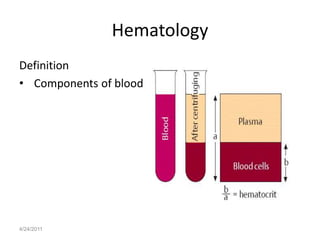
Hematology
Definition
• Components of blood


4/24/2011
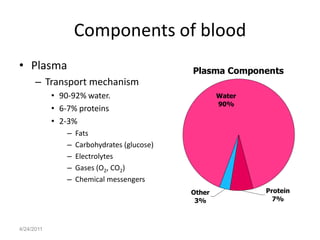
Components of blood
• Plasma                                      Plasma Components
      – Transport mechanism
            • 90-92% water.                           Water
                                                      90%
            • 6-7% proteins
            • 2-3%
                –   Fats
                –   Carbohydrates (glucose)
                –   Electrolytes
                –   Gases (O2, CO2)
                –   Chemical messengers
                                              Other           Protein
                                               3%               7%


4/24/2011
Functions
• responsible for the transport of blood gases from the lung to
  the tissues (oxygen) and from the tissues back to the lungs
  (carbon dioxide).
• White blood cells serve to defend against pathogens and
  foreign bodies(immunity). They perform these tasks most of
  the time outside theblood vessels, in the connective tissues. In
  this case the blood serves solely as a means of transportation
  from the site of cell formation (bonemarrow) to the site of
  action.


4/24/2011
4/24/2011
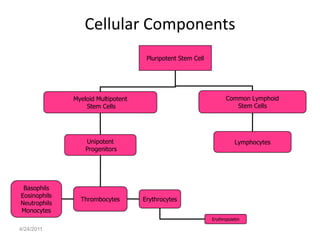
Cellular Components
                                     Pluripotent Stem Cell


              Myeloid Multipotent                                   Common Lymphoid
                  Stem Cells                                           Stem Cells


                  Unipotent                                             Lymphocytes
                  Progenitors


 Basophils
Eosinophils
                Thrombocytes        Erythrocytes
Neutrophils
Monocytes
                                                             Erythropoietin

4/24/2011
Components of blood
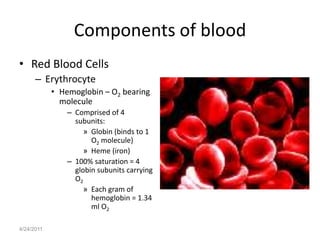
• Red Blood Cells
      – Erythrocyte
            • Hemoglobin – O2 bearing
              molecule
                – Comprised of 4
                  subunits:
                     » Globin (binds to 1
                       O2 molecule)
                     » Heme (iron)
                – 100% saturation = 4
                  globin subunits carrying
                  O2
                     » Each gram of
                       hemoglobin = 1.34
                       ml O2

4/24/2011
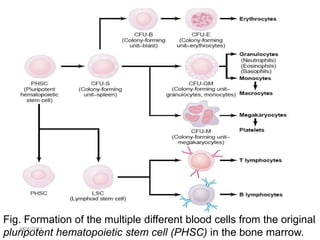
Fig. Formation of the multiple different blood cells from the original
    4/24/2011
pluripotent hematopoietic stem cell (PHSC) in the bone marrow.
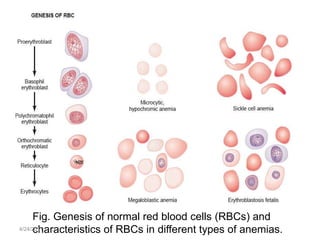
Fig. Genesis of normal red blood cells (RBCs) and
     characteristics of RBCs in different types of anemias.
4/24/2011
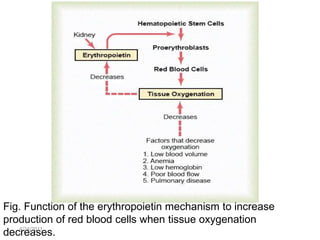
Fig. Function of the erythropoietin mechanism to increase
production of red blood cells when tissue oxygenation
   4/24/2011
decreases.
4/24/2011
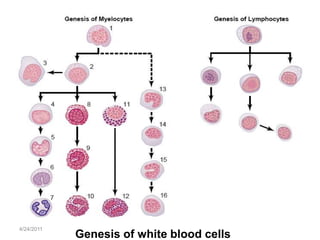
            Genesis of white blood cells
• Platelets (Thrombocytes)
      – Megakaryocytes
            • Thrombopoietin
      – Thrombocytopenia
      – Thrombocytosis


4/24/2011
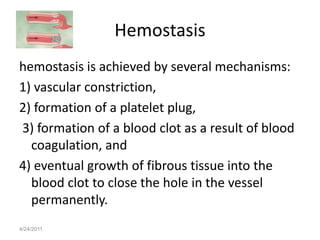
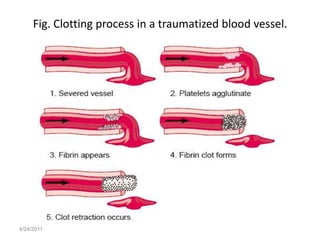
Hemostasis
hemostasis is achieved by several mechanisms:
1) vascular constriction,
2) formation of a platelet plug,
3) formation of a blood clot as a result of blood
  coagulation, and
4) eventual growth of fibrous tissue into the
  blood clot to close the hole in the vessel
  permanently.
4/24/2011
Fig. Clotting process in a traumatized blood vessel.


4/24/2011
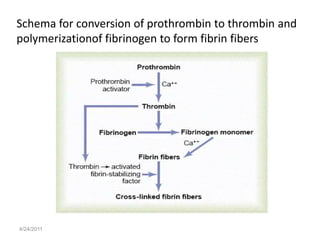
Schema for conversion of prothrombin to thrombin and
polymerizationof fibrinogen to form fibrin fibers


4/24/2011
4/24/2011
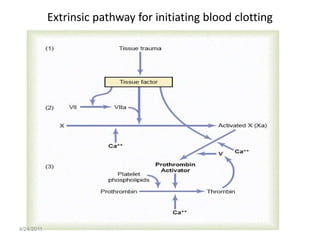
Extrinsic pathway for initiating blood clotting


4/24/2011
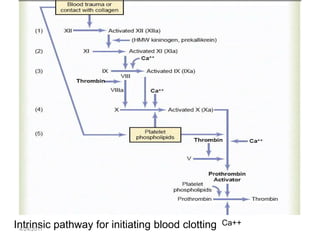
Intrinsic pathway for initiating blood clotting   Ca++
 4/24/2011
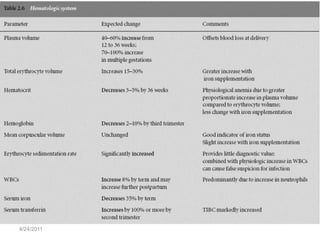
Pregnancy changes
The Most significant changes are:
•    Physiologic anemia
•   Neutrophilia
•   Mild thrombocytopenia
•   Increased procoagulant factors
•   Diminished fibrinolysis


4/24/2011
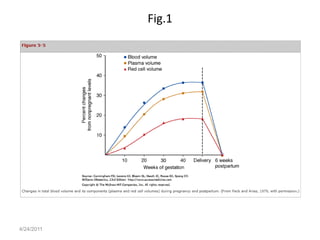
Plasma volume
• Increased by 10 to 15 %
• Total gain at term averages 1100 to 1600ml
Total volume 4700ml to 5200ml ,
i.e. 30 to 50% above non pregnant , Fig.1


4/24/2011
Fig.1


4/24/2011
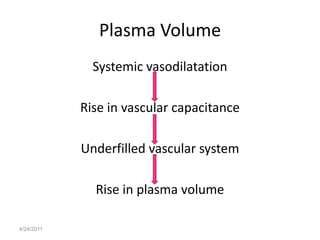
Plasma Volume
              Systemic vasodilatation

            Rise in vascular capacitance

            Underfilled vascular system

              Rise in plasma volume

4/24/2011
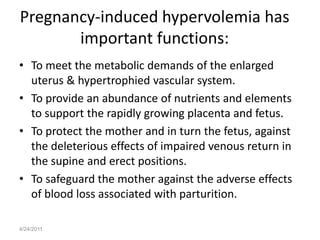
Pregnancy-induced hypervolemia has
       important functions:
• To meet the metabolic demands of the enlarged
  uterus & hypertrophied vascular system.
• To provide an abundance of nutrients and elements
  to support the rapidly growing placenta and fetus.
• To protect the mother and in turn the fetus, against
  the deleterious effects of impaired venous return in
  the supine and erect positions.
• To safeguard the mother against the adverse effects
  of blood loss associated with parturition.

4/24/2011
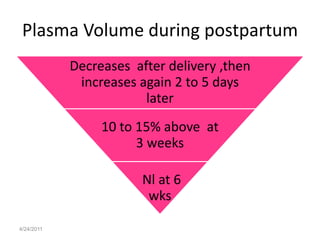
Plasma Volume during postpartum
            Decreases after delivery ,then
             increases again 2 to 5 days
                        later
                 10 to 15% above at
                       3 weeks

                        Nl at 6
                         wks

4/24/2011
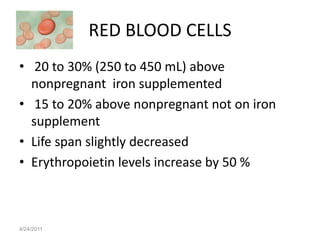
RED BLOOD CELLS
• 20 to 30% (250 to 450 mL) above
  nonpregnant iron supplemented
• 15 to 20% above nonpregnant not on iron
  supplement
• Life span slightly decreased
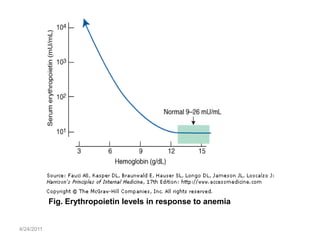
• Erythropoietin levels increase by 50 %


4/24/2011
Fig. Erythropoietin levels in response to anemia


4/24/2011
physiological or dilutional anemia of
                 pregnancy
• Observed in healthy pregnant woman
• Greatest during late 2nd to early 3rd trimester
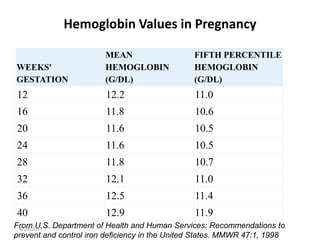
  lowest Hgb at 28 to 36wks
• Nearer to term Hgb increases
• Anemia cut off point: <11 g/dL 1st and 3rd
  trimesters and < 10.5 g/dL 2nd trimester, for
  black Americans 0.8g/dl less


4/24/2011
Hemoglobin Values in Pregnancy

                        MEAN                    FIFTH PERCENTILE
WEEKS'                  HEMOGLOBIN              HEMOGLOBIN
GESTATION               (G/DL)                  (G/DL)
12                      12.2                    11.0
16                      11.8                    10.6
20                      11.6                    10.5
24                      11.6                    10.5
28                      11.8                    10.7
32                      12.1                    11.0
36                      12.5                    11.4
40                      12.9                    11.9
From U.S. Department of Health and Human Services: Recommendations to
 4/24/2011
prevent and control iron deficiency in the United States. MMWR 47:1, 1998
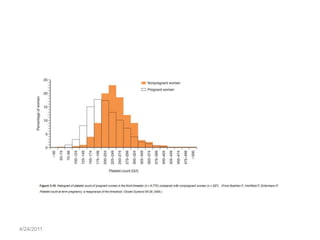
PLATELET COUNT
• Mean PLT slightly lower than healthy non
  pregnant woman
      due to the effects of hemodilution
       increased platelet consumption


4/24/2011
4/24/2011
Thrombocytopenia
• most significant obstetrical consideration concerning platelet
  physiology in pregnancy
• Gestational or incidental thrombocytopenia is characterized :
           mild asymptomatic
          occurring in the third trimester
           without any history
          not associated with maternal, fetal, or neonatal
            sequelae and
           spontaneously resolves postpartum
          Platelet counts are typically >70,000/microL, with
            about two-thirds being 130,000 to 150,000 microL
4/24/2011
WHITE BLOOD CELLS
• 1st trimester, the mean count is 8,000/mm3, Nl (5,110
  to 9,900/mm)
• 2nd & 3rd trimester, the mean is 8,500/mm3, Nl
  (5,600 to 12,200/mm3
• In labor, rise to 20,000 to 30,000/mm3,
• largely due to increases in circulating segmented
  neutrophils and granulocytes
• caused by the elevated estrogen and cortisol levels
• Returns to normal with in 1 to 2 weeks

4/24/2011
Immunologic system
• associated with suppression humoral and cell-
  mediated immunological functions
• involve suppression of T-helper (Th) 1 and T-
  cytotoxic (Tc) 1 cells, which decreases secretion of
  interleukin-2 (IL-2), interferon- , and tumor necrosis
  factor- (TNF-)
• upregulation of Th2 cells to increase secretion of IL-
  4, IL-6, and IL-13.
• In cervical mucus,immunoglobulins A and G (IgA and
  IgG) are significantly higher

4/24/2011
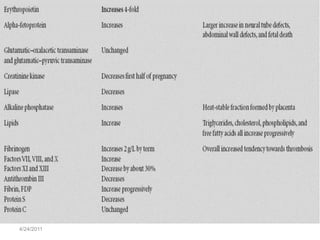
COAGULATION FACTORS AND
                  INHIBITORS
• 5 to 6 fold increased risk for thromboembolic disease
• venous stasis, vessel wall injury, and changes in the
  coagulation cascade
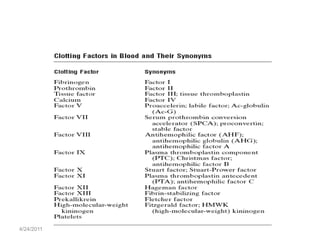
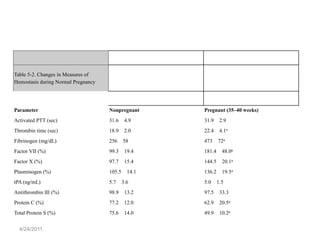
• Fibrinogen, factors II, VII, VIII, X, XII, and XIII increase
  by 20 to 200 percent
• Von Willebrand factor increases
• Antithrombin, protein C, Factor V and Factor IX levels
  remain unchanged or increase slightly
• return to baseline by six to eight weeks after delivery

4/24/2011
Table 5-2. Changes in Measures of
Hemostasis during Normal Pregnancy


Parameter                            Nonpregnant      Pregnant (35–40 weeks)
Activated PTT (sec)                  31.6     4.9     31.9     2.9
Thrombin time (sec)                  18.9     2.0     22.4     4.1a
Fibrinogen (mg/dL)                   256     58       473     72a
Factor VII (%)                       99.3     19.4    181.4     48.0a
Factor X (%)                         97.7     15.4    144.5     20.1a
Plasminogen (%)                      105.5     14.1   136.2     19.5a
tPA (ng/mL)                          5.7     3.6      5.0     1.5
Antithrombin III (%)                 98.9     13.2    97.5     33.3
Protein C (%)                        77.2     12.0    62.9     20.5a
Total Protein S (%)                  75.6     14.0    49.9     10.2a


  4/24/2011
Figure 3-11 The normal components of the coagulation cascade. (From Johnson RL:
    4/24/2011
Thromboembolic disease complicating pregnancy. In Foley MR, Strong TH [eds]:
Key points
 Maternal plasma volume increases 50 percent
  during pregnancy
 RBC volume increases approximately 18 to 30
  percent
hematocrit normally decreases during gestation but
  not below 30 percent
 Pregnancy is a hypercoagulable state
increases in the levels of the
 majority of the procoagulant factors increase and
 fibrinolytic system decreases and in some of the
  natural inhibitors of coagulation
4/24/2011
4/24/2011
4/24/2011
References
• Guyton and Hall ,Text book of medical
  physiology , 11th edition
• Williams Obstetrics,Cunningham, Leveno,
  Bloom, Hauth, Rouse, Spong, 23rd edition
• Obstetrics normal and problem pregnancies,
  Steven G. Gabbe,Jennifer R.Niebyl, Joe leigh
  simpson, 5th Edition
• Up to date , 18.2

4/24/2011
Thank you


4/24/2011
4/24/2011

Hematologic changes of pregnancy

  • 1.
    Hematologic changes ofpregnancy Berhanu Mohammed April 21, 2011
  • 2.
  • 3.
    Components of blood •Plasma Plasma Components – Transport mechanism • 90-92% water. Water 90% • 6-7% proteins • 2-3% – Fats – Carbohydrates (glucose) – Electrolytes – Gases (O2, CO2) – Chemical messengers Other Protein 3% 7% 4/24/2011
  • 4.
    Functions • responsible forthe transport of blood gases from the lung to the tissues (oxygen) and from the tissues back to the lungs (carbon dioxide). • White blood cells serve to defend against pathogens and foreign bodies(immunity). They perform these tasks most of the time outside theblood vessels, in the connective tissues. In this case the blood serves solely as a means of transportation from the site of cell formation (bonemarrow) to the site of action. 4/24/2011
  • 5.
  • 6.
    Cellular Components Pluripotent Stem Cell Myeloid Multipotent Common Lymphoid Stem Cells Stem Cells Unipotent Lymphocytes Progenitors Basophils Eosinophils Thrombocytes Erythrocytes Neutrophils Monocytes Erythropoietin 4/24/2011
  • 7.
    Components of blood •Red Blood Cells – Erythrocyte • Hemoglobin – O2 bearing molecule – Comprised of 4 subunits: » Globin (binds to 1 O2 molecule) » Heme (iron) – 100% saturation = 4 globin subunits carrying O2 » Each gram of hemoglobin = 1.34 ml O2 4/24/2011
  • 8.
    Fig. Formation ofthe multiple different blood cells from the original 4/24/2011 pluripotent hematopoietic stem cell (PHSC) in the bone marrow.
  • 9.
    Fig. Genesis ofnormal red blood cells (RBCs) and characteristics of RBCs in different types of anemias. 4/24/2011
  • 10.
    Fig. Function ofthe erythropoietin mechanism to increase production of red blood cells when tissue oxygenation 4/24/2011 decreases.
  • 11.
    4/24/2011 Genesis of white blood cells
  • 12.
    • Platelets (Thrombocytes) – Megakaryocytes • Thrombopoietin – Thrombocytopenia – Thrombocytosis 4/24/2011
  • 13.
    Hemostasis hemostasis is achievedby several mechanisms: 1) vascular constriction, 2) formation of a platelet plug, 3) formation of a blood clot as a result of blood coagulation, and 4) eventual growth of fibrous tissue into the blood clot to close the hole in the vessel permanently. 4/24/2011
  • 14.
    Fig. Clotting processin a traumatized blood vessel. 4/24/2011
  • 15.
    Schema for conversionof prothrombin to thrombin and polymerizationof fibrinogen to form fibrin fibers 4/24/2011
  • 16.
  • 17.
    Extrinsic pathway forinitiating blood clotting 4/24/2011
  • 18.
    Intrinsic pathway forinitiating blood clotting Ca++ 4/24/2011
  • 19.
    Pregnancy changes The Mostsignificant changes are: • Physiologic anemia • Neutrophilia • Mild thrombocytopenia • Increased procoagulant factors • Diminished fibrinolysis 4/24/2011
  • 20.
    Plasma volume • Increasedby 10 to 15 % • Total gain at term averages 1100 to 1600ml Total volume 4700ml to 5200ml , i.e. 30 to 50% above non pregnant , Fig.1 4/24/2011
  • 21.
  • 22.
    Plasma Volume Systemic vasodilatation Rise in vascular capacitance Underfilled vascular system Rise in plasma volume 4/24/2011
  • 23.
    Pregnancy-induced hypervolemia has important functions: • To meet the metabolic demands of the enlarged uterus & hypertrophied vascular system. • To provide an abundance of nutrients and elements to support the rapidly growing placenta and fetus. • To protect the mother and in turn the fetus, against the deleterious effects of impaired venous return in the supine and erect positions. • To safeguard the mother against the adverse effects of blood loss associated with parturition. 4/24/2011
  • 24.
    Plasma Volume duringpostpartum Decreases after delivery ,then increases again 2 to 5 days later 10 to 15% above at 3 weeks Nl at 6 wks 4/24/2011
  • 25.
    RED BLOOD CELLS •20 to 30% (250 to 450 mL) above nonpregnant iron supplemented • 15 to 20% above nonpregnant not on iron supplement • Life span slightly decreased • Erythropoietin levels increase by 50 % 4/24/2011
  • 26.
    Fig. Erythropoietin levelsin response to anemia 4/24/2011
  • 27.
    physiological or dilutionalanemia of pregnancy • Observed in healthy pregnant woman • Greatest during late 2nd to early 3rd trimester lowest Hgb at 28 to 36wks • Nearer to term Hgb increases • Anemia cut off point: <11 g/dL 1st and 3rd trimesters and < 10.5 g/dL 2nd trimester, for black Americans 0.8g/dl less 4/24/2011
  • 28.
    Hemoglobin Values inPregnancy MEAN FIFTH PERCENTILE WEEKS' HEMOGLOBIN HEMOGLOBIN GESTATION (G/DL) (G/DL) 12 12.2 11.0 16 11.8 10.6 20 11.6 10.5 24 11.6 10.5 28 11.8 10.7 32 12.1 11.0 36 12.5 11.4 40 12.9 11.9 From U.S. Department of Health and Human Services: Recommendations to 4/24/2011 prevent and control iron deficiency in the United States. MMWR 47:1, 1998
  • 29.
    PLATELET COUNT • MeanPLT slightly lower than healthy non pregnant woman due to the effects of hemodilution increased platelet consumption 4/24/2011
  • 30.
  • 31.
    Thrombocytopenia • most significantobstetrical consideration concerning platelet physiology in pregnancy • Gestational or incidental thrombocytopenia is characterized :  mild asymptomatic occurring in the third trimester  without any history not associated with maternal, fetal, or neonatal sequelae and  spontaneously resolves postpartum Platelet counts are typically >70,000/microL, with about two-thirds being 130,000 to 150,000 microL 4/24/2011
  • 32.
    WHITE BLOOD CELLS •1st trimester, the mean count is 8,000/mm3, Nl (5,110 to 9,900/mm) • 2nd & 3rd trimester, the mean is 8,500/mm3, Nl (5,600 to 12,200/mm3 • In labor, rise to 20,000 to 30,000/mm3, • largely due to increases in circulating segmented neutrophils and granulocytes • caused by the elevated estrogen and cortisol levels • Returns to normal with in 1 to 2 weeks 4/24/2011
  • 33.
    Immunologic system • associatedwith suppression humoral and cell- mediated immunological functions • involve suppression of T-helper (Th) 1 and T- cytotoxic (Tc) 1 cells, which decreases secretion of interleukin-2 (IL-2), interferon- , and tumor necrosis factor- (TNF-) • upregulation of Th2 cells to increase secretion of IL- 4, IL-6, and IL-13. • In cervical mucus,immunoglobulins A and G (IgA and IgG) are significantly higher 4/24/2011
  • 34.
    COAGULATION FACTORS AND INHIBITORS • 5 to 6 fold increased risk for thromboembolic disease • venous stasis, vessel wall injury, and changes in the coagulation cascade • Fibrinogen, factors II, VII, VIII, X, XII, and XIII increase by 20 to 200 percent • Von Willebrand factor increases • Antithrombin, protein C, Factor V and Factor IX levels remain unchanged or increase slightly • return to baseline by six to eight weeks after delivery 4/24/2011
  • 35.
    Table 5-2. Changesin Measures of Hemostasis during Normal Pregnancy Parameter Nonpregnant Pregnant (35–40 weeks) Activated PTT (sec) 31.6 4.9 31.9 2.9 Thrombin time (sec) 18.9 2.0 22.4 4.1a Fibrinogen (mg/dL) 256 58 473 72a Factor VII (%) 99.3 19.4 181.4 48.0a Factor X (%) 97.7 15.4 144.5 20.1a Plasminogen (%) 105.5 14.1 136.2 19.5a tPA (ng/mL) 5.7 3.6 5.0 1.5 Antithrombin III (%) 98.9 13.2 97.5 33.3 Protein C (%) 77.2 12.0 62.9 20.5a Total Protein S (%) 75.6 14.0 49.9 10.2a 4/24/2011
  • 36.
    Figure 3-11 Thenormal components of the coagulation cascade. (From Johnson RL: 4/24/2011 Thromboembolic disease complicating pregnancy. In Foley MR, Strong TH [eds]:
  • 37.
    Key points  Maternalplasma volume increases 50 percent during pregnancy  RBC volume increases approximately 18 to 30 percent hematocrit normally decreases during gestation but not below 30 percent  Pregnancy is a hypercoagulable state increases in the levels of the  majority of the procoagulant factors increase and  fibrinolytic system decreases and in some of the natural inhibitors of coagulation 4/24/2011
  • 38.
  • 39.
  • 40.
    References • Guyton andHall ,Text book of medical physiology , 11th edition • Williams Obstetrics,Cunningham, Leveno, Bloom, Hauth, Rouse, Spong, 23rd edition • Obstetrics normal and problem pregnancies, Steven G. Gabbe,Jennifer R.Niebyl, Joe leigh simpson, 5th Edition • Up to date , 18.2 4/24/2011
  • 41.
  • 42.

Editor's Notes

  • #3 Components of BloodRed Blood CellsWhite Blood CellsInflammatory processCoagulationBlood may be viewed as tissue—a sort of fluid transportation tissue, ofwhich the intercellular substance is the blood plasma (plasma). Thecellular components of this tissue are the red (erythrocytes) and white(leukocytes) blood cells and the platelets (thrombocytes (Fig. 6.1a, b).The proportion of the total blood volume occupied by all blood cells inpercent is called the hematocrit (see Fig. 6.3). It averages 45%, and is usuallya little higher in men (47%) than in women (43 %).
  • #5 Functions of the BloodBlood has multiple functions closely connected with its components andwith the vascular system. While a function of the blood vessels is to distributethe blood overall (heat regulation and distribution of substances),the formed and unformed blood components have some very specificfunctions.The red blood cells, for instance, are responsible for the transport ofblood gases from the lung to the tissues (oxygen) and from the tissuesback to the lungs (carbon dioxide).White blood cells serve to defend against pathogens and foreign bodies(immunity). They perform these tasks most of the time outside theblood vessels, in the connective tissues. In this case the blood servessolely as a means of transportation from the site of cell formation (bonemarrow) to the site of action.The fluid portion of the blood, the plasma, subserves several differenttransportation tasks. For instance, it undertakes the transport of nutrients from where they are absorbed (intestinal villi) to where they are utilized (organs), of metabolic products to the excretory organs (kidneys),and of substances acting inside the body to their sites of activity(hormones). Simultaneously, blood transports heat from the metabolicallyactive organs to the surface.Another task of blood is coagulation. When blood vessels are injured,the clotting factors carried in the blood, such as fibrinogen and platelets,are of vital importance. In addition to water, blood plasma contains anumber of salts (electrolytes), proteins (albumins and globulins), lipids(fatty acids and cholesterol), and carbohydrates (blood glucose), andnumerous vitamins, trace elements, and enzymes. Other noteworthyfeatures of blood include its essentially constant composition, relativelyconstant osmotic pressure, and a pH value that varies only within narrowlimits (7.2−7.4) (the so-called “constant internal milieu”).
  • #12 Genesis of white blood cells. The different cells of the myelocyte series are 1, myeloblast; 2, promyelocyte; 3,megakaryocyte; 4, neutrophil myelocyte; 5, young neutrophil metamyelocyte; 6, “band” neutrophil metamyelocyte;7, polymorphonuclear neutrophil; 8, eosinophil myelocyte; 9, eosinophil metamyelocyte; 10, polymorphonuclear eosinophil;11, basophil myelocyte; 12, polymorphonuclear basophil; 13–16, stages of monocyte formation.
  • #14 Whenever a vessel is severed or ruptured, hemostasis is achieved by several mechanisms:1) vascular constriction, (2) formation of a platelet plug, (3) formation of a blood clot as a result of blood coagulation, and (4) eventual growth of fibrous tissue into the blood clot to close the hole in the vessel permanently.