Documentation Donna Adelsperger RN, M. Ed.
Definition of Documentation Defined as written evidence of the interactions between and among health professionals, patients, and their families; the administration of procedures, treatments, and diagnostic tests; the patient’s response to them and education of the family support unit.
Defensive Documentation Major purpose of the medical record is to document the care given to the patient It also is the communication to all members of the health care team Documents and support continuity of care from one professional to the another Also a legal document
Defensive Documentation  The chart is a very persuasive witness because it is the description of the facts at the time There should be no unanswered questions in the patient’s record that plaintiff attorneys can use to construct their version of what happened 3 recommendations:  DOCUMENT -  DOCUMENT  -  DOCUMENT
Defensive Documentation  (Perinatal) (pediatric)_All nurses should know that the inadequately documented medical record can be their worse liability The well-documented medical record can be their greatest legal asset
Defensive Documentation Avoid using empty, meaningless charting phrases such as, “physician notified of patient’s condition” When report given to MD, the nurse can expect that person (MD) to respond in timely fashion.
Defensive Documentation When communicating with a charge nurse or another nurse recognized as a resource documentation of discussion seen as consultation and should be documented. Nurses rarely document this kind of communication Can use chain of command only when there is sufficient time
Documentation- Top Tips Don’t squeeze information into the chart Don’t write between the lines If there is an error, draw a single line through it, date it, initial it
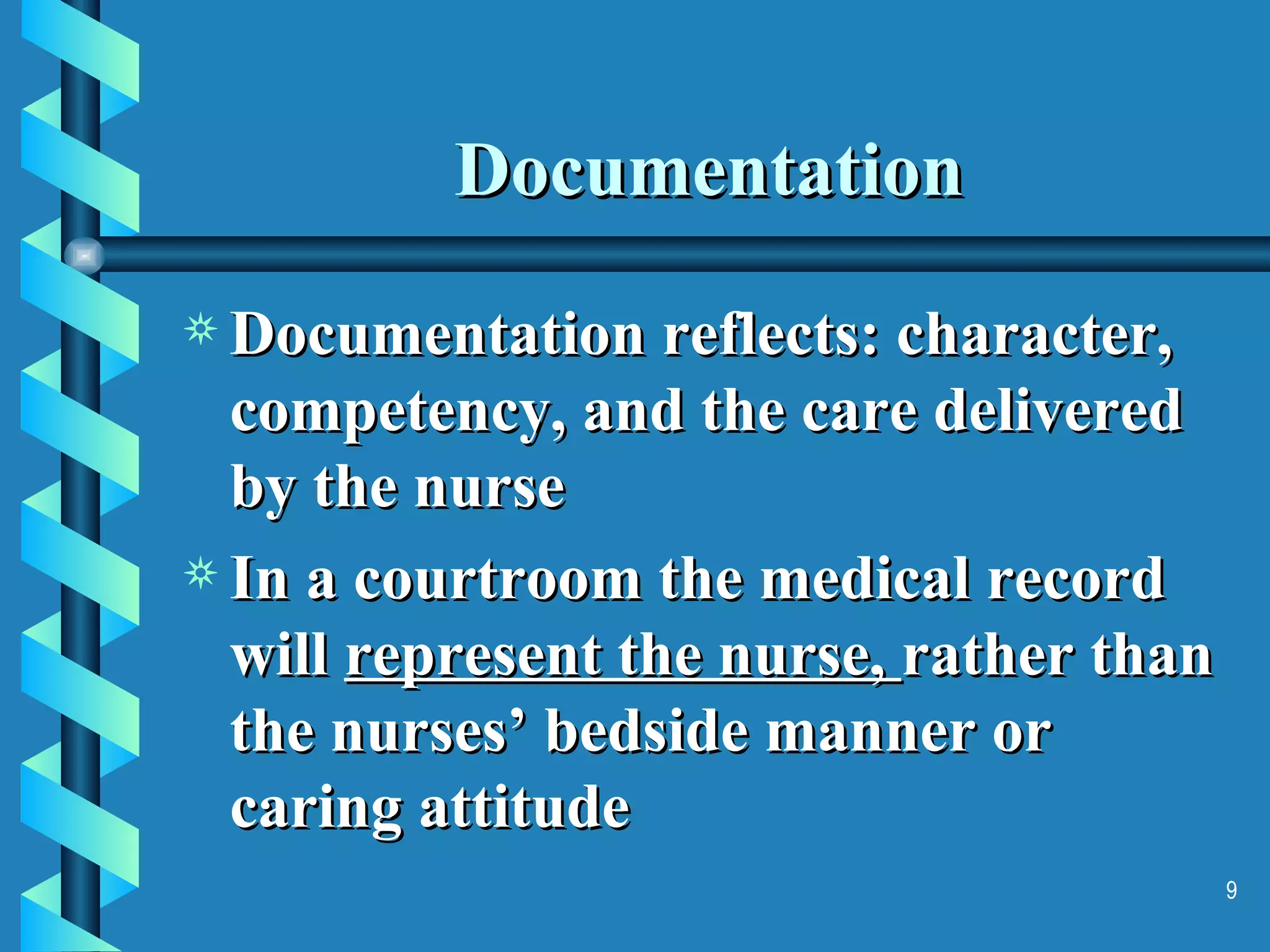
Documentation Documentation reflects: character, competency, and the care delivered by the nurse  In a courtroom the medical record will  represent the nurse,  rather than the nurses’ bedside manner or caring attitude
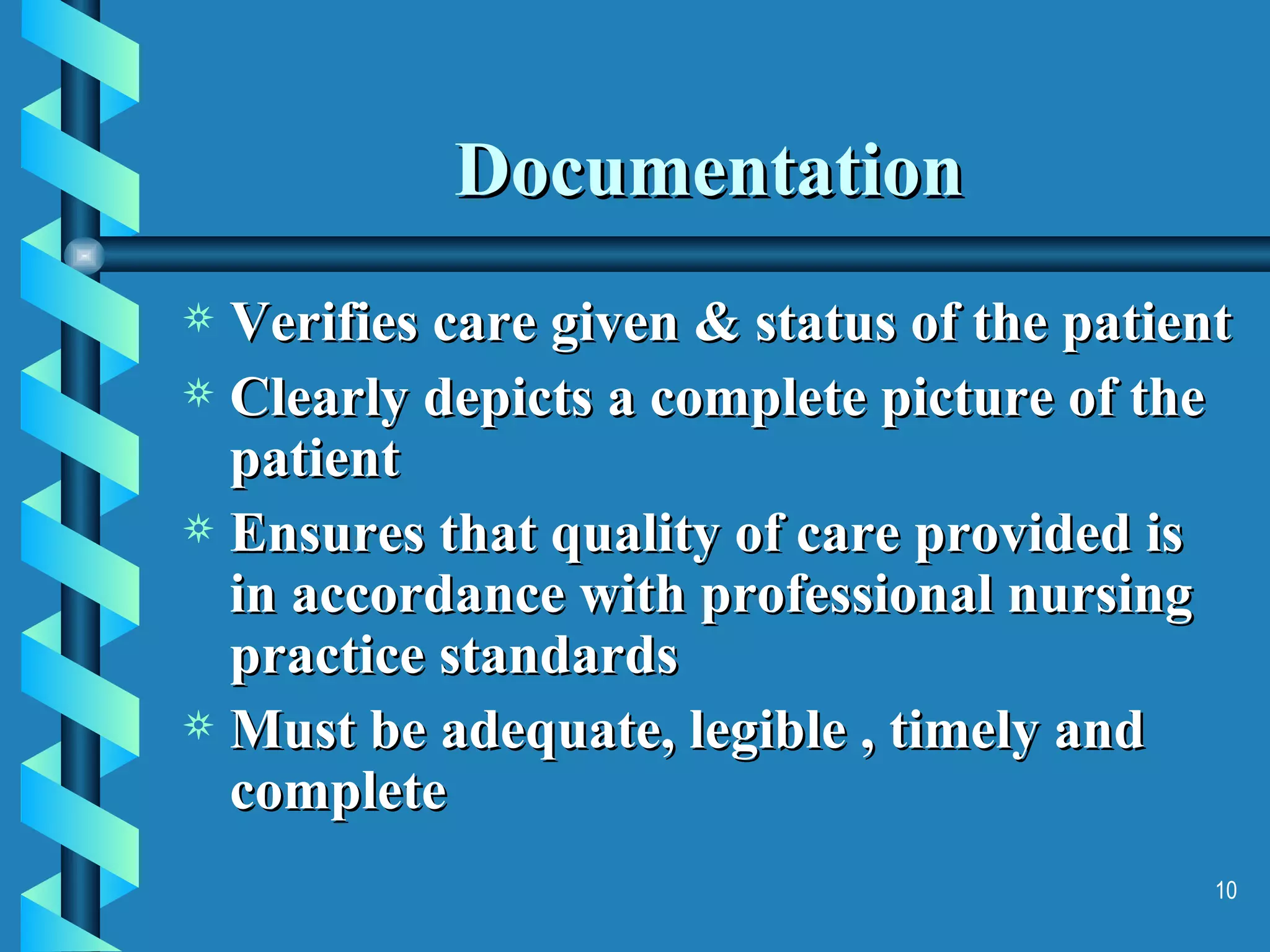
Documentation Verifies care given & status of the patient Clearly depicts a complete picture of the patient Ensures that quality of care provided is in accordance with professional nursing practice standards Must be adequate, legible , timely and complete
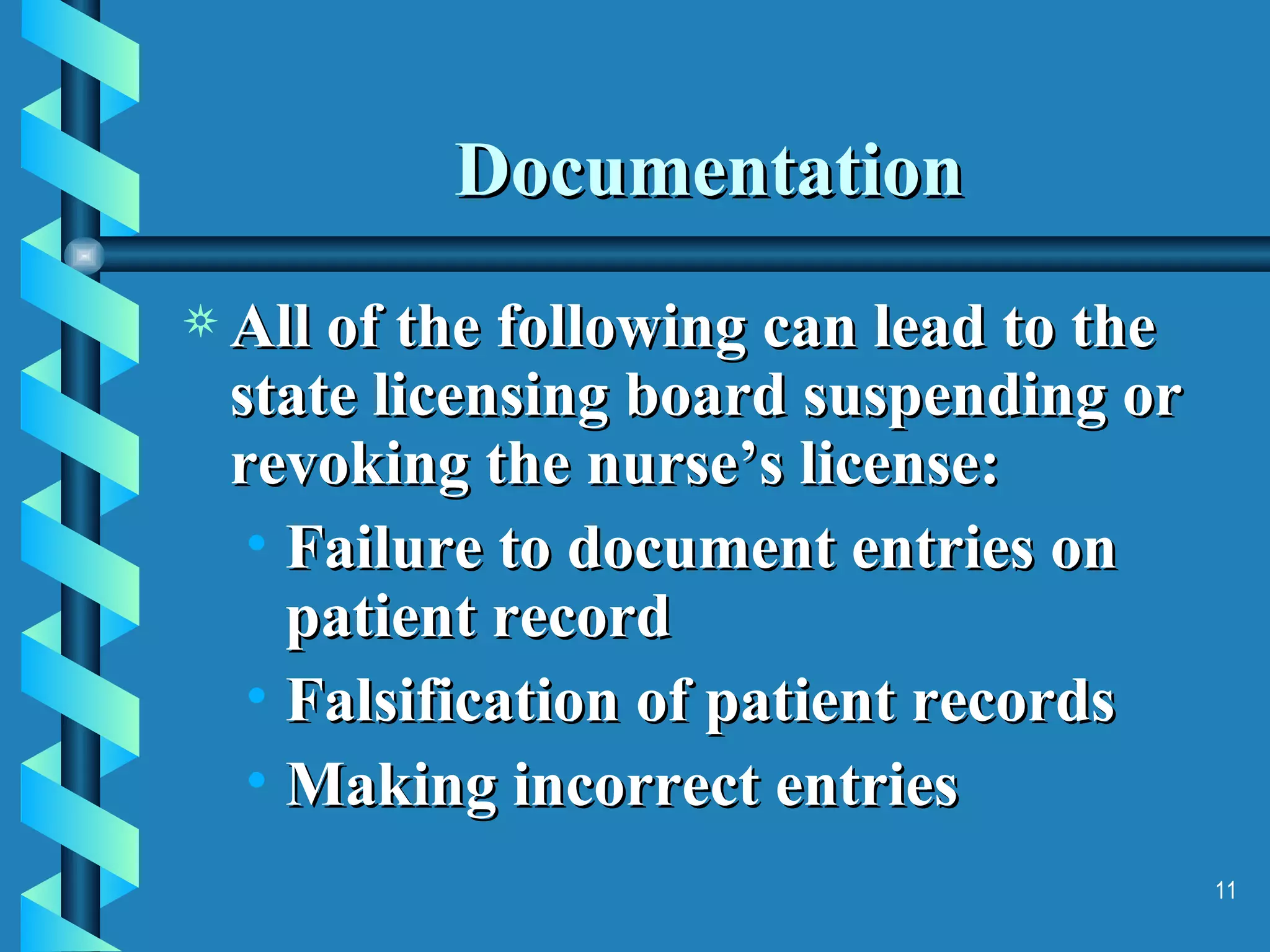
Documentation All of the following can lead to the state licensing board suspending or revoking the nurse’s license: Failure to document entries on patient record Falsification of patient records Making incorrect entries
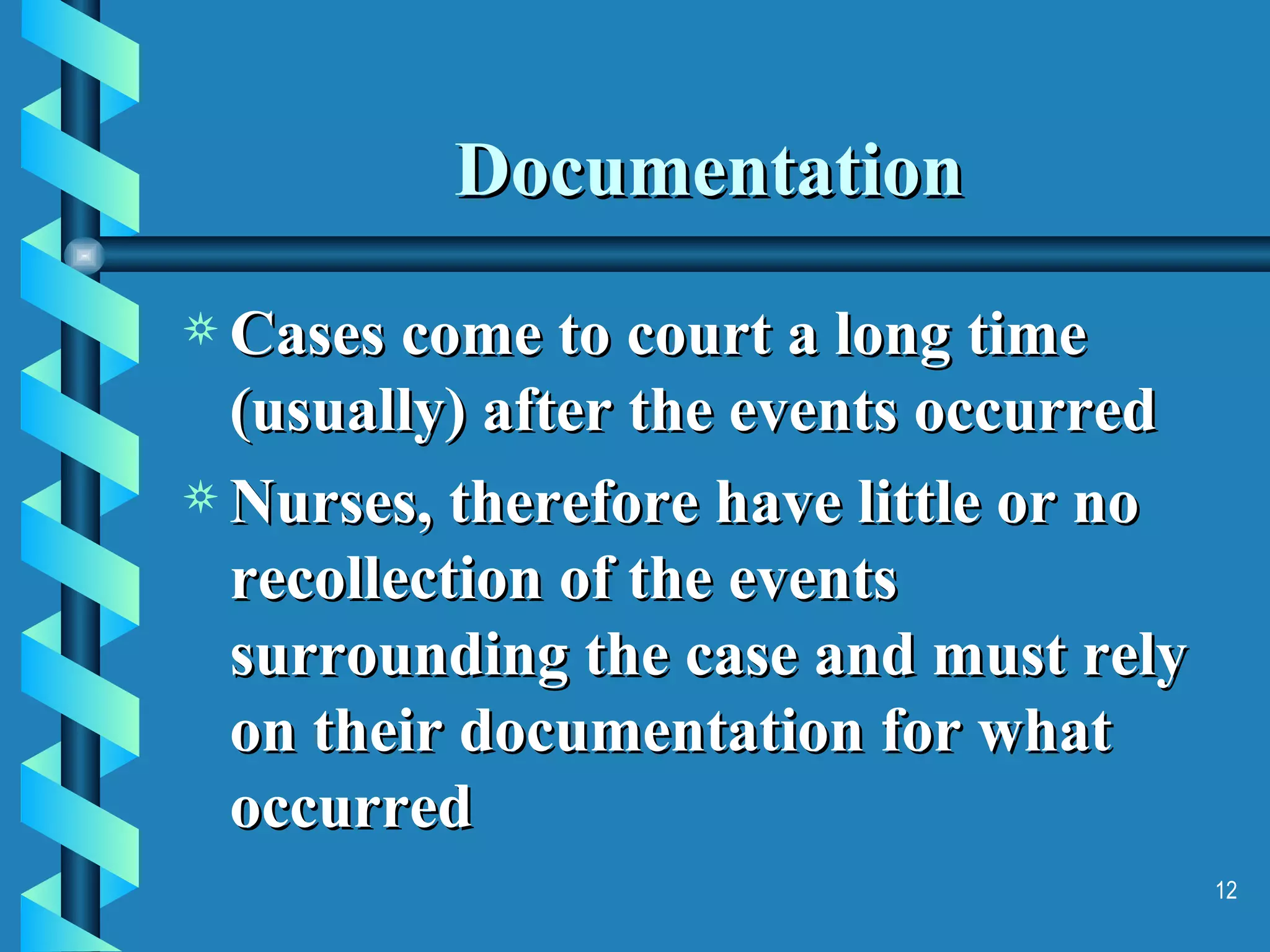
Documentation Cases come to court a long time (usually) after the events occurred Nurses, therefore have little or no recollection of the events surrounding the case and must rely on their documentation for what occurred
The Duty to Document Nurse Practice Acts state the general duty is to “record pertinent information including the response to interventions” While the medical record is “owned” by the institution it is maintained for the benefit of the patient Courts have held that poor documentation creates presumption of poor care
Intensive Documentation Required Sudden decline in patient’s condition Patient injuries/medication errors Equipment failure/incorrect use Failure of provider to respond The “red flag” patient or family Unresolved disagreements in patient care between providers
Factors that Define Quality Documentation Frequency and completeness must follow the established rules of documentation rules come from federal regulations, state statutes, accreditation boards, policies and procedures of the hospital and the standards set by professional organizations The chart must truly reflect that the standard of care for patient was met
Do Document the Following Patient behavior. Document  description  of noncompliant behavior Use quotations when appropriate Document neatly and legibly
Late Entries Add late entries at first available space Document date and time the event occurred Clearly identify the entry as a late one
Documentation Courts have issued a warning to nurses that the availability of accurate medical records is  NOT  a  technicality  but  IS  a  legal requirement According to a Charles Ward, MD, “in a courtroom the finest care rendered under the best circumstances may be difficult or impossible to defend if it is not documented”
Documentation Nurses’ communication skills lay the foundation for the care delivered to the patient Nurses are key members of the health care team Complexity of care is increasing, so complexity of nursing documentation increases Perfecting skill of documentation is just as important as any other skill used in the clinical setting

Documentation

  • 1.
  • 2.
    Definition of DocumentationDefined as written evidence of the interactions between and among health professionals, patients, and their families; the administration of procedures, treatments, and diagnostic tests; the patient’s response to them and education of the family support unit.
  • 3.
    Defensive Documentation Majorpurpose of the medical record is to document the care given to the patient It also is the communication to all members of the health care team Documents and support continuity of care from one professional to the another Also a legal document
  • 4.
    Defensive Documentation The chart is a very persuasive witness because it is the description of the facts at the time There should be no unanswered questions in the patient’s record that plaintiff attorneys can use to construct their version of what happened 3 recommendations: DOCUMENT - DOCUMENT - DOCUMENT
  • 5.
    Defensive Documentation (Perinatal) (pediatric)_All nurses should know that the inadequately documented medical record can be their worse liability The well-documented medical record can be their greatest legal asset
  • 6.
    Defensive Documentation Avoidusing empty, meaningless charting phrases such as, “physician notified of patient’s condition” When report given to MD, the nurse can expect that person (MD) to respond in timely fashion.
  • 7.
    Defensive Documentation Whencommunicating with a charge nurse or another nurse recognized as a resource documentation of discussion seen as consultation and should be documented. Nurses rarely document this kind of communication Can use chain of command only when there is sufficient time
  • 8.
    Documentation- Top TipsDon’t squeeze information into the chart Don’t write between the lines If there is an error, draw a single line through it, date it, initial it
  • 9.
    Documentation Documentation reflects:character, competency, and the care delivered by the nurse In a courtroom the medical record will represent the nurse, rather than the nurses’ bedside manner or caring attitude
  • 10.
    Documentation Verifies caregiven & status of the patient Clearly depicts a complete picture of the patient Ensures that quality of care provided is in accordance with professional nursing practice standards Must be adequate, legible , timely and complete
  • 11.
    Documentation All ofthe following can lead to the state licensing board suspending or revoking the nurse’s license: Failure to document entries on patient record Falsification of patient records Making incorrect entries
  • 12.
    Documentation Cases cometo court a long time (usually) after the events occurred Nurses, therefore have little or no recollection of the events surrounding the case and must rely on their documentation for what occurred
  • 13.
    The Duty toDocument Nurse Practice Acts state the general duty is to “record pertinent information including the response to interventions” While the medical record is “owned” by the institution it is maintained for the benefit of the patient Courts have held that poor documentation creates presumption of poor care
  • 14.
    Intensive Documentation RequiredSudden decline in patient’s condition Patient injuries/medication errors Equipment failure/incorrect use Failure of provider to respond The “red flag” patient or family Unresolved disagreements in patient care between providers
  • 15.
    Factors that DefineQuality Documentation Frequency and completeness must follow the established rules of documentation rules come from federal regulations, state statutes, accreditation boards, policies and procedures of the hospital and the standards set by professional organizations The chart must truly reflect that the standard of care for patient was met
  • 16.
    Do Document theFollowing Patient behavior. Document description of noncompliant behavior Use quotations when appropriate Document neatly and legibly
  • 17.
    Late Entries Addlate entries at first available space Document date and time the event occurred Clearly identify the entry as a late one
  • 18.
    Documentation Courts haveissued a warning to nurses that the availability of accurate medical records is NOT a technicality but IS a legal requirement According to a Charles Ward, MD, “in a courtroom the finest care rendered under the best circumstances may be difficult or impossible to defend if it is not documented”
  • 19.
    Documentation Nurses’ communicationskills lay the foundation for the care delivered to the patient Nurses are key members of the health care team Complexity of care is increasing, so complexity of nursing documentation increases Perfecting skill of documentation is just as important as any other skill used in the clinical setting