Physiological
changes during
pregnancy
Dr Nailla Memon
Senior Registrar SZWH Larkana
Genital changes
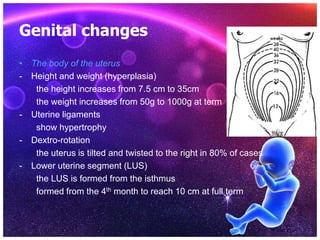
• The body of the uterus
- Height and weight (hyperplasia)
the height increases from 7.5 cm to 35cm
the weight increases from 50g to 1000g at term
- Uterine ligaments
show hypertrophy
- Dextro-rotation
the uterus is tilted and twisted to the right in 80% of cases
- Lower uterine segment (LUS)
the LUS is formed from the isthmus
formed from the 4th month to reach 10 cm at full term
Genital changes
• The cervix
- edema and congestion, and becomes soft
- mucus plug (operculum): cervical mucus closing the cervical
canal
- increased secretion from its glands
• The vulva
shows increased vascularity and varicosities
Genital changes
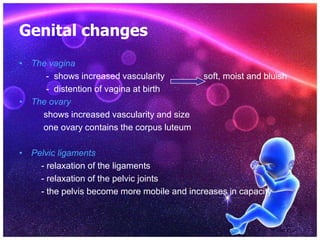
• The vagina
- shows increased vascularity soft, moist and bluish
- distention of vagina at birth
• The ovary
shows increased vascularity and size
one ovary contains the corpus luteum
• Pelvic ligaments
- relaxation of the ligaments
- relaxation of the pelvic joints
- the pelvis become more mobile and increases in capacity
Breast changes
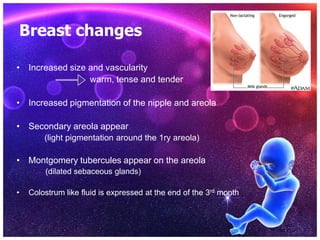
• Increased size and vascularity
warm, tense and tender
• Increased pigmentation of the nipple and areola
• Secondary areola appear
(light pigmentation around the 1ry areola)
• Montgomery tubercules appear on the areola
(dilated sebaceous glands)
• Colostrum like fluid is expressed at the end of the 3rd month
Skin changes
• Pigmentation
due to increased melanocyte stimulating hormone:
- linea nigra: pigmentation of the linea alba, more marked below
the umbilicus
- chloasma gravidarum: Butterfly pigmentation of the face (mask
of pregnancy)
• Striae gravidarum
- stretch of the abdominal wall
rupture of the subcutaneous elastic fibers
pink lines in flanks
- become white after labor
Weight increase
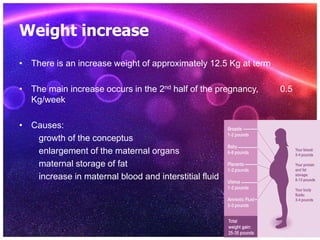
• There is an increase weight of approximately 12.5 Kg at term
• The main increase occurs in the 2nd half of the pregnancy, 0.5
Kg/week
• Causes:
growth of the conceptus
enlargement of the maternal organs
maternal storage of fat
increase in maternal blood and interstitial fluid
Skeletal changes
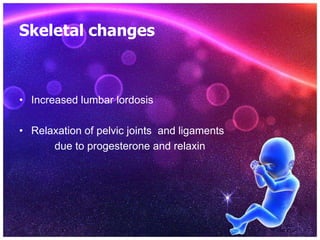
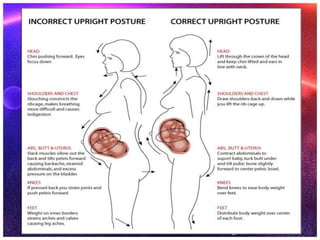
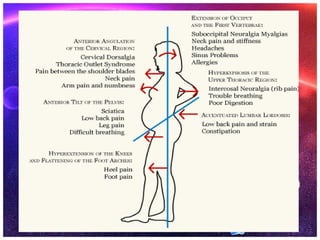
• Increased lumbar lordosis
• Relaxation of pelvic joints and ligaments
due to progesterone and relaxin
Urinary changes
• Kidneys
- increase in size
- hydronephrosis
- effective renal plasma flow is increased
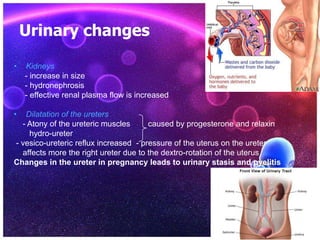
• Dilatation of the ureters
- Atony of the ureteric muscles caused by progesterone and relaxin
hydro-ureter
- vesico-ureteric reflux increased - pressure of the uterus on the ureter
affects more the right ureter due to the dextro-rotation of the uterus
Changes in the ureter in pregnancy leads to urinary stasis and pyelitis
Urinary changes
• Frequency of micturation
causes: 1st trimester: pressure of the uterus on the bladder
late in pregnancy: engagement of the head
• Urinary output
- diminished on a normal fluid intake
- increase in tubular reabsorption
- 100 extra liters of fluid pass into the renal tubules each day
- extracellular water is increased by 6 to 7 liters during pregnancy
- this is due to increased amounts of
aldosterone progesterone and oestrogen
Gastro-intestinal changes
• Increased salivation (ptyalism)
• Taste is often altered very early in pregnancy
• Increase appetite & thirst frequent small snacks
• Heart burn (reflux oesophagitis)
relaxation of the cardiac sphincter due to progesterone and relaxin
• Emesis gravidarum, morning sickness in 50 %
• Decreased gastric acidity, which interfere with iron absorption
• Constipation
reduced gut motility due to progesterone
increased water and salt absorption
Gastro-intestinal changes
• Liver
- Hepatic synthesis of albumin, plasma globulin and fibrinogen
increases
- Total hepatic synthesis of globulin increases stimulated by
estrogen
- Hormone-binding globulins rise
- gall bladder increases in size and empties more slowly
- relaxation of gall bladder increases the tendency of stone
formation
- cholestasis is almost physiological
- secretion of bile is unchanged
Cardiovascular changes
• Fall in total peripheral resistance by 6 weeks gestation to a nadir ~
40% by mid gestation
• Circulatory underfilling
activation of renin-angiotensin- aldosterone system
necessary expansion of the plasma volume
the bigger the expansion, the bigger the baby birthweight
• Total extracellular volume 16% by term
• Plasma osmolality by 10mOsm/Kg as water is retained
Cardiovascular changes
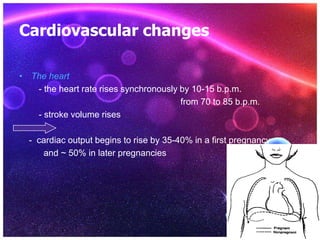
• The heart
- the heart rate rises synchronously by 10-15 b.p.m.
from 70 to 85 b.p.m.
- stroke volume rises
- cardiac output begins to rise by 35-40% in a first pregnancy
and ~ 50% in later pregnancies
Cardiovascular changes
• The blood pressure
- Korotkoff 5 used with auscultatory techniques
- slight drop in the 2nd trimester
small fall in systolic, greater fall in diastolic B.P.
opening of arterio-venous shunts at the placenta
increased pulse pressure
- supine hypotension syndrome in 8% of the women
2nd half of the pregnancy:
maternal hypotension occurs in the supine position due to pressure of
the uterus on the inferior vena cava
decreased venous return and cardiac output
Cardiovascular changes
• Noradrenaline
- pressor response to angiotensin II reduced in normal
pregnancy, unchanged to noradrenaline
- plasma noradrenaline is not increased in normal pregnancy
• Pulmonary circulation
- able to absorb high rate of flow without an increase in pressure
- pressure in right ventricle, pulmonary arteries and capillaries
does not change
- pulmonary resistance falls in early pregnancy
- progressive venodilatation + rises in venous distensibility +
capacitance throughout a normal pregnancy
Respiratory changes
• Tidal volume rises by 30% in early pregnancy
40-50% by term
• Fall in expiratory reserve and residual volume
decrease the threshold
increase the sensitivity of medulla oblongata to CO2
• Respiratory rate does not change
the minute ventilation rises by a similar amount
from 7.25L to 10.5L
• Elevation of the diaphragm in late pregnancy
dyspnea
Driven by
progesterone
Respiratory changes
• Carbon dioxide production rises sharply during the 3rd trimester
as fetal metabolism increases
• The fall in maternal P CO2
- allows more efficient placental transfer of CO2 from the fetus
- results in a fall in plasma bicarbonate concentration
( from 24-28 mmol/L to 18-22 mmol/L)
fall in plasma osmolality
venous pH rises slightly ( from 7.35 to 7.38)
Respiratory changes
• The increased alveolar ventilation small rise in PCO2
(from 96.7 to 101.8 mmHg)
• Rightward shift of the maternal oxyhaemoglobin dissociation curve
( due to an increase in 2,3-DPG in erythrocytes)
oxygen unloading to the fetus which has:
- lower PCO2 (25-30 mmHg, 3.3-4 KPa)
- marked leftward shift of the oxyhaemoglobin dissociation curve,
(due to lower sensitivity of fetal haemoglobin to 2,3-DPG)
Respiratory changes
• Increase of 16% in oxygen consumption by term
• Fall in arterio-venous oxygen difference
• Pregnancy places greater demands on the cardiovascular than the
respiratory system
Haematological changes
• Circulating red cell mass increases by 20-30%
( rises more in multiple pregnancies and iron supplement)
• Serum iron concentration falls
absorption from gut and iron-binding capacity rise
• Plasma folate concentration halves by term ( renal clearance)
red cell folate concentration falls less
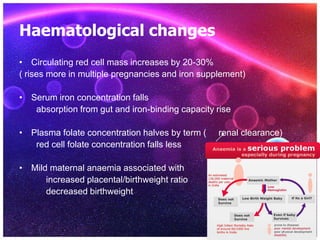
• Mild maternal anaemia associated with
increased placental/birthweight ratio
decreased birthweight
Haematological changes
• Erythropoietin rises especially if iron supplement not taken
• Human placental lactogen may stimulate haematopoiesis
• Fall in packed cell volume from 36% in early pregnancy to 32% in the 3rd
trimester ( normal plasma volume expansion)
• WBC count rises ( increase in polymorphonuclear leucocytes)
• Neutrophil number rises with oestrogen
peak at 33 weeks
stabilizing after that
until labour and the puerperium, when they rise sharply
Haematological changes
• T and B lymphocyte counts do not change but their function is
suppressed
( women become more susceptible to viral infections, malaria and
leprosy)
• Platelet count and platelet volume are largely unchanged
Haematological changes
• Coagulation
- factors VII, VIII and X rise
- absolute plasma fibrinogen doubles
- antithrombin III falls
- erythrocyte sedimentation rates increase
- Protein C unchanged
- Protein S concentrations, co-factor of protein C, fall in 1st & 2nd
trimesters
- plasma fibrinolytic activity decreases during pregnancy & labour
returns to normal values within an hour of delivery of placenta
Endocrinal changes
• Pituitary
- anterior pituitary increases in size and activity
- posterior pituitary releases oxytocin on the onset of labor
• Thyroid
- increases in size and activity: physiological goiter
- most pregnant women are euthyroid
- thyroid binding globulin concentrations double (not other thyroid
binding proteins)
- total T3, T4 are increased (not the free T3 ,T4)
• Parathyroid
increases in size and activity to regulate calcium metabolism
Endocrinal changes
• Adrenals
- increases in size and activity
- total cortisol is increased (free cortisol unchanged)
• Placental hormones
Progesterone
- produced by the corpus luteum
- levels rise steadily during pregnancy, output reaches 250mg/day
- actions:
colon activity reduced, nausea, constipation
reduced bladder and ureteric tone
diastolic pressure reduced, venous dilatation
raises temperature
Endocrinal changes
• Placental hormones
Oestrogens
- source:
ovary in early pregnancy
later, oestrone and oestradiol produced by the placenta
increased a hundredfold
oestriol produced by the placenta and fetal adrenals
increased thousandfold
- levels: output of oestrogens reaches a maximum of at least 30-40mg/day
oestriol accounts 85%
levels increase up to term
Endocrinal changes
• Placental hormones
Oestrogens
- possible actions:
1- induce growth of uterus and control its function
2- responsible for the development of breasts ( with progesterone)
3- alter chemical constitution of connective tissue, become more pliable
4- cause water retention
5- reduce sodium excretion
Metabolic changes
• Carbohydrate metabolism
- pregnancy is hyperlipidaemic and glucosuric
- after mid-pregnancy, resistance of insulin develops
- plasma glucose concentrations rise, maintained between 4.5-5.5 mmol/L
- glucose crosses the placenta, the fetus uses glucose as primary energy
substrate, transport occurs by carrier mediated mechanism
- the insulin resistance is endocrine-driven, via increase in cortisol and hPL
- concentrations of glucagons and the catecholamines are unaltered
Metabolic changes
• Carbohydrate metabolism
- carbohydrate deposited in the liver as glycogen
- some escapes to general circulation
- portion metabolised by the tissues:
converted to depot fat
stored as muscle glycogen
- first noticeable change occurs in blood sugar
- tested by giving a load of oral glucose (glucose tolerance test)
- the blood sugar, after meal, remains high facilitating placental
transfer
Metabolic changes
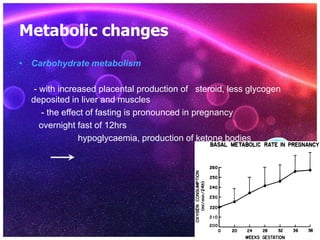
• Carbohydrate metabolism
- with increased placental production of steroid, less glycogen
deposited in liver and muscles
- the effect of fasting is pronounced in pregnancy
overnight fast of 12hrs
hypoglycaemia, production of ketone bodies
Metabolic changes
• Protein metabolism
- positive nitrogen balance
- on average 500 g of protein retained by the end of pregnancy
- blood and urine urea are reduced
• Fat metabolism
- by 30 weeks, 4Kg are stored in form of
depot fat in the abdominal wall, back and thights
modest amount in breasts
THANKYOU FOR
PAYING ATTENTION!

physiologicalchangesduringpregnancy-120719105010-phpapp02.pdf

  • 1.
    Physiological changes during pregnancy Dr NaillaMemon Senior Registrar SZWH Larkana
  • 2.
    Genital changes • Thebody of the uterus - Height and weight (hyperplasia) the height increases from 7.5 cm to 35cm the weight increases from 50g to 1000g at term - Uterine ligaments show hypertrophy - Dextro-rotation the uterus is tilted and twisted to the right in 80% of cases - Lower uterine segment (LUS) the LUS is formed from the isthmus formed from the 4th month to reach 10 cm at full term
  • 3.
    Genital changes • Thecervix - edema and congestion, and becomes soft - mucus plug (operculum): cervical mucus closing the cervical canal - increased secretion from its glands • The vulva shows increased vascularity and varicosities
  • 4.
    Genital changes • Thevagina - shows increased vascularity soft, moist and bluish - distention of vagina at birth • The ovary shows increased vascularity and size one ovary contains the corpus luteum • Pelvic ligaments - relaxation of the ligaments - relaxation of the pelvic joints - the pelvis become more mobile and increases in capacity
  • 5.
    Breast changes • Increasedsize and vascularity warm, tense and tender • Increased pigmentation of the nipple and areola • Secondary areola appear (light pigmentation around the 1ry areola) • Montgomery tubercules appear on the areola (dilated sebaceous glands) • Colostrum like fluid is expressed at the end of the 3rd month
  • 6.
    Skin changes • Pigmentation dueto increased melanocyte stimulating hormone: - linea nigra: pigmentation of the linea alba, more marked below the umbilicus - chloasma gravidarum: Butterfly pigmentation of the face (mask of pregnancy) • Striae gravidarum - stretch of the abdominal wall rupture of the subcutaneous elastic fibers pink lines in flanks - become white after labor
  • 7.
    Weight increase • Thereis an increase weight of approximately 12.5 Kg at term • The main increase occurs in the 2nd half of the pregnancy, 0.5 Kg/week • Causes: growth of the conceptus enlargement of the maternal organs maternal storage of fat increase in maternal blood and interstitial fluid
  • 8.
    Skeletal changes • Increasedlumbar lordosis • Relaxation of pelvic joints and ligaments due to progesterone and relaxin
  • 9.
    Urinary changes • Kidneys -increase in size - hydronephrosis - effective renal plasma flow is increased • Dilatation of the ureters - Atony of the ureteric muscles caused by progesterone and relaxin hydro-ureter - vesico-ureteric reflux increased - pressure of the uterus on the ureter affects more the right ureter due to the dextro-rotation of the uterus Changes in the ureter in pregnancy leads to urinary stasis and pyelitis
  • 10.
    Urinary changes • Frequencyof micturation causes: 1st trimester: pressure of the uterus on the bladder late in pregnancy: engagement of the head • Urinary output - diminished on a normal fluid intake - increase in tubular reabsorption - 100 extra liters of fluid pass into the renal tubules each day - extracellular water is increased by 6 to 7 liters during pregnancy - this is due to increased amounts of aldosterone progesterone and oestrogen
  • 11.
    Gastro-intestinal changes • Increasedsalivation (ptyalism) • Taste is often altered very early in pregnancy • Increase appetite & thirst frequent small snacks • Heart burn (reflux oesophagitis) relaxation of the cardiac sphincter due to progesterone and relaxin • Emesis gravidarum, morning sickness in 50 % • Decreased gastric acidity, which interfere with iron absorption • Constipation reduced gut motility due to progesterone increased water and salt absorption
  • 12.
    Gastro-intestinal changes • Liver -Hepatic synthesis of albumin, plasma globulin and fibrinogen increases - Total hepatic synthesis of globulin increases stimulated by estrogen - Hormone-binding globulins rise - gall bladder increases in size and empties more slowly - relaxation of gall bladder increases the tendency of stone formation - cholestasis is almost physiological - secretion of bile is unchanged
  • 13.
    Cardiovascular changes • Fallin total peripheral resistance by 6 weeks gestation to a nadir ~ 40% by mid gestation • Circulatory underfilling activation of renin-angiotensin- aldosterone system necessary expansion of the plasma volume the bigger the expansion, the bigger the baby birthweight • Total extracellular volume 16% by term • Plasma osmolality by 10mOsm/Kg as water is retained
  • 14.
    Cardiovascular changes • Theheart - the heart rate rises synchronously by 10-15 b.p.m. from 70 to 85 b.p.m. - stroke volume rises - cardiac output begins to rise by 35-40% in a first pregnancy and ~ 50% in later pregnancies
  • 15.
    Cardiovascular changes • Theblood pressure - Korotkoff 5 used with auscultatory techniques - slight drop in the 2nd trimester small fall in systolic, greater fall in diastolic B.P. opening of arterio-venous shunts at the placenta increased pulse pressure - supine hypotension syndrome in 8% of the women 2nd half of the pregnancy: maternal hypotension occurs in the supine position due to pressure of the uterus on the inferior vena cava decreased venous return and cardiac output
  • 16.
    Cardiovascular changes • Noradrenaline -pressor response to angiotensin II reduced in normal pregnancy, unchanged to noradrenaline - plasma noradrenaline is not increased in normal pregnancy • Pulmonary circulation - able to absorb high rate of flow without an increase in pressure - pressure in right ventricle, pulmonary arteries and capillaries does not change - pulmonary resistance falls in early pregnancy - progressive venodilatation + rises in venous distensibility + capacitance throughout a normal pregnancy
  • 17.
    Respiratory changes • Tidalvolume rises by 30% in early pregnancy 40-50% by term • Fall in expiratory reserve and residual volume decrease the threshold increase the sensitivity of medulla oblongata to CO2 • Respiratory rate does not change the minute ventilation rises by a similar amount from 7.25L to 10.5L • Elevation of the diaphragm in late pregnancy dyspnea Driven by progesterone
  • 18.
    Respiratory changes • Carbondioxide production rises sharply during the 3rd trimester as fetal metabolism increases • The fall in maternal P CO2 - allows more efficient placental transfer of CO2 from the fetus - results in a fall in plasma bicarbonate concentration ( from 24-28 mmol/L to 18-22 mmol/L) fall in plasma osmolality venous pH rises slightly ( from 7.35 to 7.38)
  • 19.
    Respiratory changes • Theincreased alveolar ventilation small rise in PCO2 (from 96.7 to 101.8 mmHg) • Rightward shift of the maternal oxyhaemoglobin dissociation curve ( due to an increase in 2,3-DPG in erythrocytes) oxygen unloading to the fetus which has: - lower PCO2 (25-30 mmHg, 3.3-4 KPa) - marked leftward shift of the oxyhaemoglobin dissociation curve, (due to lower sensitivity of fetal haemoglobin to 2,3-DPG)
  • 20.
    Respiratory changes • Increaseof 16% in oxygen consumption by term • Fall in arterio-venous oxygen difference • Pregnancy places greater demands on the cardiovascular than the respiratory system
  • 21.
    Haematological changes • Circulatingred cell mass increases by 20-30% ( rises more in multiple pregnancies and iron supplement) • Serum iron concentration falls absorption from gut and iron-binding capacity rise • Plasma folate concentration halves by term ( renal clearance) red cell folate concentration falls less • Mild maternal anaemia associated with increased placental/birthweight ratio decreased birthweight
  • 22.
    Haematological changes • Erythropoietinrises especially if iron supplement not taken • Human placental lactogen may stimulate haematopoiesis • Fall in packed cell volume from 36% in early pregnancy to 32% in the 3rd trimester ( normal plasma volume expansion) • WBC count rises ( increase in polymorphonuclear leucocytes) • Neutrophil number rises with oestrogen peak at 33 weeks stabilizing after that until labour and the puerperium, when they rise sharply
  • 23.
    Haematological changes • Tand B lymphocyte counts do not change but their function is suppressed ( women become more susceptible to viral infections, malaria and leprosy) • Platelet count and platelet volume are largely unchanged
  • 24.
    Haematological changes • Coagulation -factors VII, VIII and X rise - absolute plasma fibrinogen doubles - antithrombin III falls - erythrocyte sedimentation rates increase - Protein C unchanged - Protein S concentrations, co-factor of protein C, fall in 1st & 2nd trimesters - plasma fibrinolytic activity decreases during pregnancy & labour returns to normal values within an hour of delivery of placenta
  • 26.
    Endocrinal changes • Pituitary -anterior pituitary increases in size and activity - posterior pituitary releases oxytocin on the onset of labor • Thyroid - increases in size and activity: physiological goiter - most pregnant women are euthyroid - thyroid binding globulin concentrations double (not other thyroid binding proteins) - total T3, T4 are increased (not the free T3 ,T4) • Parathyroid increases in size and activity to regulate calcium metabolism
  • 27.
    Endocrinal changes • Adrenals -increases in size and activity - total cortisol is increased (free cortisol unchanged) • Placental hormones Progesterone - produced by the corpus luteum - levels rise steadily during pregnancy, output reaches 250mg/day - actions: colon activity reduced, nausea, constipation reduced bladder and ureteric tone diastolic pressure reduced, venous dilatation raises temperature
  • 28.
    Endocrinal changes • Placentalhormones Oestrogens - source: ovary in early pregnancy later, oestrone and oestradiol produced by the placenta increased a hundredfold oestriol produced by the placenta and fetal adrenals increased thousandfold - levels: output of oestrogens reaches a maximum of at least 30-40mg/day oestriol accounts 85% levels increase up to term
  • 29.
    Endocrinal changes • Placentalhormones Oestrogens - possible actions: 1- induce growth of uterus and control its function 2- responsible for the development of breasts ( with progesterone) 3- alter chemical constitution of connective tissue, become more pliable 4- cause water retention 5- reduce sodium excretion
  • 31.
    Metabolic changes • Carbohydratemetabolism - pregnancy is hyperlipidaemic and glucosuric - after mid-pregnancy, resistance of insulin develops - plasma glucose concentrations rise, maintained between 4.5-5.5 mmol/L - glucose crosses the placenta, the fetus uses glucose as primary energy substrate, transport occurs by carrier mediated mechanism - the insulin resistance is endocrine-driven, via increase in cortisol and hPL - concentrations of glucagons and the catecholamines are unaltered
  • 32.
    Metabolic changes • Carbohydratemetabolism - carbohydrate deposited in the liver as glycogen - some escapes to general circulation - portion metabolised by the tissues: converted to depot fat stored as muscle glycogen - first noticeable change occurs in blood sugar - tested by giving a load of oral glucose (glucose tolerance test) - the blood sugar, after meal, remains high facilitating placental transfer
  • 33.
    Metabolic changes • Carbohydratemetabolism - with increased placental production of steroid, less glycogen deposited in liver and muscles - the effect of fasting is pronounced in pregnancy overnight fast of 12hrs hypoglycaemia, production of ketone bodies
  • 34.
    Metabolic changes • Proteinmetabolism - positive nitrogen balance - on average 500 g of protein retained by the end of pregnancy - blood and urine urea are reduced • Fat metabolism - by 30 weeks, 4Kg are stored in form of depot fat in the abdominal wall, back and thights modest amount in breasts
  • 36.