
A Seminar on
HPCPC
Presented By
Mr. Jagadeesh Tekkali
M.Pharmacy 1st year
15AC1S0414
VIGNAN INSTITUTE OF PHARMACEUTICAL TECHNOLOGY
An ISO 9001:2008, 14001:2004, OHSAS 18001:2007 Certified Institution
Beside VSEZ, kapujaggarajupeta, Duvvada,VISAKHAPATNAM-530046
(Approved by A.I.C.T.E & PCI and affliated to JNTUK)
CONTENTS:
 INTRODUCTION
 CLASSIFICATION OF LIQUID CHROMATOGRAPHY
 PRINCIPLE INVOLVE IN HPCPC
 THEORY AND MODE’S OF OPERATION
 INSTRUMENTATION
 ADVANTAGES OF HPCPC
 APPLICATIONS OF HPCPC
 REFERENCES
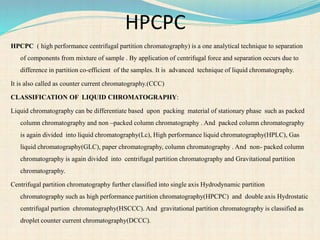
HPCPC
HPCPC ( high performance centrifugal partition chromatography) is a one analytical technique to separation
of components from mixture of sample . By application of centrifugal force and separation occurs due to
difference in partition co-efficient of the samples. It is advanced technique of liquid chromatography.
It is also called as counter current chromatography.(CCC)
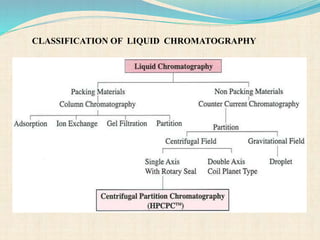
CLASSIFICATION OF LIQUID CHROMATOGRAPHY:
Liquid chromatography can be differentiate based upon packing material of stationary phase such as packed
column chromatography and non –packed column chromatography . And packed column chromatography
is again divided into liquid chromatography(Lc), High performance liquid chromatography(HPLC), Gas
liquid chromatography(GLC), paper chromatography, column chromatography . And non- packed column
chromatography is again divided into centrifugal partition chromatography and Gravitational partition
chromatography.
Centrifugal partition chromatography further classified into single axis Hydrodynamic partition
chromatography such as high performance partition chromatography(HPCPC) and double axis Hydrostatic
centrifugal partion chromatography(HSCCC). And gravitational partition chromatography is classified as
droplet counter current chromatography(DCCC).
CLASSIFICATION OF LIQUID CHROMATOGRAPHY
PRINCIPLE
“ Two Immiscible liquid phase come in contact with each other as at least one phase is
pumped through a column, a Helical coil or micro droplet cell or partition cell
connected to with channels, which contain both resulting dynamic mixing and
settling action allows the components to be separated by their respective solubility in
the two phase in the presence of centrifugal force on it.”. The affinity of the solute
for each phase can be measured by their partition-co-efficient that turn dictates the
order of elution for each compound”
THEORY AND MODE’S OF OPERATION
. High Performance Centrifugal Partition Chromatography (HPCPC) is a practical and suitable method,
particularly on the preparative scale, for the separation of bio molecules such as proteins, enzymes, etc.
it is also known as "counter current chromatography”
HPCPC is an analytical chemistry technique that is used to separate, identify, and quantify the
chemical components of a mixture.
In HPCPC solid stationary phase is not used. Instead of stationary-phase liquid is retained by centrifugal
force in discrete partition channels within a unique patented circular Partition Disk Pack. A packed
column generally contains only 2 to 7 percent of stationary phase, severely limits its capacity. In an
HPCPC system, the column contains between 50 and 80 percent stationary phase. The stationary phase
is held in numerous discrete partition cells. Micro droplets of mobile phase liquid pass continuously
through the stationary phase liquid. Any two-phase solvent mixture can be used, at any pH, to perform
normal and reversed phase chromatographic separations
In HPCPC is based on the principle of counter current chromatography (CPC) . The stationary phase of a
two –phase system is maintained in the instrument under a centrifugal force while the mobile phase is
pumped . Through a series of chambers or cells.
The stationary phase is retained inside the rotor by the
centrifugal force. Generated by rotation around a single axis. Discrete chambers connected by a
channels are the sites of mixing and settling action that allows the compounds being separated to
distributed between the two phase as the mobile phase exits the columns it is collected in test tubes for
further Analysis . Chemical compounds subjected to CPC are separated based on the partition co-efficient
of each compound in the two – phase system.
Modes of operation:
Normal-phase: A polar solvent used as stationary phase and mobile phase as non-aqueous or biphasic
solvent system used as mobile phase.
Reverse –phase: A non polar or less polar solvent used as stationary phase and mobile phase aqueous phase.
Gradient:
By changing the polarity of mobile phase either increase or dicrease elution take place. ex: methanol-water as
mobile phase heptane as stationary phase.
DUAL MODE:
mobile phase and stationary phase Direction of flow change by switching such as
 ASCENDING MODE
 DESCENDING MODE
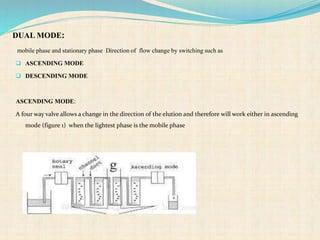
ASCENDING MODE:
A four way valve allows a change in the direction of the elution and therefore will work either in ascending
mode (figure 1) when the lightest phase is the mobile phase
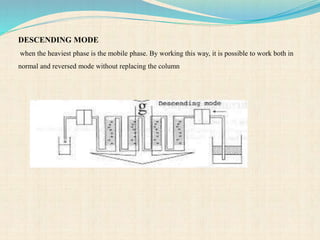
DESCENDING MODE
when the heaviest phase is the mobile phase. By working this way, it is possible to work both in
normal and reversed mode without replacing the column
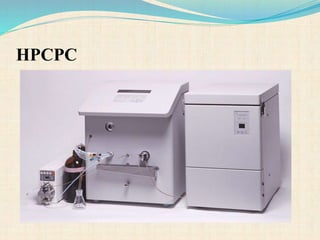
HPCPC
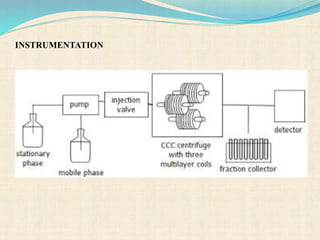
INSTRUMENTATION
PARTS
• Stationary phase
• Mobile phase
• pump
 Sample Injector
 Elutionmode switching valve
 Rotary Joint
 Patition Channel
 Rotary
 UV Detector,
 Fraction Collector
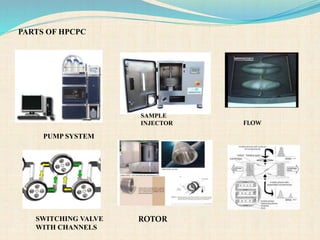
PARTS OF HPCPC
ROTORSWITCHING VALVE
WITH CHANNELS
PUMP SYSTEM
SAMPLE
INJECTOR FLOW
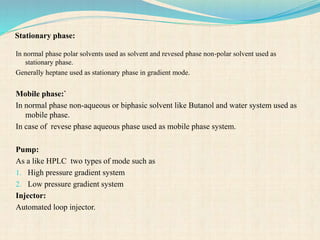
Stationary phase:
In normal phase polar solvents used as solvent and revesed phase non-polar solvent used as
stationary phase.
Generally heptane used as stationary phase in gradient mode.
Mobile phase:`
In normal phase non-aqueous or biphasic solvent like Butanol and water system used as
mobile phase.
In case of revese phase aqueous phase used as mobile phase system.
Pump:
As a like HPLC two types of mode such as
1. High pressure gradient system
2. Low pressure gradient system
Injector:
Automated loop injector.
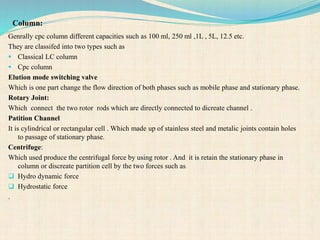
Column:
Genrally cpc column different capacities such as 100 ml, 250 ml ,1L , 5L, 12.5 etc.
They are classifed into two types such as
 Classical LC column
 Cpc column
Elution mode switching valve
Which is one part change the flow direction of both phases such as mobile phase and stationary phase.
Rotary Joint:
Which connect the two rotor rods which are directly connected to dicreate channel .
Patition Channel
It is cylindrical or rectangular cell . Which made up of stainless steel and metalic joints contain holes
to passage of stationary phase.
Centrifuge:
Which used produce the centrifugal force by using rotor . And it is retain the stationary phase in
column or discreate partition cell by the two forces such as
 Hydro dynamic force
 Hydrostatic force
.
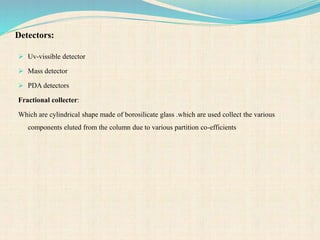
Detectors:
 Uv-vissible detector
 Mass detector
 PDA detectors
Fractional collecter:
Which are cylindrical shape made of borosilicate glass .which are used collect the various
components eluted from the column due to various partition co-efficients
ADVANTAGES
 No column to replace, no silica to recycle
 Low solvent consumption
 High flow rate for low run time
 High performances. Purity > 99%, recovery > 90%
 No sample losses
 No de naturation, no irreversible adsorption of the sample
 Huge application fields from petroleum extract to proteins.
 Low price of sationary phase.
 High throught put.
o Flexibility of mobile phase selection.
o Work at any PH.
Applications of HPCPC
 Separation of Scandium, yttrium and lanthanum in HPCPC with S-Octyl phenyl
oxy acetic acid.
 Isolation of liquiritigenin-4’-Apiosyl glucoside by HPCPC.
 Xanthones separation from mangosteen pericarp by using HPCPC.
 Bio Polymers
 Fermentation Products
 Foods &Additives
 Fine Chemicals
 Genetically Engineered Substances
 Natural Organic Compounds
 Physiological Activated Substances
 Pharmaceuticals
 Petrochemicals
 Rare Metal &Earth
REFERENCES
 Highspeed countercurrent chromatography. Chemical analysis. Yoichiro Ito, Walter D. Conway
(eds.). New
York: J. Wiley. 1996. ISBN 9780471637493.
 Liu, Yang; Friesen, J. Brent; McApline, James B.; Pauli, Guido F. (2015). "Solvent System
Selection
Strategies in Countercurrent Separation". Planta Medica 81: 1582–1591. doi:10.1055/s00351546246.
 . Mekaoui, Nazim; Faure, Karine; Berthod, Alain (2012). "Advances in Countercurrent
Chromatography for
Protein Separations". Bioanalysis 4: 833–844. doi:10.4155/bio.12.27.
 Kendall, D.; Booth, A. J.; Levy, M.S.; Lye, G. J. (2001). "Separation of supercoiled and
opencircular plasmid DNA by liquidliquid countercurrentchromatography". Biotechnology Letters
23: 613doi
 McAlpine, James B.; Friesen, J. Brent; Pauli, Guido F. (2012). "Separation of Natural Products by
Countercurrent Chromatography". In Satyajit D. Sarker, Lutfun Nahar (eds.). Natural Products
Isolation 864.
Totowa, NJ: Humana Press. pp. 221–254. Retrieved 20160221.
 Ian A. Sutherland (2007). "Recent progress on the industrial scale pof countercurrent
chromatography".Journal of Chromatography A 1151: 6–13.
doi:10.1016/j.chroma.2007.01.143.
 Sumner, Neil (2011). "Developing counter current chromatography to meet the needs of
pharmaceuticaldiscovery". Journal of Chromatography A 1218 (36): 6107–
6113.doi:10.1016/j.chroma.2011.05.001.Retrieved 20160221.
. Kurumaya, Katsuyuki; Sakamoto, Tetsuto; Okada, Yoshihito; Kajiwara, Masahiro (1988).
"Application of droplet countercurrent chromatography to the isolation of vitamin B12".
Journal of Chromatography A 435 235–240. doi:10.1016/S00219673( 01)821816.Retrieved
20160221.
 Friesen, J. Brent; McAlpine, James B.; Chen, ShaoNong;Pauli, Guido F.
(2015)."Countercurrent Separation of Natural Products: An Update". Journal
ofNaturalProducts 78 (7): 1765–1796.doi:10.1021/np501065h. Retrieved 20160221
Hpcpc ppt

Hpcpc ppt

  • 1.
    A Seminar on HPCPC PresentedBy Mr. Jagadeesh Tekkali M.Pharmacy 1st year 15AC1S0414 VIGNAN INSTITUTE OF PHARMACEUTICAL TECHNOLOGY An ISO 9001:2008, 14001:2004, OHSAS 18001:2007 Certified Institution Beside VSEZ, kapujaggarajupeta, Duvvada,VISAKHAPATNAM-530046 (Approved by A.I.C.T.E & PCI and affliated to JNTUK)
  • 2.
    CONTENTS:  INTRODUCTION  CLASSIFICATIONOF LIQUID CHROMATOGRAPHY  PRINCIPLE INVOLVE IN HPCPC  THEORY AND MODE’S OF OPERATION  INSTRUMENTATION  ADVANTAGES OF HPCPC  APPLICATIONS OF HPCPC  REFERENCES
  • 3.
    HPCPC HPCPC ( highperformance centrifugal partition chromatography) is a one analytical technique to separation of components from mixture of sample . By application of centrifugal force and separation occurs due to difference in partition co-efficient of the samples. It is advanced technique of liquid chromatography. It is also called as counter current chromatography.(CCC) CLASSIFICATION OF LIQUID CHROMATOGRAPHY: Liquid chromatography can be differentiate based upon packing material of stationary phase such as packed column chromatography and non –packed column chromatography . And packed column chromatography is again divided into liquid chromatography(Lc), High performance liquid chromatography(HPLC), Gas liquid chromatography(GLC), paper chromatography, column chromatography . And non- packed column chromatography is again divided into centrifugal partition chromatography and Gravitational partition chromatography. Centrifugal partition chromatography further classified into single axis Hydrodynamic partition chromatography such as high performance partition chromatography(HPCPC) and double axis Hydrostatic centrifugal partion chromatography(HSCCC). And gravitational partition chromatography is classified as droplet counter current chromatography(DCCC).
  • 4.
  • 5.
    PRINCIPLE “ Two Immiscibleliquid phase come in contact with each other as at least one phase is pumped through a column, a Helical coil or micro droplet cell or partition cell connected to with channels, which contain both resulting dynamic mixing and settling action allows the components to be separated by their respective solubility in the two phase in the presence of centrifugal force on it.”. The affinity of the solute for each phase can be measured by their partition-co-efficient that turn dictates the order of elution for each compound”
  • 6.
    THEORY AND MODE’SOF OPERATION . High Performance Centrifugal Partition Chromatography (HPCPC) is a practical and suitable method, particularly on the preparative scale, for the separation of bio molecules such as proteins, enzymes, etc. it is also known as "counter current chromatography” HPCPC is an analytical chemistry technique that is used to separate, identify, and quantify the chemical components of a mixture. In HPCPC solid stationary phase is not used. Instead of stationary-phase liquid is retained by centrifugal force in discrete partition channels within a unique patented circular Partition Disk Pack. A packed column generally contains only 2 to 7 percent of stationary phase, severely limits its capacity. In an HPCPC system, the column contains between 50 and 80 percent stationary phase. The stationary phase is held in numerous discrete partition cells. Micro droplets of mobile phase liquid pass continuously through the stationary phase liquid. Any two-phase solvent mixture can be used, at any pH, to perform normal and reversed phase chromatographic separations
  • 7.
    In HPCPC isbased on the principle of counter current chromatography (CPC) . The stationary phase of a two –phase system is maintained in the instrument under a centrifugal force while the mobile phase is pumped . Through a series of chambers or cells. The stationary phase is retained inside the rotor by the centrifugal force. Generated by rotation around a single axis. Discrete chambers connected by a channels are the sites of mixing and settling action that allows the compounds being separated to distributed between the two phase as the mobile phase exits the columns it is collected in test tubes for further Analysis . Chemical compounds subjected to CPC are separated based on the partition co-efficient of each compound in the two – phase system. Modes of operation: Normal-phase: A polar solvent used as stationary phase and mobile phase as non-aqueous or biphasic solvent system used as mobile phase. Reverse –phase: A non polar or less polar solvent used as stationary phase and mobile phase aqueous phase. Gradient: By changing the polarity of mobile phase either increase or dicrease elution take place. ex: methanol-water as mobile phase heptane as stationary phase.
  • 8.
    DUAL MODE: mobile phaseand stationary phase Direction of flow change by switching such as  ASCENDING MODE  DESCENDING MODE ASCENDING MODE: A four way valve allows a change in the direction of the elution and therefore will work either in ascending mode (figure 1) when the lightest phase is the mobile phase
  • 9.
    DESCENDING MODE when theheaviest phase is the mobile phase. By working this way, it is possible to work both in normal and reversed mode without replacing the column
  • 10.
  • 11.
  • 12.
    PARTS • Stationary phase •Mobile phase • pump  Sample Injector  Elutionmode switching valve  Rotary Joint  Patition Channel  Rotary  UV Detector,  Fraction Collector
  • 13.
    PARTS OF HPCPC ROTORSWITCHINGVALVE WITH CHANNELS PUMP SYSTEM SAMPLE INJECTOR FLOW
  • 14.
    Stationary phase: In normalphase polar solvents used as solvent and revesed phase non-polar solvent used as stationary phase. Generally heptane used as stationary phase in gradient mode. Mobile phase:` In normal phase non-aqueous or biphasic solvent like Butanol and water system used as mobile phase. In case of revese phase aqueous phase used as mobile phase system. Pump: As a like HPLC two types of mode such as 1. High pressure gradient system 2. Low pressure gradient system Injector: Automated loop injector.
  • 15.
    Column: Genrally cpc columndifferent capacities such as 100 ml, 250 ml ,1L , 5L, 12.5 etc. They are classifed into two types such as  Classical LC column  Cpc column Elution mode switching valve Which is one part change the flow direction of both phases such as mobile phase and stationary phase. Rotary Joint: Which connect the two rotor rods which are directly connected to dicreate channel . Patition Channel It is cylindrical or rectangular cell . Which made up of stainless steel and metalic joints contain holes to passage of stationary phase. Centrifuge: Which used produce the centrifugal force by using rotor . And it is retain the stationary phase in column or discreate partition cell by the two forces such as  Hydro dynamic force  Hydrostatic force .
  • 16.
    Detectors:  Uv-vissible detector Mass detector  PDA detectors Fractional collecter: Which are cylindrical shape made of borosilicate glass .which are used collect the various components eluted from the column due to various partition co-efficients
  • 17.
    ADVANTAGES  No columnto replace, no silica to recycle  Low solvent consumption  High flow rate for low run time  High performances. Purity > 99%, recovery > 90%  No sample losses  No de naturation, no irreversible adsorption of the sample  Huge application fields from petroleum extract to proteins.  Low price of sationary phase.  High throught put. o Flexibility of mobile phase selection. o Work at any PH.
  • 18.
    Applications of HPCPC Separation of Scandium, yttrium and lanthanum in HPCPC with S-Octyl phenyl oxy acetic acid.  Isolation of liquiritigenin-4’-Apiosyl glucoside by HPCPC.  Xanthones separation from mangosteen pericarp by using HPCPC.  Bio Polymers  Fermentation Products  Foods &Additives  Fine Chemicals  Genetically Engineered Substances  Natural Organic Compounds  Physiological Activated Substances  Pharmaceuticals  Petrochemicals  Rare Metal &Earth
  • 19.
    REFERENCES  Highspeed countercurrentchromatography. Chemical analysis. Yoichiro Ito, Walter D. Conway (eds.). New York: J. Wiley. 1996. ISBN 9780471637493.  Liu, Yang; Friesen, J. Brent; McApline, James B.; Pauli, Guido F. (2015). "Solvent System Selection Strategies in Countercurrent Separation". Planta Medica 81: 1582–1591. doi:10.1055/s00351546246.  . Mekaoui, Nazim; Faure, Karine; Berthod, Alain (2012). "Advances in Countercurrent Chromatography for Protein Separations". Bioanalysis 4: 833–844. doi:10.4155/bio.12.27.  Kendall, D.; Booth, A. J.; Levy, M.S.; Lye, G. J. (2001). "Separation of supercoiled and opencircular plasmid DNA by liquidliquid countercurrentchromatography". Biotechnology Letters 23: 613doi  McAlpine, James B.; Friesen, J. Brent; Pauli, Guido F. (2012). "Separation of Natural Products by Countercurrent Chromatography". In Satyajit D. Sarker, Lutfun Nahar (eds.). Natural Products Isolation 864. Totowa, NJ: Humana Press. pp. 221–254. Retrieved 20160221.
  • 20.
     Ian A.Sutherland (2007). "Recent progress on the industrial scale pof countercurrent chromatography".Journal of Chromatography A 1151: 6–13. doi:10.1016/j.chroma.2007.01.143.  Sumner, Neil (2011). "Developing counter current chromatography to meet the needs of pharmaceuticaldiscovery". Journal of Chromatography A 1218 (36): 6107– 6113.doi:10.1016/j.chroma.2011.05.001.Retrieved 20160221. . Kurumaya, Katsuyuki; Sakamoto, Tetsuto; Okada, Yoshihito; Kajiwara, Masahiro (1988). "Application of droplet countercurrent chromatography to the isolation of vitamin B12". Journal of Chromatography A 435 235–240. doi:10.1016/S00219673( 01)821816.Retrieved 20160221.  Friesen, J. Brent; McAlpine, James B.; Chen, ShaoNong;Pauli, Guido F. (2015)."Countercurrent Separation of Natural Products: An Update". Journal ofNaturalProducts 78 (7): 1765–1796.doi:10.1021/np501065h. Retrieved 20160221