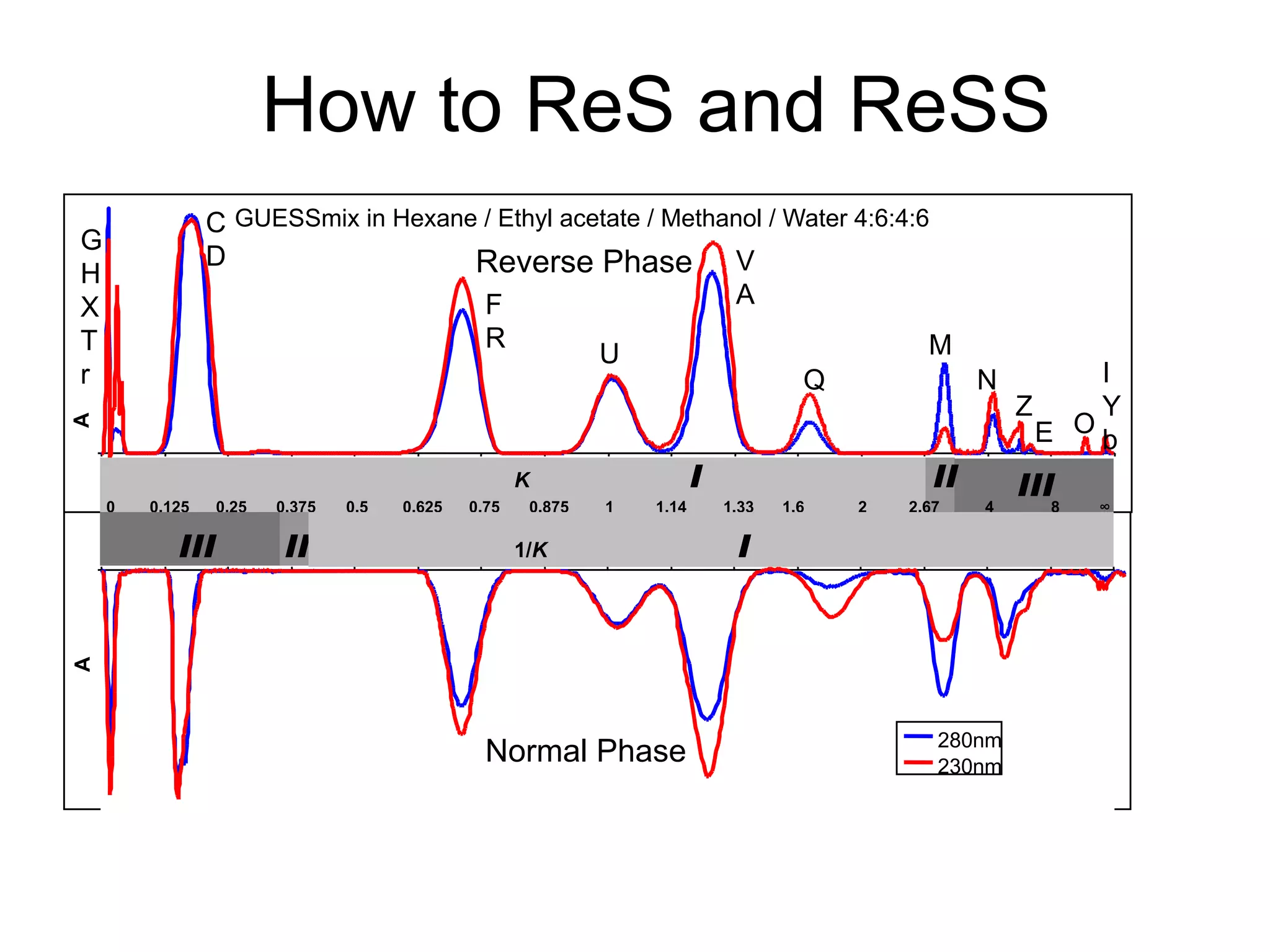
How to ReS and ReSS
A
280nm
230nm
A
K
0 0.125 0.25 0.375 0.5 0.625 0.75 0.875 1 1.14 1.33 1.6 2 2.67 4 8 ∞
IIII II
IIIII I1/K
GUESSmix in Hexane / Ethyl acetate / Methanol / Water 4:6:4:6
Reverse Phase
Normal Phase
G
H
X
T
r
C
D
F
R
U
V
A
Q
M
N
Z
E O
I
Y
b
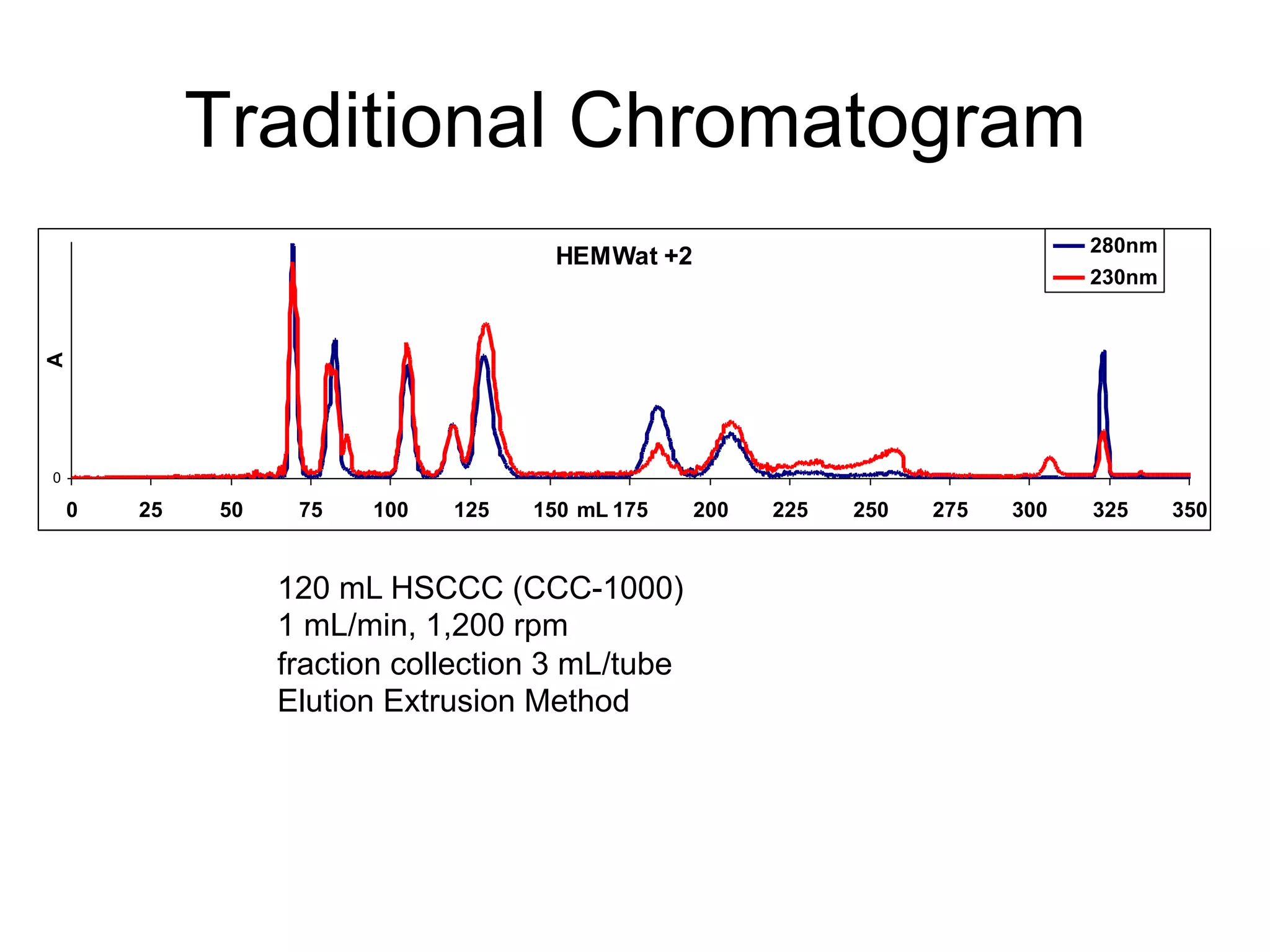
Traditional Chromatogram
HEMWat +2
0
0 25 50 75 100 125 150 175 200 225 250 275 300 325 350mL
A
280nm
230nm
120 mL HSCCC (CCC-1000)
1 mL/min, 1,200 rpm
fraction collection 3 mL/tube
Elution Extrusion Method
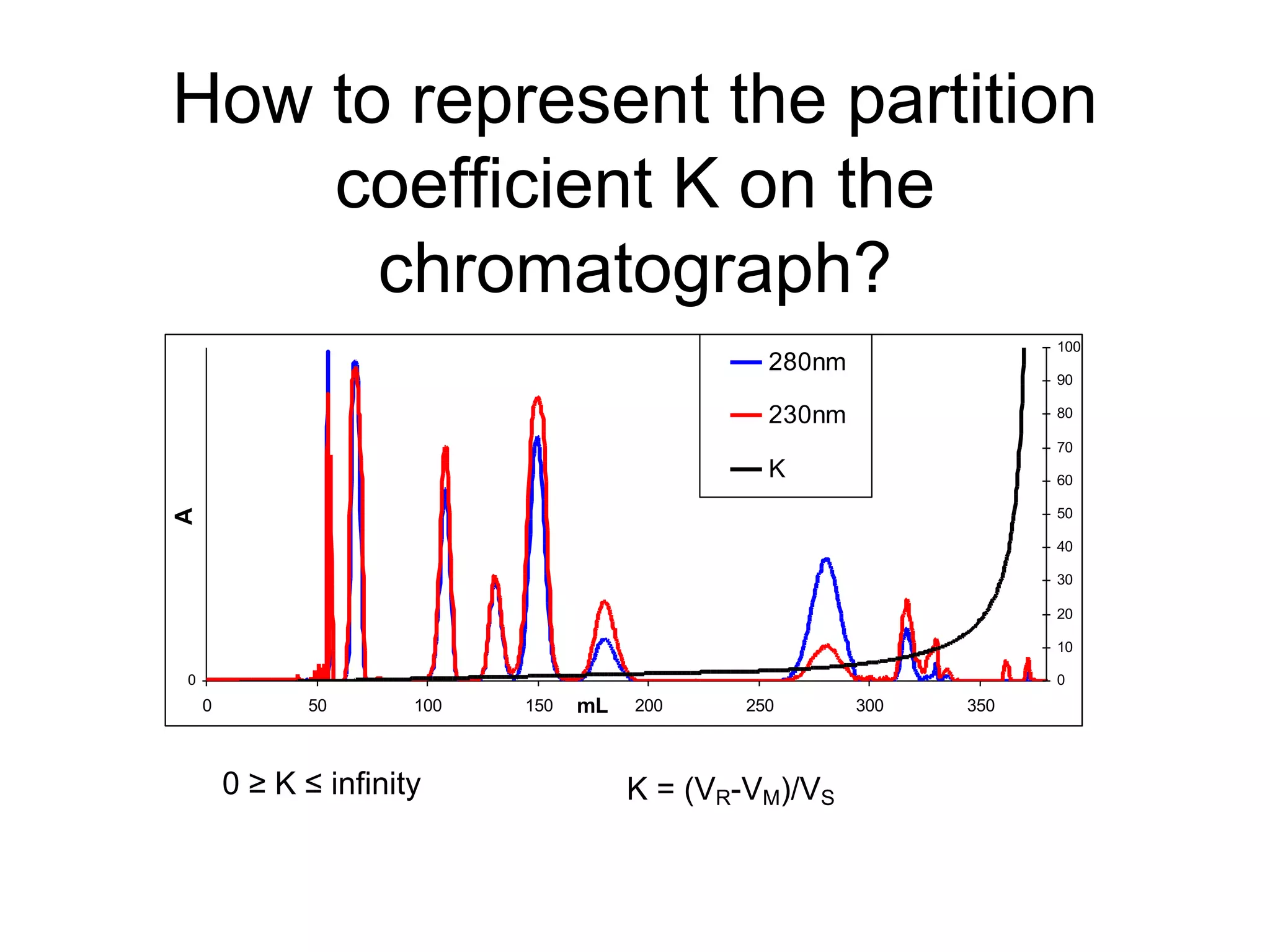
How to represent the partition
coefficient K on the
chromatograph?
0
0 50 100 150 200 250 300 350mL
A
0
10
20
30
40
50
60
70
80
90
100
280nm
230nm
K
0 ≥ K ≤ infinity K = (VR-VM)/VS
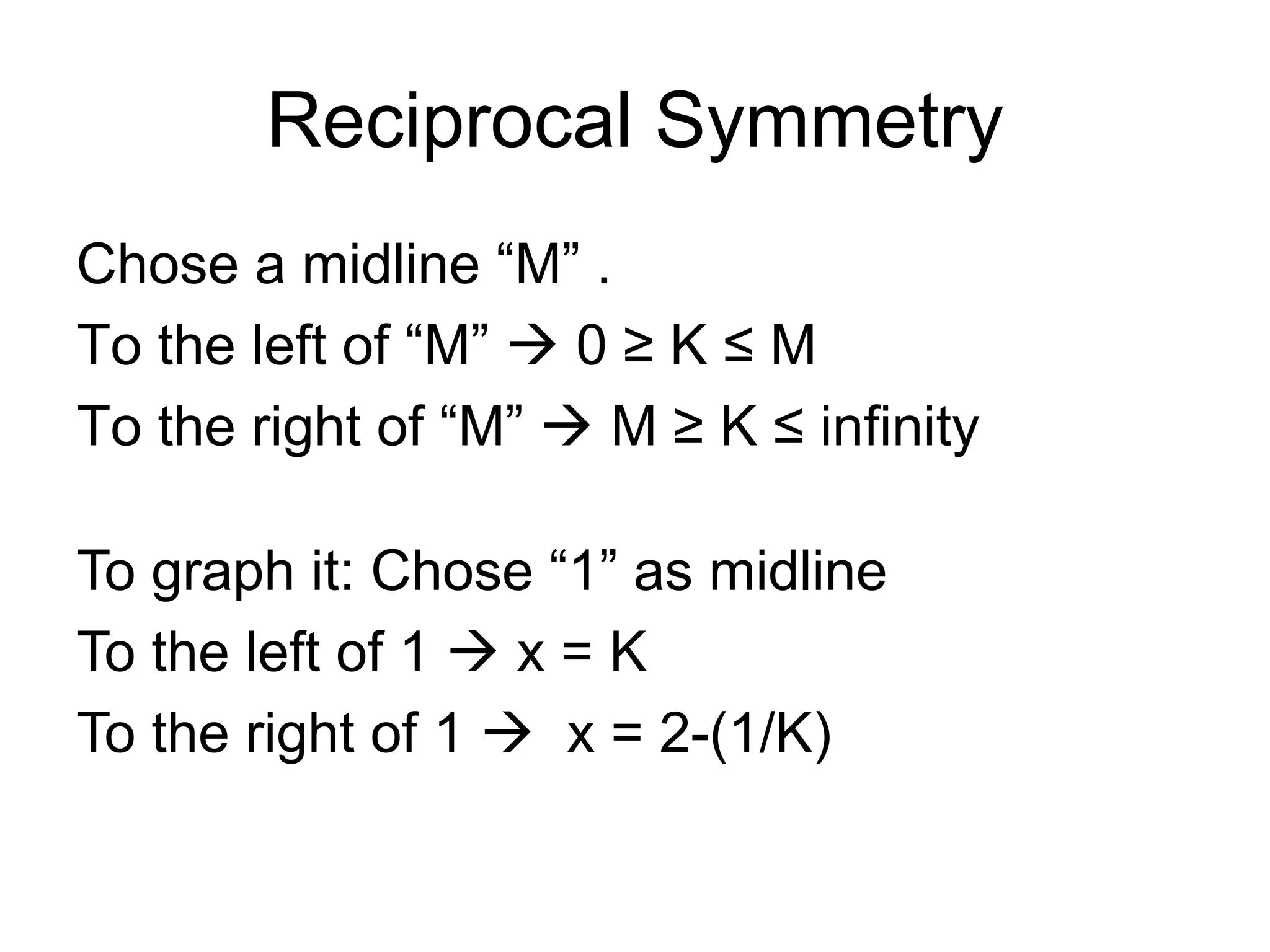
Reciprocal Symmetry
Chose a midline “M” .
To the left of “M” à 0 ≥ K ≤ M
To the right of “M” à M ≥ K ≤ infinity
To graph it: Chose “1” as midline
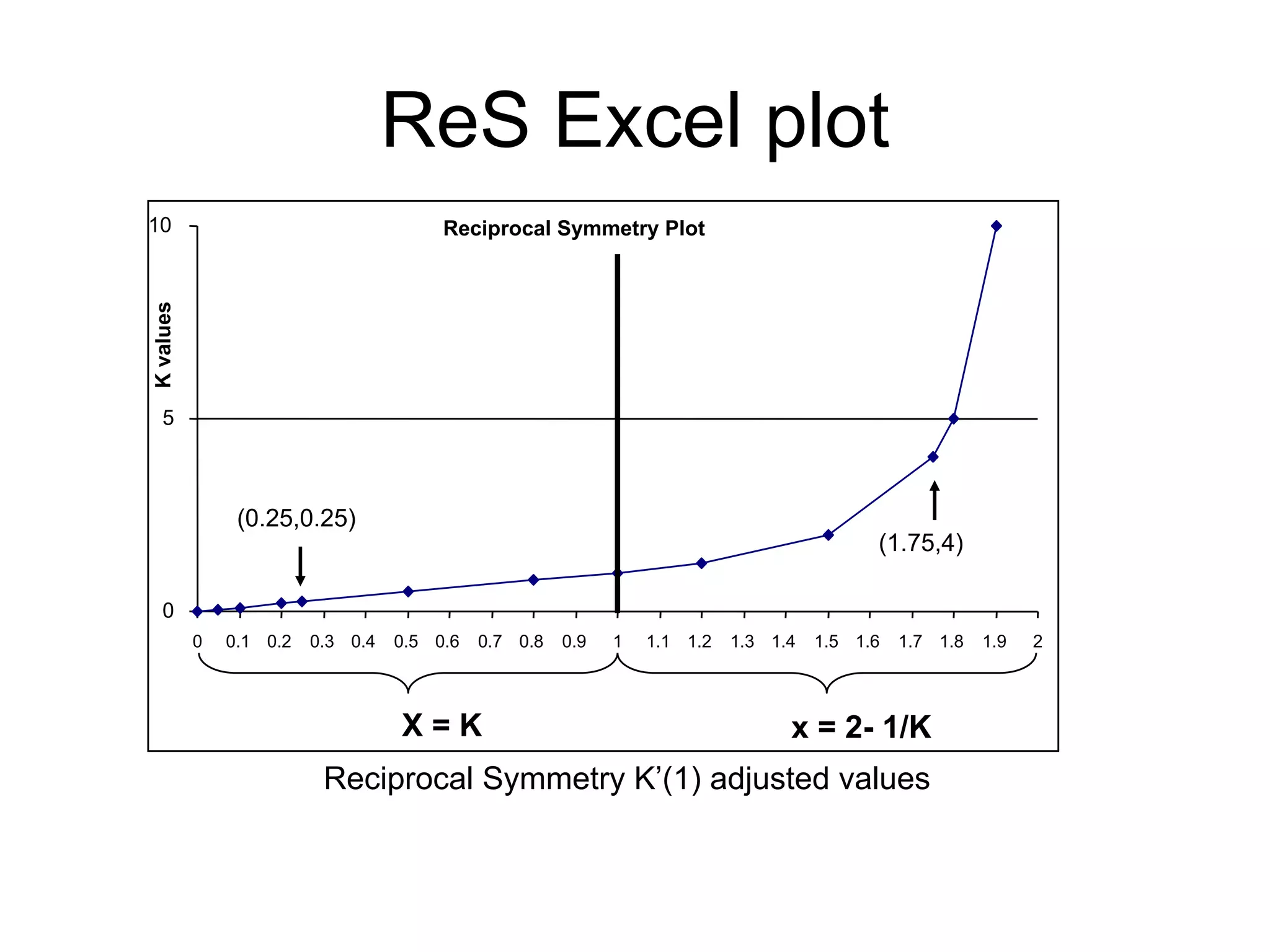
To the left of 1 à x = K
To the right of 1 à x = 2-(1/K)
Reciprocal Symmetry Plot
0
5
10
0 0.1 0.2 0.3 0.4 0.5 0.6 0.7 0.8 0.9 1 1.1 1.2 1.3 1.4 1.5 1.6 1.7 1.8 1.9 2
X = K
Kvalues
x = 2- 1/K
(0.25,0.25)
(1.75,4)
ReS Excel plot
Reciprocal Symmetry K’(1) adjusted values
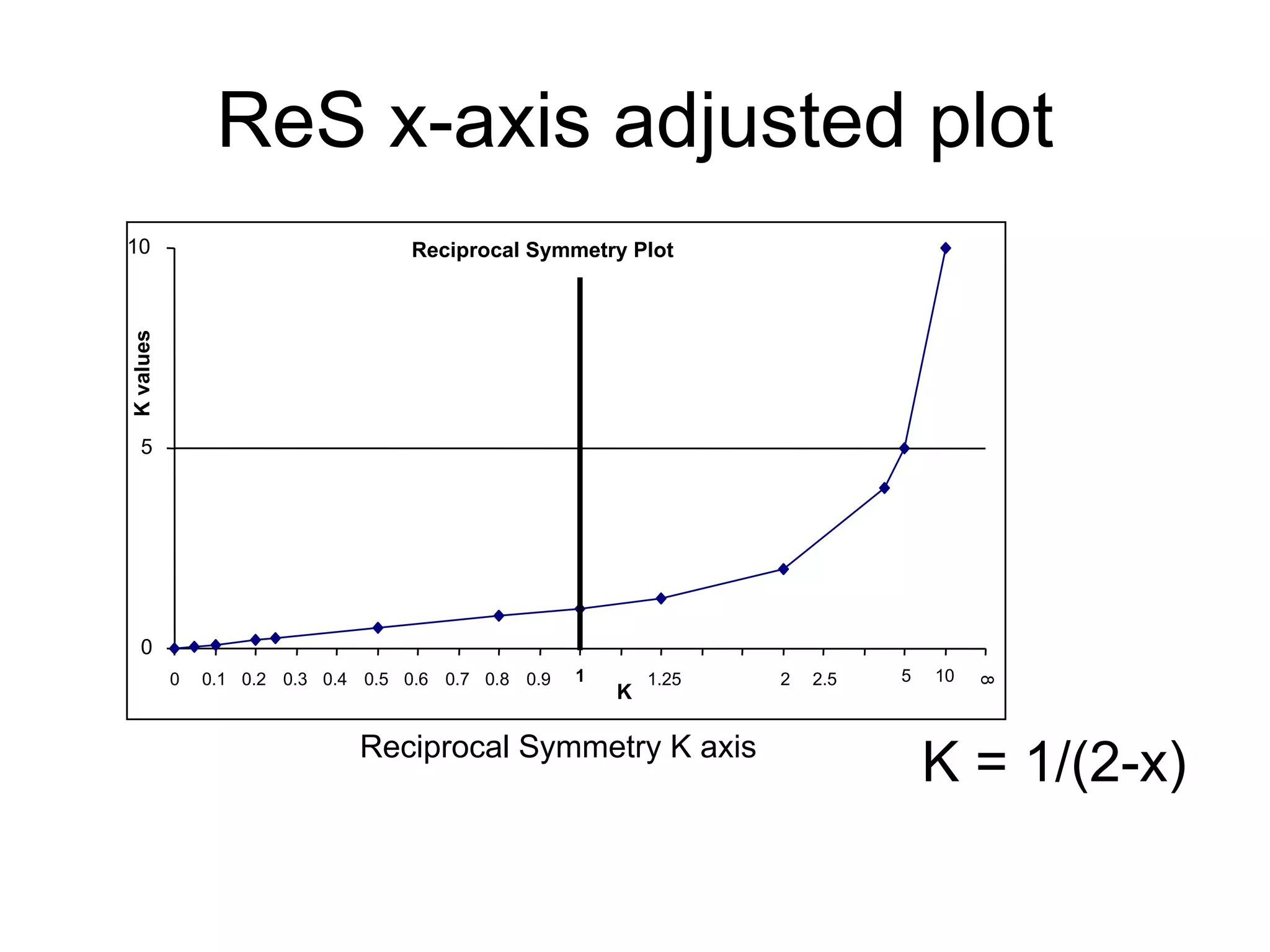
ReS x-axis adjusted plot
Reciprocal Symmetry Plot
0
5
10
0 0.1 0.2 0.3 0.4 0.5 0.6 0.7 0.8 0.9 1 1.25 2 2.5 10
8
K
Kvalues
5
Reciprocal Symmetry K axis
K = 1/(2-x)
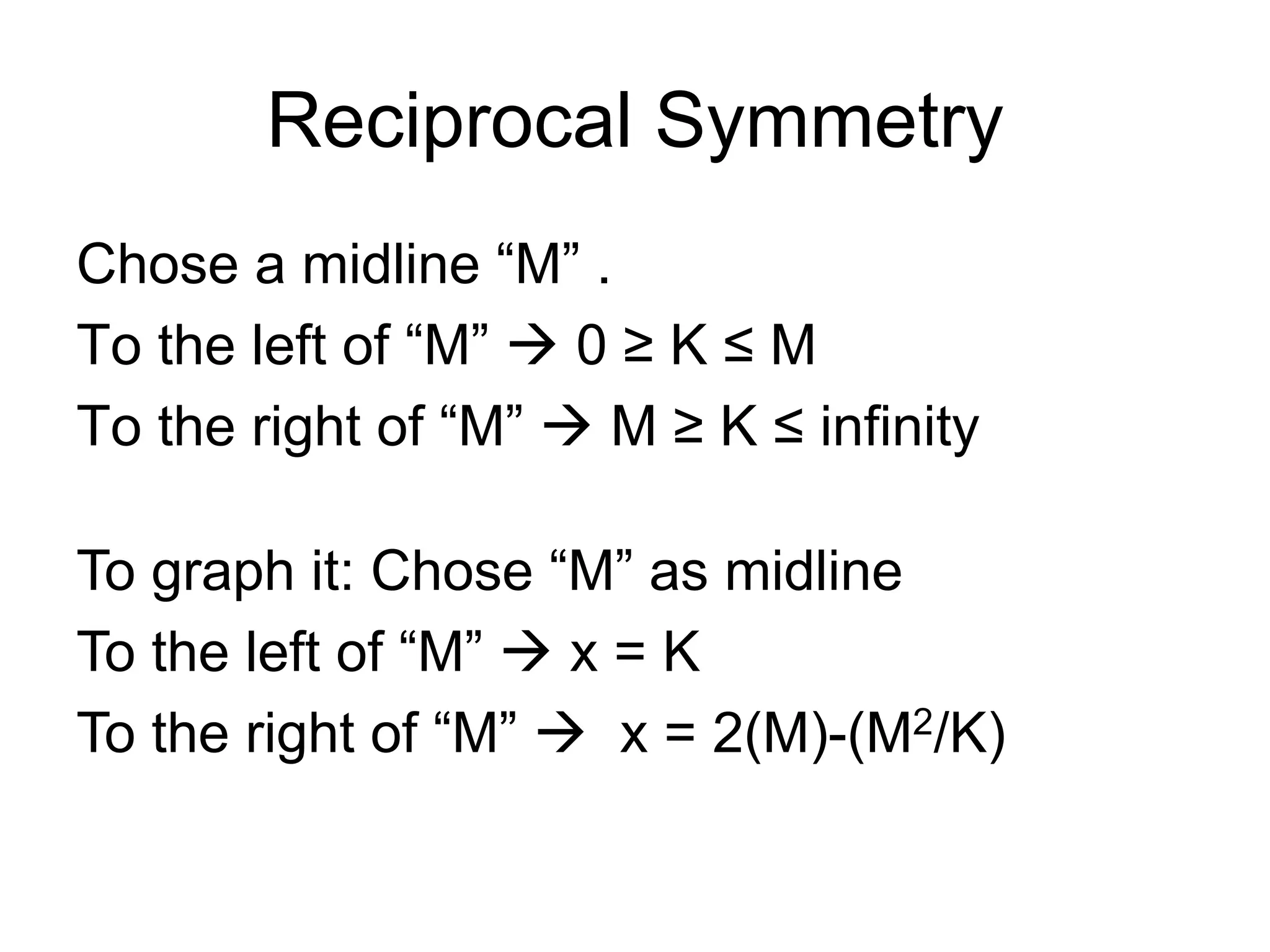
Reciprocal Symmetry
Chose a midline “M” .
To the left of “M” à 0 ≥ K ≤ M
To the right of “M” à M ≥ K ≤ infinity
To graph it: Chose “M” as midline
To the left of “M” à x = K
To the right of “M” à x = 2(M)-(M2/K)
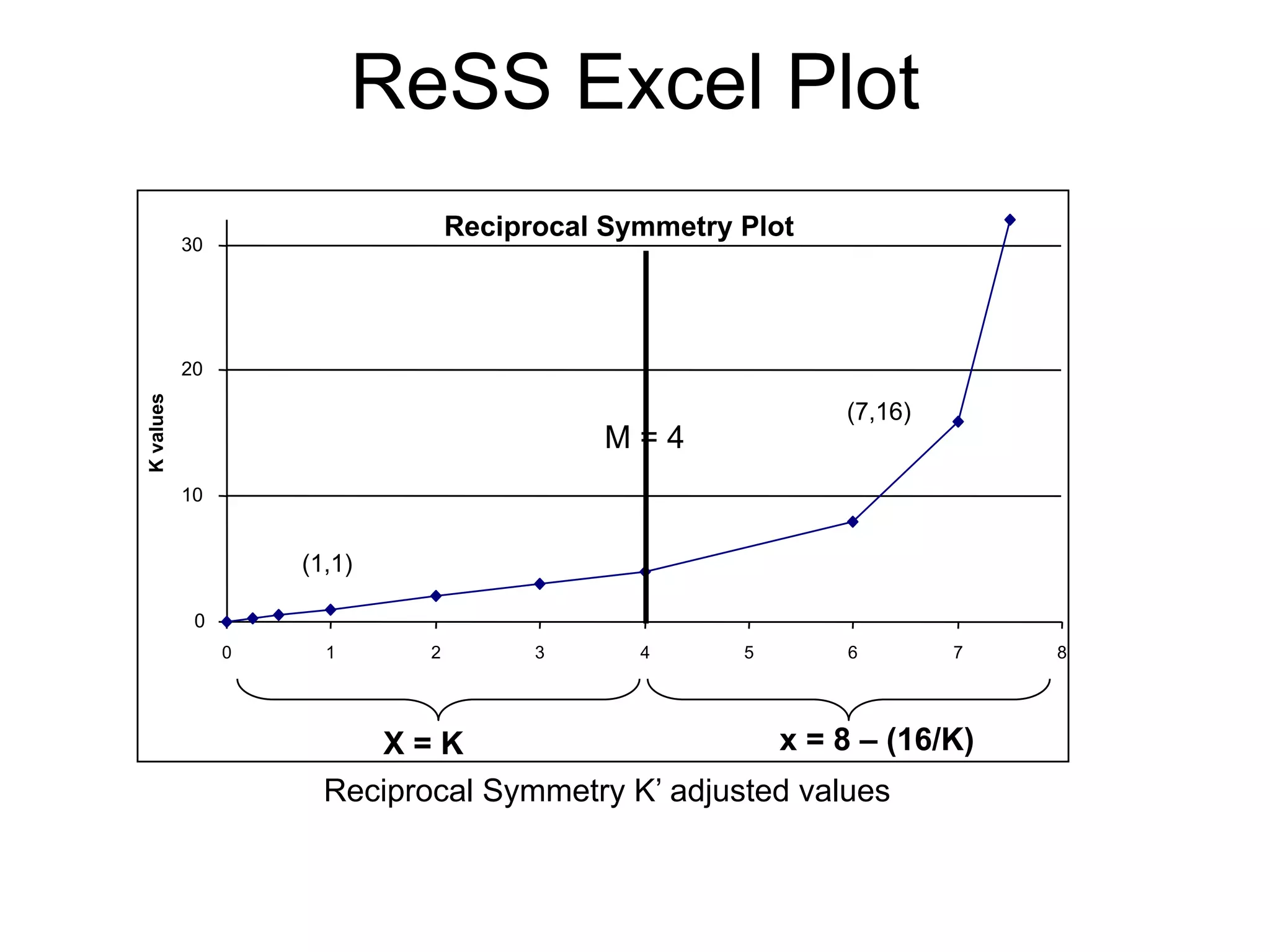
ReSS Excel Plot
Reciprocal Symmetry Plot
0
10
20
30
0 1 2 3 4 5 6 7 8
X = K
Kvalues
x = 8 – (16/K)
(1,1)
(7,16)
Reciprocal Symmetry K’ adjusted values
M = 4
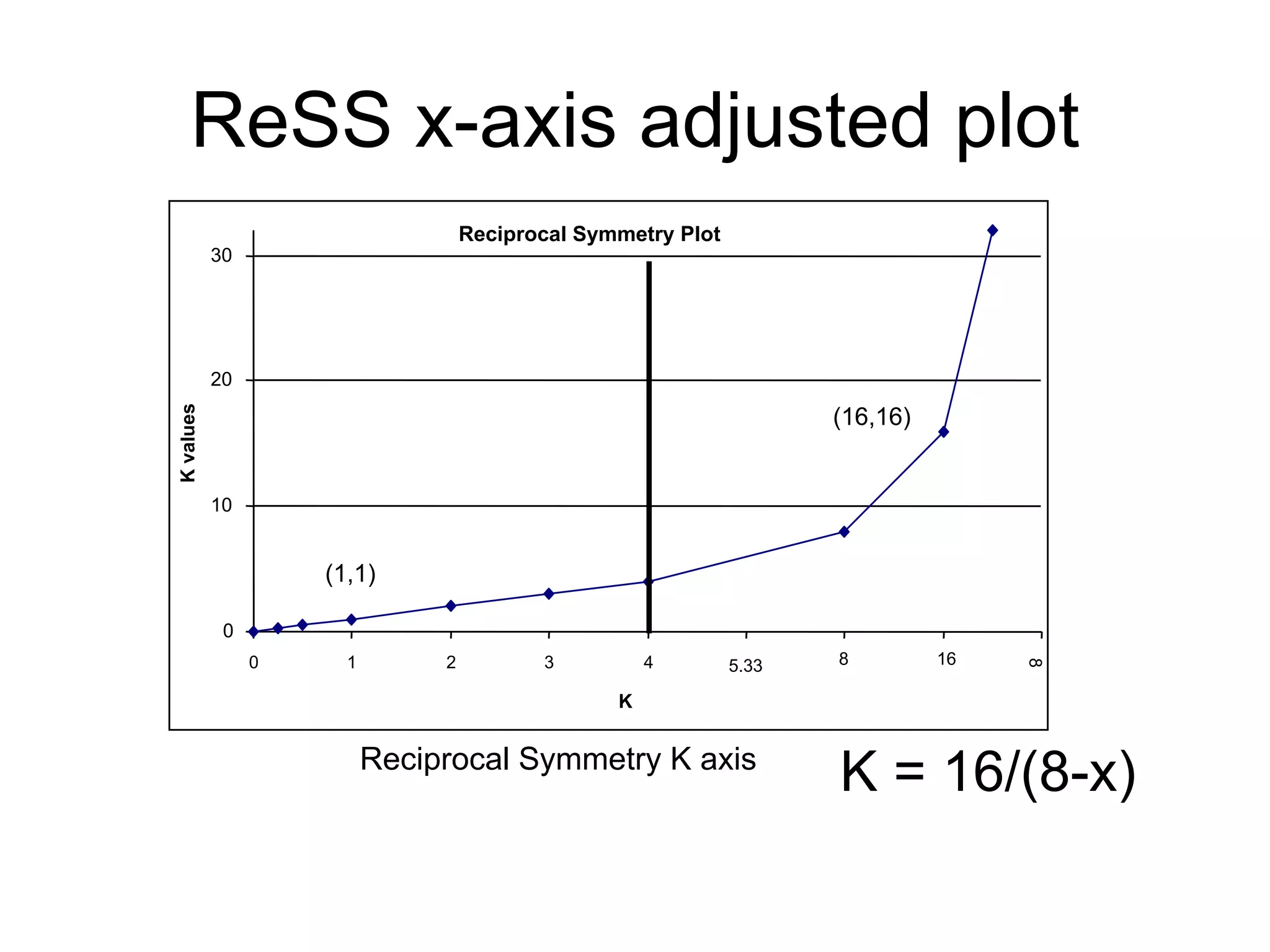
ReSS x-axis adjusted plot
K = 16/(8-x)
Reciprocal Symmetry Plot
0
10
20
30
0 1 2 3 4
8
K
Kvalues
(1,1)
(16,16)
5.33 8 16
Reciprocal Symmetry K axis
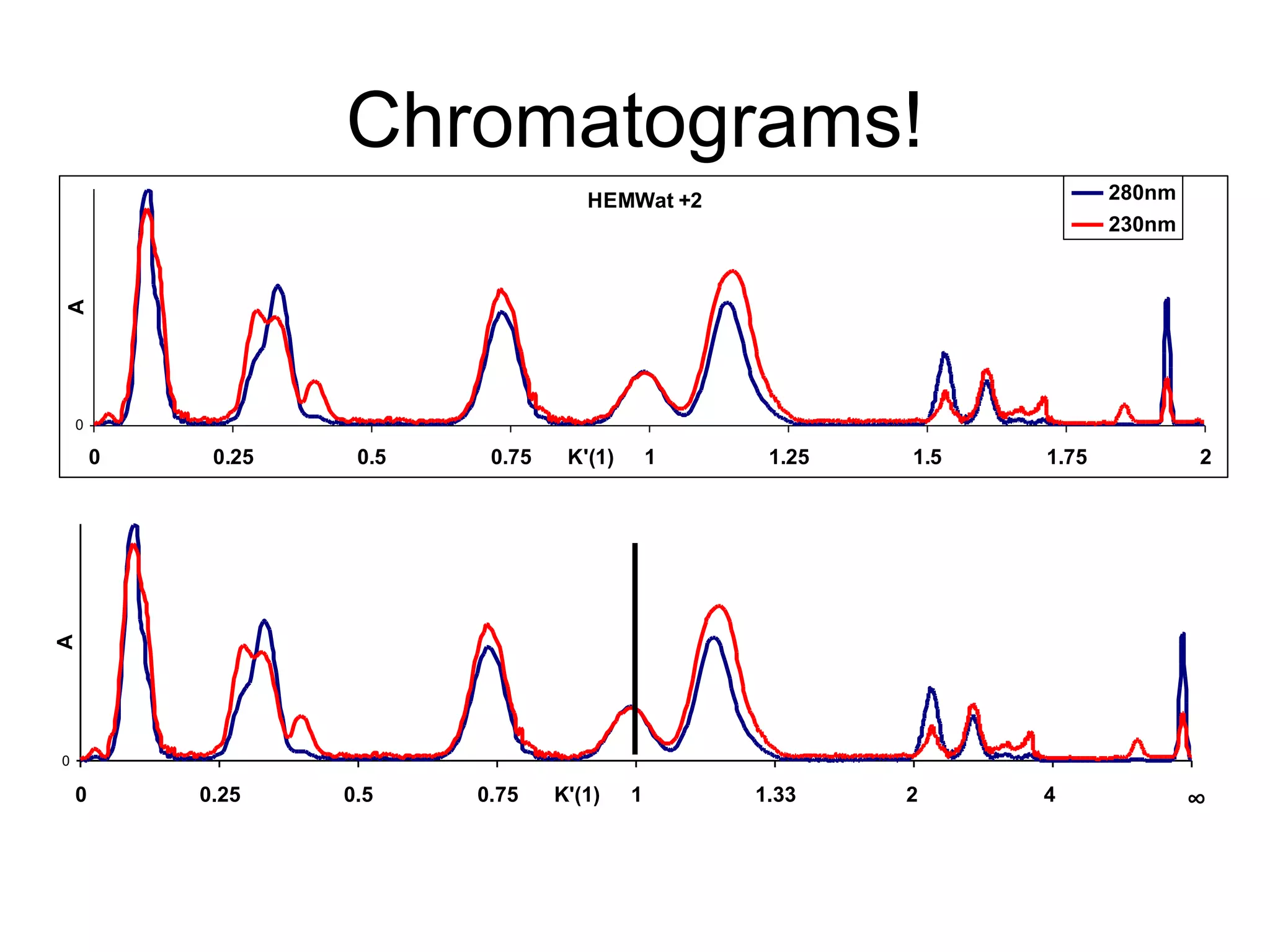
Chromatograms!
HEMWat +2
0
0 0.25 0.5 0.75 1 1.25 1.5 1.75 2K'(1)
A
280nm
230nm
0
0 0.25 0.5 0.75 1 1.33 2 4 ∞K'(1)
A
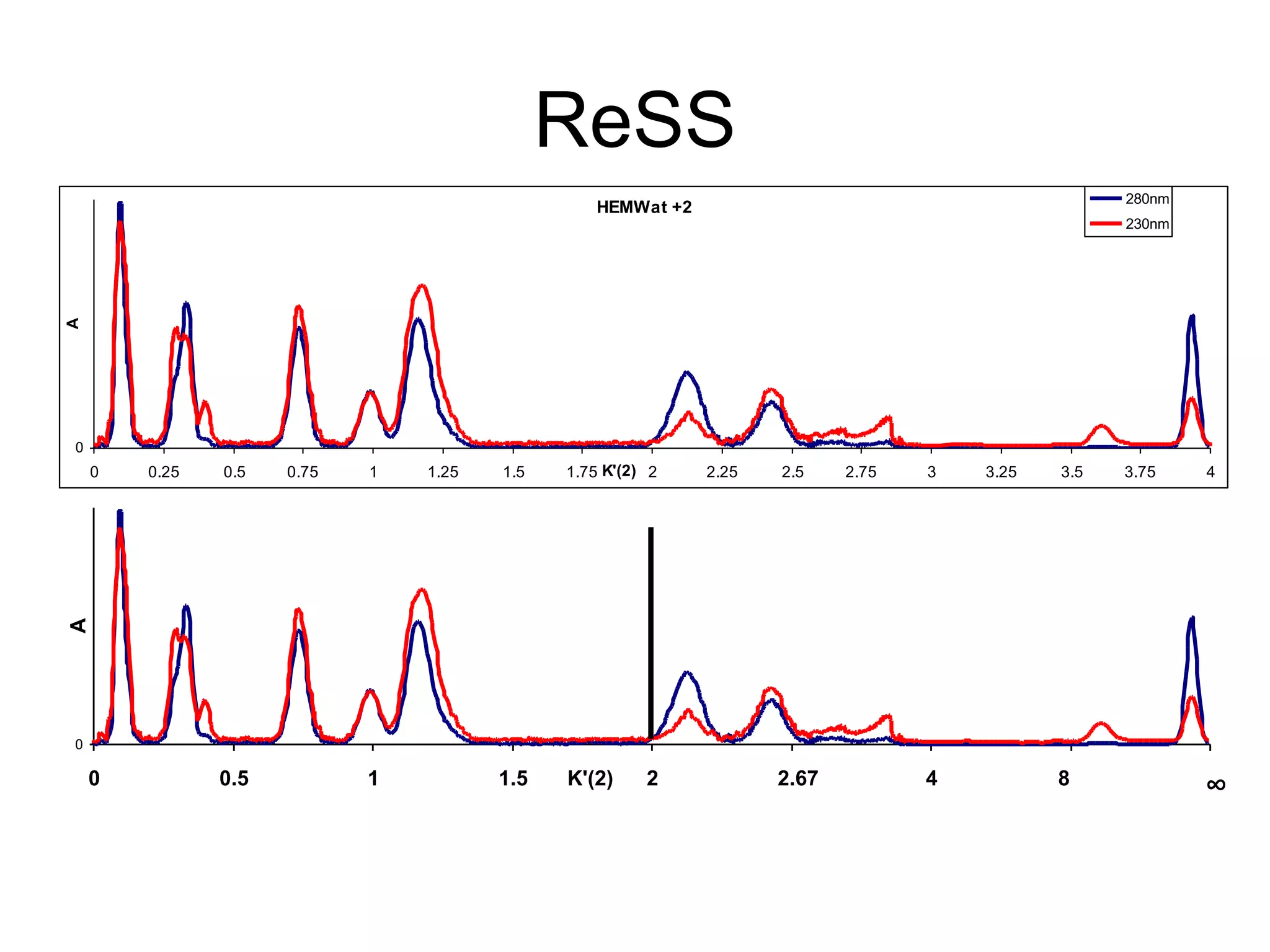
ReSS
HEMWat +2
0
0 0.25 0.5 0.75 1 1.25 1.5 1.75 2 2.25 2.5 2.75 3 3.25 3.5 3.75 4K'(2)
A
280nm
230nm
0
0 0.5 1 1.5 2 2.67 4 8
∞K'(2)
A
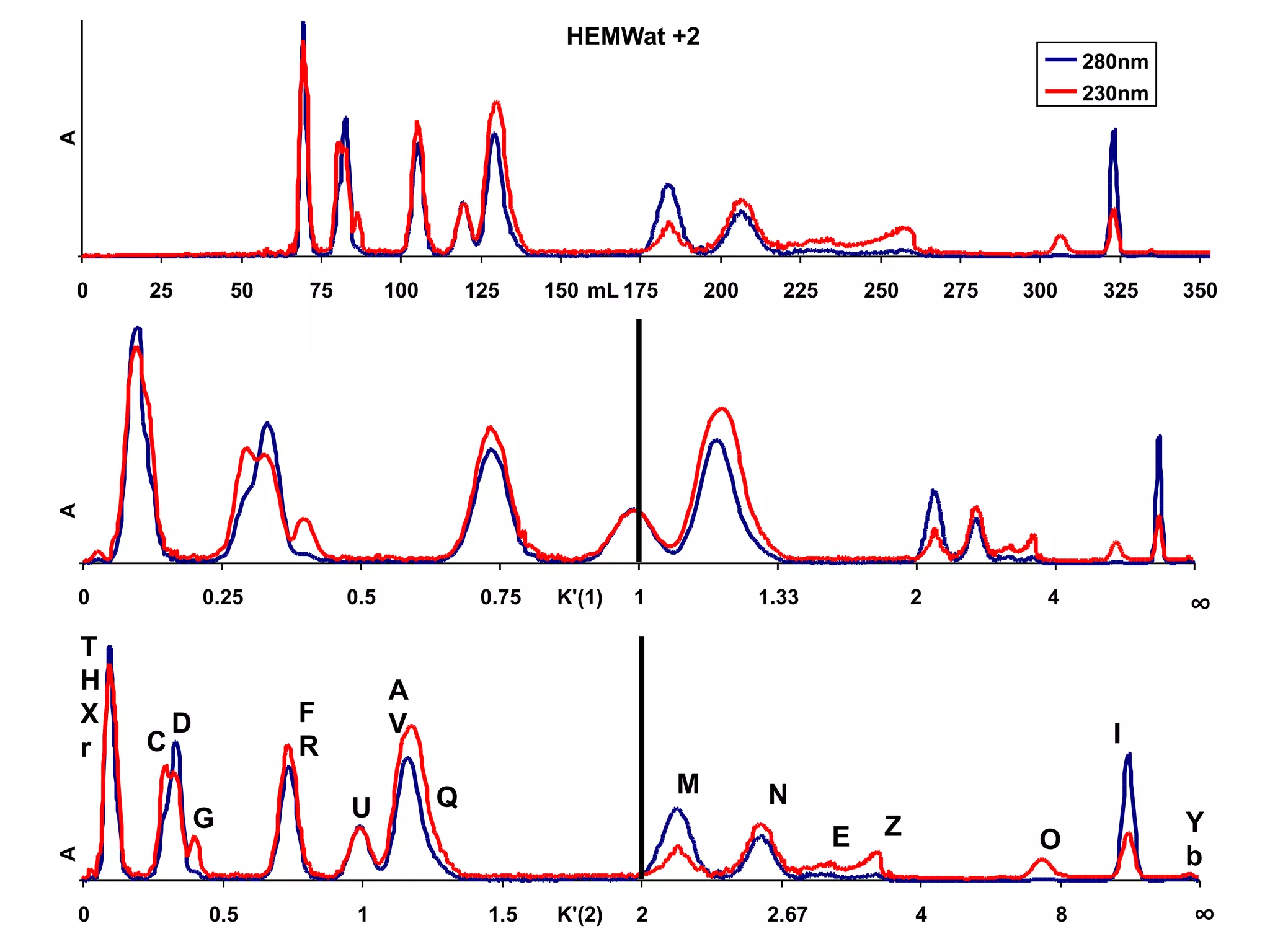
HEMWat +2
0 25 50 75 100 125 150 175 200 225 250 275 300 325 350mL
A 280nm
230nm
0 0.25 0.5 0.75 1 1.33 2 4
∞K'(1)
A
0 0.5 1 1.5 2 2.67 4 8 ∞K'(2)
A
T
H
X
r
D
Y
b
I
OZ
M
E
N
A
V
U
F
R
G
Q
C
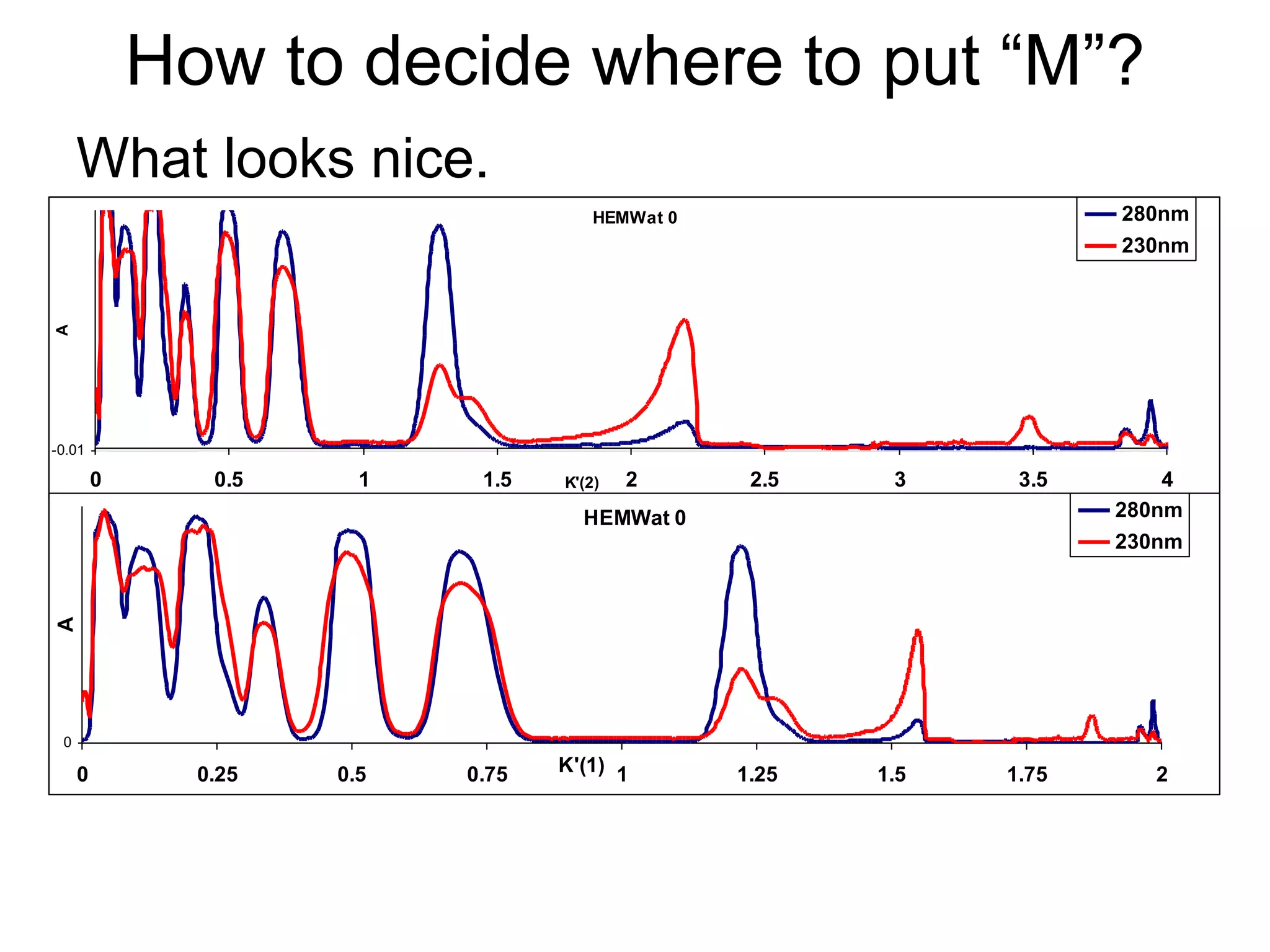
How to decide where to put “M”?
What looks nice.
HEMWat 0
-0.01
0 0.5 1 1.5 2 2.5 3 3.5 4K'(2)
A
280nm
230nm
HEMWat 0
0
0 0.25 0.5 0.75 1 1.25 1.5 1.75 2K'(1)
A
280nm
230nm
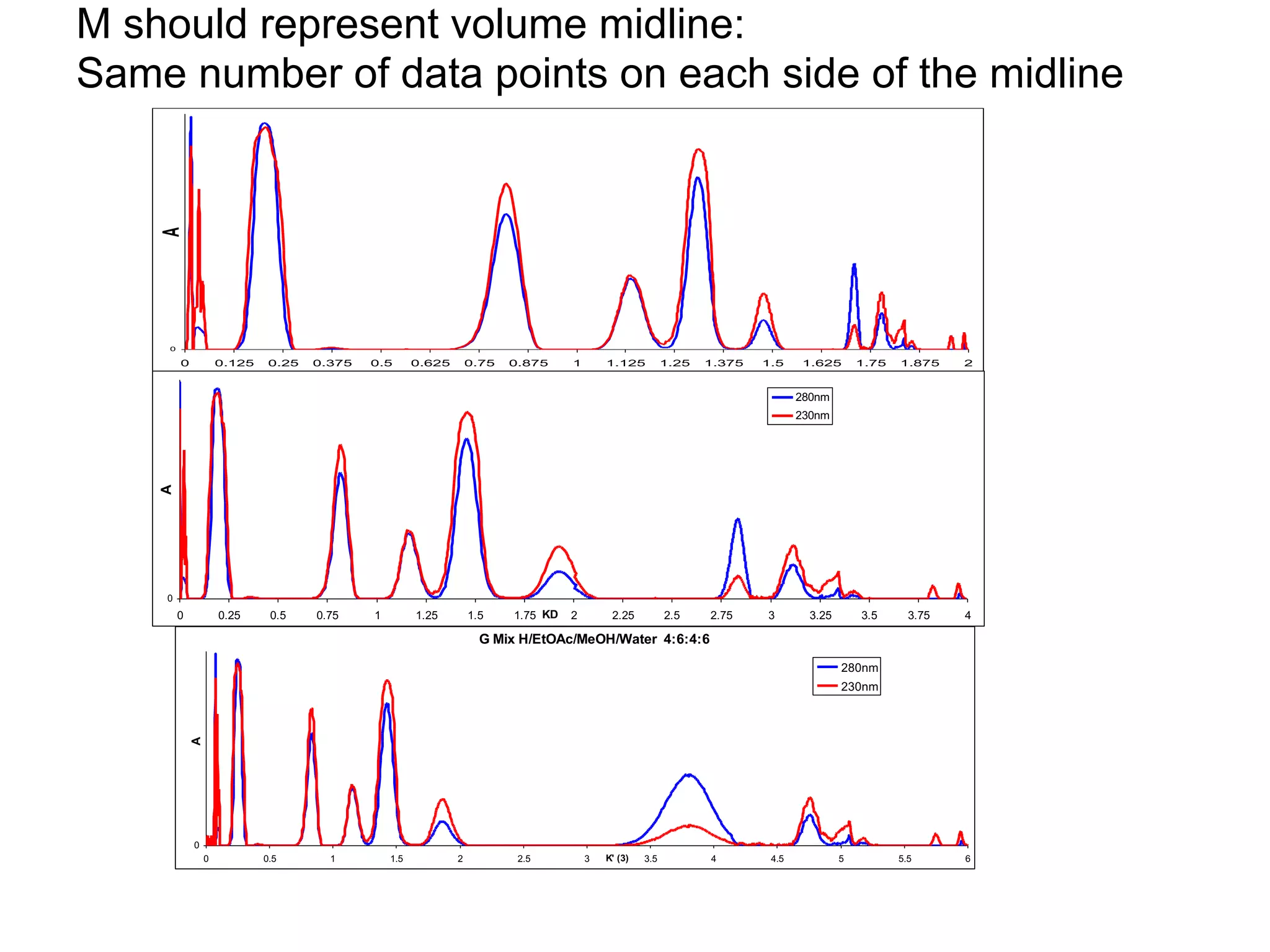
M should represent volume midline:
Same number of data points on each side of the midline
0
0 0.125 0.25 0.375 0.5 0.625 0.75 0.875 1 1.125 1.25 1.375 1.5 1.625 1.75 1.875 2
A
0
0 0.25 0.5 0.75 1 1.25 1.5 1.75 2 2.25 2.5 2.75 3 3.25 3.5 3.75 4KD
A
280nm
230nm
G Mix H/EtOAc/MeOH/Water 4:6:4:6
0
0 0.5 1 1.5 2 2.5 3 3.5 4 4.5 5 5.5 6K' (3)
A
280nm
230nm
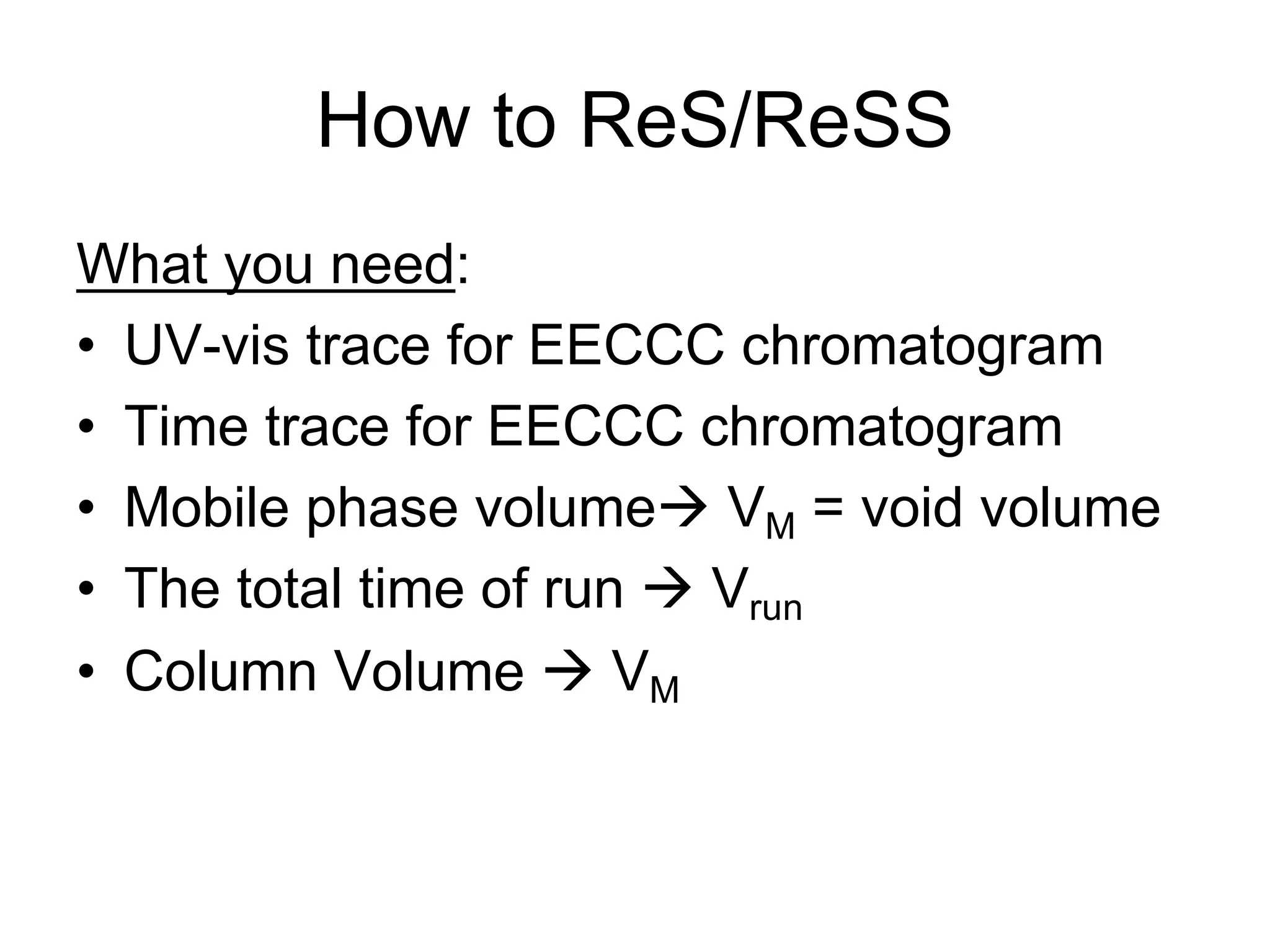
How to ReS/ReSS
What you need:
• UV-vis trace for EECCC chromatogram
• Time trace for EECCC chromatogram
• Mobile phase volumeà VM = void volume
• The total time of run à Vrun
• Column Volume à VM
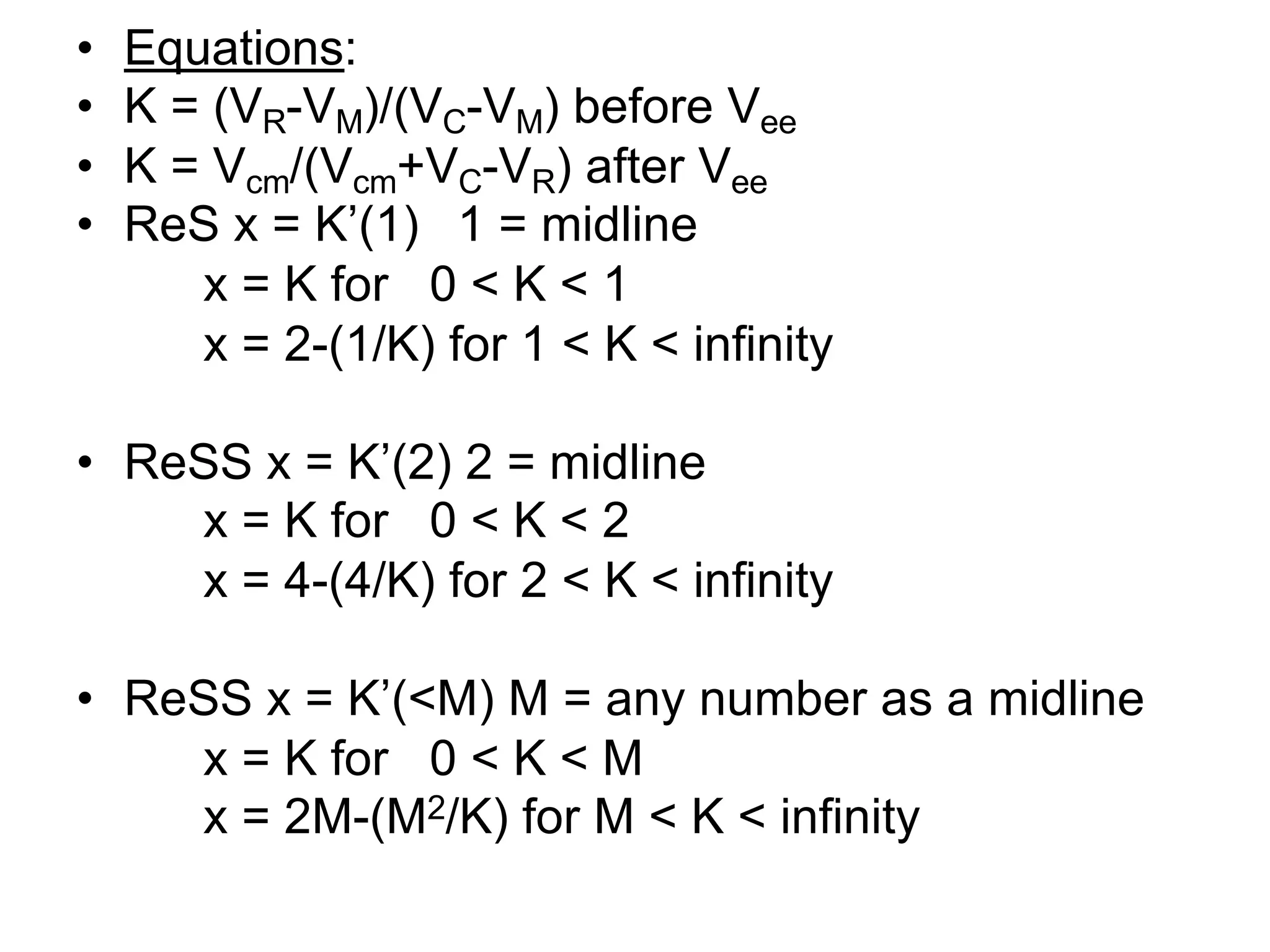
• Equations:
• K = (VR-VM)/(VC-VM) before Vee
• K = Vcm/(Vcm+VC-VR) after Vee
• ReS x = K’(1) 1 = midline
x = K for 0 < K < 1
x = 2-(1/K) for 1 < K < infinity
• ReSS x = K’(2) 2 = midline
x = K for 0 < K < 2
x = 4-(4/K) for 2 < K < infinity
• ReSS x = K’(<M) M = any number as a midline
x = K for 0 < K < M
x = 2M-(M2/K) for M < K < infinity
• Excel Sheet set up:
• A – “Elapsed time” in 20 second intervals A2 = date
• B – 280nm
• C – 230nm
• D – mL & min
• E – tube (3 mL/tube)
• F – VM F2
• Vcm F4 [F8-F10]
• Vee F6 [F8-F10+F2]
• ` Vrun F8
• VC F10
• G – K Vm < K < Vee [ROUND((D___-F$2)/(F$10-F$2),4)]
Vee < K < Vrun [ROUND(F$4/((F$4+F$10)-D___),4)]
• H – K’(1) 0 < K < 1 [ROUND((D___-F$2)/(F$10-F$2),4)]
1 < K < infinity [ROUND(2-1/G____,4)]
• I – K’(2) 0 < K < 2 [ROUND((D____-F$2)/(F$10-F$2),4)]
2 < K < infinity [ROUND(4-4/G____,4)]
Notes
With this set-up you can fool around with VM
and Vrun to fit the chromatogram nicely into
the plot.
• Columns G, H, and I require you to
manually put the two different equations in
for the proper intervals.
• Put K values into the plot, for x > midline,
once you have it in powerpoint.
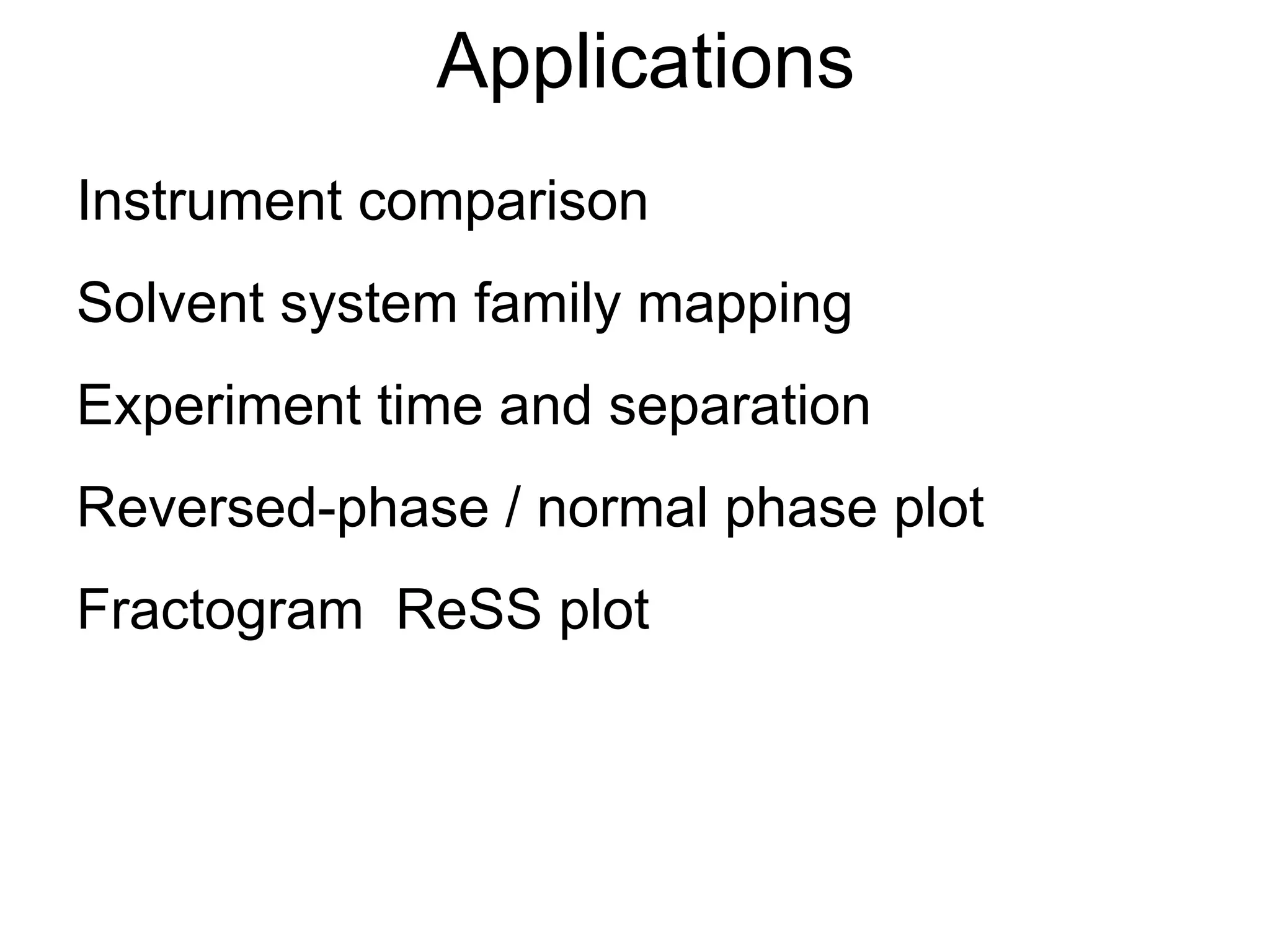
Applications
Instrument comparison
Solvent system family mapping
Experiment time and separation
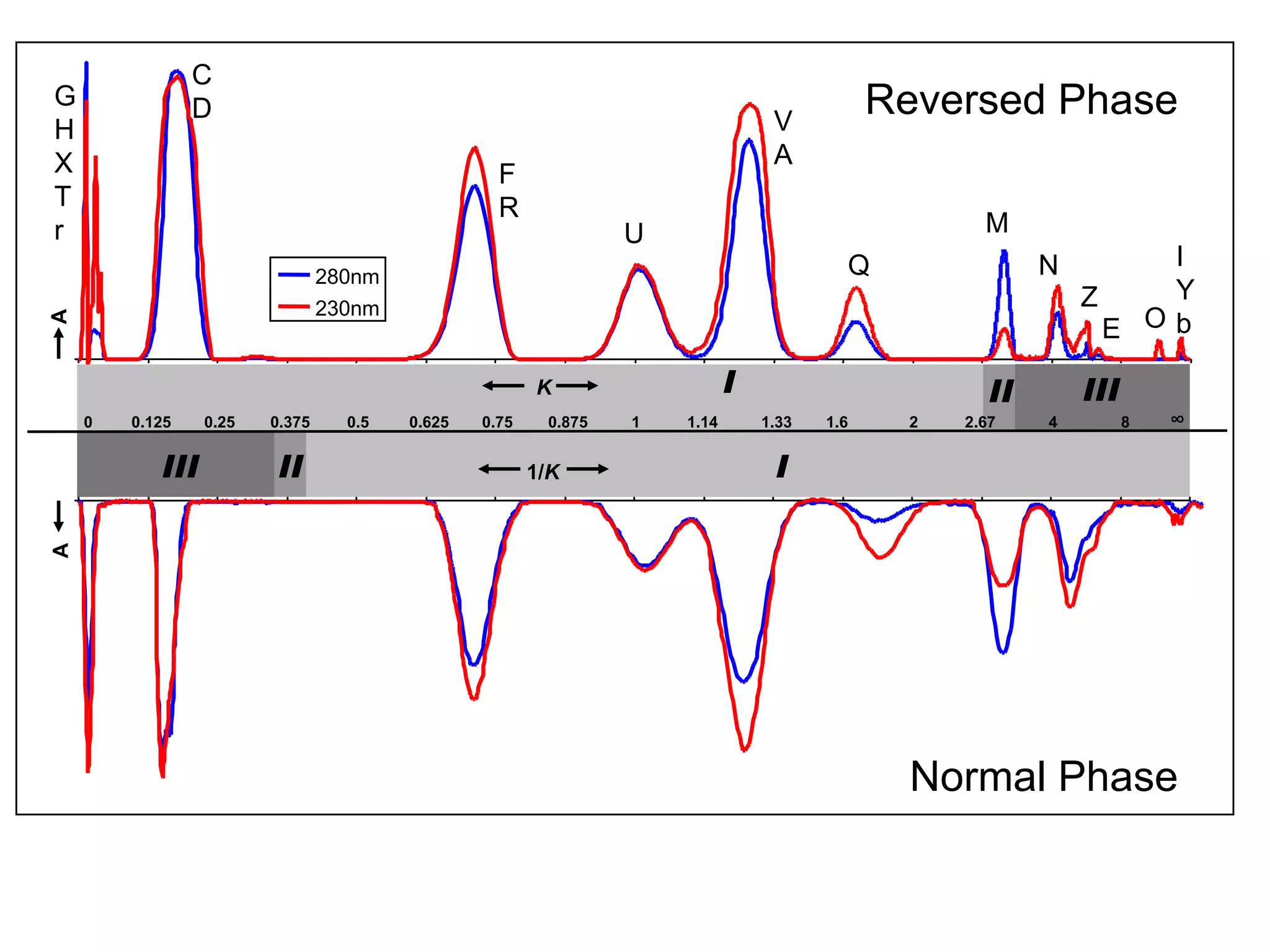
Reversed-phase / normal phase plot
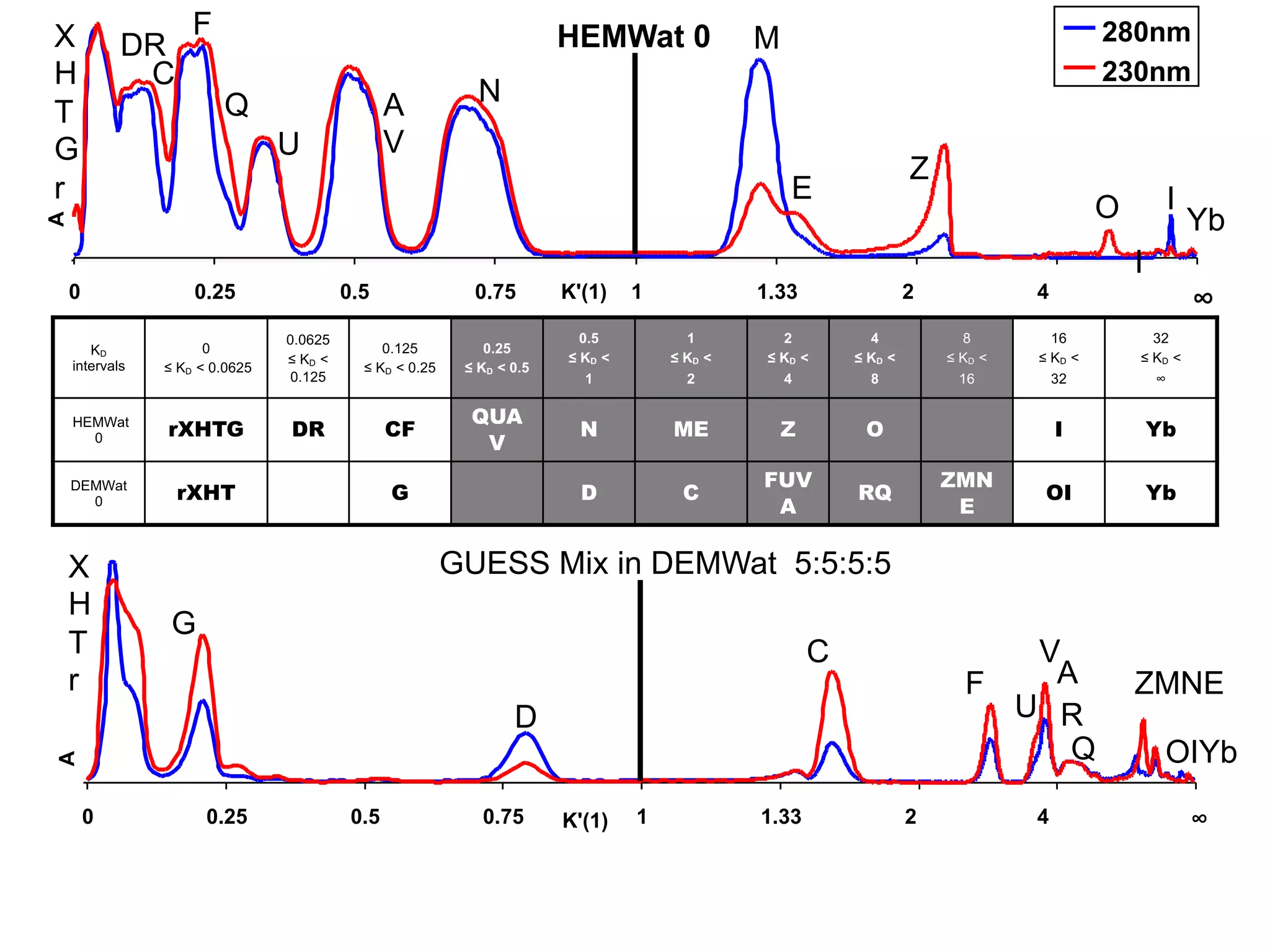
Fractogram ReSS plot
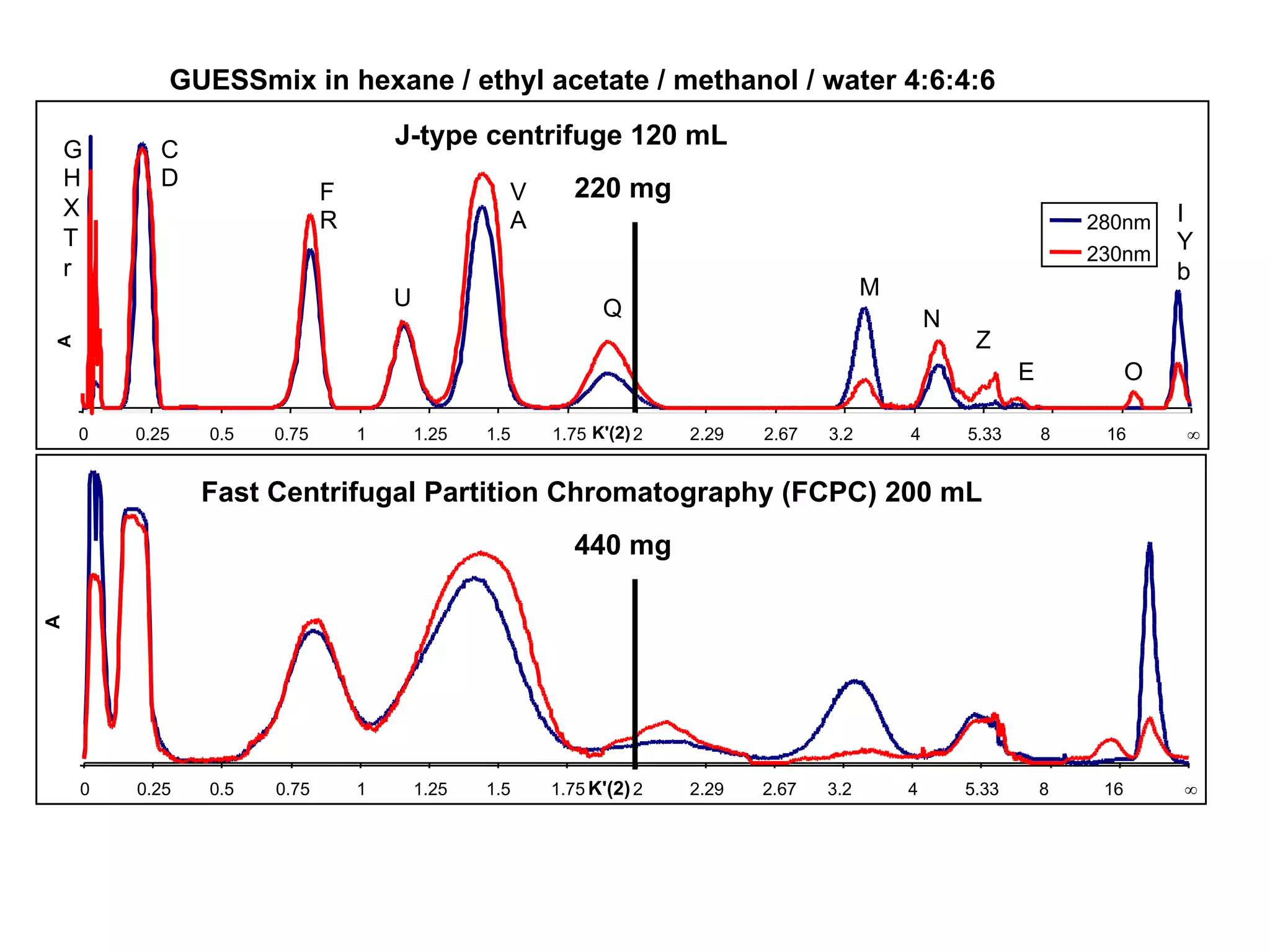
GUESSmix in hexane / ethyl acetate / methanol / water 4:6:4:6
0 0.25 0.5 0.75 1 1.25 1.5 1.75 2 2.29 2.67 3.2 4 5.33 8 16 ¥K'(2)
A
0 0.25 0.5 0.75 1 1.25 1.5 1.75 2 2.29 2.67 3.2 4 5.33 8 16 ¥K'(2)
A
280nm
230nm
J-type centrifuge 120 mL
Fast Centrifugal Partition Chromatography (FCPC) 200 mL
220 mg
440 mg
G
H
X
T
r
C
D
F
R
U
V
A
Q
M
N
Z
E O
I
Y
b
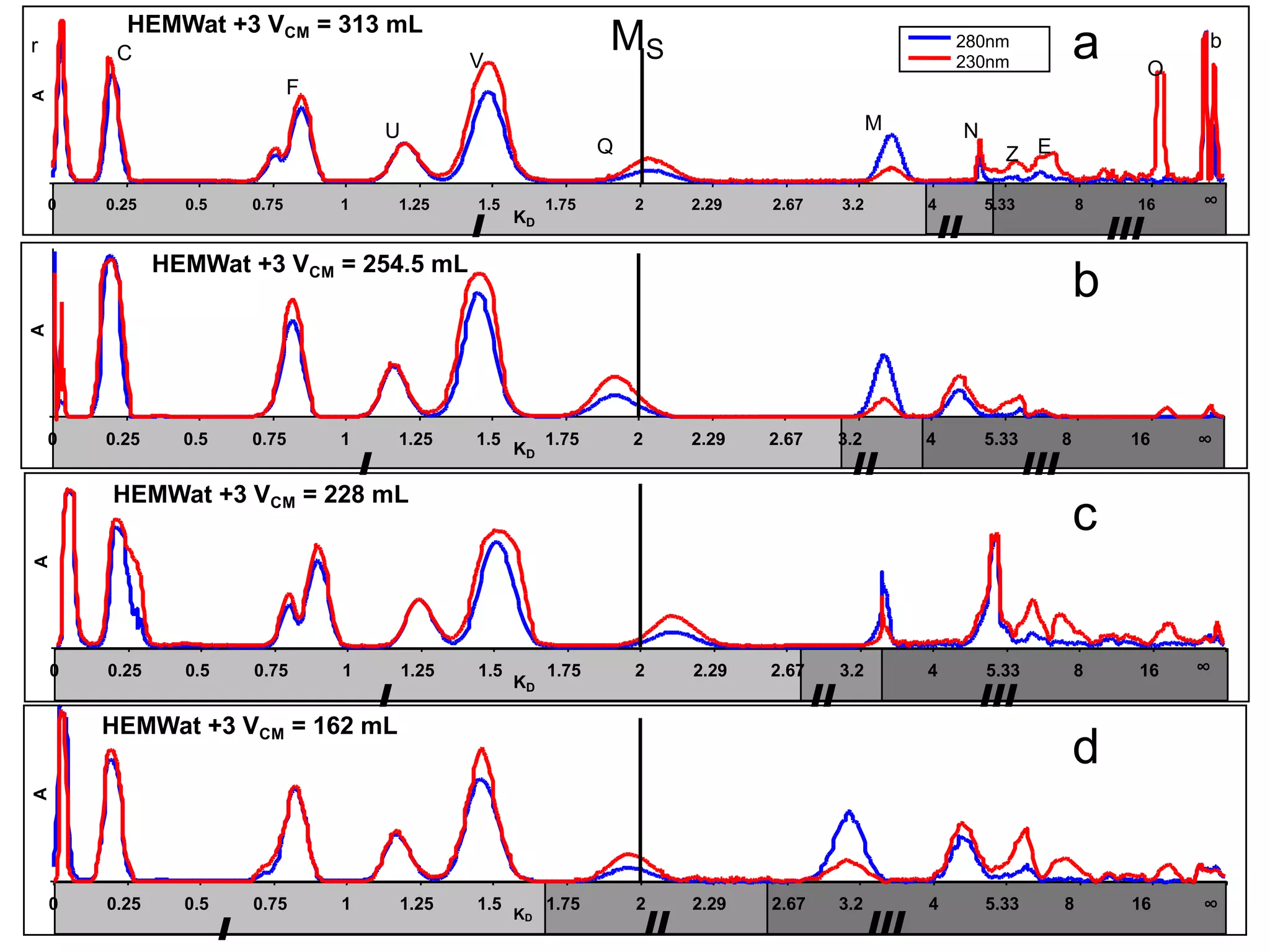
HEMWat +3 VCM = 313 mL
0 0.25 0.5 0.75 1 1.25 1.5 1.75 2 2.29 2.67 3.2 4 5.33 8 16 ∞
KD
A 280nm
230nm
I II III
r C
F
U
V
M
Q
N
Z E
O
b
HEMWat +3 VCM = 254.5 mL
0 0.25 0.5 0.75 1 1.25 1.5 1.75 2 2.29 2.67 3.2 4 5.33 8 16 ∞KD
A
HEMWat +3 VCM = 228 mL
0 0.25 0.5 0.75 1 1.25 1.5 1.75 2 2.29 2.67 3.2 4 5.33 8 16 ∞
KD
A
HEMWat +3 VCM = 162 mL
0 0.25 0.5 0.75 1 1.25 1.5 1.75 2 2.29 2.67 3.2 4 5.33 8 16 ∞KD
A
I II III
I II III
I II III
a
b
c
d
MS
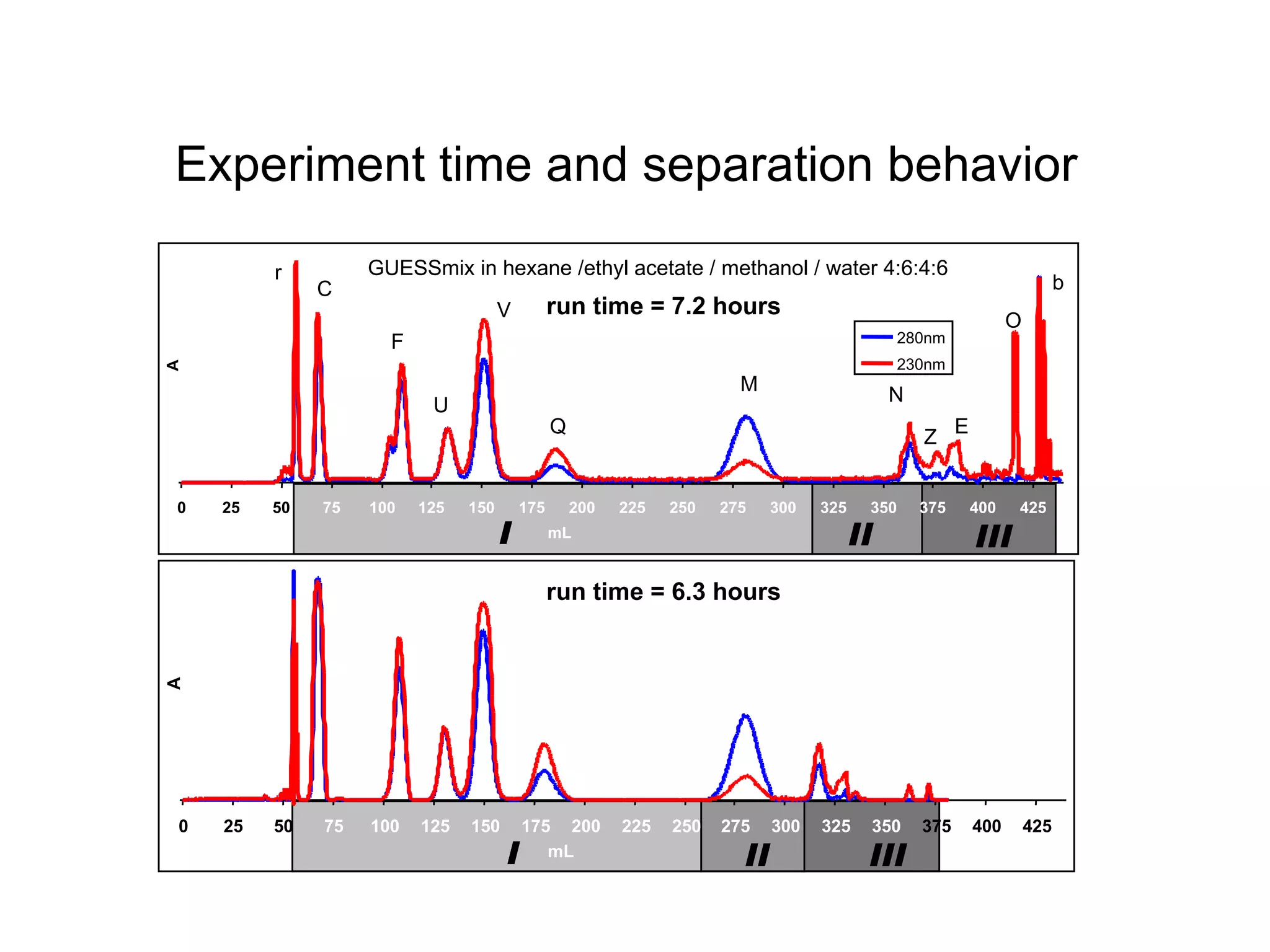
GUESSmix in hexane /ethyl acetate / methanol / water 4:6:4:6
0 25 50 75 100 125 150 175 200 225 250 275 300 325 350 375 400 425
mL
A
280nm
230nm
r
C
F
U
V
M
Q
N
Z
E
O
b
I II III
run time = 7.2 hours
0 25 50 75 100 125 150 175 200 225 250 275 300 325 350 375 400 425
mL
A
I II III
run time = 6.3 hours
Experiment time and separation behavior
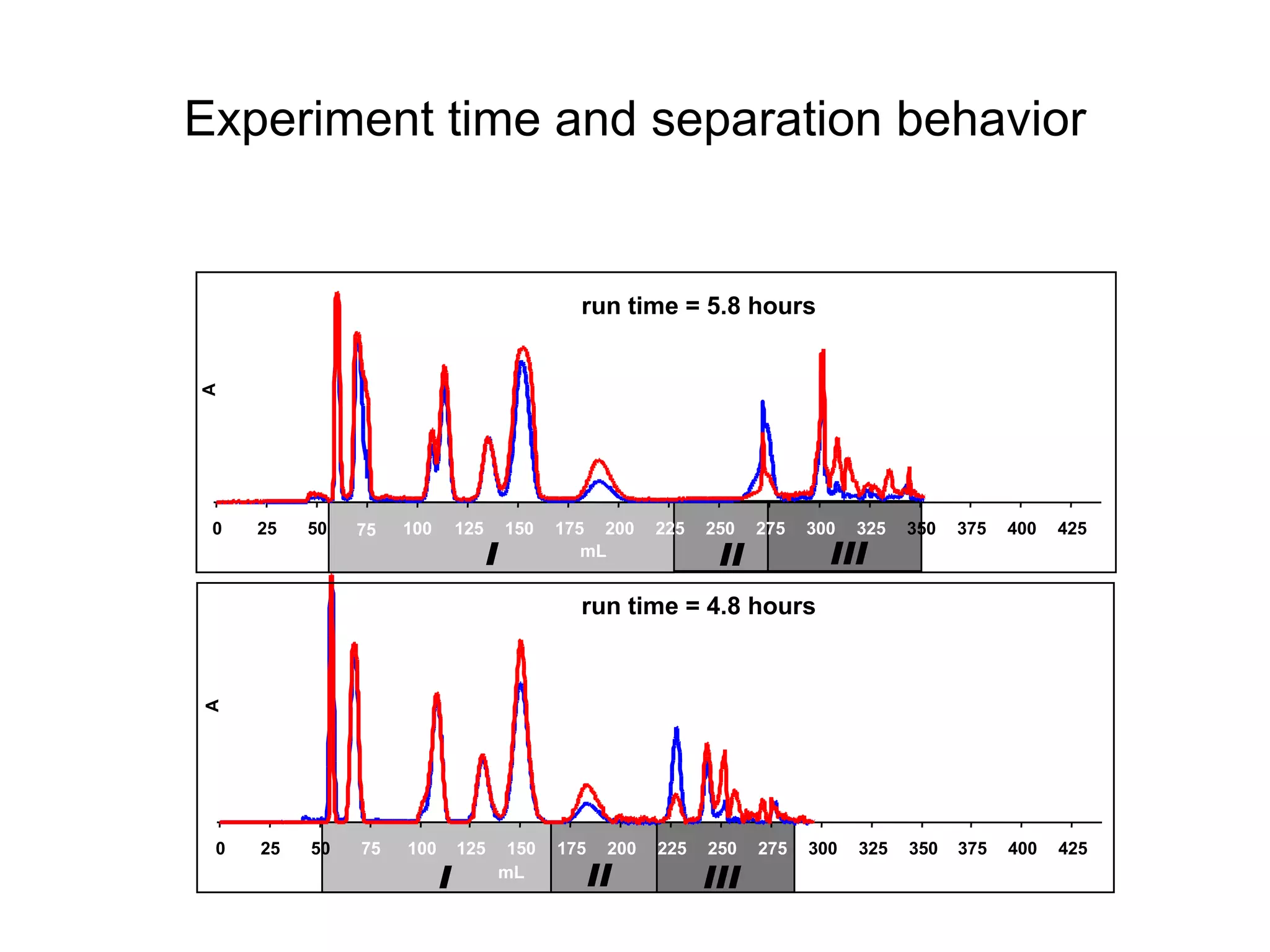
0 25 50 75 100 125 150 175 200 225 250 275 300 325 350 375 400 425
mL
A
I II III
run time = 4.8 hours
0 25 50 75 100 125 150 175 200 225 250 275 300 325 350 375 400 425
mL
A
I II III
run time = 5.8 hours
Experiment time and separation behavior
A
280nm
230nm
A
K
0 0.125 0.25 0.375 0.5 0.625 0.75 0.875 1 1.14 1.33 1.6 2 2.67 4 8 ∞
IIII II
IIIII I1/K
Reversed Phase
Normal Phase
G
H
X
T
r
C
D
F
R
U
V
A
Q
M
N
Z
E O
I
Y
b
KD
intervals
0
≤ KD < 0.0625
0.0625
≤ KD <
0.125
0.125
≤ KD < 0.25
0.25
≤ KD < 0.5
0.5
≤ KD <
1
1
≤ KD <
2
2
≤ KD <
4
4
≤ KD <
8
8
≤ KD <
16
16
≤ KD <
32
32
≤ KD <
∞
HEMWat
0 rXHTG DR CF
QUA
V
N ME Z O I Yb
DEMWat
0 rXHT G D C
FUV
A
RQ
ZMN
E
OI Yb
GUESS Mix in DEMWat 5:5:5:5
0 0.25 0.5 0.75 1 1.33 2 4 ∞K'(1)
A
HEMWat 0
0 0.25 0.5 0.75 1 1.33 2 4
∞K'(1)
A
280nm
230nm
O
I
Yb
Z
E
M
NA
VU
F
DRX
H
T
G
r
C
Q
I
X
H
T
r
G
D
C
F
U
V
A
R
Q
ZMNE
OIYb
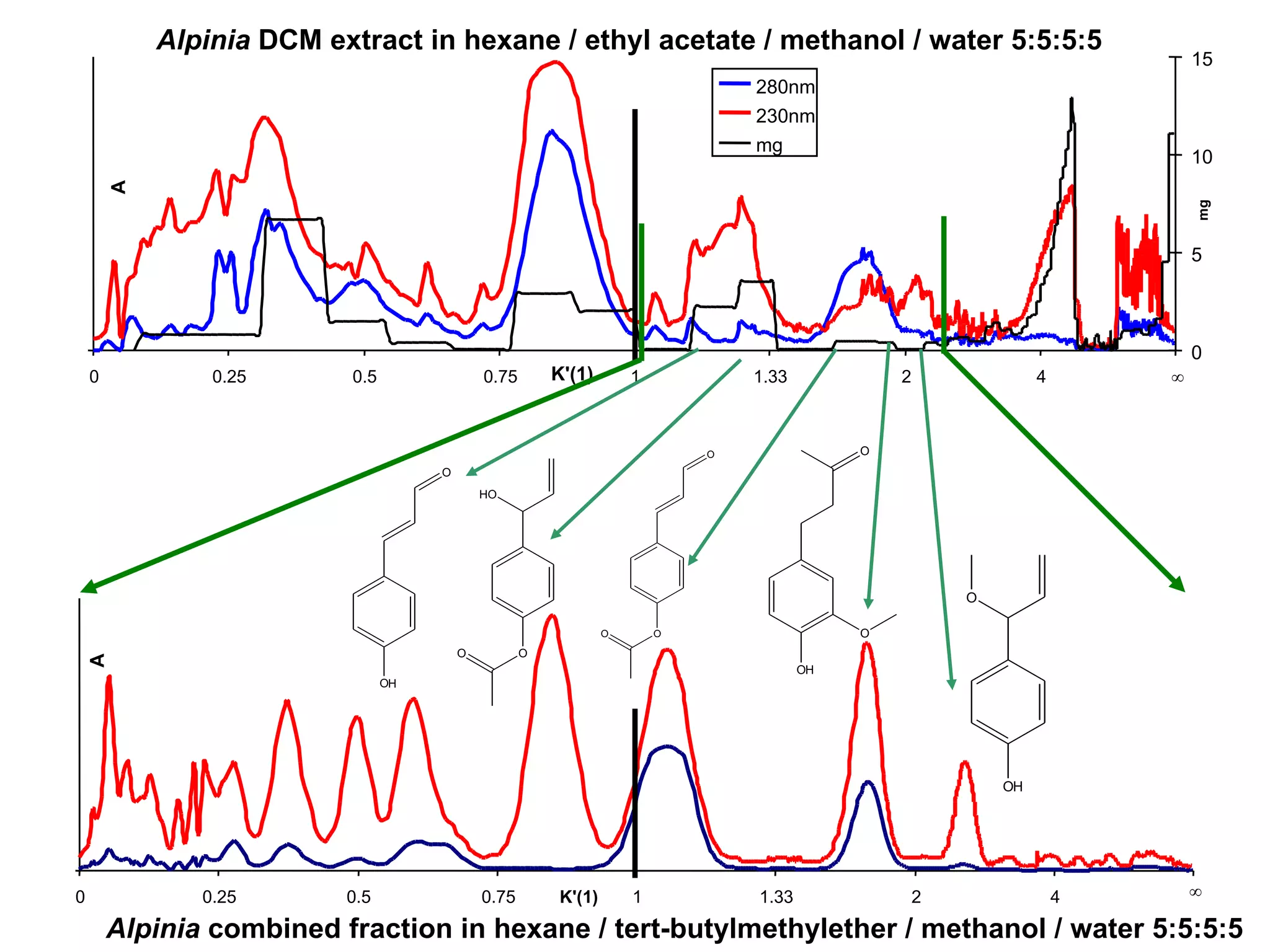
Alpinia combined fraction in hexane / tert-butylmethylether / methanol / water 5:5:5:5
0 0.25 0.5 0.75 1 1.33 2 4 ¥K'(1)
A
Alpinia DCM extract in hexane / ethyl acetate / methanol / water 5:5:5:5
0 0.25 0.5 0.75 1 1.33 2 4 ¥K'(1)
A
0
5
10
15
mg
280nm
230nm
mg
OH
O
OO
HO
OO
O
OH
O
O
OH
O
0 0.5 1 1.5 2 2.5 3 3.5 4 4.57 5.33 6.4 8 10.67 16 32 ¥
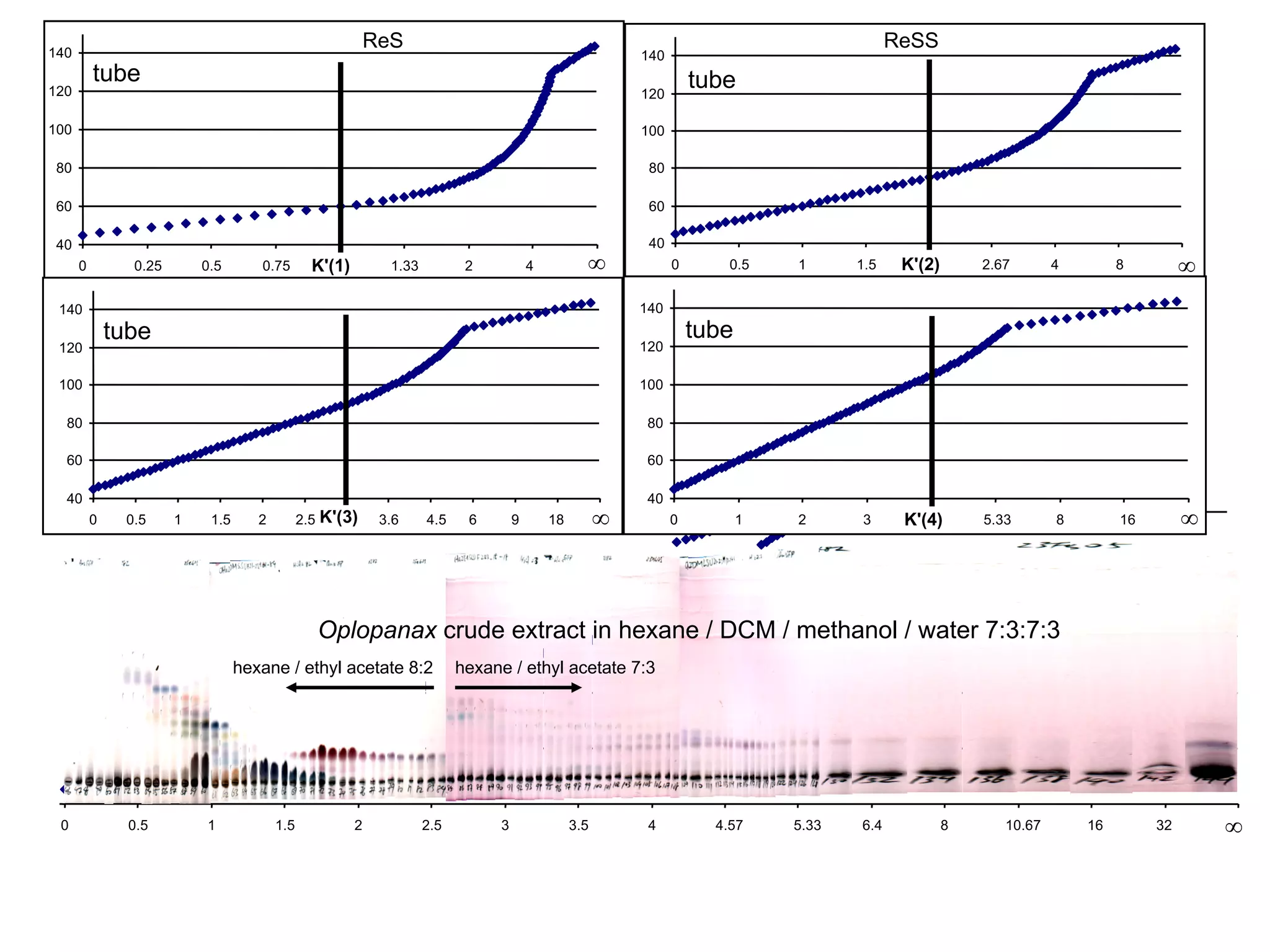
Oplopanax crude extract in hexane / DCM / methanol / water 7:3:7:3
hexane / ethyl acetate 8:2 hexane / ethyl acetate 7:3
ReS
40
60
80
100
120
140
0 0.25 0.5 0.75 1.33 2 4 ¥K'(1)
40
60
80
100
120
140
0 0.5 1 1.5 2.67 4 8 ¥K'(2)
40
60
80
100
120
140
0 0.5 1 1.5 2 2.5 3.6 4.5 6 9 18 ¥K'(3)
40
60
80
100
120
140
0 1 2 3 5.33 8 16 ¥K'(4)
tube tube
tubetube
ReSS
References
Reciprocal Symmetry Plots as a New Representation of
Countercurrent Chromatograms. G.F. Pauli, J.B. Friesen US
8175817 B2 awarded 05/08/2012.
http://www.google.com/patents/US8175817
Friesen, J. B.; Pauli, G. F., Reciprocal symmetry plots as a
representation of countercurrent chromatograms. Analytical
Chemistry 2007, 79, 2320-2324
Friesen, J. B.; Pauli, G. F., Rational development of solvent system
families in counter-current chromatography. Journal of
Chromatography A 2007, 1151, 51-59.
Friesen, J. B.; Pauli, G. F., Performance characteristics of countercurrent
separation in analysis of natural products of agricultural significance. Journal
of Agricultural and Food Chemistry 2008, 56, 19-28.
Friesen, J. B.; Pauli, G. F., GUESSmix-guided optimization of
elution-extrusion counter-current separations. Journal of
Chromatography A 2009, 1216, 4225-4231.

Reciprocal symmetry plots in Countercurrent Chromatography

  • 1.
    How to ReSand ReSS A 280nm 230nm A K 0 0.125 0.25 0.375 0.5 0.625 0.75 0.875 1 1.14 1.33 1.6 2 2.67 4 8 ∞ IIII II IIIII I1/K GUESSmix in Hexane / Ethyl acetate / Methanol / Water 4:6:4:6 Reverse Phase Normal Phase G H X T r C D F R U V A Q M N Z E O I Y b
  • 2.
    Traditional Chromatogram HEMWat +2 0 025 50 75 100 125 150 175 200 225 250 275 300 325 350mL A 280nm 230nm 120 mL HSCCC (CCC-1000) 1 mL/min, 1,200 rpm fraction collection 3 mL/tube Elution Extrusion Method
  • 3.
    How to representthe partition coefficient K on the chromatograph? 0 0 50 100 150 200 250 300 350mL A 0 10 20 30 40 50 60 70 80 90 100 280nm 230nm K 0 ≥ K ≤ infinity K = (VR-VM)/VS
  • 4.
    Reciprocal Symmetry Chose amidline “M” . To the left of “M” à 0 ≥ K ≤ M To the right of “M” à M ≥ K ≤ infinity To graph it: Chose “1” as midline To the left of 1 à x = K To the right of 1 à x = 2-(1/K)
  • 5.
    Reciprocal Symmetry Plot 0 5 10 00.1 0.2 0.3 0.4 0.5 0.6 0.7 0.8 0.9 1 1.1 1.2 1.3 1.4 1.5 1.6 1.7 1.8 1.9 2 X = K Kvalues x = 2- 1/K (0.25,0.25) (1.75,4) ReS Excel plot Reciprocal Symmetry K’(1) adjusted values
  • 6.
    ReS x-axis adjustedplot Reciprocal Symmetry Plot 0 5 10 0 0.1 0.2 0.3 0.4 0.5 0.6 0.7 0.8 0.9 1 1.25 2 2.5 10 8 K Kvalues 5 Reciprocal Symmetry K axis K = 1/(2-x)
  • 7.
    Reciprocal Symmetry Chose amidline “M” . To the left of “M” à 0 ≥ K ≤ M To the right of “M” à M ≥ K ≤ infinity To graph it: Chose “M” as midline To the left of “M” à x = K To the right of “M” à x = 2(M)-(M2/K)
  • 8.
    ReSS Excel Plot ReciprocalSymmetry Plot 0 10 20 30 0 1 2 3 4 5 6 7 8 X = K Kvalues x = 8 – (16/K) (1,1) (7,16) Reciprocal Symmetry K’ adjusted values M = 4
  • 9.
    ReSS x-axis adjustedplot K = 16/(8-x) Reciprocal Symmetry Plot 0 10 20 30 0 1 2 3 4 8 K Kvalues (1,1) (16,16) 5.33 8 16 Reciprocal Symmetry K axis
  • 10.
    Chromatograms! HEMWat +2 0 0 0.250.5 0.75 1 1.25 1.5 1.75 2K'(1) A 280nm 230nm 0 0 0.25 0.5 0.75 1 1.33 2 4 ∞K'(1) A
  • 11.
    ReSS HEMWat +2 0 0 0.250.5 0.75 1 1.25 1.5 1.75 2 2.25 2.5 2.75 3 3.25 3.5 3.75 4K'(2) A 280nm 230nm 0 0 0.5 1 1.5 2 2.67 4 8 ∞K'(2) A
  • 12.
    HEMWat +2 0 2550 75 100 125 150 175 200 225 250 275 300 325 350mL A 280nm 230nm 0 0.25 0.5 0.75 1 1.33 2 4 ∞K'(1) A 0 0.5 1 1.5 2 2.67 4 8 ∞K'(2) A T H X r D Y b I OZ M E N A V U F R G Q C
  • 13.
    How to decidewhere to put “M”? What looks nice. HEMWat 0 -0.01 0 0.5 1 1.5 2 2.5 3 3.5 4K'(2) A 280nm 230nm HEMWat 0 0 0 0.25 0.5 0.75 1 1.25 1.5 1.75 2K'(1) A 280nm 230nm
  • 14.
    M should representvolume midline: Same number of data points on each side of the midline 0 0 0.125 0.25 0.375 0.5 0.625 0.75 0.875 1 1.125 1.25 1.375 1.5 1.625 1.75 1.875 2 A 0 0 0.25 0.5 0.75 1 1.25 1.5 1.75 2 2.25 2.5 2.75 3 3.25 3.5 3.75 4KD A 280nm 230nm G Mix H/EtOAc/MeOH/Water 4:6:4:6 0 0 0.5 1 1.5 2 2.5 3 3.5 4 4.5 5 5.5 6K' (3) A 280nm 230nm
  • 15.
    How to ReS/ReSS Whatyou need: • UV-vis trace for EECCC chromatogram • Time trace for EECCC chromatogram • Mobile phase volumeà VM = void volume • The total time of run à Vrun • Column Volume à VM
  • 16.
    • Equations: • K= (VR-VM)/(VC-VM) before Vee • K = Vcm/(Vcm+VC-VR) after Vee • ReS x = K’(1) 1 = midline x = K for 0 < K < 1 x = 2-(1/K) for 1 < K < infinity • ReSS x = K’(2) 2 = midline x = K for 0 < K < 2 x = 4-(4/K) for 2 < K < infinity • ReSS x = K’(<M) M = any number as a midline x = K for 0 < K < M x = 2M-(M2/K) for M < K < infinity
  • 17.
    • Excel Sheetset up: • A – “Elapsed time” in 20 second intervals A2 = date • B – 280nm • C – 230nm • D – mL & min • E – tube (3 mL/tube) • F – VM F2 • Vcm F4 [F8-F10] • Vee F6 [F8-F10+F2] • ` Vrun F8 • VC F10 • G – K Vm < K < Vee [ROUND((D___-F$2)/(F$10-F$2),4)] Vee < K < Vrun [ROUND(F$4/((F$4+F$10)-D___),4)] • H – K’(1) 0 < K < 1 [ROUND((D___-F$2)/(F$10-F$2),4)] 1 < K < infinity [ROUND(2-1/G____,4)] • I – K’(2) 0 < K < 2 [ROUND((D____-F$2)/(F$10-F$2),4)] 2 < K < infinity [ROUND(4-4/G____,4)]
  • 18.
    Notes With this set-upyou can fool around with VM and Vrun to fit the chromatogram nicely into the plot. • Columns G, H, and I require you to manually put the two different equations in for the proper intervals. • Put K values into the plot, for x > midline, once you have it in powerpoint.
  • 19.
    Applications Instrument comparison Solvent systemfamily mapping Experiment time and separation Reversed-phase / normal phase plot Fractogram ReSS plot
  • 20.
    GUESSmix in hexane/ ethyl acetate / methanol / water 4:6:4:6 0 0.25 0.5 0.75 1 1.25 1.5 1.75 2 2.29 2.67 3.2 4 5.33 8 16 ¥K'(2) A 0 0.25 0.5 0.75 1 1.25 1.5 1.75 2 2.29 2.67 3.2 4 5.33 8 16 ¥K'(2) A 280nm 230nm J-type centrifuge 120 mL Fast Centrifugal Partition Chromatography (FCPC) 200 mL 220 mg 440 mg G H X T r C D F R U V A Q M N Z E O I Y b
  • 21.
    HEMWat +3 VCM= 313 mL 0 0.25 0.5 0.75 1 1.25 1.5 1.75 2 2.29 2.67 3.2 4 5.33 8 16 ∞ KD A 280nm 230nm I II III r C F U V M Q N Z E O b HEMWat +3 VCM = 254.5 mL 0 0.25 0.5 0.75 1 1.25 1.5 1.75 2 2.29 2.67 3.2 4 5.33 8 16 ∞KD A HEMWat +3 VCM = 228 mL 0 0.25 0.5 0.75 1 1.25 1.5 1.75 2 2.29 2.67 3.2 4 5.33 8 16 ∞ KD A HEMWat +3 VCM = 162 mL 0 0.25 0.5 0.75 1 1.25 1.5 1.75 2 2.29 2.67 3.2 4 5.33 8 16 ∞KD A I II III I II III I II III a b c d MS
  • 22.
    GUESSmix in hexane/ethyl acetate / methanol / water 4:6:4:6 0 25 50 75 100 125 150 175 200 225 250 275 300 325 350 375 400 425 mL A 280nm 230nm r C F U V M Q N Z E O b I II III run time = 7.2 hours 0 25 50 75 100 125 150 175 200 225 250 275 300 325 350 375 400 425 mL A I II III run time = 6.3 hours Experiment time and separation behavior
  • 23.
    0 25 5075 100 125 150 175 200 225 250 275 300 325 350 375 400 425 mL A I II III run time = 4.8 hours 0 25 50 75 100 125 150 175 200 225 250 275 300 325 350 375 400 425 mL A I II III run time = 5.8 hours Experiment time and separation behavior
  • 24.
    A 280nm 230nm A K 0 0.125 0.250.375 0.5 0.625 0.75 0.875 1 1.14 1.33 1.6 2 2.67 4 8 ∞ IIII II IIIII I1/K Reversed Phase Normal Phase G H X T r C D F R U V A Q M N Z E O I Y b
  • 25.
    KD intervals 0 ≤ KD <0.0625 0.0625 ≤ KD < 0.125 0.125 ≤ KD < 0.25 0.25 ≤ KD < 0.5 0.5 ≤ KD < 1 1 ≤ KD < 2 2 ≤ KD < 4 4 ≤ KD < 8 8 ≤ KD < 16 16 ≤ KD < 32 32 ≤ KD < ∞ HEMWat 0 rXHTG DR CF QUA V N ME Z O I Yb DEMWat 0 rXHT G D C FUV A RQ ZMN E OI Yb GUESS Mix in DEMWat 5:5:5:5 0 0.25 0.5 0.75 1 1.33 2 4 ∞K'(1) A HEMWat 0 0 0.25 0.5 0.75 1 1.33 2 4 ∞K'(1) A 280nm 230nm O I Yb Z E M NA VU F DRX H T G r C Q I X H T r G D C F U V A R Q ZMNE OIYb
  • 26.
    Alpinia combined fractionin hexane / tert-butylmethylether / methanol / water 5:5:5:5 0 0.25 0.5 0.75 1 1.33 2 4 ¥K'(1) A Alpinia DCM extract in hexane / ethyl acetate / methanol / water 5:5:5:5 0 0.25 0.5 0.75 1 1.33 2 4 ¥K'(1) A 0 5 10 15 mg 280nm 230nm mg OH O OO HO OO O OH O O OH O
  • 27.
    0 0.5 11.5 2 2.5 3 3.5 4 4.57 5.33 6.4 8 10.67 16 32 ¥ Oplopanax crude extract in hexane / DCM / methanol / water 7:3:7:3 hexane / ethyl acetate 8:2 hexane / ethyl acetate 7:3 ReS 40 60 80 100 120 140 0 0.25 0.5 0.75 1.33 2 4 ¥K'(1) 40 60 80 100 120 140 0 0.5 1 1.5 2.67 4 8 ¥K'(2) 40 60 80 100 120 140 0 0.5 1 1.5 2 2.5 3.6 4.5 6 9 18 ¥K'(3) 40 60 80 100 120 140 0 1 2 3 5.33 8 16 ¥K'(4) tube tube tubetube ReSS
  • 28.
    References Reciprocal Symmetry Plotsas a New Representation of Countercurrent Chromatograms. G.F. Pauli, J.B. Friesen US 8175817 B2 awarded 05/08/2012. http://www.google.com/patents/US8175817 Friesen, J. B.; Pauli, G. F., Reciprocal symmetry plots as a representation of countercurrent chromatograms. Analytical Chemistry 2007, 79, 2320-2324 Friesen, J. B.; Pauli, G. F., Rational development of solvent system families in counter-current chromatography. Journal of Chromatography A 2007, 1151, 51-59. Friesen, J. B.; Pauli, G. F., Performance characteristics of countercurrent separation in analysis of natural products of agricultural significance. Journal of Agricultural and Food Chemistry 2008, 56, 19-28. Friesen, J. B.; Pauli, G. F., GUESSmix-guided optimization of elution-extrusion counter-current separations. Journal of Chromatography A 2009, 1216, 4225-4231.