2
Drug Discovery Pathway
Efficacy
Toxicology
Safety
Preformulations
Stability Studies
Leads
Selection of
candidate drug
Preclinical Studies
Primary Screening
[Hits]
Discovery
&
Development
 Study of biological properties may lead to
discovery of new drug.
 Some drugs are directly discovered like
“LIBRIUM” (Tranquilizers).
 Another e.g. of direct discovery of drug is
penicillin(antibacterial) discovered by Alexander
Fleming.
 The average time require to bring a drug to
market range is 12-15 years.
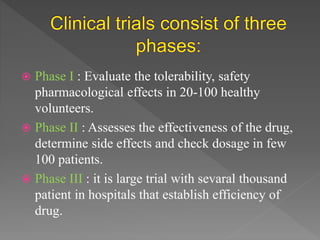
 Phase I : Evaluate the tolerability, safety
pharmacological effects in 20-100 healthy
volunteers.
 Phase II : Assesses the effectiveness of the drug,
determine side effects and check dosage in few
100 patients.
 Phase III : it is large trial with sevaral thousand
patient in hospitals that establish efficiency of
drug.
 The lead compound is one which has number of
attractive characteristics such as desirable
biological activity but may have other
undesirable characteristics such as high toxicity,
insolubility, metabolic problems.
 The ideal lead compound is modified by altering
the structure to get desired activity and to
eliminate side effects.
A) Screening:
 First step is to assay compound for particular
biological activity and potency
(i.e. antibacterial activity).
 There are two methods of screening:
1) Random screening : in this type synthetic
compound and natural products were randomly
screened for activity irrespective of their
structure. e.g.streptomycin
2) Non random screening: also called as targeted or
focused screening, is more narrow approach than
in random screening. Compound having not clear
resemblance to weakly active compound
uncovered in random screen.
OR
The compound containing different functional
group than lead, may be tested selectively. The
non-random screening is found to be more
economical and less man power intensive
compared to random screen.
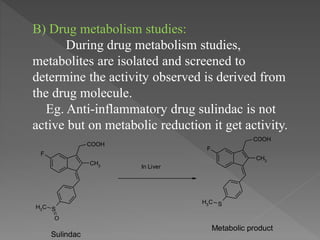
B) Drug metabolism studies:
During drug metabolism studies,
metabolites are isolated and screened to
determine the activity observed is derived from
the drug molecule.
Eg. Anti-inflammatory drug sulindac is not
active but on metabolic reduction it get activity.
CH3
SCH3
O
COOH
F
In Liver
CH3
SCH3
COOH
F
Sulindac
Metabolic product
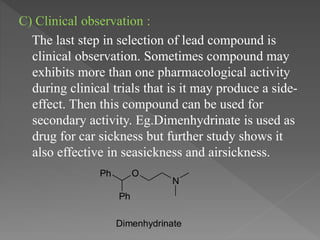
C) Clinical observation :
The last step in selection of lead compound is
clinical observation. Sometimes compound may
exhibits more than one pharmacological activity
during clinical trials that is it may produce a side-
effect. Then this compound can be used for
secondary activity. Eg.Dimenhydrinate is used as
drug for car sickness but further study shows it
also effective in seasickness and airsickness.
N
OPh
Ph
Dimenhydrinate
 After the lead compound is identified, its
structure is modified in order to improve the
desired pharmacological activity.
a) Pharmacophore identification : some groups are
essential to hold the drug in appropriate position
on the receptor. However those groups which
interfere in the pharmacophore binding need to
be removed.
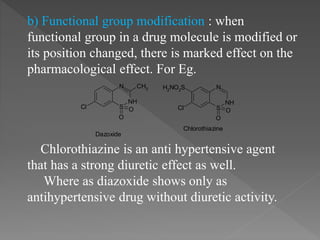
b) Functional group modification : when
functional group in a drug molecule is modified or
its position changed, there is marked effect on the
pharmacological effect. For Eg.
Chlorothiazine is an anti hypertensive agent
that has a strong diuretic effect as well.
Where as diazoxide shows only as
antihypertensive drug without diuretic activity.
N
S
NH
O
OCl
CH3
Dazoxide
N
S
NH
O
OCl
H2
NO2
S
Chlorothiazine
C) Structure activity relationships: From various
observations it has been concluded that the
physiological action of molecule was a function
of its chemical constitution are the basis for
structure-activity relationships(SAR).
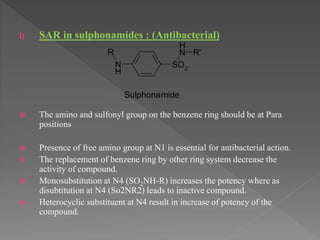
i) SAR in sulphonamides : (Antibacterial)
 The amino and sulfonyl group on the benzene ring should be at Para
positions
 Presence of free amino group at N1 is essential for antibacterial action.
 The replacement of benzene ring by other ring system decrease the
activity of compound.
 Monosubstitution at N4 (SO2NH-R) increases the potency where as
disubtitution at N4 (So2NR2) leads to inactive compound.
 Heterocyclic substituent at N4 result in increase of potency of the
compound.
SO2
N
H
R N
H
R'
Sulphonamide
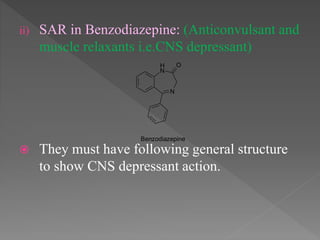
ii) SAR in Benzodiazepine: (Anticonvulsant and
muscle relaxants i.e.CNS depressant)
 They must have following general structure
to show CNS depressant action.
N
H
N
O
Benzodiazepine
 The presence of methyl group at 1 position
increases the activity .
 Replacement of O by sulphur at C2 position
decreases the potency.
 The presence of hydroxyl group at 3rd
position found to decrease the activity.
 The saturqation of double bond at C4-C5
reduce the activity.
 Electron withdrawing group like -Cl,-Br,-
NO2.etc. at 7 position increases the activity.
 Drug design is a three-dimensional puzzle
where small drug molecules, ligands, are
adjusted to the binding site of a protein.
 The factors which affect the protein-ligand
interaction can be characterized by using
molecular docking and different quantitative
structure-activity relationships (QSAR)
methods
16
1. Find interesting lead molecules quickly
2. Predicting properties and activities of untested
molecules
3. Propose compounds for synthesis
4. Validate models of receptor binding sites
5. Optimize pharmacokinetic properties of compound
17
18

Drug Discovery

  • 2.
    2 Drug Discovery Pathway Efficacy Toxicology Safety Preformulations StabilityStudies Leads Selection of candidate drug Preclinical Studies Primary Screening [Hits] Discovery & Development
  • 3.
     Study ofbiological properties may lead to discovery of new drug.  Some drugs are directly discovered like “LIBRIUM” (Tranquilizers).  Another e.g. of direct discovery of drug is penicillin(antibacterial) discovered by Alexander Fleming.  The average time require to bring a drug to market range is 12-15 years.
  • 4.
     Phase I: Evaluate the tolerability, safety pharmacological effects in 20-100 healthy volunteers.  Phase II : Assesses the effectiveness of the drug, determine side effects and check dosage in few 100 patients.  Phase III : it is large trial with sevaral thousand patient in hospitals that establish efficiency of drug.
  • 5.
     The leadcompound is one which has number of attractive characteristics such as desirable biological activity but may have other undesirable characteristics such as high toxicity, insolubility, metabolic problems.  The ideal lead compound is modified by altering the structure to get desired activity and to eliminate side effects.
  • 6.
    A) Screening:  Firststep is to assay compound for particular biological activity and potency (i.e. antibacterial activity).  There are two methods of screening: 1) Random screening : in this type synthetic compound and natural products were randomly screened for activity irrespective of their structure. e.g.streptomycin
  • 7.
    2) Non randomscreening: also called as targeted or focused screening, is more narrow approach than in random screening. Compound having not clear resemblance to weakly active compound uncovered in random screen. OR The compound containing different functional group than lead, may be tested selectively. The non-random screening is found to be more economical and less man power intensive compared to random screen.
  • 8.
    B) Drug metabolismstudies: During drug metabolism studies, metabolites are isolated and screened to determine the activity observed is derived from the drug molecule. Eg. Anti-inflammatory drug sulindac is not active but on metabolic reduction it get activity. CH3 SCH3 O COOH F In Liver CH3 SCH3 COOH F Sulindac Metabolic product
  • 9.
    C) Clinical observation: The last step in selection of lead compound is clinical observation. Sometimes compound may exhibits more than one pharmacological activity during clinical trials that is it may produce a side- effect. Then this compound can be used for secondary activity. Eg.Dimenhydrinate is used as drug for car sickness but further study shows it also effective in seasickness and airsickness. N OPh Ph Dimenhydrinate
  • 10.
     After thelead compound is identified, its structure is modified in order to improve the desired pharmacological activity. a) Pharmacophore identification : some groups are essential to hold the drug in appropriate position on the receptor. However those groups which interfere in the pharmacophore binding need to be removed.
  • 11.
    b) Functional groupmodification : when functional group in a drug molecule is modified or its position changed, there is marked effect on the pharmacological effect. For Eg. Chlorothiazine is an anti hypertensive agent that has a strong diuretic effect as well. Where as diazoxide shows only as antihypertensive drug without diuretic activity. N S NH O OCl CH3 Dazoxide N S NH O OCl H2 NO2 S Chlorothiazine
  • 12.
    C) Structure activityrelationships: From various observations it has been concluded that the physiological action of molecule was a function of its chemical constitution are the basis for structure-activity relationships(SAR).
  • 13.
    i) SAR insulphonamides : (Antibacterial)  The amino and sulfonyl group on the benzene ring should be at Para positions  Presence of free amino group at N1 is essential for antibacterial action.  The replacement of benzene ring by other ring system decrease the activity of compound.  Monosubstitution at N4 (SO2NH-R) increases the potency where as disubtitution at N4 (So2NR2) leads to inactive compound.  Heterocyclic substituent at N4 result in increase of potency of the compound. SO2 N H R N H R' Sulphonamide
  • 14.
    ii) SAR inBenzodiazepine: (Anticonvulsant and muscle relaxants i.e.CNS depressant)  They must have following general structure to show CNS depressant action. N H N O Benzodiazepine
  • 15.
     The presenceof methyl group at 1 position increases the activity .  Replacement of O by sulphur at C2 position decreases the potency.  The presence of hydroxyl group at 3rd position found to decrease the activity.  The saturqation of double bond at C4-C5 reduce the activity.  Electron withdrawing group like -Cl,-Br,- NO2.etc. at 7 position increases the activity.
  • 16.
     Drug designis a three-dimensional puzzle where small drug molecules, ligands, are adjusted to the binding site of a protein.  The factors which affect the protein-ligand interaction can be characterized by using molecular docking and different quantitative structure-activity relationships (QSAR) methods 16
  • 17.
    1. Find interestinglead molecules quickly 2. Predicting properties and activities of untested molecules 3. Propose compounds for synthesis 4. Validate models of receptor binding sites 5. Optimize pharmacokinetic properties of compound 17
  • 18.