BY:
BALASUNDARESAN M
 RECALL
• Reasons
• Types of Recall
• Recall Classification
• Levels of Recall
• How to Recall the Product?
• How To Notify The Consumers?
• Regulatory Guidelines
• SOP on ProductRecall
CONTENT

2
 Recall is an action taken to withdraw/remove the
drugs from distribution or use including corrective
action for which deficiencies are reported in
quality, efficacy or safety.
 Recalls also include drugs prohibited under the
Provisions of Drugs & Cosmetics Act and also those
products for which product licenses are
suspended/cancelled
3
Recall

 Products which are already distributed or sold, may requireat
times to be recalled from market for various reasons.
 e.g. - substandard quality detected after the product was
distributed
- damage of goods during transit.
 Such recalled products should be clearly identified and stored
separately in a secure area until a decision is taken on their
force.
 Such decision should be made as soon aspossible.
 Recall applies a;
Total ban or Permanent removal
Temporary ban or Temporary removal
Recalled Products

4
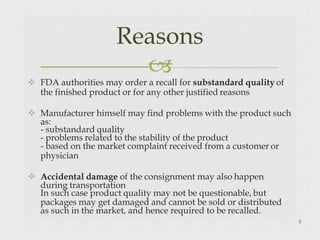
 FDA authorities may order a recall for substandard quality of
the finished product or for any other justified reasons
 Manufacturer himself may find problems with the product such
as:
- substandard quality
- problems related to the stability of the product
- based on the market complaint received from a customer or
physician
 Accidental damage of the consignment may also happen
during transportation
In such case product quality may not be questionable, but
packages may get damaged and cannot be sold or distributed
as such in the market, and hence required to be recalled.
5
Reasons


Types of Recall
6
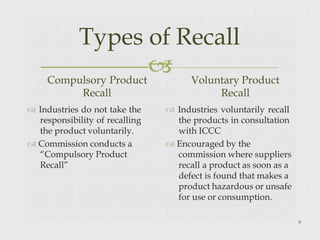
Compulsory Product
Recall
 Industries do not take the
responsibility of recalling
the product voluntarily.
 Commission conducts a
“Compulsory Product
Recall”
Voluntary Product
Recall
 Industries voluntarily recall
the products in consultation
with ICCC
 Encouraged by the
commission where suppliers
recall a product as soon as a
defect is found that makes a
product hazardous or unsafe
for use or consumption.
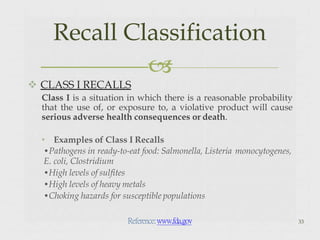
 CLASS I RECALLS
Class I is a situation in which there is a reasonable probability
that the use of, or exposure to, a violative product will cause
serious adverse health consequences or death.
• Examples of Class I Recalls
•Pathogens in ready-to-eat food: Salmonella, Listeria monocytogenes,
E. coli, Clostridium
•High levels of sulfites
•High levels of heavy metals
•Choking hazards for susceptible populations
33
Recall Classification

Reference:www.fda.gov
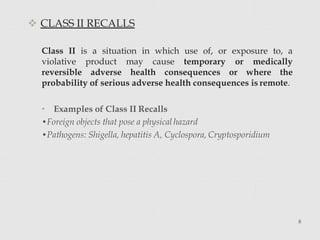
 CLASS II RECALLS
Class II is a situation in which use of, or exposure to, a
violative product may cause temporary or medically
reversible adverse health consequences or where the
probability of serious adverse health consequences is remote.
• Examples of Class II Recalls
•Foreign objects that pose a physical hazard
•Pathogens: Shigella, hepatitis A, Cyclospora, Cryptosporidium
8
 CLASS III RECALLS
Class III is a situation in which use of, or exposure to, a
violative product is not likely to cause adverse health
consequences.
• Example of Class III Recalls
An example might be bottles of aspirin that contains 90 tablets
instead of the 100 stated on the label.
9

 Based on the category of risks involved, a time
line of :
 Within 24 hours up to a maximum of 72 hours for Class I
recall
 For Class II recall up to a maximum of 10 days and
 For Class III recall up to a maximum of 30 days is allowed.
10
Time Lines For Effective
Recall System & Rapid Alert
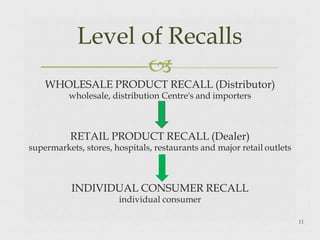
WHOLESALE PRODUCT RECALL (Distributor)
wholesale, distribution Centre's and importers
RETAIL PRODUCT RECALL (Dealer)
supermarkets, stores, hospitals, restaurants and major retail outlets
INDIVIDUAL CONSUMER RECALL
individual consumer
Level of Recalls

11

1. Product Recall Process
Product is likely to cause injury/adverse health effect to a person,
the Supplier should identify & take the necessary steps required to
recall the product, control the risk and coordinate the recall
process.
2. Level of Recall
A product can be recalled at 3 levels; wholesale, retail, individual
consumer or combination of any two or three levels.
Determination of the level of recall is dependent of how far the
product has penetrated the market from the supplier.
12
How to Recall the
Product?
3. Recall Strategy
13
Supplier should develop recall strategies for various levels of recall
as specified.
Supplier should consider the following:
 Notification mechanism to stop distribution and sale of
product.
 How to effectively and efficiently remove potentially unsafe
product from market place
 Isolation and safe storage of recovered product
 Disposal of product or return of product to market
 Availability of resources for remedial action.
4. Product Recovery, Storage and Disposal
14
 Methods of product recovery: product may be recovered by being
returned to the supplier, supermarkets, wholesellers or retailers.
 Methods of product storage: recovered products must be stored in
an area that is isolated and separated from any other products.
 Methods of corrective actions or product disposal:
Food products– destroyed by burial, denatured through retort and
incinerated under supervision by the relevant or appointed officers
Product for general or consumer use– returned to the manufacturers or
destroyed through the appropriate industrial practices.
5. Remedial Actions by the Supplier
The Supplier’s notification to its distribution chain and clients
should include advice on how to settle for the returned products at
the wholesale, retail and consumer level.
The notification should be clear and concise to ensure no
distribution chain and client business operations are affected
severely.
6. Monitoring the Effectiveness of the Product Recall
The measurement standard is the total number of products
recovered against the total number of products being issued.
15
Supplier must have a scale of measurement for measuring the
effectiveness of the recall.
7. Post Recall Reporting
One month after the termination of recall process, the Supplier is
required to furnish the recall coordination unit with a final report
on the recall.
The report should contain the following information with details;
a. Copy of letter to customers
b. Circumstance leading to the recall
c. Actions taken by the supplier including copies of media statement
d. Method of disposal
e. Proposed action to avoid future recurrence
f. Difficulties experienced in conducting the recall
g. Forms of assistance from government agencies and industries.

 Public Notification
Through media coverage system
16
The media coverage system covers radio broadcast, television,
newspapers, TV news and current affairs programs.
 Media Release
Short, concise, clear and written in simple language.
Should contain the product recall detail, problem or hazard,
actions to take, remedial action, names, address, phone numbers
and email address of people.
How To Notify The
Consumers?
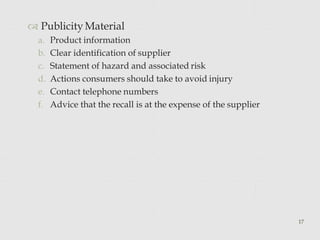
 PublicityMaterial
17
a. Product information
b. Clear identification of supplier
c. Statement of hazard and associated risk
d. Actions consumers should take to avoid injury
e. Contact telephone numbers
f. Advice that the recall is at the expense of the supplier
44
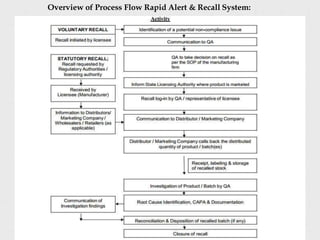
Overview of Process Flow Rapid Alert & Recall System:
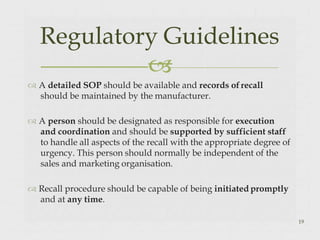
 A detailed SOP should be available and records ofrecall
should be maintained by the manufacturer.
 A person should be designated as responsible for execution
and coordination and should be supported by sufficient staff
to handle all aspects of the recall with the appropriate degree of
urgency. This person should normally be independent of the
sales and marketing organisation.
 Recall procedure should be capable of being initiated promptly
and at any time.
19
Regulatory Guidelines

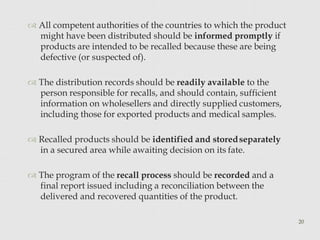
 All competent authorities of the countries to which the product
might have been distributed should be informed promptly if
products are intended to be recalled because these are being
defective (or suspected of).
 The distribution records should be readily available to the
person responsible for recalls, and should contain, sufficient
information on wholesellers and directly supplied customers,
including those for exported products and medical samples.
 Recalled products should be identified and storedseparately
in a secured area while awaiting decision on its fate.
 The program of the recall process should be recorded and a
final report issued including a reconciliation between the
delivered and recovered quantities of the product.
20
 The effectiveness of the recall procedure should be evaluated
from time to time by a dummy recall.
 A detailed check-list may be designed by the manufacturer to
recall a product.
21
1.0 OBJECTIVE:
To specify a method of operation that will ensure the prompt and
effective removal of any medicines for which XYZ Pharmaceuticals Ltd. Is
the manufacturer and which may represent a health hazard to the
consumer or user from the market.
1. RESPONSIBILITY
2. General manager (QA/QC, Regulatory):
General Manager (Manufacturing):
3.In case of adverse event a committee evaluates the crisis. It consists of
following individuals:
- GM/QA/QC, Regulatory
- GM Manufacturing
- V.P-Marketing
- V.P – International Marketing
- GM, Formulation and Development - V.P – Technical Operations
- Medical advisor
SOP on Product Recall

48
All available members of the crisis committee shall review the crisis
and take appropriate action.
23
3.0 ACCOUNTABILITY
Vice President
1. DEFINITION
1.“Violation Medicine” means any medicine for which XYZ
Pharmaceuticals Ltd is the manufacturer and,
2. which is reported to be causing serious adverse health reactions-not
include in the package insert and/or
3.With regard to which reports of serious adverse health reactions
described in the package insert are being received with unacceptable
frequency, and/ or
4. which has a material formulation error, or other errors, and/ or,
5. Which has a material labelling error, or other errors, and/or,
6.Which has a result of on going stability studies, is found not to
comply with the release specifications.
4.2 PROCEDURE
24
1.Any employee of XYZ Pharmaceutical Ltd becoming aware of
“Violative medicine” immediately notifies the GM, QA/QC/Regulatory
or in his absence GM, Manufacturing.
2.If the GM, QA/QC/Regulatory or GM, Manufacturing, is of opinion
that the violation is of a sufficiently serious nature to possibly warrant a
medicine recall, he shall immediately quarantine existing in-house stocks
of the relevant medicines and obtain the following information :
a) The product name, strength, packs size, batch number,
Manufacturing Date and Expiry Date.
b) The total number of units released for sale.
c) The Date on which distribution commenced.
d) The total number of units distributed.
e) The number of units still in stock in factory and with stockiest(s)
through the Market.
f) The nature of reported violation.
The above information is recorded on the attached document “Medicine
Recall Control document” under “Product Information” (Annexure- 2)
3.In the light of above information GM-(QA/QC/Regulatory) or GM-
(Manufacturing) or GM-(Formulation and Development) evaluates the
health hazard presented by the medicine and documents this evaluation
on the attached document “Medicine Recall Control Document” under
Health Hazard Evaluation (Annexure-3).
4.Taking into consideration the available information as well as the
health hazard evaluation the GM-(QA/QC/Regulatory) formulates a
proposed recall strategy. The recall strategy specifies the nature of
communication to be used (phone, fax, telegram, letters, telemail, etc.) as
well as the level in the distribution chain to which recall is
extended.(wholesalers, retailers, general public, etc.)
5.The GM-(QA/QC/Regulatory) or GM-(Manufacturing) informs
concerned Regulatory Authorities in India and other countries as
appropriate to the distribution of the medicine. Relevant records shall be
submitted to Regulatory Authorities together with proposed plan of
action.
25
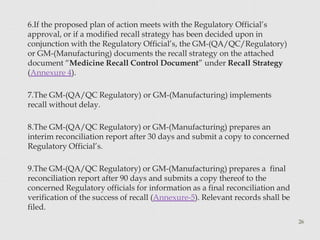
6.If the proposed plan of action meets with the Regulatory Official’s
approval, or if a modified recall strategy has been decided upon in
conjunction with the Regulatory Official’s, the GM-(QA/QC/Regulatory)
or GM-(Manufacturing) documents the recall strategy on the attached
document “Medicine Recall Control Document” under Recall Strategy
(Annexure 4).
7.The GM-(QA/QC Regulatory) or GM-(Manufacturing) implements
recall without delay.
8.The GM-(QA/QC Regulatory) or GM-(Manufacturing) prepares an
interim reconciliation report after 30 days and submit a copy to concerned
Regulatory Official’s.
9.The GM-(QA/QC Regulatory) or GM-(Manufacturing) prepares a final
reconciliation report after 90 days and submits a copy thereof to the
concerned Regulatory officials for information as a final reconciliation and
verification of the success of recall (Annexure-5). Relevant records shall be
filed.
26
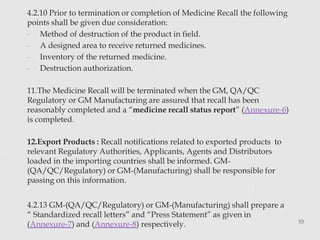
4.2.10 Prior to termination or completion of Medicine Recall the following
points shall be given due consideration:
- Method of destruction of the product in field.
- A designed area to receive returned medicines.
- Inventory of the returned medicine.
- Destruction authorization.
11.The Medicine Recall will be terminated when the GM, QA/QC
Regulatory or GM Manufacturing are assured that recall has been
reasonably completed and a “medicine recall status report” (Annexure-6)
is completed.
12.Export Products : Recall notifications related to exported products to
relevant Regulatory Authorities, Applicants, Agents and Distributors
loaded in the importing countries shall be informed. GM-
(QA/QC/Regulatory) or GM-(Manufacturing) shall be responsible for
passing on this information.
4.2.13 GM-(QA/QC/Regulatory) or GM-(Manufacturing) shall prepare a
“ Standardized recall letters” and “Press Statement” as given in
(Annexure-7) and (Annexure-8) respectively. 53
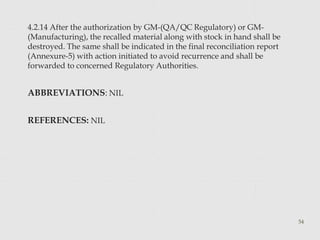
4.2.14 After the authorization by GM-(QA/QC Regulatory) or GM-
(Manufacturing), the recalled material along with stock in hand shall be
destroyed. The same shall be indicated in the final reconciliation report
(Annexure-5) with action initiated to avoid recurrence and shall be
forwarded to concerned Regulatory Authorities.
ABBREVIATIONS: NIL
REFERENCES: NIL
54
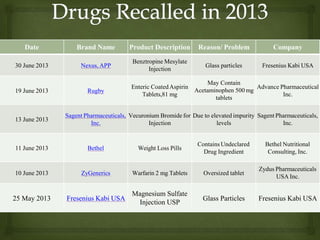
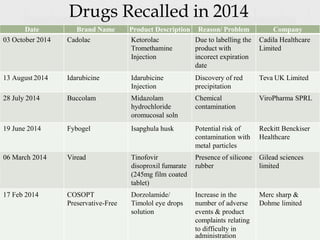
Date Brand Name Product Description Reason/ Problem Company
30 June 2013 Nexus, APP
Benztropine Mesylate
Injection
Glass particles Fresenius Kabi USA
19 June 2013 Rugby
Enteric CoatedAspirin
Tablets,81 mg
May Contain
Acetaminophen 500 mg
tablets
Advance Pharmaceutical
Inc.
13 June 2013
Sagent Pharmaceuticals,
Inc.
Vecuronium Bromide for
Injection
Due to elevated impurity
levels
Sagent Pharmaceuticals,
Inc.
11 June 2013 Bethel Weight Loss Pills
Contains Undeclared
Drug Ingredient
Bethel Nutritional
Consulting, Inc.
10 June 2013 ZyGenerics Warfarin 2 mg Tablets Oversized tablet
Zydus Pharmaceuticals
USA Inc.
25 May 2013 Fresenius Kabi USA
Magnesium Sulfate
Injection USP
Glass Particles Fresenius Kabi USA
56
Date Brand Name Product Description Reason/ Problem Company
03 October 2014 Cadolac Ketorolac Due to labelling the Cadila Healthcare
Tromethamine product with Limited
Injection incorect expiration
date
13 August 2014 Idarubicine Idarubicine Discovery of red Teva UK Limited
Injection precipitation
28 July 2014 Buccolam Midazolam Chemical ViroPharma SPRL
hydrochloride contamination
oromucosal soln
19 June 2014 Fybogel Isapghula husk Potential risk of Reckitt Benckiser
contamination with Healthcare
metal particles
06 March 2014 Viread Tinofovir Presence of silicone Gilead sciences
disoproxil fumarate rubber limited
(245mg film coated
tablet)
17 Feb 2014 COSOPT Dorzolamide/ Increase in the Merc sharp &
Preservative-Free Timolol eye drops number of adverse Dohme limited
solution events & product
complaints relating
to difficulty in
administration
Drugs Recalled in 2014
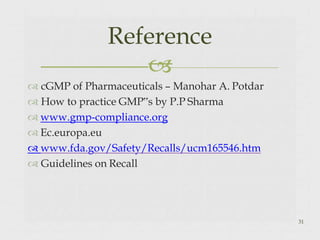
 cGMP of Pharmaceuticals – Manohar A. Potdar
 How to practice GMP‟s by P.P Sharma
 www.gmp-compliance.org
 Ec.europa.eu
 www.fda.gov/Safety/Recalls/ucm165546.htm
 Guidelines on Recall
31
Reference


THANK YOU 
32

RECALL.pptx

  • 1.
  • 2.
     RECALL • Reasons •Types of Recall • Recall Classification • Levels of Recall • How to Recall the Product? • How To Notify The Consumers? • Regulatory Guidelines • SOP on ProductRecall CONTENT  2
  • 3.
     Recall isan action taken to withdraw/remove the drugs from distribution or use including corrective action for which deficiencies are reported in quality, efficacy or safety.  Recalls also include drugs prohibited under the Provisions of Drugs & Cosmetics Act and also those products for which product licenses are suspended/cancelled 3 Recall 
  • 4.
     Products whichare already distributed or sold, may requireat times to be recalled from market for various reasons.  e.g. - substandard quality detected after the product was distributed - damage of goods during transit.  Such recalled products should be clearly identified and stored separately in a secure area until a decision is taken on their force.  Such decision should be made as soon aspossible.  Recall applies a; Total ban or Permanent removal Temporary ban or Temporary removal Recalled Products  4
  • 5.
     FDA authoritiesmay order a recall for substandard quality of the finished product or for any other justified reasons  Manufacturer himself may find problems with the product such as: - substandard quality - problems related to the stability of the product - based on the market complaint received from a customer or physician  Accidental damage of the consignment may also happen during transportation In such case product quality may not be questionable, but packages may get damaged and cannot be sold or distributed as such in the market, and hence required to be recalled. 5 Reasons 
  • 6.
     Types of Recall 6 CompulsoryProduct Recall  Industries do not take the responsibility of recalling the product voluntarily.  Commission conducts a “Compulsory Product Recall” Voluntary Product Recall  Industries voluntarily recall the products in consultation with ICCC  Encouraged by the commission where suppliers recall a product as soon as a defect is found that makes a product hazardous or unsafe for use or consumption.
  • 7.
     CLASS IRECALLS Class I is a situation in which there is a reasonable probability that the use of, or exposure to, a violative product will cause serious adverse health consequences or death. • Examples of Class I Recalls •Pathogens in ready-to-eat food: Salmonella, Listeria monocytogenes, E. coli, Clostridium •High levels of sulfites •High levels of heavy metals •Choking hazards for susceptible populations 33 Recall Classification  Reference:www.fda.gov
  • 8.
     CLASS IIRECALLS Class II is a situation in which use of, or exposure to, a violative product may cause temporary or medically reversible adverse health consequences or where the probability of serious adverse health consequences is remote. • Examples of Class II Recalls •Foreign objects that pose a physical hazard •Pathogens: Shigella, hepatitis A, Cyclospora, Cryptosporidium 8
  • 9.
     CLASS IIIRECALLS Class III is a situation in which use of, or exposure to, a violative product is not likely to cause adverse health consequences. • Example of Class III Recalls An example might be bottles of aspirin that contains 90 tablets instead of the 100 stated on the label. 9
  • 10.
      Based onthe category of risks involved, a time line of :  Within 24 hours up to a maximum of 72 hours for Class I recall  For Class II recall up to a maximum of 10 days and  For Class III recall up to a maximum of 30 days is allowed. 10 Time Lines For Effective Recall System & Rapid Alert
  • 11.
    WHOLESALE PRODUCT RECALL(Distributor) wholesale, distribution Centre's and importers RETAIL PRODUCT RECALL (Dealer) supermarkets, stores, hospitals, restaurants and major retail outlets INDIVIDUAL CONSUMER RECALL individual consumer Level of Recalls  11
  • 12.
     1. Product RecallProcess Product is likely to cause injury/adverse health effect to a person, the Supplier should identify & take the necessary steps required to recall the product, control the risk and coordinate the recall process. 2. Level of Recall A product can be recalled at 3 levels; wholesale, retail, individual consumer or combination of any two or three levels. Determination of the level of recall is dependent of how far the product has penetrated the market from the supplier. 12 How to Recall the Product?
  • 13.
    3. Recall Strategy 13 Suppliershould develop recall strategies for various levels of recall as specified. Supplier should consider the following:  Notification mechanism to stop distribution and sale of product.  How to effectively and efficiently remove potentially unsafe product from market place  Isolation and safe storage of recovered product  Disposal of product or return of product to market  Availability of resources for remedial action.
  • 14.
    4. Product Recovery,Storage and Disposal 14  Methods of product recovery: product may be recovered by being returned to the supplier, supermarkets, wholesellers or retailers.  Methods of product storage: recovered products must be stored in an area that is isolated and separated from any other products.  Methods of corrective actions or product disposal: Food products– destroyed by burial, denatured through retort and incinerated under supervision by the relevant or appointed officers Product for general or consumer use– returned to the manufacturers or destroyed through the appropriate industrial practices. 5. Remedial Actions by the Supplier The Supplier’s notification to its distribution chain and clients should include advice on how to settle for the returned products at the wholesale, retail and consumer level. The notification should be clear and concise to ensure no distribution chain and client business operations are affected severely.
  • 15.
    6. Monitoring theEffectiveness of the Product Recall The measurement standard is the total number of products recovered against the total number of products being issued. 15 Supplier must have a scale of measurement for measuring the effectiveness of the recall. 7. Post Recall Reporting One month after the termination of recall process, the Supplier is required to furnish the recall coordination unit with a final report on the recall. The report should contain the following information with details; a. Copy of letter to customers b. Circumstance leading to the recall c. Actions taken by the supplier including copies of media statement d. Method of disposal e. Proposed action to avoid future recurrence f. Difficulties experienced in conducting the recall g. Forms of assistance from government agencies and industries.
  • 16.
      Public Notification Throughmedia coverage system 16 The media coverage system covers radio broadcast, television, newspapers, TV news and current affairs programs.  Media Release Short, concise, clear and written in simple language. Should contain the product recall detail, problem or hazard, actions to take, remedial action, names, address, phone numbers and email address of people. How To Notify The Consumers?
  • 17.
     PublicityMaterial 17 a. Productinformation b. Clear identification of supplier c. Statement of hazard and associated risk d. Actions consumers should take to avoid injury e. Contact telephone numbers f. Advice that the recall is at the expense of the supplier
  • 18.
    44 Overview of ProcessFlow Rapid Alert & Recall System:
  • 19.
     A detailedSOP should be available and records ofrecall should be maintained by the manufacturer.  A person should be designated as responsible for execution and coordination and should be supported by sufficient staff to handle all aspects of the recall with the appropriate degree of urgency. This person should normally be independent of the sales and marketing organisation.  Recall procedure should be capable of being initiated promptly and at any time. 19 Regulatory Guidelines 
  • 20.
     All competentauthorities of the countries to which the product might have been distributed should be informed promptly if products are intended to be recalled because these are being defective (or suspected of).  The distribution records should be readily available to the person responsible for recalls, and should contain, sufficient information on wholesellers and directly supplied customers, including those for exported products and medical samples.  Recalled products should be identified and storedseparately in a secured area while awaiting decision on its fate.  The program of the recall process should be recorded and a final report issued including a reconciliation between the delivered and recovered quantities of the product. 20
  • 21.
     The effectivenessof the recall procedure should be evaluated from time to time by a dummy recall.  A detailed check-list may be designed by the manufacturer to recall a product. 21
  • 22.
    1.0 OBJECTIVE: To specifya method of operation that will ensure the prompt and effective removal of any medicines for which XYZ Pharmaceuticals Ltd. Is the manufacturer and which may represent a health hazard to the consumer or user from the market. 1. RESPONSIBILITY 2. General manager (QA/QC, Regulatory): General Manager (Manufacturing): 3.In case of adverse event a committee evaluates the crisis. It consists of following individuals: - GM/QA/QC, Regulatory - GM Manufacturing - V.P-Marketing - V.P – International Marketing - GM, Formulation and Development - V.P – Technical Operations - Medical advisor SOP on Product Recall  48
  • 23.
    All available membersof the crisis committee shall review the crisis and take appropriate action. 23 3.0 ACCOUNTABILITY Vice President 1. DEFINITION 1.“Violation Medicine” means any medicine for which XYZ Pharmaceuticals Ltd is the manufacturer and, 2. which is reported to be causing serious adverse health reactions-not include in the package insert and/or 3.With regard to which reports of serious adverse health reactions described in the package insert are being received with unacceptable frequency, and/ or 4. which has a material formulation error, or other errors, and/ or, 5. Which has a material labelling error, or other errors, and/or, 6.Which has a result of on going stability studies, is found not to comply with the release specifications.
  • 24.
    4.2 PROCEDURE 24 1.Any employeeof XYZ Pharmaceutical Ltd becoming aware of “Violative medicine” immediately notifies the GM, QA/QC/Regulatory or in his absence GM, Manufacturing. 2.If the GM, QA/QC/Regulatory or GM, Manufacturing, is of opinion that the violation is of a sufficiently serious nature to possibly warrant a medicine recall, he shall immediately quarantine existing in-house stocks of the relevant medicines and obtain the following information : a) The product name, strength, packs size, batch number, Manufacturing Date and Expiry Date. b) The total number of units released for sale. c) The Date on which distribution commenced. d) The total number of units distributed. e) The number of units still in stock in factory and with stockiest(s) through the Market. f) The nature of reported violation. The above information is recorded on the attached document “Medicine Recall Control document” under “Product Information” (Annexure- 2)
  • 25.
    3.In the lightof above information GM-(QA/QC/Regulatory) or GM- (Manufacturing) or GM-(Formulation and Development) evaluates the health hazard presented by the medicine and documents this evaluation on the attached document “Medicine Recall Control Document” under Health Hazard Evaluation (Annexure-3). 4.Taking into consideration the available information as well as the health hazard evaluation the GM-(QA/QC/Regulatory) formulates a proposed recall strategy. The recall strategy specifies the nature of communication to be used (phone, fax, telegram, letters, telemail, etc.) as well as the level in the distribution chain to which recall is extended.(wholesalers, retailers, general public, etc.) 5.The GM-(QA/QC/Regulatory) or GM-(Manufacturing) informs concerned Regulatory Authorities in India and other countries as appropriate to the distribution of the medicine. Relevant records shall be submitted to Regulatory Authorities together with proposed plan of action. 25
  • 26.
    6.If the proposedplan of action meets with the Regulatory Official’s approval, or if a modified recall strategy has been decided upon in conjunction with the Regulatory Official’s, the GM-(QA/QC/Regulatory) or GM-(Manufacturing) documents the recall strategy on the attached document “Medicine Recall Control Document” under Recall Strategy (Annexure 4). 7.The GM-(QA/QC Regulatory) or GM-(Manufacturing) implements recall without delay. 8.The GM-(QA/QC Regulatory) or GM-(Manufacturing) prepares an interim reconciliation report after 30 days and submit a copy to concerned Regulatory Official’s. 9.The GM-(QA/QC Regulatory) or GM-(Manufacturing) prepares a final reconciliation report after 90 days and submits a copy thereof to the concerned Regulatory officials for information as a final reconciliation and verification of the success of recall (Annexure-5). Relevant records shall be filed. 26
  • 27.
    4.2.10 Prior totermination or completion of Medicine Recall the following points shall be given due consideration: - Method of destruction of the product in field. - A designed area to receive returned medicines. - Inventory of the returned medicine. - Destruction authorization. 11.The Medicine Recall will be terminated when the GM, QA/QC Regulatory or GM Manufacturing are assured that recall has been reasonably completed and a “medicine recall status report” (Annexure-6) is completed. 12.Export Products : Recall notifications related to exported products to relevant Regulatory Authorities, Applicants, Agents and Distributors loaded in the importing countries shall be informed. GM- (QA/QC/Regulatory) or GM-(Manufacturing) shall be responsible for passing on this information. 4.2.13 GM-(QA/QC/Regulatory) or GM-(Manufacturing) shall prepare a “ Standardized recall letters” and “Press Statement” as given in (Annexure-7) and (Annexure-8) respectively. 53
  • 28.
    4.2.14 After theauthorization by GM-(QA/QC Regulatory) or GM- (Manufacturing), the recalled material along with stock in hand shall be destroyed. The same shall be indicated in the final reconciliation report (Annexure-5) with action initiated to avoid recurrence and shall be forwarded to concerned Regulatory Authorities. ABBREVIATIONS: NIL REFERENCES: NIL 54
  • 29.
    Date Brand NameProduct Description Reason/ Problem Company 30 June 2013 Nexus, APP Benztropine Mesylate Injection Glass particles Fresenius Kabi USA 19 June 2013 Rugby Enteric CoatedAspirin Tablets,81 mg May Contain Acetaminophen 500 mg tablets Advance Pharmaceutical Inc. 13 June 2013 Sagent Pharmaceuticals, Inc. Vecuronium Bromide for Injection Due to elevated impurity levels Sagent Pharmaceuticals, Inc. 11 June 2013 Bethel Weight Loss Pills Contains Undeclared Drug Ingredient Bethel Nutritional Consulting, Inc. 10 June 2013 ZyGenerics Warfarin 2 mg Tablets Oversized tablet Zydus Pharmaceuticals USA Inc. 25 May 2013 Fresenius Kabi USA Magnesium Sulfate Injection USP Glass Particles Fresenius Kabi USA
  • 30.
    56 Date Brand NameProduct Description Reason/ Problem Company 03 October 2014 Cadolac Ketorolac Due to labelling the Cadila Healthcare Tromethamine product with Limited Injection incorect expiration date 13 August 2014 Idarubicine Idarubicine Discovery of red Teva UK Limited Injection precipitation 28 July 2014 Buccolam Midazolam Chemical ViroPharma SPRL hydrochloride contamination oromucosal soln 19 June 2014 Fybogel Isapghula husk Potential risk of Reckitt Benckiser contamination with Healthcare metal particles 06 March 2014 Viread Tinofovir Presence of silicone Gilead sciences disoproxil fumarate rubber limited (245mg film coated tablet) 17 Feb 2014 COSOPT Dorzolamide/ Increase in the Merc sharp & Preservative-Free Timolol eye drops number of adverse Dohme limited solution events & product complaints relating to difficulty in administration Drugs Recalled in 2014
  • 31.
     cGMP ofPharmaceuticals – Manohar A. Potdar  How to practice GMP‟s by P.P Sharma  www.gmp-compliance.org  Ec.europa.eu  www.fda.gov/Safety/Recalls/ucm165546.htm  Guidelines on Recall 31 Reference 
  • 32.