Scale Kubernetes to Support
50,000 Services
Haibin Michael Xie, Senior Staff Engineer/Architect, Huawei
Agenda
• Challenges while scaling services
• Solutions and prototypes
• Performance data
• Q&A
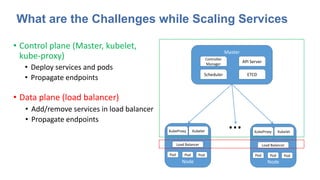
Master
What are the Challenges while Scaling Services
• Control plane (Master, kubelet,
kube-proxy) API Server
Controller
Manager
Scheduler
Node
KubeProxy
…
ETCD
Kubelet
Load Balancer
• Deploy services and pods
• Propagate endpoints
• Add/remove services in load balancer
• Propagate endpoints
• Data plane (load balancer)
Pod Pod Pod
Node
KubeProxy Kubelet
Load Balancer
Pod Pod Pod
API Server
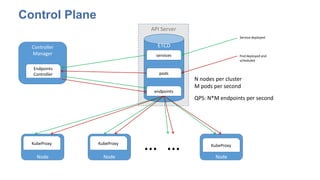
Control Plane
ETCD
services
Controller
Manager
pods
endpoints
Endpoints
Controller
Node
KubeProxy
Node
KubeProxy
Node
KubeProxy
… …
N nodes per cluster
M pods per second
QPS: N*M endpoints per second
Service deployed
Pod deployed and
scheduled
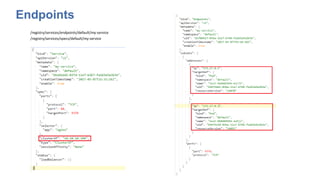
Endpoints
/registry/services/endpoints/default/my-service
/registry/services/specs/default/my-service
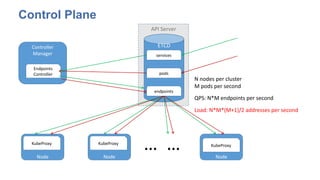
API Server
Control Plane
ETCD
services
Controller
Manager
pods
endpoints
Endpoints
Controller
Node
KubeProxy
Node
KubeProxy
Node
KubeProxy
… …
N nodes per cluster
M pods per second
QPS: N*M endpoints per second
Load: N*M*(M+1)/2 addresses per second
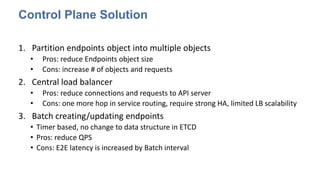
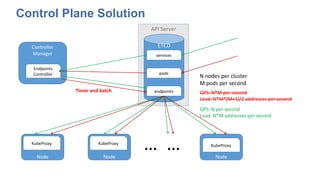
Control Plane Solution
1. Partition endpoints object into multiple objects
• Pros: reduce Endpoints object size
• Cons: increase # of objects and requests
2. Central load balancer
• Pros: reduce connections and requests to API server
• Cons: one more hop in service routing, require strong HA, limited LB scalability
3. Batch creating/updating endpoints
• Timer based, no change to data structure in ETCD
• Pros: reduce QPS
• Cons: E2E latency is increased by Batch interval
API Server
Control Plane Solution
ETCD
services
Controller
Manager
pods
endpoints
Endpoints
Controller
Node
KubeProxy
Node
KubeProxy
Node
KubeProxy
… …
QPS: N*M per second
Load: N*M*(M+1)/2 addresses per second
Timer and batch QPS: N*M per second
Load: N*M*(M+1)/2 addresses per second
QPS: N per second
Load: N*M addresses per second
N nodes per cluster
M pods per second
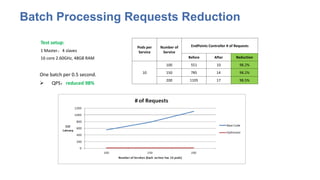
Batch Processing Requests Reduction
One batch per 0.5 second.
 QPS:reduced 98%
Pods per
Service
Number of
Service
EndPoints Controller # of Requests
Before After Reduction
10
100 551 10 98.2%
150 785 14 98.2%
200 1105 17 98.5%
Test setup:
1 Master,4 slaves
16 core 2.60GHz, 48GB RAM
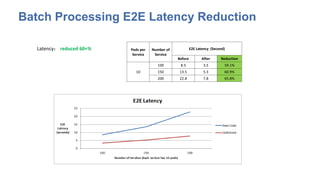
Batch Processing E2E Latency Reduction
Latency: reduced 60+% Pods per
Service
Number of
Service
E2E Latency (Second)
Before After Reduction
10
100 8.5 3.5 59.1%
150 13.5 5.3 60.9%
200 22.8 7.8 65.8%
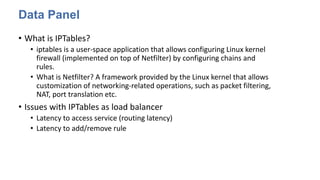
Data Panel
• What is IPTables?
• iptables is a user-space application that allows configuring Linux kernel
firewall (implemented on top of Netfilter) by configuring chains and
rules.
• What is Netfilter? A framework provided by the Linux kernel that allows
customization of networking-related operations, such as packet filtering,
NAT, port translation etc.
• Issues with IPTables as load balancer
• Latency to access service (routing latency)
• Latency to add/remove rule
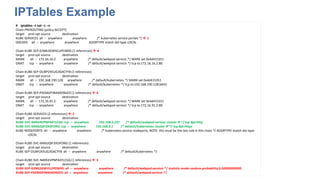
IPTables Example
# Iptables –t nat –L –n
Chain PREROUTING (policy ACCEPT)
target prot opt source destination
KUBE-SERVICES all -- anywhere anywhere /* kubernetes service portals */  1
DOCKER all -- anywhere anywhere ADDRTYPE match dst-type LOCAL
Chain KUBE-SEP-G3MLSGWVLUPEIMXS (1 references)  4
target prot opt source destination
MARK all -- 172.16.16.2 anywhere /* default/webpod-service: */ MARK set 0x4d415351
DNAT tcp -- anywhere anywhere /* default/webpod-service: */ tcp to:172.16.16.2:80
Chain KUBE-SEP-OUBP2X5UG3G4CYYB (1 references)
target prot opt source destination
MARK all -- 192.168.190.128 anywhere /* default/kubernetes: */ MARK set 0x4d415351
DNAT tcp -- anywhere anywhere /* default/kubernetes: */ tcp to:192.168.190.128:6443
Chain KUBE-SEP-PXEMGP3B44XONJEO (1 references)  4
target prot opt source destination
MARK all -- 172.16.91.2 anywhere /* default/webpod-service: */ MARK set 0x4d415351
DNAT tcp -- anywhere anywhere /* default/webpod-service: */ tcp to:172.16.91.2:80
Chain KUBE-SERVICES (2 references)  2
target prot opt source destination
KUBE-SVC-N4RX4VPNP4ATLCGG tcp -- anywhere 192.168.3.237 /* default/webpod-service: cluster IP */ tcp dpt:http
KUBE-SVC-6N4SJQIF3IX3FORG tcp -- anywhere 192.168.3.1 /* default/kubernetes: cluster IP */ tcp dpt:https
KUBE-NODEPORTS all -- anywhere anywhere /* kubernetes service nodeports; NOTE: this must be the last rule in this chain */ ADDRTYPE match dst-type
LOCAL
Chain KUBE-SVC-6N4SJQIF3IX3FORG (1 references)
target prot opt source destination
KUBE-SEP-OUBP2X5UG3G4CYYB all -- anywhere anywhere /* default/kubernetes: */
Chain KUBE-SVC-N4RX4VPNP4ATLCGG (1 references)  3
target prot opt source destination
KUBE-SEP-G3MLSGWVLUPEIMXS all -- anywhere anywhere /* default/webpod-service: */ statistic mode random probability 0.50000000000
KUBE-SEP-PXEMGP3B44XONJEO all -- anywhere anywhere /* default/webpod-service: */
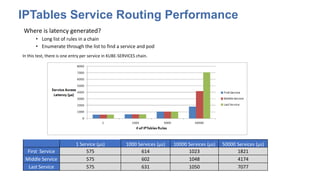
IPTables Service Routing Performance
1 Service (µs) 1000 Services (µs) 10000 Services (µs) 50000 Services (µs)
First Service 575 614 1023 1821
Middle Service 575 602 1048 4174
Last Service 575 631 1050 7077
In this test, there is one entry per service in KUBE-SERVICES chain.
Where is latency generated?
• Long list of rules in a chain
• Enumerate through the list to find a service and pod
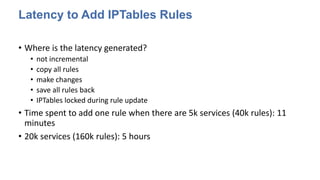
Latency to Add IPTables Rules
• Where is the latency generated?
• not incremental
• copy all rules
• make changes
• save all rules back
• IPTables locked during rule update
• Time spent to add one rule when there are 5k services (40k rules): 11
minutes
• 20k services (160k rules): 5 hours
Data Plane Solution
• Re-struct IPTables using search tree (Performance benefit)
• Replace IPTables with IPVS (Performance and beyond)
VIP
Restruct IPTables by Search Tree
10.10.0.0/16
10.10.1.0/24
VIP: 10.10.1.5 VIP:10.10.1.100
10.10.100.0/24
VIP:10.10.100.1
Service VIP range: 10.10.0.0/16
CIDR list = [16, 24], defines tree layout
Create 3 services: 10.10.1.5, 10.10.1.100, 10.10.100.1
Search tree based service routing time complexity: , m is tree depth
Original service routing time complexity: O(n)
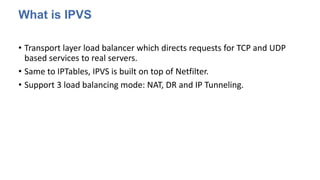
What is IPVS
• Transport layer load balancer which directs requests for TCP and UDP
based services to real servers.
• Same to IPTables, IPVS is built on top of Netfilter.
• Support 3 load balancing mode: NAT, DR and IP Tunneling.
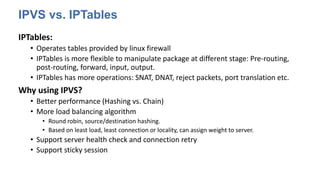
IPVS vs. IPTables
IPTables:
• Operates tables provided by linux firewall
• IPTables is more flexible to manipulate package at different stage: Pre-routing,
post-routing, forward, input, output.
• IPTables has more operations: SNAT, DNAT, reject packets, port translation etc.
Why using IPVS?
• Better performance (Hashing vs. Chain)
• More load balancing algorithm
• Round robin, source/destination hashing.
• Based on least load, least connection or locality, can assign weight to server.
• Support server health check and connection retry
• Support sticky session
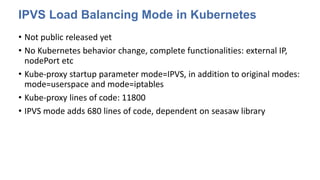
IPVS Load Balancing Mode in Kubernetes
• Not public released yet
• No Kubernetes behavior change, complete functionalities: external IP,
nodePort etc
• Kube-proxy startup parameter mode=IPVS, in addition to original modes:
mode=userspace and mode=iptables
• Kube-proxy lines of code: 11800
• IPVS mode adds 680 lines of code, dependent on seasaw library
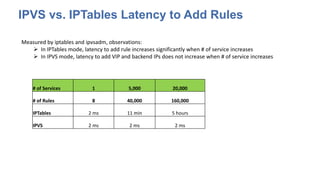
IPVS vs. IPTables Latency to Add Rules
# of Services 1 5,000 20,000
# of Rules 8 40,000 160,000
IPTables 2 ms 11 min 5 hours
IPVS 2 ms 2 ms 2 ms
Measured by iptables and ipvsadm, observations:
 In IPTables mode, latency to add rule increases significantly when # of service increases
 In IPVS mode, latency to add VIP and backend IPs does not increase when # of service increases
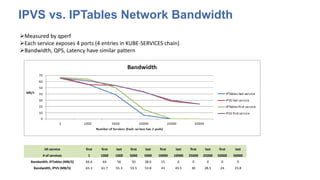
IPVS vs. IPTables Network Bandwidth
Measured by qperf
Each service exposes 4 ports (4 entries in KUBE-SERVICES chain)
Bandwidth, QPS, Latency have similar pattern
ith service first first last first last first last first last first last
# of services 1 1000 1000 5000 5000 10000 10000 25000 25000 50000 50000
Bandwidth, IPTables (MB/S) 66.6 64 56 50 38.6 15 6 0 0 0 0
Bandwidth, IPVS (MB/S) 65.3 61.7 55.3 53.5 53.8 43 43.5 30 28.5 24 23.8
More Perf/Scalability Work Done
• Scale nodes and pods in single cluster
• Reduce E2E latency of deploying pods/services
• Increase pod deployment throughput
• Improve scheduling performance
Thank You
haibin.michael.xie@huawei.com

Scale Kubernetes to support 50000 services

  • 1.
    Scale Kubernetes toSupport 50,000 Services Haibin Michael Xie, Senior Staff Engineer/Architect, Huawei
  • 2.
    Agenda • Challenges whilescaling services • Solutions and prototypes • Performance data • Q&A
  • 3.
    Master What are theChallenges while Scaling Services • Control plane (Master, kubelet, kube-proxy) API Server Controller Manager Scheduler Node KubeProxy … ETCD Kubelet Load Balancer • Deploy services and pods • Propagate endpoints • Add/remove services in load balancer • Propagate endpoints • Data plane (load balancer) Pod Pod Pod Node KubeProxy Kubelet Load Balancer Pod Pod Pod
  • 4.
    API Server Control Plane ETCD services Controller Manager pods endpoints Endpoints Controller Node KubeProxy Node KubeProxy Node KubeProxy …… N nodes per cluster M pods per second QPS: N*M endpoints per second Service deployed Pod deployed and scheduled
  • 5.
  • 6.
    API Server Control Plane ETCD services Controller Manager pods endpoints Endpoints Controller Node KubeProxy Node KubeProxy Node KubeProxy …… N nodes per cluster M pods per second QPS: N*M endpoints per second Load: N*M*(M+1)/2 addresses per second
  • 7.
    Control Plane Solution 1.Partition endpoints object into multiple objects • Pros: reduce Endpoints object size • Cons: increase # of objects and requests 2. Central load balancer • Pros: reduce connections and requests to API server • Cons: one more hop in service routing, require strong HA, limited LB scalability 3. Batch creating/updating endpoints • Timer based, no change to data structure in ETCD • Pros: reduce QPS • Cons: E2E latency is increased by Batch interval
  • 8.
    API Server Control PlaneSolution ETCD services Controller Manager pods endpoints Endpoints Controller Node KubeProxy Node KubeProxy Node KubeProxy … … QPS: N*M per second Load: N*M*(M+1)/2 addresses per second Timer and batch QPS: N*M per second Load: N*M*(M+1)/2 addresses per second QPS: N per second Load: N*M addresses per second N nodes per cluster M pods per second
  • 9.
    Batch Processing RequestsReduction One batch per 0.5 second.  QPS:reduced 98% Pods per Service Number of Service EndPoints Controller # of Requests Before After Reduction 10 100 551 10 98.2% 150 785 14 98.2% 200 1105 17 98.5% Test setup: 1 Master,4 slaves 16 core 2.60GHz, 48GB RAM
  • 10.
    Batch Processing E2ELatency Reduction Latency: reduced 60+% Pods per Service Number of Service E2E Latency (Second) Before After Reduction 10 100 8.5 3.5 59.1% 150 13.5 5.3 60.9% 200 22.8 7.8 65.8%
  • 11.
    Data Panel • Whatis IPTables? • iptables is a user-space application that allows configuring Linux kernel firewall (implemented on top of Netfilter) by configuring chains and rules. • What is Netfilter? A framework provided by the Linux kernel that allows customization of networking-related operations, such as packet filtering, NAT, port translation etc. • Issues with IPTables as load balancer • Latency to access service (routing latency) • Latency to add/remove rule
  • 12.
    IPTables Example # Iptables–t nat –L –n Chain PREROUTING (policy ACCEPT) target prot opt source destination KUBE-SERVICES all -- anywhere anywhere /* kubernetes service portals */  1 DOCKER all -- anywhere anywhere ADDRTYPE match dst-type LOCAL Chain KUBE-SEP-G3MLSGWVLUPEIMXS (1 references)  4 target prot opt source destination MARK all -- 172.16.16.2 anywhere /* default/webpod-service: */ MARK set 0x4d415351 DNAT tcp -- anywhere anywhere /* default/webpod-service: */ tcp to:172.16.16.2:80 Chain KUBE-SEP-OUBP2X5UG3G4CYYB (1 references) target prot opt source destination MARK all -- 192.168.190.128 anywhere /* default/kubernetes: */ MARK set 0x4d415351 DNAT tcp -- anywhere anywhere /* default/kubernetes: */ tcp to:192.168.190.128:6443 Chain KUBE-SEP-PXEMGP3B44XONJEO (1 references)  4 target prot opt source destination MARK all -- 172.16.91.2 anywhere /* default/webpod-service: */ MARK set 0x4d415351 DNAT tcp -- anywhere anywhere /* default/webpod-service: */ tcp to:172.16.91.2:80 Chain KUBE-SERVICES (2 references)  2 target prot opt source destination KUBE-SVC-N4RX4VPNP4ATLCGG tcp -- anywhere 192.168.3.237 /* default/webpod-service: cluster IP */ tcp dpt:http KUBE-SVC-6N4SJQIF3IX3FORG tcp -- anywhere 192.168.3.1 /* default/kubernetes: cluster IP */ tcp dpt:https KUBE-NODEPORTS all -- anywhere anywhere /* kubernetes service nodeports; NOTE: this must be the last rule in this chain */ ADDRTYPE match dst-type LOCAL Chain KUBE-SVC-6N4SJQIF3IX3FORG (1 references) target prot opt source destination KUBE-SEP-OUBP2X5UG3G4CYYB all -- anywhere anywhere /* default/kubernetes: */ Chain KUBE-SVC-N4RX4VPNP4ATLCGG (1 references)  3 target prot opt source destination KUBE-SEP-G3MLSGWVLUPEIMXS all -- anywhere anywhere /* default/webpod-service: */ statistic mode random probability 0.50000000000 KUBE-SEP-PXEMGP3B44XONJEO all -- anywhere anywhere /* default/webpod-service: */
  • 13.
    IPTables Service RoutingPerformance 1 Service (µs) 1000 Services (µs) 10000 Services (µs) 50000 Services (µs) First Service 575 614 1023 1821 Middle Service 575 602 1048 4174 Last Service 575 631 1050 7077 In this test, there is one entry per service in KUBE-SERVICES chain. Where is latency generated? • Long list of rules in a chain • Enumerate through the list to find a service and pod
  • 14.
    Latency to AddIPTables Rules • Where is the latency generated? • not incremental • copy all rules • make changes • save all rules back • IPTables locked during rule update • Time spent to add one rule when there are 5k services (40k rules): 11 minutes • 20k services (160k rules): 5 hours
  • 15.
    Data Plane Solution •Re-struct IPTables using search tree (Performance benefit) • Replace IPTables with IPVS (Performance and beyond)
  • 16.
    VIP Restruct IPTables bySearch Tree 10.10.0.0/16 10.10.1.0/24 VIP: 10.10.1.5 VIP:10.10.1.100 10.10.100.0/24 VIP:10.10.100.1 Service VIP range: 10.10.0.0/16 CIDR list = [16, 24], defines tree layout Create 3 services: 10.10.1.5, 10.10.1.100, 10.10.100.1 Search tree based service routing time complexity: , m is tree depth Original service routing time complexity: O(n)
  • 17.
    What is IPVS •Transport layer load balancer which directs requests for TCP and UDP based services to real servers. • Same to IPTables, IPVS is built on top of Netfilter. • Support 3 load balancing mode: NAT, DR and IP Tunneling.
  • 18.
    IPVS vs. IPTables IPTables: •Operates tables provided by linux firewall • IPTables is more flexible to manipulate package at different stage: Pre-routing, post-routing, forward, input, output. • IPTables has more operations: SNAT, DNAT, reject packets, port translation etc. Why using IPVS? • Better performance (Hashing vs. Chain) • More load balancing algorithm • Round robin, source/destination hashing. • Based on least load, least connection or locality, can assign weight to server. • Support server health check and connection retry • Support sticky session
  • 19.
    IPVS Load BalancingMode in Kubernetes • Not public released yet • No Kubernetes behavior change, complete functionalities: external IP, nodePort etc • Kube-proxy startup parameter mode=IPVS, in addition to original modes: mode=userspace and mode=iptables • Kube-proxy lines of code: 11800 • IPVS mode adds 680 lines of code, dependent on seasaw library
  • 20.
    IPVS vs. IPTablesLatency to Add Rules # of Services 1 5,000 20,000 # of Rules 8 40,000 160,000 IPTables 2 ms 11 min 5 hours IPVS 2 ms 2 ms 2 ms Measured by iptables and ipvsadm, observations:  In IPTables mode, latency to add rule increases significantly when # of service increases  In IPVS mode, latency to add VIP and backend IPs does not increase when # of service increases
  • 21.
    IPVS vs. IPTablesNetwork Bandwidth Measured by qperf Each service exposes 4 ports (4 entries in KUBE-SERVICES chain) Bandwidth, QPS, Latency have similar pattern ith service first first last first last first last first last first last # of services 1 1000 1000 5000 5000 10000 10000 25000 25000 50000 50000 Bandwidth, IPTables (MB/S) 66.6 64 56 50 38.6 15 6 0 0 0 0 Bandwidth, IPVS (MB/S) 65.3 61.7 55.3 53.5 53.8 43 43.5 30 28.5 24 23.8
  • 22.
    More Perf/Scalability WorkDone • Scale nodes and pods in single cluster • Reduce E2E latency of deploying pods/services • Increase pod deployment throughput • Improve scheduling performance
  • 23.