HIGH PERFORMANCE COMPUTING WITH
ACCELARATORS
CONTENTS
 INTRODUCTION
 STATE OF AFFAIRS
 ACCELERATORS
 TYPES OF ACCELERATORS
 GPU
 FPGAs
 IBM CELL
 CONCLUSION
 REFERENCE
INTRODUCTION
 High performance computing (HPC) uses
supercomputers and computer clusters to solve
advanced computing problems.
 Applied in business uses : data warehouses, transaction
process etc.
 A synonym for supercomputers.
 Supercomputer is used to refer a more powerful subset
of HPC.
 Hardware acceleration.
STATE OF AFFAIRS
 In the past few years, a new class of HPC systems has
emerged.
 Unconventional processor —such as IBM's Cell
processor and graphics processing units (GPUs)—for
heavy computations
 Conventional CPU mostly for non-compute-intensive
tasks, such as I/O and communication.
 e.g. : Roadrunner and Tianhe-1.
 Alternative technologies includes:
 General purpose Graphical Processing Units (GPGPUs)
 Field Programmable Gate Arrays (FPGAs) boards.
 Clear Speed Floating Point boards
 IBM cell processors
ACCELERATOR
 Accelerators are computing components containing
functional units, together with memory and control
systems.
 An ideal accelerator has the following characteristics:
1. Much faster and easy to program.
2. Improves price/performance .
3. Improves performance/watt.
FEATURES OF
ACCELERATORS
 A slow clock period compared to CPUs.
 Aggregate high performance is achieved through
parallelism.
 Transferring data between the accelerators and CPUs is
slow compared to the memory bandwidth available for
the primary processors.
 Needs lots of data reuse for good performance.
 The fewer the bits, the better the performance.
 Integer is faster than 32-bit floating-point which is faster
than 64-bit floating-point.
 Learning the theoretical peak is difficult.
 Software tools lacking.
 Requires programming in languages designed for the
particular technology.
TYPES OF
ACCELERATORS
1. GPU (Graphics Processing Unit)
 A specialized microprocessor that offloads and
accelerates 3D or 2D graphics rendering from the
microprocessor.
 Used in embedded systems, mobile phones, personal
computers, workstations, and game consoles.
 It is a processor attached to a graphics card dedicated to
calculating floating point operation.
 HPC GPU consumes more energy than CPU.
 GPU doing floating point code use only half the power
of one doing pure graphics code.
 Max memory per GPU is about 1 GB.
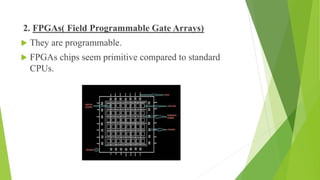
2. FPGAs( Field Programmable Gate Arrays)
 They are programmable.
 FPGAs chips seem primitive compared to standard
CPUs.
 Compared to modern CPUs, FPGAs run at very modest
speeds.
 Running code on FPGAs is difficult as it involves some
steps that are not necessary for CPUs.
 HARDWARE:-Some are designed to perform integer
calculations and others for floating point calculations.
 SOFTWARE:- There is a spectrum of FPGA software
development tools.
 At one end is the popular hardware design language.
 Verilog
 The smaller the number of bits, the less space required.
 So more can be contained on a chip and hence better
performance.
 3.CLEAR SPEED’S FLOATING POINT ACCELERATORS
 Two ways to use : one is to make a call to a routine from
their math library.
 And other way to access it is to write routines using the
Clear speed accelerator language Cn.
 Some are designed to perform integer calculations and
others are for floating-point calculation.
 Produces a board that is designed to accelerate floating-
point calculations
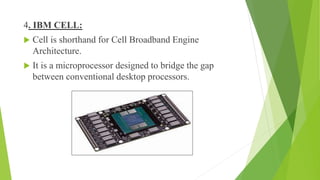
4. IBM CELL:
 Cell is shorthand for Cell Broadband Engine
Architecture.
 It is a microprocessor designed to bridge the gap
between conventional desktop processors.
 CELL ARCHITECTURE:
 Cell has a total of nine cores and is a heterogeneous
multiprocessor with a unique design.
 First major commercial application of Cell was in
Sony’s PlayStation 3.
CONCLUSION
 There are multiple families of accelerators
suitable for executing applications from portions
of HPC space
 These include GPGPUs, FPGAs, ClearSpeed and
the Cell processor.
 They are best at the following:
 GPGPUs: graphics, 32-bit floating-point .
 FPGAs: embedded applications, applications that
require a small number of bits.
 Clear speed: matrix-matrix multiplication, 64-bit
floating-point .
REFERENCE
 http://www.computer.org/portal/web/csdl/maga
zines/cise#4
 http://www.hp.com/techservers/hpccn/hpccolla
boration/ADCatalyst/downloads/accel erators.pdf
 http://en.wikipedia.org/wiki/Graphics_processin
g_unit
 http://www.scientificcomputing.com/HPC-
Future.aspx
 http://www.nvidia.com/object/fermi_architectur
e.html
 http://www.top500.o
THANK YOU

High performance computing with accelarators

  • 1.
    HIGH PERFORMANCE COMPUTINGWITH ACCELARATORS
  • 2.
    CONTENTS  INTRODUCTION  STATEOF AFFAIRS  ACCELERATORS  TYPES OF ACCELERATORS  GPU  FPGAs  IBM CELL  CONCLUSION  REFERENCE
  • 3.
    INTRODUCTION  High performancecomputing (HPC) uses supercomputers and computer clusters to solve advanced computing problems.  Applied in business uses : data warehouses, transaction process etc.  A synonym for supercomputers.  Supercomputer is used to refer a more powerful subset of HPC.  Hardware acceleration.
  • 4.
    STATE OF AFFAIRS In the past few years, a new class of HPC systems has emerged.  Unconventional processor —such as IBM's Cell processor and graphics processing units (GPUs)—for heavy computations  Conventional CPU mostly for non-compute-intensive tasks, such as I/O and communication.  e.g. : Roadrunner and Tianhe-1.
  • 5.
     Alternative technologiesincludes:  General purpose Graphical Processing Units (GPGPUs)  Field Programmable Gate Arrays (FPGAs) boards.  Clear Speed Floating Point boards  IBM cell processors
  • 6.
    ACCELERATOR  Accelerators arecomputing components containing functional units, together with memory and control systems.  An ideal accelerator has the following characteristics: 1. Much faster and easy to program. 2. Improves price/performance . 3. Improves performance/watt.
  • 7.
    FEATURES OF ACCELERATORS  Aslow clock period compared to CPUs.  Aggregate high performance is achieved through parallelism.  Transferring data between the accelerators and CPUs is slow compared to the memory bandwidth available for the primary processors.  Needs lots of data reuse for good performance.  The fewer the bits, the better the performance.
  • 8.
     Integer isfaster than 32-bit floating-point which is faster than 64-bit floating-point.  Learning the theoretical peak is difficult.  Software tools lacking.  Requires programming in languages designed for the particular technology.
  • 9.
    TYPES OF ACCELERATORS 1. GPU(Graphics Processing Unit)  A specialized microprocessor that offloads and accelerates 3D or 2D graphics rendering from the microprocessor.  Used in embedded systems, mobile phones, personal computers, workstations, and game consoles.  It is a processor attached to a graphics card dedicated to calculating floating point operation.
  • 10.
     HPC GPUconsumes more energy than CPU.  GPU doing floating point code use only half the power of one doing pure graphics code.  Max memory per GPU is about 1 GB.
  • 11.
    2. FPGAs( FieldProgrammable Gate Arrays)  They are programmable.  FPGAs chips seem primitive compared to standard CPUs.
  • 12.
     Compared tomodern CPUs, FPGAs run at very modest speeds.  Running code on FPGAs is difficult as it involves some steps that are not necessary for CPUs.  HARDWARE:-Some are designed to perform integer calculations and others for floating point calculations.
  • 13.
     SOFTWARE:- Thereis a spectrum of FPGA software development tools.  At one end is the popular hardware design language.  Verilog  The smaller the number of bits, the less space required.  So more can be contained on a chip and hence better performance.
  • 14.
     3.CLEAR SPEED’SFLOATING POINT ACCELERATORS  Two ways to use : one is to make a call to a routine from their math library.  And other way to access it is to write routines using the Clear speed accelerator language Cn.  Some are designed to perform integer calculations and others are for floating-point calculation.  Produces a board that is designed to accelerate floating- point calculations
  • 15.
    4. IBM CELL: Cell is shorthand for Cell Broadband Engine Architecture.  It is a microprocessor designed to bridge the gap between conventional desktop processors.
  • 17.
     CELL ARCHITECTURE: Cell has a total of nine cores and is a heterogeneous multiprocessor with a unique design.  First major commercial application of Cell was in Sony’s PlayStation 3.
  • 18.
    CONCLUSION  There aremultiple families of accelerators suitable for executing applications from portions of HPC space  These include GPGPUs, FPGAs, ClearSpeed and the Cell processor.  They are best at the following:  GPGPUs: graphics, 32-bit floating-point .  FPGAs: embedded applications, applications that require a small number of bits.  Clear speed: matrix-matrix multiplication, 64-bit floating-point .
  • 19.
    REFERENCE  http://www.computer.org/portal/web/csdl/maga zines/cise#4  http://www.hp.com/techservers/hpccn/hpccolla boration/ADCatalyst/downloads/accelerators.pdf  http://en.wikipedia.org/wiki/Graphics_processin g_unit  http://www.scientificcomputing.com/HPC- Future.aspx  http://www.nvidia.com/object/fermi_architectur e.html  http://www.top500.o
  • 20.