Chapter 10

Financial Issue
for the Operation and management of MICE


E-mail: tpavit@hotmail.com
    081-082-
  . 081-082-7273
                                           1
Objectives
1. outline the overall financial implications of conventions and
   meetings to the MICE industry
2. design, produce, monitor and control a financial budget for a
   convention or meeting covering both expenses and potential
   income
3. outline the concept of yield management and explore its
   application to convention and meetings
4. identify some of the legal liabilities associated with organising
   conventions and meetings
5. establish a system of risk management and explore its application
   to conventions and meetings
6. recognise the importance of ethical behaviour within the
   convention and meeting industry


                                                                       2
Introductions
• This chapter covers a range of critical elements in convention
  management.
• The topics introduce students to the nature of budgets and their
  importance to the well being of a convention and meeting
  organisation, whether a venue, a conference organiser or a firm of
  PCOs.
• However, we have also included some vital factors that impact on
  the operational and managerial aspects of conventions. These
  include the issue of ethical business practices, certainly a topical
  theme in today's cut-throat economic and commercial environment.
• The other major factor is that of risk management and its potential
  consequences to convention organisers.


                                                                         3
Outlines
1.   Financial Philosophy and Objectives
2.   MICE Budget
3.   The Negotiation Process
4.   The Billing Process


                                           4
Financial Philosophy
   and Objectives


                       5
Corporate Organizations
• Generally, Mice Events have been seen as a cost to the business
• The main philosophy of MICE events is focusing on planning,
  marketing, sales or production
• The purpose of the event will also determine how the budget is to
  be spent and which outcomes would be its consequences
     spent,


                                                                      6
Associations
• Expenses incurred in the provision of convention or meeting do not
  exceed the income received.
• Purposes of meeting is for the purpose of continuing education and
  networking opportunities for its members.
• Generate sufficient income from the event to support other member
  activities throughout the year.
• To maximize, stimulate and increase membership growth, and the
  financial goal in this instance might simply be to break even or
  even to allow a small deficit.


                                                                       7
MICE Budget


              8
MICE Budget
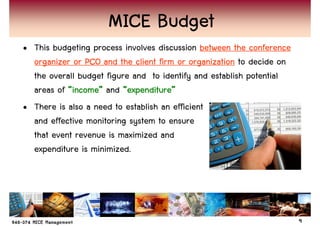
• This budgeting process involves discussion between the conference
  organizer or PCO and the client firm or organization to decide on
  the overall budget figure and to identify and establish potential
  areas of “income” and “expenditure”
            income”        expenditure”
• There is also a need to establish an efficient
  and effective monitoring system to ensure
  that event revenue is maximized and
  expenditure is minimized.


                                                                      9
MICE Budget
• The tasks in this process would clearly involve:
                                          involve:
     1. Identifying sources of income
     2. Identifying areas of expenditures
     3. Other issues concerning the budget process


                                                     10
Identifying sources of income
               and expenditure
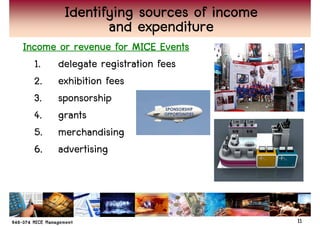
Income or revenue for MICE Events
  1. delegate registration fees
  2. exhibition fees
  3. sponsorship
  4. grants
  5. merchandising
  6. advertising


                                        11
Identifying sources of income
                  and expenditure
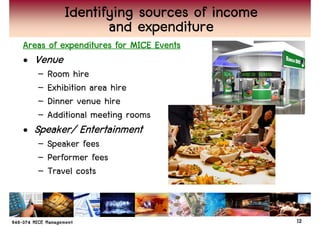
Areas of expenditures for MICE Events
• Venue
   –   Room hire
   –   Exhibition area hire
   –   Dinner venue hire
   –   Additional meeting rooms
• Speaker/ Entertainment
   peaker/ Entertainment
   – Speaker fees
   – Performer fees
   – Travel costs


                                           12
Identifying sources of income
                  and expenditure
Areas of expenditures for MICE Events
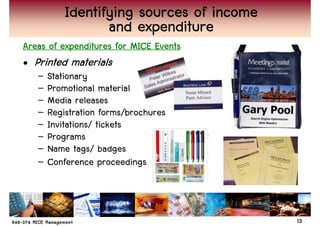
• Printed materials
   –   Stationary
   –   Promotional material
   –   Media releases
   –   Registration forms/brochures
   –   Invitations/ tickets
   –   Programs
   –   Name tags/ badges
   –   Conference proceedings


                                           13
Identifying sources of income
                 and expenditure
Areas of expenditures for MICE Events
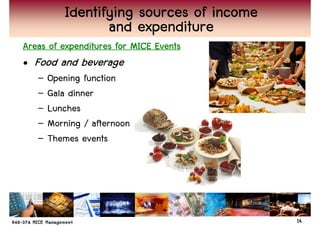
• Food and beverage
   –   Opening function
   –   Gala dinner
   –   Lunches
   –   Morning / afternoon
   –   Themes events


                                          14
Identifying sources of income
                  and expenditure
Areas of expenditures for MICE Events
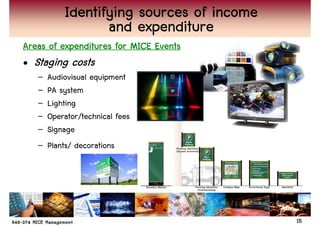
• Staging costs
   –   Audiovisual equipment
   –   PA system
   –   Lighting
   –   Operator/technical fees
   –   Signage
   –   Plants/ decorations


                                           15
Identifying sources of income
                  and expenditure
Areas of expenditures for MICE Events
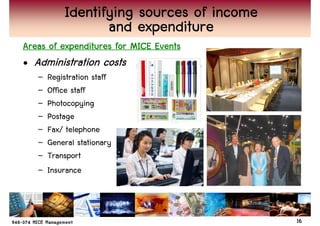
• Administration costs
   –   Registration staff
   –   Office staff
   –   Photocopying
   –   Postage
   –   Fax/ telephone
   –   General stationary
   –   Transport
   –   Insurance


                                           16
MICE Budget
Other issues concerning MICE Budget
   1.   Especially for those international events, exchange rates
        and currency fluctuations need to be taken into
        consideration
   2.   Delegate registration fees for events held within the
        host country should be paid in local currency
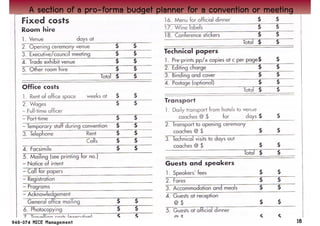
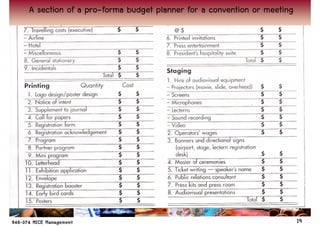
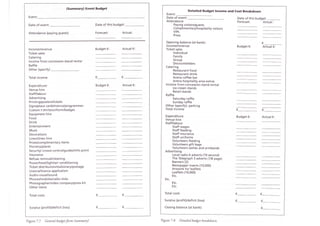
   3.   See more details on attached page about the outlines of
        a section of pro-forma budget for a particular event


                                                                    17
A section of a pro-forma budget planner for a convention or meeting


                                                                      18
A section of a pro-forma budget planner for a convention or meeting


                                                                      19
20
Monitoring the Budget
• The conference organizer is responsible
  for ensuring the viability of the budget
  and financial plan for a convention or
  meeting. In order to make sure that the
  final outcome is satisfactory.
• The simplest way of monitoring financial
  transaction is to use income and
  expenditure statements and cash flow
  forecasts.


                                             21
Monitoring the Budget
Areas for cost containment
• Providing speakers in writing as to what audiovisual equipment able
  for presentations
• Reviewing the event’s master account produced by the venue,
  including a daily check of items charged to the master account and
  an agreement as to the final delegate numbers for each F&B
  occasion
• Checking the number of delegates attending the event and, in
  particular, the numbers of delegates who actually plan to attend
  particular activities
• Providing guidelines on the reimbursement of travel expenses


                                                                        22
Negotiation Process


                      23
The Conference Organizer
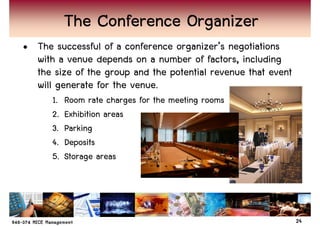
• The successful of a conference organizer’s negotiations
  with a venue depends on a number of factors, including
  the size of the group and the potential revenue that event
  will generate for the venue.
      1.   Room rate charges for the meeting rooms
      2.   Exhibition areas
      3.   Parking
      4.   Deposits
      5.   Storage areas


                                                               24
The Venue
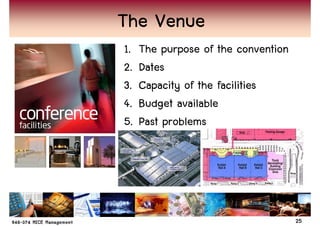
1.   The purpose of the convention
2.   Dates
3.   Capacity of the facilities
4.   Budget available
5.   Past problems


                                     25
Area for Negotiation
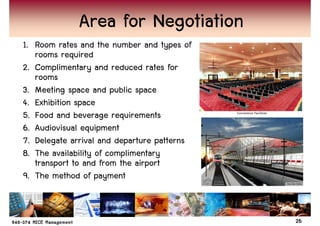
1. Room rates and the number and types of
   rooms required
2. Complimentary and reduced rates for
   rooms
3. Meeting space and public space
4. Exhibition space
5. Food and beverage requirements
6. Audiovisual equipment
7. Delegate arrival and departure patterns
8. The availability of complimentary
   transport to and from the airport
9. The method of payment


                                             26
Calculating
Break-
Break-even Point

                   27
Break-
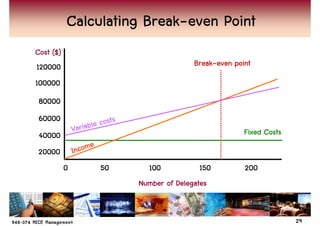
         Calculating Break-even Point
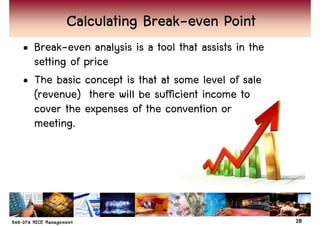
• Break-even analysis is a tool that assists in the
  setting of price
• The basic concept is that at some level of sale
  (revenue) there will be sufficient income to
  cover the expenses of the convention or
  meeting.


                                                      28
Break-
           Calculating Break-even Point
Cost ($)
120000                                          Break-
                                                Break-even point
100000
 80000
 60000
               Variab le costs
 40000                                                        Fixed Costs
20000          In come
           0             50        100           150          200
                                 Number of Delegates


                                                                            29
The Billing Process


                      30
Billing Process
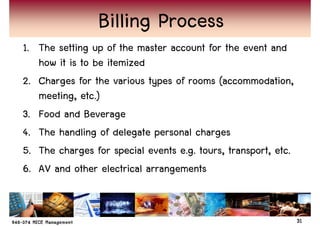
1. The setting up of the master account for the event and
   how it is to be itemized
2. Charges for the various types of rooms (accommodation,
   meeting, etc.)
3. Food and Beverage
4. The handling of delegate personal charges
5. The charges for special events e.g. tours, transport, etc.
6. AV and other electrical arrangements


                                                                31
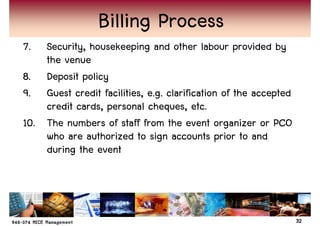
Billing Process
7.  Security, housekeeping and other labour provided by
    the venue
8. Deposit policy
9. Guest credit facilities, e.g. clarification of the accepted
    credit cards, personal cheques, etc.
10. The numbers of staff from the event organizer or PCO
    who are authorized to sign accounts prior to and
    during the event


                                                                 32
How to handle with the payments
            • Clearly identify areas of
              master account would cover
              and personal expenditures of
              delegates
            • Setting up the payment
              requirements; e.g. deposits,
              schedule of payment, etc.


                                             33
Question and Answer


                      34

Chapter 10 financial issue for mice events

  • 1.
    Chapter 10 Financial Issue forthe Operation and management of MICE E-mail: tpavit@hotmail.com 081-082- . 081-082-7273 1
  • 2.
    Objectives 1. outline theoverall financial implications of conventions and meetings to the MICE industry 2. design, produce, monitor and control a financial budget for a convention or meeting covering both expenses and potential income 3. outline the concept of yield management and explore its application to convention and meetings 4. identify some of the legal liabilities associated with organising conventions and meetings 5. establish a system of risk management and explore its application to conventions and meetings 6. recognise the importance of ethical behaviour within the convention and meeting industry 2
  • 3.
    Introductions • This chaptercovers a range of critical elements in convention management. • The topics introduce students to the nature of budgets and their importance to the well being of a convention and meeting organisation, whether a venue, a conference organiser or a firm of PCOs. • However, we have also included some vital factors that impact on the operational and managerial aspects of conventions. These include the issue of ethical business practices, certainly a topical theme in today's cut-throat economic and commercial environment. • The other major factor is that of risk management and its potential consequences to convention organisers. 3
  • 4.
    Outlines 1. Financial Philosophy and Objectives 2. MICE Budget 3. The Negotiation Process 4. The Billing Process 4
  • 5.
    Financial Philosophy and Objectives 5
  • 6.
    Corporate Organizations • Generally,Mice Events have been seen as a cost to the business • The main philosophy of MICE events is focusing on planning, marketing, sales or production • The purpose of the event will also determine how the budget is to be spent and which outcomes would be its consequences spent, 6
  • 7.
    Associations • Expenses incurredin the provision of convention or meeting do not exceed the income received. • Purposes of meeting is for the purpose of continuing education and networking opportunities for its members. • Generate sufficient income from the event to support other member activities throughout the year. • To maximize, stimulate and increase membership growth, and the financial goal in this instance might simply be to break even or even to allow a small deficit. 7
  • 8.
  • 9.
    MICE Budget • Thisbudgeting process involves discussion between the conference organizer or PCO and the client firm or organization to decide on the overall budget figure and to identify and establish potential areas of “income” and “expenditure” income” expenditure” • There is also a need to establish an efficient and effective monitoring system to ensure that event revenue is maximized and expenditure is minimized. 9
  • 10.
    MICE Budget • Thetasks in this process would clearly involve: involve: 1. Identifying sources of income 2. Identifying areas of expenditures 3. Other issues concerning the budget process 10
  • 11.
    Identifying sources ofincome and expenditure Income or revenue for MICE Events 1. delegate registration fees 2. exhibition fees 3. sponsorship 4. grants 5. merchandising 6. advertising 11
  • 12.
    Identifying sources ofincome and expenditure Areas of expenditures for MICE Events • Venue – Room hire – Exhibition area hire – Dinner venue hire – Additional meeting rooms • Speaker/ Entertainment peaker/ Entertainment – Speaker fees – Performer fees – Travel costs 12
  • 13.
    Identifying sources ofincome and expenditure Areas of expenditures for MICE Events • Printed materials – Stationary – Promotional material – Media releases – Registration forms/brochures – Invitations/ tickets – Programs – Name tags/ badges – Conference proceedings 13
  • 14.
    Identifying sources ofincome and expenditure Areas of expenditures for MICE Events • Food and beverage – Opening function – Gala dinner – Lunches – Morning / afternoon – Themes events 14
  • 15.
    Identifying sources ofincome and expenditure Areas of expenditures for MICE Events • Staging costs – Audiovisual equipment – PA system – Lighting – Operator/technical fees – Signage – Plants/ decorations 15
  • 16.
    Identifying sources ofincome and expenditure Areas of expenditures for MICE Events • Administration costs – Registration staff – Office staff – Photocopying – Postage – Fax/ telephone – General stationary – Transport – Insurance 16
  • 17.
    MICE Budget Other issuesconcerning MICE Budget 1. Especially for those international events, exchange rates and currency fluctuations need to be taken into consideration 2. Delegate registration fees for events held within the host country should be paid in local currency 3. See more details on attached page about the outlines of a section of pro-forma budget for a particular event 17
  • 18.
    A section ofa pro-forma budget planner for a convention or meeting 18
  • 19.
    A section ofa pro-forma budget planner for a convention or meeting 19
  • 20.
  • 21.
    Monitoring the Budget •The conference organizer is responsible for ensuring the viability of the budget and financial plan for a convention or meeting. In order to make sure that the final outcome is satisfactory. • The simplest way of monitoring financial transaction is to use income and expenditure statements and cash flow forecasts. 21
  • 22.
    Monitoring the Budget Areasfor cost containment • Providing speakers in writing as to what audiovisual equipment able for presentations • Reviewing the event’s master account produced by the venue, including a daily check of items charged to the master account and an agreement as to the final delegate numbers for each F&B occasion • Checking the number of delegates attending the event and, in particular, the numbers of delegates who actually plan to attend particular activities • Providing guidelines on the reimbursement of travel expenses 22
  • 23.
  • 24.
    The Conference Organizer •The successful of a conference organizer’s negotiations with a venue depends on a number of factors, including the size of the group and the potential revenue that event will generate for the venue. 1. Room rate charges for the meeting rooms 2. Exhibition areas 3. Parking 4. Deposits 5. Storage areas 24
  • 25.
    The Venue 1. The purpose of the convention 2. Dates 3. Capacity of the facilities 4. Budget available 5. Past problems 25
  • 26.
    Area for Negotiation 1.Room rates and the number and types of rooms required 2. Complimentary and reduced rates for rooms 3. Meeting space and public space 4. Exhibition space 5. Food and beverage requirements 6. Audiovisual equipment 7. Delegate arrival and departure patterns 8. The availability of complimentary transport to and from the airport 9. The method of payment 26
  • 27.
  • 28.
    Break- Calculating Break-even Point • Break-even analysis is a tool that assists in the setting of price • The basic concept is that at some level of sale (revenue) there will be sufficient income to cover the expenses of the convention or meeting. 28
  • 29.
    Break- Calculating Break-even Point Cost ($) 120000 Break- Break-even point 100000 80000 60000 Variab le costs 40000 Fixed Costs 20000 In come 0 50 100 150 200 Number of Delegates 29
  • 30.
  • 31.
    Billing Process 1. Thesetting up of the master account for the event and how it is to be itemized 2. Charges for the various types of rooms (accommodation, meeting, etc.) 3. Food and Beverage 4. The handling of delegate personal charges 5. The charges for special events e.g. tours, transport, etc. 6. AV and other electrical arrangements 31
  • 32.
    Billing Process 7. Security, housekeeping and other labour provided by the venue 8. Deposit policy 9. Guest credit facilities, e.g. clarification of the accepted credit cards, personal cheques, etc. 10. The numbers of staff from the event organizer or PCO who are authorized to sign accounts prior to and during the event 32
  • 33.
    How to handlewith the payments • Clearly identify areas of master account would cover and personal expenditures of delegates • Setting up the payment requirements; e.g. deposits, schedule of payment, etc. 33
  • 34.