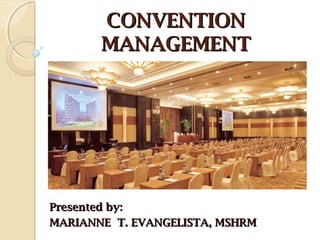
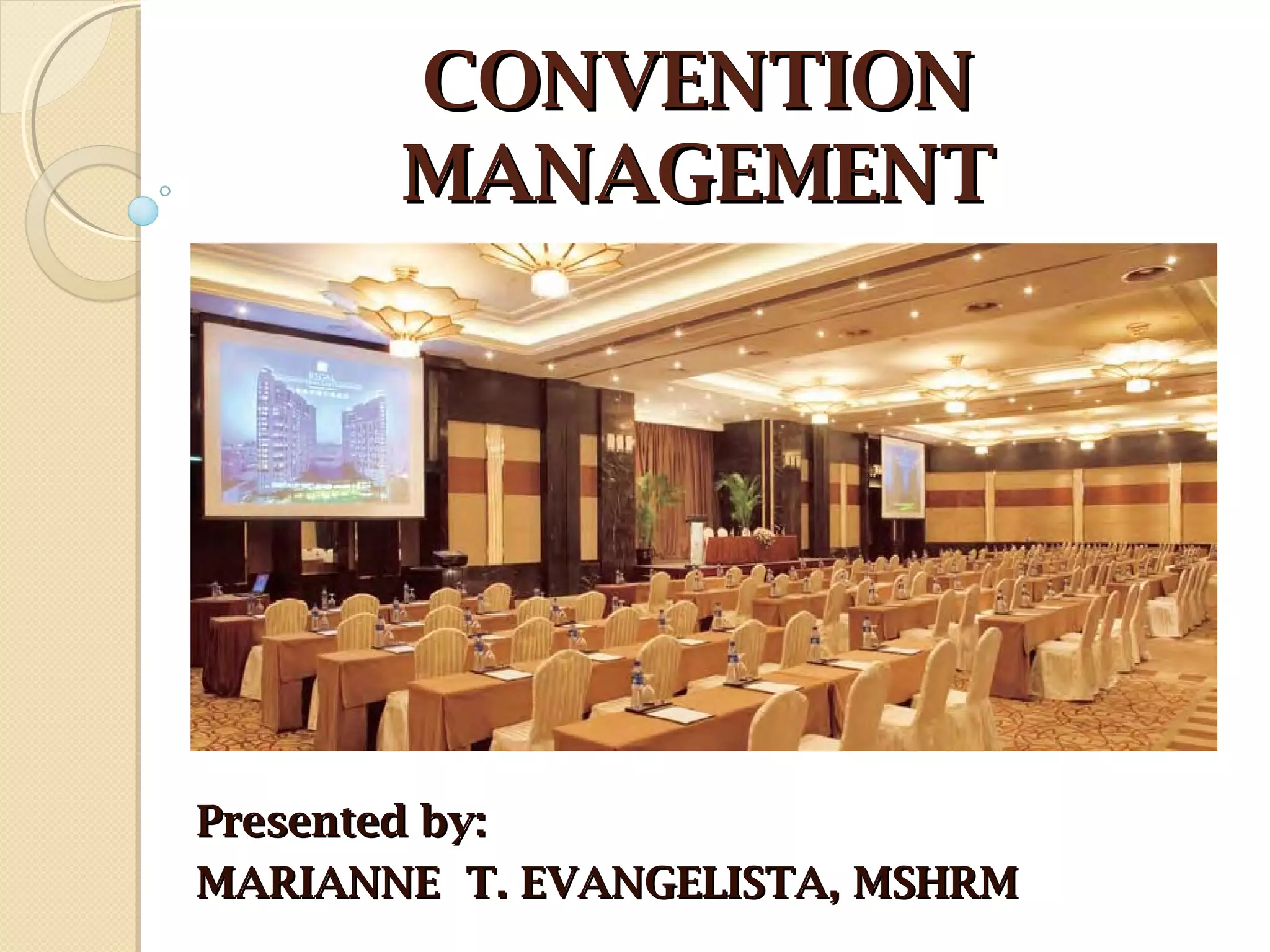
CONVENTIONCONVENTION
MANAGEMENTMANAGEMENT
Presented by:Presented by:
MARIANNE T. EVANGELISTA, MSHRMMARIANNE T. EVANGELISTA, MSHRM
ROLE OF MICE TO TOURISMROLE OF MICE TO TOURISM
INDUSTRYINDUSTRY
The convention and exhibition
industry is an exciting and
profitable segment of the tourism
industry.
A major source of revenue for the
tourism industry comes from the
meetings, conventions and
exhibitions segment of the industry.
COMPONENTS OF THECOMPONENTS OF THE
CONVENTION INDUSTRYCONVENTION INDUSTRY
There are 4 major components of the
convention industry namely:
1. Planners and Groups they represent
2. Host Facilities

3. Services
4. Exhibitors
PLANNERSPLANNERS
 Are individuals or
groups that plan
meetings, conventions
and exhibitions.
 Planners are classified
into a number of
categories such as
corporate meeting
planners, association
meeting planners and
independent meeting
planners
CORPORATE MEETINGCORPORATE MEETING
PLANNERSPLANNERS
Are type of meeting planners who
work exclusively for a corporation
PLANNERS
& GROUPS
THEY
REPRESENT
ASSOCIATION MEETINGASSOCIATION MEETING
PLANNERSPLANNERS
Are type of meeting planners who
work exclusively for an
association.
PLANNERS
& GROUPS
THEY
REPRESENT
INDEPENDENT MEETINGINDEPENDENT MEETING
PLANNERSPLANNERS
Are type of meeting planners who
work contact their services to both
associations and corporations
PLANNERS
& GROUPS
THEY
REPRESENT
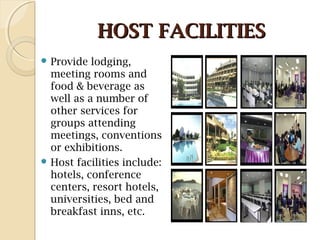
HOST FACILITIESHOST FACILITIES
 Provide lodging,
meeting rooms and
food & beverage as
well as a number of
other services for
groups attending
meetings, conventions
or exhibitions.
 Host facilities include:
hotels, conference
centers, resort hotels,
universities, bed and
breakfast inns, etc.
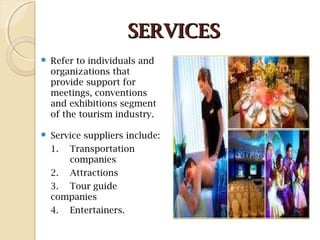
SERVICESSERVICES
 Refer to individuals and
organizations that
provide support for
meetings, conventions
and exhibitions segment
of the tourism industry.
 Service suppliers include:
1. Transportation
companies
2. Attractions
3. Tour guide
companies
4. Entertainers.
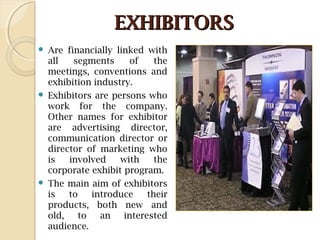
EXHIBITORSEXHIBITORS
 Are financially linked with
all segments of the
meetings, conventions and
exhibition industry.
 Exhibitors are persons who
work for the company.
Other names for exhibitor
are advertising director,
communication director or
director of marketing who
is involved with the
corporate exhibit program.
 The main aim of exhibitors
is to introduce their
products, both new and
old, to an interested
audience.
HISTORY OF MEETINGS,HISTORY OF MEETINGS,
CONVENTIONS AND EXHIBITIONSCONVENTIONS AND EXHIBITIONS
 Archeologist who investigated ancient cultures have
found remains that served as places where primitive
people gathered to discuss common interests such
as hunting plans, war activities, peace negotiations
and tribal celebrations. Each village had its common
gathering place.
 As geographical areas grew, cities became the
meeting paces for people who wanted to trade
goods or discuss common problems.
 As cities became the center of activities for
geographical regions and transportation improved,
the desire of the people to gather and discuss things
of common interest became more widespread.
THE GROWTH OF MEETINGS,THE GROWTH OF MEETINGS,
CONVENTIONS AND EXHIBITIONCONVENTIONS AND EXHIBITION
INDUSTRYINDUSTRY
 The growth of meetings, conventions and
exhibitions industry has been remarkable. Most of
this development has occurred within the past 2-5
years. This growth has been due to several factors:
1. Meeting Planners Association
2. The Airline Industry
3. The Lodging Industry
4. Convention Centers
5. Conference Centers
6. Meeting Technology
7. Ground Handlers
MEETING PLANNERSMEETING PLANNERS
ASSOCIATIONASSOCIATION
 There was unmatched development of the
associations connected with meeting
planners. These associations not only grew
in numbers but also expanded the list of
services they offered to their numbers.
 Majority of these associations increased
their emphasis on education. Other growth
factors included the rise of the independent
meeting planners, the increase in the
number of women planners, certification and
development of standards and the
integration of travel agents into the
profession.
AIRLINE INDUSTRYAIRLINE INDUSTRY
The advancement of the airline
industry enabled people to travel
quickly and efficiently.
This was made possible by the
introduction of the jet airplane – an
invention that revolutionized
transportation worldwide.
LODGING INDUSTRYLODGING INDUSTRY
The lodging industry recognized the
financial importance of meetings,
conventions and exhibitions.
Hotels grew and became convention
center. Hoteliers learned to adopt
their services to different clients.
Property marketing directors learned
how to work with meeting planners.
CONVENTION CENTERSCONVENTION CENTERS
Convention centers expanded in
terms of exhibition spaces,
accessibility and storage facilities.
They were able to accommodate all
the activities of a convention and
trade show under one roof.
Traffic was improved allowing large
numbers of people to move quickly
from one area to another.
CONVENTION BUREAUSCONVENTION BUREAUS
Convention bureaus grew rapidly
both in numbers and size of
operations.
The number of bureaus has doubled
since 1980, from 100 to more than
250. their operators have become
more professional. They actively
participated in industry and
association affairs.
CONFERENCE CENTERSCONFERENCE CENTERS
Conference centers changed their
appearances during the past two
decades. For some time they
maintained a “business only”
appearance. This has been replaced
by modern restaurants, recreational
facilities and the latest high-tech
audio-visual equipment.
MEETING TECHNOLOGYMEETING TECHNOLOGY
Modern audiovisual equipment gave
meeting planners a greater degree of
flexibility and creativity that was
never possible in the past.
Video projectors, 360 degree
projection techniques, multi-image
presentations and unique sound
systems have become very common.
GROUND HANDLERGROUND HANDLER
Effective ground arrangements
become necessary as meetings and
conventions become more complex.
Ground arrangement include
planning tours, transportation,
sightseeing, banquets and hotel
reservation.
Convention service companies were
established in the 1970’s to develop
creative meeting programs.
KEY PLAYERS IN THEKEY PLAYERS IN THE
INDUSTRYINDUSTRY
 The size of the convention and meetings industry has
greatly expanded. These players are the following:
1. Association
2. Convention Centers
3. Conference Centers
4. Corporate Meeting; Planners
5. Independent Meeting Planners
6. Tour Operators
7. Tradeshows and Expositions
8. Hotels
9. Convention and Visitor Bureaus
10. Incentive Travel
ASSOCIATIONSASSOCIATIONS
 An association is an organized body that
promotes and enhances a common interest
activity or purpose.
 Association are classified into 2 main
categories – trade associations and
professional associations. Both are
organized for the betterment of their
members.
 The main activity for both types of
associations is to gather and exchange
information through publications,
educational seminars, newsletters and
meetings.
CONVENTION CENTERSCONVENTION CENTERS
A convention center is a public
assembly facility which is designed
to host meetings and exhibits under
one roof.
It has also provision banquet, food
and beverage and concession
service.
Most convention centers are owned
by city, country or state government
and are operated by a designed
board or authority.
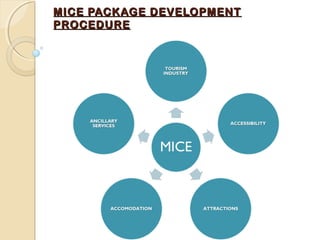
MICE PACKAGE DEVELOPMENTMICE PACKAGE DEVELOPMENT
PROCEDUREPROCEDURE
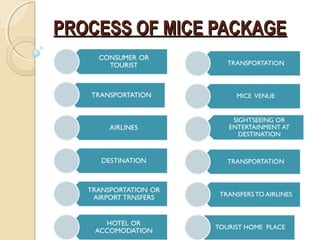
PROCESS OF MICE PACKAGEPROCESS OF MICE PACKAGE
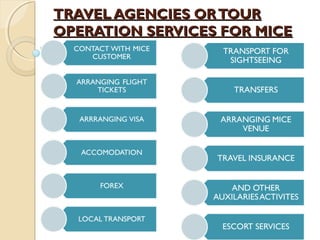
TRAVEL AGENCIES ORTOURTRAVEL AGENCIES ORTOUR
OPERATION SERVICES FOR MICEOPERATION SERVICES FOR MICE
AccessibilityAccessibility
Cost: the monetary expense of transportation andthe monetary expense of transportation and
access.access.
 TimeTime: the duration/distance of travel involved and: the duration/distance of travel involved and
the opportunity cost of that time.the opportunity cost of that time.
Frequency:Frequency: the frequency of connections to thethe frequency of connections to the
site.site.
 Convenience:Convenience: the scheduling convenience of thethe scheduling convenience of the
connections.connections.
 Barriers:Barriers: the extent of any travel formalities,the extent of any travel formalities,
which inhibit travel such as visas, customs, etcwhich inhibit travel such as visas, customs, etc.
Local SupportLocal Support
Local Chapter: the extent of assistance andthe extent of assistance and
backing offered by the local chapter of thebacking offered by the local chapter of the
Association.Association.
 CVB/Convention CentreCVB/Convention Centre: the extent of planning,: the extent of planning,
logistical and promotional support offered.logistical and promotional support offered.
 SubsidiesSubsidies: the extent to which the destination: the extent to which the destination
offers to defray costs through rebates andoffers to defray costs through rebates and
Subsidies.Subsidies.
Other AttractionsOther Attractions
Entertainment:Entertainment: Restaurants, Bars,Theatres,Restaurants, Bars,Theatres,
Nightclubs etc.Nightclubs etc.
 Shopping:Shopping: Malls, Major Department Stores, LowMalls, Major Department Stores, Low
Prices etc.Prices etc.
 Sightseeing:Sightseeing: Architecture, Museums, Monuments,Architecture, Museums, Monuments,
Attractions, Parks, Historical Sites, Local Tours.Attractions, Parks, Historical Sites, Local Tours.
 Recreation:Recreation: Sports And Activities Either AsSports And Activities Either As
Spectator Or Participant.Spectator Or Participant.
 Professional opportunities:Professional opportunities: Visiting LocalVisiting Local
Clients, Negotiations, Business Deals, Selling, MakingClients, Negotiations, Business Deals, Selling, Making
Contacts etc.Contacts etc.
Accommodation FacilitiesAccommodation Facilities
Capacity:Capacity: The number of rooms available andThe number of rooms available and
whether more than a single hotel is required.whether more than a single hotel is required.
 Cost:Cost: The cost of suitable accommodation at theThe cost of suitable accommodation at the
site.site.
 Service:Service: The perception of standards of service.The perception of standards of service.
 Security:Security: The extent to which the hotels provideThe extent to which the hotels provide
safe and secure environment.safe and secure environment.
 AvailabilityAvailability:Are the facilities available when:Are the facilities available when
required?required?
Meeting FacilitiesMeeting Facilities
Capacity:Capacity: Ability of site to provide suitable sizedAbility of site to provide suitable sized
facilities.facilities.
 Layout:Layout: suitability of facility layout and floor plan.suitability of facility layout and floor plan.
 Cost:Cost: the cost of the meeting space required.the cost of the meeting space required.
 Ambience:Ambience: the ability of the facility to create anthe ability of the facility to create an
appropriate atmosphere and environment.appropriate atmosphere and environment.
 Service:Service: the perception of the standards ofthe perception of the standards of
service.service.
 Security:Security: the extent to which the facility providesthe extent to which the facility provides
a safe and secure meeting space.a safe and secure meeting space.
 Availability:Availability: are the facilities available whenare the facilities available when
required.required.
InformationInformation
Experience: has the site performed satisfactorily in
the past.
Reputation: what is the reputation of the
destination among other meeting planners.
Marketing: the effectiveness of the destination’s
marketing activities.
Site EnvironmentSite Environment
Climate: the desirability of the destination’s
climate.
Setting: the attractiveness of the destinations
surroundings.
Infrastructure: the suitability and standard of local
infrastructure.
Hospitality: the extent to which the host
Other CriteriaOther Criteria
RisksRisks: the possibility of strikes, natural disasters,the possibility of strikes, natural disasters,
boycotts, and other possible adverse events.boycotts, and other possible adverse events.
 Profitability:Profitability: the extent to which the site wouldthe extent to which the site would
produce a profit for the organizers.produce a profit for the organizers.
 Association Promotion:Association Promotion: would the site addwould the site add
credibility to the association and build membership.credibility to the association and build membership.
 Novelty:Novelty: the extent to which the destinationthe extent to which the destination
represents a novel location for the association’s nextrepresents a novel location for the association’s next
Convention.Convention.
Top Mice destinations of worldTop Mice destinations of world
SingaporeSingapore
ShanghaiShanghai
KualalumpurKualalumpur
BangkokBangkok
HonkongHonkong
Seoul (Korea)Seoul (Korea)
Vienna (AustriaVienna (Austria))
 Guangzhou(China)Guangzhou(China)
 FrankfurtFrankfurt
,Dusseldorf,,Dusseldorf,
Hamburg (Germany)Hamburg (Germany)
 Paris (France)Paris (France)
 Barcelona (Spain)Barcelona (Spain)
 GenevaGeneva
(Switzerland)(Switzerland)
 Stockholm (Sweden)Stockholm (Sweden)
 JakartaJakarta
REFRENCESREFRENCES
Mr. Surjeet sir (Department of Hotel & TourismMr. Surjeet sir (Department of Hotel & Tourism
Management.Management.
India as a Global Conventions DestinationIndia as a Global Conventions Destination
prospects & strategy:- by Ministry of Tourism,prospects & strategy:- by Ministry of Tourism,
Govt. of India.Govt. of India.
 Introduction to Hospitality Management :-Introduction to Hospitality Management :-
By John R.WalkerBy John R.Walker
http://www.haryanatourism.gov.in/destination/rahttp://www.haryanatourism.gov.in/destination/ra
jhans.aspjhans.asp
http://www.incredibleindia.org/newsite/cms_paghttp://www.incredibleindia.org/newsite/cms_pag
e.asp?pageid=866e.asp?pageid=866
http://www.conventionicpb.org/conf_locations.ahttp://www.conventionicpb.org/conf_locations.a
spsp
CONVENTION MANAGEMENT

CONVENTION MANAGEMENT

  • 1.
    CONVENTIONCONVENTION MANAGEMENTMANAGEMENT Presented by:Presented by: MARIANNET. EVANGELISTA, MSHRMMARIANNE T. EVANGELISTA, MSHRM
  • 3.
    ROLE OF MICETO TOURISMROLE OF MICE TO TOURISM INDUSTRYINDUSTRY The convention and exhibition industry is an exciting and profitable segment of the tourism industry. A major source of revenue for the tourism industry comes from the meetings, conventions and exhibitions segment of the industry.
  • 4.
    COMPONENTS OF THECOMPONENTSOF THE CONVENTION INDUSTRYCONVENTION INDUSTRY There are 4 major components of the convention industry namely: 1. Planners and Groups they represent 2. Host Facilities 3. Services 4. Exhibitors
  • 5.
    PLANNERSPLANNERS  Are individualsor groups that plan meetings, conventions and exhibitions.  Planners are classified into a number of categories such as corporate meeting planners, association meeting planners and independent meeting planners
  • 6.
    CORPORATE MEETINGCORPORATE MEETING PLANNERSPLANNERS Aretype of meeting planners who work exclusively for a corporation PLANNERS & GROUPS THEY REPRESENT
  • 7.
    ASSOCIATION MEETINGASSOCIATION MEETING PLANNERSPLANNERS Aretype of meeting planners who work exclusively for an association. PLANNERS & GROUPS THEY REPRESENT
  • 8.
    INDEPENDENT MEETINGINDEPENDENT MEETING PLANNERSPLANNERS Aretype of meeting planners who work contact their services to both associations and corporations PLANNERS & GROUPS THEY REPRESENT
  • 9.
    HOST FACILITIESHOST FACILITIES Provide lodging, meeting rooms and food & beverage as well as a number of other services for groups attending meetings, conventions or exhibitions.  Host facilities include: hotels, conference centers, resort hotels, universities, bed and breakfast inns, etc.
  • 10.
    SERVICESSERVICES  Refer toindividuals and organizations that provide support for meetings, conventions and exhibitions segment of the tourism industry.  Service suppliers include: 1. Transportation companies 2. Attractions 3. Tour guide companies 4. Entertainers.
  • 11.
    EXHIBITORSEXHIBITORS  Are financiallylinked with all segments of the meetings, conventions and exhibition industry.  Exhibitors are persons who work for the company. Other names for exhibitor are advertising director, communication director or director of marketing who is involved with the corporate exhibit program.  The main aim of exhibitors is to introduce their products, both new and old, to an interested audience.
  • 12.
    HISTORY OF MEETINGS,HISTORYOF MEETINGS, CONVENTIONS AND EXHIBITIONSCONVENTIONS AND EXHIBITIONS  Archeologist who investigated ancient cultures have found remains that served as places where primitive people gathered to discuss common interests such as hunting plans, war activities, peace negotiations and tribal celebrations. Each village had its common gathering place.  As geographical areas grew, cities became the meeting paces for people who wanted to trade goods or discuss common problems.  As cities became the center of activities for geographical regions and transportation improved, the desire of the people to gather and discuss things of common interest became more widespread.
  • 13.
    THE GROWTH OFMEETINGS,THE GROWTH OF MEETINGS, CONVENTIONS AND EXHIBITIONCONVENTIONS AND EXHIBITION INDUSTRYINDUSTRY  The growth of meetings, conventions and exhibitions industry has been remarkable. Most of this development has occurred within the past 2-5 years. This growth has been due to several factors: 1. Meeting Planners Association 2. The Airline Industry 3. The Lodging Industry 4. Convention Centers 5. Conference Centers 6. Meeting Technology 7. Ground Handlers
  • 14.
    MEETING PLANNERSMEETING PLANNERS ASSOCIATIONASSOCIATION There was unmatched development of the associations connected with meeting planners. These associations not only grew in numbers but also expanded the list of services they offered to their numbers.  Majority of these associations increased their emphasis on education. Other growth factors included the rise of the independent meeting planners, the increase in the number of women planners, certification and development of standards and the integration of travel agents into the profession.
  • 15.
    AIRLINE INDUSTRYAIRLINE INDUSTRY Theadvancement of the airline industry enabled people to travel quickly and efficiently. This was made possible by the introduction of the jet airplane – an invention that revolutionized transportation worldwide.
  • 16.
    LODGING INDUSTRYLODGING INDUSTRY Thelodging industry recognized the financial importance of meetings, conventions and exhibitions. Hotels grew and became convention center. Hoteliers learned to adopt their services to different clients. Property marketing directors learned how to work with meeting planners.
  • 17.
    CONVENTION CENTERSCONVENTION CENTERS Conventioncenters expanded in terms of exhibition spaces, accessibility and storage facilities. They were able to accommodate all the activities of a convention and trade show under one roof. Traffic was improved allowing large numbers of people to move quickly from one area to another.
  • 18.
    CONVENTION BUREAUSCONVENTION BUREAUS Conventionbureaus grew rapidly both in numbers and size of operations. The number of bureaus has doubled since 1980, from 100 to more than 250. their operators have become more professional. They actively participated in industry and association affairs.
  • 19.
    CONFERENCE CENTERSCONFERENCE CENTERS Conferencecenters changed their appearances during the past two decades. For some time they maintained a “business only” appearance. This has been replaced by modern restaurants, recreational facilities and the latest high-tech audio-visual equipment.
  • 20.
    MEETING TECHNOLOGYMEETING TECHNOLOGY Modernaudiovisual equipment gave meeting planners a greater degree of flexibility and creativity that was never possible in the past. Video projectors, 360 degree projection techniques, multi-image presentations and unique sound systems have become very common.
  • 21.
    GROUND HANDLERGROUND HANDLER Effectiveground arrangements become necessary as meetings and conventions become more complex. Ground arrangement include planning tours, transportation, sightseeing, banquets and hotel reservation. Convention service companies were established in the 1970’s to develop creative meeting programs.
  • 22.
    KEY PLAYERS INTHEKEY PLAYERS IN THE INDUSTRYINDUSTRY  The size of the convention and meetings industry has greatly expanded. These players are the following: 1. Association 2. Convention Centers 3. Conference Centers 4. Corporate Meeting; Planners 5. Independent Meeting Planners 6. Tour Operators 7. Tradeshows and Expositions 8. Hotels 9. Convention and Visitor Bureaus 10. Incentive Travel
  • 23.
    ASSOCIATIONSASSOCIATIONS  An associationis an organized body that promotes and enhances a common interest activity or purpose.  Association are classified into 2 main categories – trade associations and professional associations. Both are organized for the betterment of their members.  The main activity for both types of associations is to gather and exchange information through publications, educational seminars, newsletters and meetings.
  • 24.
    CONVENTION CENTERSCONVENTION CENTERS Aconvention center is a public assembly facility which is designed to host meetings and exhibits under one roof. It has also provision banquet, food and beverage and concession service. Most convention centers are owned by city, country or state government and are operated by a designed board or authority.
  • 25.
    MICE PACKAGE DEVELOPMENTMICEPACKAGE DEVELOPMENT PROCEDUREPROCEDURE
  • 26.
    PROCESS OF MICEPACKAGEPROCESS OF MICE PACKAGE
  • 27.
    TRAVEL AGENCIES ORTOURTRAVELAGENCIES ORTOUR OPERATION SERVICES FOR MICEOPERATION SERVICES FOR MICE
  • 28.
    AccessibilityAccessibility Cost: the monetaryexpense of transportation andthe monetary expense of transportation and access.access.  TimeTime: the duration/distance of travel involved and: the duration/distance of travel involved and the opportunity cost of that time.the opportunity cost of that time. Frequency:Frequency: the frequency of connections to thethe frequency of connections to the site.site.  Convenience:Convenience: the scheduling convenience of thethe scheduling convenience of the connections.connections.  Barriers:Barriers: the extent of any travel formalities,the extent of any travel formalities, which inhibit travel such as visas, customs, etcwhich inhibit travel such as visas, customs, etc.
  • 29.
    Local SupportLocal Support LocalChapter: the extent of assistance andthe extent of assistance and backing offered by the local chapter of thebacking offered by the local chapter of the Association.Association.  CVB/Convention CentreCVB/Convention Centre: the extent of planning,: the extent of planning, logistical and promotional support offered.logistical and promotional support offered.  SubsidiesSubsidies: the extent to which the destination: the extent to which the destination offers to defray costs through rebates andoffers to defray costs through rebates and Subsidies.Subsidies.
  • 30.
    Other AttractionsOther Attractions Entertainment:Entertainment:Restaurants, Bars,Theatres,Restaurants, Bars,Theatres, Nightclubs etc.Nightclubs etc.  Shopping:Shopping: Malls, Major Department Stores, LowMalls, Major Department Stores, Low Prices etc.Prices etc.  Sightseeing:Sightseeing: Architecture, Museums, Monuments,Architecture, Museums, Monuments, Attractions, Parks, Historical Sites, Local Tours.Attractions, Parks, Historical Sites, Local Tours.  Recreation:Recreation: Sports And Activities Either AsSports And Activities Either As Spectator Or Participant.Spectator Or Participant.  Professional opportunities:Professional opportunities: Visiting LocalVisiting Local Clients, Negotiations, Business Deals, Selling, MakingClients, Negotiations, Business Deals, Selling, Making Contacts etc.Contacts etc.
  • 31.
    Accommodation FacilitiesAccommodation Facilities Capacity:Capacity:The number of rooms available andThe number of rooms available and whether more than a single hotel is required.whether more than a single hotel is required.  Cost:Cost: The cost of suitable accommodation at theThe cost of suitable accommodation at the site.site.  Service:Service: The perception of standards of service.The perception of standards of service.  Security:Security: The extent to which the hotels provideThe extent to which the hotels provide safe and secure environment.safe and secure environment.  AvailabilityAvailability:Are the facilities available when:Are the facilities available when required?required?
  • 32.
    Meeting FacilitiesMeeting Facilities Capacity:Capacity:Ability of site to provide suitable sizedAbility of site to provide suitable sized facilities.facilities.  Layout:Layout: suitability of facility layout and floor plan.suitability of facility layout and floor plan.  Cost:Cost: the cost of the meeting space required.the cost of the meeting space required.  Ambience:Ambience: the ability of the facility to create anthe ability of the facility to create an appropriate atmosphere and environment.appropriate atmosphere and environment.  Service:Service: the perception of the standards ofthe perception of the standards of service.service.  Security:Security: the extent to which the facility providesthe extent to which the facility provides a safe and secure meeting space.a safe and secure meeting space.  Availability:Availability: are the facilities available whenare the facilities available when required.required.
  • 33.
    InformationInformation Experience: has thesite performed satisfactorily in the past. Reputation: what is the reputation of the destination among other meeting planners. Marketing: the effectiveness of the destination’s marketing activities. Site EnvironmentSite Environment Climate: the desirability of the destination’s climate. Setting: the attractiveness of the destinations surroundings. Infrastructure: the suitability and standard of local infrastructure. Hospitality: the extent to which the host
  • 34.
    Other CriteriaOther Criteria RisksRisks:the possibility of strikes, natural disasters,the possibility of strikes, natural disasters, boycotts, and other possible adverse events.boycotts, and other possible adverse events.  Profitability:Profitability: the extent to which the site wouldthe extent to which the site would produce a profit for the organizers.produce a profit for the organizers.  Association Promotion:Association Promotion: would the site addwould the site add credibility to the association and build membership.credibility to the association and build membership.  Novelty:Novelty: the extent to which the destinationthe extent to which the destination represents a novel location for the association’s nextrepresents a novel location for the association’s next Convention.Convention.
  • 35.
    Top Mice destinationsof worldTop Mice destinations of world SingaporeSingapore ShanghaiShanghai KualalumpurKualalumpur BangkokBangkok HonkongHonkong Seoul (Korea)Seoul (Korea) Vienna (AustriaVienna (Austria))  Guangzhou(China)Guangzhou(China)  FrankfurtFrankfurt ,Dusseldorf,,Dusseldorf, Hamburg (Germany)Hamburg (Germany)  Paris (France)Paris (France)  Barcelona (Spain)Barcelona (Spain)  GenevaGeneva (Switzerland)(Switzerland)  Stockholm (Sweden)Stockholm (Sweden)  JakartaJakarta
  • 36.
    REFRENCESREFRENCES Mr. Surjeet sir(Department of Hotel & TourismMr. Surjeet sir (Department of Hotel & Tourism Management.Management. India as a Global Conventions DestinationIndia as a Global Conventions Destination prospects & strategy:- by Ministry of Tourism,prospects & strategy:- by Ministry of Tourism, Govt. of India.Govt. of India.  Introduction to Hospitality Management :-Introduction to Hospitality Management :- By John R.WalkerBy John R.Walker http://www.haryanatourism.gov.in/destination/rahttp://www.haryanatourism.gov.in/destination/ra jhans.aspjhans.asp http://www.incredibleindia.org/newsite/cms_paghttp://www.incredibleindia.org/newsite/cms_pag e.asp?pageid=866e.asp?pageid=866 http://www.conventionicpb.org/conf_locations.ahttp://www.conventionicpb.org/conf_locations.a spsp

Editor's Notes

  • #7 CORPORATION – IS A BUSINESS ASSOCIATION – IS A GUILD / GROUP