][Welcome to
Marketing Strategy
Marketing Strategies During The
Introduction Stage
McGraw-Hill/Irwin © 2006 The McGraw-Hill Companies, Inc. All rights reserved.
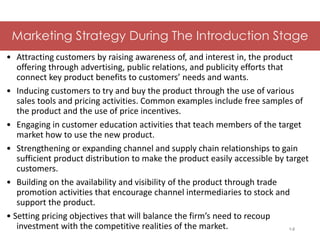
Marketing Strategy During The Introduction Stage
• Attracting customers by raising awareness of, and interest in, the product
offering through advertising, public relations, and publicity efforts that
connect key product benefits to customers’ needs and wants.
• Inducing customers to try and buy the product through the use of various
sales tools and pricing activities. Common examples include free samples of
the product and the use of price incentives.
• Engaging in customer education activities that teach members of the target
market how to use the new product.
• Strengthening or expanding channel and supply chain relationships to gain
sufficient product distribution to make the product easily accessible by target
customers.
• Building on the availability and visibility of the product through trade
promotion activities that encourage channel intermediaries to stock and
support the product.
• Setting pricing objectives that will balance the firm’s need to recoup
investment with the competitive realities of the market. 1-2
McGraw-Hill/Irwin © 2006 The McGraw-Hill Companies, Inc. All rights reserved.
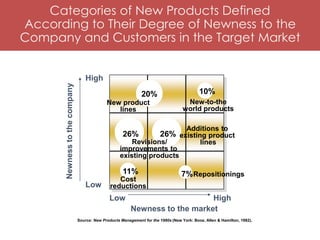
Categories of New Products Defined
According to Their Degree of Newness to the
Company and Customers in the Target Market
High
Low
Low High
Newness to the market
Source: New Products Management for the 1980s (New York: Booz, Allen & Hamilton, 1982).
Newnesstothecompany
26% 26%
20%
New product
lines
Revisions/
improvements to
existing products
11%
Cost
reductions
7%
Additions to
existing product
lines
Repositionings
10%
New-to-the
world products
McGraw-Hill/Irwin © 2006 The McGraw-Hill Companies, Inc. All rights reserved.
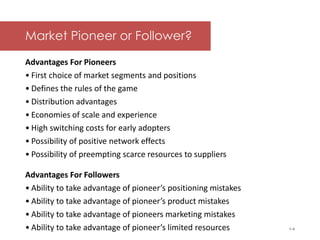
Market Pioneer or Follower?
Advantages For Pioneers
• First choice of market segments and positions
• Defines the rules of the game
• Distribution advantages
• Economies of scale and experience
• High switching costs for early adopters
• Possibility of positive network effects
• Possibility of preempting scarce resources to suppliers
Advantages For Followers
• Ability to take advantage of pioneer’s positioning mistakes
• Ability to take advantage of pioneer’s product mistakes
• Ability to take advantage of pioneers marketing mistakes
• Ability to take advantage of pioneer’s limited resources 1-4
McGraw-Hill/Irwin © 2006 The McGraw-Hill Companies, Inc. All rights reserved.
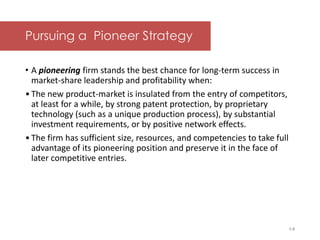
Pursuing a Pioneer Strategy
• A pioneering firm stands the best chance for long-term success in
market-share leadership and profitability when:
•The new product-market is insulated from the entry of competitors,
at least for a while, by strong patent protection, by proprietary
technology (such as a unique production process), by substantial
investment requirements, or by positive network effects.
•The firm has sufficient size, resources, and competencies to take full
advantage of its pioneering position and preserve it in the face of
later competitive entries.
1-5
McGraw-Hill/Irwin © 2006 The McGraw-Hill Companies, Inc. All rights reserved.
Strategic Options For Pioneers
•Mass-market penetration
•Niche penetration
•Skimming and early withdrawal
NOTE THAT
• First mover advantage is trumped by pioneers who are
better. Best beats first. Concentrate on being best.
• Being a pioneer without the basis for sustainable
competitive advantage is a trap!
• around Exhibit 8.9.
1-6
McGraw-Hill/Irwin © 2006 The McGraw-Hill Companies, Inc. All rights reserved.
Assignment & Discussion
How might introductory marketing plans differ under each of
these pioneering strategies?
Instructor: Build a discussion around Exhibit 8.11
1-7
McGraw-Hill/Irwin © 2006 The McGraw-Hill Companies, Inc. All rights reserved.
Pursuing a Follower Strategy
• A follower will most likely succeed when:
•There are few legal, technological, or financial barriers to inhibit
entry.
•It has sufficient resources or competencies to overwhelm the
pioneer’s early advantage.
1-8
McGraw-Hill/Irwin © 2006 The McGraw-Hill Companies, Inc. All rights reserved.
 THANK YOU 

5.2. mlc introduction stage

  • 1.
    ][Welcome to Marketing Strategy MarketingStrategies During The Introduction Stage
  • 2.
    McGraw-Hill/Irwin © 2006The McGraw-Hill Companies, Inc. All rights reserved. Marketing Strategy During The Introduction Stage • Attracting customers by raising awareness of, and interest in, the product offering through advertising, public relations, and publicity efforts that connect key product benefits to customers’ needs and wants. • Inducing customers to try and buy the product through the use of various sales tools and pricing activities. Common examples include free samples of the product and the use of price incentives. • Engaging in customer education activities that teach members of the target market how to use the new product. • Strengthening or expanding channel and supply chain relationships to gain sufficient product distribution to make the product easily accessible by target customers. • Building on the availability and visibility of the product through trade promotion activities that encourage channel intermediaries to stock and support the product. • Setting pricing objectives that will balance the firm’s need to recoup investment with the competitive realities of the market. 1-2
  • 3.
    McGraw-Hill/Irwin © 2006The McGraw-Hill Companies, Inc. All rights reserved. Categories of New Products Defined According to Their Degree of Newness to the Company and Customers in the Target Market High Low Low High Newness to the market Source: New Products Management for the 1980s (New York: Booz, Allen & Hamilton, 1982). Newnesstothecompany 26% 26% 20% New product lines Revisions/ improvements to existing products 11% Cost reductions 7% Additions to existing product lines Repositionings 10% New-to-the world products
  • 4.
    McGraw-Hill/Irwin © 2006The McGraw-Hill Companies, Inc. All rights reserved. Market Pioneer or Follower? Advantages For Pioneers • First choice of market segments and positions • Defines the rules of the game • Distribution advantages • Economies of scale and experience • High switching costs for early adopters • Possibility of positive network effects • Possibility of preempting scarce resources to suppliers Advantages For Followers • Ability to take advantage of pioneer’s positioning mistakes • Ability to take advantage of pioneer’s product mistakes • Ability to take advantage of pioneers marketing mistakes • Ability to take advantage of pioneer’s limited resources 1-4
  • 5.
    McGraw-Hill/Irwin © 2006The McGraw-Hill Companies, Inc. All rights reserved. Pursuing a Pioneer Strategy • A pioneering firm stands the best chance for long-term success in market-share leadership and profitability when: •The new product-market is insulated from the entry of competitors, at least for a while, by strong patent protection, by proprietary technology (such as a unique production process), by substantial investment requirements, or by positive network effects. •The firm has sufficient size, resources, and competencies to take full advantage of its pioneering position and preserve it in the face of later competitive entries. 1-5
  • 6.
    McGraw-Hill/Irwin © 2006The McGraw-Hill Companies, Inc. All rights reserved. Strategic Options For Pioneers •Mass-market penetration •Niche penetration •Skimming and early withdrawal NOTE THAT • First mover advantage is trumped by pioneers who are better. Best beats first. Concentrate on being best. • Being a pioneer without the basis for sustainable competitive advantage is a trap! • around Exhibit 8.9. 1-6
  • 7.
    McGraw-Hill/Irwin © 2006The McGraw-Hill Companies, Inc. All rights reserved. Assignment & Discussion How might introductory marketing plans differ under each of these pioneering strategies? Instructor: Build a discussion around Exhibit 8.11 1-7
  • 8.
    McGraw-Hill/Irwin © 2006The McGraw-Hill Companies, Inc. All rights reserved. Pursuing a Follower Strategy • A follower will most likely succeed when: •There are few legal, technological, or financial barriers to inhibit entry. •It has sufficient resources or competencies to overwhelm the pioneer’s early advantage. 1-8
  • 9.
    McGraw-Hill/Irwin © 2006The McGraw-Hill Companies, Inc. All rights reserved.  THANK YOU 