Welcome toHUMAN RESOURCES
MANAGEMENT
HOW TO CREATE A MARKET-
COMPETITIVE PAY PLAN
Dyah Pramanik, MM
[ ]
Copyright © 2011 Pearson Education,
Inc. publishing as Prentice Hall
8–2
CHAPTER 7c
HOW TO CREATE A
MARKET-COMPETITIVE
PAY PLAN
8–3
LEARNING OUTCOMES
1. Explain in detail how to establish pay
rates.
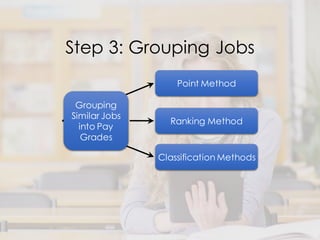
Step 3: Grouping Jobs
Point Method
Ranking Method
Classification Methods
Grouping
Similar Jobs
into Pay
Grades
S t e p
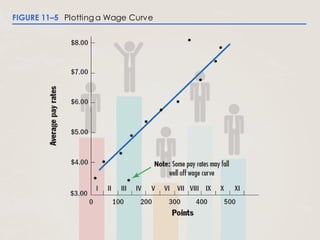
The Wage Curve
• Shows the pay rates paid for jobs in
each pay grade, relative to the points or
rankings assigned to each job or grade
by the job evaluation.
• Shows the relationships between the
value of the job as determined by one
of the job evaluation methods and the
current average pay rates for your
grades.
Price
Each
Pay
Grade4
FIGURE 11–5 Plotting a Wage Curve
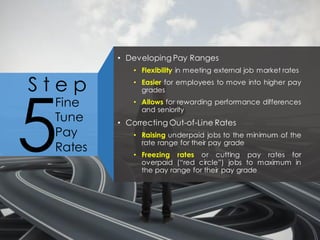
S t e p
Fine
Tune
Pay
Rates5
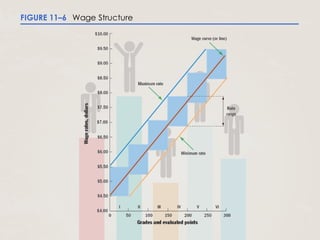
• Developing Pay Ranges
• Flexibility in meeting external job market rates
• Easier for employees to move into higher pay
grades
• Allows for rewarding performance differences
and seniority
• Correcting Out-of-Line Rates
• Raising underpaid jobs to the minimum of the
rate range for their pay grade
• Freezing rates or cutting pay rates for
overpaid (“red circle”) jobs to maximum in
the pay range for their pay grade
FIGURE 11–6 Wage Structure
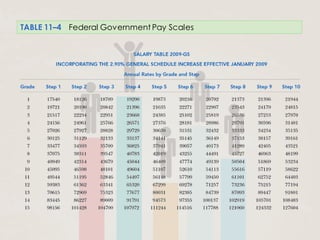
TABLE 11–4 Federal Government Pay Scales
HR in Practice:
Developing a
Workable Pay
Plan
• Simplified Approach:
• Conduct a wage survey
• Conduct a job evaluation
• Conduct once-a-year job
appraisals
• Compile the compensation
budget for upcoming year
FIGURE 11–7
Compensation
Administration
Checklist
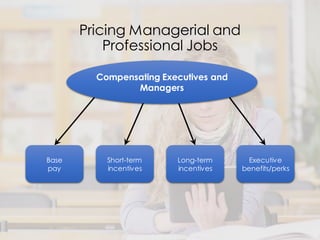
Pricing Managerial and
Professional Jobs
Base
pay
Executive
benefits/perks
Short-term
incentives
Long-term
incentives
Compensating Executives and
Managers
Pricing Managerial and Professional Jobs
• What Determines ExecutivePay?
• CEO pay is set by the board of directors taking into account
factors such as the business strategy, corporate trends, and
where they want to be in the short and long term.
• CEOs can have considerableinfluence over the boards that
determine their pay.
• Firms pay CEOs based on the complexity of the jobs they fill.
• Shareholder activism and government oversight have tightened
the restrictions on what companies pay top executives.
• Boards are reducing the relativeimportance of base salary while
boosting the emphasis on performance-basedpay.
Compensating
Professional
Employees
• Employers can use job evaluation for
professional jobs.
• Compensable factors focus on
problem solving, creativity, job
scope, and technical knowledge
and expertise.
• Firms use the point method and
factor comparison methods,
although job classification is most
popular.
• Professional jobs are market-priced
to establish the values for
benchmark jobs.
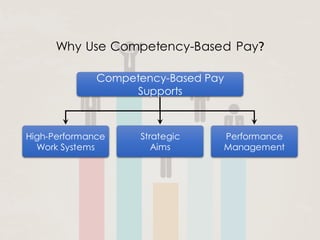
Why Use Competency-Based Pay?
High-Performance
Work Systems
Strategic
Aims
Competency-Based Pay
Supports
Performance
Management
Competency
Based
Pay in
Practice
• Main elements of skill / competency /
knowledge–based pay programs:
1. A system that defines specificskills
2. A process for tying the person’s pay to
his or her skill
3. A training system that lets employees
seek and acquire skills
4. A formal competency testing system
5. A work design that lets employees move
among jobs to permit work assignment
flexibility
Competency-
Based Pay:
Pros and Cons
• Pros
• Higher quality
• Lower absenteeism
• Fewer accidents
• Cons
• Pay program implementation
problems
• Costs of paying for unused
knowledge, skills,and behaviors
• Complexity of program
• Uncertainty that the program
improves productivity
Special
Topics in
Compensation
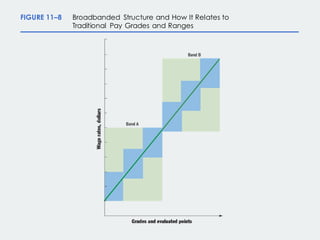
Broadbanding
• Consolidating salary grades and
ranges into a few wide levels or
“bands,” each of which contains a
relatively wide range of jobs and
salary levels.
• Pros and Cons
• More flexibility in assigning
workers to different job grades
• Provides support for flatter
hierarchies and teams
• Promotes skills learning and
mobility
• Lack of permanence in job
responsibilities can be unsettling
to new employees.
FIGURE 11–8 Broadbanded Structure and How It Relates to
Traditional Pay Grades and Ranges
Comparable Worth
• Concept:
• Employers should be required to pay men and womenequal
wages for dissimilarjobs that are of comparable (rather than
strictly equal) value to the employer.
• Basis:
• Seeks to address the issue that womenhave jobs that are
dissimilar to those of men and those jobs are often
consistently valuedless than men’s jobs.
• Question at Hand:
• Who willget to make final decisions on the comparability of
jobs?
• Employers
• Courts
The Pay Gap
Factors Lowering the Earnings of Women:
1. Women’s starting salaries are traditionally lower.
2. Salary increases for women in professional jobs do
not reflect their above-averageperformance.
3. In white-collar jobs, men change jobs more
frequently, enabling them to be promoted to
higher-level jobsoverwomen withmore seniority.
4. In blue-collar jobs, women tend to be placed in
departmentswithlower-payingjobs.
Board Oversight of Executive Pay
• Factors Influencing Executive Compensation
• FASB requirements for expensing of stock options
at fair market value.
• U.S. government’s “pay czar” overseeing certain pay
awards in firms which had U.S. treasury loans.
• Increased SEC reporting requirements for compensation-
related information.
• Increased executive liability for accuracy in corporate
financial reporting under the Sarbanes Oxley Act.
• Shareholder activism protesting excessive executive
compensation due to lack of independence by executive
board compensation committees.
Improving Productivity Through
HRIS: Automating
Compensation Administration
• Benefits of Compensation Automation:
• Allows for quick updating of compensation programs
• Eliminates costs of formerly manual processes
• Coordinates centralized compensation budgets to
preventoverages in compensation and raises
• Can integrate and automatically administerother pay
actions
K E Y T E R M S
• employee compensation
• direct financial payments
• indirect financial payments
• Davis-Bacon Act (1931)
• Walsh-Healey Public Contract
Act (1936)
• Title VII of the 1964 Civil Rights
Act
• Fair Labor Standards Act (1938)
• Equal Pay Act (1963)
• EmployeeRetirement Income
Security Act (ERISA)
• salary compression
• salary survey
• benchmark job
• job evaluation
• compensable factor
• ranking method
• job classification (or
grading) method
• classes
• grades
• grade definition
• point method
• factor comparison method
• pay grade
• wage curve
• pay ranges
• competency-basedpay
• competencies
• broadbanding
• comparable worth

Topic7.1c compensation how_to_createa_market-competitive_payplannew

  • 1.
    Welcome toHUMAN RESOURCES MANAGEMENT HOWTO CREATE A MARKET- COMPETITIVE PAY PLAN Dyah Pramanik, MM [ ] Copyright © 2011 Pearson Education, Inc. publishing as Prentice Hall
  • 2.
    8–2 CHAPTER 7c HOW TOCREATE A MARKET-COMPETITIVE PAY PLAN
  • 3.
    8–3 LEARNING OUTCOMES 1. Explainin detail how to establish pay rates.
  • 4.
    Step 3: GroupingJobs Point Method Ranking Method Classification Methods Grouping Similar Jobs into Pay Grades
  • 5.
    S t ep The Wage Curve • Shows the pay rates paid for jobs in each pay grade, relative to the points or rankings assigned to each job or grade by the job evaluation. • Shows the relationships between the value of the job as determined by one of the job evaluation methods and the current average pay rates for your grades. Price Each Pay Grade4
  • 6.
  • 7.
    S t ep Fine Tune Pay Rates5 • Developing Pay Ranges • Flexibility in meeting external job market rates • Easier for employees to move into higher pay grades • Allows for rewarding performance differences and seniority • Correcting Out-of-Line Rates • Raising underpaid jobs to the minimum of the rate range for their pay grade • Freezing rates or cutting pay rates for overpaid (“red circle”) jobs to maximum in the pay range for their pay grade
  • 8.
  • 9.
    TABLE 11–4 FederalGovernment Pay Scales
  • 10.
    HR in Practice: Developinga Workable Pay Plan • Simplified Approach: • Conduct a wage survey • Conduct a job evaluation • Conduct once-a-year job appraisals • Compile the compensation budget for upcoming year
  • 11.
  • 12.
    Pricing Managerial and ProfessionalJobs Base pay Executive benefits/perks Short-term incentives Long-term incentives Compensating Executives and Managers
  • 13.
    Pricing Managerial andProfessional Jobs • What Determines ExecutivePay? • CEO pay is set by the board of directors taking into account factors such as the business strategy, corporate trends, and where they want to be in the short and long term. • CEOs can have considerableinfluence over the boards that determine their pay. • Firms pay CEOs based on the complexity of the jobs they fill. • Shareholder activism and government oversight have tightened the restrictions on what companies pay top executives. • Boards are reducing the relativeimportance of base salary while boosting the emphasis on performance-basedpay.
  • 14.
    Compensating Professional Employees • Employers canuse job evaluation for professional jobs. • Compensable factors focus on problem solving, creativity, job scope, and technical knowledge and expertise. • Firms use the point method and factor comparison methods, although job classification is most popular. • Professional jobs are market-priced to establish the values for benchmark jobs.
  • 15.
    Why Use Competency-BasedPay? High-Performance Work Systems Strategic Aims Competency-Based Pay Supports Performance Management
  • 16.
    Competency Based Pay in Practice • Mainelements of skill / competency / knowledge–based pay programs: 1. A system that defines specificskills 2. A process for tying the person’s pay to his or her skill 3. A training system that lets employees seek and acquire skills 4. A formal competency testing system 5. A work design that lets employees move among jobs to permit work assignment flexibility
  • 17.
    Competency- Based Pay: Pros andCons • Pros • Higher quality • Lower absenteeism • Fewer accidents • Cons • Pay program implementation problems • Costs of paying for unused knowledge, skills,and behaviors • Complexity of program • Uncertainty that the program improves productivity
  • 18.
    Special Topics in Compensation Broadbanding • Consolidatingsalary grades and ranges into a few wide levels or “bands,” each of which contains a relatively wide range of jobs and salary levels. • Pros and Cons • More flexibility in assigning workers to different job grades • Provides support for flatter hierarchies and teams • Promotes skills learning and mobility • Lack of permanence in job responsibilities can be unsettling to new employees.
  • 19.
    FIGURE 11–8 BroadbandedStructure and How It Relates to Traditional Pay Grades and Ranges
  • 20.
    Comparable Worth • Concept: •Employers should be required to pay men and womenequal wages for dissimilarjobs that are of comparable (rather than strictly equal) value to the employer. • Basis: • Seeks to address the issue that womenhave jobs that are dissimilar to those of men and those jobs are often consistently valuedless than men’s jobs. • Question at Hand: • Who willget to make final decisions on the comparability of jobs? • Employers • Courts
  • 21.
    The Pay Gap FactorsLowering the Earnings of Women: 1. Women’s starting salaries are traditionally lower. 2. Salary increases for women in professional jobs do not reflect their above-averageperformance. 3. In white-collar jobs, men change jobs more frequently, enabling them to be promoted to higher-level jobsoverwomen withmore seniority. 4. In blue-collar jobs, women tend to be placed in departmentswithlower-payingjobs.
  • 22.
    Board Oversight ofExecutive Pay • Factors Influencing Executive Compensation • FASB requirements for expensing of stock options at fair market value. • U.S. government’s “pay czar” overseeing certain pay awards in firms which had U.S. treasury loans. • Increased SEC reporting requirements for compensation- related information. • Increased executive liability for accuracy in corporate financial reporting under the Sarbanes Oxley Act. • Shareholder activism protesting excessive executive compensation due to lack of independence by executive board compensation committees.
  • 23.
    Improving Productivity Through HRIS:Automating Compensation Administration • Benefits of Compensation Automation: • Allows for quick updating of compensation programs • Eliminates costs of formerly manual processes • Coordinates centralized compensation budgets to preventoverages in compensation and raises • Can integrate and automatically administerother pay actions
  • 24.
    K E YT E R M S • employee compensation • direct financial payments • indirect financial payments • Davis-Bacon Act (1931) • Walsh-Healey Public Contract Act (1936) • Title VII of the 1964 Civil Rights Act • Fair Labor Standards Act (1938) • Equal Pay Act (1963) • EmployeeRetirement Income Security Act (ERISA) • salary compression • salary survey • benchmark job • job evaluation • compensable factor • ranking method • job classification (or grading) method • classes • grades • grade definition • point method • factor comparison method • pay grade • wage curve • pay ranges • competency-basedpay • competencies • broadbanding • comparable worth