EVENTS AND EVENT
MANAGEMENT
Prepared by:
Prof. Rowena R. De Leon
EVENT
Is a general term
indicating the coming
together a number of
people in one place, to
confer or carry out a
particular activity.
EVENT
 Is anything that happens or a
very important occurrence.
Can range from local, regional
and international.
 As an activity established to
evolves the local population in
a shared experience to their
mutual benefits
SPECIAL EVENT
A unique moment in time
celebrated with
ceremony and ritual to
satisfy special
needs.(2002,p.6)
SPECIAL EVENT
 A special event is a one-time or
infrequently occurring event outside
normal or activities of the
sponsoring or organizing body;
 To the customer or guest, a special
event is an opportunity for a leisure,
social or cultural experience outside
the normal range of choices or
beyond everyday experience.(1997,
Common Characteristics of
Events
 Are unique occurrences that do not
happen very often
 Have a LIMITED duration (happening
within hours or days at the most)
 Happen with a live audience in attendance
 Require one or more groups to plan and
organize
 Are staged for a purpose
Types of Events
Events vary in size, content and purpose making
the industry extremely diverse. As an event
leader, it is important for you to distinguish
the difference in terminology. This will enable
you grasp the kind of event your client would
like to produce. This way you can plan,
manage and coordinate the event
requirements well (Aastroff and Abbey,1998)
Types of Events
1. Events based on size
EVENTS MANAGEMENT
 Is one of the professional courses
included in the curriculum fore
tourism and hospitality programs,
even to some other business
management-related programs.
 This course as required is significant
competency that was embedded in
the curriculum in order for the
industry professionals to become
EVENTS MANAGEMENT
A function requiring public
assembly for the purpose of
celebration, education,
marketing and reunion;
The process that includes
research, design, planning,
coordinating and evaluation of
It is a science and art
It is a venue to incorporate
principles in the field of
management and business
with social graces, protocol,
and the art of creating
unique.
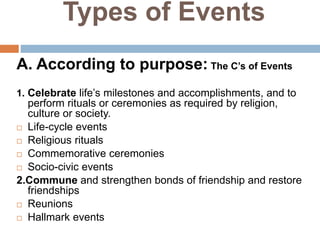
Types of Events
A. According to purpose: The C’s of Events
1. Celebrate life’s milestones and accomplishments, and to
perform rituals or ceremonies as required by religion,
culture or society.
 Life-cycle events
 Religious rituals
 Commemorative ceremonies
 Socio-civic events
2.Commune and strengthen bonds of friendship and restore
friendships
 Reunions
 Hallmark events
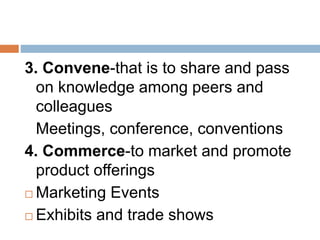
3. Convene-that is to share and pass
on knowledge among peers and
colleagues
Meetings, conference, conventions
4. Commerce-to market and promote
product offerings
 Marketing Events
 Exhibits and trade shows
B. According to the number of
participants(few,many,multitude)
D. According to Frequency
 Monthly
 Quarterly
 Semestral
 Annual
 Biennial
D.According to Magnitude Impact
Field of Specialization
 Civic Events
 Expositions
 Hallmark Events
 Incentive Travel
 Retail Events
 Social life-cycle
events
 Tourism
 Conventions
 Fairs and Festivals
 Hospitality
 Meetings and
Conferences
 Reunions
 Sports Events
Event Terms and Its
Meaning
Meeting an assembly of
individuals gathered to
discuss items of material
interest, or engage in
professional development
thru learning activities.
Conference
1. A participatory meeting defined for the discussion of
subjects related to a specific topic or area. May
include fact-finding, problem-solving and
consultation.
2. An event used by any organization to meet and
exchange views, convey a message, open a debate
or give publicity to some area of opinion on a
specific issue. No tradition, continuity or specific
period is required to convene a conference. Although
not generally limited, conferences are usually of
short duration with specific objectives. Conferences
are generally smaller in scale.
3. An assembly of a large number of individuals to
discuss items of mutual interest, or engage in
professional development through learning.
Congress
1. A scheduled, periodic
meeting of delegates or
representatives of interested
groups to discuss a subject.
2. The European term for
convention.
Convention
 A general or formal meeting of
a legislative body or social or
economic group to provide
information of a particular
situation, and to establish
consent on policies among
participants. Usually of limited
duration and set objectives, but
no determined frequency.
Foreign Meeting
 A meeting comprised of
attendees from other
nations; also known as
international meeting or
institute.
Seminar
 A lecture, representation,
and discuss under the
guidance of an expert
discussion leader allowing
participants to share
experiences in a particular
field.
Workshop
1. A training session in which participants develop
skills and knowledge in a given field.
2. an event designed to stimulate intensive
discussion and compensate for diverging views
in a particular discipline.
3. an informal public session of free discussion
organized to take place between formal plenary
sessions on a subject chosen by the
participants or on a special problem suggested
by the organizers.
Exhibit
 Although the term exhibit,
booth and stand are often
used interchangeably, an
exhibit is actually all of the
display materials and
products housed in a booth
or stand.
Exhibition
 A display for public view
of products or promotional
materials for the purpose of
PR, sales, and/or
marketing; also known as
exposition, industrial show,
or trade show.
Fair
 A public celebration
that includes
commercial and civic
activities.
Festival
 A public celebration that
conveys, thru a
kaleidoscope of activities.
Parade
 A moving pageant
including floats,
bands, individual
entertainers, and
dignitaries.
Event Marketing
 The process that integrates a
range of marketing elements and a
central event sponsorship or lifestyle-
themed activity. This process
incorporates advertising, employee
and consumer programs, sales
promotion, PR, causes, business, TV
property, and trade promotion with a
specific event.

Events and event management

  • 1.
    EVENTS AND EVENT MANAGEMENT Preparedby: Prof. Rowena R. De Leon
  • 2.
    EVENT Is a generalterm indicating the coming together a number of people in one place, to confer or carry out a particular activity.
  • 3.
    EVENT  Is anythingthat happens or a very important occurrence. Can range from local, regional and international.  As an activity established to evolves the local population in a shared experience to their mutual benefits
  • 4.
    SPECIAL EVENT A uniquemoment in time celebrated with ceremony and ritual to satisfy special needs.(2002,p.6)
  • 5.
    SPECIAL EVENT  Aspecial event is a one-time or infrequently occurring event outside normal or activities of the sponsoring or organizing body;  To the customer or guest, a special event is an opportunity for a leisure, social or cultural experience outside the normal range of choices or beyond everyday experience.(1997,
  • 6.
    Common Characteristics of Events Are unique occurrences that do not happen very often  Have a LIMITED duration (happening within hours or days at the most)  Happen with a live audience in attendance  Require one or more groups to plan and organize  Are staged for a purpose
  • 7.
    Types of Events Eventsvary in size, content and purpose making the industry extremely diverse. As an event leader, it is important for you to distinguish the difference in terminology. This will enable you grasp the kind of event your client would like to produce. This way you can plan, manage and coordinate the event requirements well (Aastroff and Abbey,1998)
  • 8.
    Types of Events 1.Events based on size
  • 9.
    EVENTS MANAGEMENT  Isone of the professional courses included in the curriculum fore tourism and hospitality programs, even to some other business management-related programs.  This course as required is significant competency that was embedded in the curriculum in order for the industry professionals to become
  • 10.
    EVENTS MANAGEMENT A functionrequiring public assembly for the purpose of celebration, education, marketing and reunion; The process that includes research, design, planning, coordinating and evaluation of
  • 11.
    It is ascience and art It is a venue to incorporate principles in the field of management and business with social graces, protocol, and the art of creating unique.
  • 12.
    Types of Events A.According to purpose: The C’s of Events 1. Celebrate life’s milestones and accomplishments, and to perform rituals or ceremonies as required by religion, culture or society.  Life-cycle events  Religious rituals  Commemorative ceremonies  Socio-civic events 2.Commune and strengthen bonds of friendship and restore friendships  Reunions  Hallmark events
  • 13.
    3. Convene-that isto share and pass on knowledge among peers and colleagues Meetings, conference, conventions 4. Commerce-to market and promote product offerings  Marketing Events  Exhibits and trade shows
  • 14.
    B. According tothe number of participants(few,many,multitude) D. According to Frequency  Monthly  Quarterly  Semestral  Annual  Biennial D.According to Magnitude Impact
  • 15.
    Field of Specialization Civic Events  Expositions  Hallmark Events  Incentive Travel  Retail Events  Social life-cycle events  Tourism  Conventions  Fairs and Festivals  Hospitality  Meetings and Conferences  Reunions  Sports Events
  • 16.
    Event Terms andIts Meaning Meeting an assembly of individuals gathered to discuss items of material interest, or engage in professional development thru learning activities.
  • 17.
    Conference 1. A participatorymeeting defined for the discussion of subjects related to a specific topic or area. May include fact-finding, problem-solving and consultation. 2. An event used by any organization to meet and exchange views, convey a message, open a debate or give publicity to some area of opinion on a specific issue. No tradition, continuity or specific period is required to convene a conference. Although not generally limited, conferences are usually of short duration with specific objectives. Conferences are generally smaller in scale. 3. An assembly of a large number of individuals to discuss items of mutual interest, or engage in professional development through learning.
  • 18.
    Congress 1. A scheduled,periodic meeting of delegates or representatives of interested groups to discuss a subject. 2. The European term for convention.
  • 19.
    Convention  A generalor formal meeting of a legislative body or social or economic group to provide information of a particular situation, and to establish consent on policies among participants. Usually of limited duration and set objectives, but no determined frequency.
  • 20.
    Foreign Meeting  Ameeting comprised of attendees from other nations; also known as international meeting or institute.
  • 21.
    Seminar  A lecture,representation, and discuss under the guidance of an expert discussion leader allowing participants to share experiences in a particular field.
  • 22.
    Workshop 1. A trainingsession in which participants develop skills and knowledge in a given field. 2. an event designed to stimulate intensive discussion and compensate for diverging views in a particular discipline. 3. an informal public session of free discussion organized to take place between formal plenary sessions on a subject chosen by the participants or on a special problem suggested by the organizers.
  • 23.
    Exhibit  Although theterm exhibit, booth and stand are often used interchangeably, an exhibit is actually all of the display materials and products housed in a booth or stand.
  • 24.
    Exhibition  A displayfor public view of products or promotional materials for the purpose of PR, sales, and/or marketing; also known as exposition, industrial show, or trade show.
  • 25.
    Fair  A publiccelebration that includes commercial and civic activities.
  • 26.
    Festival  A publiccelebration that conveys, thru a kaleidoscope of activities.
  • 27.
    Parade  A movingpageant including floats, bands, individual entertainers, and dignitaries.
  • 28.
    Event Marketing  Theprocess that integrates a range of marketing elements and a central event sponsorship or lifestyle- themed activity. This process incorporates advertising, employee and consumer programs, sales promotion, PR, causes, business, TV property, and trade promotion with a specific event.