][Welcome to
Marketing Strategy
Positioning Strategy for Attractive
Market
McGraw-Hill/Irwin © 2006 The McGraw-Hill Companies, Inc. All rights reserved.
POSITIONING STRATEGIES
McGraw-Hill/Irwin © 2006 The McGraw-Hill Companies, Inc. All rights reserved.
Definitions of Positioning
• Creating distinct and valued physical and
perceptual differences between one’s product
and its competitors, as perceived by the target
customer.
• The act of designing the firm’s market offering so
that it occupies a distinct and valued place in the
minds of its target customers.
1-3
McGraw-Hill/Irwin © 2006 The McGraw-Hill Companies, Inc. All rights reserved.
Critical Words of Positioning
• Distinct: Why would anyone choose it, if it’s not different than what
they now buy?
• Valued: Differences that are not valued won’t do much good. Clear-
colored colas failed.
• Physical: The goods or services must “walk the talk” and be
different; marketing “me-too” products is very difficult.
• Perceptual: If the customer does not perceive the difference, the
difference will not matter.
• As perceived by/in the minds of: It’s what the customer perceives
that counts, not what the marketer perceives.
1-4
McGraw-Hill/Irwin © 2006 The McGraw-Hill Companies, Inc. All rights reserved.
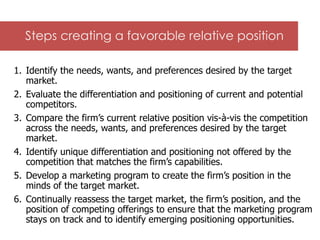
Steps creating a favorable relative position
1. Identify the needs, wants, and preferences desired by the target
market.
2. Evaluate the differentiation and positioning of current and potential
competitors.
3. Compare the firm’s current relative position vis-à-vis the competition
across the needs, wants, and preferences desired by the target
market.
4. Identify unique differentiation and positioning not offered by the
competition that matches the firm’s capabilities.
5. Develop a marketing program to create the firm’s position in the
minds of the target market.
6. Continually reassess the target market, the firm’s position, and the
position of competing offerings to ensure that the marketing program
stays on track and to identify emerging positioning opportunities.
McGraw-Hill/Irwin © 2006 The McGraw-Hill Companies, Inc. All rights reserved.
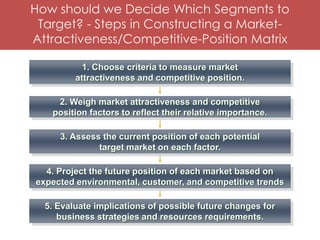
How should we Decide Which Segments to
Target? - Steps in Constructing a Market-
Attractiveness/Competitive-Position Matrix
1. Choose criteria to measure market
attractiveness and competitive position.
2. Weigh market attractiveness and competitive
position factors to reflect their relative importance.
3. Assess the current position of each potential
target market on each factor.
4. Project the future position of each market based on
expected environmental, customer, and competitive trends
5. Evaluate implications of possible future changes for
business strategies and resources requirements.
McGraw-Hill/Irwin © 2006 The McGraw-Hill Companies, Inc. All rights reserved.
6-7
A Useful Tool for Assessing Market Segments:
Segment Rating Chart
WEIGHT RATING (0-10) TOTAL
Market attractiveness factors
Customer needs and behavior .5 10 5.0
Segment size and growth rate .3 7 2.1
Macro trends .2 8 1.6
Total: Market attractiveness 1.0 8.7
Competitive position factors
Opportunity for competitive advantage .6 7 4.2
Capabilities and resources .2 5 1.0
Industry attractiveness .2 7 1.4
Total: Competitive position 1.0 6.6
McGraw-Hill/Irwin © 2006 The McGraw-Hill Companies, Inc. All rights reserved.
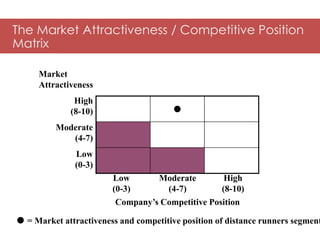
The Market Attractiveness / Competitive Position
Matrix
l
Market
Attractiveness
High
(8-10)
Moderate
(4-7)
Low
(0-3)
High
(8-10)
Moderate
(4-7)
Low
(0-3)
Company’s Competitive Position
l = Market attractiveness and competitive position of distance runners segment
McGraw-Hill/Irwin © 2006 The McGraw-Hill Companies, Inc. All rights reserved.
6-9
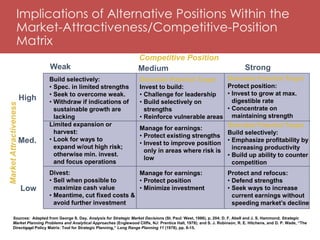
Implications of Alternative Positions Within the
Market-Attractiveness/Competitive-Position
Matrix
High
Low
Med.
MarketAttractiveness
Competitive Position
StrongMediumWeak
Desirable Potential Target
Protect position:
• Invest to grow at max.
digestible rate
• Concentrate on
maintaining strength
Desirable Potential Target
Invest to build:
• Challenge for leadership
• Build selectively on
strengths
• Reinforce vulnerable areas
Build selectively:
• Spec. in limited strengths
• Seek to overcome weak.
• Withdraw if indications of
sustainable growth are
lacking
Desirable Potential Target
Build selectively:
• Emphasize profitability by
increasing productivity
• Build up ability to counter
competition
Manage for earnings:
• Protect existing strengths
• Invest to improve position
only in areas where risk is
low
Limited expansion or
harvest:
• Look for ways to
expand w/out high risk;
otherwise min. invest.
and focus operations
Protect and refocus:
• Defend strengths
• Seek ways to increase
current earnings without
speeding market’s decline
Manage for earnings:
• Protect position
• Minimize investment
Divest:
• Sell when possible to
maximize cash value
• Meantime, cut fixed costs &
avoid further investment
Sources: Adapted from George S. Day, Analysis for Strategic Market Decisions (St. Paul: West, 1986), p. 204; D. F. Abell and J. S. Hammond, Strategic
Market Planning Problems and Analytical Approaches (Englewood Cliffs, NJ: Prentice Hall, 1979); and S. J. Robinson, R. E. Hitchens, and D. P. Wade, “The
Directional Policy Matrix: Tool for Strategic Planning,” Long Range Planning 11 (1978), pp. 8-15.
McGraw-Hill/Irwin © 2006 The McGraw-Hill Companies, Inc. All rights reserved.
7-10
Comparison of Physical and Perceptual
Positioning Analysis
Physical positioning
• Technical orientation
• Physical characteristics
• Objective measures
• Data readily available
• Physical brand properties
• Large number of dimensions
• Represents impact of product
specs and price
• Direct R&D implications
Perceptual positioning
• Consumer orientation
• Perceptual attributes
• Perceptual measures
• Need for marketing research
• Perceptual brand positions
and positioning intensities
• Limited number of dimensions
• Represents impact of product
specs and communication
• R&D implications need to be
interpreted
McGraw-Hill/Irwin © 2006 The McGraw-Hill Companies, Inc. All rights reserved.
Steps in the Positioning Process (1 of 2)
1. Identify relevant set of competitive products serving a
target market.
2. Identify the set of determinant attributes that define the “product
space” in which positions of current offerings are located.
3. Collect information from a sample of customers and
potential customers about perceptions of each product
on the determinant attributes.
McGraw-Hill/Irwin © 2006 The McGraw-Hill Companies, Inc. All rights reserved.
Steps in the Positioning Process (2 of 2)
4. Determine product’s current location (positioning) in the
product space and intensity thereof.
5. Determine customers’ most preferred combination of
determinant attributes.
6. Examine the fit between preferences of market segments
and current position of product (market positioning).
7. Write positioning statement or value proposition to guide
development and implementation of marketing strategy.
McGraw-Hill/Irwin © 2006 The McGraw-Hill Companies, Inc. All rights reserved.
The Tangible Output Of The Positioning Process
• A written statement: two approaches to writing it down:
•Positioning statement
•Value proposition
1-13
McGraw-Hill/Irwin © 2006 The McGraw-Hill Companies, Inc. All rights reserved.
7-14
Key Questions
Concerning Positioning Decisions
•For whom are they written?
•In what sort of language?
•Should they focus on features or benefits?
•How many differentiating attributes should
anchor them?
McGraw-Hill/Irwin © 2006 The McGraw-Hill Companies, Inc. All rights reserved.
Positioning’s Role
• What is positioning’s role once a product’s positioning
strategy has been determined?
• Positioning is the foundation from which marketing mix
decisions are made Product decisions: What features are
needed to deliver the required benefits?
• Pricing decisions: How should the product be priced relative to
competition?
• Promotion: What should promotional messages say to create
the desired perception in the target customer's mind?
• Place: Through what channels should the good or service be
marketed to create the desired perception in the target
customer's mind?
1-15
McGraw-Hill/Irwin © 2006 The McGraw-Hill Companies, Inc. All rights reserved.
 Thank You 
1-16

4.5. market positioning

  • 1.
    ][Welcome to Marketing Strategy PositioningStrategy for Attractive Market
  • 2.
    McGraw-Hill/Irwin © 2006The McGraw-Hill Companies, Inc. All rights reserved. POSITIONING STRATEGIES
  • 3.
    McGraw-Hill/Irwin © 2006The McGraw-Hill Companies, Inc. All rights reserved. Definitions of Positioning • Creating distinct and valued physical and perceptual differences between one’s product and its competitors, as perceived by the target customer. • The act of designing the firm’s market offering so that it occupies a distinct and valued place in the minds of its target customers. 1-3
  • 4.
    McGraw-Hill/Irwin © 2006The McGraw-Hill Companies, Inc. All rights reserved. Critical Words of Positioning • Distinct: Why would anyone choose it, if it’s not different than what they now buy? • Valued: Differences that are not valued won’t do much good. Clear- colored colas failed. • Physical: The goods or services must “walk the talk” and be different; marketing “me-too” products is very difficult. • Perceptual: If the customer does not perceive the difference, the difference will not matter. • As perceived by/in the minds of: It’s what the customer perceives that counts, not what the marketer perceives. 1-4
  • 5.
    McGraw-Hill/Irwin © 2006The McGraw-Hill Companies, Inc. All rights reserved. Steps creating a favorable relative position 1. Identify the needs, wants, and preferences desired by the target market. 2. Evaluate the differentiation and positioning of current and potential competitors. 3. Compare the firm’s current relative position vis-à-vis the competition across the needs, wants, and preferences desired by the target market. 4. Identify unique differentiation and positioning not offered by the competition that matches the firm’s capabilities. 5. Develop a marketing program to create the firm’s position in the minds of the target market. 6. Continually reassess the target market, the firm’s position, and the position of competing offerings to ensure that the marketing program stays on track and to identify emerging positioning opportunities.
  • 6.
    McGraw-Hill/Irwin © 2006The McGraw-Hill Companies, Inc. All rights reserved. How should we Decide Which Segments to Target? - Steps in Constructing a Market- Attractiveness/Competitive-Position Matrix 1. Choose criteria to measure market attractiveness and competitive position. 2. Weigh market attractiveness and competitive position factors to reflect their relative importance. 3. Assess the current position of each potential target market on each factor. 4. Project the future position of each market based on expected environmental, customer, and competitive trends 5. Evaluate implications of possible future changes for business strategies and resources requirements.
  • 7.
    McGraw-Hill/Irwin © 2006The McGraw-Hill Companies, Inc. All rights reserved. 6-7 A Useful Tool for Assessing Market Segments: Segment Rating Chart WEIGHT RATING (0-10) TOTAL Market attractiveness factors Customer needs and behavior .5 10 5.0 Segment size and growth rate .3 7 2.1 Macro trends .2 8 1.6 Total: Market attractiveness 1.0 8.7 Competitive position factors Opportunity for competitive advantage .6 7 4.2 Capabilities and resources .2 5 1.0 Industry attractiveness .2 7 1.4 Total: Competitive position 1.0 6.6
  • 8.
    McGraw-Hill/Irwin © 2006The McGraw-Hill Companies, Inc. All rights reserved. The Market Attractiveness / Competitive Position Matrix l Market Attractiveness High (8-10) Moderate (4-7) Low (0-3) High (8-10) Moderate (4-7) Low (0-3) Company’s Competitive Position l = Market attractiveness and competitive position of distance runners segment
  • 9.
    McGraw-Hill/Irwin © 2006The McGraw-Hill Companies, Inc. All rights reserved. 6-9 Implications of Alternative Positions Within the Market-Attractiveness/Competitive-Position Matrix High Low Med. MarketAttractiveness Competitive Position StrongMediumWeak Desirable Potential Target Protect position: • Invest to grow at max. digestible rate • Concentrate on maintaining strength Desirable Potential Target Invest to build: • Challenge for leadership • Build selectively on strengths • Reinforce vulnerable areas Build selectively: • Spec. in limited strengths • Seek to overcome weak. • Withdraw if indications of sustainable growth are lacking Desirable Potential Target Build selectively: • Emphasize profitability by increasing productivity • Build up ability to counter competition Manage for earnings: • Protect existing strengths • Invest to improve position only in areas where risk is low Limited expansion or harvest: • Look for ways to expand w/out high risk; otherwise min. invest. and focus operations Protect and refocus: • Defend strengths • Seek ways to increase current earnings without speeding market’s decline Manage for earnings: • Protect position • Minimize investment Divest: • Sell when possible to maximize cash value • Meantime, cut fixed costs & avoid further investment Sources: Adapted from George S. Day, Analysis for Strategic Market Decisions (St. Paul: West, 1986), p. 204; D. F. Abell and J. S. Hammond, Strategic Market Planning Problems and Analytical Approaches (Englewood Cliffs, NJ: Prentice Hall, 1979); and S. J. Robinson, R. E. Hitchens, and D. P. Wade, “The Directional Policy Matrix: Tool for Strategic Planning,” Long Range Planning 11 (1978), pp. 8-15.
  • 10.
    McGraw-Hill/Irwin © 2006The McGraw-Hill Companies, Inc. All rights reserved. 7-10 Comparison of Physical and Perceptual Positioning Analysis Physical positioning • Technical orientation • Physical characteristics • Objective measures • Data readily available • Physical brand properties • Large number of dimensions • Represents impact of product specs and price • Direct R&D implications Perceptual positioning • Consumer orientation • Perceptual attributes • Perceptual measures • Need for marketing research • Perceptual brand positions and positioning intensities • Limited number of dimensions • Represents impact of product specs and communication • R&D implications need to be interpreted
  • 11.
    McGraw-Hill/Irwin © 2006The McGraw-Hill Companies, Inc. All rights reserved. Steps in the Positioning Process (1 of 2) 1. Identify relevant set of competitive products serving a target market. 2. Identify the set of determinant attributes that define the “product space” in which positions of current offerings are located. 3. Collect information from a sample of customers and potential customers about perceptions of each product on the determinant attributes.
  • 12.
    McGraw-Hill/Irwin © 2006The McGraw-Hill Companies, Inc. All rights reserved. Steps in the Positioning Process (2 of 2) 4. Determine product’s current location (positioning) in the product space and intensity thereof. 5. Determine customers’ most preferred combination of determinant attributes. 6. Examine the fit between preferences of market segments and current position of product (market positioning). 7. Write positioning statement or value proposition to guide development and implementation of marketing strategy.
  • 13.
    McGraw-Hill/Irwin © 2006The McGraw-Hill Companies, Inc. All rights reserved. The Tangible Output Of The Positioning Process • A written statement: two approaches to writing it down: •Positioning statement •Value proposition 1-13
  • 14.
    McGraw-Hill/Irwin © 2006The McGraw-Hill Companies, Inc. All rights reserved. 7-14 Key Questions Concerning Positioning Decisions •For whom are they written? •In what sort of language? •Should they focus on features or benefits? •How many differentiating attributes should anchor them?
  • 15.
    McGraw-Hill/Irwin © 2006The McGraw-Hill Companies, Inc. All rights reserved. Positioning’s Role • What is positioning’s role once a product’s positioning strategy has been determined? • Positioning is the foundation from which marketing mix decisions are made Product decisions: What features are needed to deliver the required benefits? • Pricing decisions: How should the product be priced relative to competition? • Promotion: What should promotional messages say to create the desired perception in the target customer's mind? • Place: Through what channels should the good or service be marketed to create the desired perception in the target customer's mind? 1-15
  • 16.
    McGraw-Hill/Irwin © 2006The McGraw-Hill Companies, Inc. All rights reserved.  Thank You  1-16