Welcome toHUMAN RESOURCES
MANAGEMENT
CompensationBasic Factors in
Determining Pay Rates
Dyah Pramanik, MM
[ ]
8–2
CHAPTER 7a
BASIC FACTORS IN DETERMINING
PAY RATES
8–3
LEARNING OUTCOMES
1. List the basic factors determining
pay rates.
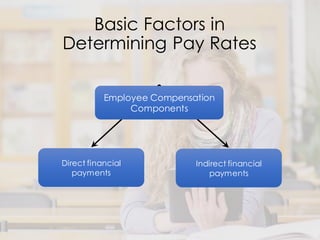
Basic Factors in
Determining Pay Rates
Direct financial
payments
Indirect financial
payments
Employee Compensation
Components
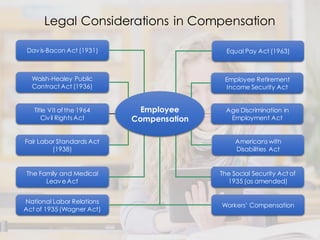
Legal Considerations in Compensation
Employee
Compensation
Equal Pay Act (1963)
Employee Retirement
Income Security Act
Age Discrimination in
Employment Act
Americans with
Disabilities Act
Davis-Bacon Act (1931)
Walsh-Healey Public
Contract Act (1936)
Title VII of the 1964
Civil RightsAct
Fair Labor Standards Act
(1938)
The Family and Medical
LeaveAct
The Social Security Act of
1935 (as amended)
National Labor Relations
Act of 1935 (Wagner Act)
Workers’ Compensation
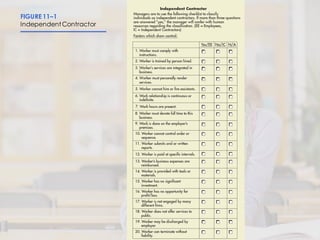
FIGURE 11–1
IndependentContractor
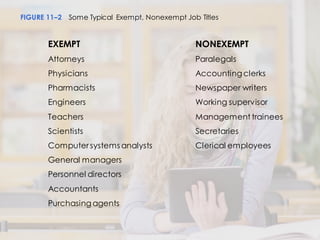
FIGURE 11–2 Some Typical Exempt, Nonexempt Job Titles
EXEMPT
Attorneys
Physicians
Pharmacists
Engineers
Teachers
Scientists
Computer systems analysts
General managers
Personnel directors
Accountants
Purchasing agents
NONEXEMPT
Paralegals
Accounting clerks
Newspaper writers
Working supervisor
Management trainees
Secretaries
Clerical employees
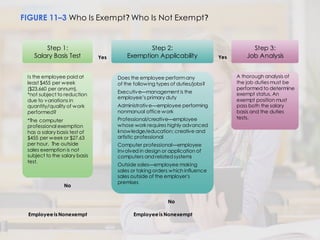
FIGURE 11–3 Who Is Exempt? Who Is Not Exempt?
Step 2:
Exemption Applicability
Step 1:
Salary Basis Test
Step 3:
Job Analysis
Does the employee performany
of the following types of duties/jobs?
Executive—management is the
employee’s primary duty
Administrative—employee performing
nonmanual office work
Professional/creative—employee
whose work requires highly advanced
knowledge/education; creative and
artistic professional
Computer professional—employee
involved in design or application of
computers and related systems
Outside sales—employee making
sales or taking orders which influence
sales outside of the employer's
premises
Is the employee paid at
least $455 per week
($23,660 per annum),
*not subject to reduction
due to variations in
quantity/quality of work
performed?
*The computer
professional exemption
has a salary basis test of
$455 per week or $27.63
per hour. The outside
sales exemption is not
subject to the salary basis
test.
A thorough analysis of
the job duties must be
performed to determine
exempt status. An
exempt position must
pass both the salary
basis and the duties
tests.
Employee is Nonexempt Employee is Nonexempt
Yes Yes
No
No
Corporate Policies,
Competitive
Strategy,
and Compensation
• Aligned Reward Strategy
• The employer’s basic task:
• To create a bundle of rewards—a
total reward package—that
specifically elicits the employee
behaviors that the firm needs to
support and achieveits competitive
strategy.
• The HR or compensationmanager
along with top management creates
pay policies that are consistent with
the firm’s strategicaims.
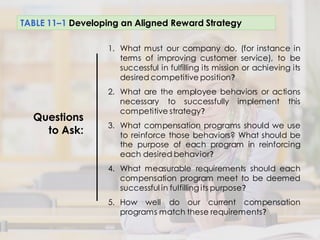
TABLE 11–1 Developing an Aligned Reward Strategy
Questions
to Ask:
1. What must our company do, (for instance in
terms of improving customer service), to be
successful in fulfilling its mission or achieving its
desired competitive position?
2. What are the employee behaviors or actions
necessary to successfully implement this
competitive strategy?
3. What compensation programs should we use
to reinforce those behaviors? What should be
the purpose of each program in reinforcing
each desired behavior?
4. What measurable requirements should each
compensation program meet to be deemed
successful in fulfilling its purpose?
5. How well do our current compensation
programs match these requirements?
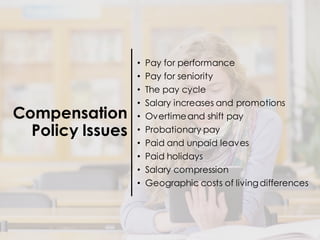
Compensation
Policy Issues
• Pay for performance
• Pay for seniority
• The pay cycle
• Salary increases and promotions
• Overtimeand shift pay
• Probationary pay
• Paid and unpaid leaves
• Paid holidays
• Salary compression
• Geographic costs of livingdifferences
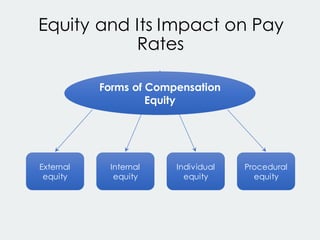
Equity and Its Impact on Pay
Rates
External
equity
Procedural
equity
Internal
equity
Individual
equity
Forms of Compensation
Equity
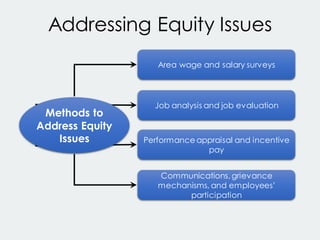
Addressing Equity Issues
Area wage and salary surveys
Job analysis and job evaluation
Performance appraisal and incentive
pay
Communications,grievance
mechanisms, and employees’
participation
Methods to
Address Equity
Issues
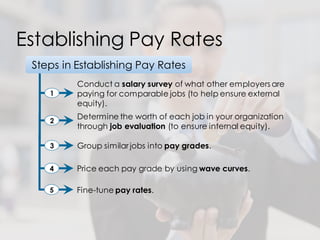
Establishing Pay Rates
1
2
3
4
5
Steps in Establishing Pay Rates
Determine the worth of each job in your organization
through job evaluation (to ensure internal equity).
Conduct a salary survey of what other employers are
paying for comparable jobs (to help ensure external
equity).
Group similar jobs into pay grades.
Price each pay grade by using wave curves.
Fine-tune pay rates.
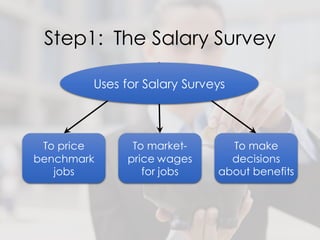
Step1: The Salary Survey
To price
benchmark
jobs
To make
decisions
about benefits
Uses for Salary Surveys
To market-
price wages
for jobs
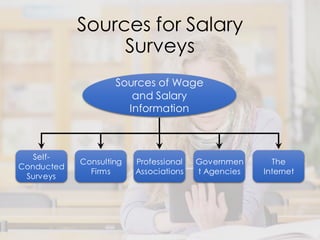
Sources for Salary
Surveys
Self-
Conducted
Surveys
Governmen
t Agencies
Consulting
Firms
Sources of Wage
and Salary
Information
Professional
Associations
The
Internet
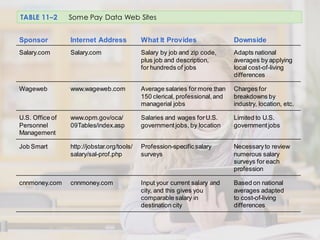
TABLE 11–2 Some Pay Data Web Sites
Sponsor Internet Address What It Provides Downside
Salary.com Salary.com Salary by job and zip code,
plus job and description,
for hundreds of jobs
Adapts national
averages by applying
local cost-of-living
differences
Wageweb www.wageweb.com Average salaries for more than
150 clerical, professional,and
managerial jobs
Charges for
breakdowns by
industry, location, etc.
U.S. Office of
Personnel
Management
www.opm.gov/oca/
09Tables/index.asp
Salaries and wages forU.S.
governmentjobs, by location
Limited to U.S.
governmentjobs
Job Smart http://jobstar.org/tools/
salary/sal-prof.php
Profession-specificsalary
surveys
Necessaryto review
numerous salary
surveys for each
profession
cnnmoney.com cnnmoney.com Input your current salary and
city, and this gives you
comparable salary in
destination city
Based on national
averages adapted
to cost-of-living
differences
8–18
All rights reserved. No part of this publication may be reproduced,
stored in a retrieval system, or transmitted, in any form or by any
means, electronic, mechanical, photocopying, recording, or
otherwise, without the prior written permission of the publisher.
Printed in the United States of America.
Copyright © 2011 Pearson Education, Inc.
publishing as Prentice Hall

Topic7.1a compensation basic_factors_in_determining_pay_rates new

  • 1.
    Welcome toHUMAN RESOURCES MANAGEMENT CompensationBasicFactors in Determining Pay Rates Dyah Pramanik, MM [ ]
  • 2.
    8–2 CHAPTER 7a BASIC FACTORSIN DETERMINING PAY RATES
  • 3.
    8–3 LEARNING OUTCOMES 1. Listthe basic factors determining pay rates.
  • 4.
    Basic Factors in DeterminingPay Rates Direct financial payments Indirect financial payments Employee Compensation Components
  • 5.
    Legal Considerations inCompensation Employee Compensation Equal Pay Act (1963) Employee Retirement Income Security Act Age Discrimination in Employment Act Americans with Disabilities Act Davis-Bacon Act (1931) Walsh-Healey Public Contract Act (1936) Title VII of the 1964 Civil RightsAct Fair Labor Standards Act (1938) The Family and Medical LeaveAct The Social Security Act of 1935 (as amended) National Labor Relations Act of 1935 (Wagner Act) Workers’ Compensation
  • 6.
  • 7.
    FIGURE 11–2 SomeTypical Exempt, Nonexempt Job Titles EXEMPT Attorneys Physicians Pharmacists Engineers Teachers Scientists Computer systems analysts General managers Personnel directors Accountants Purchasing agents NONEXEMPT Paralegals Accounting clerks Newspaper writers Working supervisor Management trainees Secretaries Clerical employees
  • 8.
    FIGURE 11–3 WhoIs Exempt? Who Is Not Exempt? Step 2: Exemption Applicability Step 1: Salary Basis Test Step 3: Job Analysis Does the employee performany of the following types of duties/jobs? Executive—management is the employee’s primary duty Administrative—employee performing nonmanual office work Professional/creative—employee whose work requires highly advanced knowledge/education; creative and artistic professional Computer professional—employee involved in design or application of computers and related systems Outside sales—employee making sales or taking orders which influence sales outside of the employer's premises Is the employee paid at least $455 per week ($23,660 per annum), *not subject to reduction due to variations in quantity/quality of work performed? *The computer professional exemption has a salary basis test of $455 per week or $27.63 per hour. The outside sales exemption is not subject to the salary basis test. A thorough analysis of the job duties must be performed to determine exempt status. An exempt position must pass both the salary basis and the duties tests. Employee is Nonexempt Employee is Nonexempt Yes Yes No No
  • 9.
    Corporate Policies, Competitive Strategy, and Compensation •Aligned Reward Strategy • The employer’s basic task: • To create a bundle of rewards—a total reward package—that specifically elicits the employee behaviors that the firm needs to support and achieveits competitive strategy. • The HR or compensationmanager along with top management creates pay policies that are consistent with the firm’s strategicaims.
  • 10.
    TABLE 11–1 Developingan Aligned Reward Strategy Questions to Ask: 1. What must our company do, (for instance in terms of improving customer service), to be successful in fulfilling its mission or achieving its desired competitive position? 2. What are the employee behaviors or actions necessary to successfully implement this competitive strategy? 3. What compensation programs should we use to reinforce those behaviors? What should be the purpose of each program in reinforcing each desired behavior? 4. What measurable requirements should each compensation program meet to be deemed successful in fulfilling its purpose? 5. How well do our current compensation programs match these requirements?
  • 11.
    Compensation Policy Issues • Payfor performance • Pay for seniority • The pay cycle • Salary increases and promotions • Overtimeand shift pay • Probationary pay • Paid and unpaid leaves • Paid holidays • Salary compression • Geographic costs of livingdifferences
  • 12.
    Equity and ItsImpact on Pay Rates External equity Procedural equity Internal equity Individual equity Forms of Compensation Equity
  • 13.
    Addressing Equity Issues Areawage and salary surveys Job analysis and job evaluation Performance appraisal and incentive pay Communications,grievance mechanisms, and employees’ participation Methods to Address Equity Issues
  • 14.
    Establishing Pay Rates 1 2 3 4 5 Stepsin Establishing Pay Rates Determine the worth of each job in your organization through job evaluation (to ensure internal equity). Conduct a salary survey of what other employers are paying for comparable jobs (to help ensure external equity). Group similar jobs into pay grades. Price each pay grade by using wave curves. Fine-tune pay rates.
  • 15.
    Step1: The SalarySurvey To price benchmark jobs To make decisions about benefits Uses for Salary Surveys To market- price wages for jobs
  • 16.
    Sources for Salary Surveys Self- Conducted Surveys Governmen tAgencies Consulting Firms Sources of Wage and Salary Information Professional Associations The Internet
  • 17.
    TABLE 11–2 SomePay Data Web Sites Sponsor Internet Address What It Provides Downside Salary.com Salary.com Salary by job and zip code, plus job and description, for hundreds of jobs Adapts national averages by applying local cost-of-living differences Wageweb www.wageweb.com Average salaries for more than 150 clerical, professional,and managerial jobs Charges for breakdowns by industry, location, etc. U.S. Office of Personnel Management www.opm.gov/oca/ 09Tables/index.asp Salaries and wages forU.S. governmentjobs, by location Limited to U.S. governmentjobs Job Smart http://jobstar.org/tools/ salary/sal-prof.php Profession-specificsalary surveys Necessaryto review numerous salary surveys for each profession cnnmoney.com cnnmoney.com Input your current salary and city, and this gives you comparable salary in destination city Based on national averages adapted to cost-of-living differences
  • 18.
    8–18 All rights reserved.No part of this publication may be reproduced, stored in a retrieval system, or transmitted, in any form or by any means, electronic, mechanical, photocopying, recording, or otherwise, without the prior written permission of the publisher. Printed in the United States of America. Copyright © 2011 Pearson Education, Inc. publishing as Prentice Hall