][Welcome to
Marketing Strategy
Evaluating and Controlling
Marketing Activities
McGraw-Hill/Irwin © 2006 The McGraw-Hill Companies, Inc. All rights reserved.
Strategic Issues in Marketing Implementation
* The Link Between Planning and Implementation
* The Elements of Marketing Implementation
* Approaches to Marketing Implementation
* Internal Marketing and Marketing Implementation
* Evaluating and Controlling Marketing Activities
1-2
McGraw-Hill/Irwin © 2006 The McGraw-Hill Companies, Inc. All rights reserved.
Strategic Issues in Marketing Implementation
• Formal Marketing Controls
- Input Controls
- Process Controls
- Output Controls
• Informal Marketing Controls
- Employee Self-Control
- Social Control
- Cultural Control
• Scheduling Marketing Activities
1-3
McGraw-Hill/Irwin © 2006 The McGraw-Hill Companies, Inc. All rights reserved.
Evaluating and Controlling Marketing
Activities
• A marketing strategy can achieve its desired results only if
implemented properly.
• Properly is the key word.
• It is important to remember that a firm’s intended marketing
strategy often differs from the realized strategy (the one that
actually takes place).
• This also means that actual performance is often different from
expectations.
1-4
McGraw-Hill/Irwin © 2006 The McGraw-Hill Companies, Inc. All rights reserved.
Evaluating and Controlling Marketing
Activities
Typically, there are four possible causes for this difference:
1. The marketing strategy was inappropriate or unrealistic.
2. The implementation was inappropriate for the strategy.
3. The implementation process was mismanaged.
4. The internal and/or external environments changed
substantially between the development of the marketing
strategy and its implementation.
1-5
McGraw-Hill/Irwin © 2006 The McGraw-Hill Companies, Inc. All rights reserved.
Evaluating and Controlling Marketing
Activities
• Although the best way to handle implementation problems is to
recognize them in advance, no manager can successfully
recognize all of the subtle and unpredictable warning signs of
implementation failure.
• It is important that the potential for implementation failures be
managed strategically by having a system of marketing controls
in place that allows the firm to spot potential problems before
they cause real trouble.
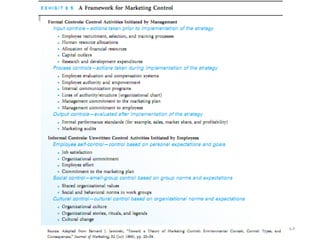
• Exhibit 9.5 outlines a framework for marketing control that
includes two major types of control: formal controls and informal
controls.
• Although we discuss each type of marketing control separately,
most firms use combinations of these control types to monitor
strategy implementation.
1-6
McGraw-Hill/Irwin © 2006 The McGraw-Hill Companies, Inc. All rights reserved.
1-7
McGraw-Hill/Irwin © 2006 The McGraw-Hill Companies, Inc. All rights reserved.
Formal Marketing Controls
• Formal marketing controls are activities, mechanisms,
or processes designed by the firm to help ensure the
successful implementation of the marketing strategy.
• The elements of formal control influence the behaviors
of employees before and during implementation, and to
assess performance outcomes at the completion of the
implementation process.
• These elements are referred to as input, process, and
output controls respectively.
1-8
McGraw-Hill/Irwin © 2006 The McGraw-Hill Companies, Inc. All rights reserved.
Informal Marketing Controls
• Formal marketing controls are overt in their attempt to
influence employee behavior and marketing
performance.
• Informal controls, on the other hand, are more subtle.
Informal marketing controls are unwritten, employee-
based mechanisms that subtly affect the behaviors of
employees, both as individuals and in groups.
• Informal controls deal with personal objectives and
behaviors, as well as group-based norms and
expectations.
• There are three types of informal control: employee
self-control, social control, and cultural control.
1-9
McGraw-Hill/Irwin © 2006 The McGraw-Hill Companies, Inc. All rights reserved.
Scheduling Marketing Activities
• Successful implementation requires that employees know
the specific activities for which they are responsible and the
timetable for completing each activity.
• Creating a master schedule of marketing activities can be a
challenging task because of the wide variety of activities
required to execute the plan, the sequential nature of many
activities (some take precedence over others and must be
performed first), and the fact that time is of the essence in
implementing the plan.
1-10
McGraw-Hill/Irwin © 2006 The McGraw-Hill Companies, Inc. All rights reserved.
Scheduling Marketing Activities
The basic steps involved in creating a schedule and
timeline for implementation include:
1. Identify the Specific Activities to Be Performed
2. Determine the Time Required to Complete Each
Activity.
3. Determine Which Activities Must Precede Others.
4. Arrange the Proper Sequence and Timing of All
Activities.
5. Assign Responsibility.
1-11
McGraw-Hill/Irwin © 2006 The McGraw-Hill Companies, Inc. All rights reserved.
 Thank You 
1-12

6.2. evaluating and controlling marketing activities

  • 1.
    ][Welcome to Marketing Strategy Evaluatingand Controlling Marketing Activities
  • 2.
    McGraw-Hill/Irwin © 2006The McGraw-Hill Companies, Inc. All rights reserved. Strategic Issues in Marketing Implementation * The Link Between Planning and Implementation * The Elements of Marketing Implementation * Approaches to Marketing Implementation * Internal Marketing and Marketing Implementation * Evaluating and Controlling Marketing Activities 1-2
  • 3.
    McGraw-Hill/Irwin © 2006The McGraw-Hill Companies, Inc. All rights reserved. Strategic Issues in Marketing Implementation • Formal Marketing Controls - Input Controls - Process Controls - Output Controls • Informal Marketing Controls - Employee Self-Control - Social Control - Cultural Control • Scheduling Marketing Activities 1-3
  • 4.
    McGraw-Hill/Irwin © 2006The McGraw-Hill Companies, Inc. All rights reserved. Evaluating and Controlling Marketing Activities • A marketing strategy can achieve its desired results only if implemented properly. • Properly is the key word. • It is important to remember that a firm’s intended marketing strategy often differs from the realized strategy (the one that actually takes place). • This also means that actual performance is often different from expectations. 1-4
  • 5.
    McGraw-Hill/Irwin © 2006The McGraw-Hill Companies, Inc. All rights reserved. Evaluating and Controlling Marketing Activities Typically, there are four possible causes for this difference: 1. The marketing strategy was inappropriate or unrealistic. 2. The implementation was inappropriate for the strategy. 3. The implementation process was mismanaged. 4. The internal and/or external environments changed substantially between the development of the marketing strategy and its implementation. 1-5
  • 6.
    McGraw-Hill/Irwin © 2006The McGraw-Hill Companies, Inc. All rights reserved. Evaluating and Controlling Marketing Activities • Although the best way to handle implementation problems is to recognize them in advance, no manager can successfully recognize all of the subtle and unpredictable warning signs of implementation failure. • It is important that the potential for implementation failures be managed strategically by having a system of marketing controls in place that allows the firm to spot potential problems before they cause real trouble. • Exhibit 9.5 outlines a framework for marketing control that includes two major types of control: formal controls and informal controls. • Although we discuss each type of marketing control separately, most firms use combinations of these control types to monitor strategy implementation. 1-6
  • 7.
    McGraw-Hill/Irwin © 2006The McGraw-Hill Companies, Inc. All rights reserved. 1-7
  • 8.
    McGraw-Hill/Irwin © 2006The McGraw-Hill Companies, Inc. All rights reserved. Formal Marketing Controls • Formal marketing controls are activities, mechanisms, or processes designed by the firm to help ensure the successful implementation of the marketing strategy. • The elements of formal control influence the behaviors of employees before and during implementation, and to assess performance outcomes at the completion of the implementation process. • These elements are referred to as input, process, and output controls respectively. 1-8
  • 9.
    McGraw-Hill/Irwin © 2006The McGraw-Hill Companies, Inc. All rights reserved. Informal Marketing Controls • Formal marketing controls are overt in their attempt to influence employee behavior and marketing performance. • Informal controls, on the other hand, are more subtle. Informal marketing controls are unwritten, employee- based mechanisms that subtly affect the behaviors of employees, both as individuals and in groups. • Informal controls deal with personal objectives and behaviors, as well as group-based norms and expectations. • There are three types of informal control: employee self-control, social control, and cultural control. 1-9
  • 10.
    McGraw-Hill/Irwin © 2006The McGraw-Hill Companies, Inc. All rights reserved. Scheduling Marketing Activities • Successful implementation requires that employees know the specific activities for which they are responsible and the timetable for completing each activity. • Creating a master schedule of marketing activities can be a challenging task because of the wide variety of activities required to execute the plan, the sequential nature of many activities (some take precedence over others and must be performed first), and the fact that time is of the essence in implementing the plan. 1-10
  • 11.
    McGraw-Hill/Irwin © 2006The McGraw-Hill Companies, Inc. All rights reserved. Scheduling Marketing Activities The basic steps involved in creating a schedule and timeline for implementation include: 1. Identify the Specific Activities to Be Performed 2. Determine the Time Required to Complete Each Activity. 3. Determine Which Activities Must Precede Others. 4. Arrange the Proper Sequence and Timing of All Activities. 5. Assign Responsibility. 1-11
  • 12.
    McGraw-Hill/Irwin © 2006The McGraw-Hill Companies, Inc. All rights reserved.  Thank You  1-12