Composition II
Week Two
Thursday
September 1, 2016
Due Today:
Milestone One
 APA:
◦ Use figures (ex: 10, 23, 908) to express numbers ten
and above
 Example: The farmer sold 85 eggs at the market
◦ Use words for numbers below 10
 Example: The farmer only has seven chickens.
 MLA:
◦ Spell out numbers written in one or two words
 Example: The spoiled teenager had sixty-five tank tops in
her closet.
◦ Use figures for numbers that use more than three words
 Example: The spoiled teenager had 121 pairs of jeans.
 Hyphenate compound numbers from twenty-
one to ninety-nine
 When dates are required to open a sentence,
spell them out
◦ Example: Nineteen ninety-nine was the greatest
year of my life.
 Use numerals with symbols and abbreviations
◦ Example: $4,000.00
◦ Example: 100%
◦ Example: 7:55 p.m.
 Your instructor will read you
three sentences. Write each one
with the number in proper APA
style format.
 Your instructor will read you
three sentences. Write each one
with the number in proper MLA
style format.
The Basics
 MLA is mostly used in the liberal arts and
humanities
◦ What are some majors that would write in MLA
format?
 A style of documentation that is based on a
general method that may be applied to
different types of writing
 Using in-text citations that match an end-of
paper list of Works Cited
◦ In-text citation: identifies a source in the body of
the paper at the point where it is summarized
◦ Works Cited: A list of sources (usually at the end of
your paper) you have incorporated into your paper
by using the ideas, information, and quotes of
others
 Every source in the Works Cited page must be
mentioned in the paper
 Every source mentioned in the body of the
paper must be included in the Works Cited
page
 The first word in each entry on the Works
Cited page must also appear in the in-text
citation
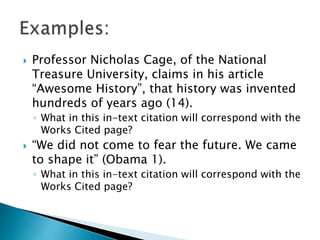
 Professor Nicholas Cage, of the National
Treasure University, claims in his article
“Awesome History”, that history was invented
hundreds of years ago (14).
◦ What in this in-text citation will correspond with the
Works Cited page?
 “We did not come to fear the future. We came
to shape it” (Obama 1).
◦ What in this in-text citation will correspond with the
Works Cited page?
 A typical in-text citation contains two
elements:
◦ The last name of the author
◦ Page number
 Two methods of using in-text citations:
◦ Parenthetical method
◦ Attributive tag method
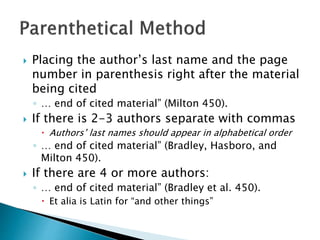
 Placing the author’s last name and the page
number in parenthesis right after the material
being cited
◦ … end of cited material” (Milton 450).
 If there is 2-3 authors separate with commas
 Authors’ last names should appear in alphabetical order
◦ … end of cited material” (Bradley, Hasboro, and
Milton 450).
 If there are 4 or more authors:
◦ … end of cited material” (Bradley et al. 450).
 Et alia is Latin for “and other things”
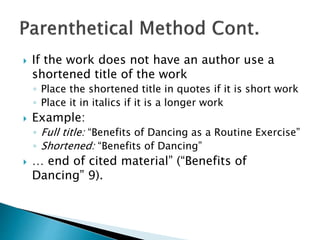
 If the work does not have an author use a
shortened title of the work
◦ Place the shortened title in quotes if it is short work
◦ Place it in italics if it is a longer work
 Example:
◦ Full title: “Benefits of Dancing as a Routine Exercise”
◦ Shortened: “Benefits of Dancing”
 … end of cited material” (“Benefits of
Dancing” 9).
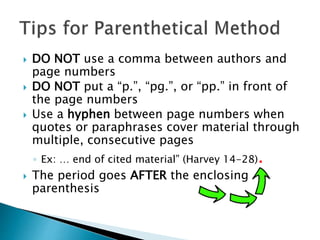
 DO NOT use a comma between authors and
page numbers
 DO NOT put a “p.”, “pg.”, or “pp.” in front of
the page numbers
 Use a hyphen between page numbers when
quotes or paraphrases cover material through
multiple, consecutive pages
◦ Ex: … end of cited material” (Harvey 14-28).
 The period goes AFTER the enclosing
parenthesis
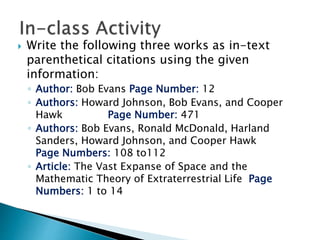
 Write the following three works as in-text
parenthetical citations using the given
information:
◦ Author: Bob Evans Page Number: 12
◦ Authors: Howard Johnson, Bob Evans, and Cooper
Hawk Page Number: 471
◦ Authors: Bob Evans, Ronald McDonald, Harland
Sanders, Howard Johnson, and Cooper Hawk
Page Numbers: 108 to112
◦ Article: The Vast Expanse of Space and the
Mathematic Theory of Extraterrestrial Life Page
Numbers: 1 to 14
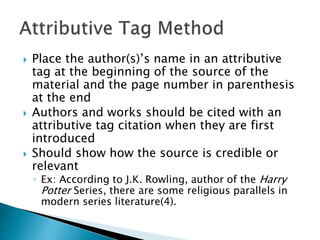
 Place the author(s)’s name in an attributive
tag at the beginning of the source of the
material and the page number in parenthesis
at the end
 Authors and works should be cited with an
attributive tag citation when they are first
introduced
 Should show how the source is credible or
relevant
◦ Ex: According to J.K. Rowling, author of the Harry
Potter Series, there are some religious parallels in
modern series literature(4).
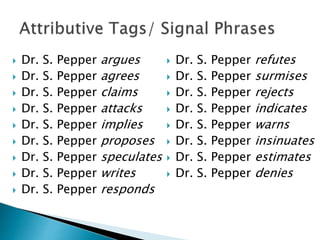
 Dr. S. Pepper argues
 Dr. S. Pepper agrees
 Dr. S. Pepper claims
 Dr. S. Pepper attacks
 Dr. S. Pepper implies
 Dr. S. Pepper proposes
 Dr. S. Pepper speculates
 Dr. S. Pepper writes
 Dr. S. Pepper responds
 Dr. S. Pepper refutes
 Dr. S. Pepper surmises
 Dr. S. Pepper rejects
 Dr. S. Pepper indicates
 Dr. S. Pepper warns
 Dr. S. Pepper insinuates
 Dr. S. Pepper estimates
 Dr. S. Pepper denies
 Attributive tags can strengthen a claim or
weaken the opposing claim
 This citation should signal the intent of the
quote
◦ Is it positive or negative? Does it convey the quote’s
intention?
 Ex: Edgar Poe, a world famous poet, speculated that….
 Ex: Radical liberal Joe Shmoe claims in his article…
 Ex: Disgraced politician Kingsley Lear once believed…
 Ex: Director Kermit Frogger, in a bold expression of
taste and class, created…
 Tags can be placed after, within, or before a
quotation
 After:
◦ Capitalize the beginning of the quote
◦ If the first word is not capitalized in the source,
enclose the letter in brackets and capitalize it
 Ex: “I’ll be back for another term as Senator,” was
Arnold Terminator’s final remark in his famous speech
“Another Run” (2).
 Ex:“[T]he most famous politician at the time, Arnold
Terminator, promised more jobs and less layoffs”
Edgar Watcher summarized in his review of the speech
“Another Run”(5).
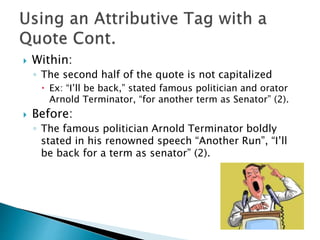
 Within:
◦ The second half of the quote is not capitalized
 Ex: “I’ll be back,” stated famous politician and orator
Arnold Terminator, “for another term as Senator” (2).
 Before:
◦ The famous politician Arnold Terminator boldly
stated in his renowned speech “Another Run”, “I’ll
be back for a term as senator” (2).
 Use the following quote and information to create
an in-text citation using the attributive tag method.
Use attributive tags that are after, before, and
within the quote:
◦ “A study shows that kids prefer the taste of Cinnamon
Toast Crunch to the taste of Captain Crunch, and only 10%
of kids claimed to enjoy both cereals.”
◦ Page: 92
◦ Source: Kellogg's Journal of Taste
◦ Article: “The Influence of Cartoon Marketing Strategies on
Taste”
◦ Author: Bonnie Breakfaster
◦ Credentials: PhD in Psychology
 Specializes in children’s psychological associations with taste
 Use when your source provides stable page
numbers:
◦ If you quote something
◦ If you paraphrase a specific passage
◦ When you refer to data or details from a specific page or
range of pages
 Do not include a page number if:
◦ You are referring to an argument of the whole source
instead of a specific page or passage
◦ If the page does not have stable page numbers
 If the work has numbered paragraphs cite them with the
abbreviation “par.” or “pars.”
 Ex: … end of cited material” (Milton, par. 12).
◦ If no page material is reliable omit the page numbers
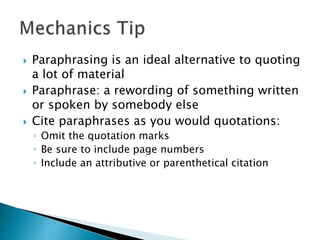
 Paraphrasing is an ideal alternative to quoting
a lot of material
 Paraphrase: a rewording of something written
or spoken by somebody else
 Cite paraphrases as you would quotations:
◦ Omit the quotation marks
◦ Be sure to include page numbers
◦ Include an attributive or parenthetical citation
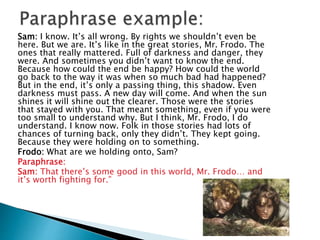
Sam: I know. It’s all wrong. By rights we shouldn’t even be
here. But we are. It’s like in the great stories, Mr. Frodo. The
ones that really mattered. Full of darkness and danger, they
were. And sometimes you didn’t want to know the end.
Because how could the end be happy? How could the world
go back to the way it was when so much bad had happened?
But in the end, it’s only a passing thing, this shadow. Even
darkness must pass. A new day will come. And when the sun
shines it will shine out the clearer. Those were the stories
that stayed with you. That meant something, even if you were
too small to understand why. But I think, Mr. Frodo, I do
understand. I know now. Folk in those stories had lots of
chances of turning back, only they didn’t. They kept going.
Because they were holding on to something.
Frodo: What are we holding onto, Sam?
Paraphrase:
Sam: That there’s some good in this world, Mr. Frodo… and
it’s worth fighting for.”
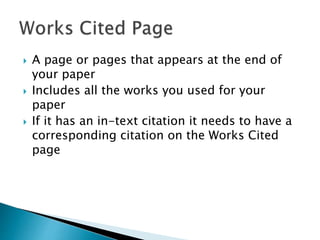
 A page or pages that appears at the end of
your paper
 Includes all the works you used for your
paper
 If it has an in-text citation it needs to have a
corresponding citation on the Works Cited
page
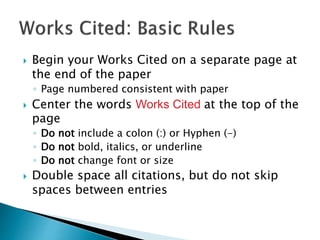
 Begin your Works Cited on a separate page at
the end of the paper
◦ Page numbered consistent with paper
 Center the words Works Cited at the top of the
page
◦ Do not include a colon (:) or Hyphen (-)
◦ Do not bold, italics, or underline
◦ Do not change font or size
 Double space all citations, but do not skip
spaces between entries
 Entries should be listed in alphabetical order by
author (or title if there is not author)
◦ If there is more than one entry by the same author,
works should be arranged alphabetically by title of the
work
◦ Do not list titles such as Dr., Saint, Mrs.
◦ Include suffixes such as Jr. or III
◦ Names are written in this order: Last name, First name,
Middle initial
 Ex: Schafer, Erin O.
 Each entry should include a medium of
publication
◦ Ex: Print, Web, DVD
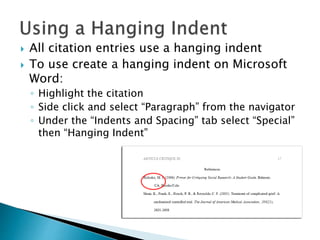
 All citation entries use a hanging indent
 To use create a hanging indent on Microsoft
Word:
◦ Highlight the citation
◦ Side click and select “Paragraph” from the navigator
◦ Under the “Indents and Spacing” tab select “Special”
then “Hanging Indent”
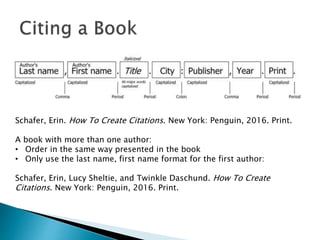
Schafer, Erin. How To Create Citations. New York: Penguin, 2016. Print.
A book with more than one author:
• Order in the same way presented in the book
• Only use the last name, first name format for the first author:
Schafer, Erin, Lucy Sheltie, and Twinkle Daschund. How To Create
Citations. New York: Penguin, 2016. Print.
 Your instructor will hand your group a book.
Locate all the necessary information and
compose an entry for your Works Cited page.
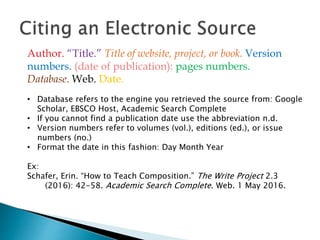
• Database refers to the engine you retrieved the source from: Google
Scholar, EBSCO Host, Academic Search Complete
• If you cannot find a publication date use the abbreviation n.d.
• Version numbers refer to volumes (vol.), editions (ed.), or issue
numbers (no.)
• Format the date in this fashion: Day Month Year
Ex:
Schafer, Erin. “How to Teach Composition.” The Write Project 2.3
(2016): 42-58. Academic Search Complete. Web. 1 May 2016.
Author. “Title.” Title of website, project, or book. Version
numbers. (date of publication): pages numbers.
Database. Web. Date.
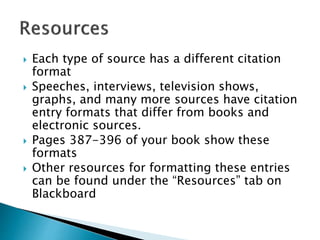
 Each type of source has a different citation
format
 Speeches, interviews, television shows,
graphs, and many more sources have citation
entry formats that differ from books and
electronic sources.
 Pages 387-396 of your book show these
formats
 Other resources for formatting these entries
can be found under the “Resources” tab on
Blackboard
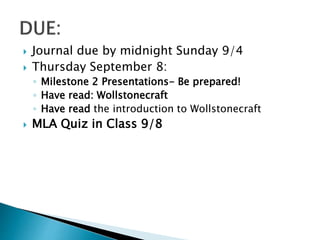
 Journal due by midnight Sunday 9/4
 Thursday September 8:
◦ Milestone 2 Presentations- Be prepared!
◦ Have read: Wollstonecraft
◦ Have read the introduction to Wollstonecraft
 MLA Quiz in Class 9/8

Week two thurs

  • 1.
    Composition II Week Two Thursday September1, 2016 Due Today: Milestone One
  • 2.
     APA: ◦ Usefigures (ex: 10, 23, 908) to express numbers ten and above  Example: The farmer sold 85 eggs at the market ◦ Use words for numbers below 10  Example: The farmer only has seven chickens.  MLA: ◦ Spell out numbers written in one or two words  Example: The spoiled teenager had sixty-five tank tops in her closet. ◦ Use figures for numbers that use more than three words  Example: The spoiled teenager had 121 pairs of jeans.
  • 3.
     Hyphenate compoundnumbers from twenty- one to ninety-nine  When dates are required to open a sentence, spell them out ◦ Example: Nineteen ninety-nine was the greatest year of my life.  Use numerals with symbols and abbreviations ◦ Example: $4,000.00 ◦ Example: 100% ◦ Example: 7:55 p.m.
  • 4.
     Your instructorwill read you three sentences. Write each one with the number in proper APA style format.  Your instructor will read you three sentences. Write each one with the number in proper MLA style format.
  • 5.
  • 6.
     MLA ismostly used in the liberal arts and humanities ◦ What are some majors that would write in MLA format?  A style of documentation that is based on a general method that may be applied to different types of writing
  • 7.
     Using in-textcitations that match an end-of paper list of Works Cited ◦ In-text citation: identifies a source in the body of the paper at the point where it is summarized ◦ Works Cited: A list of sources (usually at the end of your paper) you have incorporated into your paper by using the ideas, information, and quotes of others
  • 8.
     Every sourcein the Works Cited page must be mentioned in the paper  Every source mentioned in the body of the paper must be included in the Works Cited page  The first word in each entry on the Works Cited page must also appear in the in-text citation
  • 9.
     Professor NicholasCage, of the National Treasure University, claims in his article “Awesome History”, that history was invented hundreds of years ago (14). ◦ What in this in-text citation will correspond with the Works Cited page?  “We did not come to fear the future. We came to shape it” (Obama 1). ◦ What in this in-text citation will correspond with the Works Cited page?
  • 10.
     A typicalin-text citation contains two elements: ◦ The last name of the author ◦ Page number  Two methods of using in-text citations: ◦ Parenthetical method ◦ Attributive tag method
  • 11.
     Placing theauthor’s last name and the page number in parenthesis right after the material being cited ◦ … end of cited material” (Milton 450).  If there is 2-3 authors separate with commas  Authors’ last names should appear in alphabetical order ◦ … end of cited material” (Bradley, Hasboro, and Milton 450).  If there are 4 or more authors: ◦ … end of cited material” (Bradley et al. 450).  Et alia is Latin for “and other things”
  • 12.
     If thework does not have an author use a shortened title of the work ◦ Place the shortened title in quotes if it is short work ◦ Place it in italics if it is a longer work  Example: ◦ Full title: “Benefits of Dancing as a Routine Exercise” ◦ Shortened: “Benefits of Dancing”  … end of cited material” (“Benefits of Dancing” 9).
  • 13.
     DO NOTuse a comma between authors and page numbers  DO NOT put a “p.”, “pg.”, or “pp.” in front of the page numbers  Use a hyphen between page numbers when quotes or paraphrases cover material through multiple, consecutive pages ◦ Ex: … end of cited material” (Harvey 14-28).  The period goes AFTER the enclosing parenthesis
  • 14.
     Write thefollowing three works as in-text parenthetical citations using the given information: ◦ Author: Bob Evans Page Number: 12 ◦ Authors: Howard Johnson, Bob Evans, and Cooper Hawk Page Number: 471 ◦ Authors: Bob Evans, Ronald McDonald, Harland Sanders, Howard Johnson, and Cooper Hawk Page Numbers: 108 to112 ◦ Article: The Vast Expanse of Space and the Mathematic Theory of Extraterrestrial Life Page Numbers: 1 to 14
  • 15.
     Place theauthor(s)’s name in an attributive tag at the beginning of the source of the material and the page number in parenthesis at the end  Authors and works should be cited with an attributive tag citation when they are first introduced  Should show how the source is credible or relevant ◦ Ex: According to J.K. Rowling, author of the Harry Potter Series, there are some religious parallels in modern series literature(4).
  • 16.
     Dr. S.Pepper argues  Dr. S. Pepper agrees  Dr. S. Pepper claims  Dr. S. Pepper attacks  Dr. S. Pepper implies  Dr. S. Pepper proposes  Dr. S. Pepper speculates  Dr. S. Pepper writes  Dr. S. Pepper responds  Dr. S. Pepper refutes  Dr. S. Pepper surmises  Dr. S. Pepper rejects  Dr. S. Pepper indicates  Dr. S. Pepper warns  Dr. S. Pepper insinuates  Dr. S. Pepper estimates  Dr. S. Pepper denies
  • 17.
     Attributive tagscan strengthen a claim or weaken the opposing claim  This citation should signal the intent of the quote ◦ Is it positive or negative? Does it convey the quote’s intention?  Ex: Edgar Poe, a world famous poet, speculated that….  Ex: Radical liberal Joe Shmoe claims in his article…  Ex: Disgraced politician Kingsley Lear once believed…  Ex: Director Kermit Frogger, in a bold expression of taste and class, created…
  • 18.
     Tags canbe placed after, within, or before a quotation  After: ◦ Capitalize the beginning of the quote ◦ If the first word is not capitalized in the source, enclose the letter in brackets and capitalize it  Ex: “I’ll be back for another term as Senator,” was Arnold Terminator’s final remark in his famous speech “Another Run” (2).  Ex:“[T]he most famous politician at the time, Arnold Terminator, promised more jobs and less layoffs” Edgar Watcher summarized in his review of the speech “Another Run”(5).
  • 19.
     Within: ◦ Thesecond half of the quote is not capitalized  Ex: “I’ll be back,” stated famous politician and orator Arnold Terminator, “for another term as Senator” (2).  Before: ◦ The famous politician Arnold Terminator boldly stated in his renowned speech “Another Run”, “I’ll be back for a term as senator” (2).
  • 20.
     Use thefollowing quote and information to create an in-text citation using the attributive tag method. Use attributive tags that are after, before, and within the quote: ◦ “A study shows that kids prefer the taste of Cinnamon Toast Crunch to the taste of Captain Crunch, and only 10% of kids claimed to enjoy both cereals.” ◦ Page: 92 ◦ Source: Kellogg's Journal of Taste ◦ Article: “The Influence of Cartoon Marketing Strategies on Taste” ◦ Author: Bonnie Breakfaster ◦ Credentials: PhD in Psychology  Specializes in children’s psychological associations with taste
  • 21.
     Use whenyour source provides stable page numbers: ◦ If you quote something ◦ If you paraphrase a specific passage ◦ When you refer to data or details from a specific page or range of pages  Do not include a page number if: ◦ You are referring to an argument of the whole source instead of a specific page or passage ◦ If the page does not have stable page numbers  If the work has numbered paragraphs cite them with the abbreviation “par.” or “pars.”  Ex: … end of cited material” (Milton, par. 12). ◦ If no page material is reliable omit the page numbers
  • 22.
     Paraphrasing isan ideal alternative to quoting a lot of material  Paraphrase: a rewording of something written or spoken by somebody else  Cite paraphrases as you would quotations: ◦ Omit the quotation marks ◦ Be sure to include page numbers ◦ Include an attributive or parenthetical citation
  • 23.
    Sam: I know.It’s all wrong. By rights we shouldn’t even be here. But we are. It’s like in the great stories, Mr. Frodo. The ones that really mattered. Full of darkness and danger, they were. And sometimes you didn’t want to know the end. Because how could the end be happy? How could the world go back to the way it was when so much bad had happened? But in the end, it’s only a passing thing, this shadow. Even darkness must pass. A new day will come. And when the sun shines it will shine out the clearer. Those were the stories that stayed with you. That meant something, even if you were too small to understand why. But I think, Mr. Frodo, I do understand. I know now. Folk in those stories had lots of chances of turning back, only they didn’t. They kept going. Because they were holding on to something. Frodo: What are we holding onto, Sam? Paraphrase: Sam: That there’s some good in this world, Mr. Frodo… and it’s worth fighting for.”
  • 24.
     A pageor pages that appears at the end of your paper  Includes all the works you used for your paper  If it has an in-text citation it needs to have a corresponding citation on the Works Cited page
  • 25.
     Begin yourWorks Cited on a separate page at the end of the paper ◦ Page numbered consistent with paper  Center the words Works Cited at the top of the page ◦ Do not include a colon (:) or Hyphen (-) ◦ Do not bold, italics, or underline ◦ Do not change font or size  Double space all citations, but do not skip spaces between entries
  • 26.
     Entries shouldbe listed in alphabetical order by author (or title if there is not author) ◦ If there is more than one entry by the same author, works should be arranged alphabetically by title of the work ◦ Do not list titles such as Dr., Saint, Mrs. ◦ Include suffixes such as Jr. or III ◦ Names are written in this order: Last name, First name, Middle initial  Ex: Schafer, Erin O.  Each entry should include a medium of publication ◦ Ex: Print, Web, DVD
  • 27.
     All citationentries use a hanging indent  To use create a hanging indent on Microsoft Word: ◦ Highlight the citation ◦ Side click and select “Paragraph” from the navigator ◦ Under the “Indents and Spacing” tab select “Special” then “Hanging Indent”
  • 28.
    Schafer, Erin. HowTo Create Citations. New York: Penguin, 2016. Print. A book with more than one author: • Order in the same way presented in the book • Only use the last name, first name format for the first author: Schafer, Erin, Lucy Sheltie, and Twinkle Daschund. How To Create Citations. New York: Penguin, 2016. Print.
  • 29.
     Your instructorwill hand your group a book. Locate all the necessary information and compose an entry for your Works Cited page.
  • 30.
    • Database refersto the engine you retrieved the source from: Google Scholar, EBSCO Host, Academic Search Complete • If you cannot find a publication date use the abbreviation n.d. • Version numbers refer to volumes (vol.), editions (ed.), or issue numbers (no.) • Format the date in this fashion: Day Month Year Ex: Schafer, Erin. “How to Teach Composition.” The Write Project 2.3 (2016): 42-58. Academic Search Complete. Web. 1 May 2016. Author. “Title.” Title of website, project, or book. Version numbers. (date of publication): pages numbers. Database. Web. Date.
  • 31.
     Each typeof source has a different citation format  Speeches, interviews, television shows, graphs, and many more sources have citation entry formats that differ from books and electronic sources.  Pages 387-396 of your book show these formats  Other resources for formatting these entries can be found under the “Resources” tab on Blackboard
  • 32.
     Journal dueby midnight Sunday 9/4  Thursday September 8: ◦ Milestone 2 Presentations- Be prepared! ◦ Have read: Wollstonecraft ◦ Have read the introduction to Wollstonecraft  MLA Quiz in Class 9/8