DOCUMENTATION DATA IN RESEARCH IN IN RESEARCH Methodology.pptx
Data documentation in research methodology is the process of recording information about data collection, analysis, and the research process in general.
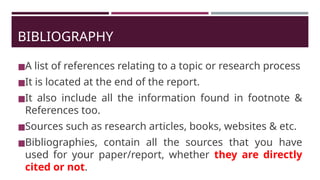
BIBLIOGRAPHY
◼A list ofreferences relating to a topic or research process
◼It is located at the end of the report.
◼It also include all the information found in footnote &
References too.
◼Sources such as research articles, books, websites & etc.
◼Bibliographies, contain all the sources that you have
used for your paper/report, whether they are directly
cited or not.
3.
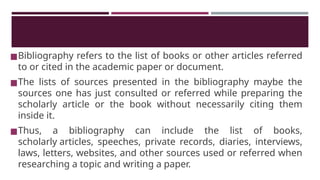
◼Bibliography refers tothe list of books or other articles referred
to or cited in the academic paper or document.
◼The lists of sources presented in the bibliography maybe the
sources one has just consulted or referred while preparing the
scholarly article or the book without necessarily citing them
inside it.
◼Thus, a bibliography can include the list of books,
scholarly articles, speeches, private records, diaries, interviews,
laws, letters, websites, and other sources used or referred when
researching a topic and writing a paper.
4.
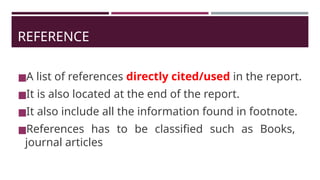
REFERENCE
◼A list ofreferences directly cited/used in the report.
◼It is also located at the end of the report.
◼It also include all the information found in footnote.
◼References has to be classified such as Books,
journal articles
5.
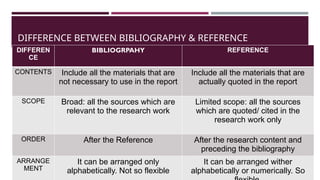
DIFFERENCE BETWEEN BIBLIOGRAPHY& REFERENCE
DIFFEREN
CE
BIBLIOGRPAHY REFERENCE
CONTENTS Include all the materials that are
not necessary to use in the report
Include all the materials that are
actually quoted in the report
SCOPE Broad: all the sources which are
relevant to the research work
Limited scope: all the sources
which are quoted/ cited in the
research work only
ORDER After the Reference After the research content and
preceding the bibliography
ARRANGE
MENT
It can be arranged only
alphabetically. Not so flexible
It can be arranged wither
alphabetically or numerically. So
6.
DIFFERENCE BETWEEN BIBLIOGRAPHY& REFERENCE
DIFFER
ENCE
BIBLIOGRPAHY REFERENCE
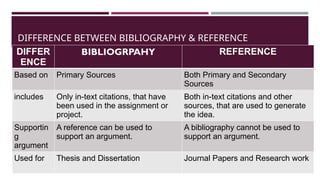
Based on Primary Sources Both Primary and Secondary
Sources
includes Only in-text citations, that have
been used in the assignment or
project.
Both in-text citations and other
sources, that are used to generate
the idea.
Supportin
g
argument
A reference can be used to
support an argument.
A bibliography cannot be used to
support an argument.
Used for Thesis and Dissertation Journal Papers and Research work
7.
FOOTNOTES
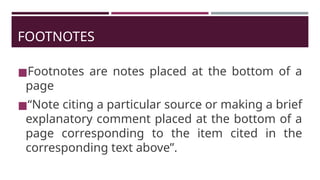
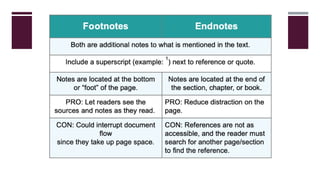
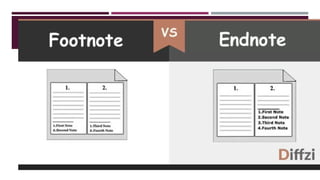
◼Footnotes are notesplaced at the bottom of a
page
◼“Note citing a particular source or making a brief
explanatory comment placed at the bottom of a
page corresponding to the item cited in the
corresponding text above”.
8.
FOOT NOTE
ADVANTAGES
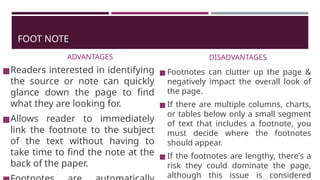
◼Readers interestedin identifying
the source or note can quickly
glance down the page to find
what they are looking for.
◼Allows reader to immediately
link the footnote to the subject
of the text without having to
take time to find the note at the
back of the paper.
DISADVANTAGES
◼ Footnotes can clutter up the page &
negatively impact the overall look of
the page.
◼ If there are multiple columns, charts,
or tables below only a small segment
of text that includes a footnote, you
must decide where the footnotes
should appear.
◼ If the footnotes are lengthy, there's a
risk they could dominate the page,
although this issue is considered
9.
TYPES OF FOOTNOTES
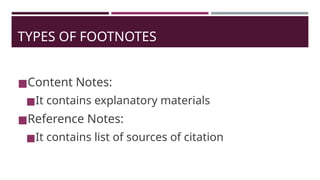
◼ContentNotes:
◼It contains explanatory materials
◼Reference Notes:
◼It contains list of sources of citation
10.
FORMAT OF FOOTNOTES
◼Placement:It denoted by index number i.e.
Superscript at the point of the reference.
◼Contents: Author Name, title of the article, place
of publication, Publisher’s name, Year.
◼Name of the authors: Surname should be
located at first
12.
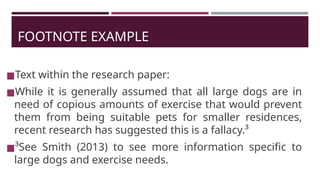
FOOTNOTE EXAMPLE
◼Text withinthe research paper:
◼While it is generally assumed that all large dogs are in
need of copious amounts of exercise that would prevent
them from being suitable pets for smaller residences,
recent research has suggested this is a fallacy.³
◼³See Smith (2013) to see more information specific to
large dogs and exercise needs.
15.
ENDNOTES
◼Note citing aparticular source or making a brief
explanatory comment placed at the end of a
research paper and arranged sequentially in
relation to where the reference appears in the
paper.
16.
ENDNOTE
ADVANTAGES
◼Endnotes are lessdistracting to
the reader and allows the
narrative to flow better.
◼Endnotes don't clutter up the
page.
◼As a separate section of a
research paper, endnotes allow
the reader to read and
contemplate all the notes at
DISADVANTAGES
◼ If you want to look at the text of a
particular endnote, you have to flip to
the end of the research paper to find
the information.
◼ Depending on how they are created
[i.e., continuous numbering or
numbers that start over for each
chapter], you may have to remember
the chapter number as well as the
endnote number in order to find the
correct one.
19.
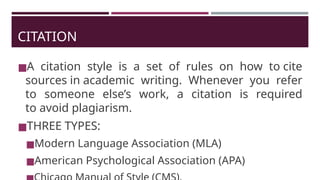
CITATION
◼A citation styleis a set of rules on how to cite
sources in academic writing. Whenever you refer
to someone else’s work, a citation is required
to avoid plagiarism.
◼THREE TYPES:
◼Modern Language Association (MLA)
◼American Psychological Association (APA)
20.
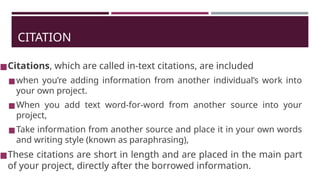
CITATION
◼Citations, which arecalled in-text citations, are included
◼when you’re adding information from another individual’s work into
your own project.
◼When you add text word-for-word from another source into your
project,
◼Take information from another source and place it in your own words
and writing style (known as paraphrasing),
◼These citations are short in length and are placed in the main part
of your project, directly after the borrowed information.
23.
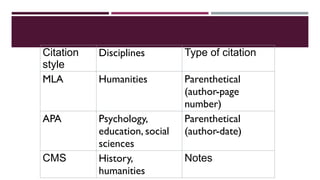
Citation
style
Disciplines Type ofcitation
MLA Humanities Parenthetical
(author-page
number)
APA Psychology,
education, social
sciences
Parenthetical
(author-date)
CMS History,
humanities
Notes
24.
WHO CREATED IT?
◼The American Psychological Association is an organization created for
individuals in the psychology field.
◼ With close to 121,000 members, they provide educational opportunities,
funding, guidance, and research information for everything psychology-
related.
◼ They also have numerous high-quality databases, peer-reviewed journals,
and books that revolve around mental health.
◼ It is also credited with creating their own specific citation and reference style.
◼ Today, this format is used by individuals not only in the psychology field, but
many other subject areas as well. Education, economics, business, and social
sciences also use APA style quite frequently.
25.
WHY WAS THISSTYLE CREATED?
◼This format was first developed in 1929 to form a standardized
way for researchers in science fields to document their
sources.
◼Prior to the inception of these standards and guidelines,
individuals were recognizing the work of other authors by
including bits and pieces of information in random order.
◼Having a standard format for citing sources allows readers to
glance at a citation or APA reference and easily locate the title,
author, year published, and other critical pieces of information
needed to understand a source.
26.
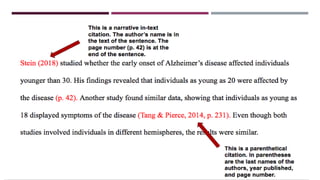
APA FORMAT BASICSIN IN-TEXT CITATION
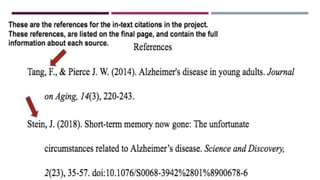
◼When using APA format, follow the author-date method of in-text
citation. This means that the author's last name and the year of
publication for the source should appear in the text, like, for
example, (Jones, 1998). One complete reference for each source
should appear in the reference list at the end of the paper.
◼If you are referring to an idea from another work but NOT directly
quoting the material, or making reference to an entire book,
article or other work, you only have to make reference to the
author and year of publication and not the page number in your
in-text reference.
27.
APA FORMAT BASICSIN IN-TEXT CITATION
◼On the other hand, if you are directly quoting or borrowing from
another work, you should include the page number at the end of
the parenthetical citation. Use the abbreviation “p.” (for one
page) or “pp.” (for multiple pages) before listing the page
number(s). Use an en dash for page ranges. For example, you
might write (Jones, 1998, p. 199) or (Jones, 1998, pp. 199–201).
This information is reiterated below.
◼Regardless of how they are referenced, all sources that are cited
in the text must appear in the reference list at the end of the
paper.
28.
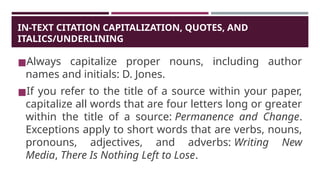
IN-TEXT CITATION CAPITALIZATION,QUOTES, AND
ITALICS/UNDERLINING
◼Always capitalize proper nouns, including author
names and initials: D. Jones.
◼If you refer to the title of a source within your paper,
capitalize all words that are four letters long or greater
within the title of a source: Permanence and Change.
Exceptions apply to short words that are verbs, nouns,
pronouns, adjectives, and adverbs: Writing New
Media, There Is Nothing Left to Lose.
29.
◼“Well, you’re aboutto enter the land of the free
and the brave. And I don’t know how you got
that stamp on your passport. The priest must
know someone” (Tóibín, 2009, p. 52).
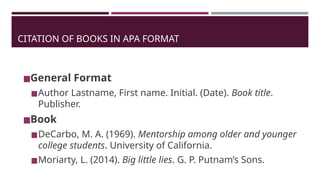
CITATION OF BOOKSIN APA FORMAT
◼General Format
◼Author Lastname, First name. Initial. (Date). Book title.
Publisher.
◼Book
◼DeCarbo, M. A. (1969). Mentorship among older and younger
college students. University of California.
◼Moriarty, L. (2014). Big little lies. G. P. Putnam’s Sons.
32.
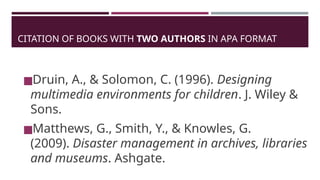
CITATION OF BOOKSWITH TWO AUTHORS IN APA FORMAT
◼Druin, A., & Solomon, C. (1996). Designing
multimedia environments for children. J. Wiley &
Sons.
◼Matthews, G., Smith, Y., & Knowles, G.
(2009). Disaster management in archives, libraries
and museums. Ashgate.
33.
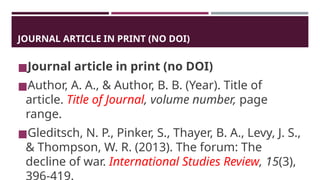
JOURNAL ARTICLE INPRINT (NO DOI)
◼Journal article in print (no DOI)
◼Author, A. A., & Author, B. B. (Year). Title of
article. Title of Journal, volume number, page
range.
◼Gleditsch, N. P., Pinker, S., Thayer, B. A., Levy, J. S.,
& Thompson, W. R. (2013). The forum: The
decline of war. International Studies Review, 15(3),
34.
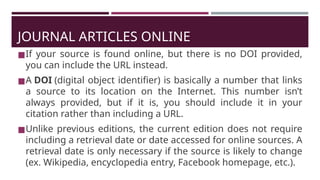
JOURNAL ARTICLES ONLINE
◼Ifyour source is found online, but there is no DOI provided,
you can include the URL instead.
◼A DOI (digital object identifier) is basically a number that links
a source to its location on the Internet. This number isn’t
always provided, but if it is, you should include it in your
citation rather than including a URL.
◼Unlike previous editions, the current edition does not require
including a retrieval date or date accessed for online sources. A
retrieval date is only necessary if the source is likely to change
(ex. Wikipedia, encyclopedia entry, Facebook homepage, etc.).
35.
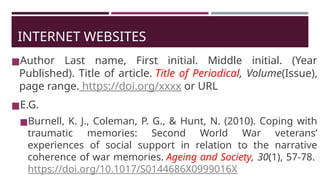
INTERNET WEBSITES
◼Author Lastname, First initial. Middle initial. (Year
Published). Title of article. Title of Periodical, Volume(Issue),
page range. https://doi.org/xxxx or URL
◼E.G.
◼Burnell, K. J., Coleman, P. G., & Hunt, N. (2010). Coping with
traumatic memories: Second World War veterans’
experiences of social support in relation to the narrative
coherence of war memories. Ageing and Society, 30(1), 57-78.
https://doi.org/10.1017/S0144686X0999016X
36.
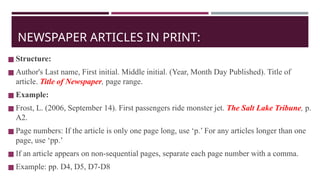
NEWSPAPER ARTICLES INPRINT:
◼ Structure:
◼ Author's Last name, First initial. Middle initial. (Year, Month Day Published). Title of
article. Title of Newspaper, page range.
◼ Example:
◼ Frost, L. (2006, September 14). First passengers ride monster jet. The Salt Lake Tribune, p.
A2.
◼ Page numbers: If the article is only one page long, use ‘p.’ For any articles longer than one
page, use ‘pp.’
◼ If an article appears on non-sequential pages, separate each page number with a comma.
◼ Example: pp. D4, D5, D7-D8
37.
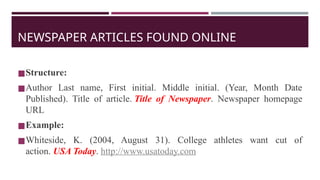
NEWSPAPER ARTICLES FOUNDONLINE
◼Structure:
◼Author Last name, First initial. Middle initial. (Year, Month Date
Published). Title of article. Title of Newspaper. Newspaper homepage
URL
◼Example:
◼Whiteside, K. (2004, August 31). College athletes want cut of
action. USA Today. http://www.usatoday.com
38.
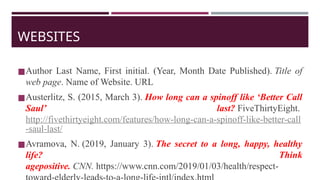
WEBSITES
◼Author Last Name,First initial. (Year, Month Date Published). Title of
web page. Name of Website. URL
◼Austerlitz, S. (2015, March 3). How long can a spinoff like ‘Better Call
Saul’ last? FiveThirtyEight.
http://fivethirtyeight.com/features/how-long-can-a-spinoff-like-better-call
-saul-last/
◼Avramova, N. (2019, January 3). The secret to a long, happy, healthy
life? Think
agepositive. CNN. https://www.cnn.com/2019/01/03/health/respect-
39.
DOCTORAL DISSERTATIONS &MASTER’S THESES FOUND
ON A DATABASE
◼Last name, First initial. Middle initial. (Year published). Title of
dissertation or thesis [Doctoral dissertation or Master’s thesis,
Name of Institution]. Name of database or archive. URL
◼Frederickson, J. (2020). Paleoecology of Medial Cretaceous
Dinosaurs from Western North America. [Doctoral Dissertation,
University of Oklahoma]. EBSCO Open Dissertations.
http://search.ebscohost.com/login.aspx?direct=true&db=ddu&
AN=BED47433A6CF4E99&site=ehost-live
40.
ANNOTATED BIBLIOGRAPHY
◼An annotatedbibliography is a list of citations to
books, articles, and documents. Each citation is
followed by a brief (usually about 150 words)
descriptive and evaluative paragraph, the annotation.
The purpose of the annotation is to inform the reader
of the relevance, accuracy, and quality of the sources
cited.
PLAGIARISM
◼ Itis presentingsomeone else's work or ideas as your
own, with or without their consent, by incorporating it
into your work without full acknowledgement.
◼All published and unpublished material, whether in
manuscript, printed or electronic form, is covered
under this definition.
43.
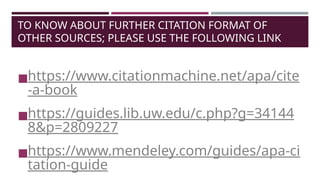
TO KNOW ABOUTFURTHER CITATION FORMAT OF
OTHER SOURCES; PLEASE USE THE FOLLOWING LINK
◼https://www.citationmachine.net/apa/cite
-a-book
◼https://guides.lib.uw.edu/c.php?g=34144
8&p=2809227
◼https://www.mendeley.com/guides/apa-ci
tation-guide



![ENDNOTE
ADVANTAGES
◼Endnotes are less distracting to
the reader and allows the
narrative to flow better.
◼Endnotes don't clutter up the
page.
◼As a separate section of a
research paper, endnotes allow
the reader to read and
contemplate all the notes at
DISADVANTAGES
◼ If you want to look at the text of a
particular endnote, you have to flip to
the end of the research paper to find
the information.
◼ Depending on how they are created
[i.e., continuous numbering or
numbers that start over for each
chapter], you may have to remember
the chapter number as well as the
endnote number in order to find the
correct one.](https://image.slidesharecdn.com/documentation-250502082851-d36fa135/85/DOCUMENTATION-DATA-IN-RESEARCH-IN-IN-RESEARCH-Methodology-pptx-16-320.jpg)

![GROUPS AND ORGANIZATIONS
◼First APA citation for an organization with an
abbreviation: (World Health Organization [WHO],
Yea](https://image.slidesharecdn.com/documentation-250502082851-d36fa135/85/DOCUMENTATION-DATA-IN-RESEARCH-IN-IN-RESEARCH-Methodology-pptx-30-320.jpg)
![DOCTORAL DISSERTATIONS & MASTER’S THESES FOUND
ON A DATABASE
◼Last name, First initial. Middle initial. (Year published). Title of
dissertation or thesis [Doctoral dissertation or Master’s thesis,
Name of Institution]. Name of database or archive. URL
◼Frederickson, J. (2020). Paleoecology of Medial Cretaceous
Dinosaurs from Western North America. [Doctoral Dissertation,
University of Oklahoma]. EBSCO Open Dissertations.
http://search.ebscohost.com/login.aspx?direct=true&db=ddu&
AN=BED47433A6CF4E99&site=ehost-live](https://image.slidesharecdn.com/documentation-250502082851-d36fa135/85/DOCUMENTATION-DATA-IN-RESEARCH-IN-IN-RESEARCH-Methodology-pptx-39-320.jpg)