
HOW SSL/TLS (HTTPS) WORKS
Saptarshi Basu
BACKGROUND
HIGH AVAILABILITY
LOAD BALANCER
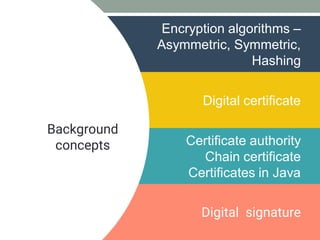
Encryption algorithms –
Asymmetric, Symmetric,
Hashing
Digital certificate
Certificate authority
Chain certificate
Certificates in Java
Digital signature
Background
concepts
Encryption
algorithms
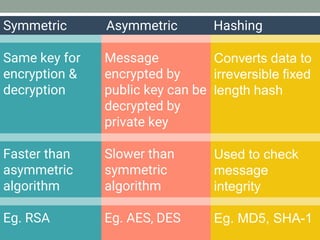
Symmetric
Asymmetric
Hashing
Same key for
encryption &
decryption
Faster than
asymmetric
algorithm
Eg. RSA
Message
encrypted by
public key can be
decrypted by
private key
Slower than
symmetric
algorithm
Eg. AES, DES
Converts data to
irreversible fixed
length hash
Used to check
message
integrity
Eg. MD5, SHA-1
Symmetric Asymmetric Hashing
RELATEDCONCEPTS-
BASE64ENCODINGNOT FOR ENCRYPTION
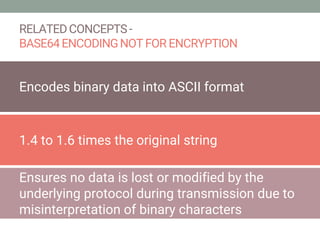
Encodes binary data into ASCII format
1.4 to 1.6 times the original string
Ensures no data is lost or modified by the
underlying protocol during transmission due to
misinterpretation of binary characters
• Digital Certificate
DIGITAL CERTIFICATE
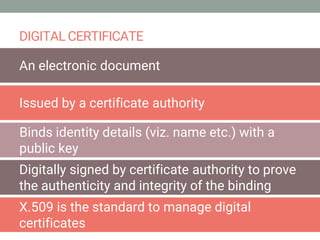
An electronic document
Issued by a certificate authority
Binds identity details (viz. name etc.) with a
public key
Digitally signed by certificate authority to prove
the authenticity and integrity of the binding
X.509 is the standard to manage digital
certificates
Certificate authority
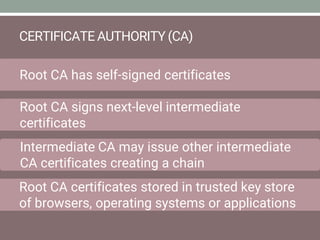
CERTIFICATE AUTHORITY (CA)
Root CA has self-signed certificates
Root CA signs next-level intermediate
certificates
Root CA certificates stored in trusted key store
of browsers, operating systems or applications
Intermediate CA may issue other intermediate
CA certificates creating a chain
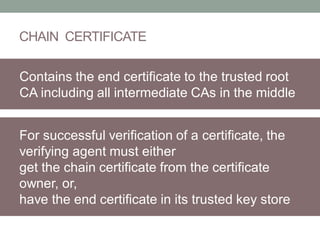
CHAIN CERTIFICATE
Contains the end certificate to the trusted root
CA including all intermediate CAs in the middle
For successful verification of a certificate, the
verifying agent must either
get the chain certificate from the certificate
owner, or,
have the end certificate in its trusted key store
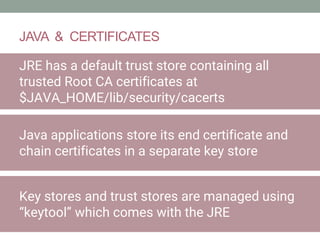
JAVA & CERTIFICATES
JRE has a default trust store containing all
trusted Root CA certificates at
$JAVA_HOME/lib/security/cacerts
Java applications store its end certificate and
chain certificates in a separate key store
Key stores and trust stores are managed using
“keytool” which comes with the JRE
Digital signature
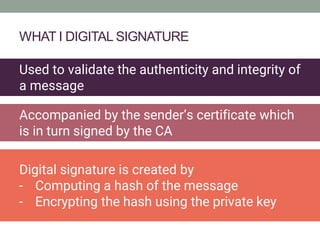
WHAT I DIGITAL SIGNATURE
Used to validate the authenticity and integrity of
a message
Digital signature is created by
- Computing a hash of the message
- Encrypting the hash using the private key
Accompanied by the sender’s certificate which
is in turn signed by the CA
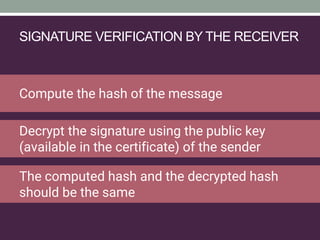
SIGNATURE VERIFICATION BY THE RECEIVER
Compute the hash of the message
The computed hash and the decrypted hash
should be the same
Decrypt the signature using the public key
(available in the certificate) of the sender
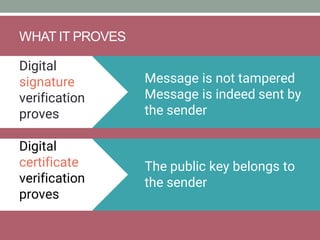
WHAT IT PROVES
Digital
certificate
verification
proves
Digital
signature
verification
proves
Message is not tampered
Message is indeed sent by
the sender
The public key belongs to
the sender
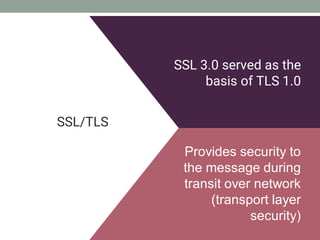
SSL/TLS
SSL 3.0 served as the
basis of TLS 1.0
Provides security to
the message during
transit over network
(transport layer
security)
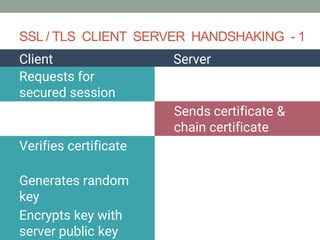
SSL / TLS CLIENT SERVER HANDSHAKING - 1
Requests for
secured session
Sends certificate &
chain certificate
Verifies certificate
Generates random
key
Encrypts key with
server public key
Client Server
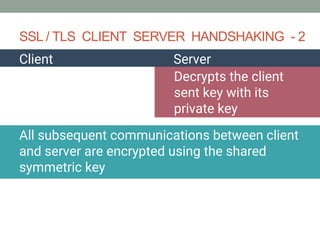
SSL / TLS CLIENT SERVER HANDSHAKING - 2
All subsequent communications between client
and server are encrypted using the shared
symmetric key
Decrypts the client
sent key with its
private key
Client Server
How ssl works

How ssl works

  • 1.
    HOW SSL/TLS (HTTPS)WORKS Saptarshi Basu
  • 2.
    BACKGROUND HIGH AVAILABILITY LOAD BALANCER Encryptionalgorithms – Asymmetric, Symmetric, Hashing Digital certificate Certificate authority Chain certificate Certificates in Java Digital signature Background concepts
  • 3.
  • 4.
    Same key for encryption& decryption Faster than asymmetric algorithm Eg. RSA Message encrypted by public key can be decrypted by private key Slower than symmetric algorithm Eg. AES, DES Converts data to irreversible fixed length hash Used to check message integrity Eg. MD5, SHA-1 Symmetric Asymmetric Hashing
  • 5.
    RELATEDCONCEPTS- BASE64ENCODINGNOT FOR ENCRYPTION Encodesbinary data into ASCII format 1.4 to 1.6 times the original string Ensures no data is lost or modified by the underlying protocol during transmission due to misinterpretation of binary characters
  • 6.
  • 7.
    DIGITAL CERTIFICATE An electronicdocument Issued by a certificate authority Binds identity details (viz. name etc.) with a public key Digitally signed by certificate authority to prove the authenticity and integrity of the binding X.509 is the standard to manage digital certificates
  • 8.
  • 9.
    CERTIFICATE AUTHORITY (CA) RootCA has self-signed certificates Root CA signs next-level intermediate certificates Root CA certificates stored in trusted key store of browsers, operating systems or applications Intermediate CA may issue other intermediate CA certificates creating a chain
  • 10.
    CHAIN CERTIFICATE Contains theend certificate to the trusted root CA including all intermediate CAs in the middle For successful verification of a certificate, the verifying agent must either get the chain certificate from the certificate owner, or, have the end certificate in its trusted key store
  • 11.
    JAVA & CERTIFICATES JREhas a default trust store containing all trusted Root CA certificates at $JAVA_HOME/lib/security/cacerts Java applications store its end certificate and chain certificates in a separate key store Key stores and trust stores are managed using “keytool” which comes with the JRE
  • 12.
  • 13.
    WHAT I DIGITALSIGNATURE Used to validate the authenticity and integrity of a message Digital signature is created by - Computing a hash of the message - Encrypting the hash using the private key Accompanied by the sender’s certificate which is in turn signed by the CA
  • 14.
    SIGNATURE VERIFICATION BYTHE RECEIVER Compute the hash of the message The computed hash and the decrypted hash should be the same Decrypt the signature using the public key (available in the certificate) of the sender
  • 15.
    WHAT IT PROVES Digital certificate verification proves Digital signature verification proves Messageis not tampered Message is indeed sent by the sender The public key belongs to the sender
  • 16.
    SSL/TLS SSL 3.0 servedas the basis of TLS 1.0 Provides security to the message during transit over network (transport layer security)
  • 17.
    SSL / TLSCLIENT SERVER HANDSHAKING - 1 Requests for secured session Sends certificate & chain certificate Verifies certificate Generates random key Encrypts key with server public key Client Server
  • 18.
    SSL / TLSCLIENT SERVER HANDSHAKING - 2 All subsequent communications between client and server are encrypted using the shared symmetric key Decrypts the client sent key with its private key Client Server