G.C. Hurtt, S. Frolking, M.G. Fearon, B. Moore III
E. Shevliakova, S. Malyshev, S.W. Pacala, R.A. Houghton
The Underpinnings of Land-Use History
Three Centuries of Global Gridded Land-use Transitions
Wood Harvest Activity, and Resulting Secondary Lands
Princeton
University
Woods Hole
Research Ctr.
QuickTime™ anda
TIFF (LZW) decompressor
are needed to seethis picture.
The Global Scale of Human Activities
• The concentrations of several greenhouse gases
have substantially increased in the atmosphere.1
• Anthropogenic N fixation now exceeds natural N
fixation.2
• More than 50% of available freshwater is
appropriated for human purposes.3
• Approx. 65% of marine fish stocks are fully
exploited, or over exploited.4
• We are now in the 6th great extinction event.5
(1) IPCC 2001 (2) Kaiser 2001 (3) Postel et al 1996 (4) FAO 2000 (5) Lawton and May 1995; Pimm et al
1995. See also Steffen et al. 2003.
Land-use
• Nearly 50% of the land surface has been transformed
by direct human action.1
• > 25% of forests have been cleared.2
• Habitat destruction is the primary risk for species
extinctions.3
• Land-cover change affects regional and global climate.4
• Land-use change is an important and highly uncertain
term in the global carbon budget.5
• Net re-growth on recovering “secondary” lands is the
dominant carbon sink mechanism in some regions.6
(1) Vitousek et al 1986; Turner eet al 1990; Daily 1995 (2) Waring & Running 1998. (3) UNEP 2002; Sala et al
2000; (4) Pielke et al. 2002; Roy et al 2004 (5) IPCC 2001. (6) Caspersen et al., 2000; Pacala et al 2001; Hurtt et
al, 2002. See also Steffen et al 2003.
Understanding the Consequences of
Land-use Activities
• Patterns of land-use
• Biogeochemistry on managed lands
• Management practices
• Fate of agricultural products
• Land-use transitions
• Earth System interactions
Key Questions
• What are the patterns of the land-use
transition events that produced the patterns
of agriculture and logged forests?
• What are the spatial patterns and age of
lands recovering from prior land-use
activities?
• What is the net effect of land-use change
events that release carbon, and the carbon
sinks provided by recovering “secondary”
lands?
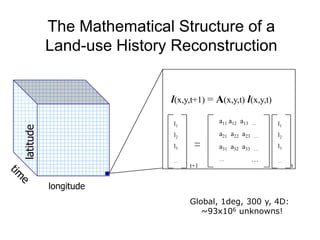
The Mathematical Structure of a
Land-use History Reconstruction
l1
l2
l3
…
a11 a12 a13 …
a21 a22 a23 …
a31 a32 a33 …
… …
l(x,y,t+1) = A(x,y,t) l(x,y,t)
t+1 t
longitude
latitude
l1
l2
l3
…
Global, 1deg, 300 y, 4D:
~93x106 unknowns!
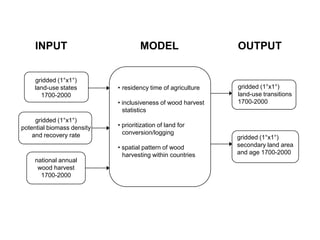
gridded (1°x1°)
land-use states
1700-2000
gridded (1°x1°)
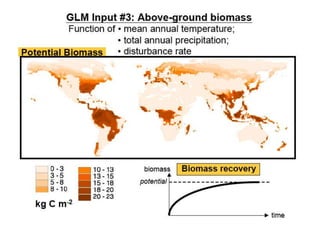
potential biomass density
and recovery rate
national annual
wood harvest
1700-2000
gridded (1°x1°)
land-use transitions
1700-2000
INPUT OUTPUTMODEL
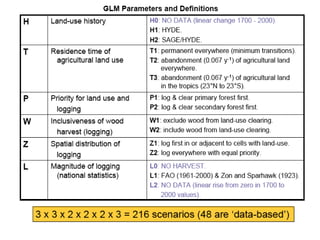
• residency time of agriculture
• inclusiveness of wood harvest
statistics
• prioritization of land for
conversion/logging
• spatial pattern of wood
harvesting within countries
gridded (1°x1°)
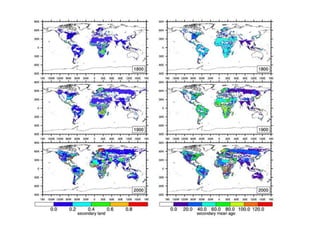
secondary land area
and age 1700-2000
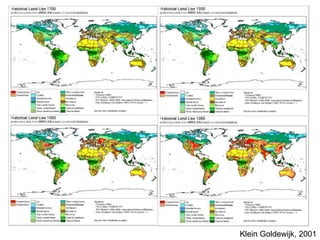
Klein Goldewijk, 2001
QuickTime™ anda
TIFF (LZW) decompressor
are needed to seethis picture.
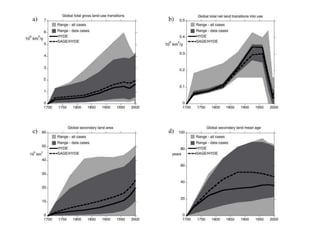
a)
c) d)
b)
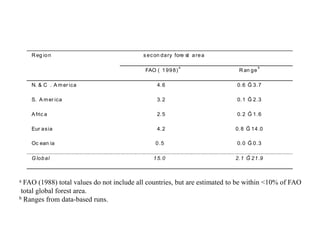
Reg ion s econ dary fore st area
FAO ( 1998)
a
Ran ge
b
N. & C . A mer ica 4.6 0.6 Ğ 3.7
S. A mer ica 3.2 0.1 Ğ 2.3
Afric a 2.5 0.2 Ğ 1.6
Eur asia 4.2 0.8 Ğ 14.0
Oc ean ia 0.5 0.0 Ğ 0.3
G lobal 15.0 2.1 Ğ 21.9
1
a FAO (1988) total values do not include all countries, but are estimated to be within <10% of FAO
total global forest area.
b Ranges from data-based runs.
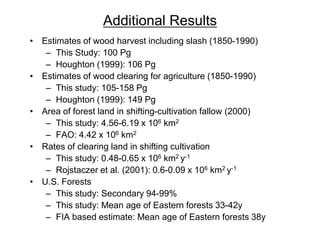
Additional Results
• Estimates of wood harvest including slash (1850-1990)
– This Study: 100 Pg
– Houghton (1999): 106 Pg
• Estimates of wood clearing for agriculture (1850-1990)
– This study: 105-158 Pg
– Houghton (1999): 149 Pg
• Area of forest land in shifting-cultivation fallow (2000)
– This study: 4.56-6.19 x 10⁶ km2
– FAO: 4.42 x 10⁶ km2
• Rates of clearing land in shifting cultivation
– This study: 0.48-0.65 x 10⁶ km2 y-1
– Rojstaczer et al. (2001): 0.6-0.09 x 10⁶ km2 y-1
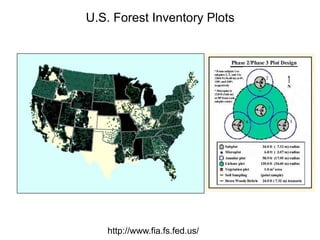
• U.S. Forests
– This study: Secondary 94-99%
– This study: Mean age of Eastern forests 33-42y
– FIA based estimate: Mean age of Eastern forests 38y
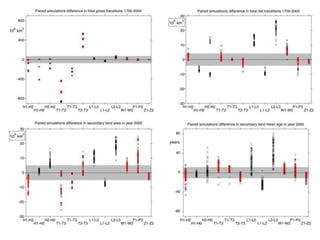
Key Findings
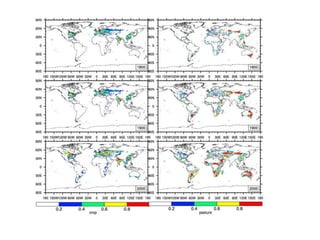
• 42-68% of land surface was impacted by human
land-use activities (agriculture + wood harvest) 1700-
2000.
• Total secondary land area increased 10-44 x 106 km2
during this period; about half is forested.
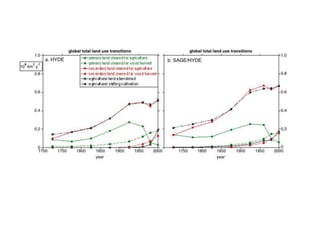
• Wood harvesting and shifting cultivation generated
70-90% of secondary land; permanent agriculture
changes generated the rest.
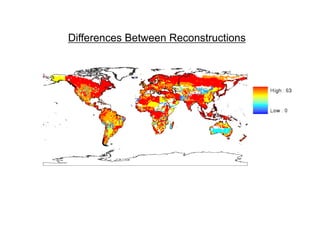
Differences Between Reconstructions
U.S. Forest Inventory Plots
http://www.fia.fs.fed.us/
QuickTime™ anda
TIFF (LZW) decompressor
are needed to seethis picture.
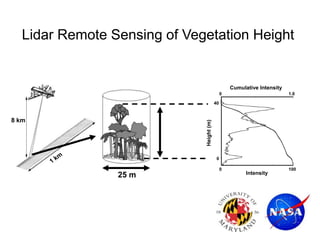
0
40
Height(m)
0 100
Intensity
Cumulative Intensity
0 1.0
25 m
8 km
Lidar Remote Sensing of Vegetation Height
http://icesat.gsfc.nasa.gov/intro.html
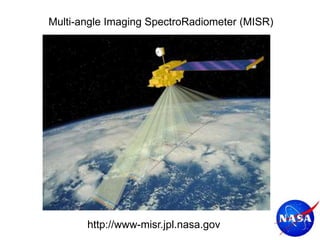
Multi-angle Imaging SpectroRadiometer (MISR)
http://www-misr.jpl.nasa.gov
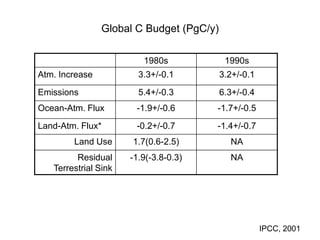
Global C Budget (PgC/y)
1980s 1990s
Atm. Increase 3.3+/-0.1 3.2+/-0.1
Emissions 5.4+/-0.3 6.3+/-0.4
Ocean-Atm. Flux -1.9+/-0.6 -1.7+/-0.5
Land-Atm. Flux* -0.2+/-0.7 -1.4+/-0.7
Land Use 1.7(0.6-2.5) NA
Residual
Terrestrial Sink
-1.9(-3.8-0.3) NA
IPCC, 2001
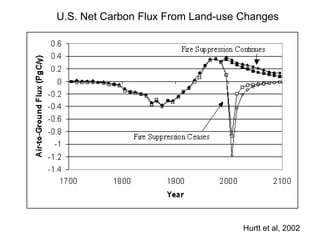
Hurtt et al, 2002
U.S. Net Carbon Flux From Land-use Changes
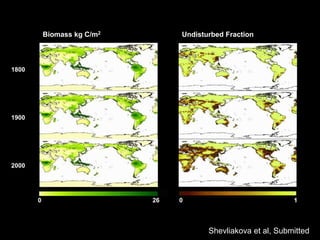
Biomass kg C/m2 Undisturbed Fraction
1900
1800
2000
0 26 0 1
Shevliakova et al, Submitted
QuickTime™ anda
TIFF (LZW) decompressor
are needed to seethis picture.
Summary/Conclusion
• This study provides the first global gridded estimates of land-use
transitions (land conversions), wood harvesting, and resulting
secondary lands annually, for the period 1700-2000
• Major results are consistent with large sets of input data, and
compare favorably to aggregated independent estimates.
• To best refine these estimates, new efforts are needed to
characterize vegetation structure globally using remote sensing
and field data.
• Additional future challenges include: understanding the dynamics
on agriculture lands (including management), creating integrated
models capable of tracking land-use activities and estimating
their consequences, and developing consistent models of land-
use in the future.

How have humans changed the land

  • 1.
    G.C. Hurtt, S.Frolking, M.G. Fearon, B. Moore III E. Shevliakova, S. Malyshev, S.W. Pacala, R.A. Houghton The Underpinnings of Land-Use History Three Centuries of Global Gridded Land-use Transitions Wood Harvest Activity, and Resulting Secondary Lands Princeton University Woods Hole Research Ctr. QuickTime™ anda TIFF (LZW) decompressor are needed to seethis picture.
  • 2.
    The Global Scaleof Human Activities • The concentrations of several greenhouse gases have substantially increased in the atmosphere.1 • Anthropogenic N fixation now exceeds natural N fixation.2 • More than 50% of available freshwater is appropriated for human purposes.3 • Approx. 65% of marine fish stocks are fully exploited, or over exploited.4 • We are now in the 6th great extinction event.5 (1) IPCC 2001 (2) Kaiser 2001 (3) Postel et al 1996 (4) FAO 2000 (5) Lawton and May 1995; Pimm et al 1995. See also Steffen et al. 2003.
  • 3.
    Land-use • Nearly 50%of the land surface has been transformed by direct human action.1 • > 25% of forests have been cleared.2 • Habitat destruction is the primary risk for species extinctions.3 • Land-cover change affects regional and global climate.4 • Land-use change is an important and highly uncertain term in the global carbon budget.5 • Net re-growth on recovering “secondary” lands is the dominant carbon sink mechanism in some regions.6 (1) Vitousek et al 1986; Turner eet al 1990; Daily 1995 (2) Waring & Running 1998. (3) UNEP 2002; Sala et al 2000; (4) Pielke et al. 2002; Roy et al 2004 (5) IPCC 2001. (6) Caspersen et al., 2000; Pacala et al 2001; Hurtt et al, 2002. See also Steffen et al 2003.
  • 4.
    Understanding the Consequencesof Land-use Activities • Patterns of land-use • Biogeochemistry on managed lands • Management practices • Fate of agricultural products • Land-use transitions • Earth System interactions
  • 5.
    Key Questions • Whatare the patterns of the land-use transition events that produced the patterns of agriculture and logged forests? • What are the spatial patterns and age of lands recovering from prior land-use activities? • What is the net effect of land-use change events that release carbon, and the carbon sinks provided by recovering “secondary” lands?
  • 6.
    The Mathematical Structureof a Land-use History Reconstruction l1 l2 l3 … a11 a12 a13 … a21 a22 a23 … a31 a32 a33 … … … l(x,y,t+1) = A(x,y,t) l(x,y,t) t+1 t longitude latitude l1 l2 l3 … Global, 1deg, 300 y, 4D: ~93x106 unknowns!
  • 7.
    gridded (1°x1°) land-use states 1700-2000 gridded(1°x1°) potential biomass density and recovery rate national annual wood harvest 1700-2000 gridded (1°x1°) land-use transitions 1700-2000 INPUT OUTPUTMODEL • residency time of agriculture • inclusiveness of wood harvest statistics • prioritization of land for conversion/logging • spatial pattern of wood harvesting within countries gridded (1°x1°) secondary land area and age 1700-2000
  • 8.
  • 12.
    QuickTime™ anda TIFF (LZW)decompressor are needed to seethis picture.
  • 13.
  • 17.
    Reg ion secon dary fore st area FAO ( 1998) a Ran ge b N. & C . A mer ica 4.6 0.6 Ğ 3.7 S. A mer ica 3.2 0.1 Ğ 2.3 Afric a 2.5 0.2 Ğ 1.6 Eur asia 4.2 0.8 Ğ 14.0 Oc ean ia 0.5 0.0 Ğ 0.3 G lobal 15.0 2.1 Ğ 21.9 1 a FAO (1988) total values do not include all countries, but are estimated to be within <10% of FAO total global forest area. b Ranges from data-based runs.
  • 18.
    Additional Results • Estimatesof wood harvest including slash (1850-1990) – This Study: 100 Pg – Houghton (1999): 106 Pg • Estimates of wood clearing for agriculture (1850-1990) – This study: 105-158 Pg – Houghton (1999): 149 Pg • Area of forest land in shifting-cultivation fallow (2000) – This study: 4.56-6.19 x 10⁶ km2 – FAO: 4.42 x 10⁶ km2 • Rates of clearing land in shifting cultivation – This study: 0.48-0.65 x 10⁶ km2 y-1 – Rojstaczer et al. (2001): 0.6-0.09 x 10⁶ km2 y-1 • U.S. Forests – This study: Secondary 94-99% – This study: Mean age of Eastern forests 33-42y – FIA based estimate: Mean age of Eastern forests 38y
  • 19.
    Key Findings • 42-68%of land surface was impacted by human land-use activities (agriculture + wood harvest) 1700- 2000. • Total secondary land area increased 10-44 x 106 km2 during this period; about half is forested. • Wood harvesting and shifting cultivation generated 70-90% of secondary land; permanent agriculture changes generated the rest.
  • 21.
  • 22.
    U.S. Forest InventoryPlots http://www.fia.fs.fed.us/
  • 23.
    QuickTime™ anda TIFF (LZW)decompressor are needed to seethis picture.
  • 24.
    0 40 Height(m) 0 100 Intensity Cumulative Intensity 01.0 25 m 8 km Lidar Remote Sensing of Vegetation Height
  • 25.
  • 26.
    Multi-angle Imaging SpectroRadiometer(MISR) http://www-misr.jpl.nasa.gov
  • 27.
    Global C Budget(PgC/y) 1980s 1990s Atm. Increase 3.3+/-0.1 3.2+/-0.1 Emissions 5.4+/-0.3 6.3+/-0.4 Ocean-Atm. Flux -1.9+/-0.6 -1.7+/-0.5 Land-Atm. Flux* -0.2+/-0.7 -1.4+/-0.7 Land Use 1.7(0.6-2.5) NA Residual Terrestrial Sink -1.9(-3.8-0.3) NA IPCC, 2001
  • 28.
    Hurtt et al,2002 U.S. Net Carbon Flux From Land-use Changes
  • 29.
    Biomass kg C/m2Undisturbed Fraction 1900 1800 2000 0 26 0 1 Shevliakova et al, Submitted
  • 30.
    QuickTime™ anda TIFF (LZW)decompressor are needed to seethis picture. Summary/Conclusion • This study provides the first global gridded estimates of land-use transitions (land conversions), wood harvesting, and resulting secondary lands annually, for the period 1700-2000 • Major results are consistent with large sets of input data, and compare favorably to aggregated independent estimates. • To best refine these estimates, new efforts are needed to characterize vegetation structure globally using remote sensing and field data. • Additional future challenges include: understanding the dynamics on agriculture lands (including management), creating integrated models capable of tracking land-use activities and estimating their consequences, and developing consistent models of land- use in the future.