GSOC sequestration
potential
Rosa Cuevas Corona, GSP Secretariat
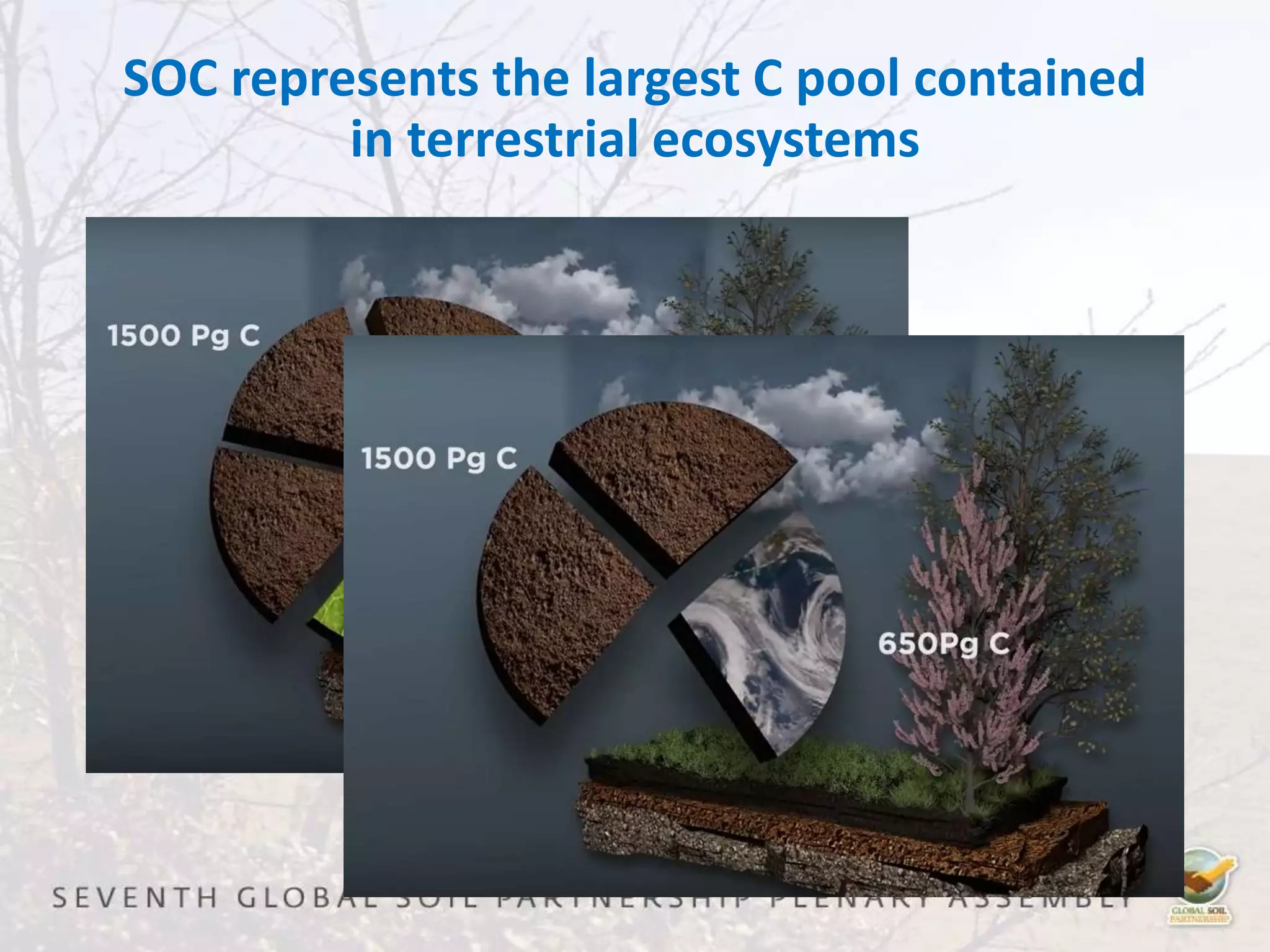
SOC represents the largest C pool contained
in terrestrial ecosystems
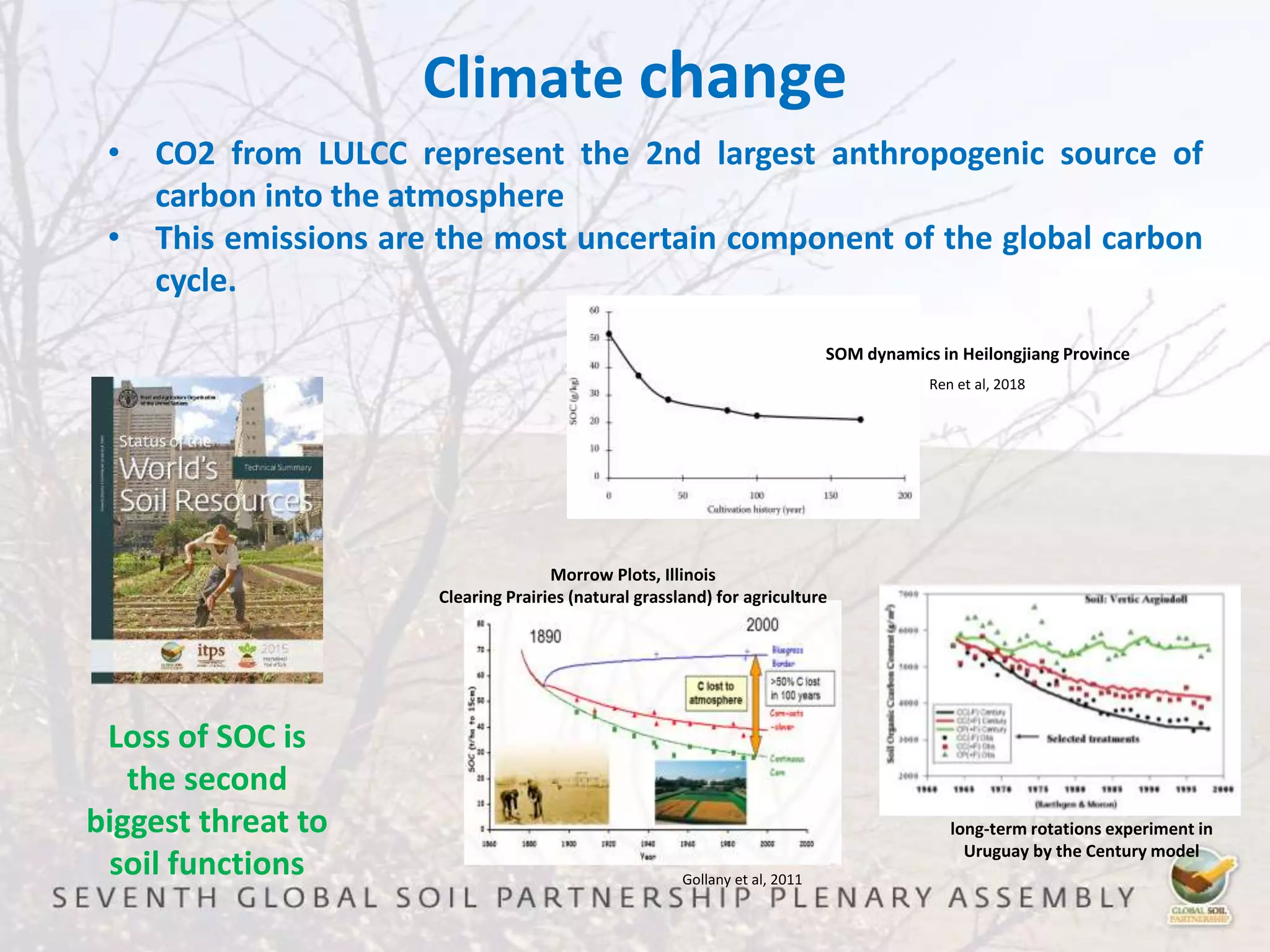
SOM dynamics in Heilongjiang Province
Morrow Plots, Illinois
Clearing Prairies (natural grassland) for agriculture
Gollany et al, 2011
Ren et al, 2018
long-term rotations experiment in
Uruguay by the Century model
Climate change
• CO2 from LULCC represent the 2nd largest anthropogenic source of
carbon into the atmosphere
• This emissions are the most uncertain component of the global carbon
cycle.
Loss of SOC is
the second
biggest threat to
soil functions
Mulching Cover cropping
Integrated Nutrient
Management
Rhizobium
Complex farming
systems
No-till
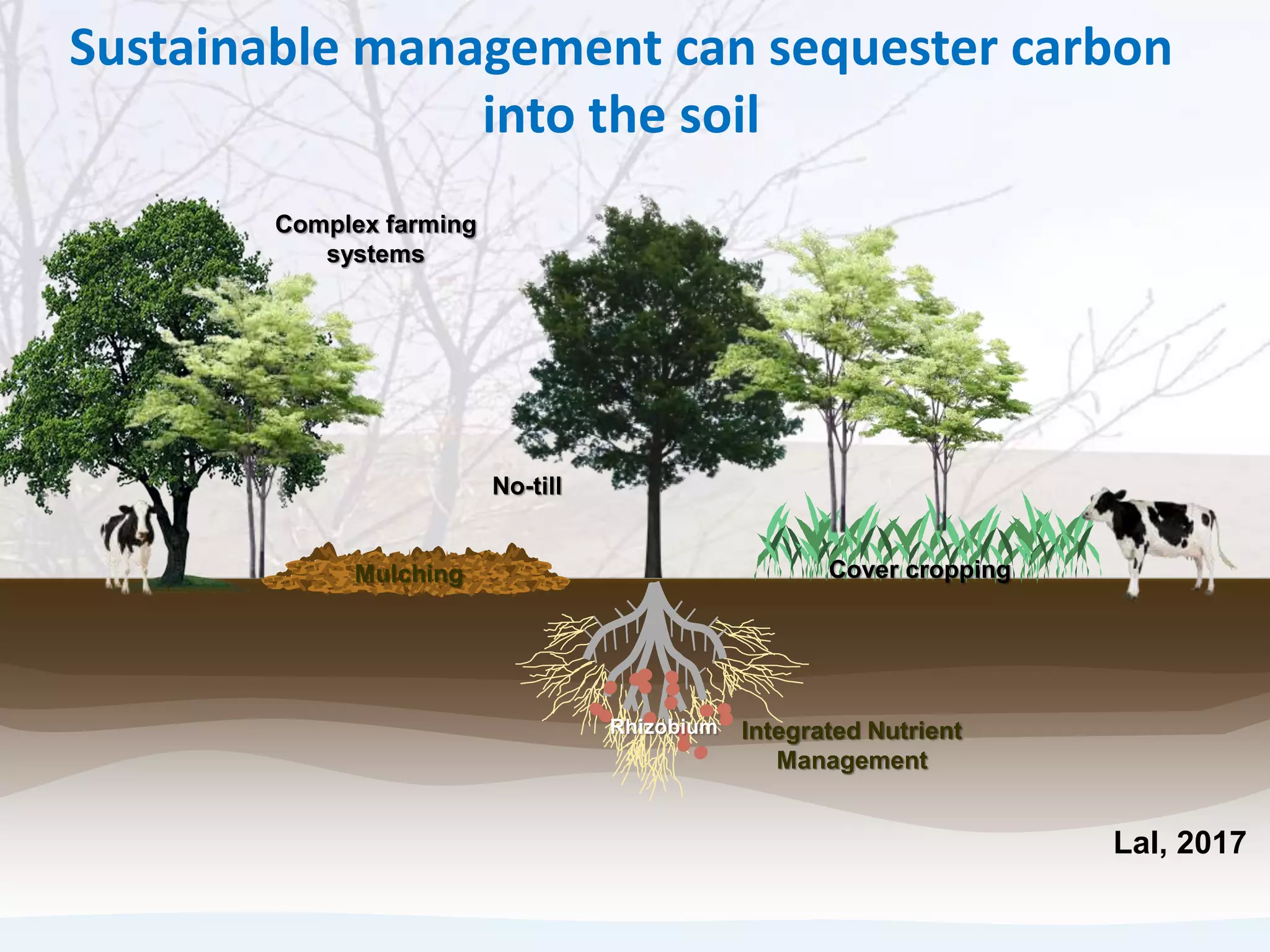
Sustainable management can sequester carbon
into the soil
Lal, 2017
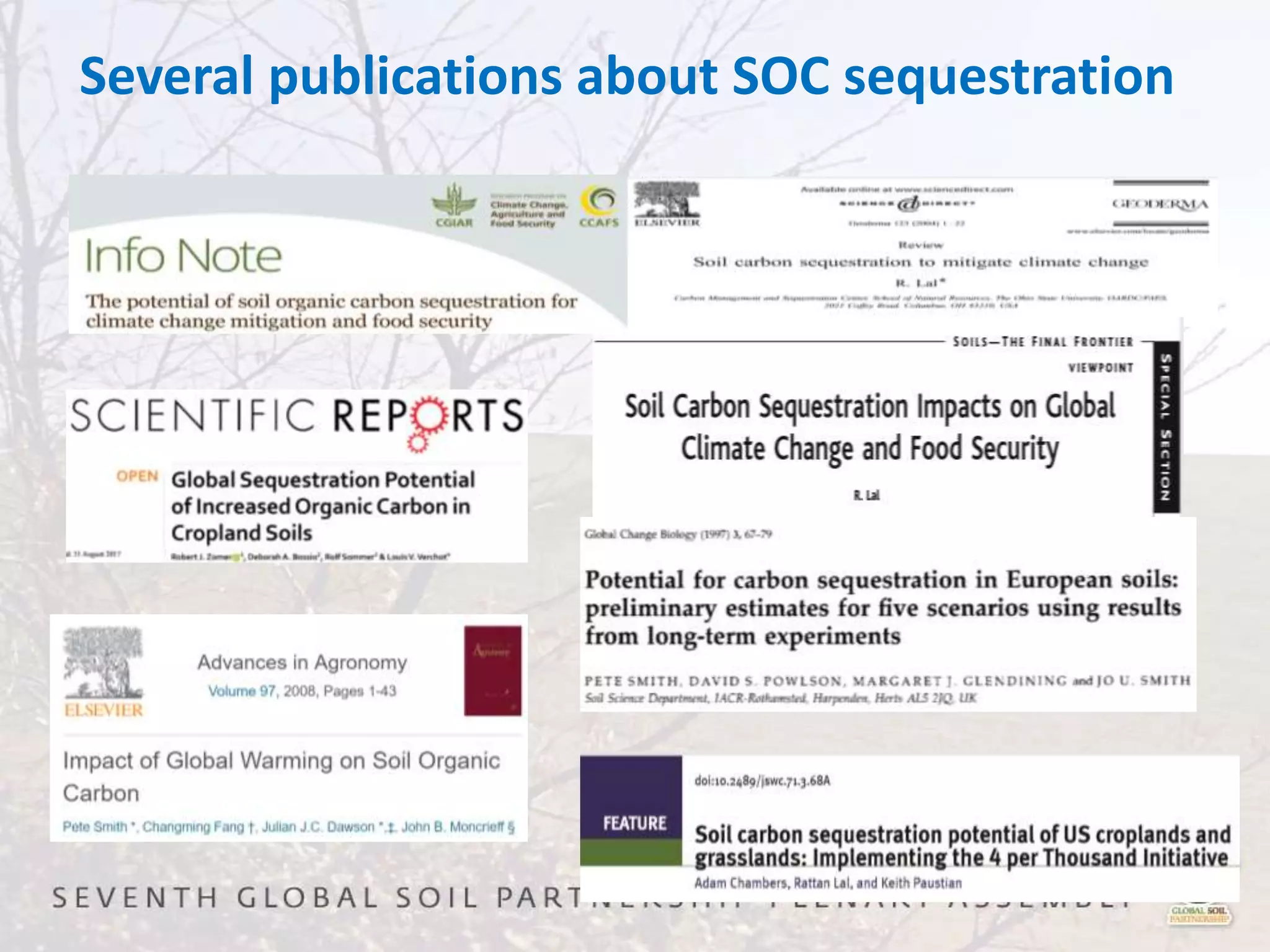
Several publications about SOC sequestration
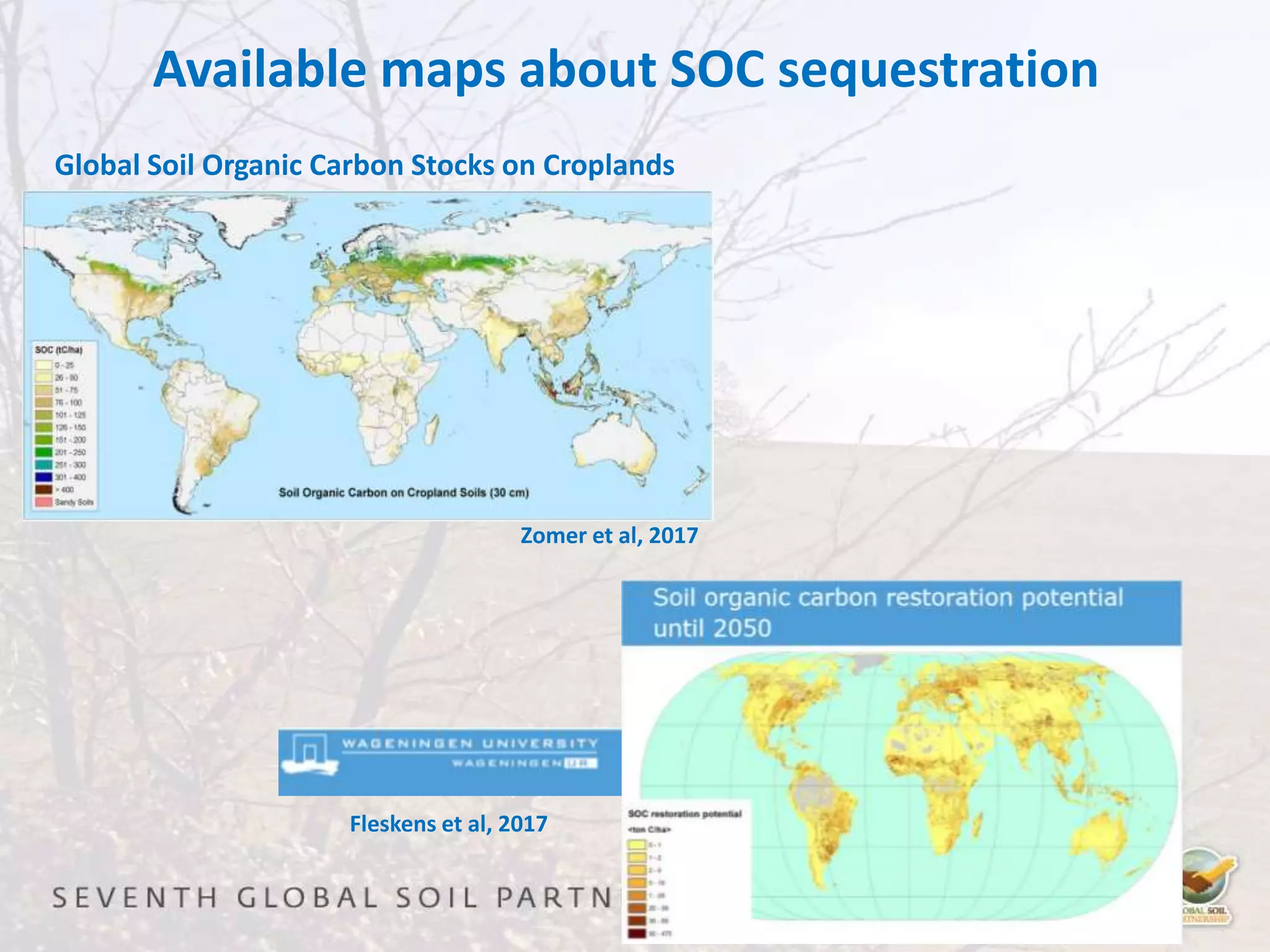
Global Soil Organic Carbon Stocks on Croplands
Available maps about SOC sequestration
Fleskens et al, 2017
Zomer et al, 2017
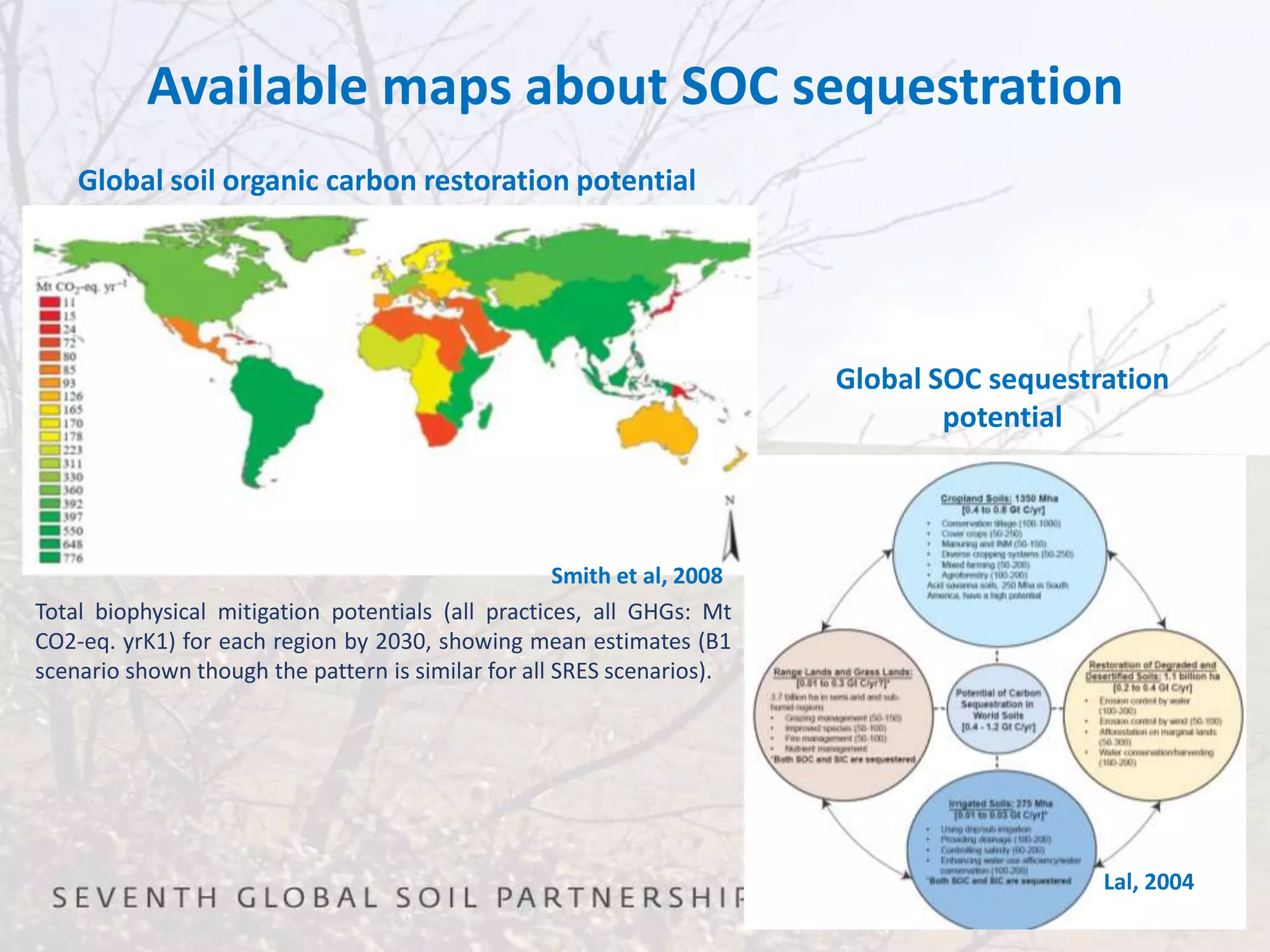
Global SOC sequestration
potential
Available maps about SOC sequestration
Total biophysical mitigation potentials (all practices, all GHGs: Mt
CO2-eq. yrK1) for each region by 2030, showing mean estimates (B1
scenario shown though the pattern is similar for all SRES scenarios).
Global soil organic carbon restoration potential
Smith et al, 2008
Lal, 2004
Several initiatives about C and SOC
sequestration
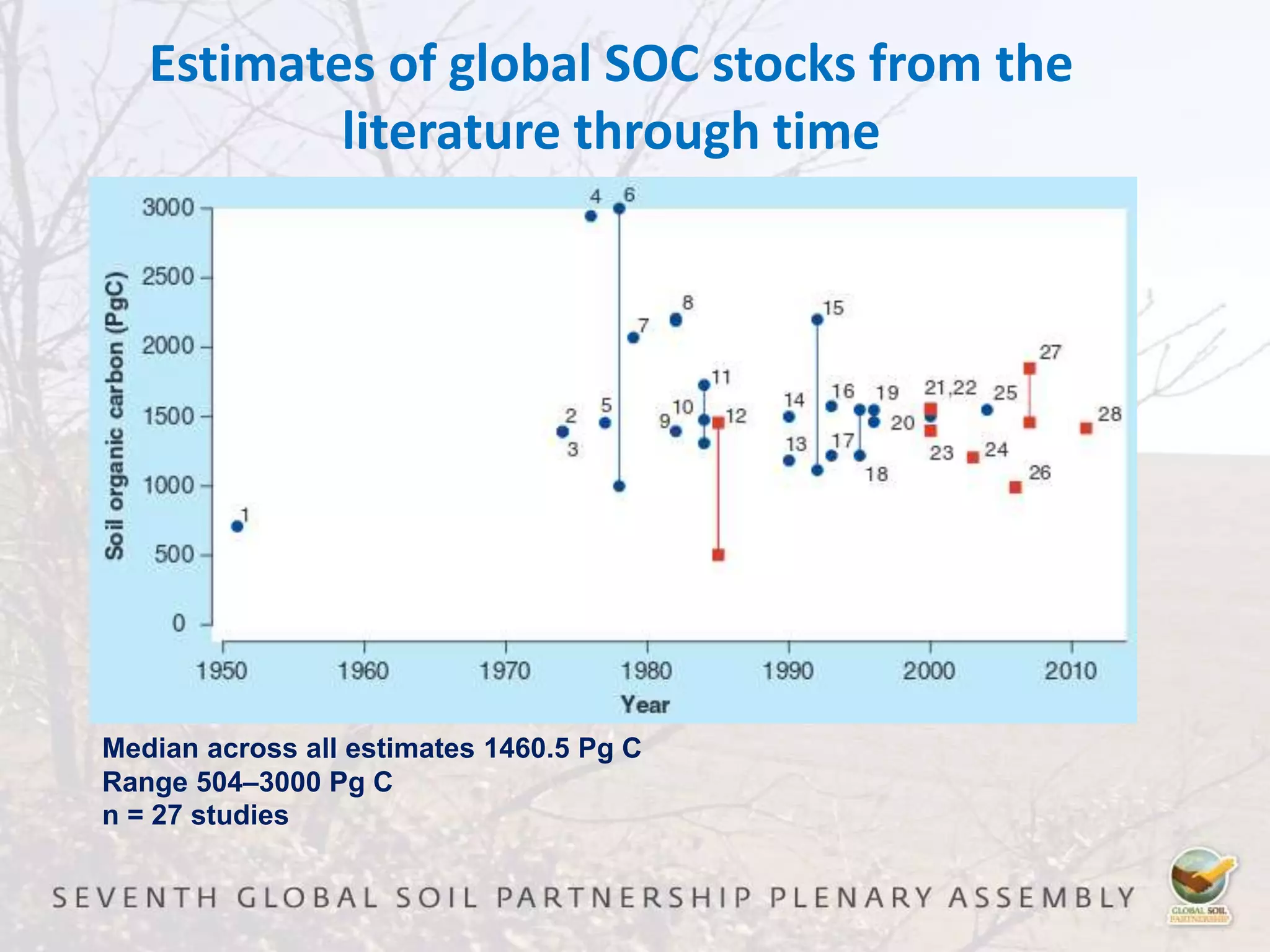
Estimates of global SOC stocks from the
literature through time
Median across all estimates 1460.5 Pg C
Range 504–3000 Pg C
n = 27 studies
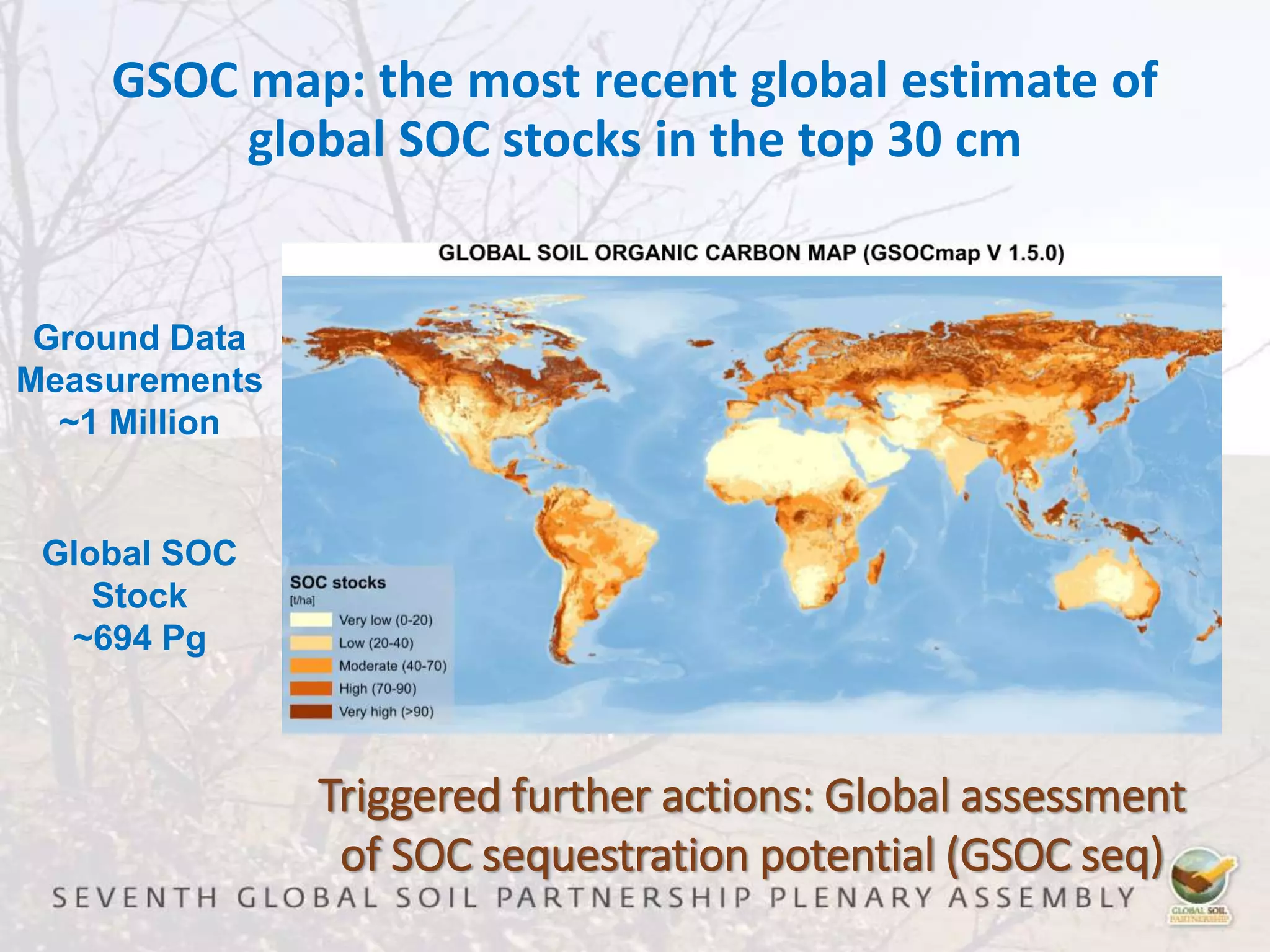
GSOC map: the most recent global estimate of
global SOC stocks in the top 30 cm
Ground Data
Measurements
~1 Million
Global SOC
Stock
~694 Pg
Triggered further actions: Global assessment
of SOC sequestration potential (GSOC seq)
Why should we continue with this topic?
• There are high expectations on the world's soils to
contribute to climate change mitigation and adaptation.
• The United Nations Statistics Division (UNSD), defined
the bellow and aboveground SOC stocks as a universal
sub-indicator (15.3.1) to asses land degradation.
• Need to contribute to enhancement of soil productivity
and food security.
• There is a request from member countries to generate
updated information about the global potential of SOC
sequestration. GSOC17, 6th GSP Plenary Assembly/26th
COAG session.
• Empower countries to know and generate their own
information about their SOC sequestration potential.
Why should we continue with this topic?
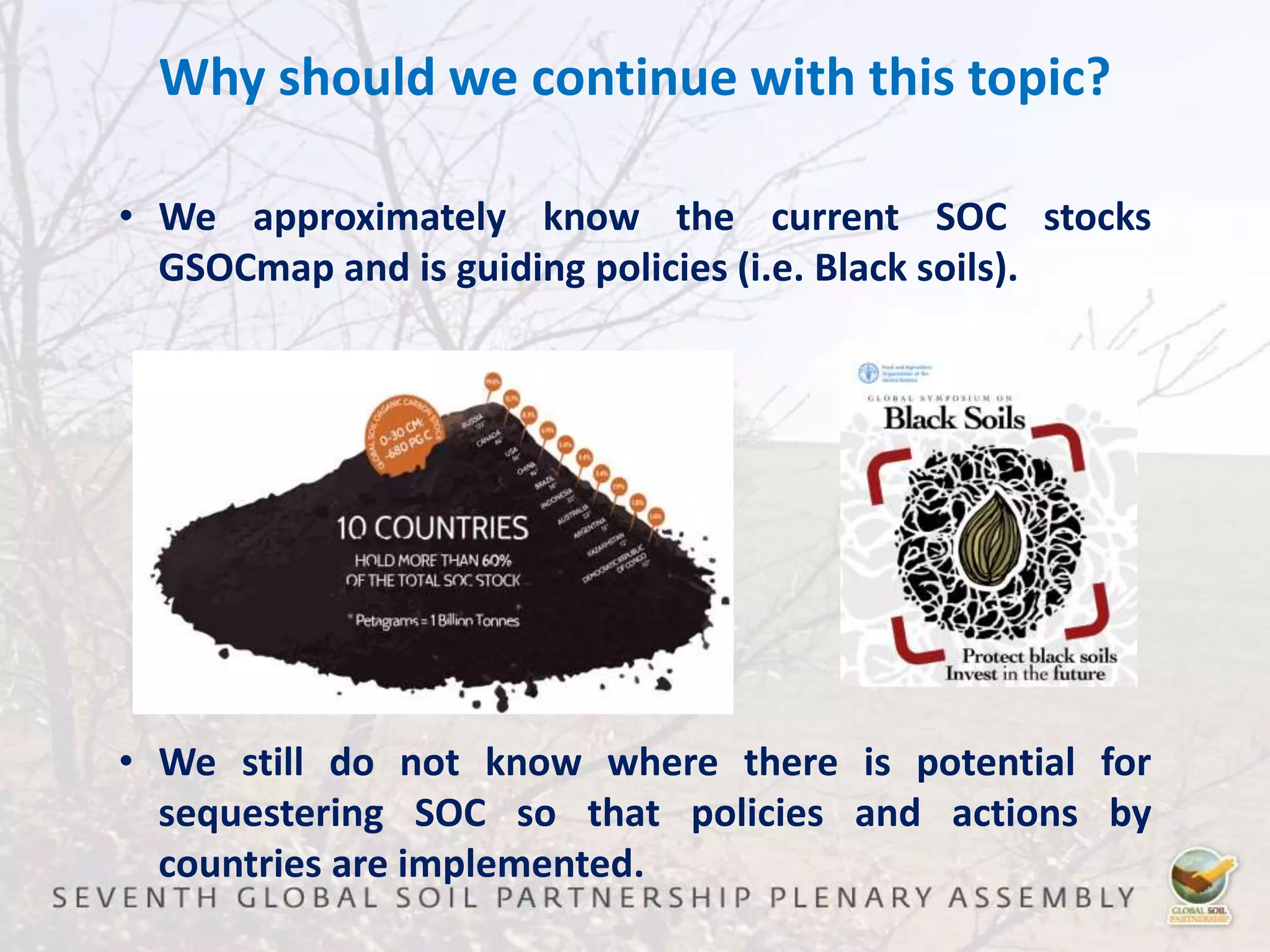
• We approximately know the current SOC stocks
GSOCmap and is guiding policies (i.e. Black soils).
• We still do not know where there is potential for
sequestering SOC so that policies and actions by
countries are implemented.
What is the added value?
• Country driven approach (bottom-up).
• Information will be generated by national experts.
• Information will be generated by the countries and for the
countries.
• Empowerment of the countries.
• Capacity development at national and regional level trough
SOC modeling and mapping workshops.
• Estimation of attainable SOC stocks for each context and
country.
Global assessment of soil organic carbon
sequestration potential (GSOC seq)
Objective
• Preparation of the GSOC seq map following a
country-driven approach including country
capacity development.
Global assessment of soil organic carbon
sequestration potential (GSOC seq)
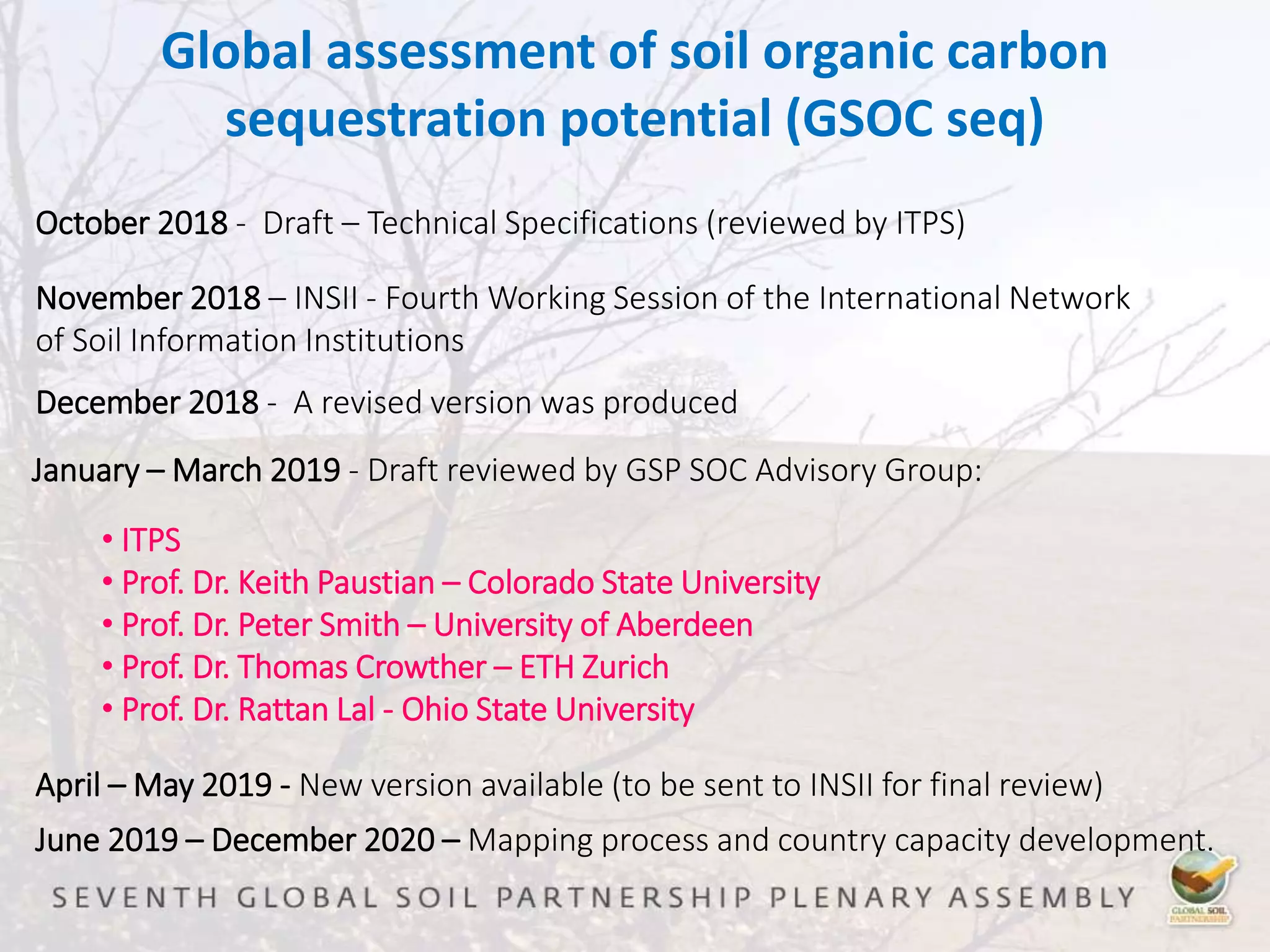
January – March 2019 - Draft reviewed by GSP SOC Advisory Group:
• ITPS
• Prof. Dr. Keith Paustian – Colorado State University
• Prof. Dr. Peter Smith – University of Aberdeen
• Prof. Dr. Thomas Crowther – ETH Zurich
• Prof. Dr. Rattan Lal - Ohio State University
October 2018 - Draft – Technical Specifications (reviewed by ITPS)
November 2018 – INSII - Fourth Working Session of the International Network
of Soil Information Institutions
December 2018 - A revised version was produced
April – May 2019 - New version available (to be sent to INSII for final review)
June 2019 – December 2020 – Mapping process and country capacity development.
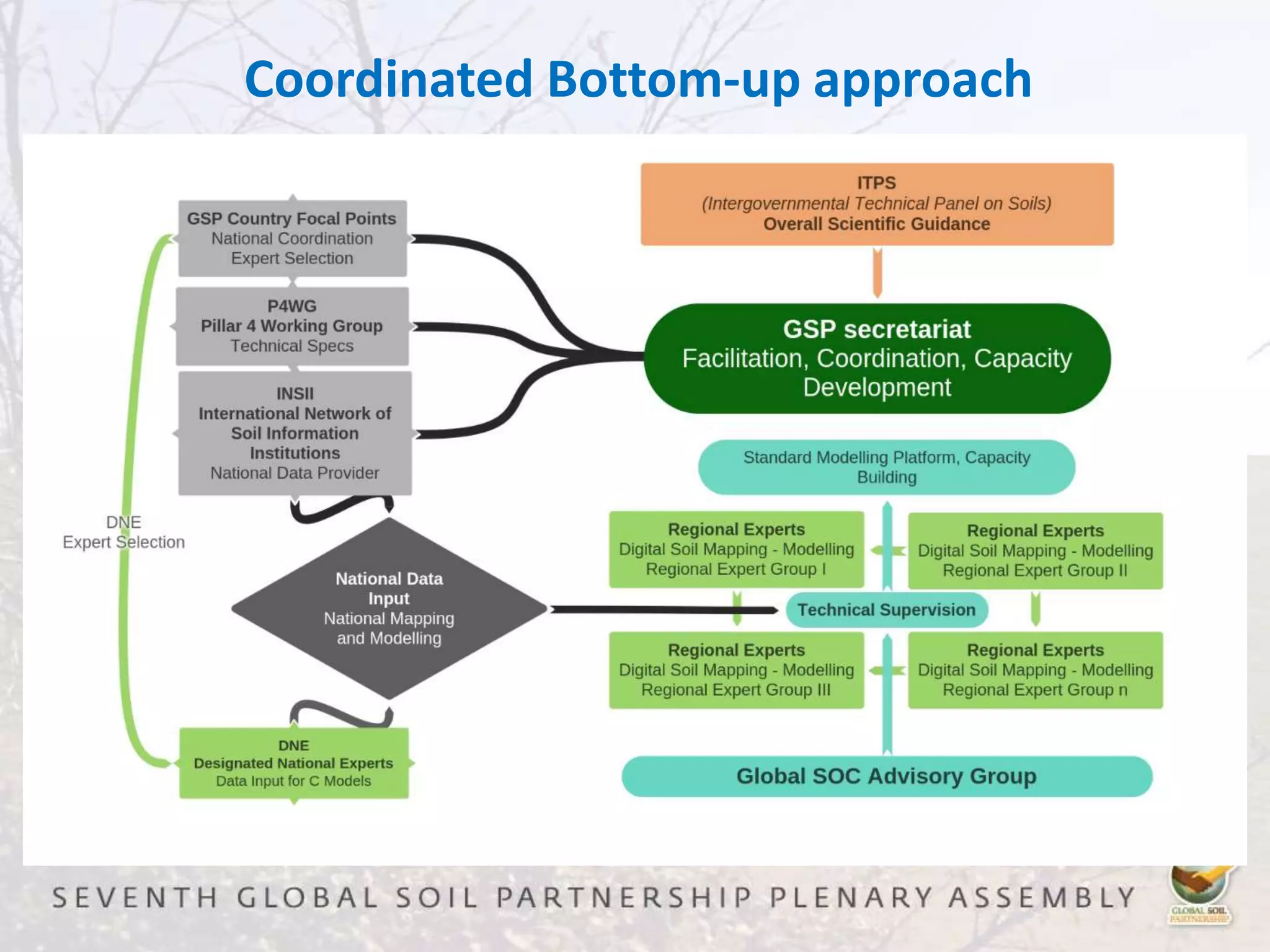
Coordinated Bottom-up approach
Comments from GSP SOC Advisory Group
• Key principles should govern the work:
• careful coordination of data and analytical methods;
• same data sources;
• same carbon model and assumptions within a model.
• Not feasible to have semi-independent efforts (country-driven
analyses) and yield consistent results. A modelling team is
needed.
• Sensitivity and uncertainty should be established.
• Definition of a realistic and feasible 'recommended land use and
management practices’ is the main challenge.
Global soil carbon sequestration potential maps

Global soil carbon sequestration potential maps

  • 1.
  • 2.
    SOC represents thelargest C pool contained in terrestrial ecosystems
  • 3.
    SOM dynamics inHeilongjiang Province Morrow Plots, Illinois Clearing Prairies (natural grassland) for agriculture Gollany et al, 2011 Ren et al, 2018 long-term rotations experiment in Uruguay by the Century model Climate change • CO2 from LULCC represent the 2nd largest anthropogenic source of carbon into the atmosphere • This emissions are the most uncertain component of the global carbon cycle. Loss of SOC is the second biggest threat to soil functions
  • 4.
    Mulching Cover cropping IntegratedNutrient Management Rhizobium Complex farming systems No-till Sustainable management can sequester carbon into the soil Lal, 2017
  • 5.
    Several publications aboutSOC sequestration
  • 6.
    Global Soil OrganicCarbon Stocks on Croplands Available maps about SOC sequestration Fleskens et al, 2017 Zomer et al, 2017
  • 7.
    Global SOC sequestration potential Availablemaps about SOC sequestration Total biophysical mitigation potentials (all practices, all GHGs: Mt CO2-eq. yrK1) for each region by 2030, showing mean estimates (B1 scenario shown though the pattern is similar for all SRES scenarios). Global soil organic carbon restoration potential Smith et al, 2008 Lal, 2004
  • 8.
    Several initiatives aboutC and SOC sequestration
  • 9.
    Estimates of globalSOC stocks from the literature through time Median across all estimates 1460.5 Pg C Range 504–3000 Pg C n = 27 studies
  • 10.
    GSOC map: themost recent global estimate of global SOC stocks in the top 30 cm Ground Data Measurements ~1 Million Global SOC Stock ~694 Pg Triggered further actions: Global assessment of SOC sequestration potential (GSOC seq)
  • 11.
    Why should wecontinue with this topic? • There are high expectations on the world's soils to contribute to climate change mitigation and adaptation. • The United Nations Statistics Division (UNSD), defined the bellow and aboveground SOC stocks as a universal sub-indicator (15.3.1) to asses land degradation. • Need to contribute to enhancement of soil productivity and food security. • There is a request from member countries to generate updated information about the global potential of SOC sequestration. GSOC17, 6th GSP Plenary Assembly/26th COAG session. • Empower countries to know and generate their own information about their SOC sequestration potential.
  • 12.
    Why should wecontinue with this topic? • We approximately know the current SOC stocks GSOCmap and is guiding policies (i.e. Black soils). • We still do not know where there is potential for sequestering SOC so that policies and actions by countries are implemented.
  • 13.
    What is theadded value? • Country driven approach (bottom-up). • Information will be generated by national experts. • Information will be generated by the countries and for the countries. • Empowerment of the countries. • Capacity development at national and regional level trough SOC modeling and mapping workshops. • Estimation of attainable SOC stocks for each context and country.
  • 14.
    Global assessment ofsoil organic carbon sequestration potential (GSOC seq) Objective • Preparation of the GSOC seq map following a country-driven approach including country capacity development.
  • 15.
    Global assessment ofsoil organic carbon sequestration potential (GSOC seq) January – March 2019 - Draft reviewed by GSP SOC Advisory Group: • ITPS • Prof. Dr. Keith Paustian – Colorado State University • Prof. Dr. Peter Smith – University of Aberdeen • Prof. Dr. Thomas Crowther – ETH Zurich • Prof. Dr. Rattan Lal - Ohio State University October 2018 - Draft – Technical Specifications (reviewed by ITPS) November 2018 – INSII - Fourth Working Session of the International Network of Soil Information Institutions December 2018 - A revised version was produced April – May 2019 - New version available (to be sent to INSII for final review) June 2019 – December 2020 – Mapping process and country capacity development.
  • 16.
  • 17.
    Comments from GSPSOC Advisory Group • Key principles should govern the work: • careful coordination of data and analytical methods; • same data sources; • same carbon model and assumptions within a model. • Not feasible to have semi-independent efforts (country-driven analyses) and yield consistent results. A modelling team is needed. • Sensitivity and uncertainty should be established. • Definition of a realistic and feasible 'recommended land use and management practices’ is the main challenge.

Editor's Notes

  • #3 The role of soil organic carbon in global carbon cycles is receiving increasing attention both as a potentially large and uncertain source of CO2 emissions in response to predicted global temperature rises, and as a natural sink for carbon able to reduce atmospheric CO2.
  • #4 Carbon emissions from land use and land cover change (LULCC) represent the second largest anthropogenic source of carbon into the atmosphere, and they are the most uncertain component of the global carbon cycle. ƒHence, a need exists for improved understanding of soil carbon stocks, their distribution and likely impacts of management options on soil carbon emissions to improve models and policies.
  • #5 The SOC sequestration is caused by those practices that add high amounts of biomass to the soil, cause minimal soil disturbance, conserve soil and water, improve soil structure, enhance activity and species diversity of soil fauna, and strengthen mechanisms of elemental cycling. An extensive body of research has shown that land management practices can increase soil carbon stocks on agricultural lands with practices including: Cover cropping, addition of organic manures, conservation tillage, mulching, fertility management, agroforestry, and rotational grazing
  • #7 We model the global SOC restoration potential in the top 30cm of soil as a full-scale SOC Restoration scenario by aggregating the effects of the most effective restoration category in each location. SLM and reforestation practices can affect SOC in two ways: Restoring SOC and Preventing SOC loss Establishing SOC restoration potential requires: i) restoration and prevention trend lines considering time after investment (literature review) ii) SOC restoration ceilings (S-World) iii) Current levels of soil loss and SOC loss (NDVI+S-World) iv) Classification of restoration measures and developing an allocation mechanism for these categories of restoration measures (WOCAT and data review)
  • #8 We model the global SOC restoration potential in the top 30cm of soil as a full-scale SOC Restoration scenario by aggregating the effects of the most effective restoration category in each location. SLM and reforestation practices can affect SOC in two ways: Restoring SOC and Preventing SOC loss Establishing SOC restoration potential requires: i) restoration and prevention trend lines considering time after investment (literature review) ii) SOC restoration ceilings (S-World) iii) Current levels of soil loss and SOC loss (NDVI+S-World) iv) Classification of restoration measures and developing an allocation mechanism for these categories of restoration measures (WOCAT and data review)
  • #9 CIRCASA (Coordination of International Research Cooperation on soil Carbon Sequestration in Agriculture) aims to develop international synergies concerning research and knowledge exchange in the field of carbon sequestration in agricultural soils at European Union and global levels, with active engagement of all relevant stakeholders. The Verified Carbon Standard (VCS) Programme. There are several methodologies relevant for SOC management in agriculture and forestry. The Soil Carbon Quantification Methodology was approved since 2012. It supports sustainable methods of agriculture and other land use. The OCCP is a voluntary program for the verification, certification, and registration of Oklahoma carbon offsets and avoided emissions from agriculture, forestry, and geologic sequestration. It provides project verification to approved aggregators and buyers of carbon offsets. AFR100 (the African Forest Landscape Restoration Initiative) is a country-led effort to bring 100 million hectares of land in Africa into restoration by 2030. 
  • #10 SOC stocks are temporally and spatially variable which complicates sampling, measuring and monitoring SOC stocks. Countries place great emphasis on managing, increasing and monitoring SOC stocks for sustainable development, fostering adaptation to climate change, sustainable agriculture, and restoration of degraded soils. However, quantifying these benefits will not be possible unless changes in C stocks can be measured and monitored accurately and cost‐effectively. Accurate SOC measurement and monitoring requires the establishment of baseline SOC stocks from which to measure future changes associated with environmental changes and management. There is general agreement that the technical potential for sequestration of carbon in soil is significant, and some consensus on the magnitude of that potential.
  • #11 First test round of the Global Soil Information System following a bottom-up approach. First ever global soil organic carbon assessment done by a Country Driven Approach. supports the national capacities to build their National Soil Information Systems. has proven the feasibility of a distributed approach. Triggered further actions: Global Soil Organic Carbon Sequestration Assessment, Global SOC Monitoring Network
  • #12 SOC stocks are temporally and spatially variable which complicates sampling, measuring and monitoring SOC stocks. Countries place great emphasis on managing, increasing and monitoring SOC stocks for sustainable development, fostering adaptation to climate change, sustainable agriculture, and restoration of degraded soils. However, quantifying these benefits will not be possible unless changes in C stocks can be measured and monitored accurately and cost‐effectively. Accurate SOC measurement and monitoring requires the establishment of baseline SOC stocks from which to measure future changes associated with environmental changes and management. There is general agreement that the technical potential for sequestration of carbon in soil is significant, and some consensus on the magnitude of that potential.
  • #13 Black soils are of particular global importance because of their relevance to food security and climate change. Considering the great importance of these soils, it becomes crucial to promote their conservation and sustainable use and maintain their functioning in the longer term to keep them supporting food security while protecting the environment and mitigating climate change. Considering the importance of soils with very high SOC content, the International Network of Black Soils (INBS) was launched during the Global Symposium on Soil Organic Carbon on 21-23 March 2017. The objective of the network is to foster technical cooperation among countries having these precious soils. Objectives of the INBS To provide a platform for countries with BS to discuss common issues related to the conservation and SM of BS. To develop a report on the global status. To foster collaboration among countries. Identify relevant research gaps. Platform for enhancing collaboration and synergies to move SSM forward and achieve implementation in black soil region countries of the world.
  • #15 However, understanding the potential for sequestering SOC is still unknown.
  • #17 The use of a single ‘soil-centered’ carbon model is proposed, in order to obtain consistent results. Based on its widespread use, fewer data requirements, and relative simplicity to obtain input data compared to other models, Roth-C model is suggested. Modeling, data analysis and digital mapping should be performed by country designed experts, following a standard protocol. Careful coordination and harmonization of climatic, land cover, soil data (same resolution) required as direct or indirect inputs, and election of defined data sources is essential in order to obtain consistent results among regions and countries. National expert opinion (local extensionists, local researchers, local officers) is required in order to current and feasible ‘improved’ land use/management practices, required as direct or indirect inputs to run the models. The role of National experts/analysts is also key to interpreting, discussing and supervising preliminary and final results. The set-up of a team of regional modeling-digital mapping experts is proposed, in order to develop protocols (‘Cook-book’), develop technical capacity in different countries and regions through technical work-shops, and to coordinate and guide national modeling and mapping activities General technical guidance and supervision by a group of designated expert advisers (SOC Advisory Group) is proposed.