STRESS MANAGEMENT
EMPLOYEE ASSISTANCE SERVICE FOR EDUCATION (EASE)
LOS ANGELES COUNTY OFFICE OF EDUCATION
PRESENTER: Monica Borunda, LMFT, CCTP
Revised by Professor McNair 02 /14/2022
DR. EMILY HERNANDEZ, LMFT
DIRECTOR
1
OBJECTIVE
◼Explore the biological, physiological, and social
aspects of the human stress response
2
HOW DOES STRESS
AFFECT OUR BODIES?
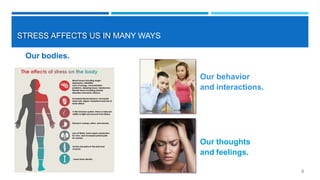
STRESS AFFECTS US IN MANY WAYS
Our thoughts
and feelings.
Our bodies.
Our behavior
and interactions.
Photo
by
®Thinkstock
Photo
by
®Thinkstock
4
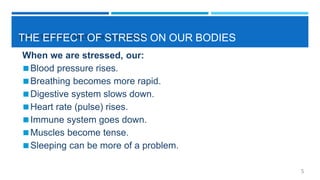
THE EFFECT OF STRESS ON OUR BODIES
When we are stressed, our:
◼Blood pressure rises.
◼Breathing becomes more rapid.
◼Digestive system slows down.
◼Heart rate (pulse) rises.
◼Immune system goes down.
◼Muscles become tense.
◼Sleeping can be more of a problem.
5
Copyright Goodheart-Willcox Co., Inc. May not be posted to a publicly accessible website.
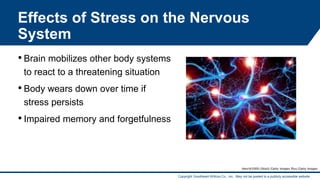
Effects of Stress on the Nervous
System
• Brain mobilizes other body systems
to react to a threatening situation
• Body wears down over time if
stress persists
• Impaired memory and forgetfulness
Henrik5000/iStock/Getty Images Plus/Getty Images
6
Copyright Goodheart-Willcox Co., Inc. May not be posted to a publicly accessible website.
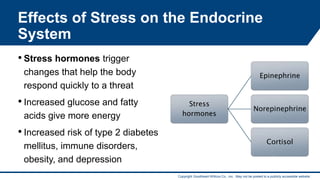
Effects of Stress on the Endocrine
System
• Stress hormones trigger
changes that help the body
respond quickly to a threat
• Increased glucose and fatty
acids give more energy
• Increased risk of type 2 diabetes
mellitus, immune disorders,
obesity, and depression
Stress
hormones
Epinephrine
Norepinephrine
Cortisol
7
Copyright Goodheart-Willcox Co., Inc. May not be posted to a publicly accessible website.
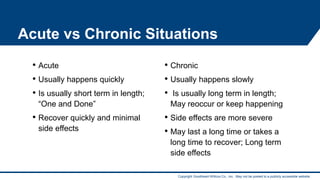
• Chronic
• Usually happens slowly
• Is usually long term in length;
May reoccur or keep happening
• Side effects are more severe
• May last a long time or takes a
long time to recover; Long term
side effects
• Acute
• Usually happens quickly
• Is usually short term in length;
“One and Done”
• Recover quickly and minimal
side effects
Acute vs Chronic Situations
8
Copyright Goodheart-Willcox Co., Inc. May not be posted to a publicly accessible website.
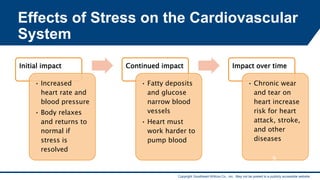
Effects of Stress on the Cardiovascular
System
Initial impact
• Increased
heart rate and
blood pressure
• Body relaxes
and returns to
normal if
stress is
resolved
Continued impact
• Fatty deposits
and glucose
narrow blood
vessels
• Heart must
work harder to
pump blood
Impact over time
• Chronic wear
and tear on
heart increase
risk for heart
attack, stroke,
and other
diseases
9
Copyright Goodheart-Willcox Co., Inc. May not be posted to a publicly accessible website.
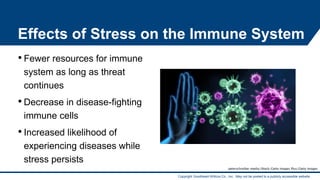
Effects of Stress on the Immune System
• Fewer resources for immune
system as long as threat
continues
• Decrease in disease-fighting
immune cells
• Increased likelihood of
experiencing diseases while
stress persists
peterschreiber.media/iStock/Getty Images Plus/Getty Images
10
Copyright Goodheart-Willcox Co., Inc. May not be posted to a publicly accessible website.
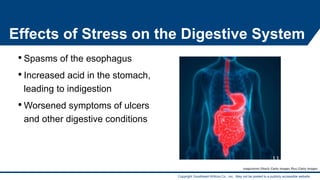
Effects of Stress on the Digestive System
• Spasms of the esophagus
• Increased acid in the stomach,
leading to indigestion
• Worsened symptoms of ulcers
and other digestive conditions
magicmine/iStock/Getty Images Plus/Getty Images
11
Copyright Goodheart-Willcox Co., Inc. May not be posted to a publicly accessible website.
Effects of Stress on the Reproductive
System
• Decreased levels of sex hormones
• Lower levels of sperm in males
• Restricted ovulation in females
• Decreased sexual arousal
• Reduced fertility
• Changes in the menstrual cycle
12
Copyright Goodheart-Willcox Co., Inc. May not be posted to a publicly accessible website.
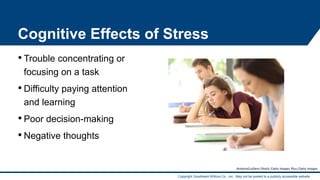
Cognitive Effects of Stress
• Trouble concentrating or
focusing on a task
• Difficulty paying attention
and learning
• Poor decision-making
• Negative thoughts
AntonioGuillem/iStock/Getty Images Plus/Getty Images
13
Copyright Goodheart-Willcox Co., Inc. May not be posted to a publicly accessible website.
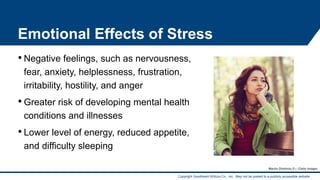
Emotional Effects of Stress
• Negative feelings, such as nervousness,
fear, anxiety, helplessness, frustration,
irritability, hostility, and anger
• Greater risk of developing mental health
conditions and illnesses
• Lower level of energy, reduced appetite,
and difficulty sleeping
Martin Dimitrov/E+/Getty Images
14
Copyright Goodheart-Willcox Co., Inc. May not be posted to a publicly accessible website.
Stress-Related Disorders
• Mental illness that develops as a result of stressful events
• Examples:
• Acute stress disorder
• Begins immediately after the stressful event occurs and lasts from three
days to one month
• Post-traumatic stress disorder (PTSD)
• Characterized by a strong and lingering reaction to extreme stress
15
Copyright Goodheart-Willcox Co., Inc. May not be posted to a publicly accessible website.
Burnout
• State of emotional, physical, and mental exhaustion
• Can lead to significant negative consequences for emotional and
physical health
• Difficulty sleeping
• Negative feelings
• Substance abuse
• Increased risk of developing an illness
• Certain health conditions 16
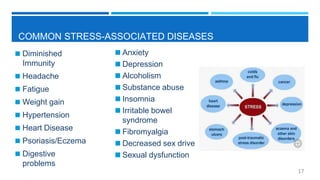
COMMON STRESS-ASSOCIATED DISEASES
◼ Diminished
Immunity
◼ Headache
◼ Fatigue
◼ Weight gain
◼ Hypertension
◼ Heart Disease
◼ Psoriasis/Eczema
◼ Digestive
problems
◼Anxiety
◼Depression
◼Alcoholism
◼Substance abuse
◼Insomnia
◼Irritable bowel
syndrome
◼Fibromyalgia
◼Decreased sex drive
◼Sexual dysfunction
17

HOW DOES STRESS AFFECT YOUR BODY ?

  • 1.
    STRESS MANAGEMENT EMPLOYEE ASSISTANCESERVICE FOR EDUCATION (EASE) LOS ANGELES COUNTY OFFICE OF EDUCATION PRESENTER: Monica Borunda, LMFT, CCTP Revised by Professor McNair 02 /14/2022 DR. EMILY HERNANDEZ, LMFT DIRECTOR 1
  • 2.
    OBJECTIVE ◼Explore the biological,physiological, and social aspects of the human stress response 2
  • 3.
  • 4.
    STRESS AFFECTS USIN MANY WAYS Our thoughts and feelings. Our bodies. Our behavior and interactions. Photo by ®Thinkstock Photo by ®Thinkstock 4
  • 5.
    THE EFFECT OFSTRESS ON OUR BODIES When we are stressed, our: ◼Blood pressure rises. ◼Breathing becomes more rapid. ◼Digestive system slows down. ◼Heart rate (pulse) rises. ◼Immune system goes down. ◼Muscles become tense. ◼Sleeping can be more of a problem. 5
  • 6.
    Copyright Goodheart-Willcox Co.,Inc. May not be posted to a publicly accessible website. Effects of Stress on the Nervous System • Brain mobilizes other body systems to react to a threatening situation • Body wears down over time if stress persists • Impaired memory and forgetfulness Henrik5000/iStock/Getty Images Plus/Getty Images 6
  • 7.
    Copyright Goodheart-Willcox Co.,Inc. May not be posted to a publicly accessible website. Effects of Stress on the Endocrine System • Stress hormones trigger changes that help the body respond quickly to a threat • Increased glucose and fatty acids give more energy • Increased risk of type 2 diabetes mellitus, immune disorders, obesity, and depression Stress hormones Epinephrine Norepinephrine Cortisol 7
  • 8.
    Copyright Goodheart-Willcox Co.,Inc. May not be posted to a publicly accessible website. • Chronic • Usually happens slowly • Is usually long term in length; May reoccur or keep happening • Side effects are more severe • May last a long time or takes a long time to recover; Long term side effects • Acute • Usually happens quickly • Is usually short term in length; “One and Done” • Recover quickly and minimal side effects Acute vs Chronic Situations 8
  • 9.
    Copyright Goodheart-Willcox Co.,Inc. May not be posted to a publicly accessible website. Effects of Stress on the Cardiovascular System Initial impact • Increased heart rate and blood pressure • Body relaxes and returns to normal if stress is resolved Continued impact • Fatty deposits and glucose narrow blood vessels • Heart must work harder to pump blood Impact over time • Chronic wear and tear on heart increase risk for heart attack, stroke, and other diseases 9
  • 10.
    Copyright Goodheart-Willcox Co.,Inc. May not be posted to a publicly accessible website. Effects of Stress on the Immune System • Fewer resources for immune system as long as threat continues • Decrease in disease-fighting immune cells • Increased likelihood of experiencing diseases while stress persists peterschreiber.media/iStock/Getty Images Plus/Getty Images 10
  • 11.
    Copyright Goodheart-Willcox Co.,Inc. May not be posted to a publicly accessible website. Effects of Stress on the Digestive System • Spasms of the esophagus • Increased acid in the stomach, leading to indigestion • Worsened symptoms of ulcers and other digestive conditions magicmine/iStock/Getty Images Plus/Getty Images 11
  • 12.
    Copyright Goodheart-Willcox Co.,Inc. May not be posted to a publicly accessible website. Effects of Stress on the Reproductive System • Decreased levels of sex hormones • Lower levels of sperm in males • Restricted ovulation in females • Decreased sexual arousal • Reduced fertility • Changes in the menstrual cycle 12
  • 13.
    Copyright Goodheart-Willcox Co.,Inc. May not be posted to a publicly accessible website. Cognitive Effects of Stress • Trouble concentrating or focusing on a task • Difficulty paying attention and learning • Poor decision-making • Negative thoughts AntonioGuillem/iStock/Getty Images Plus/Getty Images 13
  • 14.
    Copyright Goodheart-Willcox Co.,Inc. May not be posted to a publicly accessible website. Emotional Effects of Stress • Negative feelings, such as nervousness, fear, anxiety, helplessness, frustration, irritability, hostility, and anger • Greater risk of developing mental health conditions and illnesses • Lower level of energy, reduced appetite, and difficulty sleeping Martin Dimitrov/E+/Getty Images 14
  • 15.
    Copyright Goodheart-Willcox Co.,Inc. May not be posted to a publicly accessible website. Stress-Related Disorders • Mental illness that develops as a result of stressful events • Examples: • Acute stress disorder • Begins immediately after the stressful event occurs and lasts from three days to one month • Post-traumatic stress disorder (PTSD) • Characterized by a strong and lingering reaction to extreme stress 15
  • 16.
    Copyright Goodheart-Willcox Co.,Inc. May not be posted to a publicly accessible website. Burnout • State of emotional, physical, and mental exhaustion • Can lead to significant negative consequences for emotional and physical health • Difficulty sleeping • Negative feelings • Substance abuse • Increased risk of developing an illness • Certain health conditions 16
  • 17.
    COMMON STRESS-ASSOCIATED DISEASES ◼Diminished Immunity ◼ Headache ◼ Fatigue ◼ Weight gain ◼ Hypertension ◼ Heart Disease ◼ Psoriasis/Eczema ◼ Digestive problems ◼Anxiety ◼Depression ◼Alcoholism ◼Substance abuse ◼Insomnia ◼Irritable bowel syndrome ◼Fibromyalgia ◼Decreased sex drive ◼Sexual dysfunction 17