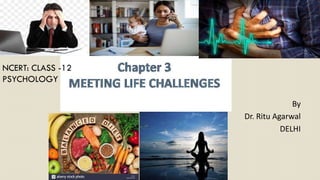
NATURE, TYPES ANDSOURCES OF STRESS
STRESS
“The pattern of responses an organism makes to stimulus event that disturbs the
equilibrium and exceeds a person’s ability to cope”(NCERT, 2017).
Hans selye - “the nonspecific response of the body to any demand”
Forms:
• Eustress: good stress and is one of a person’s best assets for achieving peak
performance and managing minor crises.
• Distress: it is latter manifestation of stress that causes our body’s wear and tear.
2
3.
Nature of Stress
•Latin words
• ‘strictus’, meaning tight or narrow
• ‘stringere’, the verb meaning to tighten
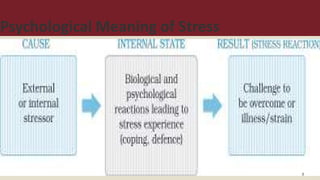
• Stressors are events that cause our body to give the stress response.
• The reaction to external stressors is called ‘strain’
3
4.
Nature of Stress
Hansselye - “the nonspecific response of the body to any demand”
• regardless of the cause of the threat, the individual will respond with the same
physiological pattern of reactions.
• Different stressors may produce somewhat different patterns of stress reaction, and
different individuals may have different characteristic modes of response.
• Stress is a dynamic mental/cognitive state.
• a disruption in homeostasis or an imbalance that gives rise to a requirement for
resolution of that imbalance or restoration of homeostasis.
4
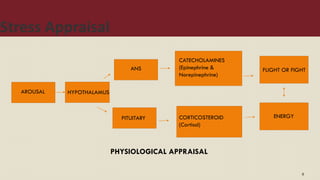
Perception of stress
COGNITIVEMODEL OF STRESS BY LAZARUS AND HIS COLLEAGUES
• The perception of stress is dependent upon the individual’s cognitive appraisal of events and
the resources available to deal with them.
• Lazarus has distinguished between two types of appraisal:
• Primary- refers to the perception of a new or changing environment as positive, neutral or negative in its
consequences.
• Negative events are appraised for their possible harm, threat or challenge.
(Harm is the assessment of the damage that was has already been done by an event
Threat is the assessment of possible future damage that may be brought about by the event
Challenge appraisals are associated with more confident expectations of the ability to cope with stressful event,
the potential to overcome and even profit from the event.)
• Secondary-When we perceive an event as stressful, we assess of our coping abilities and resources and
whether they will be sufficient to meet the harm, threat or challenge of the event.
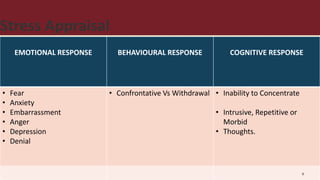
• This two-level appraisal process determines not only our cognitive and behavioural responses but also our
emotional and physiological responses to external events. These are subjective and depends on many factors past
experiences are one of them. 6
Stress Appraisal
EMOTIONAL RESPONSEBEHAVIOURAL RESPONSE COGNITIVE RESPONSE
• Fear
• Anxiety
• Embarrassment
• Anger
• Depression
• Denial
• Confrontative Vs Withdrawal • Inability to Concentrate
• Intrusive, Repetitive or
Morbid
• Thoughts.
9
10.
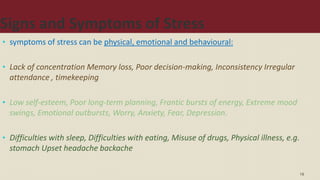
Signs and Symptomsof Stress
• symptoms of stress can be physical, emotional and behavioural:
• Lack of concentration Memory loss, Poor decision-making, Inconsistency Irregular
attendance , timekeeping
• Low self-esteem, Poor long-term planning, Frantic bursts of energy, Extreme mood
swings, Emotional outbursts, Worry, Anxiety, Fear, Depression.
• Difficulties with sleep, Difficulties with eating, Misuse of drugs, Physical illness, e.g.
stomach Upset headache backache
10
11.
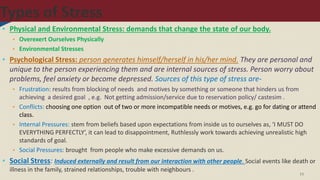
Types of Stress
•Physical and Environmental Stress: demands that change the state of our body.
• Overexert Ourselves Physically
• Environmental Stresses
• Psychological Stress: person generates himself/herself in his/her mind. They are personal and
unique to the person experiencing them and are internal sources of stress. Person worry about
problems, feel anxiety or become depressed. Sources of this type of stress are-
• Frustration: results from blocking of needs and motives by something or someone that hinders us from
achieving a desired goal , e.g. Not getting admission/service due to reservation policy/ castesim .
• Conflicts: choosing one option out of two or more incompatible needs or motives, e.g. go for dating or attend
class.
• Internal Pressures: stem from beliefs based upon expectations from inside us to ourselves as, ‘I MUST DO
EVERYTHING PERFECTLY’, it can lead to disappointment, Ruthlessly work towards achieving unrealistic high
standards of goal.
• Social Pressures: brought from people who make excessive demands on us.
• Social Stress: Induced externally and result from our interaction with other people. Social events like death or
illness in the family, strained relationships, trouble with neighbours .
11
12.
Sources of Stress
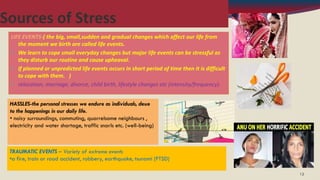
LIFEEVENTS-( the big, small,sudden and gradual changes which affect our life from
the moment we birth are called life events.
• We learn to cope small everyday changes but major life events can be stressful as
they disturb our routine and cause upheaval.
• If planned or unpredicted life events occurs in short period of time then it is difficult
to cope with them. )
• relocation, marriage, divorce, child birth, lifestyle changes etc (intensity/frequency).
12
HASSLES-the personal stresses we endure as individuals, deue
to the happenings in our daily life.
• noisy surroundings, commuting, quarrelsome neighbours ,
electricity and water shortage, traffic snarls etc. (well-being)
TRAUMATIC EVENTS – Variety of extreme events
•a fire, train or road accident, robbery, earthquake, tsunami (PTSD)
13.
EFFECTS OF STRESS
•Emotional Effects- mood swings, erratic behavior, vicious circle of decreasing
confidence, anxiety and depression, increased physical, tension, increased
psychological tension.
• Physiological Effects- adrenaline and cortisol, extremely damaging to the body in the
long-term effects, slowing down of the digestive system, expansion of air passages in
the lungs, increased heart rate, and constriction of blood vessels.
• Cognitive Effects- mental overload, irrational decisions, poor concentration, and
reduced short- term, memory capacity.
• Behavioural Effects- eating less nutritional food, increasing intake of stimulant such as
caffeine, excessive consumption of cigarettes, alcohol and other drugs such as
tranquillizers, disrupted sleep patterns, increased absenteeism, and reduced work
performance.
13
14.
Stress and Health
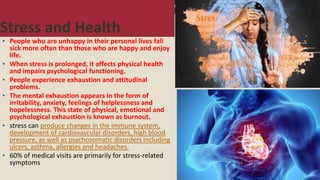
•People who are unhappy in their personal lives fall
sick more often than those who are happy and enjoy
life.
• When stress is prolonged, it affects physical health
and impairs psychological functioning.
• People experience exhaustion and attitudinal
problems.
• The mental exhaustion appears in the form of
irritability, anxiety, feelings of helplessness and
hopelessness. This state of physical, emotional and
psychological exhaustion is known as burnout.
• stress can produce changes in the immune system,
development of cardiovascular disorders, high blood
pressure, as well as psychosomatic disorders including
ulcers, asthma, allergies and headaches.
• 60% of medical visits are primarily for stress-related
symptoms
14
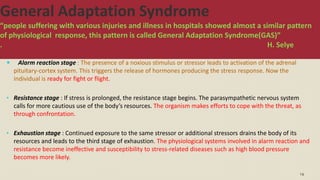
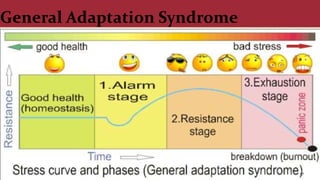
General Adaptation Syndrome
“peoplesuffering with various injuries and illness in hospitals showed almost a similar pattern
of physiological response, this pattern is called General Adaptation Syndrome(GAS)”
. H. Selye
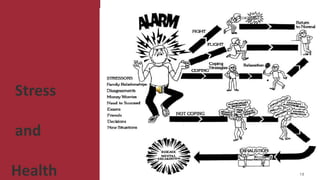
Alarm reaction stage : The presence of a noxious stimulus or stressor leads to activation of the adrenal
pituitary-cortex system. This triggers the release of hormones producing the stress response. Now the
individual is ready for fight or flight.
• Resistance stage : If stress is prolonged, the resistance stage begins. The parasympathetic nervous system
calls for more cautious use of the body’s resources. The organism makes efforts to cope with the threat, as
through confrontation.
• Exhaustion stage : Continued exposure to the same stressor or additional stressors drains the body of its
resources and leads to the third stage of exhaustion. The physiological systems involved in alarm reaction and
resistance become ineffective and susceptibility to stress-related diseases such as high blood pressure
becomes more likely.
16
Stress and theImmune System
• The immune system guards the body against attackers, both from
within and outside.
• Psychoneuroimmunology focuses on the links between the mind,
the brain and the immune system.
• The white blood cells (leucocytes) within the immune system
identify and destroy foreign bodies (antigens) such as viruses.
• It also leads to the production of antibodies.
• T cells, B cells and natural killer cells are the different kind of
leucocytes.
• T cells destroy invaders, and increase immunological activity.
18
19.
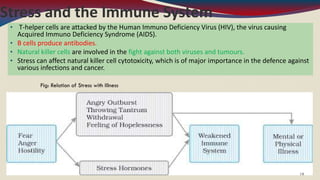
Stress and theImmune System
• T-helper cells are attacked by the Human Immuno Deficiency Virus (HIV), the virus causing
Acquired Immuno Deficiency Syndrome (AIDS).
• B cells produce antibodies.
• Natural killer cells are involved in the fight against both viruses and tumours.
• Stress can affect natural killer cell cytotoxicity, which is of major importance in the defence against
various infections and cancer.
19
Fig: Relation of Stress with Illness
20.
Examination Anxiety
• involvesfeelings of tension or uneasiness that occur before, during, or after an examination
• Examination stress has been characterized as “evaluative apprehension” or “evaluative
stress” and produces debilitating behavioural, cognitive, and physiological effects no
different from those produced by any other stressor.
• intense emotional reactions, negative thoughts about themselves, feelings of inadequacy,
helplessness, and loss of status and esteem that impair their performance.
• While preparing for examinations:
• one must spend enough time for study
• overview and weigh one’s strengths and weaknesses
• discuss difficulties with teachers and classmates
• plan a revision timetable
• condense notes
• space out revision periods
• most importantly on the examination day concentrate on staying calm.
20
21.
Lifestyle
Stressed individuals maybe-
• more likely to expose themselves to pathogens, which are agents causing physical
illness.
• have poor nutritional habits, sleep less and are likely to engage in other health
risking behaviours like smoking and alcohol abuse.
• Such health impairing behaviours develop gradually and are accompanied by
pleasant experiences temporarily.
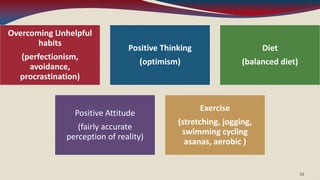
Health promoting behaviour like balanced diet, regular exercise, family support, etc.
play an important role in good health.
• Adhering to a lifestyle that includes balanced low fat diet, regular exercise and
continued activity along with positive thinking enhances health and longevity.
21
22.
• The waywe cope with stress often depends on rigid deep-seated beliefs, based
on experience, e.g. when caught in a traffic jam we feel angry, because we
believe that the traffic ‘should’ move faster.
• To manage stress we often need to reassess the way we think and learn coping
strategies.
The three coping strategies given by ENDLER and PARKER are- TEA
1.TASK- ORIENTED
2.EMOTION -ORIENTED
3.AVOIDANCE -ORIENTED
22
23.
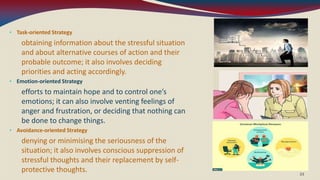
• Task-oriented Strategy
obtaininginformation about the stressful situation
and about alternative courses of action and their
probable outcome; it also involves deciding
priorities and acting accordingly.
• Emotion-oriented Strategy
efforts to maintain hope and to control one’s
emotions; it can also involve venting feelings of
anger and frustration, or deciding that nothing can
be done to change things.
• Avoidance-oriented Strategy
denying or minimising the seriousness of the
situation; it also involves conscious suppression of
stressful thoughts and their replacement by self-
protective thoughts. 23
24.
COPING WITH STRESS
Lazarusand Folkman
• Coping refers to constantly changing cognitive and behavioural efforts to
master, reduce or tolerate the internal or external demands that are created
by the stressful transaction.
• Coping serves to allow the individual to manage or alter a problem and
regulate the emotional response to that problem.
• problem-focused “I made a plan of action and followed it”.
• emotion focused “I did some things to let it out of my system”.
24
Stress Management Techniques
27
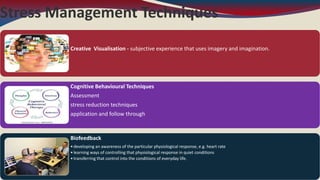
CreativeVisualisation - subjective experience that uses imagery and imagination.
Cognitive Behavioural Techniques
Assessment
stress reduction techniques
application and follow through
Biofeedback
•developing an awareness of the particular physiological response, e.g. heart rate
•learning ways of controlling that physiological response in quiet conditions
•transferring that control into the conditions of everyday life.
28.
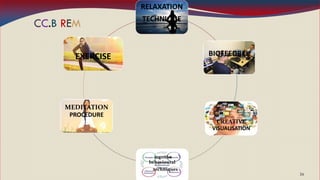
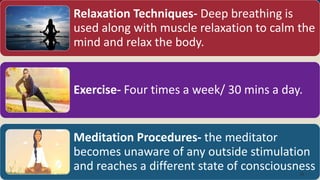
Relaxation Techniques- Deepbreathing is
used along with muscle relaxation to calm the
mind and relax the body.
Exercise- Four times a week/ 30 mins a day.
Meditation Procedures- the meditator
becomes unaware of any outside stimulation
and reaches a different state of consciousness
28
29.
PROMOTION POSITVE HEALTHAND WELL-
BEING
1. STRESS RESISTANT PERSONALITY(KOBASA)
PERSONALITY TRAIT OF HARDINESS(set of beliefs about oneself, the world and how they
interact)
CONSISTS -3 Cs
Commitment( to work, family, hobbies and social life, see changes in life as normal and
positive rather than as a threat.)
Control( sense of control over our life)
Challenge(feeling of challenge)
29
30.
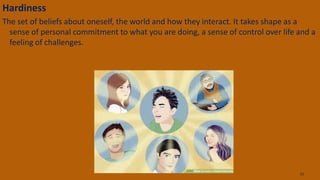
Hardiness
The set ofbeliefs about oneself, the world and how they interact. It takes shape as a
sense of personal commitment to what you are doing, a sense of control over life and a
feeling of challenges.
30
31.
PROMOTING POSITIVE HEALTHAND WELL-BEING
31
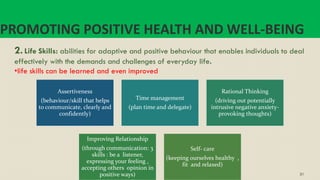
2.Life Skills: abilities for adaptive and positive behaviour that enables individuals to deal
effectively with the demands and challenges of everyday life.
•life skills can be learned and even improved
Assertiveness
(behaviour/skill that helps
to communicate, clearly and
confidently)
Time management
(plan time and delegate)
Rational Thinking
(driving out potentially
intrusive negative anxiety-
provoking thoughts)
Improving Relationship
(through communication: 3
skills : be a listener,
expressing your feeling ,
accepting others opinion in
positive ways)
Self- care
(keeping ourselves healthy ,
fit and relaxed)
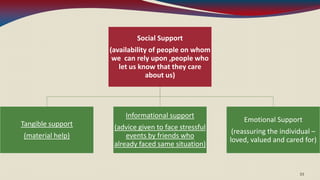
Social Support
(availability ofpeople on whom
we can rely upon ,people who
let us know that they care
about us)
Tangible support
(material help)
Informational support
(advice given to face stressful
events by friends who
already faced same situation)
Emotional Support
(reassuring the individual –
loved, valued and cared for)
33
 Most read
 Most read