Value-Added Process Engineering February 2011 Helen Housch NASA MSFC [email_address] Sally Godfrey NASA GSFC [email_address]
Agenda Agency Process Requirements 7 Software Engineering Processes  Purpose, Benefits, and Experiences Honorable Mention February 2011
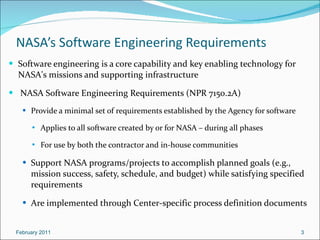
NASA’s Software Engineering Requirements Software engineering is a core capability and key enabling technology for NASA's missions and supporting infrastructure NASA Software Engineering Requirements (NPR 7150.2A) Provide a minimal set of requirements established by the Agency for software Applies to all software created by or for NASA – during all phases For use by both the contractor and in-house communities  Support NASA programs/projects to accomplish planned goals (e.g., mission success, safety, schedule, and budget) while satisfying specified requirements Are implemented through Center-specific process definition documents February 2011
NPR 7150.2A  CMMI Requirement [SWE-032] The project shall ensure that software is acquired, developed and maintained by an organization with a non-expired Capability Maturity Model Integration® for Development (CMMI-DEV) rating  as measured by a Software Engineering Institute (SEI) authorized lead appraiser as follows: For Class A software:  CMMI-DEV Maturity Level 3 Rating or higher for software, or CMMI-DEV Capability Level 3 Rating or higher in all CMMI-DEV Maturity Level 2 and Maturity Level 3 process areas for software.  For Class B software:  CMMI-DEV Maturity Level 2 Rating or higher for software, or CMMI-DEV Capability Level 2 Rating or higher for all Maturity Level 2 process areas. For Class C software:  The required CMMI-DEV Maturity Level for Class C software will be defined per Center or project requirements. February 2011
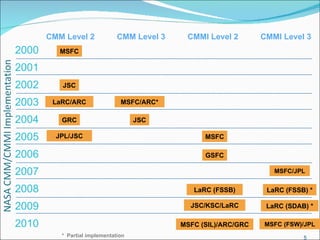
2000 CMMI Level 3 CMM Level 2 MSFC LaRC/ARC GRC JPL/JSC CMMI Level 2 CMM Level 3 MSFC/JPL LaRC (FSSB) * JSC/KSC/LaRC MSFC (SIL)/ARC/GRC GSFC *  Partial implementation MSFC (FSW)/JPL JSC LaRC (FSSB) LaRC (SDAB) * MSFC/ARC* MSFC 2001 2002 2003 2004 2005 2006 2007 2008 2009 2010 JSC
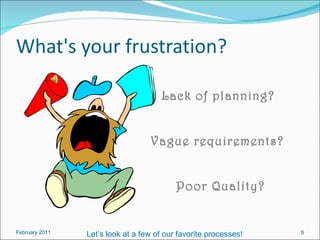
What's your frustration?  February 2011 Vague requirements? Lack of planning? Poor Quality? Let’s look at a few of our favorite processes!
# 7 Product Integration Product integration is the assembly of software components to ensure correct product functionality  Product integration is: a highly critical and non-trivial part of the development frequently overlooked during planning phase Critical elements of product integration include: defining and implementing the integration environment management of interfaces component integration sequences communication between stakeholders  For software systems, integration is typically the first opportunity to observe implementation results February 2011
# 7 Product Integration  Benefits Exposes and drives out defects prior to formal testing Reduces costs for error correction and re-testing Can reduce the length of formal testing (fewer error corrections necessary) Last opportunity to create new functionality before formal test begins Encourages well-defined interfaces and components for easier inspection, integration, and automation Increases the probability for high quality products and timely deliveries to verification and validation activities February 2011
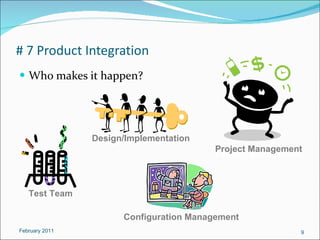
# 7 Product Integration  Who makes it happen? February 2011 Design/Implementation Design/Implementation Test Team Test Team Project Management Project Management Configuration Management Configuration Management
# 6 Configuration Management Configuration Management (CM) establishes and maintains the integrity of specified work products Typically the most misunderstood and under appreciated process Fundamental CM involves … Identifying configuration items  Controlling changes to configuration items Establishing a CM system that supports control objectives Sustaining integrity of baseline products Maintaining accurate status of configuration data February 2011
# 6 Configuration Management Benefits Baselines provide a stable foundation for continuing evolution of specified work products Build Variance Detection Knowing the last known good build, changes can be effectively detected and examined or rolling back to the last known good configuration can be achieved  Effective Change Management Knowing the configuration of a given CI saves time that would be spent figuring out the configuration versus being able to immediately engineer the change in the known configuration  February 2011
# 6 Configuration Management Benefits (cont’d) Enhanced Ability to Rebuild If a CI fails or is involved in a disaster, it is far easier to rebuild if the final production build of the CI is known Assists with Cost/Schedule Estimating Understanding what software goes into a given CI allows for proper costing to serve as an input to planning and estimating process February 2011
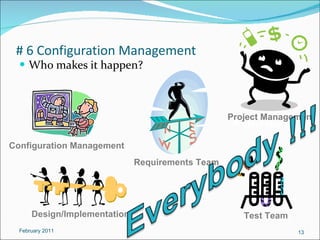
# 6 Configuration Management Who makes it happen? February 2011 Test Team Test Team Project Management Project Management Configuration Management Configuration Management Requirements Team Requirements Team Design/Implementation Design/Implementation
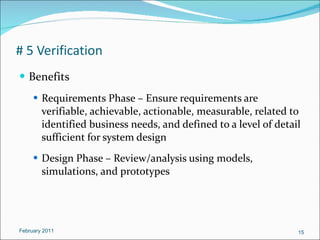
# 5 Verification Software verification is a broad and complex software engineering discipline  that ensures transitional and final work products adhere to their specified requirements Growth in complexity of designs increases the importance of formal verification techniques Key concepts include … Select verification work products Establish verification environment/procedures/criteria Perform verification February 2011
# 5 Verification Benefits Requirements Phase – Ensure requirements are verifiable, achievable, actionable, measurable, related to identified business needs, and defined to a level of detail sufficient for system design Design Phase – Review/analysis using models, simulations, and prototypes February 2011
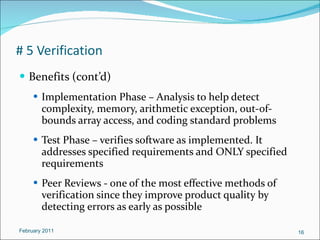
# 5 Verification Benefits (cont’d) Implementation Phase – Analysis to help detect complexity, memory, arithmetic exception, out-of-bounds array access, and coding standard problems Test Phase – verifies software as implemented. It addresses specified requirements and ONLY specified requirements Peer Reviews - one of the most effective methods of verification since they improve product quality by detecting errors as early as possible February 2011
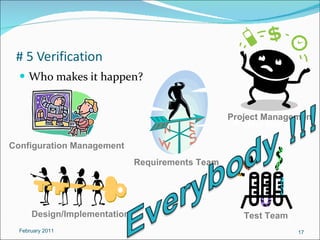
# 5 Verification Who makes it happen? February 2011 Test Team Test Team Project Management Project Management Configuration Management Configuration Management Requirements Team Requirements Team Design/Implementation Design/Implementation
# 4 Software Assurance  Product assurance provides management and staff an objective evaluation of organizational processes and associated work products Key concepts include … Objectively evaluate processes/products against specified standards Document non-compliance issues and provide feedback to management and staff Ensure non-compliances are addressed February 2011
# 4 Software Assurance Benefits Product assurance provides insight into process implementation as compared to process definition Identifies process improvement opportunities Monitors process implementation effectiveness Ensures critical work products align with specified standards in support of customer/contract requirements Provides management with visibility into process effectiveness and product quality February 2011
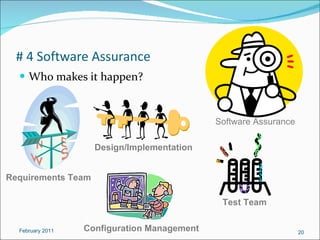
# 4 Software Assurance Who makes it happen? February 2011 Software Assurance Requirements Team Requirements Team Design/Implementation Design/Implementation Configuration Management Configuration Management Test Team Test Team
# 3 Measurement and Analysis Measurement and analysis defines and maintains a measurement capability that supports management information needs as they relate to mission objectives Key concepts include … Identify mission objectives Derive measures from mission objectives  Select analysis techniques Define data collection, storage, and reporting mechanism February 2011
# 3 Measurement and Analysis Benefits Provides quantitative determination of how well you are doing relative to mission objectives, other projects, the past, and/or the plan Provides a mechanism to monitor selected aspects of a project to provide timely information for management decision making Improves communication  Encourages appropriate behavior  Pinpoints opportunities for improvement  February 2011
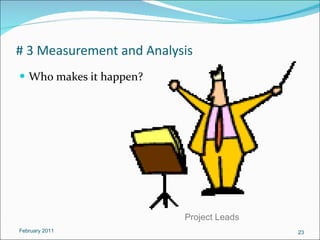
# 3 Measurement and Analysis Who makes it happen? February 2011 Project Leads
# 2 Requirements Management Requirements management documents and verifies requirements and requirements changes that meet customer expectations Key concepts include … Understand operational concepts and system-level requirements Establish and manage changes to detailed software requirements Maintain bi-directional traceability Identify inconsistencies between requirements and work products February 2011
# 2 Requirements Management Benefits Encourages development of high-quality requirements and elicitation of requirements from customers Bi-directional traceability enables close evaluation to eliminate lower level requirements that do not support mission requirements Allows detailed requirements definition and tracking to ensure product completeness Enables requirements change management to ensure product lifecycle integrity Helps avoid requirement creep February 2011
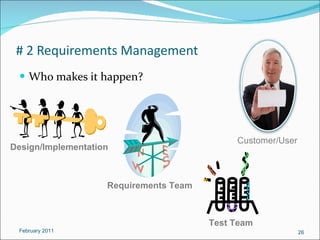
# 2 Requirements Management Who makes it happen? February 2011 Customer/User Design/Implementation Test Team Requirements Team Requirements Team
# 1 Planning & Monitoring Project planning defines and documents the necessary project activities so that they may be monitored to ensure deviations are recognized soon enough to take corrective actions  Key concepts include … Develop and maintain the project plan/schedule Establish work product and task estimates Define communication and monitoring methods Conduct milestone/progress reviews February 2011
# 1 Planning & Monitoring Key concepts (cont’d) Obtain commitment to the plan Monitor against the plan Estimates  Commitments Risks Stakeholder involvement Take corrective actions when necessary February 2011
# 1 Planning & Monitoring Benefits Ensures timely determination of cost/schedule impacts Allows standardization and quantifying of project goals Enables tracking of project schedule milestones Provides insight into technical/cost risk management Identifies stakeholder participation issues Tracks/controls corrective actions to closure Monitors management of project data February 2011
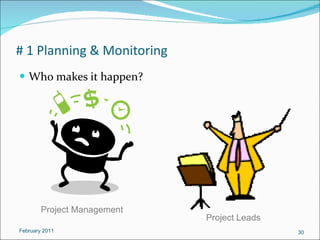
# 1 Planning & Monitoring Who makes it happen? February 2011 Project Management Project Leads
Honorable Mention Keys to keep all these processes working well… Sponsorship (management support) Stress the importance of  maintaining good processes Ensure that adequate resources are available to support processes Standardization of processes Have a library of process assets --process descriptions, tools, templates, lessons learned  Use a measurement repository to capture organizational “norms”, improve cost estimation and gauge success of improvements Develop tailoring guidelines to make processes reasonable for all types of projects February 2011
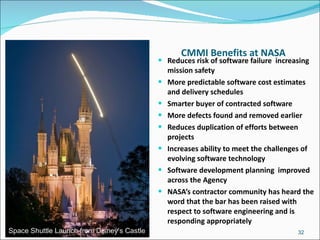
CMMI Benefits at NASA Reduces risk of software failure  increasing mission safety More predictable software cost estimates and delivery schedules Smarter buyer of contracted software More defects found and removed earlier Reduces duplication of efforts between projects Increases ability to meet the challenges of evolving software technology Software development planning  improved across the Agency NASA’s contractor community has heard the word that the bar has been raised with respect to software engineering and is responding appropriately February 2011 Space Shuttle Launch from Disney’s Castle
Enjoy the journey! February 2011

Housch

  • 1.
    Value-Added Process EngineeringFebruary 2011 Helen Housch NASA MSFC [email_address] Sally Godfrey NASA GSFC [email_address]
  • 2.
    Agenda Agency ProcessRequirements 7 Software Engineering Processes Purpose, Benefits, and Experiences Honorable Mention February 2011
  • 3.
    NASA’s Software EngineeringRequirements Software engineering is a core capability and key enabling technology for NASA's missions and supporting infrastructure NASA Software Engineering Requirements (NPR 7150.2A) Provide a minimal set of requirements established by the Agency for software Applies to all software created by or for NASA – during all phases For use by both the contractor and in-house communities Support NASA programs/projects to accomplish planned goals (e.g., mission success, safety, schedule, and budget) while satisfying specified requirements Are implemented through Center-specific process definition documents February 2011
  • 4.
    NPR 7150.2A CMMI Requirement [SWE-032] The project shall ensure that software is acquired, developed and maintained by an organization with a non-expired Capability Maturity Model Integration® for Development (CMMI-DEV) rating as measured by a Software Engineering Institute (SEI) authorized lead appraiser as follows: For Class A software: CMMI-DEV Maturity Level 3 Rating or higher for software, or CMMI-DEV Capability Level 3 Rating or higher in all CMMI-DEV Maturity Level 2 and Maturity Level 3 process areas for software. For Class B software: CMMI-DEV Maturity Level 2 Rating or higher for software, or CMMI-DEV Capability Level 2 Rating or higher for all Maturity Level 2 process areas. For Class C software: The required CMMI-DEV Maturity Level for Class C software will be defined per Center or project requirements. February 2011
  • 5.
    2000 CMMI Level3 CMM Level 2 MSFC LaRC/ARC GRC JPL/JSC CMMI Level 2 CMM Level 3 MSFC/JPL LaRC (FSSB) * JSC/KSC/LaRC MSFC (SIL)/ARC/GRC GSFC * Partial implementation MSFC (FSW)/JPL JSC LaRC (FSSB) LaRC (SDAB) * MSFC/ARC* MSFC 2001 2002 2003 2004 2005 2006 2007 2008 2009 2010 JSC
  • 6.
    What's your frustration? February 2011 Vague requirements? Lack of planning? Poor Quality? Let’s look at a few of our favorite processes!
  • 7.
    # 7 ProductIntegration Product integration is the assembly of software components to ensure correct product functionality Product integration is: a highly critical and non-trivial part of the development frequently overlooked during planning phase Critical elements of product integration include: defining and implementing the integration environment management of interfaces component integration sequences communication between stakeholders For software systems, integration is typically the first opportunity to observe implementation results February 2011
  • 8.
    # 7 ProductIntegration Benefits Exposes and drives out defects prior to formal testing Reduces costs for error correction and re-testing Can reduce the length of formal testing (fewer error corrections necessary) Last opportunity to create new functionality before formal test begins Encourages well-defined interfaces and components for easier inspection, integration, and automation Increases the probability for high quality products and timely deliveries to verification and validation activities February 2011
  • 9.
    # 7 ProductIntegration Who makes it happen? February 2011 Design/Implementation Design/Implementation Test Team Test Team Project Management Project Management Configuration Management Configuration Management
  • 10.
    # 6 ConfigurationManagement Configuration Management (CM) establishes and maintains the integrity of specified work products Typically the most misunderstood and under appreciated process Fundamental CM involves … Identifying configuration items Controlling changes to configuration items Establishing a CM system that supports control objectives Sustaining integrity of baseline products Maintaining accurate status of configuration data February 2011
  • 11.
    # 6 ConfigurationManagement Benefits Baselines provide a stable foundation for continuing evolution of specified work products Build Variance Detection Knowing the last known good build, changes can be effectively detected and examined or rolling back to the last known good configuration can be achieved Effective Change Management Knowing the configuration of a given CI saves time that would be spent figuring out the configuration versus being able to immediately engineer the change in the known configuration February 2011
  • 12.
    # 6 ConfigurationManagement Benefits (cont’d) Enhanced Ability to Rebuild If a CI fails or is involved in a disaster, it is far easier to rebuild if the final production build of the CI is known Assists with Cost/Schedule Estimating Understanding what software goes into a given CI allows for proper costing to serve as an input to planning and estimating process February 2011
  • 13.
    # 6 ConfigurationManagement Who makes it happen? February 2011 Test Team Test Team Project Management Project Management Configuration Management Configuration Management Requirements Team Requirements Team Design/Implementation Design/Implementation
  • 14.
    # 5 VerificationSoftware verification is a broad and complex software engineering discipline that ensures transitional and final work products adhere to their specified requirements Growth in complexity of designs increases the importance of formal verification techniques Key concepts include … Select verification work products Establish verification environment/procedures/criteria Perform verification February 2011
  • 15.
    # 5 VerificationBenefits Requirements Phase – Ensure requirements are verifiable, achievable, actionable, measurable, related to identified business needs, and defined to a level of detail sufficient for system design Design Phase – Review/analysis using models, simulations, and prototypes February 2011
  • 16.
    # 5 VerificationBenefits (cont’d) Implementation Phase – Analysis to help detect complexity, memory, arithmetic exception, out-of-bounds array access, and coding standard problems Test Phase – verifies software as implemented. It addresses specified requirements and ONLY specified requirements Peer Reviews - one of the most effective methods of verification since they improve product quality by detecting errors as early as possible February 2011
  • 17.
    # 5 VerificationWho makes it happen? February 2011 Test Team Test Team Project Management Project Management Configuration Management Configuration Management Requirements Team Requirements Team Design/Implementation Design/Implementation
  • 18.
    # 4 SoftwareAssurance Product assurance provides management and staff an objective evaluation of organizational processes and associated work products Key concepts include … Objectively evaluate processes/products against specified standards Document non-compliance issues and provide feedback to management and staff Ensure non-compliances are addressed February 2011
  • 19.
    # 4 SoftwareAssurance Benefits Product assurance provides insight into process implementation as compared to process definition Identifies process improvement opportunities Monitors process implementation effectiveness Ensures critical work products align with specified standards in support of customer/contract requirements Provides management with visibility into process effectiveness and product quality February 2011
  • 20.
    # 4 SoftwareAssurance Who makes it happen? February 2011 Software Assurance Requirements Team Requirements Team Design/Implementation Design/Implementation Configuration Management Configuration Management Test Team Test Team
  • 21.
    # 3 Measurementand Analysis Measurement and analysis defines and maintains a measurement capability that supports management information needs as they relate to mission objectives Key concepts include … Identify mission objectives Derive measures from mission objectives Select analysis techniques Define data collection, storage, and reporting mechanism February 2011
  • 22.
    # 3 Measurementand Analysis Benefits Provides quantitative determination of how well you are doing relative to mission objectives, other projects, the past, and/or the plan Provides a mechanism to monitor selected aspects of a project to provide timely information for management decision making Improves communication Encourages appropriate behavior Pinpoints opportunities for improvement February 2011
  • 23.
    # 3 Measurementand Analysis Who makes it happen? February 2011 Project Leads
  • 24.
    # 2 RequirementsManagement Requirements management documents and verifies requirements and requirements changes that meet customer expectations Key concepts include … Understand operational concepts and system-level requirements Establish and manage changes to detailed software requirements Maintain bi-directional traceability Identify inconsistencies between requirements and work products February 2011
  • 25.
    # 2 RequirementsManagement Benefits Encourages development of high-quality requirements and elicitation of requirements from customers Bi-directional traceability enables close evaluation to eliminate lower level requirements that do not support mission requirements Allows detailed requirements definition and tracking to ensure product completeness Enables requirements change management to ensure product lifecycle integrity Helps avoid requirement creep February 2011
  • 26.
    # 2 RequirementsManagement Who makes it happen? February 2011 Customer/User Design/Implementation Test Team Requirements Team Requirements Team
  • 27.
    # 1 Planning& Monitoring Project planning defines and documents the necessary project activities so that they may be monitored to ensure deviations are recognized soon enough to take corrective actions Key concepts include … Develop and maintain the project plan/schedule Establish work product and task estimates Define communication and monitoring methods Conduct milestone/progress reviews February 2011
  • 28.
    # 1 Planning& Monitoring Key concepts (cont’d) Obtain commitment to the plan Monitor against the plan Estimates Commitments Risks Stakeholder involvement Take corrective actions when necessary February 2011
  • 29.
    # 1 Planning& Monitoring Benefits Ensures timely determination of cost/schedule impacts Allows standardization and quantifying of project goals Enables tracking of project schedule milestones Provides insight into technical/cost risk management Identifies stakeholder participation issues Tracks/controls corrective actions to closure Monitors management of project data February 2011
  • 30.
    # 1 Planning& Monitoring Who makes it happen? February 2011 Project Management Project Leads
  • 31.
    Honorable Mention Keysto keep all these processes working well… Sponsorship (management support) Stress the importance of maintaining good processes Ensure that adequate resources are available to support processes Standardization of processes Have a library of process assets --process descriptions, tools, templates, lessons learned Use a measurement repository to capture organizational “norms”, improve cost estimation and gauge success of improvements Develop tailoring guidelines to make processes reasonable for all types of projects February 2011
  • 32.
    CMMI Benefits atNASA Reduces risk of software failure increasing mission safety More predictable software cost estimates and delivery schedules Smarter buyer of contracted software More defects found and removed earlier Reduces duplication of efforts between projects Increases ability to meet the challenges of evolving software technology Software development planning improved across the Agency NASA’s contractor community has heard the word that the bar has been raised with respect to software engineering and is responding appropriately February 2011 Space Shuttle Launch from Disney’s Castle
  • 33.
    Enjoy the journey!February 2011

Editor's Notes

  • #4 NPR covers: acquisition, management , development, operations, maintenance, and retirement