Headquarters
Independent Program & Cost Evaluation


                             State-of-the-Art
                                    in
                      Independent Review Execution


                        Tahani Amer and Kaiser Adeni
                             Review Managers
                   Independent Program Assessment Office

                               8th Annual 2011 NASA Program Management Challenge

                                               February 10, 2011
Outline
Headquarters
Independent Program and Cost Evaluation


                •       Look Back at FY10 Reviews
                •       Review Process Improvements
                •       SRB Balance & Structure
                •       SRB Members Roles & Responsibilities
                •       SRB Coordination (between Mission Directorates,
                        Centers, and Programs/projects (P/p))
                •       SRB Products
                •       SRB – HB updates
                •       IPAO State-of-the-Art Activities
                •       Look Forward


                                                                          2
Look Back at FY10 Reviews
Headquarters
Independent Program and Cost Evaluation


•     8 Programs and 20 project review activities executed in FY10:
              Preliminary Design Review: MAVEN
              Critical Design Reviews: GRAIL, RBSP, GPM, TDRS, LDCM, MMS,
               OCO-II
              System Integration Reviews: MSL, GRAIL and Juno
              ORR/FRR/PLAR: WISE
              Program Approval Review: RPS and LQP
              Program Implementation Review: SCaN, ESMP, D/NF
              Special Reviews: MSL, CxP, Aquarius, SOFIA
              8 Non-IPAO reviews: 2- GOES-R, ASP, AvSP, ATP, FAP, ENAS, CAS


                                                                          3
FY10 Completed Reviews
Headquarters
Independent Program and Cost Evaluation


                                                                   4
FY10 Completed Reviews
Headquarters
Independent Program and Cost Evaluation


                                                                   5
FY10 IPAO Completed Reviews
                                          IPAO supported 8 non-IPAO review activities in FY10
Headquarters
Independent Program and Cost Evaluation


                                                                                                6
Review Process Improvements
Headquarters
Independent Program and Cost Evaluation


       •      SRB process improvements:
               •      Quick Look Reports (one-pagers);
               •      30-day reporting requirement;
               •      Increased coordination for programmatic assessments;
               •      Readiness-to-proceed assessments;
               •      Alternate opinions for non-consensus boards;
               •      Key Decision Point (KDP) Decision Memo improvements;
               •      Deferral of program reviews approved at APMC;
               •      Institutionalized electronic signature of SRB approval letters;
               •      Streamlining of ToR content as defined in draft NPR
                      7120.5E;


                                                                                   7
Review Process Improvements
Headquarters
Independent Program and Cost Evaluation


       •      SRB process improvements (continued):
               •      Better coordination of SRB team nomination process; early
                      stakeholders involvement in the process to ensure proper
                      team balance of competency/currency/independence;
               •      Final reports are posted on APMC electronic repository
                      (https://nx.arc.nasa.gov/nx/dsweb/View/Collection-93608); notification at
                      APMC when reports are posted;
               •      Strengthening and improving the rigor and integration of the
                      technical and programmatic assessments;
               •      Working with SMD and the Centers to formulate principles on
                      conducting joint Program/project reviews when there is a
                      significant external partner involved. Efforts are evolving
                      w/ExoMars and JPSS.

                                                                                            8
SRB Balance & Structure
Headquarters
Independent Program and Cost Evaluation


         •      SRB members should be competent, current, and
                independent from the management or advocacy chain of
                the P/p, with membership balanced between the host
                Center and other organizations to ensure the needs of
                the convening authorities are met.
         •      Although balance of each SRB member is important,
                ultimately the goal is to have the SRB, as a whole,
                balanced.
         •      More inclusive set of discussion with Center and TA
         •      It is not a numerical formula, but it goals to meet
                Agency’s goals


                                                                    9
SRB Balance & Structure
Headquarters
Independent Program and Cost Evaluation

              Competency
                  Relevant experience and expertise with the technical, specific
                   technologies and programmatic domain of the P/p under review.
              Currency
                  Addresses recent/current experience and expertise in
                   programmatics or the technical domain(s) of the project or program
                   under review.
                  Understanding of current Agency governance, project management
                   and systems engineering policies, procedures and methods,
                   specifically NPR 7120.5, NPR 7123.1, NPD 1000.5, specific Center
                   practices and procedures and the SRB Handbook.
              Independence
                  Not in the programmatic chain of command of the program or
                   project and have no conflicts of interest either personally,
                   institutionally or organizationally.

                                                                                 10
SRB Members Roles & Responsibilities
Headquarters
Independent Program and Cost Evaluation

   •      A member of an SRB is an “agent” of the convening authorities:
            More emphasis on programmatic risk assessment and analysis;


                 More emphasis on the individual member independent report (IMIR);

                 Advise the SRB Chair and the Review Manager (RM) on areas that
                  require particular attention by the SRB per their area of expertise;

                 Support the SRB “Quick-Look Report” summaries and briefings to the
                  Convening Authorities (CA), and provide expert opinion to SRB
                  preliminary and final reports.


                                                                                    11
SRB Coordination
Headquarters
Independent Program and Cost Evaluation

•     Coordination with the Mission Directorates:
              Early and frequent coordination is conducted with the Mission Directorate Program
               Executive (PE) to:
                 Establish SRB membership
                       Chair with support from RM establishes the discipline areas to be covered
                       PE/MDs provide a list of potential candidates. CAs approve or provide alternate
                        nominations
                       RM leads the vetting effort for Organizational and Personal Conflict of Interest
                        (OCI/PCI) in coordination with the LaRC Legal Office and Contracting Officer(s)
                 Finalize Terms of Reference (ToR) content
                       Content is reviewed and agreed-to prior to final approval by the CA
                       Identify any additional Mission Directorate review criteria
                 Establish timing of the Site Visit
                 Establish post-review out brief schedule
                       CMC/DPMC briefing
                       APMC briefing (Cat 1 and some Cat 2 Programs/projects)
                       APMC special topics for Cat 2 project life cycle reviews
                 Pause and Learn (PAL)

                                                                                                   12
SRB Coordination
Headquarters
Independent Program and Cost Evaluation


      •      Coordination with the Center
                    Coordination with the Center is conducted to:
                       Coordinate and develop a list of SRB candidates from the Center based on the
                         discipline areas established by the Chair
                       Facilitate the review of the ToR content and ensure that the Center specific
                         requirements are being met
                             Golden Rules
                             JPL Rules
                       Facilitate Center CA approvals of ToRs, team nominations, etc.
                       Establish dates for post-review CMC briefing
                    Establish a Community of Practice (CoP) at each Center (in progress)
                       Knowledge sharing of best practices and expectations for independent assessment
                       Review manifest coordination and approval
                       Identify Center personnel to participate in SRBs
                       Assist with nomination of high potential candidates for RM assignment with IPAO
                       Request potential Center Review Managers as detailees to IPAO
                       Develop a CoP for the Agency after completion on the discussion with Centers


                                                                                                 13
SRB Coordination
Headquarters
Independent Program and Cost Evaluation


      •     Coordination with Program/project:
                    Program/project pre-planning coordination begins ~120 days prior to Site Visit to:
                        Establish Site Visit review requirements
                            Discipline areas to be covered
                        Data drop timeline for cost and schedule products
                        Establish agreement on Terms of Reference (ToR) review criteria
                            Single ToR for LCR (0.5E)
                        Readiness to Proceed Review
                        Establish timing of the Site Visit
                        Establish post-review out brief schedule
                            Quick- Look Report (One Pagers)
                            P/p briefing
                            CMC briefing
                            DPMC briefing
                            APMC briefing (Cat 1 and some Cat 2 P/p)


                                                                                                          14
Headquarters
                                               SRB Products
Independent Program and Cost Evaluation

                 SRB products produced for each Site Visit:
                           Briefings
                               One-pager (Quick Look Report)
                               P/p Briefing
                               CMC Briefing
                               DPMC
                               APMC Briefing (if a Cat 1 Project)

                          ToRs, team nomination letters, alternate opinions
                          Vetting Package
                              OCI/PCI mitigation plans/annual vetting
                              SRB member resumes/bios
                              SRB approval letters

                           Reports
                             Final SRB summary report to include each SRB individual reports
                             to DA. https://nx.arc.nasa.gov/nx/dsweb/View/Collection-93608
                             IPAO Review Record
                             RRD for the Agency
                                                                                           15
Headquarters
                                          SRB –HB Update
Independent Program and Cost Evaluation


                 Guidance to the P/p and SRB members

                 The SRB-HB is posted on the
                http://nodis.hq.nasa.gov/policy_letters/NM_7120-81_.pdf

                 Updates to comply with NPR 7120.5E


                                                                          16
IPAO State-of-the-Art Activities
Headquarters
Independent Program and Cost Evaluation


     •      JCL assessments and improved programmatic analysis:
                   Using Defense Contract Management Agency (DCMA) and Government
                    Accounting Office (GAO) criterion as standard evaluation criteria for
                    schedules
                   Implementation of standard analysis timeline allowing for time to work
                    with the projects to improve cost and schedule concerns
                   Analysis processes have been defined and documented in Standard
                    Operating Procedure Instructions (SOPI)
     •      Better risk assessments:
                   Using state-of-the-art tools for integrated risk analysis
                   Establishment of Schedule Analysis Working Group (SAWG) to develop a
                    CoP for programmatic risk analysis
     •      Forensics Study:
                   Analysis of the SRB findings
                   Identify trends and systematic issues
                   Provide recommendation to improve PM at NASA
                                                                                             17
IPAO State-of-the-Art Activities
Headquarters
Independent Program and Cost Evaluation


      •     Lessons Learned (LL) after each review
                    IPAO members share the LL with RMs and PAG Analysts
                    Database of LL
      •     ILCR - Customer/CA/SRB member surveys
                    Developed ILCR surveys & Approved by CA
                    Implementing the survey: RBSP
      •     Training: RMs & Chairs
      •     Outreach Effort: Articles, PM Track, Visits to Centers, PAL
      •     Developmental Program: Detail opportunity to support
            Agency Project Management


                                                                             18
Look Forward
Headquarters
Independent Program and Cost Evaluation


         •      Implementation of the NPR 7120.5E
         •      Update the SRB Hand Book
         •      Continue coordination with MDs, Centers, and P/p
         •      Communities of Practice
         •      SRB Balance
         •      Independent Reviews involving external partners
         •      Independent Reviews and Technology P/p


                                                             19
Headquarters
Independent Program and Cost Evaluation


                                          Back-up Slides


                                                           20
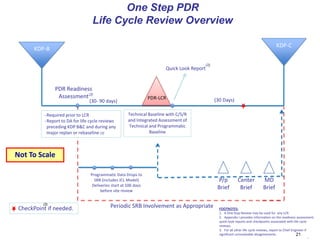
One Step PDR
                                                Life Cycle Review Overview
Headquarters
Independent Program and Cost Evaluation
                                                                                                                                                    KDP-C
                 KDP-B

                                                                                                      (2)
                                                                                      Quick Look Report


                             PDR Readiness
                              Assessment (2)                                   PDR-LCR
                                              (30- 90 days)                                                 (30 Days)

                        -Required prior to LCR                      Technical Baseline with C/S/R
                        -Report to DA for life cycle reviews        and Integrated Assessment of
                         preceding KDP B&C and during any            Technical and Programmatic
                         major replan or rebaseline (3)                        Baseline


      Not To Scale

                                               Programmatic Data Drops to
                                                 SRB (includes JCL Model)                                     P/p         Center           MD
                                                Deliveries start at 100 days
                                                     before site review
                                                                                                             Brief         Brief           Brief

                       (2)
        CheckPoint if needed.                             Periodic SRB Involvement as Appropriate             FOOTNOTES:
                                                                                                              1. A One Step Review may be used for any LCR.
                                                                                                              2. Appendix I provides information on the readiness assessment,
                                                                                                              quick-look reports and checkpoints associated with life cycle
                                                                                                              reviews.
                                                                                                              3. For all other life cycle reviews, report to Chief Engineer if
                                                                                                              significant unresolvable disagreements.                 21
                                                                                                                                                                     Page 21
Two Step PDR
                                                    Life Cycle Review Overview
Headquarters
Independent Program and Cost Evaluation
                                                                                                                                                              KDP-C
            KDP-B                                                                 PDR LCR


                                                                                                         (2)
                                                                                       Quick Look Report                                       (2)
                                                                                                                        Quick Look Report

                             PDR Readiness
                                                                                               Independent Integrated
                              Assessment (2)                           PDR
                                                                                                  PDR Assessment
                                                 (30-90 days)                        (1-6 months)                                 (30 Days)


           -Required prior to LCR                               Technical Baseline                        Integrated
           -Report to DA for life cycle reviews                     with Cost,                          Assessment of
            preceding KDP B&C and during any                    Schedule, and Risk                      Technical and
            major replan or rebaseline (3)                         Information                          Programmatic
                                                                                                           Baseline


     Not To Scale

                                          Programmatic Data Drops to              Resolve Tech
                                            SRB (includes JCL Model)          Issues/Risks, Update                       P/p        Center           MD
                                                                             Cost/Schedule Baseline
                                                                                                                        Brief        Brief           Brief

                       (2)
         CheckPoint if needed.                                     Periodic SRB Involvement as Appropriate
                                                                                                                         FOOTNOTES:
                                                                                                                         1. A Two Step Review may be used for any LCR
                                                                                                                         2. Appendix I provides information on the readiness assessment,
                                                                                                                         quick-look reports and checkpoints associated with life cycle
                                                                                                                         reviews
                                                                                                                         3. For all other life cycle reviews report to Chief Engineer if 22
                                                                                                                         significant unresolvable disagreements                22 Page

Amer.tahani

  • 1.
    Headquarters Independent Program &Cost Evaluation State-of-the-Art in Independent Review Execution Tahani Amer and Kaiser Adeni Review Managers Independent Program Assessment Office 8th Annual 2011 NASA Program Management Challenge February 10, 2011
  • 2.
    Outline Headquarters Independent Program andCost Evaluation • Look Back at FY10 Reviews • Review Process Improvements • SRB Balance & Structure • SRB Members Roles & Responsibilities • SRB Coordination (between Mission Directorates, Centers, and Programs/projects (P/p)) • SRB Products • SRB – HB updates • IPAO State-of-the-Art Activities • Look Forward 2
  • 3.
    Look Back atFY10 Reviews Headquarters Independent Program and Cost Evaluation • 8 Programs and 20 project review activities executed in FY10:  Preliminary Design Review: MAVEN  Critical Design Reviews: GRAIL, RBSP, GPM, TDRS, LDCM, MMS, OCO-II  System Integration Reviews: MSL, GRAIL and Juno  ORR/FRR/PLAR: WISE  Program Approval Review: RPS and LQP  Program Implementation Review: SCaN, ESMP, D/NF  Special Reviews: MSL, CxP, Aquarius, SOFIA  8 Non-IPAO reviews: 2- GOES-R, ASP, AvSP, ATP, FAP, ENAS, CAS 3
  • 4.
  • 5.
  • 6.
    FY10 IPAO CompletedReviews IPAO supported 8 non-IPAO review activities in FY10 Headquarters Independent Program and Cost Evaluation 6
  • 7.
    Review Process Improvements Headquarters IndependentProgram and Cost Evaluation • SRB process improvements: • Quick Look Reports (one-pagers); • 30-day reporting requirement; • Increased coordination for programmatic assessments; • Readiness-to-proceed assessments; • Alternate opinions for non-consensus boards; • Key Decision Point (KDP) Decision Memo improvements; • Deferral of program reviews approved at APMC; • Institutionalized electronic signature of SRB approval letters; • Streamlining of ToR content as defined in draft NPR 7120.5E; 7
  • 8.
    Review Process Improvements Headquarters IndependentProgram and Cost Evaluation • SRB process improvements (continued): • Better coordination of SRB team nomination process; early stakeholders involvement in the process to ensure proper team balance of competency/currency/independence; • Final reports are posted on APMC electronic repository (https://nx.arc.nasa.gov/nx/dsweb/View/Collection-93608); notification at APMC when reports are posted; • Strengthening and improving the rigor and integration of the technical and programmatic assessments; • Working with SMD and the Centers to formulate principles on conducting joint Program/project reviews when there is a significant external partner involved. Efforts are evolving w/ExoMars and JPSS. 8
  • 9.
    SRB Balance &Structure Headquarters Independent Program and Cost Evaluation • SRB members should be competent, current, and independent from the management or advocacy chain of the P/p, with membership balanced between the host Center and other organizations to ensure the needs of the convening authorities are met. • Although balance of each SRB member is important, ultimately the goal is to have the SRB, as a whole, balanced. • More inclusive set of discussion with Center and TA • It is not a numerical formula, but it goals to meet Agency’s goals 9
  • 10.
    SRB Balance &Structure Headquarters Independent Program and Cost Evaluation  Competency  Relevant experience and expertise with the technical, specific technologies and programmatic domain of the P/p under review.  Currency  Addresses recent/current experience and expertise in programmatics or the technical domain(s) of the project or program under review.  Understanding of current Agency governance, project management and systems engineering policies, procedures and methods, specifically NPR 7120.5, NPR 7123.1, NPD 1000.5, specific Center practices and procedures and the SRB Handbook.  Independence  Not in the programmatic chain of command of the program or project and have no conflicts of interest either personally, institutionally or organizationally. 10
  • 11.
    SRB Members Roles& Responsibilities Headquarters Independent Program and Cost Evaluation • A member of an SRB is an “agent” of the convening authorities:  More emphasis on programmatic risk assessment and analysis;  More emphasis on the individual member independent report (IMIR);  Advise the SRB Chair and the Review Manager (RM) on areas that require particular attention by the SRB per their area of expertise;  Support the SRB “Quick-Look Report” summaries and briefings to the Convening Authorities (CA), and provide expert opinion to SRB preliminary and final reports. 11
  • 12.
    SRB Coordination Headquarters Independent Programand Cost Evaluation • Coordination with the Mission Directorates:  Early and frequent coordination is conducted with the Mission Directorate Program Executive (PE) to:  Establish SRB membership  Chair with support from RM establishes the discipline areas to be covered  PE/MDs provide a list of potential candidates. CAs approve or provide alternate nominations  RM leads the vetting effort for Organizational and Personal Conflict of Interest (OCI/PCI) in coordination with the LaRC Legal Office and Contracting Officer(s)  Finalize Terms of Reference (ToR) content  Content is reviewed and agreed-to prior to final approval by the CA  Identify any additional Mission Directorate review criteria  Establish timing of the Site Visit  Establish post-review out brief schedule  CMC/DPMC briefing  APMC briefing (Cat 1 and some Cat 2 Programs/projects)  APMC special topics for Cat 2 project life cycle reviews  Pause and Learn (PAL) 12
  • 13.
    SRB Coordination Headquarters Independent Programand Cost Evaluation • Coordination with the Center  Coordination with the Center is conducted to:  Coordinate and develop a list of SRB candidates from the Center based on the discipline areas established by the Chair  Facilitate the review of the ToR content and ensure that the Center specific requirements are being met  Golden Rules  JPL Rules  Facilitate Center CA approvals of ToRs, team nominations, etc.  Establish dates for post-review CMC briefing  Establish a Community of Practice (CoP) at each Center (in progress)  Knowledge sharing of best practices and expectations for independent assessment  Review manifest coordination and approval  Identify Center personnel to participate in SRBs  Assist with nomination of high potential candidates for RM assignment with IPAO  Request potential Center Review Managers as detailees to IPAO  Develop a CoP for the Agency after completion on the discussion with Centers 13
  • 14.
    SRB Coordination Headquarters Independent Programand Cost Evaluation • Coordination with Program/project:  Program/project pre-planning coordination begins ~120 days prior to Site Visit to:  Establish Site Visit review requirements  Discipline areas to be covered  Data drop timeline for cost and schedule products  Establish agreement on Terms of Reference (ToR) review criteria  Single ToR for LCR (0.5E)  Readiness to Proceed Review  Establish timing of the Site Visit  Establish post-review out brief schedule  Quick- Look Report (One Pagers)  P/p briefing  CMC briefing  DPMC briefing  APMC briefing (Cat 1 and some Cat 2 P/p) 14
  • 15.
    Headquarters SRB Products Independent Program and Cost Evaluation SRB products produced for each Site Visit:  Briefings  One-pager (Quick Look Report)  P/p Briefing  CMC Briefing  DPMC  APMC Briefing (if a Cat 1 Project) ToRs, team nomination letters, alternate opinions Vetting Package  OCI/PCI mitigation plans/annual vetting  SRB member resumes/bios  SRB approval letters  Reports Final SRB summary report to include each SRB individual reports to DA. https://nx.arc.nasa.gov/nx/dsweb/View/Collection-93608 IPAO Review Record RRD for the Agency 15
  • 16.
    Headquarters SRB –HB Update Independent Program and Cost Evaluation  Guidance to the P/p and SRB members  The SRB-HB is posted on the http://nodis.hq.nasa.gov/policy_letters/NM_7120-81_.pdf  Updates to comply with NPR 7120.5E 16
  • 17.
    IPAO State-of-the-Art Activities Headquarters IndependentProgram and Cost Evaluation • JCL assessments and improved programmatic analysis:  Using Defense Contract Management Agency (DCMA) and Government Accounting Office (GAO) criterion as standard evaluation criteria for schedules  Implementation of standard analysis timeline allowing for time to work with the projects to improve cost and schedule concerns  Analysis processes have been defined and documented in Standard Operating Procedure Instructions (SOPI) • Better risk assessments:  Using state-of-the-art tools for integrated risk analysis  Establishment of Schedule Analysis Working Group (SAWG) to develop a CoP for programmatic risk analysis • Forensics Study:  Analysis of the SRB findings  Identify trends and systematic issues  Provide recommendation to improve PM at NASA 17
  • 18.
    IPAO State-of-the-Art Activities Headquarters IndependentProgram and Cost Evaluation • Lessons Learned (LL) after each review  IPAO members share the LL with RMs and PAG Analysts  Database of LL • ILCR - Customer/CA/SRB member surveys  Developed ILCR surveys & Approved by CA  Implementing the survey: RBSP • Training: RMs & Chairs • Outreach Effort: Articles, PM Track, Visits to Centers, PAL • Developmental Program: Detail opportunity to support Agency Project Management 18
  • 19.
    Look Forward Headquarters Independent Programand Cost Evaluation • Implementation of the NPR 7120.5E • Update the SRB Hand Book • Continue coordination with MDs, Centers, and P/p • Communities of Practice • SRB Balance • Independent Reviews involving external partners • Independent Reviews and Technology P/p 19
  • 20.
    Headquarters Independent Program andCost Evaluation Back-up Slides 20
  • 21.
    One Step PDR Life Cycle Review Overview Headquarters Independent Program and Cost Evaluation KDP-C KDP-B (2) Quick Look Report PDR Readiness Assessment (2) PDR-LCR (30- 90 days) (30 Days) -Required prior to LCR Technical Baseline with C/S/R -Report to DA for life cycle reviews and Integrated Assessment of preceding KDP B&C and during any Technical and Programmatic major replan or rebaseline (3) Baseline Not To Scale Programmatic Data Drops to SRB (includes JCL Model) P/p Center MD Deliveries start at 100 days before site review Brief Brief Brief (2) CheckPoint if needed. Periodic SRB Involvement as Appropriate FOOTNOTES: 1. A One Step Review may be used for any LCR. 2. Appendix I provides information on the readiness assessment, quick-look reports and checkpoints associated with life cycle reviews. 3. For all other life cycle reviews, report to Chief Engineer if significant unresolvable disagreements. 21 Page 21
  • 22.
    Two Step PDR Life Cycle Review Overview Headquarters Independent Program and Cost Evaluation KDP-C KDP-B PDR LCR (2) Quick Look Report (2) Quick Look Report PDR Readiness Independent Integrated Assessment (2) PDR PDR Assessment (30-90 days) (1-6 months) (30 Days) -Required prior to LCR Technical Baseline Integrated -Report to DA for life cycle reviews with Cost, Assessment of preceding KDP B&C and during any Schedule, and Risk Technical and major replan or rebaseline (3) Information Programmatic Baseline Not To Scale Programmatic Data Drops to Resolve Tech SRB (includes JCL Model) Issues/Risks, Update P/p Center MD Cost/Schedule Baseline Brief Brief Brief (2) CheckPoint if needed. Periodic SRB Involvement as Appropriate FOOTNOTES: 1. A Two Step Review may be used for any LCR 2. Appendix I provides information on the readiness assessment, quick-look reports and checkpoints associated with life cycle reviews 3. For all other life cycle reviews report to Chief Engineer if 22 significant unresolvable disagreements 22 Page