It’s Not Just About the IT:
Developing Systems that
People Can (and Will) Use

             Terry Conroy
Associate CIO for Enterprise Architecture
             NASA/GSFC
               February 2008
Agenda

  IT Project Facts and Figures
  Potential Pitfalls
  Success Strategies
  Summary


NASA PM CHALLENGE     2          February 2008
IT Facts and Figures
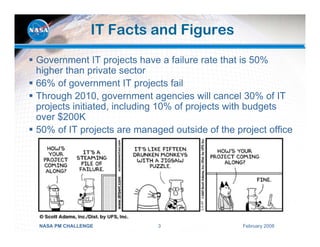
Government IT projects have a failure rate that is 50%
higher than private sector
66% of government IT projects fail
Through 2010, government agencies will cancel 30% of IT
projects initiated, including 10% of projects with budgets
over $200K
50% of IT projects are managed outside of the project office


NASA PM CHALLENGE           3                   February 2008
Potential Pitfalls

Requirements
 – Unclear objective for the solution being provided
 – Automating a process instead of providing a solution
 – Requirements defined by technical community based on how the
   technology works
 – Concept of operations is not considered
 – Adding one more light to the Christmas tree
      • Being all things to all people
      • Lack of baseline-->scope creep
Data Management
 –   Unclear authoritative source(s)
 –   Interfaces/integration to other systems ill-defined or missing
 –   Data standards not fully developed
 –   Lack of reconciliation process
 –   No end-user method in place to correct errors


NASA PM CHALLENGE                        4                            February 2008
Potential Pitfalls

  Customer Expectations
    –   Undefined “extra” features
    –   Doesn’t answer “what’s in it for me?”
    –   Doesn’t work as described
    –   System availability and use is based on technical constraints
    –   Getting help becomes a treasure hunt
  Usability
    – 508 compliance (web accessibility) standards ignored
    – System assumes understanding of IT language and
      processes
    – Minimal focus on end-users’ platform/browser and user
      interface requirements
    – Testing is not done with a diverse population


NASA PM CHALLENGE                  5                       February 2008
Potential Pitfalls

  Business Process
    – Changes to policies and procedures will be added “later”
    – System flow does not follow mission/business process
    – New manual processes and/or people are added to the work
      flow that were not defined in the requirements or design
    – Lack of familiarity with technology and IT trends and drivers
    – Not understanding customer’s willingness to change
    – Weak governance and change control processes
  Risk Management
    –   Risks, what risks?
    –   Unilateral decision-making on what is/not a risk
    –   Decision on risk mitigation is deferred
    –   Not following structured methodology (I.e., 7120.5)

NASA PM CHALLENGE                  6                          February 2008
Potential Pitfalls

  Contractor Management
    – Too much reliance on contractor expertise
    – Focus is only on the application and not on integration with
      other systems or business processes
    – Lack of clarity on definition of a “finished” system
    – Majority of time focused on development
    – Contract is written to perform a task, not provide a solution
  Project Management
    –   Methodology used is determined “as needed”
    –   Inadequately prepared project manager
    –   Focus solely on implementation and not on-going operations
    –   Focus on IT-only aspects
    –   Schedule becomes the primary driver without shift in budget
        or requirements
NASA PM CHALLENGE                 7                        February 2008
Potential Pitfalls

  Accountability
    – Unclear who owns the mission/business and IT processes,
      hardware, software and on-going operations
    – Unclear who gets the “final” say at multiple points in the
      system development lifecycle
    – People who “own” a piece of the process or system don’t talk
      to other people who think they own the same thing
  Sustainability
    – IT products are leading/bleeding edge or ancient
    – Cost of hardware, software or personnel to run the system
      exceeds the budget
    – Interoperability requirements not defined
    – No alignment with future functional requirements and/or IT
      direction
    – Insufficient planning for long-range projects

NASA PM CHALLENGE                8                       February 2008
Success Strategies

  Manage the Project
    –   Use a methodology that follows best practices
    –   Develop the concept of operations with the design
    –   Identify cost, schedule, requirements trade-offs
    –   Identify non-negotiable requirements
    –   Test, test, test
  Mitigate Risks
    –   Use case scenarios can point out problem areas early
    –   Draw end-to-end work flow and data flow diagrams
    –   Develop a data dictionary
    –   Document and publish agreed to changes
    –   Include the IT security person as part of the team


NASA PM CHALLENGE                  9                        February 2008
Success Strategies

  Focus on Outcome
    – Clearly define the outcome goal
    – Design for change, scaling the system to grow and/or add
      functionality
    – Time spent on requirements and design is time well spent
    – Be pragmatic in initial rollout so the customer gets a product
    – Use customer feedback for refinements and next steps
  Understand the Environment
    – Make allies of the people who can help make the project
      successful
    – Speak in a language the community understands
    – Identify and resolve cultural barriers


NASA PM CHALLENGE                 10                       February 2008
Success Strategies

  Understand the Business Process
    – Recognize and implement necessary policy and procedure
      changes for the system to be viable before the system goes
      into production
    – Establish mechanism for issue resolution
    – Identify what needs to change, write it down and develop a
      plan for managing it
  Manage Customer Expectations
    – Consistently answer the “what’s in it for me?” question
    – Provide opportunities for input into changes to requirements
      or design throughout the development lifecycle
    – Give credit for good ideas


NASA PM CHALLENGE                11                      February 2008
Success Strategies

  Communicate Early and Often
   – Identify communities of interest
   – Develop communication plan that includes opportunities for
     customer contribution
   – Define multiple channels for disseminating information and
     use those channels consistently
   – Provide a feedback loop
   – Provide timely answers to question
   – Listen
        • Generally, people who do the work know best how their jobs
          should be done
        • Different thinking isn’t wrong
        • If the user can’t find it, the function’s not there


NASA PM CHALLENGE                       12                      February 2008
Summary

  Look at the world through the eyes of your customer
  Challenge the status quo
  Listen first; talk second
  The more people engaged in the process, the more
  likely the outcome will be accepted
  Define roles and responsibilities
  Automation is not always the right answer
  Design global; build local
  Communication is a two-way street


NASA PM CHALLENGE          13                 February 2008

Terry.conroy

  • 1.
    It’s Not JustAbout the IT: Developing Systems that People Can (and Will) Use Terry Conroy Associate CIO for Enterprise Architecture NASA/GSFC February 2008
  • 2.
    Agenda ITProject Facts and Figures Potential Pitfalls Success Strategies Summary NASA PM CHALLENGE 2 February 2008
  • 3.
    IT Facts andFigures Government IT projects have a failure rate that is 50% higher than private sector 66% of government IT projects fail Through 2010, government agencies will cancel 30% of IT projects initiated, including 10% of projects with budgets over $200K 50% of IT projects are managed outside of the project office NASA PM CHALLENGE 3 February 2008
  • 4.
    Potential Pitfalls Requirements –Unclear objective for the solution being provided – Automating a process instead of providing a solution – Requirements defined by technical community based on how the technology works – Concept of operations is not considered – Adding one more light to the Christmas tree • Being all things to all people • Lack of baseline-->scope creep Data Management – Unclear authoritative source(s) – Interfaces/integration to other systems ill-defined or missing – Data standards not fully developed – Lack of reconciliation process – No end-user method in place to correct errors NASA PM CHALLENGE 4 February 2008
  • 5.
    Potential Pitfalls Customer Expectations – Undefined “extra” features – Doesn’t answer “what’s in it for me?” – Doesn’t work as described – System availability and use is based on technical constraints – Getting help becomes a treasure hunt Usability – 508 compliance (web accessibility) standards ignored – System assumes understanding of IT language and processes – Minimal focus on end-users’ platform/browser and user interface requirements – Testing is not done with a diverse population NASA PM CHALLENGE 5 February 2008
  • 6.
    Potential Pitfalls Business Process – Changes to policies and procedures will be added “later” – System flow does not follow mission/business process – New manual processes and/or people are added to the work flow that were not defined in the requirements or design – Lack of familiarity with technology and IT trends and drivers – Not understanding customer’s willingness to change – Weak governance and change control processes Risk Management – Risks, what risks? – Unilateral decision-making on what is/not a risk – Decision on risk mitigation is deferred – Not following structured methodology (I.e., 7120.5) NASA PM CHALLENGE 6 February 2008
  • 7.
    Potential Pitfalls Contractor Management – Too much reliance on contractor expertise – Focus is only on the application and not on integration with other systems or business processes – Lack of clarity on definition of a “finished” system – Majority of time focused on development – Contract is written to perform a task, not provide a solution Project Management – Methodology used is determined “as needed” – Inadequately prepared project manager – Focus solely on implementation and not on-going operations – Focus on IT-only aspects – Schedule becomes the primary driver without shift in budget or requirements NASA PM CHALLENGE 7 February 2008
  • 8.
    Potential Pitfalls Accountability – Unclear who owns the mission/business and IT processes, hardware, software and on-going operations – Unclear who gets the “final” say at multiple points in the system development lifecycle – People who “own” a piece of the process or system don’t talk to other people who think they own the same thing Sustainability – IT products are leading/bleeding edge or ancient – Cost of hardware, software or personnel to run the system exceeds the budget – Interoperability requirements not defined – No alignment with future functional requirements and/or IT direction – Insufficient planning for long-range projects NASA PM CHALLENGE 8 February 2008
  • 9.
    Success Strategies Manage the Project – Use a methodology that follows best practices – Develop the concept of operations with the design – Identify cost, schedule, requirements trade-offs – Identify non-negotiable requirements – Test, test, test Mitigate Risks – Use case scenarios can point out problem areas early – Draw end-to-end work flow and data flow diagrams – Develop a data dictionary – Document and publish agreed to changes – Include the IT security person as part of the team NASA PM CHALLENGE 9 February 2008
  • 10.
    Success Strategies Focus on Outcome – Clearly define the outcome goal – Design for change, scaling the system to grow and/or add functionality – Time spent on requirements and design is time well spent – Be pragmatic in initial rollout so the customer gets a product – Use customer feedback for refinements and next steps Understand the Environment – Make allies of the people who can help make the project successful – Speak in a language the community understands – Identify and resolve cultural barriers NASA PM CHALLENGE 10 February 2008
  • 11.
    Success Strategies Understand the Business Process – Recognize and implement necessary policy and procedure changes for the system to be viable before the system goes into production – Establish mechanism for issue resolution – Identify what needs to change, write it down and develop a plan for managing it Manage Customer Expectations – Consistently answer the “what’s in it for me?” question – Provide opportunities for input into changes to requirements or design throughout the development lifecycle – Give credit for good ideas NASA PM CHALLENGE 11 February 2008
  • 12.
    Success Strategies Communicate Early and Often – Identify communities of interest – Develop communication plan that includes opportunities for customer contribution – Define multiple channels for disseminating information and use those channels consistently – Provide a feedback loop – Provide timely answers to question – Listen • Generally, people who do the work know best how their jobs should be done • Different thinking isn’t wrong • If the user can’t find it, the function’s not there NASA PM CHALLENGE 12 February 2008
  • 13.
    Summary Lookat the world through the eyes of your customer Challenge the status quo Listen first; talk second The more people engaged in the process, the more likely the outcome will be accepted Define roles and responsibilities Automation is not always the right answer Design global; build local Communication is a two-way street NASA PM CHALLENGE 13 February 2008