1
Software Project Management
Session 10: Integration & Testing
2
Today
• Software Quality Assurance
• Integration
• Test planning
• Types of testing
• Test metrics
• Test tools
• More MS-Project how-to
3
Session 9 Review
• Project Control
– Planning
– Measuring
– Evaluating
– Acting
• MS Project
4
Earned Value Analysis
• BCWS
• BCWP
• Earned value
• ACWP
• Variances
• CV, SV
• Ratios
• SPI, CPI. CR
• Benefits
– Consistency, forecasting, early warning
5
MS Project
• Continued
6
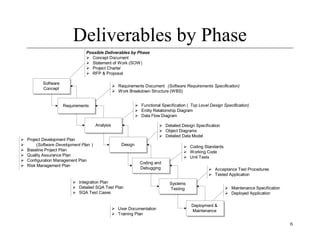
Deliverables by Phase
Software
Concept
Requirements
Analysis
Design
Coding and
Debugging
Systems
Testing
Deployment &
Maintenance
Possible Deliverables by Phase
 Concept Document
 Statement of Work (SOW)
 Project Charter
 RFP & Proposal
 Requirements Document (Software Requirements Specification)
 Work Breakdown Structure (WBS)
 Functional Specification ( Top Level Design Specification)
 Entity Relationship Diagram
 Data Flow Diagram
 Detailed Design Specification
 Object Diagrams
 Detailed Data Model
 Coding Standards
 Working Code
 Unit Tests
 Acceptance Test Procedures
 Tested Application
 Maintenance Specification
 Deployed Application
 Project Development Plan
 (Software Development Plan )
 Baseline Project Plan
 Quality Assurance Plan
 Configuration Management Plan
 Risk Management Plan
 Integration Plan
 Detailed SQA Test Plan
 SQA Test Cases
 User Documentation
 Training Plan
7
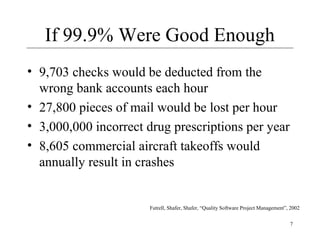
If 99.9% Were Good Enough
• 9,703 checks would be deducted from the
wrong bank accounts each hour
• 27,800 pieces of mail would be lost per hour
• 3,000,000 incorrect drug prescriptions per year
• 8,605 commercial aircraft takeoffs would
annually result in crashes
Futrell, Shafer, Shafer, “Quality Software Project Management”, 2002
8
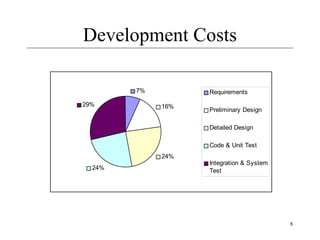
Development Costs
7%
16%
24%
24%
29%
Requirements
Preliminary Design
Detailed Design
Code & Unit Test
Integration & System
Test
9
Integration & Testing
• Development/Integration/Testing
• Most common place for schedule & activity overlap
• Sometimes Integration/Testing thought of
as one phase
• Progressively aggregates functionality
• QA team works in parallel with dev. team
10
Integration Approaches
• Top Down
• Core or overarching system(s) implemented 1st
• Combined into minimal “shell” system
• “Stubs” are used to fill-out incomplete sections
– Eventually replaced by actual modules
• Bottom Up
• Starts with individual modules and builds-up
• Individual units (after unit testing) are combined
into sub-systems
• Sub-systems are combined into the whole
11
Integration
• Who does integration testing?
– Can be either development and/or QA team
• Staffing and budget are at peak
• “Crunch mode”
• Issues
• Pressure
• Delivery date nears
• Unexpected failures (bugs)
• Motivation issues
• User acceptance conflicts
12
Validation and Verification
• V & V
• Validation
– Are we building the right product?
• Verification
– Are we building the product right?
– Testing
– Inspection
– Static analysis
13
Quality Assurance
• QA or SQA (Software Quality Assurance)
• Good QA comes from good process
• When does SQA begin?
– During requirements
• A CMM Level 2 function
• QA is your best window into the project
14
Test Plans (SQAP)
• Software Quality Assurance Plan
– Should be complete near end of requirements
• See example
– Even use the IEEE 730 standard
15
SQAP
• Standard sections
– Purpose
– Reference documents
– Management
– Documentation
– Standards, practices, conventions, metrics
• Quality measures
• Testing practices
16
SQAP
• Standard sections continued
– Reviews and Audits
• Process and specific reviews
– Requirements Review (SRR)
– Test Plan Review
– Code reviews
– Post-mortem review
– Risk Management
• Tie-in QA to overall risk mgmt. Plan
– Problem Reporting and Corrective Action
– Tools, Techniques, Methodologies
– Records Collection and Retention
17
Software Quality
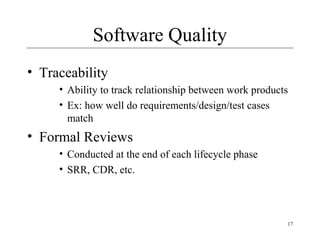
• Traceability
• Ability to track relationship between work products
• Ex: how well do requirements/design/test cases
match
• Formal Reviews
• Conducted at the end of each lifecycle phase
• SRR, CDR, etc.
18
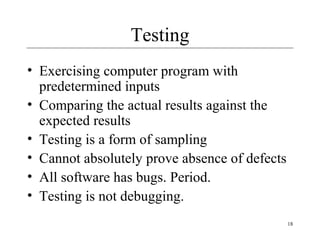
Testing
• Exercising computer program with
predetermined inputs
• Comparing the actual results against the
expected results
• Testing is a form of sampling
• Cannot absolutely prove absence of defects
• All software has bugs. Period.
• Testing is not debugging.
19
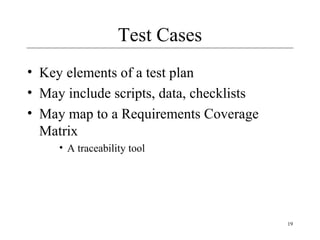
Test Cases
• Key elements of a test plan
• May include scripts, data, checklists
• May map to a Requirements Coverage
Matrix
• A traceability tool
20
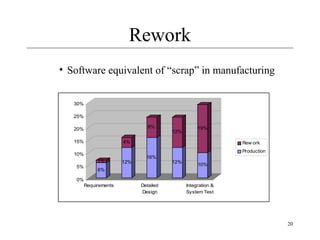
Rework
• Software equivalent of “scrap” in manufacturing
6%
1% 12%
4%
16%
8%
12%
12%
10%
19%
0%
5%
10%
15%
20%
25%
30%
Requirements Detailed
Design
Integration &
System Test
Rew ork
Production
21
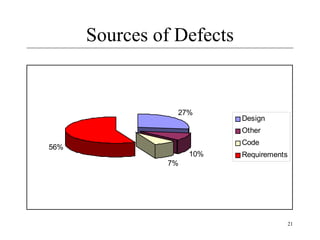
Sources of Defects
27%
10%
7%
56%
Design
Other
Code
Requirements
22
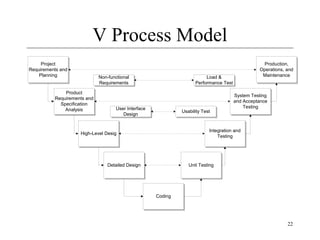
V Process Model
Product
Requirements and
Specification
Analysis
Project
Requirements and
Planning
Production,
Operations, and
Maintenance
System Testing
and Acceptance
Testing
Integration and
Testing
Unit Testing
Coding
Detailed Design
High-Level Desig
Non-functional
Requirements
Load &
Performance Test
User Interface
Design
Usability Test
23
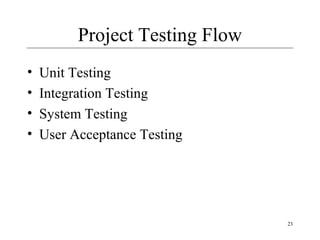
Project Testing Flow
• Unit Testing
• Integration Testing
• System Testing
• User Acceptance Testing
24
Black-Box Testing
• Functional Testing
• Program is a “black-box”
– Not concerned with how it works but what it
does
– Focus on inputs & outputs
• Test cases are based on SRS (specs)
25
White-Box Testing
• Accounts for the structure of the program
• Coverage
– Statements executed
– Paths followed through the code
26
Unit Testing
• a.k.a. Module Testing
• Type of white-box testing
– Sometimes treated black-box
• Who does Unit Testing?
• Developers
• Unit tests are written in code
– Same language as the module
– a.k.a. “Test drivers”
• When do Unit Testing?
• Ongoing during development
• As individual modules are completed
27
Unit Testing
• Individual tests can be grouped
– “Test Suites”
• JUnit
• Part of the XP methodology
• “Test-first programming”
28
Integration Testing
• Testing interfaces between components
• First step after Unit Testing
• Components may work alone but fail when
put together
• Defect may exist in one module but
manifest in another
• Black-box tests
29
System Testing
• Testing the complete system
• A type of black-box testing
30
User Acceptance Testing
• Last milestone in testing phase
• Ultimate customer test & sign-off
• Sometimes synonymous with beta tests
• Customer is satisfied software meets their
requirements
• Based on “Acceptance Criteria”
– Conditions the software must meet for customer to
accept the system
– Ideally defined before contract is signed
– Use quantifiable, measurable conditions
31
Regression Testing
– Re-running of tests after fixes or changes are
made to software or the environment
– EX: QA finds defect, developer fixes, QA runs
regression test to verify
– Automated tools very helpful for this
32
Compatibility Testing
– Testing against other “platforms”
• Ex: Testing against multiple browsers
• Does it work under Netscape/IE, Windows/Mac
33
External Testing Milestones
• Alpha 1st
, Beta 2nd
• Testing by users outside the organization
• Typically done by users
• Alpha release
• Given to very limited user set
• Product is not feature-complete
• During later portions of test phase
• Beta release
• Customer testing and evaluation
• Most important feature
• Preferably after software stabilizes
34
External Testing Milestones
• Value of Beta Testing
• Testing in the real world
• Getting a software assessment
• Marketing
• Augmenting you staff
• Do not determine features based on it
• Too late!
• Beta testers must be “recruited”
• From: Existing base, marketing, tech support, site
• Requires the role of “Beta Manager”
• All this must be scheduled by PM
35
External Testing Milestones
• Release Candidate (RC)
• To be sent to manufacturing if testing successful
• Release to Manufacturing (RTM)
• Production release formally sent to manufacturing
• Aim for a “stabilization period” before each
of these milestones
• Team focus on quality, integration, stability
36
Test Scripts
• Two meanings
• 1. Set of step-by-step instructions intended
to lead test personnel through tests
– List of all actions and expected responses
• 2. Automated test script (program)
37
Static Testing
• Reviews
• Most artifacts can be reviewed
• Proposal, contract, schedule, requirements, code,
data model, test plans
– Peer Reviews
• Methodical examination of software work products
by peers to identify defects and necessary changes
• Goal: remove defects early and efficiently
• Planned by PM, performed in meetings, documented
• CMM Level 3 activity
38
Automated Testing
• Human testers = inefficient
• Pros
• Lowers overall cost of testing
• Tools can run unattended
• Tools run through ‘suites’ faster than people
• Great for regression and compatibility tests
• Tests create a body of knowledge
• Can reduce QA staff size
• Cons
• But not everything can be automated
• Learning curve or expertise in tools
• Cost of high-end tools $5-80K (low-end are still cheap)
39
Test Tools
• Capture & Playback
• Coverage Analysis
• Performance Testing
• Test Case Management
40
Load & Stress Testing
• Push system beyond capacity limits
• Often done via automated scripts
• By the QA team
• Near end of functional tests
• Can show
– Hidden functional issues
– Maximum system capacity
– Unacceptable data or service loss
– Determine if “Performance Requirements” met
• Remember, these are part of “non-functional” requirements
41
Load & Stress Testing
• Metrics
– Minimal acceptable response time
– Minimal acceptable number of concurrent users
– Minimal acceptable downtime
• Vendors: High-End
– Segue
– Mercury
– Empirix
42
Performance Metrics
Source: Athens Consulting Group
Bad Good
Must support 500 users Must support 500
simultaneous users
10 second response time [Average|Maximum|90th
percentile] response time
must be X seconds
Must handle 1M hits per
day
Must handle peak load
of 28 page requests per
second
43
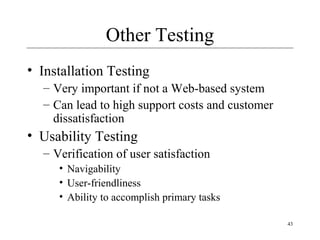
Other Testing
• Installation Testing
– Very important if not a Web-based system
– Can lead to high support costs and customer
dissatisfaction
• Usability Testing
– Verification of user satisfaction
• Navigability
• User-friendliness
• Ability to accomplish primary tasks
44
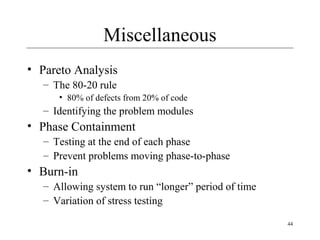
Miscellaneous
• Pareto Analysis
– The 80-20 rule
• 80% of defects from 20% of code
– Identifying the problem modules
• Phase Containment
– Testing at the end of each phase
– Prevent problems moving phase-to-phase
• Burn-in
– Allowing system to run “longer” period of time
– Variation of stress testing
45
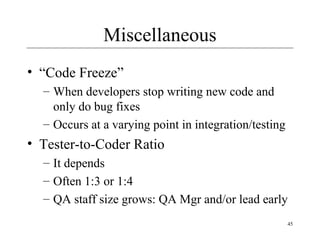
Miscellaneous
• “Code Freeze”
– When developers stop writing new code and
only do bug fixes
– Occurs at a varying point in integration/testing
• Tester-to-Coder Ratio
– It depends
– Often 1:3 or 1:4
– QA staff size grows: QA Mgr and/or lead early
46
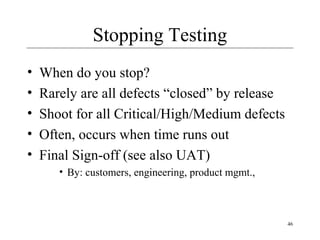
Stopping Testing
• When do you stop?
• Rarely are all defects “closed” by release
• Shoot for all Critical/High/Medium defects
• Often, occurs when time runs out
• Final Sign-off (see also UAT)
• By: customers, engineering, product mgmt.,
47
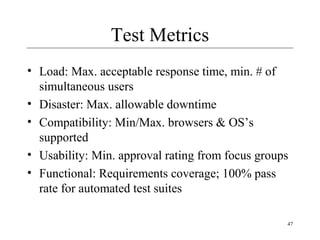
Test Metrics
• Load: Max. acceptable response time, min. # of
simultaneous users
• Disaster: Max. allowable downtime
• Compatibility: Min/Max. browsers & OS’s
supported
• Usability: Min. approval rating from focus groups
• Functional: Requirements coverage; 100% pass
rate for automated test suites
48
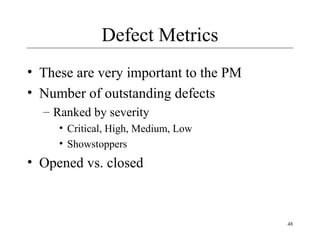
Defect Metrics
• These are very important to the PM
• Number of outstanding defects
– Ranked by severity
• Critical, High, Medium, Low
• Showstoppers
• Opened vs. closed
49
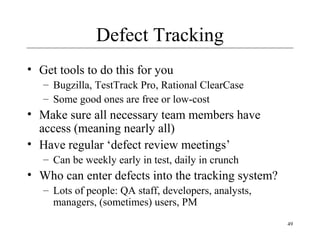
Defect Tracking
• Get tools to do this for you
– Bugzilla, TestTrack Pro, Rational ClearCase
– Some good ones are free or low-cost
• Make sure all necessary team members have
access (meaning nearly all)
• Have regular ‘defect review meetings’
– Can be weekly early in test, daily in crunch
• Who can enter defects into the tracking system?
– Lots of people: QA staff, developers, analysts,
managers, (sometimes) users, PM
50
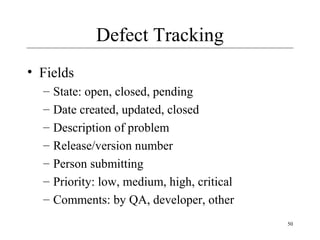
Defect Tracking
• Fields
– State: open, closed, pending
– Date created, updated, closed
– Description of problem
– Release/version number
– Person submitting
– Priority: low, medium, high, critical
– Comments: by QA, developer, other
51
Defect Metrics
• Open Rates
– How many new bugs over a period of time
• Close Rates
– How many closed over that same period
– Ex: 10 bugs/day
• Change Rate
– Number of times the same issue updated
• Fix Failed Counts
– Fixes that didn’t really fix (still open)
– One measure of “vibration” in project
52
Defect Rates
• Microsoft Study
– 10-20/KLOC during test
– 0.5/KLOC after release
53
Test Environments
• You need to test somewhere. Where?
• Typically separate hardware/network
environment(s)
54
Hardware Environments
• Development
• QA
• Staging (optional)
• Production
55
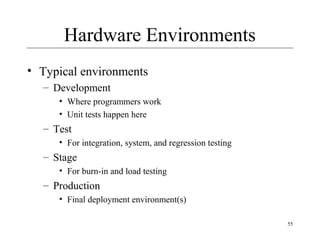
Hardware Environments
• Typical environments
– Development
• Where programmers work
• Unit tests happen here
– Test
• For integration, system, and regression testing
– Stage
• For burn-in and load testing
– Production
• Final deployment environment(s)
56
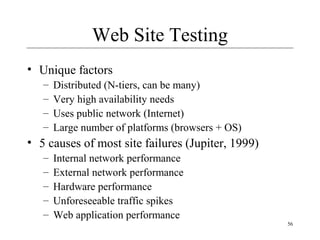
Web Site Testing
• Unique factors
– Distributed (N-tiers, can be many)
– Very high availability needs
– Uses public network (Internet)
– Large number of platforms (browsers + OS)
• 5 causes of most site failures (Jupiter, 1999)
– Internal network performance
– External network performance
– Hardware performance
– Unforeseeable traffic spikes
– Web application performance
57
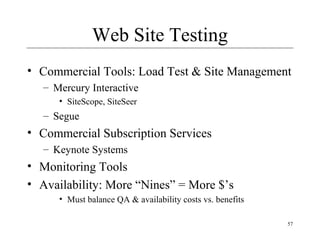
Web Site Testing
• Commercial Tools: Load Test & Site Management
– Mercury Interactive
• SiteScope, SiteSeer
– Segue
• Commercial Subscription Services
– Keynote Systems
• Monitoring Tools
• Availability: More “Nines” = More $’s
• Must balance QA & availability costs vs. benefits
58
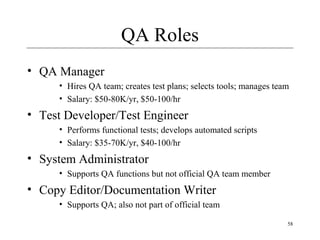
QA Roles
• QA Manager
• Hires QA team; creates test plans; selects tools; manages team
• Salary: $50-80K/yr, $50-100/hr
• Test Developer/Test Engineer
• Performs functional tests; develops automated scripts
• Salary: $35-70K/yr, $40-100/hr
• System Administrator
• Supports QA functions but not official QA team member
• Copy Editor/Documentation Writer
• Supports QA; also not part of official team
59
MS-Project Q&A
60
Homework
• McConnell: 16 “Project Recovery”
• Schwalbe: 16 “Closing”
• Your final MS-Project schedule due class after
next
– Add resources and dependencies to your plan
– Add durations and costs
– Send interim versions
– Remember, most important part of your grade
– Get to me with any questions
• Iterate & get feedback
• Don’t work in the dark
61
Questions?

Software Project Management lecture 10

  • 1.
    1 Software Project Management Session10: Integration & Testing
  • 2.
    2 Today • Software QualityAssurance • Integration • Test planning • Types of testing • Test metrics • Test tools • More MS-Project how-to
  • 3.
    3 Session 9 Review •Project Control – Planning – Measuring – Evaluating – Acting • MS Project
  • 4.
    4 Earned Value Analysis •BCWS • BCWP • Earned value • ACWP • Variances • CV, SV • Ratios • SPI, CPI. CR • Benefits – Consistency, forecasting, early warning
  • 5.
  • 6.
    6 Deliverables by Phase Software Concept Requirements Analysis Design Codingand Debugging Systems Testing Deployment & Maintenance Possible Deliverables by Phase  Concept Document  Statement of Work (SOW)  Project Charter  RFP & Proposal  Requirements Document (Software Requirements Specification)  Work Breakdown Structure (WBS)  Functional Specification ( Top Level Design Specification)  Entity Relationship Diagram  Data Flow Diagram  Detailed Design Specification  Object Diagrams  Detailed Data Model  Coding Standards  Working Code  Unit Tests  Acceptance Test Procedures  Tested Application  Maintenance Specification  Deployed Application  Project Development Plan  (Software Development Plan )  Baseline Project Plan  Quality Assurance Plan  Configuration Management Plan  Risk Management Plan  Integration Plan  Detailed SQA Test Plan  SQA Test Cases  User Documentation  Training Plan
  • 7.
    7 If 99.9% WereGood Enough • 9,703 checks would be deducted from the wrong bank accounts each hour • 27,800 pieces of mail would be lost per hour • 3,000,000 incorrect drug prescriptions per year • 8,605 commercial aircraft takeoffs would annually result in crashes Futrell, Shafer, Shafer, “Quality Software Project Management”, 2002
  • 8.
  • 9.
    9 Integration & Testing •Development/Integration/Testing • Most common place for schedule & activity overlap • Sometimes Integration/Testing thought of as one phase • Progressively aggregates functionality • QA team works in parallel with dev. team
  • 10.
    10 Integration Approaches • TopDown • Core or overarching system(s) implemented 1st • Combined into minimal “shell” system • “Stubs” are used to fill-out incomplete sections – Eventually replaced by actual modules • Bottom Up • Starts with individual modules and builds-up • Individual units (after unit testing) are combined into sub-systems • Sub-systems are combined into the whole
  • 11.
    11 Integration • Who doesintegration testing? – Can be either development and/or QA team • Staffing and budget are at peak • “Crunch mode” • Issues • Pressure • Delivery date nears • Unexpected failures (bugs) • Motivation issues • User acceptance conflicts
  • 12.
    12 Validation and Verification •V & V • Validation – Are we building the right product? • Verification – Are we building the product right? – Testing – Inspection – Static analysis
  • 13.
    13 Quality Assurance • QAor SQA (Software Quality Assurance) • Good QA comes from good process • When does SQA begin? – During requirements • A CMM Level 2 function • QA is your best window into the project
  • 14.
    14 Test Plans (SQAP) •Software Quality Assurance Plan – Should be complete near end of requirements • See example – Even use the IEEE 730 standard
  • 15.
    15 SQAP • Standard sections –Purpose – Reference documents – Management – Documentation – Standards, practices, conventions, metrics • Quality measures • Testing practices
  • 16.
    16 SQAP • Standard sectionscontinued – Reviews and Audits • Process and specific reviews – Requirements Review (SRR) – Test Plan Review – Code reviews – Post-mortem review – Risk Management • Tie-in QA to overall risk mgmt. Plan – Problem Reporting and Corrective Action – Tools, Techniques, Methodologies – Records Collection and Retention
  • 17.
    17 Software Quality • Traceability •Ability to track relationship between work products • Ex: how well do requirements/design/test cases match • Formal Reviews • Conducted at the end of each lifecycle phase • SRR, CDR, etc.
  • 18.
    18 Testing • Exercising computerprogram with predetermined inputs • Comparing the actual results against the expected results • Testing is a form of sampling • Cannot absolutely prove absence of defects • All software has bugs. Period. • Testing is not debugging.
  • 19.
    19 Test Cases • Keyelements of a test plan • May include scripts, data, checklists • May map to a Requirements Coverage Matrix • A traceability tool
  • 20.
    20 Rework • Software equivalentof “scrap” in manufacturing 6% 1% 12% 4% 16% 8% 12% 12% 10% 19% 0% 5% 10% 15% 20% 25% 30% Requirements Detailed Design Integration & System Test Rew ork Production
  • 21.
  • 22.
    22 V Process Model Product Requirementsand Specification Analysis Project Requirements and Planning Production, Operations, and Maintenance System Testing and Acceptance Testing Integration and Testing Unit Testing Coding Detailed Design High-Level Desig Non-functional Requirements Load & Performance Test User Interface Design Usability Test
  • 23.
    23 Project Testing Flow •Unit Testing • Integration Testing • System Testing • User Acceptance Testing
  • 24.
    24 Black-Box Testing • FunctionalTesting • Program is a “black-box” – Not concerned with how it works but what it does – Focus on inputs & outputs • Test cases are based on SRS (specs)
  • 25.
    25 White-Box Testing • Accountsfor the structure of the program • Coverage – Statements executed – Paths followed through the code
  • 26.
    26 Unit Testing • a.k.a.Module Testing • Type of white-box testing – Sometimes treated black-box • Who does Unit Testing? • Developers • Unit tests are written in code – Same language as the module – a.k.a. “Test drivers” • When do Unit Testing? • Ongoing during development • As individual modules are completed
  • 27.
    27 Unit Testing • Individualtests can be grouped – “Test Suites” • JUnit • Part of the XP methodology • “Test-first programming”
  • 28.
    28 Integration Testing • Testinginterfaces between components • First step after Unit Testing • Components may work alone but fail when put together • Defect may exist in one module but manifest in another • Black-box tests
  • 29.
    29 System Testing • Testingthe complete system • A type of black-box testing
  • 30.
    30 User Acceptance Testing •Last milestone in testing phase • Ultimate customer test & sign-off • Sometimes synonymous with beta tests • Customer is satisfied software meets their requirements • Based on “Acceptance Criteria” – Conditions the software must meet for customer to accept the system – Ideally defined before contract is signed – Use quantifiable, measurable conditions
  • 31.
    31 Regression Testing – Re-runningof tests after fixes or changes are made to software or the environment – EX: QA finds defect, developer fixes, QA runs regression test to verify – Automated tools very helpful for this
  • 32.
    32 Compatibility Testing – Testingagainst other “platforms” • Ex: Testing against multiple browsers • Does it work under Netscape/IE, Windows/Mac
  • 33.
    33 External Testing Milestones •Alpha 1st , Beta 2nd • Testing by users outside the organization • Typically done by users • Alpha release • Given to very limited user set • Product is not feature-complete • During later portions of test phase • Beta release • Customer testing and evaluation • Most important feature • Preferably after software stabilizes
  • 34.
    34 External Testing Milestones •Value of Beta Testing • Testing in the real world • Getting a software assessment • Marketing • Augmenting you staff • Do not determine features based on it • Too late! • Beta testers must be “recruited” • From: Existing base, marketing, tech support, site • Requires the role of “Beta Manager” • All this must be scheduled by PM
  • 35.
    35 External Testing Milestones •Release Candidate (RC) • To be sent to manufacturing if testing successful • Release to Manufacturing (RTM) • Production release formally sent to manufacturing • Aim for a “stabilization period” before each of these milestones • Team focus on quality, integration, stability
  • 36.
    36 Test Scripts • Twomeanings • 1. Set of step-by-step instructions intended to lead test personnel through tests – List of all actions and expected responses • 2. Automated test script (program)
  • 37.
    37 Static Testing • Reviews •Most artifacts can be reviewed • Proposal, contract, schedule, requirements, code, data model, test plans – Peer Reviews • Methodical examination of software work products by peers to identify defects and necessary changes • Goal: remove defects early and efficiently • Planned by PM, performed in meetings, documented • CMM Level 3 activity
  • 38.
    38 Automated Testing • Humantesters = inefficient • Pros • Lowers overall cost of testing • Tools can run unattended • Tools run through ‘suites’ faster than people • Great for regression and compatibility tests • Tests create a body of knowledge • Can reduce QA staff size • Cons • But not everything can be automated • Learning curve or expertise in tools • Cost of high-end tools $5-80K (low-end are still cheap)
  • 39.
    39 Test Tools • Capture& Playback • Coverage Analysis • Performance Testing • Test Case Management
  • 40.
    40 Load & StressTesting • Push system beyond capacity limits • Often done via automated scripts • By the QA team • Near end of functional tests • Can show – Hidden functional issues – Maximum system capacity – Unacceptable data or service loss – Determine if “Performance Requirements” met • Remember, these are part of “non-functional” requirements
  • 41.
    41 Load & StressTesting • Metrics – Minimal acceptable response time – Minimal acceptable number of concurrent users – Minimal acceptable downtime • Vendors: High-End – Segue – Mercury – Empirix
  • 42.
    42 Performance Metrics Source: AthensConsulting Group Bad Good Must support 500 users Must support 500 simultaneous users 10 second response time [Average|Maximum|90th percentile] response time must be X seconds Must handle 1M hits per day Must handle peak load of 28 page requests per second
  • 43.
    43 Other Testing • InstallationTesting – Very important if not a Web-based system – Can lead to high support costs and customer dissatisfaction • Usability Testing – Verification of user satisfaction • Navigability • User-friendliness • Ability to accomplish primary tasks
  • 44.
    44 Miscellaneous • Pareto Analysis –The 80-20 rule • 80% of defects from 20% of code – Identifying the problem modules • Phase Containment – Testing at the end of each phase – Prevent problems moving phase-to-phase • Burn-in – Allowing system to run “longer” period of time – Variation of stress testing
  • 45.
    45 Miscellaneous • “Code Freeze” –When developers stop writing new code and only do bug fixes – Occurs at a varying point in integration/testing • Tester-to-Coder Ratio – It depends – Often 1:3 or 1:4 – QA staff size grows: QA Mgr and/or lead early
  • 46.
    46 Stopping Testing • Whendo you stop? • Rarely are all defects “closed” by release • Shoot for all Critical/High/Medium defects • Often, occurs when time runs out • Final Sign-off (see also UAT) • By: customers, engineering, product mgmt.,
  • 47.
    47 Test Metrics • Load:Max. acceptable response time, min. # of simultaneous users • Disaster: Max. allowable downtime • Compatibility: Min/Max. browsers & OS’s supported • Usability: Min. approval rating from focus groups • Functional: Requirements coverage; 100% pass rate for automated test suites
  • 48.
    48 Defect Metrics • Theseare very important to the PM • Number of outstanding defects – Ranked by severity • Critical, High, Medium, Low • Showstoppers • Opened vs. closed
  • 49.
    49 Defect Tracking • Gettools to do this for you – Bugzilla, TestTrack Pro, Rational ClearCase – Some good ones are free or low-cost • Make sure all necessary team members have access (meaning nearly all) • Have regular ‘defect review meetings’ – Can be weekly early in test, daily in crunch • Who can enter defects into the tracking system? – Lots of people: QA staff, developers, analysts, managers, (sometimes) users, PM
  • 50.
    50 Defect Tracking • Fields –State: open, closed, pending – Date created, updated, closed – Description of problem – Release/version number – Person submitting – Priority: low, medium, high, critical – Comments: by QA, developer, other
  • 51.
    51 Defect Metrics • OpenRates – How many new bugs over a period of time • Close Rates – How many closed over that same period – Ex: 10 bugs/day • Change Rate – Number of times the same issue updated • Fix Failed Counts – Fixes that didn’t really fix (still open) – One measure of “vibration” in project
  • 52.
    52 Defect Rates • MicrosoftStudy – 10-20/KLOC during test – 0.5/KLOC after release
  • 53.
    53 Test Environments • Youneed to test somewhere. Where? • Typically separate hardware/network environment(s)
  • 54.
    54 Hardware Environments • Development •QA • Staging (optional) • Production
  • 55.
    55 Hardware Environments • Typicalenvironments – Development • Where programmers work • Unit tests happen here – Test • For integration, system, and regression testing – Stage • For burn-in and load testing – Production • Final deployment environment(s)
  • 56.
    56 Web Site Testing •Unique factors – Distributed (N-tiers, can be many) – Very high availability needs – Uses public network (Internet) – Large number of platforms (browsers + OS) • 5 causes of most site failures (Jupiter, 1999) – Internal network performance – External network performance – Hardware performance – Unforeseeable traffic spikes – Web application performance
  • 57.
    57 Web Site Testing •Commercial Tools: Load Test & Site Management – Mercury Interactive • SiteScope, SiteSeer – Segue • Commercial Subscription Services – Keynote Systems • Monitoring Tools • Availability: More “Nines” = More $’s • Must balance QA & availability costs vs. benefits
  • 58.
    58 QA Roles • QAManager • Hires QA team; creates test plans; selects tools; manages team • Salary: $50-80K/yr, $50-100/hr • Test Developer/Test Engineer • Performs functional tests; develops automated scripts • Salary: $35-70K/yr, $40-100/hr • System Administrator • Supports QA functions but not official QA team member • Copy Editor/Documentation Writer • Supports QA; also not part of official team
  • 59.
  • 60.
    60 Homework • McConnell: 16“Project Recovery” • Schwalbe: 16 “Closing” • Your final MS-Project schedule due class after next – Add resources and dependencies to your plan – Add durations and costs – Send interim versions – Remember, most important part of your grade – Get to me with any questions • Iterate & get feedback • Don’t work in the dark
  • 61.

Editor's Notes

  • #3 No lab today More lab in later term